ASEXUAL REPRODUCTION
IN PLANTS
 There are many form of asexual

reproduction in plants. Some of these
are discussed below.
 1. Fragmentation
 2. Budding
 3. Spore formation
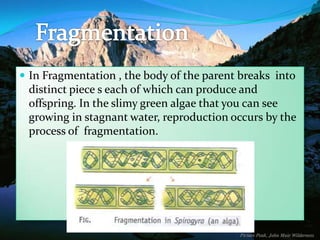
 In Fragmentation , the body of the parent breaks into

distinct piece s each of which can produce and
offspring. In the slimy green algae that you can see
growing in stagnant water, reproduction occurs by the
process of fragmentation.
Budding
 In budding , a bulb-like projection called bud

occurs on the body of parent organism. This
bud grows into an offspring and may
eventually break away in the parent.
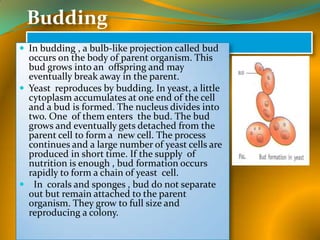
 Yeast reproduces by budding. In yeast, a little
cytoplasm accumulates at one end of the cell
and a bud is formed. The nucleus divides into
two. One of them enters the bud. The bud
grows and eventually gets detached from the
parent cell to form a new cell. The process
continues and a large number of yeast cells are
produced in short time. If the supply of
nutrition is enough , bud formation occurs
rapidly to form a chain of yeast cell.
 In corals and sponges , bud do not separate
out but remain attached to the parent
organism. They grow to full size and
reproducing a colony.
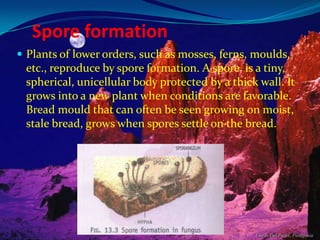
Spore formation
 Plants of lower orders, such as mosses, ferns, moulds,

etc., reproduce by spore formation. A spore is a tiny,
spherical, unicellular body protected by a thick wall. It
grows into a new plant when conditions are favorable.
Bread mould that can often be seen growing on moist,
stale bread, grows when spores settle on the bread.
TOPIC- ASEXUAL  REPRODUCTION  IN  PLANT

TOPIC- ASEXUAL REPRODUCTION IN PLANT

  • 2.
    ASEXUAL REPRODUCTION IN PLANTS There are many form of asexual reproduction in plants. Some of these are discussed below.  1. Fragmentation  2. Budding  3. Spore formation
  • 3.
     In Fragmentation, the body of the parent breaks into distinct piece s each of which can produce and offspring. In the slimy green algae that you can see growing in stagnant water, reproduction occurs by the process of fragmentation.
  • 4.
    Budding  In budding, a bulb-like projection called bud occurs on the body of parent organism. This bud grows into an offspring and may eventually break away in the parent.  Yeast reproduces by budding. In yeast, a little cytoplasm accumulates at one end of the cell and a bud is formed. The nucleus divides into two. One of them enters the bud. The bud grows and eventually gets detached from the parent cell to form a new cell. The process continues and a large number of yeast cells are produced in short time. If the supply of nutrition is enough , bud formation occurs rapidly to form a chain of yeast cell.  In corals and sponges , bud do not separate out but remain attached to the parent organism. They grow to full size and reproducing a colony.
  • 5.
    Spore formation  Plantsof lower orders, such as mosses, ferns, moulds, etc., reproduce by spore formation. A spore is a tiny, spherical, unicellular body protected by a thick wall. It grows into a new plant when conditions are favorable. Bread mould that can often be seen growing on moist, stale bread, grows when spores settle on the bread.