The Personality Psychopathology Five  (PSY-5) William P. Wattles, Ph.D. Francis Marion University
Five-factor model (FFM) One of the more prominent models in contemporary psychology is what is known as the five-factor model of personality. A dimensional rather than categorical approach from 1933
“ If this hypothesis is correct—if we have truly discovered the basic dimensions of personality—it marks a turning point for personality psychology.” McCrae RR,  John OP.  1992. An introduction to the Five Factor Model and its applications.  J. Pers.  60:175 215
The five-factor model of personality The five-factor model of personality is a hierarchical organization of personality traits in terms of five basic dimensions: Extraversion, Agreeableness, Conscientiousness, Neuroticism, and Openness to Experience.
The common variance among personality traits can be understood in terms of the five factors of.  conscientiousness agreeableness neuroticism openness  extroversion-introversion Costa, P. T. & McCrae, R. R. (1995). Psychological Bulletin , Vol 117(2), Mar 1995. pp. 216-220.
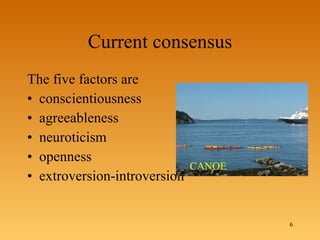
Current consensus The five factors are conscientiousness agreeableness neuroticism openness  extroversion-introversion CANOE
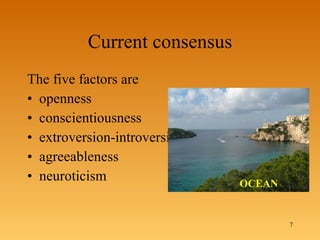
Current consensus The five factors are openness  conscientiousness extroversion-introversion agreeableness neuroticism OCEAN
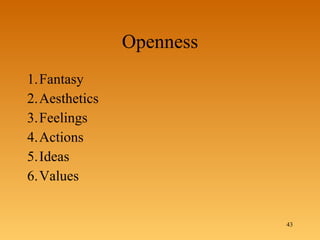
Openness Openness refers to how willing people are to make adjustments in notions and activities in accordance with new ideas or situations appreciation for art, emotion, adventure, unusual ideas, imagination, curiosity, and variety of experience
Conscientiousness Conscientiousness refers to how much a person considers others when making decisions. tendency to show self-discipline, act dutifully, and aim for achievement; planned rather than spontaneous behaviour.
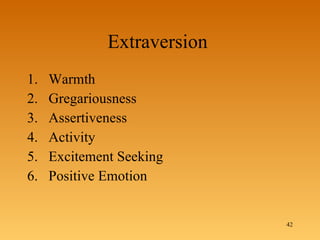
Extroversion Extroversion is defined as a trait characterized by a keen interest in other people and external events, and venturing forth with confidence into the unknown. energy, positive emotions,  surgency , and the tendency to seek stimulation and the company of others
Agreeableness Agreeableness measures how compatible people are with other people, or basically how able they are to get along with others a tendency to be compassionate and cooperative rather than suspicious and antagonistic towards others.
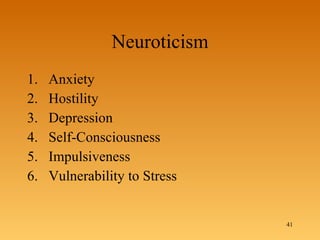
Neuroticism Neuroticism is a dimension of personality defined by stability and low anxiety at one end as opposed to instability and high anxiety at the other end. a tendency to experience unpleasant emotions easily, such as anger, anxiety, depression, or vulnerability
People at the extremes one or more of the five variables are likely to have some sort of psychological abnormality associated with that trait.  People are likely to select their environment in such a way that this trait is perpetuated.  To keep this cycle from iterating, psychologists make their patients come to terms with the flawed trait, allowing the patient to break the cycle
Individual differences Situational constraints The Big Five personality traits are empirical observations, not a theory
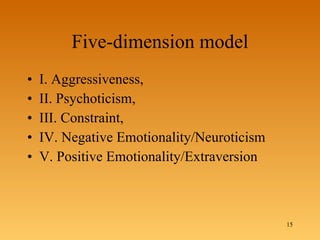
Five-dimension model I. Aggressiveness,  II. Psychoticism,  III. Constraint,  IV. Negative Emotionality/Neuroticism V. Positive Emotionality/Extraversion
I. Aggressiveness Aggressiveness entails dispositional differences in  agonal  behavior, particularly offensive aggression
I. Aggressiveness grandiosity versus egalitarianism  If you see yourself on approximately the same level as most others, this tends to inhibit aggressiveness, whereas genocide and less malignant forms of aggression count heavily on perceptions of differential worth.
I. Aggressiveness The desire for power and influence are also features of PSY-5 Aggressiveness  Enjoyment of intimidating others to achieve one’s goals.
II. Psychoticism Psychoticism assesses the gross  verisimilitude  of our inner models of the outer social and object world.
II. Psychoticism Although all of us have illusions, misperceptions, and mistaken beliefs, only a few have delusions and hallucinations.  Disconnection from reality, unshared beliefs, unusual sensory and perceptual experiences Feel alienated with unrealistic expectation of harm
III. Constraint Constraint combines features of  Control versus Impulsiveness Harm-avoidance (physical risk aversion)  Traditionalism (a dimension ranging from moral conservatism to the orientation of the  libertine ).
III. Constraint This Constraint dimension is relevant to personality psychopathology in that it has obsessive–compulsive personality disorder at one end and antisocial personality disorder at the other end
III. Constraint Someone low in PSY-5 Constraint would be impulsive, a risk taker and excitement seeker.
IV. Negative Emotionality/Neuroticism A broad affective disposition to experience negative emotions, especially anxiety and nervousness.
V. Positive Emotionality/Extraversion A broad disposition to experience positive affects to seek out and enjoy social experiences, and to have the energy to pursue goals and be engaged in life's tasks.
The PSY-5 constructs are models of traits designed to aid in personality description and to complement personality disorder diagnosis with quantitative dimensions.
PSY-5 Interpretation The Personality Psychopathology Five represent five important differences between adaptive and nonadaptive personality style. Interpret low scores only for INTR and DISC scales  Page 173
Aggressiveness (AGGR)  High scores  Grandiose Resentful Cold at times cruel.  This scale assesses a sort of hostile narcissist.  1. Aggressiveness (i.e., is the person aggressive, assaultive, rude and uncaring?).
Psychoticism PSYC)  High scores  have-poor reality testing Suspicious hostile.  2. Psychoticism (i.e., does the person have a healthy contact with reality, or is the person likely to have unrealistic beliefs, misperceptions, and psychotic experiences?).
Discontraint (DISC) High scores  insufficient delay of gratification Unreliable Rebellious Hedonistic acting out.  3. Constraint (i.e., is the person responsible and emotionally controlled or a disorganized risk-taker with little regard for legality?).
Discontraint (DISC) Low scores ( ≤ 40) Self-controlled and not impulsive Do not take may physical risks High tolerance for boredom Tend to follow rules and laws May prefer structure in therapy
Negative emotionality/ Neuroticism (NEGE) High scores: Worry Stress Hypersensitivity emotional under control. 4. Negative Emotionality/Neuroticism (NEM; i.e., is the person tense, anxious, and likely to experience negative affect?).
Introversion/Low Positive Emotionality (INTR) High scores have low energy, withdrawn, anhedonia, and low self-esteem;  Schizoid or impoverished emotional life. Low Positive Emotionality 5. Positive Emotionality/Extraversion (PEM; i.e., is the person energetic and interested in social contacts or anhedonic and withdrawn?)
Introversion/Low Positive Emotionality (INTR) Low scores ( ≤ 40) Able to experience joy Sociable Lots of energy
Scale Development Replicated rational selection was developed to identify potential items. One effect of using replicated rational selection is to build highly obvious rather than subtle scales. 114 undergraduates
No item is used in more than one PSY-5 scale.
Item example For example, 95% of the item selectors trained in the nervous versus calm aspect of Negative Emotionality/Neuroticism picked MMPI–2 Item 405,  I am usually calm and not easily upset .
Reliability and Validity These are enduring personality characteristics so they should be stable. PSY-5 scales are generally temporally stable.
Reliability and Validity The college sample total screened sample size is 2,928 (1,150 men, 1,778 women) The Psychiatric A sample is a composite sample of 328 patients (184 men, 144 women) in chronic care
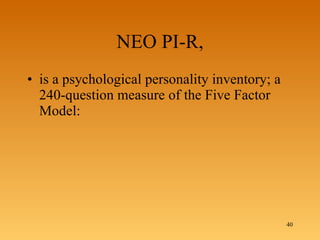
NEO PI-R, is a psychological personality inventory; a 240-question measure of the Five Factor Model:
Neuroticism 1. Anxiety  2. Hostility  3. Depression  4. Self-Consciousness  5. Impulsiveness  6. Vulnerability to Stress
Extraversion  Warmth  Gregariousness  Assertiveness  Activity  Excitement Seeking  Positive Emotion
Openness 1. Fantasy  2. Aesthetics  3. Feelings  4. Actions  5. Ideas  6. Values
Agreeableness  1. Trust  2. Straightforwardness  3. Altruism  4. Compliance  5. Modesty  6. Tendermindedness
Conscientiousness 1. Competence  2. Order  3. Dutifulness  4. Achievement Striving  5. Self-Discipline  6. Deliberation
The End
Agonal : Associated with or relating to great pain, especially the agony of death.
Verisimilitude : The quality of appearing to be true or real.
Libertine :  One who acts without moral restraint; a dissolute person.
Surgency Other synonyms for surgency include dominance, self-confidence, competitiveness, outgoing, extroverted, and decisive.  Surgency involves patterns of behavior often exhibited in group settings and generally concerned with getting ahead in life.  Individuals lower in surgency prefer to work by themselves and have relatively little interest in influencing, controlling, or competing with others.

The Big Five

  • 1.
    The Personality PsychopathologyFive (PSY-5) William P. Wattles, Ph.D. Francis Marion University
  • 2.
    Five-factor model (FFM)One of the more prominent models in contemporary psychology is what is known as the five-factor model of personality. A dimensional rather than categorical approach from 1933
  • 3.
    “ If thishypothesis is correct—if we have truly discovered the basic dimensions of personality—it marks a turning point for personality psychology.” McCrae RR, John OP. 1992. An introduction to the Five Factor Model and its applications. J. Pers. 60:175 215
  • 4.
    The five-factor modelof personality The five-factor model of personality is a hierarchical organization of personality traits in terms of five basic dimensions: Extraversion, Agreeableness, Conscientiousness, Neuroticism, and Openness to Experience.
  • 5.
    The common varianceamong personality traits can be understood in terms of the five factors of. conscientiousness agreeableness neuroticism openness extroversion-introversion Costa, P. T. & McCrae, R. R. (1995). Psychological Bulletin , Vol 117(2), Mar 1995. pp. 216-220.
  • 6.
    Current consensus Thefive factors are conscientiousness agreeableness neuroticism openness extroversion-introversion CANOE
  • 7.
    Current consensus Thefive factors are openness conscientiousness extroversion-introversion agreeableness neuroticism OCEAN
  • 8.
    Openness Openness refersto how willing people are to make adjustments in notions and activities in accordance with new ideas or situations appreciation for art, emotion, adventure, unusual ideas, imagination, curiosity, and variety of experience
  • 9.
    Conscientiousness Conscientiousness refersto how much a person considers others when making decisions. tendency to show self-discipline, act dutifully, and aim for achievement; planned rather than spontaneous behaviour.
  • 10.
    Extroversion Extroversion isdefined as a trait characterized by a keen interest in other people and external events, and venturing forth with confidence into the unknown. energy, positive emotions, surgency , and the tendency to seek stimulation and the company of others
  • 11.
    Agreeableness Agreeableness measureshow compatible people are with other people, or basically how able they are to get along with others a tendency to be compassionate and cooperative rather than suspicious and antagonistic towards others.
  • 12.
    Neuroticism Neuroticism isa dimension of personality defined by stability and low anxiety at one end as opposed to instability and high anxiety at the other end. a tendency to experience unpleasant emotions easily, such as anger, anxiety, depression, or vulnerability
  • 13.
    People at theextremes one or more of the five variables are likely to have some sort of psychological abnormality associated with that trait. People are likely to select their environment in such a way that this trait is perpetuated. To keep this cycle from iterating, psychologists make their patients come to terms with the flawed trait, allowing the patient to break the cycle
  • 14.
    Individual differences Situationalconstraints The Big Five personality traits are empirical observations, not a theory
  • 15.
    Five-dimension model I.Aggressiveness, II. Psychoticism, III. Constraint, IV. Negative Emotionality/Neuroticism V. Positive Emotionality/Extraversion
  • 16.
    I. Aggressiveness Aggressivenessentails dispositional differences in agonal behavior, particularly offensive aggression
  • 17.
    I. Aggressiveness grandiosityversus egalitarianism If you see yourself on approximately the same level as most others, this tends to inhibit aggressiveness, whereas genocide and less malignant forms of aggression count heavily on perceptions of differential worth.
  • 18.
    I. Aggressiveness Thedesire for power and influence are also features of PSY-5 Aggressiveness Enjoyment of intimidating others to achieve one’s goals.
  • 19.
    II. Psychoticism Psychoticismassesses the gross verisimilitude of our inner models of the outer social and object world.
  • 20.
    II. Psychoticism Althoughall of us have illusions, misperceptions, and mistaken beliefs, only a few have delusions and hallucinations. Disconnection from reality, unshared beliefs, unusual sensory and perceptual experiences Feel alienated with unrealistic expectation of harm
  • 21.
    III. Constraint Constraintcombines features of Control versus Impulsiveness Harm-avoidance (physical risk aversion) Traditionalism (a dimension ranging from moral conservatism to the orientation of the libertine ).
  • 22.
    III. Constraint ThisConstraint dimension is relevant to personality psychopathology in that it has obsessive–compulsive personality disorder at one end and antisocial personality disorder at the other end
  • 23.
    III. Constraint Someonelow in PSY-5 Constraint would be impulsive, a risk taker and excitement seeker.
  • 24.
    IV. Negative Emotionality/NeuroticismA broad affective disposition to experience negative emotions, especially anxiety and nervousness.
  • 25.
    V. Positive Emotionality/ExtraversionA broad disposition to experience positive affects to seek out and enjoy social experiences, and to have the energy to pursue goals and be engaged in life's tasks.
  • 26.
    The PSY-5 constructsare models of traits designed to aid in personality description and to complement personality disorder diagnosis with quantitative dimensions.
  • 27.
    PSY-5 Interpretation ThePersonality Psychopathology Five represent five important differences between adaptive and nonadaptive personality style. Interpret low scores only for INTR and DISC scales Page 173
  • 28.
    Aggressiveness (AGGR) High scores Grandiose Resentful Cold at times cruel. This scale assesses a sort of hostile narcissist. 1. Aggressiveness (i.e., is the person aggressive, assaultive, rude and uncaring?).
  • 29.
    Psychoticism PSYC) High scores have-poor reality testing Suspicious hostile. 2. Psychoticism (i.e., does the person have a healthy contact with reality, or is the person likely to have unrealistic beliefs, misperceptions, and psychotic experiences?).
  • 30.
    Discontraint (DISC) Highscores insufficient delay of gratification Unreliable Rebellious Hedonistic acting out. 3. Constraint (i.e., is the person responsible and emotionally controlled or a disorganized risk-taker with little regard for legality?).
  • 31.
    Discontraint (DISC) Lowscores ( ≤ 40) Self-controlled and not impulsive Do not take may physical risks High tolerance for boredom Tend to follow rules and laws May prefer structure in therapy
  • 32.
    Negative emotionality/ Neuroticism(NEGE) High scores: Worry Stress Hypersensitivity emotional under control. 4. Negative Emotionality/Neuroticism (NEM; i.e., is the person tense, anxious, and likely to experience negative affect?).
  • 33.
    Introversion/Low Positive Emotionality(INTR) High scores have low energy, withdrawn, anhedonia, and low self-esteem; Schizoid or impoverished emotional life. Low Positive Emotionality 5. Positive Emotionality/Extraversion (PEM; i.e., is the person energetic and interested in social contacts or anhedonic and withdrawn?)
  • 34.
    Introversion/Low Positive Emotionality(INTR) Low scores ( ≤ 40) Able to experience joy Sociable Lots of energy
  • 35.
    Scale Development Replicatedrational selection was developed to identify potential items. One effect of using replicated rational selection is to build highly obvious rather than subtle scales. 114 undergraduates
  • 36.
    No item isused in more than one PSY-5 scale.
  • 37.
    Item example Forexample, 95% of the item selectors trained in the nervous versus calm aspect of Negative Emotionality/Neuroticism picked MMPI–2 Item 405, I am usually calm and not easily upset .
  • 38.
    Reliability and ValidityThese are enduring personality characteristics so they should be stable. PSY-5 scales are generally temporally stable.
  • 39.
    Reliability and ValidityThe college sample total screened sample size is 2,928 (1,150 men, 1,778 women) The Psychiatric A sample is a composite sample of 328 patients (184 men, 144 women) in chronic care
  • 40.
    NEO PI-R, isa psychological personality inventory; a 240-question measure of the Five Factor Model:
  • 41.
    Neuroticism 1. Anxiety 2. Hostility 3. Depression 4. Self-Consciousness 5. Impulsiveness 6. Vulnerability to Stress
  • 42.
    Extraversion Warmth Gregariousness Assertiveness Activity Excitement Seeking Positive Emotion
  • 43.
    Openness 1. Fantasy 2. Aesthetics 3. Feelings 4. Actions 5. Ideas 6. Values
  • 44.
    Agreeableness 1.Trust 2. Straightforwardness 3. Altruism 4. Compliance 5. Modesty 6. Tendermindedness
  • 45.
    Conscientiousness 1. Competence 2. Order 3. Dutifulness 4. Achievement Striving 5. Self-Discipline 6. Deliberation
  • 46.
  • 47.
    Agonal : Associatedwith or relating to great pain, especially the agony of death.
  • 48.
    Verisimilitude : Thequality of appearing to be true or real.
  • 49.
    Libertine : One who acts without moral restraint; a dissolute person.
  • 50.
    Surgency Other synonymsfor surgency include dominance, self-confidence, competitiveness, outgoing, extroverted, and decisive. Surgency involves patterns of behavior often exhibited in group settings and generally concerned with getting ahead in life. Individuals lower in surgency prefer to work by themselves and have relatively little interest in influencing, controlling, or competing with others.

Editor's Notes

  • #5 conscientiousness agreeableness neuroticism openness extroversion-introversion
  • #36 In typical deductive test construction, the deduction leads to item writing; however, in replicated rational selection, deduction leads instead to item selection from a fixed item pool. In the replicated rational selection approach, lay item selectors are first trained to understand a psychological construct. Then the item selectors examine the defined pool of items, designating any items they feel tap the construct they have studied. However, unlike previous deductive systems in which the task is entrusted to one or two item writers or selectors, initial item selection is replicated across many selectors. Items that are repeatedly picked across the sample of selectors are used to form preliminary scales.