





The Big Five
Personality Factor Theory
By: Prabhleen Arora
Introduction
• Paul Costa and Robert MCcrae found the five
personality factors , which are often known as ‘Big
Five Factors’….
• These includes the following five factors ….
• Openness to Experience
• Conscientiousness
• Extraversion
• Agreeableness
• Neuroticism
Openness to experience
• Openness reflected the degree of
intellectual curiosity , creativity
and variety a person has .
• It also describes the extent to
which a person is imaginative or
independent and depicts a
personal preference for a variety of
activities for a swift routine.
• This trait feature characteristics
such as imagination and insight.
• People who are high in this trait
tends to have wide range of
interests and are more
adventurous and creative.
• People who are low in this trait are
very traditional and may struggle
with lateral thinking.
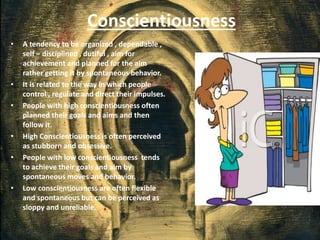
Conscientiousness
• A tendency to be organized , dependable ,
self – disciplined , dutiful , aim for
achievement and planned for the aim
rather getting it by spontaneous behavior.
• It is related to the way in which people
control , regulate and direct their impulses.
• People with high conscientiousness often
planned their goals and aims and then
follow it.
• High Conscientiousness is often perceived
as stubborn and obsessive.
• People with low conscientiousness tends
to achieve their goals and aim by
spontaneous moves and behavior.
• Low conscientiousness are often flexible
and spontaneous but can be perceived as
sloppy and unreliable.
Extroversion
• Extroversion is characterized by excitability , sociability , talkativeness ,
assertiveness and high amount of emotional expressiveness .
• People who are high in extroversion tends to be outgoing and tends to
gain energy in social situations , they enjoy interacting with people and
are perceived as full of energy.
• They tends to enthusiastic and action-oriented individuals.
• High extroversion can also be perceived as attention seeking and
domineering,
• People who are low in extroversion are very reserved and tend to be shy
in social gatherings .....
• Low extroversion can also be perceived as aloof or self – absorbing.
Agreeableness
• A tendency to be compassionate , co-operative
kind and affectionate rather than suspicious ,
rude and antagonistic toward others
• It is also the measure of one’s trusting and
helpful nature and whether a person is
generally well – tempered or not.
• Agreeable Personality :-
• People who are high in agreeableness are naïve
and submissive in nature.
• Agreeable individuals values getting along with
others and are more considerate.
• They have an optimistic view of human nature.
• Dis-Agreeable Personality:-
• People who are low in agreeableness are competitive or
challenging people , which are also assumed as untrustworthy and
argumentative and can be manipulative at times.
• Dis-agreeable individuals placed self-interest above getting along
with others.
• They are generally unconcerned for others feeling and are less
likely to extend themselves for others.
• Sometimes there skepticism for others motive causes them to be
suspicious , unfriendly and uncooperative.
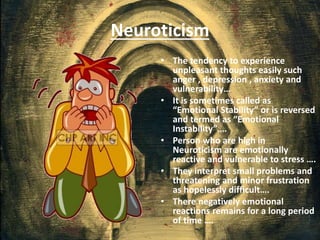
Neuroticism
• The tendency to experience
unpleasant thoughts easily such
anger , depression , anxiety and
vulnerability…
• It is sometimes called as
“Emotional Stability” or is reversed
and termed as “Emotional
Instability”….
• Person who are high in
Neuroticism are emotionally
reactive and vulnerable to stress ….
• They interpret small problems and
threatening and minor frustration
as hopelessly difficult….
• There negatively emotional
reactions remains for a long period
of time ….
• People who are high in Neuroticism tends to experience
mood swings anxiety , moodiness , irritability and
sadness…..
• The high level of Neuroticism can diminish the ability of a
person to think clearly , make decisions and cope
effectively with the stress issues …..
• People who are low in Neuroticism are less emotionally
upset and less emotionally reactive …..
• They tends to be calm , composed , emotionally stable ….
• They are free from persistent negative feelings …..
~ The five personality factor theory ~

~ The five personality factor theory ~

  • 1.
    The Big Five PersonalityFactor Theory By: Prabhleen Arora
  • 2.
    Introduction • Paul Costaand Robert MCcrae found the five personality factors , which are often known as ‘Big Five Factors’…. • These includes the following five factors …. • Openness to Experience • Conscientiousness • Extraversion • Agreeableness • Neuroticism
  • 3.
    Openness to experience •Openness reflected the degree of intellectual curiosity , creativity and variety a person has . • It also describes the extent to which a person is imaginative or independent and depicts a personal preference for a variety of activities for a swift routine. • This trait feature characteristics such as imagination and insight. • People who are high in this trait tends to have wide range of interests and are more adventurous and creative. • People who are low in this trait are very traditional and may struggle with lateral thinking.
  • 4.
    Conscientiousness • A tendencyto be organized , dependable , self – disciplined , dutiful , aim for achievement and planned for the aim rather getting it by spontaneous behavior. • It is related to the way in which people control , regulate and direct their impulses. • People with high conscientiousness often planned their goals and aims and then follow it. • High Conscientiousness is often perceived as stubborn and obsessive. • People with low conscientiousness tends to achieve their goals and aim by spontaneous moves and behavior. • Low conscientiousness are often flexible and spontaneous but can be perceived as sloppy and unreliable.
  • 5.
    Extroversion • Extroversion ischaracterized by excitability , sociability , talkativeness , assertiveness and high amount of emotional expressiveness . • People who are high in extroversion tends to be outgoing and tends to gain energy in social situations , they enjoy interacting with people and are perceived as full of energy. • They tends to enthusiastic and action-oriented individuals. • High extroversion can also be perceived as attention seeking and domineering, • People who are low in extroversion are very reserved and tend to be shy in social gatherings ..... • Low extroversion can also be perceived as aloof or self – absorbing.
  • 6.
    Agreeableness • A tendencyto be compassionate , co-operative kind and affectionate rather than suspicious , rude and antagonistic toward others • It is also the measure of one’s trusting and helpful nature and whether a person is generally well – tempered or not. • Agreeable Personality :- • People who are high in agreeableness are naïve and submissive in nature. • Agreeable individuals values getting along with others and are more considerate. • They have an optimistic view of human nature.
  • 7.
    • Dis-Agreeable Personality:- •People who are low in agreeableness are competitive or challenging people , which are also assumed as untrustworthy and argumentative and can be manipulative at times. • Dis-agreeable individuals placed self-interest above getting along with others. • They are generally unconcerned for others feeling and are less likely to extend themselves for others. • Sometimes there skepticism for others motive causes them to be suspicious , unfriendly and uncooperative.
  • 8.
    Neuroticism • The tendencyto experience unpleasant thoughts easily such anger , depression , anxiety and vulnerability… • It is sometimes called as “Emotional Stability” or is reversed and termed as “Emotional Instability”…. • Person who are high in Neuroticism are emotionally reactive and vulnerable to stress …. • They interpret small problems and threatening and minor frustration as hopelessly difficult…. • There negatively emotional reactions remains for a long period of time ….
  • 9.
    • People whoare high in Neuroticism tends to experience mood swings anxiety , moodiness , irritability and sadness….. • The high level of Neuroticism can diminish the ability of a person to think clearly , make decisions and cope effectively with the stress issues ….. • People who are low in Neuroticism are less emotionally upset and less emotionally reactive ….. • They tends to be calm , composed , emotionally stable …. • They are free from persistent negative feelings …..