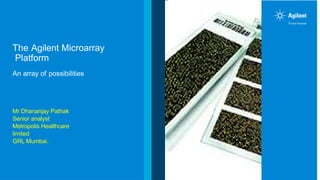
The Agilent Microarray
Platform
Mr Dhananjay Pathak
Senior analyst
Metropolis Healthcare
limited
GRL Mumbai.
An array of possibilities
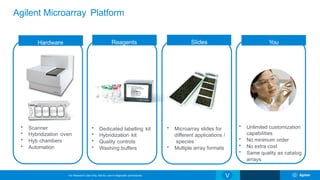
Agilent Microarray Platform
Hardware
V
For Research Use Only. Not for use in diagnostic procedures.
Reagents Slides You
• Scanner
• Hybridization oven
• Hyb chambers
• Automation
• Dedicated labelling kit
• Hybridization kit
• Quality controls
• Washing buffers
• Microarray slides for
different applications /
species
• Multiple array formats
• Unlimited customization
capabilities
• No minimum order
• No extra cost
• Same quality as catalog
arrays
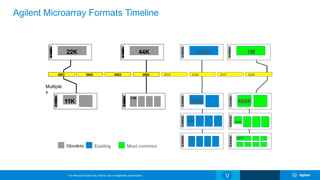
1M
400K
180K
60K
Agilent Microarray Formats Timeline
244K
44K
105K
15K
2005 2006 2007 2008
Existing Most common
22K 44K
1.9K
11K
Multiple
x
2001 2002 2003 2004
Obsolete
V
For Research Use Only. Not for use in diagnostic procedures.
2000
22K
135
m
2006
244K
55 m
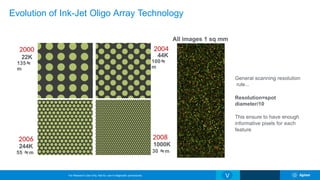
All images 1 sq mm
Evolution of Ink-Jet Oligo Array Technology
2008
1000K
30 m
2004
44K
100
m
General scanning resolution
rule...
Resolution=spot
diameter/10
This ensure to have enough
informative pixels for each
feature
V
For Research Use Only. Not for use in diagnostic procedures.
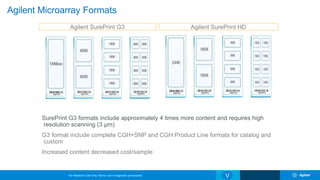
Agilent Microarray Formats
SurePrint G3 formats include approximately 4 times more content and requires high
resolution scanning (3 µm)
G3 format include complete CGH+SNP and CGH Product Line formats for catalog and
custom
Increased content decreased cost/sample
Agilent SurePrint HD
Agilent SurePrint G3
V
For Research Use Only. Not for use in diagnostic procedures.
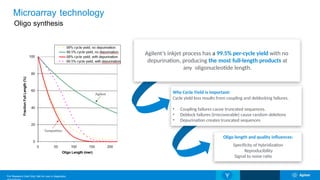
Microarray technology
Oligo synthesis
For Research Use Only. Not for use in diagnostic
Agilent’s inkjet process has a 99.5% per-cycle yield with no
depurination, producing the most full-length products at
any oligonucleotide length.
Why Cycle Yield is important:
Cycle yield loss results from coupling and deblocking failures.
• Coupling failures cause truncated sequences.
• Deblock failures (irrecoverable) cause random deletions
• Depurination creates truncated sequences
Oligo length and quality influences:
Specificity of hybridization
Reproducibility
Signal to noise ratio
Y
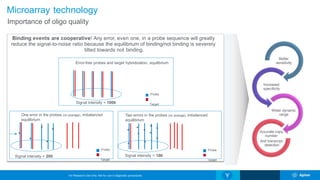
Binding events are cooperative! Any error, even one, in a probe sequence will greatly
reduce the signal-to-noise ratio because the equilibrium of binding/not binding is severely
tilted towards not binding.
Error-free probes and target hybridization, equilibrium
One error in the probes (on average), imbalanced
equilibrium
Two errors in the probes (on average), imbalanced
equilibrium
Probe
Target
Probe
Target
*
*
* *
* *
*
*
Signal intensity = 1000
Signal intensity = 200 Signal intensity = 100
*
*
*
*
*
*
*
Probe
Target
Better
sensitivity
Increased
specificity
Wider dynamic
range
Accurate copy
number
And transcript
detection
Microarray technology
Importance of oligo quality
Y
For Research Use Only. Not for use in diagnostic procedures.
While number of probes on the array has just limited impact, probe length
really makes the difference
• Longer probe gives higher specificity
→ ability to detect with precision also complex r
e
g
i
o
n
s
• Less probes are needed to confidently make a CN call or to detect an
expressed gene
→ so less probe are needed to achieve s
a
m
e
performances
• Longer probe provide better sensitivity
→ ability to work also with complex/lower q
u
a
l
i
t
y
samples
• Increase specificity and sensitivity provide a wider dynamic range
→ enabling better CN call, more precise profiling
Microarray Technology
Importance of oligo lengh
Y
For Research Use Only. Not for use in diagnostic
A T A T
C G
C G A T C G
T C G A T C
A T C G A T
G A T C G A
C G A T C G
T C G A T C
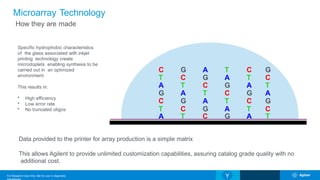
Microarray Technology
How they are made
Data provided to the printer for array production is a simple matrix
This allows Agilent to provide unlimited customization capabilities, assuring catalog grade quality with no
additional cost.
Specific hydrophobic characteristics
of the glass associated with inkjet
printing technology create
microdoplets enabling synthesis to be
carried out in an optimized
environment.
This results in:
• High efficiency
• Low error rate
• No truncated oligos
Y
For Research Use Only. Not for use in diagnostic
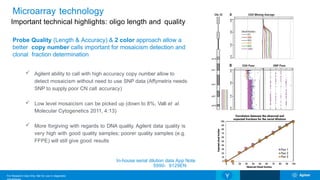
In-house serial dilution data App Note
5990- 9129EN
Probe Quality (Length & Accuracy) & 2 color approach allow a
better copy number calls important for mosaicism detection and
clonal fraction determination
 Agilent ability to call with high accuracy copy number allow to
detect mosaicism without need to use SNP data (Affymetrix needs
SNP to supply poor CN call accuracy)
 Low level mosaicism can be picked up (down to 8%, Valli et al.
Molecular Cytogenetics 2011, 4:13)
 More forgiving with regards to DNA quality. Agilent data quality is
very high with good quality samples; poorer quality samples (e.g.
FFPE) will still give good results
Y
For Research Use Only. Not for use in diagnostic
Microarray technology
Important technical highlights: oligo length and quality
Microarray technology
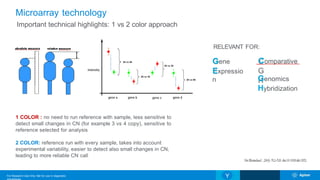
Important technical highlights: 1 vs 2 color approach
RELEVANT FOR:
1 COLOR : no need to run reference with sample, less sensitive to
detect small changes in CN (for example 3 vs 4 copy), sensitive to
reference selected for analysis
2 COLOR: reference run with every sample, takes into account
experimental variability, easier to detect also small changes in CN,
leading to more reliable CN call
Comparative
Genomics
Hybridization
Gene
Expressio
n
Y
For Research Use Only. Not for use in diagnostic
procedures.
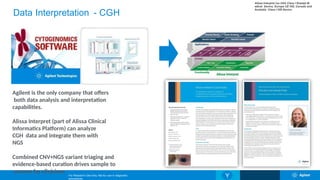
Data Interpretation - CGH
Agilent is the only company that offers
both data analysis and interpretation
capabilities.
Alissa Interpret (part of Alissa Clinical
Informatics Platform) can analyze
CGH data and integrate them with
NGS
Combined CNV+NGS variant triaging and
evidence-based curation drives sample to
answer for clinicians
Alissa Interpret isa USA Class I Exempt M
edical Device, Europe CE IVD, Canada and
Australia Class I IVD Device
Y
For Research Use Only. Not for use in diagnostic
procedures.
Example workflow: CGH
Prenatal
Research
Postnatal
Research
Cancer
PGT
• Follow up after
NIPT screening
• Screening for trisomies
and micro-dup/deletions
• Genome-wide screening
for DD/ID/CA/ASD
• Confirmatory or reflex
test to NGS
• Genome-wide screening
CNV+LOH in solid and
heme-onc tumors
• Exon-level analysis of
cancer-specific
genes
• Aneuploidy screening to
rank embryos
• Segmental dup/del
analysis
EasyChip -
customized
prenatal assay
New GenetiSure
Cyto
Microarrays
GenetiSure
Cancer Research
Arrays/Baylor
Cancer Arrays
GenetiSure Pre-
Screen Arrays
SureScan
Microarray
Scanner
CytoGenomics
&
Alissa
Y
Editing will
introduce
modification
in genome
need to
evaluat
e
editing
effects
Need to
identify
possible
secondary
insertion
sites
For Research Use Only. Not for use in diagnostic
procedures.
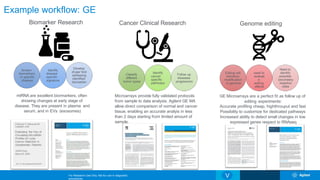
Example workflow: GE
Genome editing
Cancer Clinical Research
Biomarker Research
Screen
biomarkers
in specific
disease
Identify
disease
specific
signature
Develop
drugs/ test
adressing
identified
biomarker
miRNA are excellent biormarkers, often
showing changes at early stage of
disease. They are present in plasma and
serum, and in EVs (exosomes)
Classify
different
tumor types
Identify
cancer
specific
pathways
Follow up
dissease
progression
Microarrays provide fully validated protocols
from sample to data analysis. Agilent GE MA
allow direct comparison of normal and cancer
tissue, enabling an accurate analyis in less
than 2 days starting from limited amount of
sample.
GE Microarrays are a perfect fit as follow up of
editing experiments:
Accurate profiling cheap, highthrouput and fast
Possibility to customize for dedicated pathways
Increased ability to detect small changes in low
expressed genes respect to RNAseq
V
For Research Use Only. Not for use in diagnostic
procedures.

the agilent Microarray platform and its applications

  • 1.
    The Agilent Microarray Platform MrDhananjay Pathak Senior analyst Metropolis Healthcare limited GRL Mumbai. An array of possibilities
  • 2.
    Agilent Microarray Platform Hardware V ForResearch Use Only. Not for use in diagnostic procedures. Reagents Slides You • Scanner • Hybridization oven • Hyb chambers • Automation • Dedicated labelling kit • Hybridization kit • Quality controls • Washing buffers • Microarray slides for different applications / species • Multiple array formats • Unlimited customization capabilities • No minimum order • No extra cost • Same quality as catalog arrays
  • 3.
    1M 400K 180K 60K Agilent Microarray FormatsTimeline 244K 44K 105K 15K 2005 2006 2007 2008 Existing Most common 22K 44K 1.9K 11K Multiple x 2001 2002 2003 2004 Obsolete V For Research Use Only. Not for use in diagnostic procedures.
  • 4.
    2000 22K 135 m 2006 244K 55 m All images1 sq mm Evolution of Ink-Jet Oligo Array Technology 2008 1000K 30 m 2004 44K 100 m General scanning resolution rule... Resolution=spot diameter/10 This ensure to have enough informative pixels for each feature V For Research Use Only. Not for use in diagnostic procedures.
  • 5.
    Agilent Microarray Formats SurePrintG3 formats include approximately 4 times more content and requires high resolution scanning (3 µm) G3 format include complete CGH+SNP and CGH Product Line formats for catalog and custom Increased content decreased cost/sample Agilent SurePrint HD Agilent SurePrint G3 V For Research Use Only. Not for use in diagnostic procedures.
  • 6.
    Microarray technology Oligo synthesis ForResearch Use Only. Not for use in diagnostic Agilent’s inkjet process has a 99.5% per-cycle yield with no depurination, producing the most full-length products at any oligonucleotide length. Why Cycle Yield is important: Cycle yield loss results from coupling and deblocking failures. • Coupling failures cause truncated sequences. • Deblock failures (irrecoverable) cause random deletions • Depurination creates truncated sequences Oligo length and quality influences: Specificity of hybridization Reproducibility Signal to noise ratio Y
  • 7.
    Binding events arecooperative! Any error, even one, in a probe sequence will greatly reduce the signal-to-noise ratio because the equilibrium of binding/not binding is severely tilted towards not binding. Error-free probes and target hybridization, equilibrium One error in the probes (on average), imbalanced equilibrium Two errors in the probes (on average), imbalanced equilibrium Probe Target Probe Target * * * * * * * * Signal intensity = 1000 Signal intensity = 200 Signal intensity = 100 * * * * * * * Probe Target Better sensitivity Increased specificity Wider dynamic range Accurate copy number And transcript detection Microarray technology Importance of oligo quality Y For Research Use Only. Not for use in diagnostic procedures.
  • 8.
    While number ofprobes on the array has just limited impact, probe length really makes the difference • Longer probe gives higher specificity → ability to detect with precision also complex r e g i o n s • Less probes are needed to confidently make a CN call or to detect an expressed gene → so less probe are needed to achieve s a m e performances • Longer probe provide better sensitivity → ability to work also with complex/lower q u a l i t y samples • Increase specificity and sensitivity provide a wider dynamic range → enabling better CN call, more precise profiling Microarray Technology Importance of oligo lengh Y For Research Use Only. Not for use in diagnostic
  • 9.
    A T AT C G C G A T C G T C G A T C A T C G A T G A T C G A C G A T C G T C G A T C Microarray Technology How they are made Data provided to the printer for array production is a simple matrix This allows Agilent to provide unlimited customization capabilities, assuring catalog grade quality with no additional cost. Specific hydrophobic characteristics of the glass associated with inkjet printing technology create microdoplets enabling synthesis to be carried out in an optimized environment. This results in: • High efficiency • Low error rate • No truncated oligos Y For Research Use Only. Not for use in diagnostic
  • 10.
    In-house serial dilutiondata App Note 5990- 9129EN Probe Quality (Length & Accuracy) & 2 color approach allow a better copy number calls important for mosaicism detection and clonal fraction determination  Agilent ability to call with high accuracy copy number allow to detect mosaicism without need to use SNP data (Affymetrix needs SNP to supply poor CN call accuracy)  Low level mosaicism can be picked up (down to 8%, Valli et al. Molecular Cytogenetics 2011, 4:13)  More forgiving with regards to DNA quality. Agilent data quality is very high with good quality samples; poorer quality samples (e.g. FFPE) will still give good results Y For Research Use Only. Not for use in diagnostic Microarray technology Important technical highlights: oligo length and quality
  • 11.
    Microarray technology Important technicalhighlights: 1 vs 2 color approach RELEVANT FOR: 1 COLOR : no need to run reference with sample, less sensitive to detect small changes in CN (for example 3 vs 4 copy), sensitive to reference selected for analysis 2 COLOR: reference run with every sample, takes into account experimental variability, easier to detect also small changes in CN, leading to more reliable CN call Comparative Genomics Hybridization Gene Expressio n Y For Research Use Only. Not for use in diagnostic
  • 12.
    For Research UseOnly. Not for use in diagnostic procedures. Data Interpretation - CGH Agilent is the only company that offers both data analysis and interpretation capabilities. Alissa Interpret (part of Alissa Clinical Informatics Platform) can analyze CGH data and integrate them with NGS Combined CNV+NGS variant triaging and evidence-based curation drives sample to answer for clinicians Alissa Interpret isa USA Class I Exempt M edical Device, Europe CE IVD, Canada and Australia Class I IVD Device Y
  • 13.
    For Research UseOnly. Not for use in diagnostic procedures. Example workflow: CGH Prenatal Research Postnatal Research Cancer PGT • Follow up after NIPT screening • Screening for trisomies and micro-dup/deletions • Genome-wide screening for DD/ID/CA/ASD • Confirmatory or reflex test to NGS • Genome-wide screening CNV+LOH in solid and heme-onc tumors • Exon-level analysis of cancer-specific genes • Aneuploidy screening to rank embryos • Segmental dup/del analysis EasyChip - customized prenatal assay New GenetiSure Cyto Microarrays GenetiSure Cancer Research Arrays/Baylor Cancer Arrays GenetiSure Pre- Screen Arrays SureScan Microarray Scanner CytoGenomics & Alissa Y
  • 14.
    Editing will introduce modification in genome needto evaluat e editing effects Need to identify possible secondary insertion sites For Research Use Only. Not for use in diagnostic procedures. Example workflow: GE Genome editing Cancer Clinical Research Biomarker Research Screen biomarkers in specific disease Identify disease specific signature Develop drugs/ test adressing identified biomarker miRNA are excellent biormarkers, often showing changes at early stage of disease. They are present in plasma and serum, and in EVs (exosomes) Classify different tumor types Identify cancer specific pathways Follow up dissease progression Microarrays provide fully validated protocols from sample to data analysis. Agilent GE MA allow direct comparison of normal and cancer tissue, enabling an accurate analyis in less than 2 days starting from limited amount of sample. GE Microarrays are a perfect fit as follow up of editing experiments: Accurate profiling cheap, highthrouput and fast Possibility to customize for dedicated pathways Increased ability to detect small changes in low expressed genes respect to RNAseq V
  • 15.
    For Research UseOnly. Not for use in diagnostic procedures.