Molecular Diagnostic
Techniques of Bacterial Diseases
Droplet Digital PCR
(ddPCR)
Alan Omer Ali
Microbiology
2023 - 2024
What’s Digital PCR dPCR?
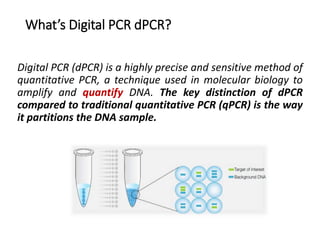
Digital PCR (dPCR) is a highly precise and sensitive method of
quantitative PCR, a technique used in molecular biology to
amplify and quantify DNA. The key distinction of dPCR
compared to traditional quantitative PCR (qPCR) is the way
it partitions the DNA sample.
History and Evolution of digital PCR :
• Early PCR Development (1980s-1990s): 980s by Kary Mullis
• Conceptualization of Digital PCR (1990s): The concept of digital PCR emerged
as a means to overcome the quantitative limitations of traditional PCR. The key
idea was to partition the PCR reaction into many small, independent reactions,
each containing zero or one target DNA molecule. This approach allows for
absolute quantification of nucleic acids without the need for standard curves.
• The term “digital PCR” was first used in the 1999 paper by Kinzler and
Vogelstein in which they described the quantitation of ras mutations in a
sample by partitioning the sample in order to perform a series of PCRs in 384
well microplates.
• Early Implementations (2000s): The early 2000s saw the development of the
first digital PCR platforms. These systems used various methods to partition
the sample, such as microfluidics, droplet generation, or chip-based arrays.
• Advancements in Technology (2010s): With advancements in
microfluidics, optics, and software analysis, digital PCR technology became
more refined. Systems like droplet digital PCR (ddPCR) and chip-based digital
PCR gained popularity.
• DNA sample is divided into many individual, parallel PCR reactions;
some of these contain the target DNA molecule while others do not.
• Essentially, the sample is diluted and partitioned into thousands of
small reactions (droplets or wells).
• ddPCR measures absolute quantities by counting nucleic acid
molecules encapsulated in discrete, volumetrically defined, water-in-
oil droplet partitions.
• digital PCR method utilizing a water-oil emulsion droplet system.
Droplets are formed in a water-oil emulsion to form the partitions that
separate the template DNA molecules.
Droplet Digital PCR (ddPCR)
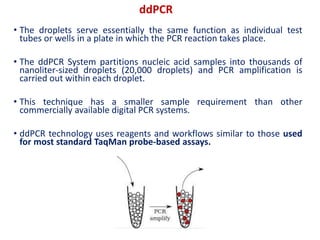
• The droplets serve essentially the same function as individual test
tubes or wells in a plate in which the PCR reaction takes place.
• The ddPCR System partitions nucleic acid samples into thousands of
nanoliter-sized droplets (20,000 droplets) and PCR amplification is
carried out within each droplet.
• This technique has a smaller sample requirement than other
commercially available digital PCR systems.
• ddPCR technology uses reagents and workflows similar to those used
for most standard TaqMan probe-based assays.
ddPCR
Principle
• ddPCR technology uses a combination of microfluidics and proprietary
surfactant chemistries to divide PCR samples into water-in-oil droplets.
• The droplets support PCR amplification of the template molecules and use
reagents and workflows similar to those used for most standard TaqMan
probe-based assays.
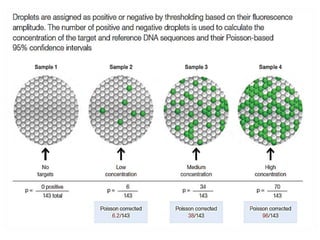
• Following PCR, each droplet is analyzed or read in a flow cytometer to
determine the fraction of PCR-positive droplets in the original sample.
• These data are then analyzed using Poisson statistics to determine the target
DNA template concentration in the original sample.
The Workflow
Preparing PCR samples:
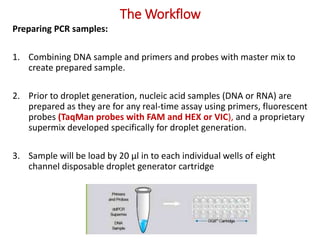
1. Combining DNA sample and primers and probes with master mix to
create prepared sample.
2. Prior to droplet generation, nucleic acid samples (DNA or RNA) are
prepared as they are for any real-time assay using primers, fluorescent
probes (TaqMan probes with FAM and HEX or VIC), and a proprietary
supermix developed specifically for droplet generation.
3. Sample will be load by 20 μl in to each individual wells of eight
channel disposable droplet generator cartridge
1. Droplet Generation:
• Samples are then placed into the Droplet Generator, which
utilizes proprietary reagents and microfluidics to partition the
samples into 20,000 nanoliter-sized droplets.
• The droplets created by the Droplet Generator should be uniform
in size and volume
• In during Droplet Generation a specified
material is added to stabilize the droplets
2. PCRAmplificationofDroplets
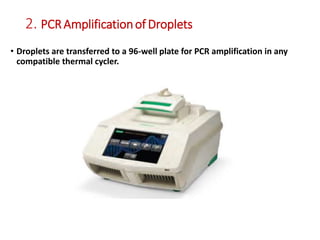
• Droplets are transferred to a 96-well plate for PCR amplification in any
compatible thermal cycler.
3. Droplet reading
• After PCR amplification of the nucleic acid target in the droplets, the
samples are placed in the Droplet Reader.
• Reader analyzes each droplet individually using a two-color detection
system (set to detect FAM and either HEX or VIC), enabling multiplexed
analysis for different targets in the same sample.
• The droplet reader and software count the PCR-positive and Permeative
droplets.
• Fluorescence measurements for each droplet in two optical channels are
used to count the numbers of positive and negative droplets per sample.
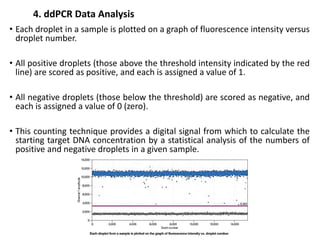
• In ddPCR, the QuantaSoft software measures the numbers of droplets that are
positive and negative for each fluorophore (for example, FAM and HEX) in a
sample.
• The fraction of positive droplets is then fitted to a Poisson distribution to
determine the absolute copy number of the target DNA molecule in the input
reaction mixture (units of copies/μl).
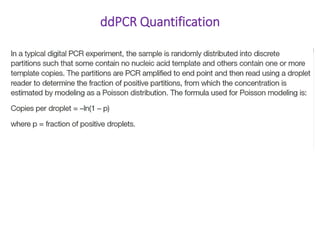
• Each droplet in a sample is plotted on a graph of fluorescence intensity versus
droplet number.
• All positive droplets (those above the threshold intensity indicated by the red
line) are scored as positive, and each is assigned a value of 1.
• All negative droplets (those below the threshold) are scored as negative, and
each is assigned a value of 0 (zero).
• This counting technique provides a digital signal from which to calculate the
starting target DNA concentration by a statistical analysis of the numbers of
positive and negative droplets in a given sample.
4. ddPCR Data Analysis
ddPCR Quantification
Advantages in application of ddPCR
1. Absolute quantification — ddPCR provides a concentration of target DNA
copies per input sample without the need for running standard curves,
making this technique ideal for target DNA measurements, viral load
analysis, and microbial quantification.
2. Genomic alterations such as gene copy number variation (CNV) — CNVs
result in too variability, complex behavioral traits, and disease. ddPCR
enables measurement of 1.2x differences in gene copy number.
3. Detection of rare sequences — researchers must amplify single genes in a
complex sample, such as a few tumor cells in a wild-type background.
ddPCR is sensitive enough to detect rare mutations or sequences
4. Gene expression and microRNA analysis — ddPCR provides stand-alone
absolute quantification of expression levels, especially low-abundance
microRNAs, with sensitivity and precision
4. Next-generation sequencing (NGS) — ddPCR quantifies NGS sample library
preparations to increase sequencing accuracy and reduce run repeats.
Validate sequencing results such as single nucleotide polymorphisms or
copy number variations with absolute quantification
5. Single cell analysis — the high degree (10- to 100-fold) of cell-cell variation
in gene expression and genomic content among homogeneous post-
mitotic, progenitor, and stem cell populations drives a need for analysis
from single cells. ddPCR enables low copy number quantification
6. Genome edit detection — ddPCR enables fast, precise, and cost-effective
assessment of HDR (Homology directed repair) and NHEJ (Non-homologous
end joining) generated by CRISPR-Cas9 or other genome editing tools
References:
• Hindson, B.J., Ness, K.D., Masquelier, D.A., Belgrader, P., Heredia, N.J., Makarewicz, A.J., Bright, I.J.,
Lucero, M.Y., Hiddessen, A.L., Legler, T.C., Kitano, T.K., Hodel, M.R., Petersen, J.F., Wyatt, P.W.,
Steenblock, E.R., Shah, P.H., Bousse, L.J., Troup, C.B., Mellen, J.C., Wittmann, D.K., Erndt, N.G.,
Cauley, T.H., Koehler, R.T., So, A.P., Dube, S., McErlane, K.M., Cawthorne, R.J., Hindson, C.M., Uhlin,
B.D., Syndercombe Court, D., Bharadwaj, R., Jarvis, G., Kellogg, D.E., Peterson, C., Gogichashvili, A.,
Girard, J.E., Gladish, N., Balkin, A., Al-Saden, R., Olson, M.T., Praul, C.A., Bruckbauer, S.T., Shah, N.,
Miller, W.H., Forgham, M.T., Kan, C., Bhangu, B., and Zimmermann, K. (2011) ‘High-throughput
droplet digital PCR system for absolute quantitation of DNA copy number’, Analytical Chemistry,
83(22), pp. 8604–8610.
• Sykes, P.J., Neoh, S.H., Brisco, M.J., Hughes, E., Condon, J., and Morley, A.A. (1992) ‘Quantitation of
targets for PCR by use of limiting dilution’, BioTechniques, 13(3), pp. 444–449.
• Vogelstein, B. and Kinzler, K.W. (1999) ‘Digital PCR’, Proceedings of the National Academy of
Sciences, 96(16), pp. 9236–9241.
• Baker, M. (2012) ‘Digital PCR hits its stride’, Nature Methods, 9(6), pp. 541–544.
• Day, E., Dear, P.H., and McCaughan, F. (2013) ‘Digital PCR strategies in the development and analysis
of molecular biomarkers for personalized medicine’, Methods, 59(1), pp. 101–107.
• Whale, A.S., Huggett, J.F., Cowen, S., Speirs, V., Shaw, J., Ellison, S., Foy, C.A., and Scott, D.J. (2012)
‘Comparison of microfluidic digital PCR and conventional quantitative PCR for measuring copy
number variation’, Nucleic Acids Research, 40(11), e82.

Digital PCR.pptx

  • 1.
    Molecular Diagnostic Techniques ofBacterial Diseases Droplet Digital PCR (ddPCR) Alan Omer Ali Microbiology 2023 - 2024
  • 2.
    What’s Digital PCRdPCR? Digital PCR (dPCR) is a highly precise and sensitive method of quantitative PCR, a technique used in molecular biology to amplify and quantify DNA. The key distinction of dPCR compared to traditional quantitative PCR (qPCR) is the way it partitions the DNA sample.
  • 4.
    History and Evolutionof digital PCR : • Early PCR Development (1980s-1990s): 980s by Kary Mullis • Conceptualization of Digital PCR (1990s): The concept of digital PCR emerged as a means to overcome the quantitative limitations of traditional PCR. The key idea was to partition the PCR reaction into many small, independent reactions, each containing zero or one target DNA molecule. This approach allows for absolute quantification of nucleic acids without the need for standard curves. • The term “digital PCR” was first used in the 1999 paper by Kinzler and Vogelstein in which they described the quantitation of ras mutations in a sample by partitioning the sample in order to perform a series of PCRs in 384 well microplates. • Early Implementations (2000s): The early 2000s saw the development of the first digital PCR platforms. These systems used various methods to partition the sample, such as microfluidics, droplet generation, or chip-based arrays. • Advancements in Technology (2010s): With advancements in microfluidics, optics, and software analysis, digital PCR technology became more refined. Systems like droplet digital PCR (ddPCR) and chip-based digital PCR gained popularity.
  • 5.
    • DNA sampleis divided into many individual, parallel PCR reactions; some of these contain the target DNA molecule while others do not. • Essentially, the sample is diluted and partitioned into thousands of small reactions (droplets or wells). • ddPCR measures absolute quantities by counting nucleic acid molecules encapsulated in discrete, volumetrically defined, water-in- oil droplet partitions. • digital PCR method utilizing a water-oil emulsion droplet system. Droplets are formed in a water-oil emulsion to form the partitions that separate the template DNA molecules. Droplet Digital PCR (ddPCR)
  • 6.
    • The dropletsserve essentially the same function as individual test tubes or wells in a plate in which the PCR reaction takes place. • The ddPCR System partitions nucleic acid samples into thousands of nanoliter-sized droplets (20,000 droplets) and PCR amplification is carried out within each droplet. • This technique has a smaller sample requirement than other commercially available digital PCR systems. • ddPCR technology uses reagents and workflows similar to those used for most standard TaqMan probe-based assays. ddPCR
  • 7.
    Principle • ddPCR technologyuses a combination of microfluidics and proprietary surfactant chemistries to divide PCR samples into water-in-oil droplets. • The droplets support PCR amplification of the template molecules and use reagents and workflows similar to those used for most standard TaqMan probe-based assays. • Following PCR, each droplet is analyzed or read in a flow cytometer to determine the fraction of PCR-positive droplets in the original sample. • These data are then analyzed using Poisson statistics to determine the target DNA template concentration in the original sample.
  • 8.
    The Workflow Preparing PCRsamples: 1. Combining DNA sample and primers and probes with master mix to create prepared sample. 2. Prior to droplet generation, nucleic acid samples (DNA or RNA) are prepared as they are for any real-time assay using primers, fluorescent probes (TaqMan probes with FAM and HEX or VIC), and a proprietary supermix developed specifically for droplet generation. 3. Sample will be load by 20 μl in to each individual wells of eight channel disposable droplet generator cartridge
  • 9.
    1. Droplet Generation: •Samples are then placed into the Droplet Generator, which utilizes proprietary reagents and microfluidics to partition the samples into 20,000 nanoliter-sized droplets. • The droplets created by the Droplet Generator should be uniform in size and volume
  • 10.
    • In duringDroplet Generation a specified material is added to stabilize the droplets
  • 11.
    2. PCRAmplificationofDroplets • Dropletsare transferred to a 96-well plate for PCR amplification in any compatible thermal cycler.
  • 12.
    3. Droplet reading •After PCR amplification of the nucleic acid target in the droplets, the samples are placed in the Droplet Reader. • Reader analyzes each droplet individually using a two-color detection system (set to detect FAM and either HEX or VIC), enabling multiplexed analysis for different targets in the same sample. • The droplet reader and software count the PCR-positive and Permeative droplets. • Fluorescence measurements for each droplet in two optical channels are used to count the numbers of positive and negative droplets per sample.
  • 13.
    • In ddPCR,the QuantaSoft software measures the numbers of droplets that are positive and negative for each fluorophore (for example, FAM and HEX) in a sample. • The fraction of positive droplets is then fitted to a Poisson distribution to determine the absolute copy number of the target DNA molecule in the input reaction mixture (units of copies/μl).
  • 15.
    • Each dropletin a sample is plotted on a graph of fluorescence intensity versus droplet number. • All positive droplets (those above the threshold intensity indicated by the red line) are scored as positive, and each is assigned a value of 1. • All negative droplets (those below the threshold) are scored as negative, and each is assigned a value of 0 (zero). • This counting technique provides a digital signal from which to calculate the starting target DNA concentration by a statistical analysis of the numbers of positive and negative droplets in a given sample. 4. ddPCR Data Analysis
  • 17.
  • 20.
    Advantages in applicationof ddPCR 1. Absolute quantification — ddPCR provides a concentration of target DNA copies per input sample without the need for running standard curves, making this technique ideal for target DNA measurements, viral load analysis, and microbial quantification. 2. Genomic alterations such as gene copy number variation (CNV) — CNVs result in too variability, complex behavioral traits, and disease. ddPCR enables measurement of 1.2x differences in gene copy number. 3. Detection of rare sequences — researchers must amplify single genes in a complex sample, such as a few tumor cells in a wild-type background. ddPCR is sensitive enough to detect rare mutations or sequences 4. Gene expression and microRNA analysis — ddPCR provides stand-alone absolute quantification of expression levels, especially low-abundance microRNAs, with sensitivity and precision
  • 21.
    4. Next-generation sequencing(NGS) — ddPCR quantifies NGS sample library preparations to increase sequencing accuracy and reduce run repeats. Validate sequencing results such as single nucleotide polymorphisms or copy number variations with absolute quantification 5. Single cell analysis — the high degree (10- to 100-fold) of cell-cell variation in gene expression and genomic content among homogeneous post- mitotic, progenitor, and stem cell populations drives a need for analysis from single cells. ddPCR enables low copy number quantification 6. Genome edit detection — ddPCR enables fast, precise, and cost-effective assessment of HDR (Homology directed repair) and NHEJ (Non-homologous end joining) generated by CRISPR-Cas9 or other genome editing tools
  • 22.
    References: • Hindson, B.J.,Ness, K.D., Masquelier, D.A., Belgrader, P., Heredia, N.J., Makarewicz, A.J., Bright, I.J., Lucero, M.Y., Hiddessen, A.L., Legler, T.C., Kitano, T.K., Hodel, M.R., Petersen, J.F., Wyatt, P.W., Steenblock, E.R., Shah, P.H., Bousse, L.J., Troup, C.B., Mellen, J.C., Wittmann, D.K., Erndt, N.G., Cauley, T.H., Koehler, R.T., So, A.P., Dube, S., McErlane, K.M., Cawthorne, R.J., Hindson, C.M., Uhlin, B.D., Syndercombe Court, D., Bharadwaj, R., Jarvis, G., Kellogg, D.E., Peterson, C., Gogichashvili, A., Girard, J.E., Gladish, N., Balkin, A., Al-Saden, R., Olson, M.T., Praul, C.A., Bruckbauer, S.T., Shah, N., Miller, W.H., Forgham, M.T., Kan, C., Bhangu, B., and Zimmermann, K. (2011) ‘High-throughput droplet digital PCR system for absolute quantitation of DNA copy number’, Analytical Chemistry, 83(22), pp. 8604–8610. • Sykes, P.J., Neoh, S.H., Brisco, M.J., Hughes, E., Condon, J., and Morley, A.A. (1992) ‘Quantitation of targets for PCR by use of limiting dilution’, BioTechniques, 13(3), pp. 444–449. • Vogelstein, B. and Kinzler, K.W. (1999) ‘Digital PCR’, Proceedings of the National Academy of Sciences, 96(16), pp. 9236–9241. • Baker, M. (2012) ‘Digital PCR hits its stride’, Nature Methods, 9(6), pp. 541–544. • Day, E., Dear, P.H., and McCaughan, F. (2013) ‘Digital PCR strategies in the development and analysis of molecular biomarkers for personalized medicine’, Methods, 59(1), pp. 101–107. • Whale, A.S., Huggett, J.F., Cowen, S., Speirs, V., Shaw, J., Ellison, S., Foy, C.A., and Scott, D.J. (2012) ‘Comparison of microfluidic digital PCR and conventional quantitative PCR for measuring copy number variation’, Nucleic Acids Research, 40(11), e82.