THE ACCOUNTING
PROCESS
Accounting for Partnership and Corporation
Lesson 2
Created by: Sheryl V. Paliza, CPA
LEARNING OBJECTIVES
 1.Identify and explain the steps in the accounting process.
 2. Identify the typical account titles used in recording transactions
 3. Explain the Double Entry System and use it in recording business
transactions
 4.Prepare adjusting entries and understand the rationale for their
preparation.
 3.Prepare closing entries and understand the rationale for their
preparation.
 5.Explain the advantages of preparing reversing entries and identify
adjusting entries that may be reversed.
Created by: Sheryl V. Paliza, CPA
ACCOUNTING PROCESS
 procedures or series of steps undertaken to come up with
the information reported in the financial statements.
 also referred to as the Accounting Cycle.
 Divided into two phases:
RECORDING PHASE
SUMMARIZING PHASE
Created by: Sheryl V. Paliza, CPA
RECORDING PHASE
 collecting information about economic transactions and the recording of
these transactions in the appropriate accounting records
Transaction - economic event that changes an asset, a liability, or
an equity account balance
Accounting records - include business documents, journals, and
ledgers.
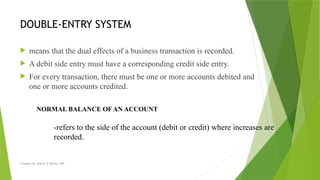
DOUBLE-ENTRY SYSTEM
 means that the dual effects of a business transaction is recorded.
 A debit side entry must have a corresponding credit side entry.
 For every transaction, there must be one or more accounts debited and
one or more accounts credited.
Created by: Sheryl V. Paliza, CPA
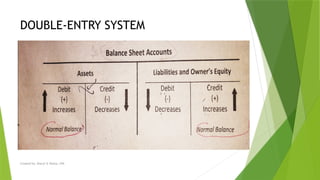
NORMAL BALANCE OF AN ACCOUNT
-refers to the side of the account (debit or credit) where increases are
recorded.
Created by: Sheryl V. Paliza, CPA
DOUBLE-ENTRY SYSTEM
Created by: Sheryl V. Paliza, CPA
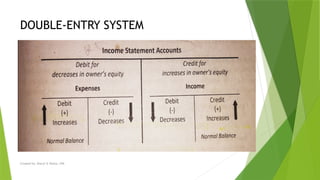
DOUBLE-ENTRY SYSTEM
Created by: Sheryl V. Paliza, CPA
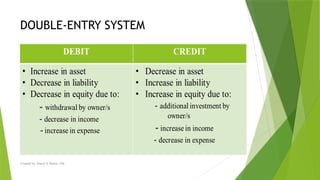
DOUBLE-ENTRY SYSTEM
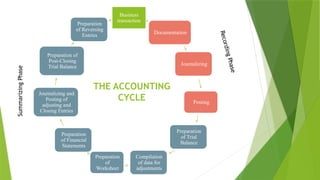
Business
transaction
Documentation
Journalizing
Posting
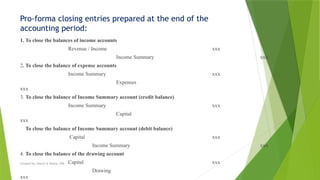
Preparation
of Trial
Balance
Compilation
of data for
adjustments
Preparation
of
Worksheet
Preparation
of Financial
Statements
Journalizing and
Posting of
adjusting and
Closing Entries
Preparation of
Post-Closing
Trial Balance
Preparation
of Reversing
Entries
THE ACCOUNTING
CYCLE
R
e
c
o
r
d
i
n
g
P
h
a
s
e
Summarizing
Phase
Created by: Sheryl V. Paliza, CPA
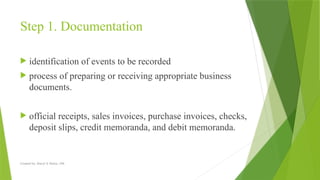
Step 1. Documentation
 identification of events to be recorded
 process of preparing or receiving appropriate business
documents.
 official receipts, sales invoices, purchase invoices, checks,
deposit slips, credit memoranda, and debit memoranda.
Created by: Sheryl V. Paliza, CPA
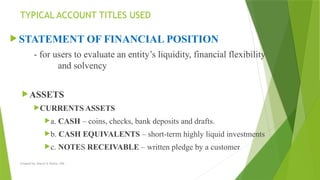
TYPICAL ACCOUNT TITLES USED
 STATEMENT OF FINANCIAL POSITION
- for users to evaluate an entity’s liquidity, financial flexibility
and solvency
ASSETS
CURRENTS ASSETS
a. CASH – coins, checks, bank deposits and drafts.
b. CASH EQUIVALENTS – short-term highly liquid investments
c. NOTES RECEIVABLE – written pledge by a customer
Created by: Sheryl V. Paliza, CPA
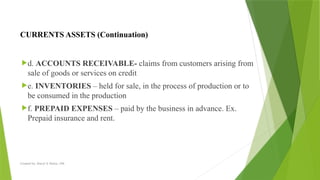
d. ACCOUNTS RECEIVABLE- claims from customers arising from
sale of goods or services on credit
e. INVENTORIES – held for sale, in the process of production or to
be consumed in the production
f. PREPAID EXPENSES – paid by the business in advance. Ex.
Prepaid insurance and rent.
CURRENTS ASSETS (Continuation)
Created by: Sheryl V. Paliza, CPA
 NON-CURRENTS ASSETS
a. PROPERTY, PLANT AND EQUIPMENT (PPE) – tangible assets
held for use in production, for rental or for administrative purposes
expected to be used during more than one period. Ex. land, building,
machinery and equipment, furniture and fixtures, motor vehicles and
equipment.
b. ACCUMULATED DEPRECIATION – contra account of PPE.
Contains the sum of the periodic depreciation charges.
c. INTANGIBLE ASSETS – identifiable, nonmonetary assets without
physical substance held for use in production, for rental or for
administrative purposes. Ex. Goodwill, patents, copyrights, licenses,
franchises, trademarks, secret processes, etc.
TYPICAL ACCOUNT TITLES USED
Created by: Sheryl V. Paliza, CPA
 STATEMENT OF FINANCIAL POSITION
 LIABILITIES
 CURRENT LIABILITIES
a. ACCOUNTS PAYABLE - claims from customers arising from sale of
goods or services on credit
b. NOTES PAYABLE – reverse of notes receivable, entity is the maker of
the note.
c. ACCRUED LIABILITES – amounts owed to others for unpaid
expenses
TYPICAL ACCOUNT TITLES USED
Created by: Sheryl V. Paliza, CPA
 NON-CURRENT LIABILITIES
a. MORTGAGE PAYABLE - long-term debts with pledge
of certain assets
b. BONDS PAYABLE – long-term debts by issuing bonds
TYPICAL ACCOUNT TITLES USED
d. UNEARNED REVENUES – payment received from customers before
providing goods or services
e. CURRENT PORTION OF LONG-TERM DEBT – portions of long-
term debts which are to be paid within one year from the balance sheet
date.
Created by: Sheryl V. Paliza, CPA
 STATEMENT OF FINANCIAL POSITION
 OWNER’S EQUITY
 a. CAPITAL – original and additional investments of the owner/s
of the entity
 b.WITHDRAWALS – when the owner/s withdraw cash or other
assets from the entity
 c. INCOME SUMMARY – temporary account used at the end of
the accounting period to close income and expenses. This account
shows the profit or loss for the period
TYPICAL ACCOUNT TITLES USED
Created by: Sheryl V. Paliza, CPA
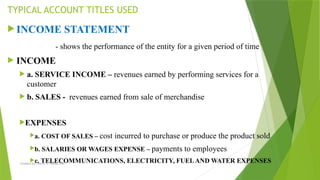
 INCOME STATEMENT
- shows the performance of the entity for a given period of time
 INCOME
 a. SERVICE INCOME – revenues earned by performing services for a
customer
 b. SALES - revenues earned from sale of merchandise
EXPENSES
a. COST OF SALES – cost incurred to purchase or produce the product sold
b. SALARIES OR WAGES EXPENSE – payments to employees
c. TELECOMMUNICATIONS, ELECTRICITY, FUELAND WATER EXPENSES
TYPICAL ACCOUNT TITLES USED
Created by: Sheryl V. Paliza, CPA
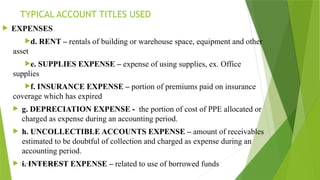
 EXPENSES
d. RENT – rentals of building or warehouse space, equipment and other
asset
e. SUPPLIES EXPENSE – expense of using supplies, ex. Office
supplies
f. INSURANCE EXPENSE – portion of premiums paid on insurance
coverage which has expired
 g. DEPRECIATION EXPENSE - the portion of cost of PPE allocated or
charged as expense during an accounting period.
 h. UNCOLLECTIBLE ACCOUNTS EXPENSE – amount of receivables
estimated to be doubtful of collection and charged as expense during an
accounting period.
 i. INTEREST EXPENSE – related to use of borrowed funds
TYPICAL ACCOUNT TITLES USED
Created by: Sheryl V. Paliza, CPA
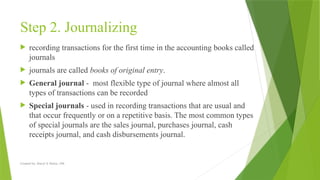
Step 2. Journalizing
 recording transactions for the first time in the accounting books called
journals
 journals are called books of original entry.
 General journal - most flexible type of journal where almost all
types of transactions can be recorded
 Special journals - used in recording transactions that are usual and
that occur frequently or on a repetitive basis. The most common types
of special journals are the sales journal, purchases journal, cash
receipts journal, and cash disbursements journal.
Created by: Sheryl V. Paliza, CPA
ILLUSTRATION
(JOUNALIZING BY A SOLE PROPRIETOR)
 Esterlina Gevera decided to organize her wedding consultancy business named
Weddings “R”” Us.
May 1 She invested P250,000 into this entity.
ENTRY
Dr. Cr.
CASH (A)
Php 250,000
GEVERA, CAPITAL (OE)
Php 250,000
May 2 Rented office space and paid two-months rent in advance.
ENTRY
PREPAID RENT (A) Php
250,000
CASH (A)
Created by: Sheryl V. Paliza, CPA
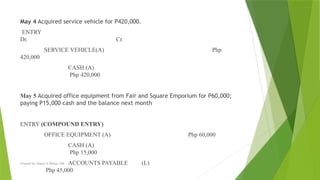
May 4 Acquired service vehicle for P420,000.
ENTRY
Dr. Cr.
SERVICE VEHICLE(A) Php
420,000
CASH (A)
Php 420,000
May 5 Acquired office equipment from Fair and Square Emporium for P60,000;
paying P15,000 cash and the balance next month
ENTRY (COMPOUND ENTRY)
OFFICE EQUIPMENT (A) Php 60,000
CASH (A)
Php 15,000
ACCOUNTS PAYABLE (L)
Php 45,000
Created by: Sheryl V. Paliza, CPA
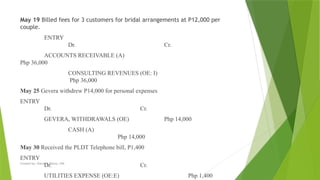
May 19 Billed fees for 3 customers for bridal arrangements at P12,000 per
couple.
ENTRY
Dr. Cr.
ACCOUNTS RECEIVABLE (A)
Php 36,000
CONSULTING REVENUES (OE: I)
Php 36,000
May 25 Gevera withdrew P14,000 for personal expenses
ENTRY
Dr. Cr.
GEVERA, WITHDRAWALS (OE) Php 14,000
CASH (A)
Php 14,000
May 30 Received the PLDT Telephone bill, P1,400
ENTRY
Dr. Cr.
UTILITIES EXPENSE (OE:E) Php 1,400
Created by: Sheryl V. Paliza, CPA
Step 3. Posting
 process of transferring the recorded transactions in the journal to the accounts in the
ledger
 to classify the effects of transactions on specific asset, liability, equity, income and
expense accounts.
 A ledger is a group of related accounts and is called the book of final entry.
1. General ledger - principal ledger which contains all the accounts that
are reported in the financial statements
Contra accounts- established to record deductions from related
accounts with positive balances such as Accumulated Depreciation (deducted from
Property, Plant and Equipment)
Adjunct accounts are accounts set up to record additions to
related accounts such as Freight-In (added to Purchases)
2. Subsidiary ledgers - contain details of some general ledger account
balances.
Created by: Sheryl V. Paliza, CPA
SUMMARIZING PHASE
 Includes the steps necessary for the preparation summary reports.
Created by: Sheryl V. Paliza, CPA
Step 4. Preparing a trial balance
 Trial balance – summary of balances of the accounts in the
general ledger
- prepared to prove the equality of debits and credit but
it does not indicate the accuracy of work done
- preparation of a trial balance is normally done in the work
sheet
Created by: Sheryl V. Paliza, CPA
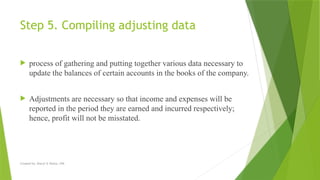
Step 5. Compiling adjusting data
 process of gathering and putting together various data necessary to
update the balances of certain accounts in the books of the company.
 Adjustments are necessary so that income and expenses will be
reported in the period they are earned and incurred respectively;
hence, profit will not be misstated.
Created by: Sheryl V. Paliza, CPA
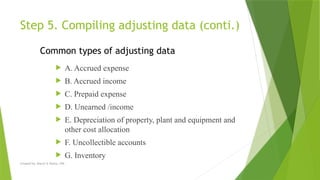
Common types of adjusting data
 A. Accrued expense
 B. Accrued income
 C. Prepaid expense
 D. Unearned /income
 E. Depreciation of property, plant and equipment and
other cost allocation
 F. Uncollectible accounts
 G. Inventory
Step 5. Compiling adjusting data (conti.)
Created by: Sheryl V. Paliza, CPA
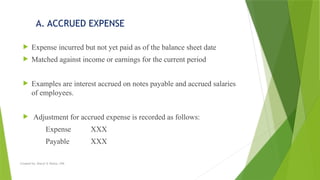
A. ACCRUED EXPENSE
 Expense incurred but not yet paid as of the balance sheet date
 Matched against income or earnings for the current period
 Examples are interest accrued on notes payable and accrued salaries
of employees.
 Adjustment for accrued expense is recorded as follows:
Expense XXX
Payable XXX
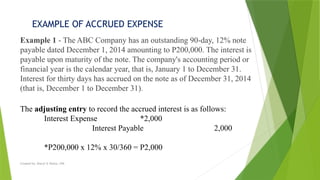
Example 1 - The ABC Company has an outstanding 90-day, 12% note
payable dated December 1, 2014 amounting to P200,000. The interest is
payable upon maturity of the note. The company's accounting period or
financial year is the calendar year, that is, January 1 to December 31.
Interest for thirty days has accrued on the note as of December 31, 2014
(that is, December 1 to December 31).
Created by: Sheryl V. Paliza, CPA
EXAMPLE OF ACCRUED EXPENSE
The adjusting entry to record the accrued interest is as follows:
Interest Expense *2,000
Interest Payable 2,000
*P200,000 x 12% x 30/360 = P2,000
Created by: Sheryl V. Paliza, CPA
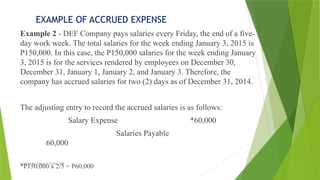
Example 2 - DEF Company pays salaries every Friday, the end of a five-
day work week. The total salaries for the week ending January 3, 2015 is
P150,000. In this case, the P150,000 salaries for the week ending January
3, 2015 is for the services rendered by employees on December 30,
December 31, January 1, January 2, and January 3. Therefore, the
company has accrued salaries for two (2) days as of December 31, 2014.
The adjusting entry to record the accrued salaries is as follows:
Salary Expense *60,000
Salaries Payable
60,000
*P150,000 x 2/5 = P60,000
EXAMPLE OF ACCRUED EXPENSE
Created by: Sheryl V. Paliza, CPA
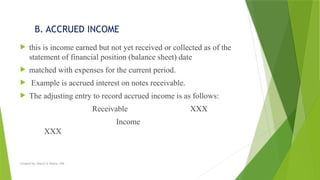
B. ACCRUED INCOME
 this is income earned but not yet received or collected as of the
statement of financial position (balance sheet) date
 matched with expenses for the current period.
 Example is accrued interest on notes receivable.
 The adjusting entry to record accrued income is as follows:
Receivable XXX
Income
XXX
Created by: Sheryl V. Paliza, CPA
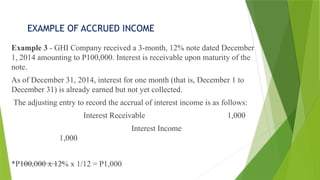
Example 3 - GHI Company received a 3-month, 12% note dated December
1, 2014 amounting to P100,000. Interest is receivable upon maturity of the
note.
As of December 31, 2014, interest for one month (that is, December 1 to
December 31) is already earned but not yet collected.
The adjusting entry to record the accrual of interest income is as follows:
Interest Receivable 1,000
Interest Income
1,000
*P100,000 x 12% x 1/12 = P1,000
EXAMPLE OF ACCRUED INCOME
Created by: Sheryl V. Paliza, CPA
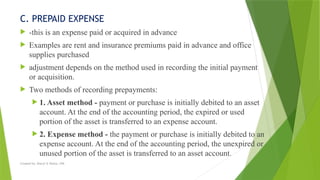
C. PREPAID EXPENSE
 -this is an expense paid or acquired in advance
 Examples are rent and insurance premiums paid in advance and office
supplies purchased
 adjustment depends on the method used in recording the initial payment
or acquisition.
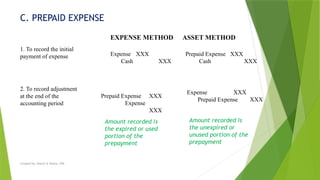
 Two methods of recording prepayments:
 1. Asset method - payment or purchase is initially debited to an asset
account. At the end of the accounting period, the expired or used
portion of the asset is transferred to an expense account.
 2. Expense method - the payment or purchase is initially debited to an
expense account. At the end of the accounting period, the unexpired or
unused portion of the asset is transferred to an asset account.
Created by: Sheryl V. Paliza, CPA
C. PREPAID EXPENSE
Expense XXX
Cash XXX
EXPENSE METHOD ASSET METHOD
Prepaid Expense XXX
Cash XXX
1. To record the initial
payment of expense
2. To record adjustment
at the end of the
accounting period
Prepaid Expense XXX
Expense
XXX
Expense XXX
Prepaid Expense XXX
Amount recorded is
the expired or used
portion of the
prepayment
Amount recorded is
the unexpired or
unused portion of the
prepayment
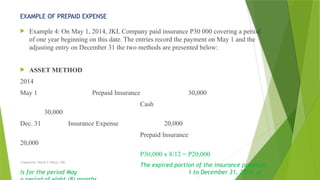
EXAMPLE OF PREPAID EXPENSE
 Example 4: On May 1, 2014, JKL Company paid insurance P30 000 covering a period
of one year beginning on this date. The entries record the payment on May 1 and the
adjusting entry on December 31 the two methods are presented below:
 ASSET METHOD
2014
May 1 Prepaid Insurance 30,000
Cash
30,000
Dec. 31 Insurance Expense 20,000
Prepaid Insurance
20,000
P30,000 x 8/12 = P20,000
The expired portion of the insurance premium
is for the period May 1 to December 31, 2014, or
Created by: Sheryl V. Paliza, CPA
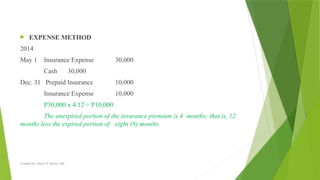
 EXPENSE METHOD
2014
May 1 Insurance Expense 30,000
Cash 30,000
Dec. 31 Prepaid Insurance 10,000
Insurance Expense 10,000
P30,000 x 4/12 = P10,000
The unexpired portion of the insurance premium is 4 months; that is, 12
months less the expired portion of eight (8) months.
Created by: Sheryl V. Paliza, CPA
D. UNEARNED INCOME
 this is income already collected but not yet earned as of the statement of financial
position (balance sheet) date, such as rental income collected in advance or
subscriptions received in advance.
 also known as deferred income
 Adjustment depends on how the initial receipt of cash is recorded.
 Two methods of recording receipt of advance payments:
 1. LIABILITY method - collection is initially credited to a liability account; at the
end of the accounting period, the earned portion of the income is transferred to an
income account
 2. INCOME method - he collection is initially credited to an income account; at
the end of the accounting period, the unearned portion of the income is transferred
to a liability account
Created by: Sheryl V. Paliza, CPA
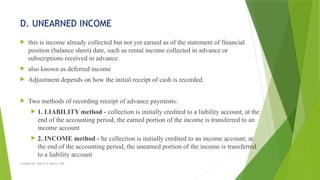
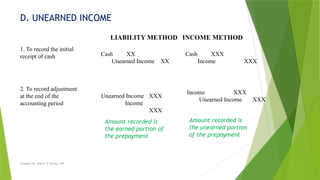
D. UNEARNED INCOME
Cash XX
Unearned Income XX
LIABILITY METHOD INCOME METHOD
Cash XXX
Income XXX
1. To record the initial
receipt of cash
2. To record adjustment
at the end of the
accounting period
Unearned Income XXX
Income
XXX
Income XXX
Unearned Income XXX
Amount recorded is
the earned portion of
the prepayment
Amount recorded is
the unearned portion
of the prepayment
Created by: Sheryl V. Paliza, CPA
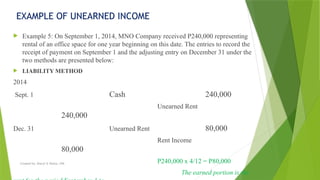
EXAMPLE OF UNEARNED INCOME
 Example 5: On September 1, 2014, MNO Company received P240,000 representing
rental of an office space for one year beginning on this date. The entries to record the
receipt of payment on September 1 and the adjusting entry on December 31 under the
two methods are presented below:
 LIABILITY METHOD
2014
Sept. 1 Cash 240,000
Unearned Rent
240,000
Dec. 31 Unearned Rent 80,000
Rent Income
80,000
P240,000 x 4/12 = P80,000
The earned portion is the
Created by: Sheryl V. Paliza, CPA
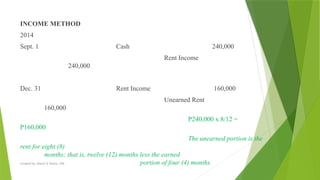
INCOME METHOD
2014
Sept. 1 Cash 240,000
Rent Income
240,000
Dec. 31 Rent Income 160,000
Unearned Rent
160,000
P240,000 x 8/12 =
P160,000
The unearned portion is the
rent for eight (8)
months; that is, twelve (12) months less the earned
portion of four (4) months.
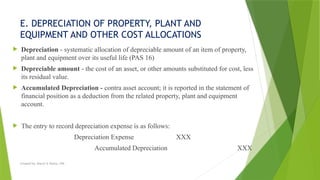
E. DEPRECIATION OF PROPERTY, PLANT AND
EQUIPMENT AND OTHER COST ALLOCATIONS
 Depreciation - systematic allocation of depreciable amount of an item of property,
plant and equipment over its useful life (PAS 16)
 Depreciable amount - the cost of an asset, or other amounts substituted for cost, less
its residual value.
 Accumulated Depreciation - contra asset account; it is reported in the statement of
financial position as a deduction from the related property, plant and equipment
account.
 The entry to record depreciation expense is as follows:
Depreciation Expense XXX
Accumulated Depreciation XXX
Created by: Sheryl V. Paliza, CPA
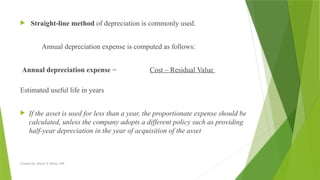
 Straight-line method of depreciation is commonly used.
Annual depreciation expense is computed as follows:
Annual depreciation expense = Cost – Residual Value
Estimated useful life in years
 If the asset is used for less than a year, the proportionate expense should be
calculated, unless the company adopts a different policy such as providing
half-year depreciation in the year of acquisition of the asset
EXAMPLE OF DEPRECIATION
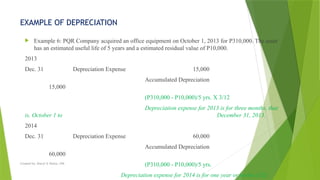
 Example 6: PQR Company acquired an office equipment on October 1, 2013 for P310,000. The asset
has an estimated useful life of 5 years and a estimated residual value of P10,000.
2013
Dec. 31 Depreciation Expense 15,000
Accumulated Depreciation
15,000
(P310,000 - P10,000)/5 yrs. X 3/12
Depreciation expense for 2013 is for three months, that
is, October 1 to December 31, 2013.
2014
Dec. 31 Depreciation Expense 60,000
Accumulated Depreciation
60,000
(P310,000 - P10,000)/5 yrs.
Depreciation expense for 2014 is for one year or twelve (12)
Created by: Sheryl V. Paliza, CPA
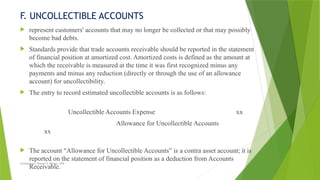
F. UNCOLLECTIBLE ACCOUNTS
 represent customers' accounts that may no longer be collected or that may possibly
become bad debts.
 Standards provide that trade accounts receivable should be reported in the statement
of financial position at amortized cost. Amortized costs is defined as the amount at
which the receivable is measured at the time it was first recognized minus any
payments and minus any reduction (directly or through the use of an allowance
account) for uncollectibility.
 The entry to record estimated uncollectible accounts is as follows:
Uncollectible Accounts Expense xx
Allowance for Uncollectible Accounts
xx
 The account "Allowance for Uncollectible Accounts” is a contra asset account; it is
reported on the statement of financial position as a deduction from Accounts
Receivable.
Created by: Sheryl V. Paliza, CPA
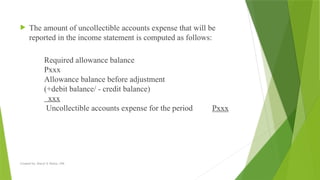
 The amount of uncollectible accounts expense that will be
reported in the income statement is computed as follows:
Required allowance balance
Pxxx
Allowance balance before adjustment
(+debit balance/ - credit balance)
xxx
Uncollectible accounts expense for the period Pxxx
Created by: Sheryl V. Paliza, CPA
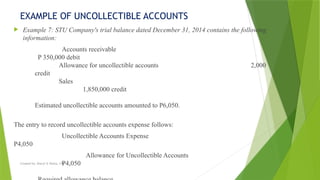
 Example 7: STU Company's trial balance dated December 31, 2014 contains the following
information:
Accounts receivable
P 350,000 debit
Allowance for uncollectible accounts 2,000
credit
Sales
1,850,000 credit
Estimated uncollectible accounts amounted to P6,050.
The entry to record uncollectible accounts expense follows:
Uncollectible Accounts Expense
P4,050
Allowance for Uncollectible Accounts
P4,050
EXAMPLE OF UNCOLLECTIBLE ACCOUNTS
Created by: Sheryl V. Paliza, CPA
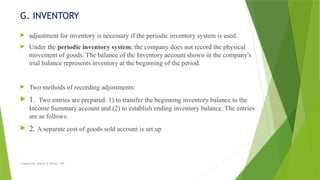
G. INVENTORY
 adjustment for inventory is necessary if the periodic inventory system is used.
 Under the periodic inventory system, the company does not record the physical
movement of goods. The balance of the Inventory account shown in the company's
trial balance represents inventory at the beginning of the period.
 Two methods of recording adjustments:
 1. Two entries are prepared: 1) to transfer the beginning inventory balance to the
Income Summary account and (2) to establish ending inventory balance. The entries
are as follows:
 2. A separate cost of goods sold account is set up
Created by: Sheryl V. Paliza, CPA
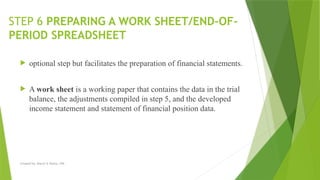
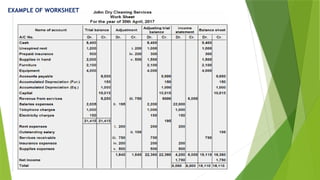
STEP 6 PREPARING A WORK SHEET/END-OF-
PERIOD SPREADSHEET
 optional step but facilitates the preparation of financial statements.
 A work sheet is a working paper that contains the data in the trial
balance, the adjustments compiled in step 5, and the developed
income statement and statement of financial position data.
Created by: Sheryl V. Paliza, CPA
EXAMPLE OF WORKSHEET
Created by: Sheryl V. Paliza, CPA
STEP 7 PREPARING THE FINANCIAL
STATEMENTS
 described as the end product of the accounting process.
 The data reported in the statements are taken from the completed work
sheet. However, if a work sheet is not prepared, the adjusting data must be
journalized and posted because the data reported in the statements are taken
from the updated balances of the accounts in the general ledger.
Created by: Sheryl V. Paliza, CPA
 PAS 1 provides that a complete set of financial statements shall
consist of the following:
1. Statement of financial position (balance sheet)
2. Statement of comprehensive income (income statement)
3. Statement of cash flows
4. Statement of changes in owners' equity
5. Notes to FS
Created by: Sheryl V. Paliza, CPA
Step 8. Adjusting and closing the books
 the adjustments that were recorded in the work sheet are now formally recorded in
the general journal and posted to the accounts in the general ledger.
 The balances of the nominal (temporary) accounts, which consist of income,
expense, and drawing accounts, are then closed to Income Summary account.
 The balance of the Income Summary account is then transferred to the owner's
equity (capital) account. A debit balance in the Income Summary account represents
a loss while a credit balance represents a profit.
 The balance of the owner's drawing account is closed to owner's equity account.
 When the closing process is completed, all nominal accounts zero balances.
Created by: Sheryl V. Paliza, CPA
Pro-forma closing entries prepared at the end of the
accounting period:
1. To close the balances of income accounts
Revenue / Income xxx
Income Summary xxx
2. To close the balance of expense accounts
Income Summary xxx
Expenses
xxx
3. To close the balance of Income Summary account (credit balance)
Income Summary xxx
Capital
xxx
To close the balance of Income Summary account (debit balance)
Capital xxx
Income Summary xxx
4. To close the balance of the drawing account
Capital xxx
Drawing
xxx
Created by: Sheryl V. Paliza, CPA
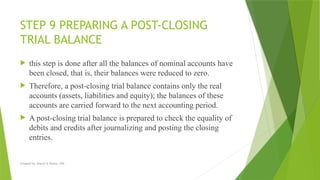
STEP 9 PREPARING A POST-CLOSING
TRIAL BALANCE
 this step is done after all the balances of nominal accounts have
been closed, that is, their balances were reduced to zero.
 Therefore, a post-closing trial balance contains only the real
accounts (assets, liabilities and equity); the balances of these
accounts are carried forward to the next accounting period.
 A post-closing trial balance is prepared to check the equality of
debits and credits after journalizing and posting the closing
entries.
Created by: Sheryl V. Paliza, CPA
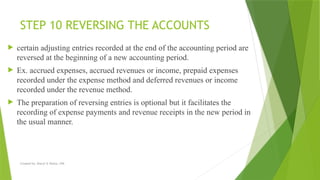
STEP 10 REVERSING THE ACCOUNTS
 certain adjusting entries recorded at the end of the accounting period are
reversed at the beginning of a new accounting period.
 Ex. accrued expenses, accrued revenues or income, prepaid expenses
recorded under the expense method and deferred revenues or income
recorded under the revenue method.
 The preparation of reversing entries is optional but it facilitates the
recording of expense payments and revenue receipts in the new period in
the usual manner.
Created by: Sheryl V. Paliza, CPA
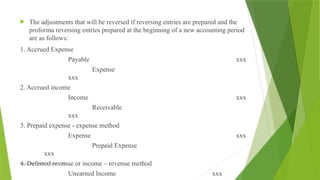
 The adjustments that will be reversed if reversing entries are prepared and the
proforma reversing entries prepared at the beginning of a new accounting period
are as follows:
1. Accrued Expense
Payable xxx
Expense
xxx
2. Accrued income
Income xxx
Receivable
xxx
3. Prepaid expense - expense method
Expense xxx
Prepaid Expense
xxx
4. Deferred revenue or income – revenue method
Unearned Income xxx

LESSON 2_THE ACCOUNTING PROCESS (1).pptx

  • 1.
    THE ACCOUNTING PROCESS Accounting forPartnership and Corporation Lesson 2 Created by: Sheryl V. Paliza, CPA
  • 2.
    Created by: SherylV. Paliza, CPA LEARNING OBJECTIVES  1.Identify and explain the steps in the accounting process.  2. Identify the typical account titles used in recording transactions  3. Explain the Double Entry System and use it in recording business transactions  4.Prepare adjusting entries and understand the rationale for their preparation.  3.Prepare closing entries and understand the rationale for their preparation.  5.Explain the advantages of preparing reversing entries and identify adjusting entries that may be reversed.
  • 3.
    Created by: SherylV. Paliza, CPA ACCOUNTING PROCESS  procedures or series of steps undertaken to come up with the information reported in the financial statements.  also referred to as the Accounting Cycle.  Divided into two phases: RECORDING PHASE SUMMARIZING PHASE
  • 4.
    Created by: SherylV. Paliza, CPA RECORDING PHASE  collecting information about economic transactions and the recording of these transactions in the appropriate accounting records Transaction - economic event that changes an asset, a liability, or an equity account balance Accounting records - include business documents, journals, and ledgers.
  • 5.
    DOUBLE-ENTRY SYSTEM  meansthat the dual effects of a business transaction is recorded.  A debit side entry must have a corresponding credit side entry.  For every transaction, there must be one or more accounts debited and one or more accounts credited. Created by: Sheryl V. Paliza, CPA NORMAL BALANCE OF AN ACCOUNT -refers to the side of the account (debit or credit) where increases are recorded.
  • 6.
    Created by: SherylV. Paliza, CPA DOUBLE-ENTRY SYSTEM
  • 7.
    Created by: SherylV. Paliza, CPA DOUBLE-ENTRY SYSTEM
  • 8.
    Created by: SherylV. Paliza, CPA DOUBLE-ENTRY SYSTEM
  • 9.
    Business transaction Documentation Journalizing Posting Preparation of Trial Balance Compilation of datafor adjustments Preparation of Worksheet Preparation of Financial Statements Journalizing and Posting of adjusting and Closing Entries Preparation of Post-Closing Trial Balance Preparation of Reversing Entries THE ACCOUNTING CYCLE R e c o r d i n g P h a s e Summarizing Phase
  • 10.
    Created by: SherylV. Paliza, CPA Step 1. Documentation  identification of events to be recorded  process of preparing or receiving appropriate business documents.  official receipts, sales invoices, purchase invoices, checks, deposit slips, credit memoranda, and debit memoranda.
  • 11.
    Created by: SherylV. Paliza, CPA TYPICAL ACCOUNT TITLES USED  STATEMENT OF FINANCIAL POSITION - for users to evaluate an entity’s liquidity, financial flexibility and solvency ASSETS CURRENTS ASSETS a. CASH – coins, checks, bank deposits and drafts. b. CASH EQUIVALENTS – short-term highly liquid investments c. NOTES RECEIVABLE – written pledge by a customer
  • 12.
    Created by: SherylV. Paliza, CPA d. ACCOUNTS RECEIVABLE- claims from customers arising from sale of goods or services on credit e. INVENTORIES – held for sale, in the process of production or to be consumed in the production f. PREPAID EXPENSES – paid by the business in advance. Ex. Prepaid insurance and rent. CURRENTS ASSETS (Continuation)
  • 13.
    Created by: SherylV. Paliza, CPA  NON-CURRENTS ASSETS a. PROPERTY, PLANT AND EQUIPMENT (PPE) – tangible assets held for use in production, for rental or for administrative purposes expected to be used during more than one period. Ex. land, building, machinery and equipment, furniture and fixtures, motor vehicles and equipment. b. ACCUMULATED DEPRECIATION – contra account of PPE. Contains the sum of the periodic depreciation charges. c. INTANGIBLE ASSETS – identifiable, nonmonetary assets without physical substance held for use in production, for rental or for administrative purposes. Ex. Goodwill, patents, copyrights, licenses, franchises, trademarks, secret processes, etc. TYPICAL ACCOUNT TITLES USED
  • 14.
    Created by: SherylV. Paliza, CPA  STATEMENT OF FINANCIAL POSITION  LIABILITIES  CURRENT LIABILITIES a. ACCOUNTS PAYABLE - claims from customers arising from sale of goods or services on credit b. NOTES PAYABLE – reverse of notes receivable, entity is the maker of the note. c. ACCRUED LIABILITES – amounts owed to others for unpaid expenses TYPICAL ACCOUNT TITLES USED
  • 15.
    Created by: SherylV. Paliza, CPA  NON-CURRENT LIABILITIES a. MORTGAGE PAYABLE - long-term debts with pledge of certain assets b. BONDS PAYABLE – long-term debts by issuing bonds TYPICAL ACCOUNT TITLES USED d. UNEARNED REVENUES – payment received from customers before providing goods or services e. CURRENT PORTION OF LONG-TERM DEBT – portions of long- term debts which are to be paid within one year from the balance sheet date.
  • 16.
    Created by: SherylV. Paliza, CPA  STATEMENT OF FINANCIAL POSITION  OWNER’S EQUITY  a. CAPITAL – original and additional investments of the owner/s of the entity  b.WITHDRAWALS – when the owner/s withdraw cash or other assets from the entity  c. INCOME SUMMARY – temporary account used at the end of the accounting period to close income and expenses. This account shows the profit or loss for the period TYPICAL ACCOUNT TITLES USED
  • 17.
    Created by: SherylV. Paliza, CPA  INCOME STATEMENT - shows the performance of the entity for a given period of time  INCOME  a. SERVICE INCOME – revenues earned by performing services for a customer  b. SALES - revenues earned from sale of merchandise EXPENSES a. COST OF SALES – cost incurred to purchase or produce the product sold b. SALARIES OR WAGES EXPENSE – payments to employees c. TELECOMMUNICATIONS, ELECTRICITY, FUELAND WATER EXPENSES TYPICAL ACCOUNT TITLES USED
  • 18.
    Created by: SherylV. Paliza, CPA  EXPENSES d. RENT – rentals of building or warehouse space, equipment and other asset e. SUPPLIES EXPENSE – expense of using supplies, ex. Office supplies f. INSURANCE EXPENSE – portion of premiums paid on insurance coverage which has expired  g. DEPRECIATION EXPENSE - the portion of cost of PPE allocated or charged as expense during an accounting period.  h. UNCOLLECTIBLE ACCOUNTS EXPENSE – amount of receivables estimated to be doubtful of collection and charged as expense during an accounting period.  i. INTEREST EXPENSE – related to use of borrowed funds TYPICAL ACCOUNT TITLES USED
  • 19.
    Created by: SherylV. Paliza, CPA Step 2. Journalizing  recording transactions for the first time in the accounting books called journals  journals are called books of original entry.  General journal - most flexible type of journal where almost all types of transactions can be recorded  Special journals - used in recording transactions that are usual and that occur frequently or on a repetitive basis. The most common types of special journals are the sales journal, purchases journal, cash receipts journal, and cash disbursements journal.
  • 20.
    Created by: SherylV. Paliza, CPA ILLUSTRATION (JOUNALIZING BY A SOLE PROPRIETOR)  Esterlina Gevera decided to organize her wedding consultancy business named Weddings “R”” Us. May 1 She invested P250,000 into this entity. ENTRY Dr. Cr. CASH (A) Php 250,000 GEVERA, CAPITAL (OE) Php 250,000 May 2 Rented office space and paid two-months rent in advance. ENTRY PREPAID RENT (A) Php 250,000 CASH (A)
  • 21.
    Created by: SherylV. Paliza, CPA May 4 Acquired service vehicle for P420,000. ENTRY Dr. Cr. SERVICE VEHICLE(A) Php 420,000 CASH (A) Php 420,000 May 5 Acquired office equipment from Fair and Square Emporium for P60,000; paying P15,000 cash and the balance next month ENTRY (COMPOUND ENTRY) OFFICE EQUIPMENT (A) Php 60,000 CASH (A) Php 15,000 ACCOUNTS PAYABLE (L) Php 45,000
  • 22.
    Created by: SherylV. Paliza, CPA May 19 Billed fees for 3 customers for bridal arrangements at P12,000 per couple. ENTRY Dr. Cr. ACCOUNTS RECEIVABLE (A) Php 36,000 CONSULTING REVENUES (OE: I) Php 36,000 May 25 Gevera withdrew P14,000 for personal expenses ENTRY Dr. Cr. GEVERA, WITHDRAWALS (OE) Php 14,000 CASH (A) Php 14,000 May 30 Received the PLDT Telephone bill, P1,400 ENTRY Dr. Cr. UTILITIES EXPENSE (OE:E) Php 1,400
  • 23.
    Created by: SherylV. Paliza, CPA Step 3. Posting  process of transferring the recorded transactions in the journal to the accounts in the ledger  to classify the effects of transactions on specific asset, liability, equity, income and expense accounts.  A ledger is a group of related accounts and is called the book of final entry. 1. General ledger - principal ledger which contains all the accounts that are reported in the financial statements Contra accounts- established to record deductions from related accounts with positive balances such as Accumulated Depreciation (deducted from Property, Plant and Equipment) Adjunct accounts are accounts set up to record additions to related accounts such as Freight-In (added to Purchases) 2. Subsidiary ledgers - contain details of some general ledger account balances.
  • 24.
    Created by: SherylV. Paliza, CPA SUMMARIZING PHASE  Includes the steps necessary for the preparation summary reports.
  • 25.
    Created by: SherylV. Paliza, CPA Step 4. Preparing a trial balance  Trial balance – summary of balances of the accounts in the general ledger - prepared to prove the equality of debits and credit but it does not indicate the accuracy of work done - preparation of a trial balance is normally done in the work sheet
  • 26.
    Created by: SherylV. Paliza, CPA Step 5. Compiling adjusting data  process of gathering and putting together various data necessary to update the balances of certain accounts in the books of the company.  Adjustments are necessary so that income and expenses will be reported in the period they are earned and incurred respectively; hence, profit will not be misstated.
  • 27.
    Created by: SherylV. Paliza, CPA Common types of adjusting data  A. Accrued expense  B. Accrued income  C. Prepaid expense  D. Unearned /income  E. Depreciation of property, plant and equipment and other cost allocation  F. Uncollectible accounts  G. Inventory Step 5. Compiling adjusting data (conti.)
  • 28.
    Created by: SherylV. Paliza, CPA A. ACCRUED EXPENSE  Expense incurred but not yet paid as of the balance sheet date  Matched against income or earnings for the current period  Examples are interest accrued on notes payable and accrued salaries of employees.  Adjustment for accrued expense is recorded as follows: Expense XXX Payable XXX
  • 29.
    Example 1 -The ABC Company has an outstanding 90-day, 12% note payable dated December 1, 2014 amounting to P200,000. The interest is payable upon maturity of the note. The company's accounting period or financial year is the calendar year, that is, January 1 to December 31. Interest for thirty days has accrued on the note as of December 31, 2014 (that is, December 1 to December 31). Created by: Sheryl V. Paliza, CPA EXAMPLE OF ACCRUED EXPENSE The adjusting entry to record the accrued interest is as follows: Interest Expense *2,000 Interest Payable 2,000 *P200,000 x 12% x 30/360 = P2,000
  • 30.
    Created by: SherylV. Paliza, CPA Example 2 - DEF Company pays salaries every Friday, the end of a five- day work week. The total salaries for the week ending January 3, 2015 is P150,000. In this case, the P150,000 salaries for the week ending January 3, 2015 is for the services rendered by employees on December 30, December 31, January 1, January 2, and January 3. Therefore, the company has accrued salaries for two (2) days as of December 31, 2014. The adjusting entry to record the accrued salaries is as follows: Salary Expense *60,000 Salaries Payable 60,000 *P150,000 x 2/5 = P60,000 EXAMPLE OF ACCRUED EXPENSE
  • 31.
    Created by: SherylV. Paliza, CPA B. ACCRUED INCOME  this is income earned but not yet received or collected as of the statement of financial position (balance sheet) date  matched with expenses for the current period.  Example is accrued interest on notes receivable.  The adjusting entry to record accrued income is as follows: Receivable XXX Income XXX
  • 32.
    Created by: SherylV. Paliza, CPA Example 3 - GHI Company received a 3-month, 12% note dated December 1, 2014 amounting to P100,000. Interest is receivable upon maturity of the note. As of December 31, 2014, interest for one month (that is, December 1 to December 31) is already earned but not yet collected. The adjusting entry to record the accrual of interest income is as follows: Interest Receivable 1,000 Interest Income 1,000 *P100,000 x 12% x 1/12 = P1,000 EXAMPLE OF ACCRUED INCOME
  • 33.
    Created by: SherylV. Paliza, CPA C. PREPAID EXPENSE  -this is an expense paid or acquired in advance  Examples are rent and insurance premiums paid in advance and office supplies purchased  adjustment depends on the method used in recording the initial payment or acquisition.  Two methods of recording prepayments:  1. Asset method - payment or purchase is initially debited to an asset account. At the end of the accounting period, the expired or used portion of the asset is transferred to an expense account.  2. Expense method - the payment or purchase is initially debited to an expense account. At the end of the accounting period, the unexpired or unused portion of the asset is transferred to an asset account.
  • 34.
    Created by: SherylV. Paliza, CPA C. PREPAID EXPENSE Expense XXX Cash XXX EXPENSE METHOD ASSET METHOD Prepaid Expense XXX Cash XXX 1. To record the initial payment of expense 2. To record adjustment at the end of the accounting period Prepaid Expense XXX Expense XXX Expense XXX Prepaid Expense XXX Amount recorded is the expired or used portion of the prepayment Amount recorded is the unexpired or unused portion of the prepayment
  • 35.
    EXAMPLE OF PREPAIDEXPENSE  Example 4: On May 1, 2014, JKL Company paid insurance P30 000 covering a period of one year beginning on this date. The entries record the payment on May 1 and the adjusting entry on December 31 the two methods are presented below:  ASSET METHOD 2014 May 1 Prepaid Insurance 30,000 Cash 30,000 Dec. 31 Insurance Expense 20,000 Prepaid Insurance 20,000 P30,000 x 8/12 = P20,000 The expired portion of the insurance premium is for the period May 1 to December 31, 2014, or Created by: Sheryl V. Paliza, CPA
  • 36.
     EXPENSE METHOD 2014 May1 Insurance Expense 30,000 Cash 30,000 Dec. 31 Prepaid Insurance 10,000 Insurance Expense 10,000 P30,000 x 4/12 = P10,000 The unexpired portion of the insurance premium is 4 months; that is, 12 months less the expired portion of eight (8) months. Created by: Sheryl V. Paliza, CPA
  • 37.
    Created by: SherylV. Paliza, CPA D. UNEARNED INCOME  this is income already collected but not yet earned as of the statement of financial position (balance sheet) date, such as rental income collected in advance or subscriptions received in advance.  also known as deferred income  Adjustment depends on how the initial receipt of cash is recorded.  Two methods of recording receipt of advance payments:  1. LIABILITY method - collection is initially credited to a liability account; at the end of the accounting period, the earned portion of the income is transferred to an income account  2. INCOME method - he collection is initially credited to an income account; at the end of the accounting period, the unearned portion of the income is transferred to a liability account
  • 38.
    Created by: SherylV. Paliza, CPA D. UNEARNED INCOME Cash XX Unearned Income XX LIABILITY METHOD INCOME METHOD Cash XXX Income XXX 1. To record the initial receipt of cash 2. To record adjustment at the end of the accounting period Unearned Income XXX Income XXX Income XXX Unearned Income XXX Amount recorded is the earned portion of the prepayment Amount recorded is the unearned portion of the prepayment
  • 39.
    Created by: SherylV. Paliza, CPA EXAMPLE OF UNEARNED INCOME  Example 5: On September 1, 2014, MNO Company received P240,000 representing rental of an office space for one year beginning on this date. The entries to record the receipt of payment on September 1 and the adjusting entry on December 31 under the two methods are presented below:  LIABILITY METHOD 2014 Sept. 1 Cash 240,000 Unearned Rent 240,000 Dec. 31 Unearned Rent 80,000 Rent Income 80,000 P240,000 x 4/12 = P80,000 The earned portion is the
  • 40.
    Created by: SherylV. Paliza, CPA INCOME METHOD 2014 Sept. 1 Cash 240,000 Rent Income 240,000 Dec. 31 Rent Income 160,000 Unearned Rent 160,000 P240,000 x 8/12 = P160,000 The unearned portion is the rent for eight (8) months; that is, twelve (12) months less the earned portion of four (4) months.
  • 41.
    E. DEPRECIATION OFPROPERTY, PLANT AND EQUIPMENT AND OTHER COST ALLOCATIONS  Depreciation - systematic allocation of depreciable amount of an item of property, plant and equipment over its useful life (PAS 16)  Depreciable amount - the cost of an asset, or other amounts substituted for cost, less its residual value.  Accumulated Depreciation - contra asset account; it is reported in the statement of financial position as a deduction from the related property, plant and equipment account.  The entry to record depreciation expense is as follows: Depreciation Expense XXX Accumulated Depreciation XXX Created by: Sheryl V. Paliza, CPA
  • 42.
    Created by: SherylV. Paliza, CPA  Straight-line method of depreciation is commonly used. Annual depreciation expense is computed as follows: Annual depreciation expense = Cost – Residual Value Estimated useful life in years  If the asset is used for less than a year, the proportionate expense should be calculated, unless the company adopts a different policy such as providing half-year depreciation in the year of acquisition of the asset
  • 43.
    EXAMPLE OF DEPRECIATION Example 6: PQR Company acquired an office equipment on October 1, 2013 for P310,000. The asset has an estimated useful life of 5 years and a estimated residual value of P10,000. 2013 Dec. 31 Depreciation Expense 15,000 Accumulated Depreciation 15,000 (P310,000 - P10,000)/5 yrs. X 3/12 Depreciation expense for 2013 is for three months, that is, October 1 to December 31, 2013. 2014 Dec. 31 Depreciation Expense 60,000 Accumulated Depreciation 60,000 (P310,000 - P10,000)/5 yrs. Depreciation expense for 2014 is for one year or twelve (12) Created by: Sheryl V. Paliza, CPA
  • 44.
    Created by: SherylV. Paliza, CPA F. UNCOLLECTIBLE ACCOUNTS  represent customers' accounts that may no longer be collected or that may possibly become bad debts.  Standards provide that trade accounts receivable should be reported in the statement of financial position at amortized cost. Amortized costs is defined as the amount at which the receivable is measured at the time it was first recognized minus any payments and minus any reduction (directly or through the use of an allowance account) for uncollectibility.  The entry to record estimated uncollectible accounts is as follows: Uncollectible Accounts Expense xx Allowance for Uncollectible Accounts xx  The account "Allowance for Uncollectible Accounts” is a contra asset account; it is reported on the statement of financial position as a deduction from Accounts Receivable.
  • 45.
    Created by: SherylV. Paliza, CPA  The amount of uncollectible accounts expense that will be reported in the income statement is computed as follows: Required allowance balance Pxxx Allowance balance before adjustment (+debit balance/ - credit balance) xxx Uncollectible accounts expense for the period Pxxx
  • 46.
    Created by: SherylV. Paliza, CPA  Example 7: STU Company's trial balance dated December 31, 2014 contains the following information: Accounts receivable P 350,000 debit Allowance for uncollectible accounts 2,000 credit Sales 1,850,000 credit Estimated uncollectible accounts amounted to P6,050. The entry to record uncollectible accounts expense follows: Uncollectible Accounts Expense P4,050 Allowance for Uncollectible Accounts P4,050 EXAMPLE OF UNCOLLECTIBLE ACCOUNTS
  • 47.
    Created by: SherylV. Paliza, CPA G. INVENTORY  adjustment for inventory is necessary if the periodic inventory system is used.  Under the periodic inventory system, the company does not record the physical movement of goods. The balance of the Inventory account shown in the company's trial balance represents inventory at the beginning of the period.  Two methods of recording adjustments:  1. Two entries are prepared: 1) to transfer the beginning inventory balance to the Income Summary account and (2) to establish ending inventory balance. The entries are as follows:  2. A separate cost of goods sold account is set up
  • 48.
    Created by: SherylV. Paliza, CPA STEP 6 PREPARING A WORK SHEET/END-OF- PERIOD SPREADSHEET  optional step but facilitates the preparation of financial statements.  A work sheet is a working paper that contains the data in the trial balance, the adjustments compiled in step 5, and the developed income statement and statement of financial position data.
  • 49.
    Created by: SherylV. Paliza, CPA EXAMPLE OF WORKSHEET
  • 50.
    Created by: SherylV. Paliza, CPA STEP 7 PREPARING THE FINANCIAL STATEMENTS  described as the end product of the accounting process.  The data reported in the statements are taken from the completed work sheet. However, if a work sheet is not prepared, the adjusting data must be journalized and posted because the data reported in the statements are taken from the updated balances of the accounts in the general ledger.
  • 51.
    Created by: SherylV. Paliza, CPA  PAS 1 provides that a complete set of financial statements shall consist of the following: 1. Statement of financial position (balance sheet) 2. Statement of comprehensive income (income statement) 3. Statement of cash flows 4. Statement of changes in owners' equity 5. Notes to FS
  • 52.
    Created by: SherylV. Paliza, CPA Step 8. Adjusting and closing the books  the adjustments that were recorded in the work sheet are now formally recorded in the general journal and posted to the accounts in the general ledger.  The balances of the nominal (temporary) accounts, which consist of income, expense, and drawing accounts, are then closed to Income Summary account.  The balance of the Income Summary account is then transferred to the owner's equity (capital) account. A debit balance in the Income Summary account represents a loss while a credit balance represents a profit.  The balance of the owner's drawing account is closed to owner's equity account.  When the closing process is completed, all nominal accounts zero balances.
  • 53.
    Created by: SherylV. Paliza, CPA Pro-forma closing entries prepared at the end of the accounting period: 1. To close the balances of income accounts Revenue / Income xxx Income Summary xxx 2. To close the balance of expense accounts Income Summary xxx Expenses xxx 3. To close the balance of Income Summary account (credit balance) Income Summary xxx Capital xxx To close the balance of Income Summary account (debit balance) Capital xxx Income Summary xxx 4. To close the balance of the drawing account Capital xxx Drawing xxx
  • 54.
    Created by: SherylV. Paliza, CPA STEP 9 PREPARING A POST-CLOSING TRIAL BALANCE  this step is done after all the balances of nominal accounts have been closed, that is, their balances were reduced to zero.  Therefore, a post-closing trial balance contains only the real accounts (assets, liabilities and equity); the balances of these accounts are carried forward to the next accounting period.  A post-closing trial balance is prepared to check the equality of debits and credits after journalizing and posting the closing entries.
  • 55.
    Created by: SherylV. Paliza, CPA STEP 10 REVERSING THE ACCOUNTS  certain adjusting entries recorded at the end of the accounting period are reversed at the beginning of a new accounting period.  Ex. accrued expenses, accrued revenues or income, prepaid expenses recorded under the expense method and deferred revenues or income recorded under the revenue method.  The preparation of reversing entries is optional but it facilitates the recording of expense payments and revenue receipts in the new period in the usual manner.
  • 56.
    Created by: SherylV. Paliza, CPA  The adjustments that will be reversed if reversing entries are prepared and the proforma reversing entries prepared at the beginning of a new accounting period are as follows: 1. Accrued Expense Payable xxx Expense xxx 2. Accrued income Income xxx Receivable xxx 3. Prepaid expense - expense method Expense xxx Prepaid Expense xxx 4. Deferred revenue or income – revenue method Unearned Income xxx

Editor's Notes

  • #5 Introduced by Fra Luca Pacioli – father of accounting