INTRODUCTION TO ACCOUNTING
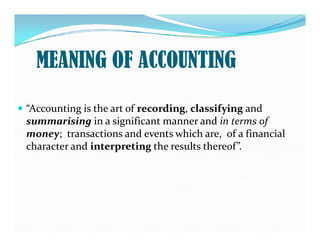
 “Accounting is the art of recording
recording, classifying
classifying and
summarising
summarising in a significant manner and in terms of
MEANING OF ACCOUNTING
summarising
summarising in a significant manner and in terms of
money; transactions and events which are, of a financial
character and interpreting
interpreting the results thereof”.
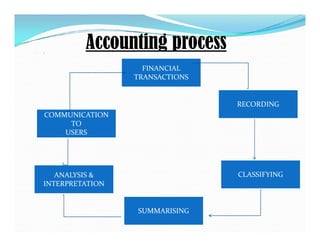
Accounting process
 T
FINANCIAL
TRANSACTIONS
RECORDING
COMMUNICATION
TO
CLASSIFYING
SUMMARISING
ANALYSIS &
INTERPRETATION
TO
USERS
CHARACTERISTICS OF ACCOUNTING
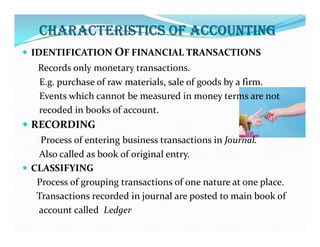
 IDENTIFICATION OF FINANCIAL TRANSACTIONS
Records only monetary transactions.
E.g. purchase of raw materials, sale of goods by a firm.
Events which cannot be measured in money terms are not
recoded in books of account.
 RECORDING
 RECORDING
Process of entering business transactions in Journal.
Also called as book of original entry.
 CLASSIFYING
Process of grouping transactions of one nature at one place.
Transactions recorded in journal are posted to main book of
account called Ledger
..
 SUMMARISING
Presenting the classified data in an understandable manner
Preparing financial statements viz.
(i) Trading & Profit & Loss A/c
(ii) Balance Sheet
 ANALYSIS & INTERPRETATION
Analysing financial data so that users can make
judgement about profitability & financial position
of the business.
 COMMUNICATING
Communicating financial information to its users.
To internal as well as external users.
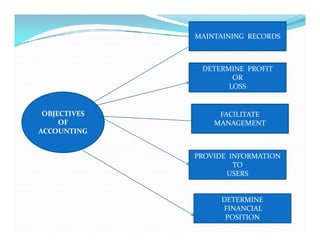
OBJECTIVES
OF
MAINTAINING RECORDS
DETERMINE PROFIT
OR
LOSS
FACILITATE
MANAGEMENT
OF
ACCOUNTING
MANAGEMENT
PROVIDE INFORMATION
TO
USERS
DETERMINE
FINANCIAL
POSITION
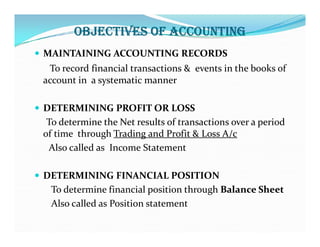
OBJECTIVES OF ACCOUNTING
 MAINTAINING ACCOUNTING RECORDS
To record financial transactions & events in the books of
account in a systematic manner
 DETERMINING PROFIT OR LOSS
To determine the Net results of transactions over a period
of time through Trading and Profit & Loss A/c
Also called as Income Statement
 DETERMINING FINANCIAL POSITION
To determine financial position through Balance Sheet
Balance Sheet
Also called as Position statement
..
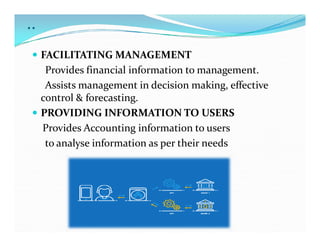
 FACILITATING MANAGEMENT
Provides financial information to management.
Assists management in decision making, effective
control & forecasting.
 PROVIDING INFORMATION TO USERS
Provides Accounting information to users
to analyse information as per their needs
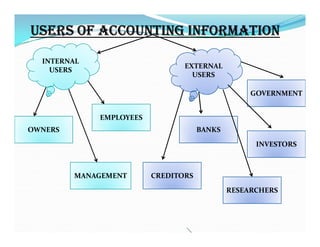
USERS OF ACCOUNTING INFORMATION
EMPLOYEES
INTERNAL
USERS
EXTERNAL
USERS
GOVERNMENT
OWNERS
MANAGEMENT
RESEARCHERS
CREDITORS
INVESTORS
BANKS
INTERNAL USERS
 OWNERS
Contribute capital in the business & bear the risk
Interested in knowing profit earned or loss incurred
by the business
 MANAGEMENT
Needs information in Decision making
such as fixing selling price, cost control, investment
into new projects
 EMPLOYEES & WORKERS
Interested in financial statements
to ensure availability of salary and bonus
EXTERNAL USERS
 BANKS
To ensure safety & recovery of the loan advanced by them to the
business
 INVESTORS
To assess earning capacity of the enterprise and ensure safety
of their investment
 GOVERNMENT
To collect information about earnings of the enterprise for
collection of taxes
Further it enables Government to take policy decisions
 CREDITORS
Those who supply goods or services on credit
Interested in assessing credit- worthiness of business
 RESEARCHERS
To use Accounting information for their research work
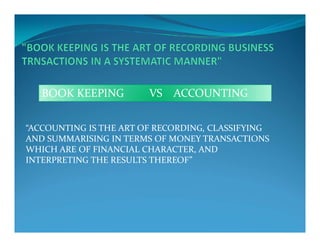
“ACCOUNTING IS THE ART OF RECORDING, CLASSIFYING
BOOK KEEPING VS ACCOUNTING
“ACCOUNTING IS THE ART OF RECORDING, CLASSIFYING
AND SUMMARISING IN TERMS OF MONEY TRANSACTIONS
WHICH ARE OF FINANCIAL CHARACTER, AND
INTERPRETING THE RESULTS THEREOF”
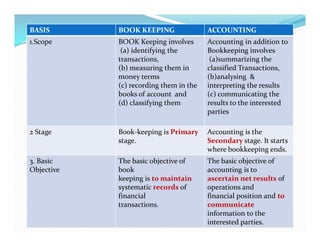
BASIS BOOK KEEPING ACCOUNTING
1.Scope BOOK Keeping involves
(a) identifying the
transactions,
(b) measuring them in
money terms
(c) recording them in the
books of account and
(d) classifying them
Accounting in addition to
Bookkeeping involves
(a)summarizing the
classified Transactions,
(b)analysing &
interpreting the results
(c) communicating the
results to the interested
parties
2 Stage Book-keeping is Primary
stage.
Accounting is the
Secondary stage. It starts
where bookkeeping ends.
3. Basic
Objective
The basic objective of
book
keeping is to maintain
systematic records of
financial
transactions.
The basic objective of
accounting is to
ascertain net results of
operations and
financial position and to
communicate
information to the
interested parties.
D
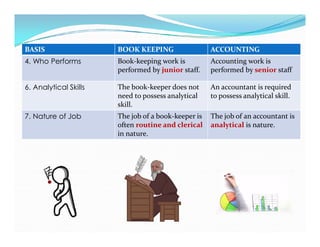
BASIS BOOK KEEPING ACCOUNTING
4. Who Performs Book-keeping work is
performed by junior staff.
Accounting work is
performed by senior staff
6. Analytical Skills The book-keeper does not
need to possess analytical
skill.
An accountant is required
to possess analytical skill.
7. Nature of Job The job of a book-keeper is
often routine and clerical
The job of an accountant is
analytical is nature.
 .
often routine and clerical
in nature.
analytical is nature.
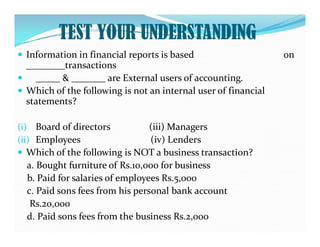
TEST YOUR UNDERSTANDING
 Information in financial reports is based on
________transactions
 _____ & _______ are External users of accounting.
 Which of the following is not an internal user of financial
statements?
(i) Board of directors (iii) Managers
(ii) Employees (iv) Lenders
 Which of the following is NOT a business transaction?
a. Bought furniture of Rs.10,000 for business
b. Paid for salaries of employees Rs.5,000
c. Paid sons fees from his personal bank account
Rs.20,000
d. Paid sons fees from the business Rs.2,000
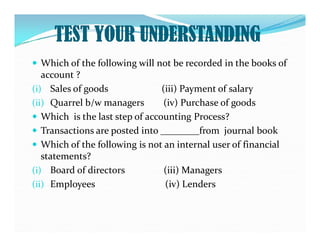
TEST YOUR UNDERSTANDING
 Which of the following will not be recorded in the books of
account ?
(i) Sales of goods (iii) Payment of salary
(ii) Quarrel b/w managers (iv) Purchase of goods
 Which is the last step of accounting Process?
 Transactions are posted into ________from journal book
 Which of the following is not an internal user of financial
statements?
(i) Board of directors (iii) Managers
(ii) Employees (iv) Lenders
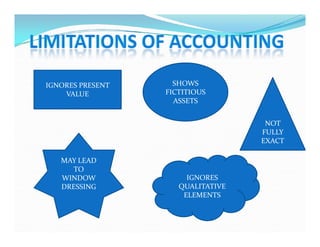
IGNORES PRESENT
VALUE
SHOWS
FICTITIOUS
ASSETS
NOT
IGNORES
QUALITATIVE
ELEMENTS
NOT
FULLY
EXACT
MAY LEAD
TO
WINDOW
DRESSING
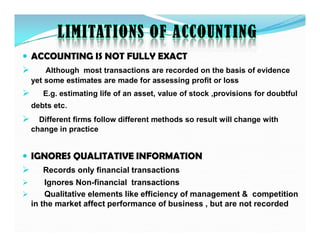
LIMITATIONS OF ACCOUNTING
 ACCOUNTING IS NOT FULLY EXACT
 Although most transactions are recorded on the basis of evidence
yet some estimates are made for assessing profit or loss
 E.g. estimating life of an asset, value of stock ,provisions for doubtful
debts etc.
 Different firms follow different methods so result will change with
change in practice
 IGNORES QUALITATIVE INFORMATION
 Records only financial transactions
 Ignores Non-financial transactions
 Qualitative elements like efficiency of management & competition
in the market affect performance of business , but are not recorded
..

 MAY LEAD TO WINDOW DRESSING
MAY LEAD TO WINDOW DRESSING
 ‘Window dressing’ means manipulation of accounts
to conceal vital facts & present a better position.
 Here Financial statements fail to provide True & fair view of
the financial position of the enterprise.

 SHOWS FICTITIOUS ASSETS
SHOWS FICTITIOUS ASSETS

 SHOWS FICTITIOUS ASSETS
SHOWS FICTITIOUS ASSETS
 Certain assets don’t have value but are shown in Balance –
sheet
 Such as preliminary expenses, discount on issue of shares
 Showing these assets in books makes result doubtful
..
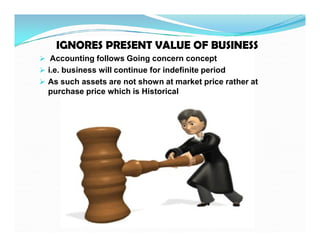
IGNORES PRESENT VALUE OF BUSINESS
 Accounting follows Going concern concept
 i.e. business will continue for indefinite period
 As such assets are not shown at market price rather at
purchase price which is Historical
QUALITATIVE CHARACTERISTICS OF ACCOUNTING

 RELIABILITY
RELIABILITY
Means users must be able to depend on information
Information must be reliable
Verifiable, free from Bias & material error

 RELEVANCE
RELEVANCE
To be relevant, information must be available in time
Must help in prediction and feedback, and
Must influence the decisions of users
Unnecessary & irrelevant information should not be given
..

 COMPARABILITY
COMPARABILITY
To be useful information must be comparable
To be comparable, accounting reports must
belong to a common period and
Use common unit of measurement
It should facilitate inter-firm & intra –firm comparisons

 UNDERSTANDABILITY
UNDERSTANDABILITY
Information should be presented in simple manner
Should be easily understood by different users
Relevant explanatory notes can be given to explain the
information given in financial statements
ADVANTAGES
ADVANTAGES OF ACCOUNTING
OF ACCOUNTING
 EVIDENCE IN LEGAL MATTERS
 PROVIDES COMPLETE & SYSTEMATIC RECORD
 PROVIDES INFORMATION ABOUT PROFIT or LOSS
 ENABLES COMPARATIVE STUDY
 FACILITATES RAISING LOANS
 HELPFUL IN DECISION MAKING
 FACILITATES SALE OF BUSINESS
THANK YOU
THANK YOU

CH- 1 INTRODUCTION TO ACCOUNTING.pdf

  • 1.
  • 2.
     “Accounting isthe art of recording recording, classifying classifying and summarising summarising in a significant manner and in terms of MEANING OF ACCOUNTING summarising summarising in a significant manner and in terms of money; transactions and events which are, of a financial character and interpreting interpreting the results thereof”.
  • 3.
  • 4.
    CHARACTERISTICS OF ACCOUNTING IDENTIFICATION OF FINANCIAL TRANSACTIONS Records only monetary transactions. E.g. purchase of raw materials, sale of goods by a firm. Events which cannot be measured in money terms are not recoded in books of account.  RECORDING  RECORDING Process of entering business transactions in Journal. Also called as book of original entry.  CLASSIFYING Process of grouping transactions of one nature at one place. Transactions recorded in journal are posted to main book of account called Ledger
  • 5.
    ..  SUMMARISING Presenting theclassified data in an understandable manner Preparing financial statements viz. (i) Trading & Profit & Loss A/c (ii) Balance Sheet  ANALYSIS & INTERPRETATION Analysing financial data so that users can make Analysing financial data so that users can make judgement about profitability & financial position of the business.  COMMUNICATING Communicating financial information to its users. To internal as well as external users.
  • 6.
  • 7.
    OBJECTIVES OF ACCOUNTING MAINTAINING ACCOUNTING RECORDS To record financial transactions & events in the books of account in a systematic manner  DETERMINING PROFIT OR LOSS To determine the Net results of transactions over a period To determine the Net results of transactions over a period of time through Trading and Profit & Loss A/c Also called as Income Statement  DETERMINING FINANCIAL POSITION To determine financial position through Balance Sheet Balance Sheet Also called as Position statement
  • 8.
    ..  FACILITATING MANAGEMENT Providesfinancial information to management. Assists management in decision making, effective control & forecasting.  PROVIDING INFORMATION TO USERS Provides Accounting information to users Provides Accounting information to users to analyse information as per their needs
  • 9.
    USERS OF ACCOUNTINGINFORMATION EMPLOYEES INTERNAL USERS EXTERNAL USERS GOVERNMENT OWNERS MANAGEMENT RESEARCHERS CREDITORS INVESTORS BANKS
  • 10.
    INTERNAL USERS  OWNERS Contributecapital in the business & bear the risk Interested in knowing profit earned or loss incurred by the business  MANAGEMENT Needs information in Decision making Needs information in Decision making such as fixing selling price, cost control, investment into new projects  EMPLOYEES & WORKERS Interested in financial statements to ensure availability of salary and bonus
  • 11.
    EXTERNAL USERS  BANKS Toensure safety & recovery of the loan advanced by them to the business  INVESTORS To assess earning capacity of the enterprise and ensure safety of their investment  GOVERNMENT To collect information about earnings of the enterprise for To collect information about earnings of the enterprise for collection of taxes Further it enables Government to take policy decisions  CREDITORS Those who supply goods or services on credit Interested in assessing credit- worthiness of business  RESEARCHERS To use Accounting information for their research work
  • 12.
    “ACCOUNTING IS THEART OF RECORDING, CLASSIFYING BOOK KEEPING VS ACCOUNTING “ACCOUNTING IS THE ART OF RECORDING, CLASSIFYING AND SUMMARISING IN TERMS OF MONEY TRANSACTIONS WHICH ARE OF FINANCIAL CHARACTER, AND INTERPRETING THE RESULTS THEREOF”
  • 13.
    BASIS BOOK KEEPINGACCOUNTING 1.Scope BOOK Keeping involves (a) identifying the transactions, (b) measuring them in money terms (c) recording them in the books of account and (d) classifying them Accounting in addition to Bookkeeping involves (a)summarizing the classified Transactions, (b)analysing & interpreting the results (c) communicating the results to the interested parties 2 Stage Book-keeping is Primary stage. Accounting is the Secondary stage. It starts where bookkeeping ends. 3. Basic Objective The basic objective of book keeping is to maintain systematic records of financial transactions. The basic objective of accounting is to ascertain net results of operations and financial position and to communicate information to the interested parties.
  • 14.
    D BASIS BOOK KEEPINGACCOUNTING 4. Who Performs Book-keeping work is performed by junior staff. Accounting work is performed by senior staff 6. Analytical Skills The book-keeper does not need to possess analytical skill. An accountant is required to possess analytical skill. 7. Nature of Job The job of a book-keeper is often routine and clerical The job of an accountant is analytical is nature.  . often routine and clerical in nature. analytical is nature.
  • 16.
    TEST YOUR UNDERSTANDING Information in financial reports is based on ________transactions  _____ & _______ are External users of accounting.  Which of the following is not an internal user of financial statements? (i) Board of directors (iii) Managers (i) Board of directors (iii) Managers (ii) Employees (iv) Lenders  Which of the following is NOT a business transaction? a. Bought furniture of Rs.10,000 for business b. Paid for salaries of employees Rs.5,000 c. Paid sons fees from his personal bank account Rs.20,000 d. Paid sons fees from the business Rs.2,000
  • 17.
    TEST YOUR UNDERSTANDING Which of the following will not be recorded in the books of account ? (i) Sales of goods (iii) Payment of salary (ii) Quarrel b/w managers (iv) Purchase of goods  Which is the last step of accounting Process?  Transactions are posted into ________from journal book  Which of the following is not an internal user of financial statements? (i) Board of directors (iii) Managers (ii) Employees (iv) Lenders
  • 18.
  • 19.
    LIMITATIONS OF ACCOUNTING ACCOUNTING IS NOT FULLY EXACT  Although most transactions are recorded on the basis of evidence yet some estimates are made for assessing profit or loss  E.g. estimating life of an asset, value of stock ,provisions for doubtful debts etc.  Different firms follow different methods so result will change with  Different firms follow different methods so result will change with change in practice  IGNORES QUALITATIVE INFORMATION  Records only financial transactions  Ignores Non-financial transactions  Qualitative elements like efficiency of management & competition in the market affect performance of business , but are not recorded
  • 20.
    ..   MAY LEADTO WINDOW DRESSING MAY LEAD TO WINDOW DRESSING  ‘Window dressing’ means manipulation of accounts to conceal vital facts & present a better position.  Here Financial statements fail to provide True & fair view of the financial position of the enterprise.   SHOWS FICTITIOUS ASSETS SHOWS FICTITIOUS ASSETS   SHOWS FICTITIOUS ASSETS SHOWS FICTITIOUS ASSETS  Certain assets don’t have value but are shown in Balance – sheet  Such as preliminary expenses, discount on issue of shares  Showing these assets in books makes result doubtful
  • 21.
    .. IGNORES PRESENT VALUEOF BUSINESS IGNORES PRESENT VALUE OF BUSINESS  Accounting follows Going concern concept  i.e. business will continue for indefinite period  As such assets are not shown at market price rather at purchase price which is Historical
  • 22.
    QUALITATIVE CHARACTERISTICS OFACCOUNTING   RELIABILITY RELIABILITY Means users must be able to depend on information Information must be reliable Verifiable, free from Bias & material error   RELEVANCE RELEVANCE To be relevant, information must be available in time Must help in prediction and feedback, and Must influence the decisions of users Unnecessary & irrelevant information should not be given
  • 23.
    ..   COMPARABILITY COMPARABILITY To beuseful information must be comparable To be comparable, accounting reports must belong to a common period and Use common unit of measurement It should facilitate inter-firm & intra –firm comparisons It should facilitate inter-firm & intra –firm comparisons   UNDERSTANDABILITY UNDERSTANDABILITY Information should be presented in simple manner Should be easily understood by different users Relevant explanatory notes can be given to explain the information given in financial statements
  • 24.
    ADVANTAGES ADVANTAGES OF ACCOUNTING OFACCOUNTING  EVIDENCE IN LEGAL MATTERS  PROVIDES COMPLETE & SYSTEMATIC RECORD  PROVIDES INFORMATION ABOUT PROFIT or LOSS  ENABLES COMPARATIVE STUDY  FACILITATES RAISING LOANS  FACILITATES RAISING LOANS  HELPFUL IN DECISION MAKING  FACILITATES SALE OF BUSINESS
  • 25.