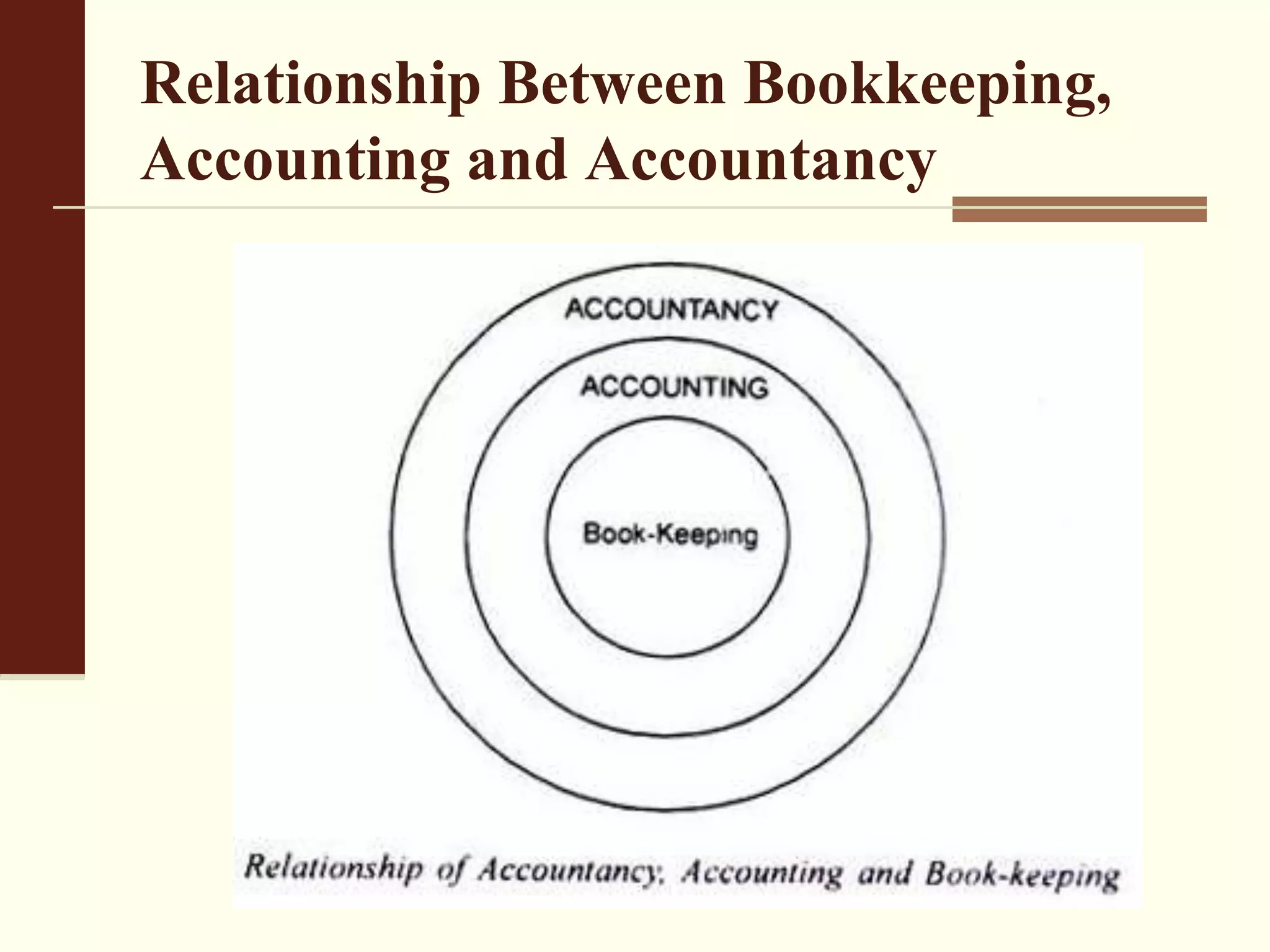
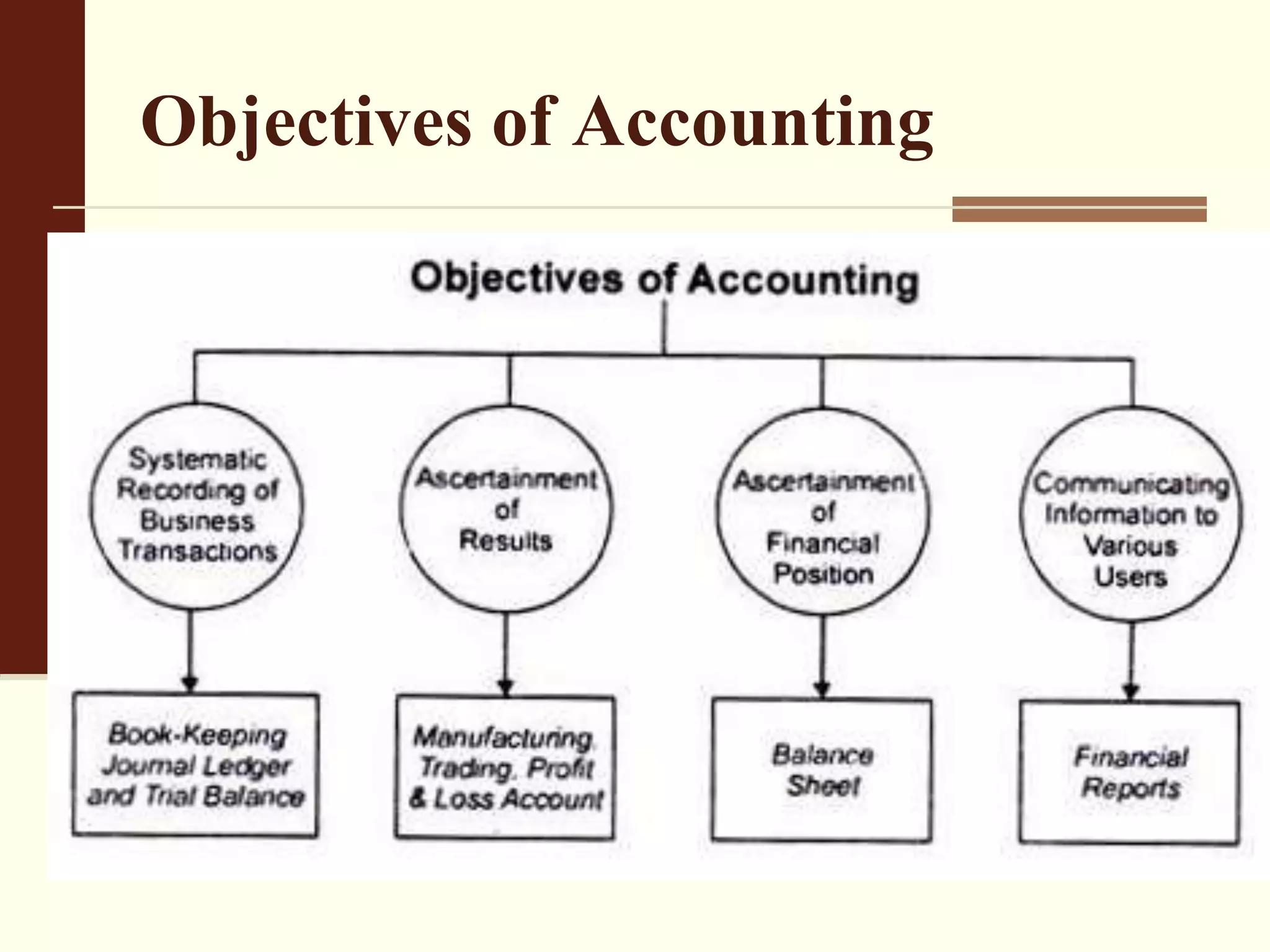
The document outlines basic accounting concepts and principles, focusing on the objectives of accounting and the roles of book keeping, accounting, and accountancy. Book keeping involves recording and maintaining financial transactions, while accounting summarizes and analyzes these transactions to communicate results. Accountancy encompasses the study of the rules and principles governing the accounting process.
Objective of thisSubject
To help students understand the accounting
concepts and principles, as well as to develop
the capability to perform the basic
accounting functions: the recognition,
valuation, measurement and recording of the
most common business transactions.
3.
Contents
Book Keeping
Accounting
Accountancy
Relationship
between book
keeping, Accounting
and accountancy
Objectives of
Accounting
4.
Book Keeping
Book-keepingis a
primary and basic
function in the
process of accounting
and concerned with
recording and
maintenance of books
of accounts only.
5.
In this processthe following basic activities
are considered essential:
Identification of the transactions from the
various business transactions, which have
financial character;
Measurement of those transactions in terms
of money;
Recording those transactions in the books of
original entry;
Classification of the transactions keeping in
view the respective ledger accounts.
In this processthe following basic activities
are considered essential:
Summarization of the classified transactions
in the shape of final accounts;
Analysis and interpretation of the results
disclosed by final accounts and drawing
meaningful conclusions;
Communicating the required information to all
the concerned parties.
8.
Accountancy
Accountancy isa study of systematic
knowledge and contains those rules,
regulations, procedures, principles, concepts,
conventions and techniques, which are to be
applied in the process of accounting.
9.
In thissense, we can say that accountancy is
a broader term that acts as a guide for the
preparation of books of accounts,
summarization of information and
communicating the results to all the
concerned parties.