Dr. MUSTAQ ADNAN
Student
MD CHEST DISEASES- final part
NIDCH
 Epidemiology
 Causes
 How to know who’s exacerbating
 When to use antibiotics
 When to use corticosteroids
 When to admit patients
 Summary
© 2018 Global Initiative for Chronic Obstructive Lung Disease
GOLD 2018 Report: Chapters
© 2018 Global Initiative for Chronic Obstructive Lung Disease
1. Definition and Overview
2. Diagnosis and InitialAssessment
3. Evidence Supporting Prevention & Maintenance
Therapy
4. Management of Stable COPD
5. Management of Exacerbations
6. COPD and Comorbidities
COPD Epidemiology
 115,000 people are diagnosed with COPD each year –
equivalent to a new diagnosis every 5 minutes
 9% in those over age 70.
COPD Definition
© 2018 Global Initiative forChronic Obstructive Lung Disease
►Chronic Obstructive Pulmonary Disease (COPD) is a common,
preventable and treatable disease that is characterized by
persistent respiratory symptoms and airflow limitation that is due
to airway and/or alveolar abnormalities usually caused by
significant exposure to noxious particles or gases.
Chronic Obstructive Pulmonary Disease (COPD)
© 2018 Global Initiative for Chronic Obstructive Lung Disease
► COPD is currently the fourth leading cause of death in the world.1
► COPD is projected to be the 3rd leading cause of death by 2020.2
► More than 3 million people died of COPD in 2012 accounting for 6% of all
deaths globally.
► Globally, the COPD burden is projected to increase in coming decades because
of continued exposure to COPD risk factors and aging of the population.
1. Lozano R, Naghavi M, Foreman K, et al. Global and regional mortality from 235 causes of death for 20 age groups in 1990 and 2010: a systematic analysis for the Global Burden of Disease Study 2010.
Lancet 2012; 380(9859): 2095-128.
2. Mathers CD, Loncar D. Projections of global mortality and burden of disease from 2002 to 2030. PLoS Med 2006; 3(11): e442.
© 2018 Global Initiative for Chronic Obstructive Lung Disease
OVERALL KEY POINTS (1 of 2):
► The most common respiratory symptoms include dyspnea, cough and/or sputum
production.These symptoms may be under-reported by patients.
► The main risk factor for COPD is tobacco smoking but other environmental
exposures such as biomass fuel exposure and air pollution may contribute.
© 2018 Global Initiative for Chronic Obstructive Lung Disease
OVERALL KEY POINTS (2 of 2):
► Besides exposures, host factors predispose individuals to develop COPD.
These include genetic abnormalities, abnormal lung development and
accelerated aging.
► COPD may be punctuated by periods of acute worsening of respiratory
symptoms, called exacerbations.
► In most patients,COPD is associated with significant concomitant chronic
diseases, which increase its morbidity and mortality.
Prevalence
© 2017 Global Initiative for Chronic Obstructive Lung Disease
Prevalence of COPD
► Systematic review and meta-analysis (Halbert et al, 2006)
► Included studies carried out in 28 countries between 1990 and 2004
► Prevalence of COPD was higher in smokers and ex-smokers compared to non-
smokers
► Higher ≥ 40 year group compared to those < 40
► Higher in men than women.
Prevalence
© 2017 Global Initiative for Chronic Obstructive Lung Disease
Prevalence of COPD
► Estimated 384 millionCOPD cases in 2010.
► Estimated global prevalence of 11.7% (95% CI 8.4%–15.0%).
► Three million deaths annually.
► With increasing prevalence of smoking in developing countries, and aging
populations in high-income countries, the prevalence of COPD is expected to
rise over the next 30 years.
► By 2030 predicted 4.5 million COPD related deaths annually.
Economic and Social Burden
© 2017 Global Initiative for Chronic Obstructive Lung Disease
► Global Burden of Disease (GBD) study
► Disability-Adjusted LifeYear (DALY)= sum of years lost because of premature
mortality and years of life lived with disability, adjusted for the severity of
disability.
► COPD is an increasing contributor to disability and mortality around the world.
► In 2013 COPD was 5th leading cause of DALYs lost.
► In the United States, COPD is the second leading cause of reduced DALYs,
trailing only ischemic heart disease
Exacerbations
 Median number of exacerbations seen in primary care was two per year, with one in three
suffering three or more exacerbations in 1 year
 Frequent exacerbators (> 2 per year):
 Chronic sputum producers
 Housebound
 Frequent colds
 Poor quality of life
 Raised inflammatory markers when stable
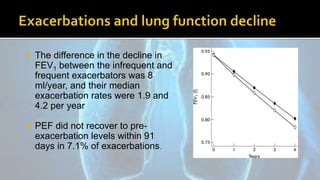
 The difference in the decline in
FEV1 between the infrequent and
frequent exacerbators was 8
ml/year, and their median
exacerbation rates were 1.9 and
4.2 per year
 PEF did not recover to pre-
exacerbation levels within 91
days in 7.1% of exacerbations.
 Symptoms usually last between 7 to 10 days during an
exacerbation, but some events may last longer.
 At 8 weeks, 20% of patients have not recovered to their pre-
exacerbation state.
 COPD exacerbations increase susceptibility to additional events.
GOLD EXECUTIVE SUMMARY 2018
Soler-Cataluna, 2010
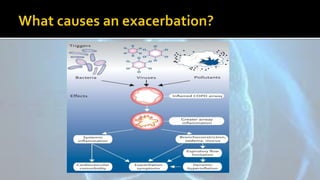
 Bacteria alone 37%
 Virus alone 10%
 Sputum eosinophilia alone 17%,
 Bacteria plus virus 12%
 Bacteria plus sputum eosinophilia 6%,
 Virus plus sputum eosinophilia 3%
 Bacteria plus virus plus sp. eosinophilia 1%
 None 14%.
 BACTERIA 55%
 VIRUS 29% (Picornaviruses, influenza A, RSV, parainfluenza
 SPUTUM EOSINOPHILIA 28%
N=182 AE-COPD. Am J Respir Crit Care Med Vol 184. pp 662–671,
2011
Bafadhel, 2011
An acute worsening of the patient’s usual pattern of respiratory symptoms
beyond normal day-to-day variability:
 Increased dyspnoea
 Worsening cough
 Increased sputum volume
 Sputum purulence
Dyspnoea:
• Airway narrowing
• Increased metabolic state
• Increased ventilation–
perfusion mismatch.
System Condition Differentiating factors
Respiratory Pneumonia
Pneumothorax
Pleural effusion
Pulmonary emboli
Focal crepitations or bronchial breathing
Hyperresonance and absent breath sounds
Dull percussion and absent breath sounds basally
Risk factors (immobility, medications), swollen calf
Cardiac Congestive cardiac failure
Ischaemic heart disease
Arrhythmias
Paroxysmal nocturnal dyspnoea, oedema
Cardiac history
Other Upper airway obstruction
TB
Stridor
Country of origin, foreign travel, exposure history
ANTIBIOTICS
Anthonisen et al, 1979
ERS/ATS Statement 2017
 Antibiotic therapy decreased treatment failure from 42% to
28% (RR 0.67) - therefore NNT to prevent one treatment
failure is 7
 The majority (58%) of patients improved without antibiotics,
suggesting not all exacerbations require antibiotics
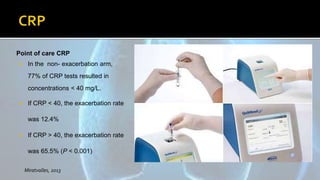
Point of care CRP
 In the non- exacerbation arm,
77% of CRP tests resulted in
concentrations < 40 mg/L.
 If CRP < 40, the exacerbation rate
was 12.4%
 If CRP > 40, the exacerbation rate
was 65.5% (P < 0.001)
Miratvalles, 2013
The only factors
significantly associated
with an increased risk of
treatment failure in
exacerbation without
antibiotics were the
increase in sputum
purulence (OR, 6.1) and a
CRP concentration ≥ 40
mg/L (OR, 13.4). When
both factors were present,
the probability of treatment
failure without antibiotics
was 63.7%.
Predictive value for clinical failure of
Anthonisen criteria (dotted line) (AUC
0.708) and with the addition of a C-
reactive protein level ≥ 40 mg/L (solid
line) (AUC 0.842) among patients with
exacerbations of mild to moderate COPD
not treated with antibiotics.
Which antibiotics to use?
 Targeted towards previous sputum results-
Moraxella commonly found, Haemophilus may need longer
courses (2 weeks), if Pseudomonas isolated > 1 occasion seek
respiratory advice
 What the patient usually responds to according to local sensitivity
pattern
 Otherwise:
Amoxicillin 500mg TDS, Co-Amoxiclav 625mg TDS,
Doxycyxline 100mg OD, Clarithromycin 500mg BD
CORTICOSTEROIDS
Bafadhel, 2012
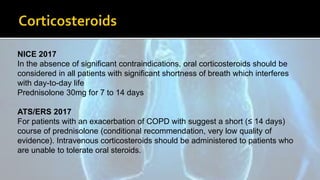
NICE 2017
In the absence of significant contraindications, oral corticosteroids should be
considered in all patients with significant shortness of breath which interferes
with day-to-day life
Prednisolone 30mg for 7 to 14 days
ATS/ERS 2017
For patients with an exacerbation of COPD with suggest a short (≤ 14 days)
course of prednisolone (conditional recommendation, very low quality of
evidence). Intravenous corticosteroids should be administered to patients who
are unable to tolerate oral steroids.
MAJOR CRITERIA
 Inability to cope at home
 Hypoxia, saturations < 90% or > 5%
drop on mild exertion
 Severe breathlessness
 Altered mental state
 Worsening peripheral oedema
MINOR CRITERIA
 Decreased level of activity
 LTOT
 Rapid onset
 Poor general condition
Suspicion of presence of differential such as pneumonia, pneumothorax,
pulmonary emboli, myocardial infarction
GOLD 2018 Report: Chapters
© 2018 Global Initiative for Chronic Obstructive Lung Disease
1. Definition and Overview
2. Diagnosis and InitialAssessment
3. Evidence Supporting Prevention & Maintenance
Therapy
4. Management of Stable COPD
5. Management of Exacerbations
6. COPD and Comorbidities
Management of Exacerbations
© 2018 Global Initiative for Chronic Obstructive Lung Disease
OVERALL KEY POINTS (1 of 3):
► An exacerbation of COPD is defined as an acute worsening of respiratory symptoms that results in
additional therapy.
► Exacerbations of COPD can be precipitated by several factors.The most common causes are
respiratory tract infections.
► The goal for treatment of COPD exacerbations is to minimize the negative impact of the current
exacerbation and to prevent subsequent events.
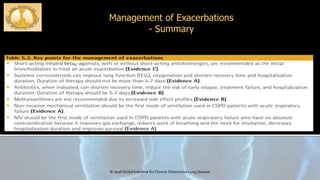
► Short-acting inhaled beta2-agonists, with or without short-acting anticholinergics, are recommended
as the initial bronchodilators to treat an acute exacerbation.
Management of Exacerbations
© 2018 Global Initiative for Chronic Obstructive Lung Disease
OVERALL KEY POINTS (2 of 3):
► Maintenance therapy with long-acting bronchodilators should be initiated as soon as possible before
hospital discharge.
► Systemic corticosteroids can improve lung function (FEV1), oxygenation and shorten recovery time
and hospitalization duration. Duration of therapy should not be more than 5-7 days.
► Antibiotics, when indicated, can shorten recovery time, reduce the risk of early relapse, treatment
failure, and hospitalization duration. Duration of therapy should be 5-7 days.
► Methylxanthines are not recommended due to increased side effect profiles.
Management of Exacerbations
© 2018 Global Initiative for Chronic Obstructive Lung Disease
OVERALL KEY POINTS (3 of 3):
► Non-invasive mechanical ventilation should be the first mode of ventilation used in COPD patients
with acute respiratory failure who have no absolute contraindication because it improves gas
exchange, reduces work of breathing and the need for intubation, decreases hospitalization duration
and improves survival.
► Following an exacerbation, appropriate measures for exacerbation prevention should be initiated (see
GOLD 2017 Chapter 3 and Chapter 4).
Management of Exacerbations
© 2018 Global Initiative for Chronic Obstructive Lung Disease
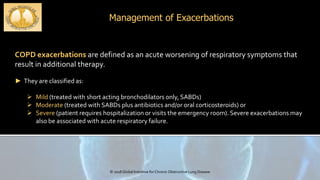
COPD exacerbations are defined as an acute worsening of respiratory symptoms that
result in additional therapy.
► They are classified as:
 Mild (treated with short acting bronchodilators only, SABDs)
 Moderate (treated with SABDs plus antibiotics and/or oral corticosteroids) or
 Severe (patient requires hospitalization or visits the emergency room). Severe exacerbations may
also be associated with acute respiratory failure.
Management of Exacerbations
© 2018 Global Initiative for Chronic Obstructive Lung Disease
Classification of hospitalized patients
No respiratory failure:
Respiratory rate: 20-30 breaths per minute; no use of accessory respiratory muscles; no
changes in mental status; hypoxemia improved with supplemental oxygen given via
Venturi mask 28-35% inspired oxygen (FiO2); no increase in PaCO2.
Management of Exacerbations
© 2018 Global Initiative for Chronic Obstructive Lung Disease
Classification of hospitalized patients
Acute respiratory failure — non-life-threatening: Respiratory rate: > 30 breaths per
minute; using accessory respiratory muscles; no change in mental status; hypoxemia
improved with supplemental oxygen viaVenturi mask 25-30% FiO2; hypercarbia i.e.,
PaCO2 increased compared with baseline or elevated 50-60 mmHg.
Management of Exacerbations
© 2018 Global Initiative for Chronic Obstructive Lung Disease
Classification of hospitalized patients
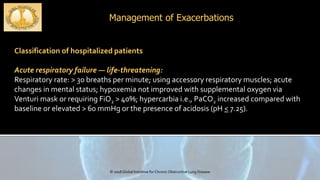
Acute respiratory failure — life-threatening:
Respiratory rate: > 30 breaths per minute; using accessory respiratory muscles; acute
changes in mental status; hypoxemia not improved with supplemental oxygen via
Venturi mask or requiring FiO2 > 40%; hypercarbia i.e., PaCO2 increased compared with
baseline or elevated > 60 mmHg or the presence of acidosis (pH < 7.25).
Management of Exacerbations
© 2018 Global Initiative for Chronic Obstructive Lung Disease
Management of Exacerbations
© 2018 Global Initiative for Chronic Obstructive Lung Disease
Management of Exacerbations
- Summary
© 2018 Global Initiative for Chronic Obstructive Lung Disease
Management of Exacerbations
© 2018 Global Initiative for Chronic Obstructive Lung Disease
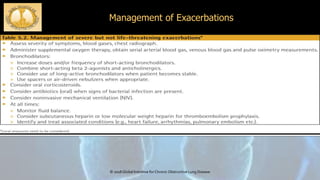
Pharmacologic treatment
The three classes of medications most commonly used forCOPD exacerbations are:
►Bronchodilators
 Although there is no high-quality evidence from RCTs, it is recommended that short-acting inhaled beta2-
agonists, with or without short-acting anticholinergics, are the initial bronchodilators for acute treatment of
a COPD exacerbation.
►Corticosteroids
 Data from studies indicate that systemic glucocorticoids in COPD exacerbations shorten recovery time and
improve lung function (FEV1).They also improve oxygenation, the risk of early relapse, treatment failure, and
the length of hospitalization.
►Antibiotics
Management of Exacerbations
© 2018 Global Initiative for Chronic Obstructive Lung Disease
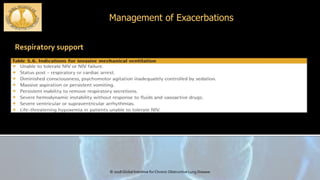
Respiratory support
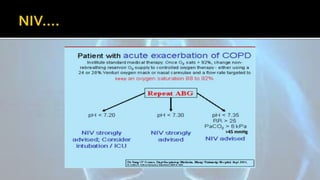
 NIV should be the first mode of ventilation used
in COPD patients with acute respiratory failure
who have no absolute contraindication because:
 1. it improves gas exchange,
 2. reduces work of breathing and the need for
intubation,
 3. decreases hospitalization duration and
 4. improves survival (evidence A)
❖ success rate of 80–85%
GOLD EXECUTIVE SUMMARY 2017
Management of Exacerbations
© 2018 Global Initiative for Chronic Obstructive Lung Disease
Respiratory support
Management of Exacerbations
© 2018 Global Initiative for Chronic Obstructive Lung Disease
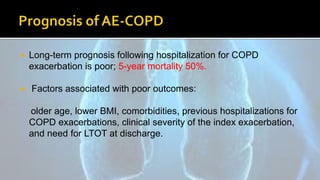
 Long-term prognosis following hospitalization for COPD
exacerbation is poor; 5-year mortality 50%.
 Factors associated with poor outcomes:
older age, lower BMI, comorbidities, previous hospitalizations for
COPD exacerbations, clinical severity of the index exacerbation,
and need for LTOT at discharge.
Who to give antibiotics to?
Unwell, sputum purulence, CRP > 40
 Who to give corticosteroids to?
Currently all
In future ? high eosinophilics only
 Who to admit?
Inability to manage at home, severe
SOB, developing peripheral oedema,
hypoxic
Differential diagnoses
• PTX
• Pneumonia
• Pulmonary emboli
• Myocardial infarction and arrhythmia
Working towards biomarker-directed
approach
COPD: Management of Acute Exacerbation

COPD: Management of Acute Exacerbation

  • 1.
    Dr. MUSTAQ ADNAN Student MDCHEST DISEASES- final part NIDCH
  • 2.
     Epidemiology  Causes How to know who’s exacerbating  When to use antibiotics  When to use corticosteroids  When to admit patients  Summary
  • 3.
    © 2018 GlobalInitiative for Chronic Obstructive Lung Disease
  • 4.
    GOLD 2018 Report:Chapters © 2018 Global Initiative for Chronic Obstructive Lung Disease 1. Definition and Overview 2. Diagnosis and InitialAssessment 3. Evidence Supporting Prevention & Maintenance Therapy 4. Management of Stable COPD 5. Management of Exacerbations 6. COPD and Comorbidities
  • 5.
    COPD Epidemiology  115,000people are diagnosed with COPD each year – equivalent to a new diagnosis every 5 minutes  9% in those over age 70.
  • 6.
    COPD Definition © 2018Global Initiative forChronic Obstructive Lung Disease ►Chronic Obstructive Pulmonary Disease (COPD) is a common, preventable and treatable disease that is characterized by persistent respiratory symptoms and airflow limitation that is due to airway and/or alveolar abnormalities usually caused by significant exposure to noxious particles or gases.
  • 7.
    Chronic Obstructive PulmonaryDisease (COPD) © 2018 Global Initiative for Chronic Obstructive Lung Disease ► COPD is currently the fourth leading cause of death in the world.1 ► COPD is projected to be the 3rd leading cause of death by 2020.2 ► More than 3 million people died of COPD in 2012 accounting for 6% of all deaths globally. ► Globally, the COPD burden is projected to increase in coming decades because of continued exposure to COPD risk factors and aging of the population. 1. Lozano R, Naghavi M, Foreman K, et al. Global and regional mortality from 235 causes of death for 20 age groups in 1990 and 2010: a systematic analysis for the Global Burden of Disease Study 2010. Lancet 2012; 380(9859): 2095-128. 2. Mathers CD, Loncar D. Projections of global mortality and burden of disease from 2002 to 2030. PLoS Med 2006; 3(11): e442.
  • 8.
    © 2018 GlobalInitiative for Chronic Obstructive Lung Disease OVERALL KEY POINTS (1 of 2): ► The most common respiratory symptoms include dyspnea, cough and/or sputum production.These symptoms may be under-reported by patients. ► The main risk factor for COPD is tobacco smoking but other environmental exposures such as biomass fuel exposure and air pollution may contribute.
  • 9.
    © 2018 GlobalInitiative for Chronic Obstructive Lung Disease OVERALL KEY POINTS (2 of 2): ► Besides exposures, host factors predispose individuals to develop COPD. These include genetic abnormalities, abnormal lung development and accelerated aging. ► COPD may be punctuated by periods of acute worsening of respiratory symptoms, called exacerbations. ► In most patients,COPD is associated with significant concomitant chronic diseases, which increase its morbidity and mortality.
  • 10.
    Prevalence © 2017 GlobalInitiative for Chronic Obstructive Lung Disease Prevalence of COPD ► Systematic review and meta-analysis (Halbert et al, 2006) ► Included studies carried out in 28 countries between 1990 and 2004 ► Prevalence of COPD was higher in smokers and ex-smokers compared to non- smokers ► Higher ≥ 40 year group compared to those < 40 ► Higher in men than women.
  • 11.
    Prevalence © 2017 GlobalInitiative for Chronic Obstructive Lung Disease Prevalence of COPD ► Estimated 384 millionCOPD cases in 2010. ► Estimated global prevalence of 11.7% (95% CI 8.4%–15.0%). ► Three million deaths annually. ► With increasing prevalence of smoking in developing countries, and aging populations in high-income countries, the prevalence of COPD is expected to rise over the next 30 years. ► By 2030 predicted 4.5 million COPD related deaths annually.
  • 12.
    Economic and SocialBurden © 2017 Global Initiative for Chronic Obstructive Lung Disease ► Global Burden of Disease (GBD) study ► Disability-Adjusted LifeYear (DALY)= sum of years lost because of premature mortality and years of life lived with disability, adjusted for the severity of disability. ► COPD is an increasing contributor to disability and mortality around the world. ► In 2013 COPD was 5th leading cause of DALYs lost. ► In the United States, COPD is the second leading cause of reduced DALYs, trailing only ischemic heart disease
  • 14.
    Exacerbations  Median numberof exacerbations seen in primary care was two per year, with one in three suffering three or more exacerbations in 1 year  Frequent exacerbators (> 2 per year):  Chronic sputum producers  Housebound  Frequent colds  Poor quality of life  Raised inflammatory markers when stable
  • 15.
     The differencein the decline in FEV1 between the infrequent and frequent exacerbators was 8 ml/year, and their median exacerbation rates were 1.9 and 4.2 per year  PEF did not recover to pre- exacerbation levels within 91 days in 7.1% of exacerbations.
  • 16.
     Symptoms usuallylast between 7 to 10 days during an exacerbation, but some events may last longer.  At 8 weeks, 20% of patients have not recovered to their pre- exacerbation state.  COPD exacerbations increase susceptibility to additional events. GOLD EXECUTIVE SUMMARY 2018
  • 17.
  • 19.
     Bacteria alone37%  Virus alone 10%  Sputum eosinophilia alone 17%,  Bacteria plus virus 12%  Bacteria plus sputum eosinophilia 6%,  Virus plus sputum eosinophilia 3%  Bacteria plus virus plus sp. eosinophilia 1%  None 14%.  BACTERIA 55%  VIRUS 29% (Picornaviruses, influenza A, RSV, parainfluenza  SPUTUM EOSINOPHILIA 28% N=182 AE-COPD. Am J Respir Crit Care Med Vol 184. pp 662–671, 2011
  • 20.
  • 21.
    An acute worseningof the patient’s usual pattern of respiratory symptoms beyond normal day-to-day variability:  Increased dyspnoea  Worsening cough  Increased sputum volume  Sputum purulence Dyspnoea: • Airway narrowing • Increased metabolic state • Increased ventilation– perfusion mismatch.
  • 22.
    System Condition Differentiatingfactors Respiratory Pneumonia Pneumothorax Pleural effusion Pulmonary emboli Focal crepitations or bronchial breathing Hyperresonance and absent breath sounds Dull percussion and absent breath sounds basally Risk factors (immobility, medications), swollen calf Cardiac Congestive cardiac failure Ischaemic heart disease Arrhythmias Paroxysmal nocturnal dyspnoea, oedema Cardiac history Other Upper airway obstruction TB Stridor Country of origin, foreign travel, exposure history
  • 23.
  • 24.
  • 25.
    ERS/ATS Statement 2017 Antibiotic therapy decreased treatment failure from 42% to 28% (RR 0.67) - therefore NNT to prevent one treatment failure is 7  The majority (58%) of patients improved without antibiotics, suggesting not all exacerbations require antibiotics
  • 27.
    Point of careCRP  In the non- exacerbation arm, 77% of CRP tests resulted in concentrations < 40 mg/L.  If CRP < 40, the exacerbation rate was 12.4%  If CRP > 40, the exacerbation rate was 65.5% (P < 0.001) Miratvalles, 2013
  • 29.
    The only factors significantlyassociated with an increased risk of treatment failure in exacerbation without antibiotics were the increase in sputum purulence (OR, 6.1) and a CRP concentration ≥ 40 mg/L (OR, 13.4). When both factors were present, the probability of treatment failure without antibiotics was 63.7%. Predictive value for clinical failure of Anthonisen criteria (dotted line) (AUC 0.708) and with the addition of a C- reactive protein level ≥ 40 mg/L (solid line) (AUC 0.842) among patients with exacerbations of mild to moderate COPD not treated with antibiotics.
  • 30.
    Which antibiotics touse?  Targeted towards previous sputum results- Moraxella commonly found, Haemophilus may need longer courses (2 weeks), if Pseudomonas isolated > 1 occasion seek respiratory advice  What the patient usually responds to according to local sensitivity pattern  Otherwise: Amoxicillin 500mg TDS, Co-Amoxiclav 625mg TDS, Doxycyxline 100mg OD, Clarithromycin 500mg BD
  • 31.
  • 33.
  • 34.
    NICE 2017 In theabsence of significant contraindications, oral corticosteroids should be considered in all patients with significant shortness of breath which interferes with day-to-day life Prednisolone 30mg for 7 to 14 days ATS/ERS 2017 For patients with an exacerbation of COPD with suggest a short (≤ 14 days) course of prednisolone (conditional recommendation, very low quality of evidence). Intravenous corticosteroids should be administered to patients who are unable to tolerate oral steroids.
  • 35.
    MAJOR CRITERIA  Inabilityto cope at home  Hypoxia, saturations < 90% or > 5% drop on mild exertion  Severe breathlessness  Altered mental state  Worsening peripheral oedema MINOR CRITERIA  Decreased level of activity  LTOT  Rapid onset  Poor general condition Suspicion of presence of differential such as pneumonia, pneumothorax, pulmonary emboli, myocardial infarction
  • 36.
    GOLD 2018 Report:Chapters © 2018 Global Initiative for Chronic Obstructive Lung Disease 1. Definition and Overview 2. Diagnosis and InitialAssessment 3. Evidence Supporting Prevention & Maintenance Therapy 4. Management of Stable COPD 5. Management of Exacerbations 6. COPD and Comorbidities
  • 37.
    Management of Exacerbations ©2018 Global Initiative for Chronic Obstructive Lung Disease OVERALL KEY POINTS (1 of 3): ► An exacerbation of COPD is defined as an acute worsening of respiratory symptoms that results in additional therapy. ► Exacerbations of COPD can be precipitated by several factors.The most common causes are respiratory tract infections. ► The goal for treatment of COPD exacerbations is to minimize the negative impact of the current exacerbation and to prevent subsequent events. ► Short-acting inhaled beta2-agonists, with or without short-acting anticholinergics, are recommended as the initial bronchodilators to treat an acute exacerbation.
  • 38.
    Management of Exacerbations ©2018 Global Initiative for Chronic Obstructive Lung Disease OVERALL KEY POINTS (2 of 3): ► Maintenance therapy with long-acting bronchodilators should be initiated as soon as possible before hospital discharge. ► Systemic corticosteroids can improve lung function (FEV1), oxygenation and shorten recovery time and hospitalization duration. Duration of therapy should not be more than 5-7 days. ► Antibiotics, when indicated, can shorten recovery time, reduce the risk of early relapse, treatment failure, and hospitalization duration. Duration of therapy should be 5-7 days. ► Methylxanthines are not recommended due to increased side effect profiles.
  • 39.
    Management of Exacerbations ©2018 Global Initiative for Chronic Obstructive Lung Disease OVERALL KEY POINTS (3 of 3): ► Non-invasive mechanical ventilation should be the first mode of ventilation used in COPD patients with acute respiratory failure who have no absolute contraindication because it improves gas exchange, reduces work of breathing and the need for intubation, decreases hospitalization duration and improves survival. ► Following an exacerbation, appropriate measures for exacerbation prevention should be initiated (see GOLD 2017 Chapter 3 and Chapter 4).
  • 40.
    Management of Exacerbations ©2018 Global Initiative for Chronic Obstructive Lung Disease COPD exacerbations are defined as an acute worsening of respiratory symptoms that result in additional therapy. ► They are classified as:  Mild (treated with short acting bronchodilators only, SABDs)  Moderate (treated with SABDs plus antibiotics and/or oral corticosteroids) or  Severe (patient requires hospitalization or visits the emergency room). Severe exacerbations may also be associated with acute respiratory failure.
  • 41.
    Management of Exacerbations ©2018 Global Initiative for Chronic Obstructive Lung Disease Classification of hospitalized patients No respiratory failure: Respiratory rate: 20-30 breaths per minute; no use of accessory respiratory muscles; no changes in mental status; hypoxemia improved with supplemental oxygen given via Venturi mask 28-35% inspired oxygen (FiO2); no increase in PaCO2.
  • 42.
    Management of Exacerbations ©2018 Global Initiative for Chronic Obstructive Lung Disease Classification of hospitalized patients Acute respiratory failure — non-life-threatening: Respiratory rate: > 30 breaths per minute; using accessory respiratory muscles; no change in mental status; hypoxemia improved with supplemental oxygen viaVenturi mask 25-30% FiO2; hypercarbia i.e., PaCO2 increased compared with baseline or elevated 50-60 mmHg.
  • 43.
    Management of Exacerbations ©2018 Global Initiative for Chronic Obstructive Lung Disease Classification of hospitalized patients Acute respiratory failure — life-threatening: Respiratory rate: > 30 breaths per minute; using accessory respiratory muscles; acute changes in mental status; hypoxemia not improved with supplemental oxygen via Venturi mask or requiring FiO2 > 40%; hypercarbia i.e., PaCO2 increased compared with baseline or elevated > 60 mmHg or the presence of acidosis (pH < 7.25).
  • 44.
    Management of Exacerbations ©2018 Global Initiative for Chronic Obstructive Lung Disease
  • 45.
    Management of Exacerbations ©2018 Global Initiative for Chronic Obstructive Lung Disease
  • 46.
    Management of Exacerbations -Summary © 2018 Global Initiative for Chronic Obstructive Lung Disease
  • 47.
    Management of Exacerbations ©2018 Global Initiative for Chronic Obstructive Lung Disease Pharmacologic treatment The three classes of medications most commonly used forCOPD exacerbations are: ►Bronchodilators  Although there is no high-quality evidence from RCTs, it is recommended that short-acting inhaled beta2- agonists, with or without short-acting anticholinergics, are the initial bronchodilators for acute treatment of a COPD exacerbation. ►Corticosteroids  Data from studies indicate that systemic glucocorticoids in COPD exacerbations shorten recovery time and improve lung function (FEV1).They also improve oxygenation, the risk of early relapse, treatment failure, and the length of hospitalization. ►Antibiotics
  • 49.
    Management of Exacerbations ©2018 Global Initiative for Chronic Obstructive Lung Disease Respiratory support
  • 50.
     NIV shouldbe the first mode of ventilation used in COPD patients with acute respiratory failure who have no absolute contraindication because:  1. it improves gas exchange,  2. reduces work of breathing and the need for intubation,  3. decreases hospitalization duration and  4. improves survival (evidence A) ❖ success rate of 80–85% GOLD EXECUTIVE SUMMARY 2017
  • 53.
    Management of Exacerbations ©2018 Global Initiative for Chronic Obstructive Lung Disease Respiratory support
  • 59.
    Management of Exacerbations ©2018 Global Initiative for Chronic Obstructive Lung Disease
  • 60.
     Long-term prognosisfollowing hospitalization for COPD exacerbation is poor; 5-year mortality 50%.  Factors associated with poor outcomes: older age, lower BMI, comorbidities, previous hospitalizations for COPD exacerbations, clinical severity of the index exacerbation, and need for LTOT at discharge.
  • 65.
    Who to giveantibiotics to? Unwell, sputum purulence, CRP > 40  Who to give corticosteroids to? Currently all In future ? high eosinophilics only  Who to admit? Inability to manage at home, severe SOB, developing peripheral oedema, hypoxic Differential diagnoses • PTX • Pneumonia • Pulmonary emboli • Myocardial infarction and arrhythmia Working towards biomarker-directed approach