TKMCE,Dept of civil engg 1
TEXTILE
REINFORCED
CONCRETE (TRC)
TKMCE,Dept of civil engg 2
ABOUT
 Textile reinforced concrete (TRC) is a high
performance composite material in which technical
textiles are composed of high performance
reinforcement fibres are embedded In
cementitious matrix.
 The textile reinforcement provides enhanced
tensile strength, ductility and other features to the
finished TRC composites.
TKMCE,Dept of civil engg 3
Continued….
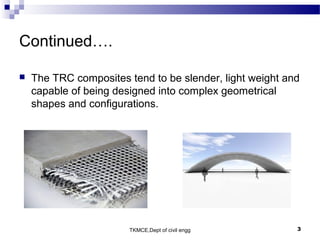
 The TRC composites tend to be slender, light weight and
capable of being designed into complex geometrical
shapes and configurations.
TKMCE,Dept of civil engg 4
TEXTILE REINFORCEMENT
MATERIALS
 The choice of fibre material for use in TRC is
based on various factors such as material
properties, corrosion and temperature
resistance, bond quality, demand or production
cost and even environmental impact.
 Fibre materials which have generally been used
and explored in TRC include, but are not limited
to:
TKMCE,Dept of civil engg 5
Continued….
1. Alkali Resistant glass (AR- glass)
2. Carbon
3. Basalt
4. Aramid
5. Polyvinyl-alcohol (PVA) with polyvinyl chloride
(PVC) coating.
TKMCE,Dept of civil engg 6
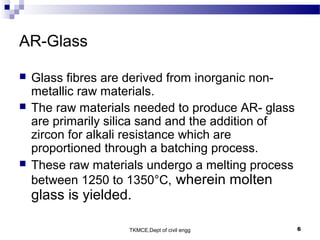
AR-Glass
 Glass fibres are derived from inorganic non-
metallic raw materials.
 The raw materials needed to produce AR- glass
are primarily silica sand and the addition of
zircon for alkali resistance which are
proportioned through a batching process.
 These raw materials undergo a melting process
between 1250 to 1350°C, wherein molten
glass is yielded.
TKMCE,Dept of civil engg 7
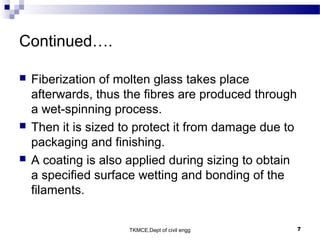
Continued….
 Fiberization of molten glass takes place
afterwards, thus the fibres are produced through
a wet-spinning process.
 Then it is sized to protect it from damage due to
packaging and finishing.
 A coating is also applied during sizing to obtain
a specified surface wetting and bonding of the
filaments.
TKMCE,Dept of civil engg 8
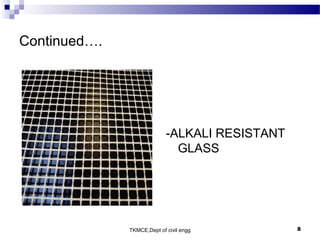
Continued….
-ALKALI RESISTANT
GLASS
TKMCE,Dept of civil engg 9
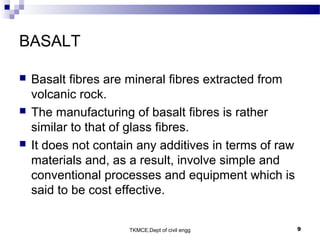
BASALT
 Basalt fibres are mineral fibres extracted from
volcanic rock.
 The manufacturing of basalt fibres is rather
similar to that of glass fibres.
 It does not contain any additives in terms of raw
materials and, as a result, involve simple and
conventional processes and equipment which is
said to be cost effective.
TKMCE,Dept of civil engg 10
Continued….
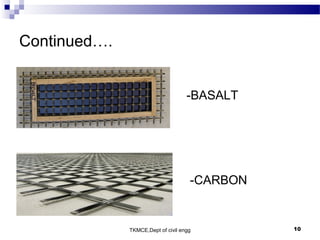
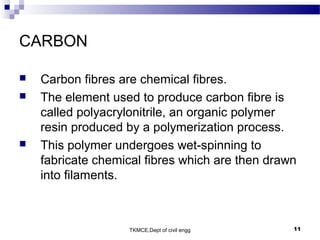
-BASALT
-CARBON
TKMCE,Dept of civil engg 11
CARBON
 Carbon fibres are chemical fibres.
 The element used to produce carbon fibre is
called polyacrylonitrile, an organic polymer
resin produced by a polymerization process.
 This polymer undergoes wet-spinning to
fabricate chemical fibres which are then drawn
into filaments.
TKMCE,Dept of civil engg 12
Continued….
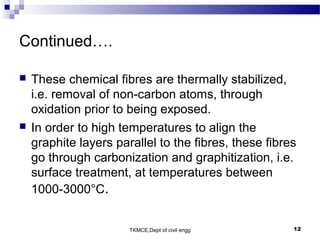
 These chemical fibres are thermally stabilized,
i.e. removal of non-carbon atoms, through
oxidation prior to being exposed.
 In order to high temperatures to align the
graphite layers parallel to the fibres, these fibres
go through carbonization and graphitization, i.e.
surface treatment, at temperatures between
1000-3000°C.
TKMCE,Dept of civil engg 13
Continued….
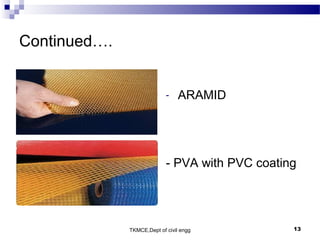
- ARAMID
- PVA with PVC coating
TKMCE,Dept of civil engg 14
FABRICATION TECHNIQUES
 Fabrication methods related to textile meshes
are abundant and can be tailored to the needs of
nearly any given application.
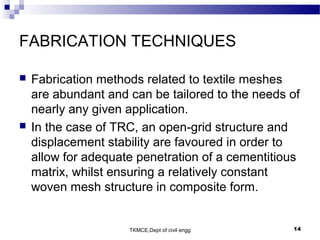
 In the case of TRC, an open-grid structure and
displacement stability are favoured in order to
allow for adequate penetration of a cementitious
matrix, whilst ensuring a relatively constant
woven mesh structure in composite form.
TKMCE,Dept of civil engg 15
Continued….
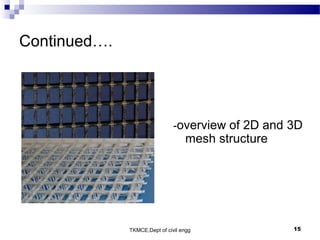
-overview of 2D and 3D
mesh structure
TKMCE,Dept of civil engg 16
Continued….
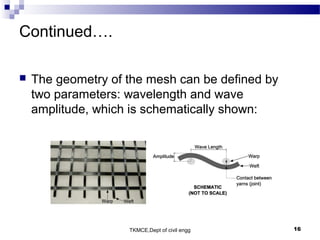
 The geometry of the mesh can be defined by
two parameters: wavelength and wave
amplitude, which is schematically shown:
TKMCE,Dept of civil engg 17
MECHANICAL BEHAVIOUR
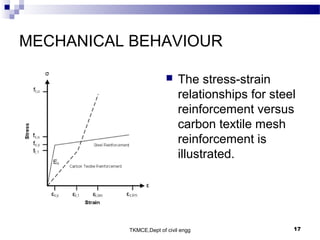
 The stress-strain
relationships for steel
reinforcement versus
carbon textile mesh
reinforcement is
illustrated.
TKMCE,Dept of civil engg 18
Continued….
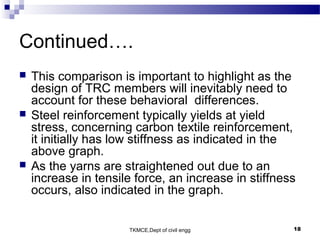
 This comparison is important to highlight as the
design of TRC members will inevitably need to
account for these behavioral differences.
 Steel reinforcement typically yields at yield
stress, concerning carbon textile reinforcement,
it initially has low stiffness as indicated in the
above graph.
 As the yarns are straightened out due to an
increase in tensile force, an increase in stiffness
occurs, also indicated in the graph.
TKMCE,Dept of civil engg 19
Continued….
 The carbon textile reinforcement undergoes a
brittle failure at the ultimate limit strain.
MICROSTRUCTURE AND BOND
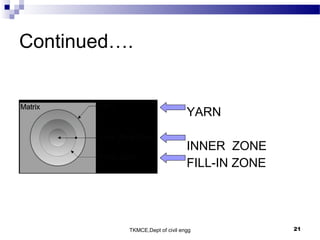
 TRC is having a complex heterogeneous
structure.
 It consist of yarn of numerous filament, which
inhibit the even penetration of the fine-grained
concrete matrix between the filaments.
TKMCE,Dept of civil engg 20
Continued….
 The fine grained concrete matrix depending on
the size of the fill-in zone.
 The fill-in zone is the depth at which adhesive
load transfer can take place between the
filament and the matrix.
 The inner zone is called core zone, is the
filament having less contact with the matrix, but
assuming that frictional load transfer is possible.
TKMCE,Dept of civil engg 21
Continued….
YARN
INNER ZONE
FILL-IN ZONE
TKMCE,Dept of civil engg 22
APPLICATION
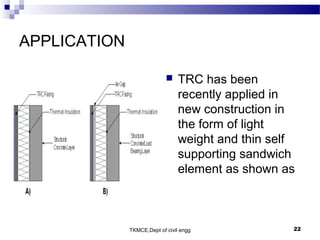
 TRC has been
recently applied in
new construction in
the form of light
weight and thin self
supporting sandwich
element as shown as
TKMCE,Dept of civil engg 23
Continued….
 Sandwich elements typically consist of an
external facing panel, a structural load-bearing
layer at the interior.
 Elements can also be designed as partially
composites, which transfer shear stresses partly
by means of ties connecting the facings.
 Life INSU-SHELL, a collaborative project.
TKMCE,Dept of civil engg 24
ADVANTAGES
 Non-corrosive nature of fibre materials.
 Provide higher degree of effectiveness.
 It enhances mechanical behaviour.
 It provides great flexibility in textile design.
 It helps in the development of cement based
composites and allows engineering of the
performance of the final products for a desired
requirement.
TKMCE,Dept of civil engg 25
CONCLUSION
 TRC has emerged as a novel composite with
various potential application in non structural,
structural materials including thin and slender
elements, repair and strengthening of existing
structural members.
 The fundamental concepts and research
background related to the textile reinforced
concrete were presented to provide adequate
frame work and motivation for this thesis.
TKMCE,Dept of civil engg 26
REFERENCES
 NATALIE WILLIAMS PORTAL, Department of civil and environmental
engineering division of structural engineering, concrete structures Chalmers
university of technologyerials in civil engineering. ISSN no.1652-916 Lic
2013:9
 H.N.SCHNEIDER and BERGMANN (3/1/2008):The application potential of
textile reinforced concrete, Vol.250,pp.7-22
 BRAMESHUBER.W. (2006): Textile reinforced concrete-state-of-the-art
report of RILEM TC 201-TRC.36.RILEM publications.2.
 PURNELL.P. (1998): The durability of glass fibre reinforced cements made
with new cementitious matrices. Ph.D. Thesis, Aston University.
 J.HEGGER, S.VOSS, A.SCHOLZEN (3/1/2008): Textile Reinforced
Concrete for light structures, Vol.251,pp.97-108
 R.HEMPEL, M.BUTLER, S.HEMPEL and H.SCHORN (5/1/2007): Durability
of Textile Reinforced Concrete, Vol.22, pp.87-108ss
TKMCE,Dept of civil engg 27
THANK YOU….
QUESTIONS ???

textile reinforced concrete

  • 1.
    TKMCE,Dept of civilengg 1 TEXTILE REINFORCED CONCRETE (TRC)
  • 2.
    TKMCE,Dept of civilengg 2 ABOUT  Textile reinforced concrete (TRC) is a high performance composite material in which technical textiles are composed of high performance reinforcement fibres are embedded In cementitious matrix.  The textile reinforcement provides enhanced tensile strength, ductility and other features to the finished TRC composites.
  • 3.
    TKMCE,Dept of civilengg 3 Continued….  The TRC composites tend to be slender, light weight and capable of being designed into complex geometrical shapes and configurations.
  • 4.
    TKMCE,Dept of civilengg 4 TEXTILE REINFORCEMENT MATERIALS  The choice of fibre material for use in TRC is based on various factors such as material properties, corrosion and temperature resistance, bond quality, demand or production cost and even environmental impact.  Fibre materials which have generally been used and explored in TRC include, but are not limited to:
  • 5.
    TKMCE,Dept of civilengg 5 Continued…. 1. Alkali Resistant glass (AR- glass) 2. Carbon 3. Basalt 4. Aramid 5. Polyvinyl-alcohol (PVA) with polyvinyl chloride (PVC) coating.
  • 6.
    TKMCE,Dept of civilengg 6 AR-Glass  Glass fibres are derived from inorganic non- metallic raw materials.  The raw materials needed to produce AR- glass are primarily silica sand and the addition of zircon for alkali resistance which are proportioned through a batching process.  These raw materials undergo a melting process between 1250 to 1350°C, wherein molten glass is yielded.
  • 7.
    TKMCE,Dept of civilengg 7 Continued….  Fiberization of molten glass takes place afterwards, thus the fibres are produced through a wet-spinning process.  Then it is sized to protect it from damage due to packaging and finishing.  A coating is also applied during sizing to obtain a specified surface wetting and bonding of the filaments.
  • 8.
    TKMCE,Dept of civilengg 8 Continued…. -ALKALI RESISTANT GLASS
  • 9.
    TKMCE,Dept of civilengg 9 BASALT  Basalt fibres are mineral fibres extracted from volcanic rock.  The manufacturing of basalt fibres is rather similar to that of glass fibres.  It does not contain any additives in terms of raw materials and, as a result, involve simple and conventional processes and equipment which is said to be cost effective.
  • 10.
    TKMCE,Dept of civilengg 10 Continued…. -BASALT -CARBON
  • 11.
    TKMCE,Dept of civilengg 11 CARBON  Carbon fibres are chemical fibres.  The element used to produce carbon fibre is called polyacrylonitrile, an organic polymer resin produced by a polymerization process.  This polymer undergoes wet-spinning to fabricate chemical fibres which are then drawn into filaments.
  • 12.
    TKMCE,Dept of civilengg 12 Continued….  These chemical fibres are thermally stabilized, i.e. removal of non-carbon atoms, through oxidation prior to being exposed.  In order to high temperatures to align the graphite layers parallel to the fibres, these fibres go through carbonization and graphitization, i.e. surface treatment, at temperatures between 1000-3000°C.
  • 13.
    TKMCE,Dept of civilengg 13 Continued…. - ARAMID - PVA with PVC coating
  • 14.
    TKMCE,Dept of civilengg 14 FABRICATION TECHNIQUES  Fabrication methods related to textile meshes are abundant and can be tailored to the needs of nearly any given application.  In the case of TRC, an open-grid structure and displacement stability are favoured in order to allow for adequate penetration of a cementitious matrix, whilst ensuring a relatively constant woven mesh structure in composite form.
  • 15.
    TKMCE,Dept of civilengg 15 Continued…. -overview of 2D and 3D mesh structure
  • 16.
    TKMCE,Dept of civilengg 16 Continued….  The geometry of the mesh can be defined by two parameters: wavelength and wave amplitude, which is schematically shown:
  • 17.
    TKMCE,Dept of civilengg 17 MECHANICAL BEHAVIOUR  The stress-strain relationships for steel reinforcement versus carbon textile mesh reinforcement is illustrated.
  • 18.
    TKMCE,Dept of civilengg 18 Continued….  This comparison is important to highlight as the design of TRC members will inevitably need to account for these behavioral differences.  Steel reinforcement typically yields at yield stress, concerning carbon textile reinforcement, it initially has low stiffness as indicated in the above graph.  As the yarns are straightened out due to an increase in tensile force, an increase in stiffness occurs, also indicated in the graph.
  • 19.
    TKMCE,Dept of civilengg 19 Continued….  The carbon textile reinforcement undergoes a brittle failure at the ultimate limit strain. MICROSTRUCTURE AND BOND  TRC is having a complex heterogeneous structure.  It consist of yarn of numerous filament, which inhibit the even penetration of the fine-grained concrete matrix between the filaments.
  • 20.
    TKMCE,Dept of civilengg 20 Continued….  The fine grained concrete matrix depending on the size of the fill-in zone.  The fill-in zone is the depth at which adhesive load transfer can take place between the filament and the matrix.  The inner zone is called core zone, is the filament having less contact with the matrix, but assuming that frictional load transfer is possible.
  • 21.
    TKMCE,Dept of civilengg 21 Continued…. YARN INNER ZONE FILL-IN ZONE
  • 22.
    TKMCE,Dept of civilengg 22 APPLICATION  TRC has been recently applied in new construction in the form of light weight and thin self supporting sandwich element as shown as
  • 23.
    TKMCE,Dept of civilengg 23 Continued….  Sandwich elements typically consist of an external facing panel, a structural load-bearing layer at the interior.  Elements can also be designed as partially composites, which transfer shear stresses partly by means of ties connecting the facings.  Life INSU-SHELL, a collaborative project.
  • 24.
    TKMCE,Dept of civilengg 24 ADVANTAGES  Non-corrosive nature of fibre materials.  Provide higher degree of effectiveness.  It enhances mechanical behaviour.  It provides great flexibility in textile design.  It helps in the development of cement based composites and allows engineering of the performance of the final products for a desired requirement.
  • 25.
    TKMCE,Dept of civilengg 25 CONCLUSION  TRC has emerged as a novel composite with various potential application in non structural, structural materials including thin and slender elements, repair and strengthening of existing structural members.  The fundamental concepts and research background related to the textile reinforced concrete were presented to provide adequate frame work and motivation for this thesis.
  • 26.
    TKMCE,Dept of civilengg 26 REFERENCES  NATALIE WILLIAMS PORTAL, Department of civil and environmental engineering division of structural engineering, concrete structures Chalmers university of technologyerials in civil engineering. ISSN no.1652-916 Lic 2013:9  H.N.SCHNEIDER and BERGMANN (3/1/2008):The application potential of textile reinforced concrete, Vol.250,pp.7-22  BRAMESHUBER.W. (2006): Textile reinforced concrete-state-of-the-art report of RILEM TC 201-TRC.36.RILEM publications.2.  PURNELL.P. (1998): The durability of glass fibre reinforced cements made with new cementitious matrices. Ph.D. Thesis, Aston University.  J.HEGGER, S.VOSS, A.SCHOLZEN (3/1/2008): Textile Reinforced Concrete for light structures, Vol.251,pp.97-108  R.HEMPEL, M.BUTLER, S.HEMPEL and H.SCHORN (5/1/2007): Durability of Textile Reinforced Concrete, Vol.22, pp.87-108ss
  • 27.
    TKMCE,Dept of civilengg 27 THANK YOU…. QUESTIONS ???