F
R
C
Lets’s
Bigin
Milad Nourizadeh
Civil engineering
department of the
University of Tabriz
•
•
•
•
•
3
CONTENTS
•
•
•
•
•
Approximately 3500 years ago,
sun-baked bricks reinforced
with straw or horse hair were
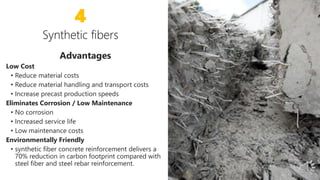
used to build the 57 m high hill
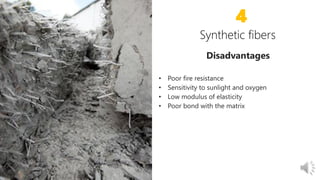
of Aqar Quf (near present-day
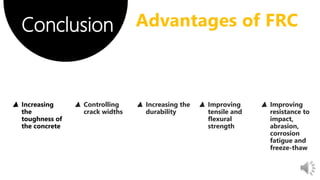
Baghdad) [1].
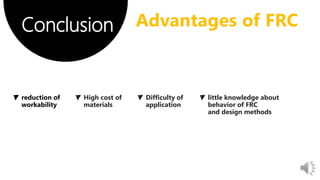
Fibre-reinforced cement-products
were invented in the late 19th
century by the Austrian Ludwig
Hatschek. He mixed 90% cement
and 10% asbestos fibres with water
and ran it through a cardboard
machine, forming strong thin
sheets [2]. Early 1900 saw the use
of asbestos fiber.
In 1950 fiber reinforced concrete
was becoming a field of interest
as asbestos being a health risk
was discovered. The steel and
glass fibers that were used in the
early work on FRC in the 1950s
and 1960s were straight and
smooth [3].
HISTORY
Serious theoretical studies of
FRC began only in the early
1960s, with the work of
Romualdi and his colleagues
[e.g. Romualdi & Batson 1963;
Romualdi & Mandel 1964]. Since
then there was no looking back,
glass, steel, polypropylene fiber
were used in concrete [3-5].
Since 1960s, more complicated
geometries of fibers have been
developed, mainly to modify their
mechanical bonding with the
cementitious matrix. Thus, modern
fibers may have profiled shapes,
hooked or deformed ends [6].
Beside the previous
development, by following
decade, fibers may occur as
bundled filaments or fibrillated
films, or they may be used in
continuous form (mats, woven
fabrics, textiles) [7].
HISTORY
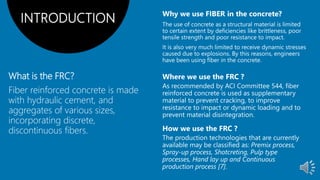
What is the FRC?
Fiber reinforced concrete is made
with hydraulic cement, and
aggregates of various sizes,
incorporating discrete,
discontinuous fibers.
INTRODUCTION
• Properties of fibers
• Properties of matrix
• Properties of application
!
Properties
of fibers
As the main parameter, the
proprieties of fibers could have
an enormous influence on the
FRC properties directly like:
the ratio of length to diameter of a fiber in which the diameter may be an equivalent
diameter. This parameter has an important role in FRC mechanical properties [7].
Properties
of matrix
Properties of
application
Different Types of Fiber Reinforced Concrete
Following are the different type of fibers generally used in the
construction industries.
1 2 3 4
A compilation of mechanical properties of commonly used fibers in concrete materials [7]
Reference ACI 544.5R-10
13
1
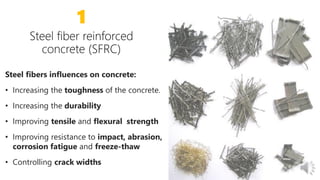
Steel fibers influences on concrete:
• Increasing the toughness of the concrete.
• Increasing the durability
• Improving tensile and flexural strength
• Improving resistance to impact, abrasion,
corrosion fatigue and freeze-thaw
• Controlling crack widths
SFRC
Volume of
fiber
Figure1- Effect of the volume of
steel fibers on the strength and
toughness of SFRC [8].
Volume of
fiber Figure 2-Effect of the volume fraction of fibers
on the compressive stress-strain curve [9].
Volume of
fiber
Figure 3-Effect of reinforcement ratio (Fiber
content) on mean crack spacing [10].
Aspect ratio
of fiber Figure 4-Influence of the aspect ratio of fibers
on the compressive stress-strain curve [9].
Geometry
of fiber
Figure5-Influence of the fiber type on
the force-displacement curves [11].
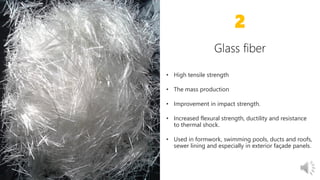
• High tensile strength
• The mass production
• Improvement in impact strength.
• Increased flexural strength, ductility and resistance
to thermal shock.
• Used in formwork, swimming pools, ducts and roofs,
sewer lining and especially in exterior façade panels.
2
GFRC
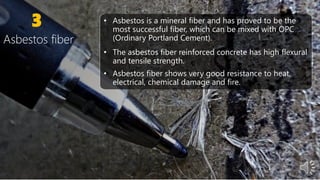
3 • Asbestos is a mineral fiber and has proved to be the
most successful fiber, which can be mixed with OPC
(Ordinary Portland Cement).
• The asbestos fiber reinforced concrete has high flexural
and tensile strength.
• Asbestos fiber shows very good resistance to heat,
electrical, chemical damage and fire.
Asbestos fiber
3
Asbestos fiber
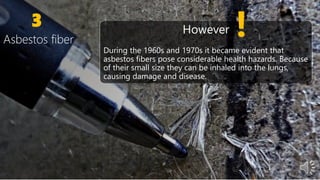
However
During the 1960s and 1970s it became evident that
asbestos fibers pose considerable health hazards. Because
of their small size they can be inhaled into the lungs,
causing damage and disease.
Advantages
Low Cost
• Reduce material costs
• Reduce material handling and transport costs
• Increase precast production speeds
Eliminates Corrosion / Low Maintenance
• No corrosion
• Increased service life
• Low maintenance costs
Environmentally Friendly
• synthetic fiber concrete reinforcement delivers a
70% reduction in carbon footprint compared with
steel fiber and steel rebar reinforcement.
4
25
Disadvantages
• Poor fire resistance
• Sensitivity to sunlight and oxygen
• Low modulus of elasticity
• Poor bond with the matrix
4
Conclusion Advantages of FRC
▲ Controlling
crack widths
▲ Increasing the
durability
▲ Improving
tensile and
flexural
strength
▲ Improving
resistance to
impact,
abrasion,
corrosion
fatigue and
freeze-thaw
Conclusion
▼ High cost of
materials
▼ Difficulty of
application
▼ little knowledge about
behavior of FRC
and design methods
Conclusion Advantages of FRC
APPLICATIONS
Rapid advances in FRC materials technology have
enabled civil engineers to incorporate FRC in a
variety of applications. Such as followings.
!
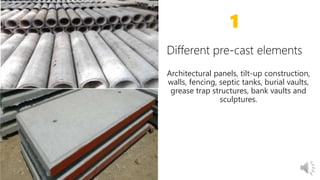
Architectural panels, tilt-up construction,
walls, fencing, septic tanks, burial vaults,
grease trap structures, bank vaults and
sculptures.
1
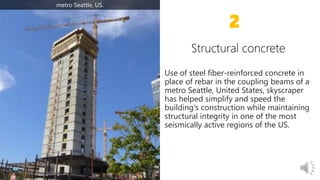
Use of steel fiber-reinforced concrete in
place of rebar in the coupling beams of a
metro Seattle, United States, skyscraper
has helped simplify and speed the
building's construction while maintaining
structural integrity in one of the most
seismically active regions of the US.
2
metro Seattle, US.
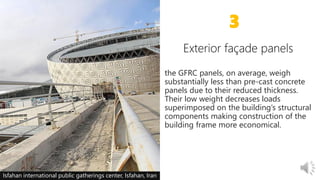
the GFRC panels, on average, weigh
substantially less than pre-cast concrete
panels due to their reduced thickness.
Their low weight decreases loads
superimposed on the building’s structural
components making construction of the
building frame more economical.
3
Isfahan international public gatherings center, Isfahan, Iran
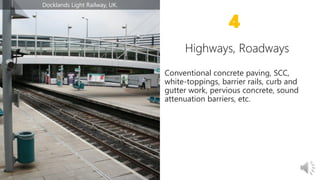
Conventional concrete paving, SCC,
white-toppings, barrier rails, curb and
gutter work, pervious concrete, sound
attenuation barriers, etc.
4
Docklands Light Railway, UK.
Fiber-reinforced concrete promises to
provide a long-term solution to bridge deck
problems [13].
5
Mackenzie River Twin Bridges, Ontario, Canada
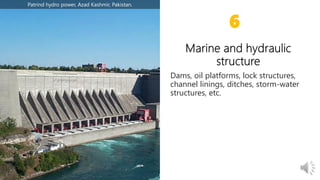
Dams, oil platforms, lock structures,
channel linings, ditches, storm-water
structures, etc.
6
Patrind hydro power, Azad Kashmir, Pakistan.
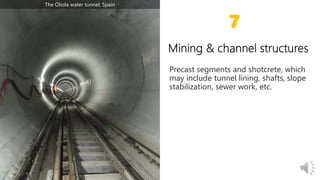
Precast segments and shotcrete, which
may include tunnel lining, shafts, slope
stabilization, sewer work, etc.
7
The Oliola water tunnel, Spain
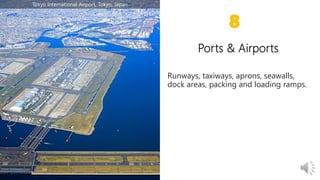
Runways, taxiways, aprons, seawalls,
dock areas, packing and loading ramps.
8
Tokyo International Airport, Tokyo, Japan
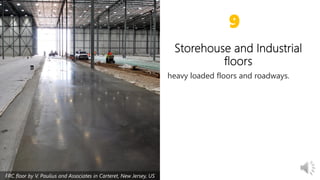
heavy loaded floors and roadways.
9
FRC floor by V. Paulius and Associates in Carteret, New Jersey, US
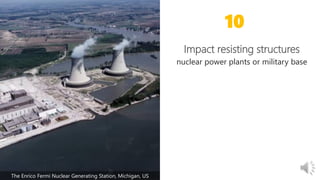
nuclear power plants or military base
Impact resisting structures
10
The Enrico Fermi Nuclear Generating Station, Michigan, US
A new technology
Textile reinforced concrete (TRC) is a composite material consisting of a cement-based
matrix with typically small maximum aggregate grain sizes and high-performance
continuous multifilament yarns made of alkali-resistant (AR) glass, carbon, polymer, or
other materials [14].
TRC
▲Corrosion resistant ▲ Durable concrete ▲Thinner and lighter
elements
TRC Advantages
▲Low transport costs ▲Easier installation and
low labor costs
▲Higher strength
properties in
comparison with steel-
reinforced concrete
Our studies
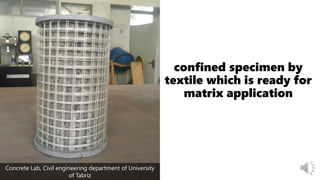
confined specimen by
textile which is ready for
matrix application
Concrete Lab, Civil engineering department of University
of Tabriz
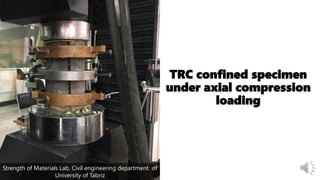
TRC confined specimen
under axial compression
loading
Strength of Materials Lab, Civil engineering department of
University of Tabriz
Research
suggestion
• Investigation on evaluating properties of UHPC (Ultra High
Performance Concrete) with a content of fibers,
• Study about thermal strength of FRC.
• Investigation on bonding properties between fibers and matrix and
how to improve it.
• Investigation on mechanical properties of waste fiber reinforced
concrete.
Any question ?
?
You click here to email me!
nourizadehmilad@gmail.com
References [4] Romualdi, J.P. & Batson, G.B. 1963. Mechanics of
crack arrest in concrete, Journal of Engineering
Mechanics 89: 147-168.
[5] Romualdi, J.P. & Mandel, J.A. 1964. Tensile strength
of concrete affected by uniformly dispersed and
closely spaced short lengths of wire reinforcement,
Journal of the American Concrete Institute 61: 657-
672.
[6] Bentur, A. and Mindess, S., Fiber Reinforced Cementitious
Composites, Elsevier Applied Science, 1990, pp. 1-2.
[7] ACI Committee 544, Report on the Physical Properties and
Durability of Fiber-Reinforced Concrete, American Concrete
Institute, Farmington Hills, MI 48331, 2010.
[8] S.P. Shah and V.B. Rangan, ‘Fiber reinforced concrete
properties’, J. American
Concrete Institute. 68, 1971, 126–135.
[9] ACI Committee 544, Design Considerations for Steel Fiber
Reinforced Concrete, American Concrete Institute, Farmington
Hills, 1999.
[1] R.N. Swamy, ‘Prospects of fibre reinforcement in
structural applications, in Advances in Cement-Matrix
Composites’, Proc. Symp. L, Materials Research Society
General Meeting, Boston, MA, Nov. 1980, Materials Research
Society, University Park, PA (now Pittsburgh, PA), 1980, pp.
159–169.
[2] Ooe. Landesarchiv (ed.), Oberoesterreicher, vol. 2, 1982;
NDB.
[3] Mindess S, ’Thirty years of fibre reinforced concrete
research at the UWM British Colombia’, In
Proceedings of an International Conference on Sustainable
Construction Materials and Technologies (Kraus RN, Naik TR,
Claisse P and Sadeghi-Pouya H (eds)). CBU, University of
Milwaukee, USA.
References
[13] Krstulovic-Opara, N.; Haghayeghi, A. R.; Haidar, M.; and
Krauss, P. D., 1995, “Use of Conventional and High-Performance
Steel Fiber-Reinforced Concrete for Bride Deck
Overlays,” ACI Materials Journal, V. 92, No. 6, Nov.-Dec.,
pp. 669-677.
[14] Brameshuber, W. (Ed.), 2006. Textile reinforced concrete:
report no. 036 of the RILEM
State-of-the-Art Report, RILEM Technical Committee 201-TRC.
[10] R. Deluce, Jordon & J. Vecchio, Frank. (2013). Cracking
behavior of steel fiber-reinforced concrete members
containing conventional reinforcement. ACI Structural
Journal. 110. 481-490.
[11] Tutankhamun Sami Sharif, ’Effect of fiber shape on
mechanical behavior of steel fiber in fiber reinforced
concrete FRC’. African Journal of Physics Vol. 3 (5), pp. 105-
109, May, 2016.
[12] Balaguru, P. and Shah, S. (1992). Fiber-reinforced cement
composites. New York: McGraw-Hill, p.343.
Fiber reinforced concrete

Fiber reinforced concrete

  • 1.
  • 2.
  • 3.
  • 4.
    Approximately 3500 yearsago, sun-baked bricks reinforced with straw or horse hair were used to build the 57 m high hill of Aqar Quf (near present-day Baghdad) [1]. Fibre-reinforced cement-products were invented in the late 19th century by the Austrian Ludwig Hatschek. He mixed 90% cement and 10% asbestos fibres with water and ran it through a cardboard machine, forming strong thin sheets [2]. Early 1900 saw the use of asbestos fiber. In 1950 fiber reinforced concrete was becoming a field of interest as asbestos being a health risk was discovered. The steel and glass fibers that were used in the early work on FRC in the 1950s and 1960s were straight and smooth [3]. HISTORY
  • 5.
    Serious theoretical studiesof FRC began only in the early 1960s, with the work of Romualdi and his colleagues [e.g. Romualdi & Batson 1963; Romualdi & Mandel 1964]. Since then there was no looking back, glass, steel, polypropylene fiber were used in concrete [3-5]. Since 1960s, more complicated geometries of fibers have been developed, mainly to modify their mechanical bonding with the cementitious matrix. Thus, modern fibers may have profiled shapes, hooked or deformed ends [6]. Beside the previous development, by following decade, fibers may occur as bundled filaments or fibrillated films, or they may be used in continuous form (mats, woven fabrics, textiles) [7]. HISTORY
  • 6.
    What is theFRC? Fiber reinforced concrete is made with hydraulic cement, and aggregates of various sizes, incorporating discrete, discontinuous fibers. INTRODUCTION
  • 7.
    • Properties offibers • Properties of matrix • Properties of application !
  • 8.
    Properties of fibers As themain parameter, the proprieties of fibers could have an enormous influence on the FRC properties directly like: the ratio of length to diameter of a fiber in which the diameter may be an equivalent diameter. This parameter has an important role in FRC mechanical properties [7].
  • 9.
  • 10.
  • 11.
    Different Types ofFiber Reinforced Concrete Following are the different type of fibers generally used in the construction industries. 1 2 3 4
  • 12.
    A compilation ofmechanical properties of commonly used fibers in concrete materials [7] Reference ACI 544.5R-10
  • 13.
    13 1 Steel fibers influenceson concrete: • Increasing the toughness of the concrete. • Increasing the durability • Improving tensile and flexural strength • Improving resistance to impact, abrasion, corrosion fatigue and freeze-thaw • Controlling crack widths
  • 14.
  • 15.
    Volume of fiber Figure1- Effectof the volume of steel fibers on the strength and toughness of SFRC [8].
  • 16.
    Volume of fiber Figure2-Effect of the volume fraction of fibers on the compressive stress-strain curve [9].
  • 17.
    Volume of fiber Figure 3-Effectof reinforcement ratio (Fiber content) on mean crack spacing [10].
  • 18.
    Aspect ratio of fiberFigure 4-Influence of the aspect ratio of fibers on the compressive stress-strain curve [9].
  • 19.
    Geometry of fiber Figure5-Influence ofthe fiber type on the force-displacement curves [11].
  • 20.
    • High tensilestrength • The mass production • Improvement in impact strength. • Increased flexural strength, ductility and resistance to thermal shock. • Used in formwork, swimming pools, ducts and roofs, sewer lining and especially in exterior façade panels. 2
  • 21.
  • 22.
    3 • Asbestosis a mineral fiber and has proved to be the most successful fiber, which can be mixed with OPC (Ordinary Portland Cement). • The asbestos fiber reinforced concrete has high flexural and tensile strength. • Asbestos fiber shows very good resistance to heat, electrical, chemical damage and fire. Asbestos fiber
  • 23.
    3 Asbestos fiber However During the1960s and 1970s it became evident that asbestos fibers pose considerable health hazards. Because of their small size they can be inhaled into the lungs, causing damage and disease.
  • 24.
    Advantages Low Cost • Reducematerial costs • Reduce material handling and transport costs • Increase precast production speeds Eliminates Corrosion / Low Maintenance • No corrosion • Increased service life • Low maintenance costs Environmentally Friendly • synthetic fiber concrete reinforcement delivers a 70% reduction in carbon footprint compared with steel fiber and steel rebar reinforcement. 4
  • 25.
    25 Disadvantages • Poor fireresistance • Sensitivity to sunlight and oxygen • Low modulus of elasticity • Poor bond with the matrix 4
  • 26.
    Conclusion Advantages ofFRC ▲ Controlling crack widths ▲ Increasing the durability ▲ Improving tensile and flexural strength ▲ Improving resistance to impact, abrasion, corrosion fatigue and freeze-thaw
  • 27.
    Conclusion ▼ High costof materials ▼ Difficulty of application ▼ little knowledge about behavior of FRC and design methods Conclusion Advantages of FRC
  • 28.
    APPLICATIONS Rapid advances inFRC materials technology have enabled civil engineers to incorporate FRC in a variety of applications. Such as followings. !
  • 29.
    Architectural panels, tilt-upconstruction, walls, fencing, septic tanks, burial vaults, grease trap structures, bank vaults and sculptures. 1
  • 30.
    Use of steelfiber-reinforced concrete in place of rebar in the coupling beams of a metro Seattle, United States, skyscraper has helped simplify and speed the building's construction while maintaining structural integrity in one of the most seismically active regions of the US. 2 metro Seattle, US.
  • 31.
    the GFRC panels,on average, weigh substantially less than pre-cast concrete panels due to their reduced thickness. Their low weight decreases loads superimposed on the building’s structural components making construction of the building frame more economical. 3 Isfahan international public gatherings center, Isfahan, Iran
  • 32.
    Conventional concrete paving,SCC, white-toppings, barrier rails, curb and gutter work, pervious concrete, sound attenuation barriers, etc. 4 Docklands Light Railway, UK.
  • 33.
    Fiber-reinforced concrete promisesto provide a long-term solution to bridge deck problems [13]. 5 Mackenzie River Twin Bridges, Ontario, Canada
  • 34.
    Dams, oil platforms,lock structures, channel linings, ditches, storm-water structures, etc. 6 Patrind hydro power, Azad Kashmir, Pakistan.
  • 35.
    Precast segments andshotcrete, which may include tunnel lining, shafts, slope stabilization, sewer work, etc. 7 The Oliola water tunnel, Spain
  • 36.
    Runways, taxiways, aprons,seawalls, dock areas, packing and loading ramps. 8 Tokyo International Airport, Tokyo, Japan
  • 37.
    heavy loaded floorsand roadways. 9 FRC floor by V. Paulius and Associates in Carteret, New Jersey, US
  • 38.
    nuclear power plantsor military base Impact resisting structures 10 The Enrico Fermi Nuclear Generating Station, Michigan, US
  • 39.
    A new technology Textilereinforced concrete (TRC) is a composite material consisting of a cement-based matrix with typically small maximum aggregate grain sizes and high-performance continuous multifilament yarns made of alkali-resistant (AR) glass, carbon, polymer, or other materials [14]. TRC
  • 40.
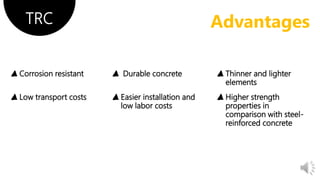
    ▲Corrosion resistant ▲Durable concrete ▲Thinner and lighter elements TRC Advantages ▲Low transport costs ▲Easier installation and low labor costs ▲Higher strength properties in comparison with steel- reinforced concrete
  • 41.
  • 42.
    confined specimen by textilewhich is ready for matrix application Concrete Lab, Civil engineering department of University of Tabriz
  • 43.
    TRC confined specimen underaxial compression loading Strength of Materials Lab, Civil engineering department of University of Tabriz
  • 44.
    Research suggestion • Investigation onevaluating properties of UHPC (Ultra High Performance Concrete) with a content of fibers, • Study about thermal strength of FRC. • Investigation on bonding properties between fibers and matrix and how to improve it. • Investigation on mechanical properties of waste fiber reinforced concrete.
  • 45.
    Any question ? ? Youclick here to email me! nourizadehmilad@gmail.com
  • 46.
    References [4] Romualdi,J.P. & Batson, G.B. 1963. Mechanics of crack arrest in concrete, Journal of Engineering Mechanics 89: 147-168. [5] Romualdi, J.P. & Mandel, J.A. 1964. Tensile strength of concrete affected by uniformly dispersed and closely spaced short lengths of wire reinforcement, Journal of the American Concrete Institute 61: 657- 672. [6] Bentur, A. and Mindess, S., Fiber Reinforced Cementitious Composites, Elsevier Applied Science, 1990, pp. 1-2. [7] ACI Committee 544, Report on the Physical Properties and Durability of Fiber-Reinforced Concrete, American Concrete Institute, Farmington Hills, MI 48331, 2010. [8] S.P. Shah and V.B. Rangan, ‘Fiber reinforced concrete properties’, J. American Concrete Institute. 68, 1971, 126–135. [9] ACI Committee 544, Design Considerations for Steel Fiber Reinforced Concrete, American Concrete Institute, Farmington Hills, 1999. [1] R.N. Swamy, ‘Prospects of fibre reinforcement in structural applications, in Advances in Cement-Matrix Composites’, Proc. Symp. L, Materials Research Society General Meeting, Boston, MA, Nov. 1980, Materials Research Society, University Park, PA (now Pittsburgh, PA), 1980, pp. 159–169. [2] Ooe. Landesarchiv (ed.), Oberoesterreicher, vol. 2, 1982; NDB. [3] Mindess S, ’Thirty years of fibre reinforced concrete research at the UWM British Colombia’, In Proceedings of an International Conference on Sustainable Construction Materials and Technologies (Kraus RN, Naik TR, Claisse P and Sadeghi-Pouya H (eds)). CBU, University of Milwaukee, USA.
  • 47.
    References [13] Krstulovic-Opara, N.;Haghayeghi, A. R.; Haidar, M.; and Krauss, P. D., 1995, “Use of Conventional and High-Performance Steel Fiber-Reinforced Concrete for Bride Deck Overlays,” ACI Materials Journal, V. 92, No. 6, Nov.-Dec., pp. 669-677. [14] Brameshuber, W. (Ed.), 2006. Textile reinforced concrete: report no. 036 of the RILEM State-of-the-Art Report, RILEM Technical Committee 201-TRC. [10] R. Deluce, Jordon & J. Vecchio, Frank. (2013). Cracking behavior of steel fiber-reinforced concrete members containing conventional reinforcement. ACI Structural Journal. 110. 481-490. [11] Tutankhamun Sami Sharif, ’Effect of fiber shape on mechanical behavior of steel fiber in fiber reinforced concrete FRC’. African Journal of Physics Vol. 3 (5), pp. 105- 109, May, 2016. [12] Balaguru, P. and Shah, S. (1992). Fiber-reinforced cement composites. New York: McGraw-Hill, p.343.