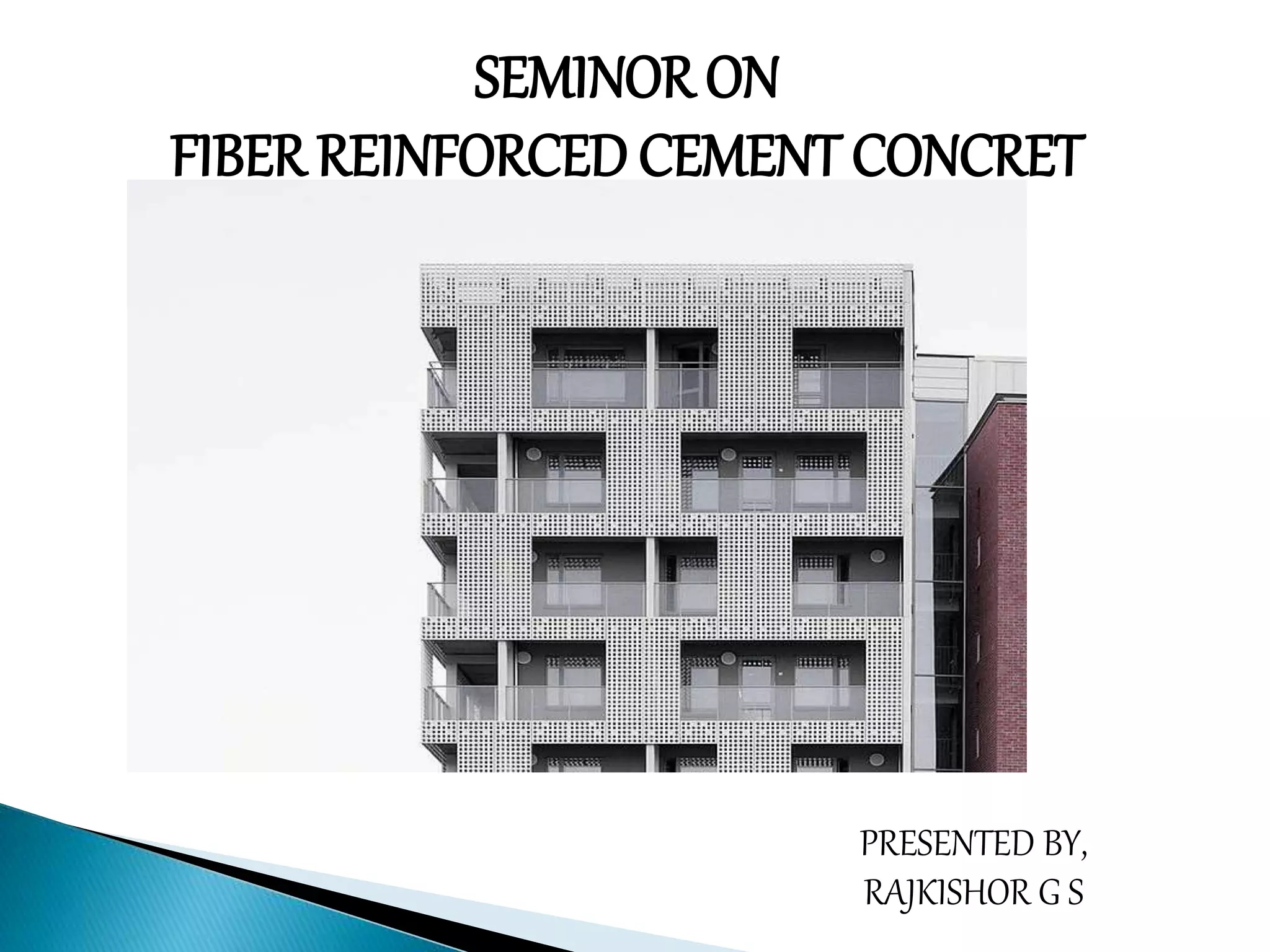
SEMINOR ON
FIBER REINFORCED CEMENT CONCRET
PRESENTED BY,
RAJKISHOR G S
INTRODUCTION:
Fiber-reinforced concrete (FRC) is concrete containing
fibrous material which increases its structural integrity. It
contains short discrete fibers that are uniformly
distributed and randomly oriented.
1. Steel - Fiber reinforced concrete
2. Non –Fiber reinforced concrete
◦ Polypropylene fiber reinforced cement motor and
concrete
◦ Glass fiber reinforced concrete
◦ Asbestos fibers
◦ Carbon fibers
◦ Organic fibers
◦ Vegetables fibers
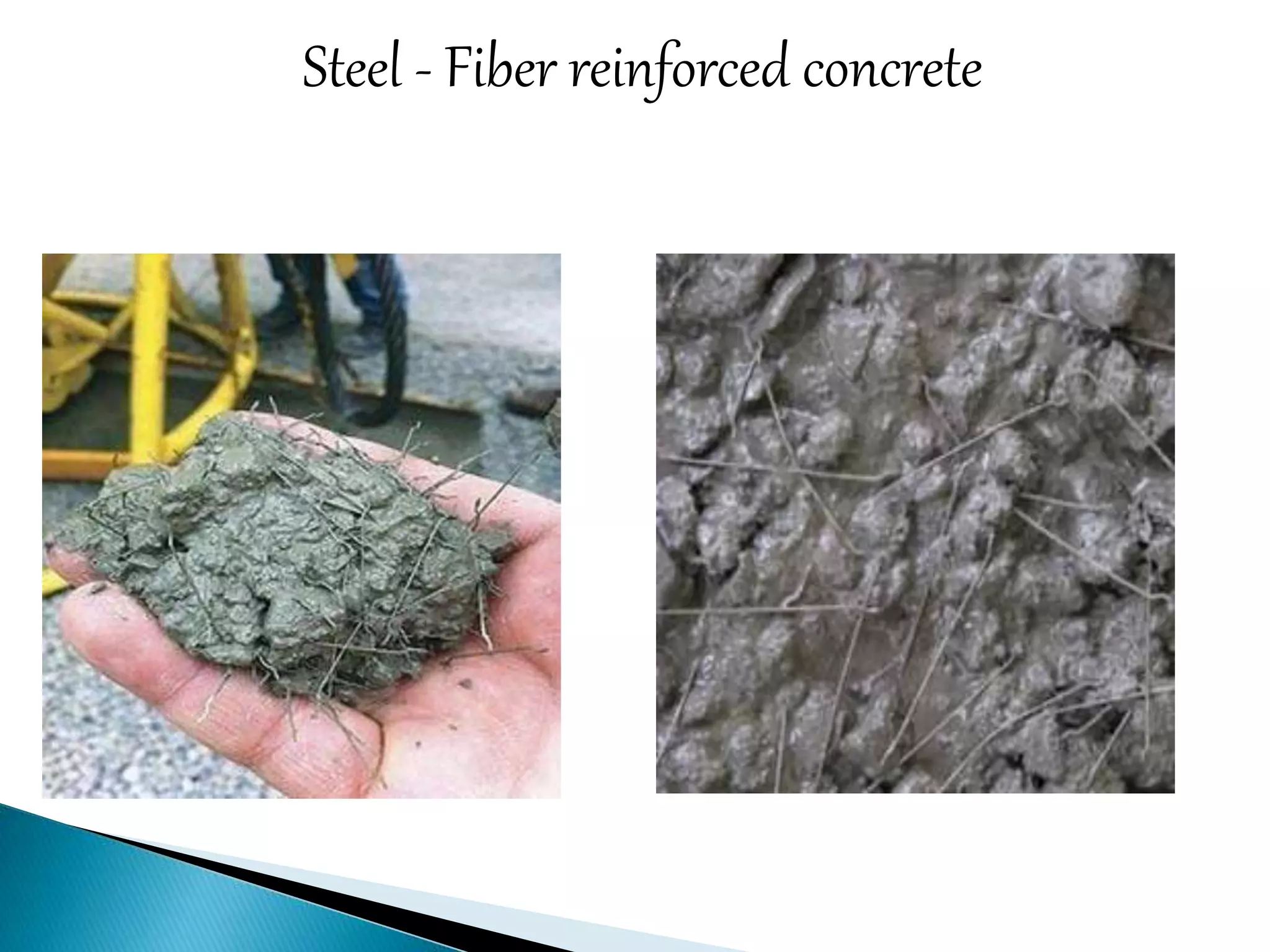
Steel - Fiber reinforced concrete
 A no of steel fiber types are available as reinforcement. Round steel
fiber the commonly used type are produced by cutting round wire in
to short length. The typical diameter lies in the range of 0.25 to
0.75mm. Steel fibers having a rectangular c/s are produced by silting
the sheets about 0.25mm thick.
 Fiber made from mild steel drawn wire. Conforming to IS:280-1976
with the diameter of wire varying from 0.3 to 0.5mm have been
practically used in India.
 Round steel fibers are produced by cutting or chopping the wire, flat
sheet fibers having a typical c/s ranging from 0.15 to 0.41mm in
thickness and 0.25 to 0.90mm in width are produced by silting flat
sheets.
 Deformed fiber, which are loosely bounded with water-soluble
glue in the form of a bundle are also available. Since individual
fibers tend to cluster together, their uniform distribution in the
matrix is often difficult. This may be avoided by adding fibers
bundles, which separate during the mixing process
PROPERTIES OF STEEL – REINFORCED CONCRETE
1. The compressive strength of concrete increases by 20 to 30
percent over plain cement concrete
2. 40mm fiber length irrespective of its diameter gives maximum
cube strength as well as cylindrical strength
3. The compressive strength increases with increase in fiber content
in concrete
4. It the concrete to restrains the internal micro cracks
Glass fibers
Glass fibers is also used in FRC in the form of filaments. Glass
fibers have high tensile strength and high fracture strain, but low
modulus. More ever ordinary borosilicate glass fibers (E-glass) and
soda-lime glass fibers(A-glass) can be easily attacked by alkali
solution in cement based composites and are thus less durable and
should be used with caution. Disadvantages of glass fibers include
low resistance to moisture, sustained loads, and cyclic loads
CARBON FIBERS:
◦ Carbon fibers from the most recent & probability the most
spectacular addition to the range of fiber available for
commercial use. Carbon fiber comes under the very high
modulus of elasticity and flexural strength. These are expansive.
Their strength & stiffness characteristics have been found to be
superior even to those of steel. But they are more vulnerable to
damage than even glass fiber, and hence are generally treated
with resign coating.
PLASTIC FIBERS:
◦ Fibers such as polypropylene, nylon, acrylic, aramid and
polyethylene have high tensile strength but low young's
modulus thus inhibiting reinforcing effect. Polypropylene and
nylon fibers are found to be suitable to increase the impart
strength. Their addition to concrete has shown better
distribute cracking and reduce crack size.
ASBESTOS FIBERS:
◦ Asbestos is a mineral fiber and has proved to be the most
successful fiber, which can be mixed with OPC. The
maximum length of asbestos fiber is 10mm but generally
fibers are shorter than this. The composite has high flexural
strength.
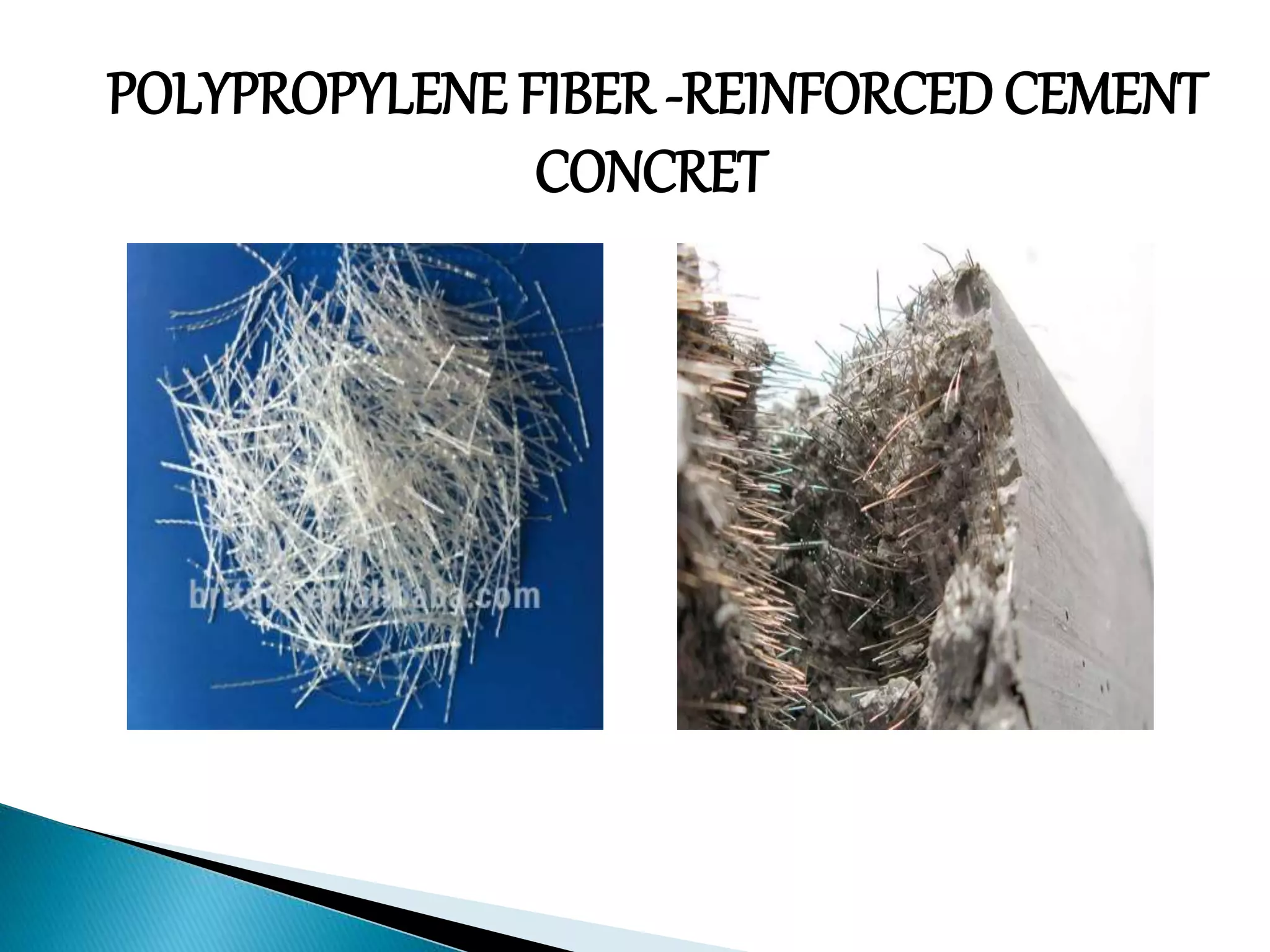
POLYPROPYLENE FIBER -REINFORCED CEMENT
CONCRET
 Polypropylene is one of the cheapest & abundantly available
polymers polypropylene fibers are resistant to most chemical &
it would be cementitious matrix which would deteriorate first
under aggressive chemical attack. Its melting point is high
(about 165 degrees centigrade). So that a working temp. As
(100 degree centigrade) may be sustained for short periods
without detriment to fiber properties.
 Polypropylene fibers being hydrophobic can be easily mixed as
they do not need lengthy contact during mixing and only need
to be evenly distressed in the mix.
 Polypropylene short fibers in small volume fractions between
0.5 to 15 commercially used in concrete.
Main role of fibers is to
◦ Bridge the cracks that develop the concrete
◦ Increase the ductility of concrete elements
◦ Improvement on Post-cracking behavior of concrete
◦ Imparts more resistance to impact load
◦ Controls plastic shrinkage cracking and dry shrinkage
cracking
◦ Lowers the permeability of concrete matrix and thus reduces
the bleeding of concrete
◦ Increase tensile and Impact strength
◦ Improved strain energy and resistance to wear
 Pavements and floors: Due the superior properties of structural
properties of steel fiber reinforced concrete(SFRC) it used for overlays
and over slabbing of roads, pavements, airfields and bridge decks,
industrial and other flooring units those subjected to wear and tear, and
attack due to chemical effects.
 Water retaining structures: overhead water tanks underground sumps
need to be watertight. Fibers contribute to control plastic and dry
shrinkage cracks, resulting in water tightness. The steel fiber concrete
has been successfully used in the repair of spilling basin at tarbela dam
in Pakistan.
 Blast resistance structures: the blast wave will cause complex stressing
of the structure compression, tension and shear. Fiber in conjuction
with conventional reinforcement provides the necessary strength to
structure to resist blast.
 Precast products: The FRC can also be used for the fabrication of
precast products like pipes, boats, beams, wall panels, stair case
steps, roof panels, manhole covers etc.
 Wearing surface to existing bridges and culverts: FRC has been
used as a wearing surface to existing bridges and culverts in
areas especially troubled by degradation caused through
abrasion by studded types.
 Repairs and rehabilitation works: FRC is cohesive and easy to
work provided fibers are thoroughly mixed in the cement
matrix. It is an ideal material for repair and rehabilitation
works.
THANK YOU
PRESENTED BY,
RAJKISHOR G S

Fiber reinforced concrete

  • 1.
    SEMINOR ON FIBER REINFORCEDCEMENT CONCRET PRESENTED BY, RAJKISHOR G S
  • 2.
    INTRODUCTION: Fiber-reinforced concrete (FRC)is concrete containing fibrous material which increases its structural integrity. It contains short discrete fibers that are uniformly distributed and randomly oriented.
  • 3.
    1. Steel -Fiber reinforced concrete 2. Non –Fiber reinforced concrete ◦ Polypropylene fiber reinforced cement motor and concrete ◦ Glass fiber reinforced concrete ◦ Asbestos fibers ◦ Carbon fibers ◦ Organic fibers ◦ Vegetables fibers
  • 4.
    Steel - Fiberreinforced concrete
  • 5.
     A noof steel fiber types are available as reinforcement. Round steel fiber the commonly used type are produced by cutting round wire in to short length. The typical diameter lies in the range of 0.25 to 0.75mm. Steel fibers having a rectangular c/s are produced by silting the sheets about 0.25mm thick.  Fiber made from mild steel drawn wire. Conforming to IS:280-1976 with the diameter of wire varying from 0.3 to 0.5mm have been practically used in India.  Round steel fibers are produced by cutting or chopping the wire, flat sheet fibers having a typical c/s ranging from 0.15 to 0.41mm in thickness and 0.25 to 0.90mm in width are produced by silting flat sheets.
  • 6.
     Deformed fiber,which are loosely bounded with water-soluble glue in the form of a bundle are also available. Since individual fibers tend to cluster together, their uniform distribution in the matrix is often difficult. This may be avoided by adding fibers bundles, which separate during the mixing process PROPERTIES OF STEEL – REINFORCED CONCRETE 1. The compressive strength of concrete increases by 20 to 30 percent over plain cement concrete 2. 40mm fiber length irrespective of its diameter gives maximum cube strength as well as cylindrical strength 3. The compressive strength increases with increase in fiber content in concrete 4. It the concrete to restrains the internal micro cracks
  • 7.
  • 8.
    Glass fibers isalso used in FRC in the form of filaments. Glass fibers have high tensile strength and high fracture strain, but low modulus. More ever ordinary borosilicate glass fibers (E-glass) and soda-lime glass fibers(A-glass) can be easily attacked by alkali solution in cement based composites and are thus less durable and should be used with caution. Disadvantages of glass fibers include low resistance to moisture, sustained loads, and cyclic loads
  • 9.
  • 10.
    ◦ Carbon fibersfrom the most recent & probability the most spectacular addition to the range of fiber available for commercial use. Carbon fiber comes under the very high modulus of elasticity and flexural strength. These are expansive. Their strength & stiffness characteristics have been found to be superior even to those of steel. But they are more vulnerable to damage than even glass fiber, and hence are generally treated with resign coating.
  • 11.
  • 12.
    ◦ Fibers suchas polypropylene, nylon, acrylic, aramid and polyethylene have high tensile strength but low young's modulus thus inhibiting reinforcing effect. Polypropylene and nylon fibers are found to be suitable to increase the impart strength. Their addition to concrete has shown better distribute cracking and reduce crack size.
  • 13.
  • 14.
    ◦ Asbestos isa mineral fiber and has proved to be the most successful fiber, which can be mixed with OPC. The maximum length of asbestos fiber is 10mm but generally fibers are shorter than this. The composite has high flexural strength.
  • 15.
  • 16.
     Polypropylene isone of the cheapest & abundantly available polymers polypropylene fibers are resistant to most chemical & it would be cementitious matrix which would deteriorate first under aggressive chemical attack. Its melting point is high (about 165 degrees centigrade). So that a working temp. As (100 degree centigrade) may be sustained for short periods without detriment to fiber properties.  Polypropylene fibers being hydrophobic can be easily mixed as they do not need lengthy contact during mixing and only need to be evenly distressed in the mix.  Polypropylene short fibers in small volume fractions between 0.5 to 15 commercially used in concrete.
  • 17.
    Main role offibers is to ◦ Bridge the cracks that develop the concrete ◦ Increase the ductility of concrete elements ◦ Improvement on Post-cracking behavior of concrete ◦ Imparts more resistance to impact load ◦ Controls plastic shrinkage cracking and dry shrinkage cracking ◦ Lowers the permeability of concrete matrix and thus reduces the bleeding of concrete ◦ Increase tensile and Impact strength ◦ Improved strain energy and resistance to wear
  • 18.
     Pavements andfloors: Due the superior properties of structural properties of steel fiber reinforced concrete(SFRC) it used for overlays and over slabbing of roads, pavements, airfields and bridge decks, industrial and other flooring units those subjected to wear and tear, and attack due to chemical effects.  Water retaining structures: overhead water tanks underground sumps need to be watertight. Fibers contribute to control plastic and dry shrinkage cracks, resulting in water tightness. The steel fiber concrete has been successfully used in the repair of spilling basin at tarbela dam in Pakistan.  Blast resistance structures: the blast wave will cause complex stressing of the structure compression, tension and shear. Fiber in conjuction with conventional reinforcement provides the necessary strength to structure to resist blast.
  • 19.
     Precast products:The FRC can also be used for the fabrication of precast products like pipes, boats, beams, wall panels, stair case steps, roof panels, manhole covers etc.  Wearing surface to existing bridges and culverts: FRC has been used as a wearing surface to existing bridges and culverts in areas especially troubled by degradation caused through abrasion by studded types.  Repairs and rehabilitation works: FRC is cohesive and easy to work provided fibers are thoroughly mixed in the cement matrix. It is an ideal material for repair and rehabilitation works.
  • 20.