ConcreteTechnology
Special Concrete And Concreting Method
Group Members
No. NAME ENROLLMENT NO.
1. PATEL KRISHNA J. 151100106046
2. PATEL PRINCE D. 151100106060
3. PATELTWINKLEV. 151100106063
4. PATEL ZENI K. 151100106066
5. PATEL RUTVIJ G. 151100106073
INTRODUCTION
• Special concretes are the concrete prepared for specific purpose like light
weight, high density, fire protection, radiation shielding etc. concrete is a
versatile material possessing good compressive strength. But it suffers from
many drawbacks like low tensile strength, permeability to liquids, corrosion
of reinforcement, susceptibility to chemical attack and low durability.
• Modification have been made from time to time to overcome the
deficiencies of cement concrete.The recent developments in the material
and construction technology have led to significant changes resulting in
improved performance, wider and more economical use.
• Research work is going on in various concrete research laboratories to get
improvement in the performance of concrete.
• Attempts are being made for improvements in the following areas.
• Improvement in mechanical properties like compressive strength, tensile
strength, impact resistance.
• Improvement in durability in terms of increased chemical and freezing
resistances.
• Improvements in impermeability, thermal insulation, abrasion, skid
resistance etc.
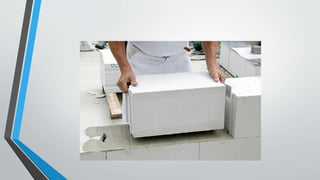
LIGHT WEIGHT CONCRETE
• The density of conventional concrete is in order of 2200 to 2600 kg/m 3.This heavy
self weight will make it uneconomical structural material.The dead weight of the
structure made up of this concrete is large compared to the imposed load to be
carried. A small reduction in dead weight for structural members like slab, beam
and column in high-rise buildings, results in considerable saving in money and
manpower.
• Attempts have been made in the past to reduce the self weight of the concrete to
increase the efficiency of concrete as a structural material.The light weight
concrete with density in the range of 300 to 1900 kg/ m3 have been successfully
developed.
The LightWeight Concrete OffersThe Following
Advantage
• Reduction of Dead Load
• Smaller section of structural members can be adopted.
• Lower haulage and handling costs.
• Increase in the progress of work.
• Reduction of foundation costs, particularly in the case of weak soil and tall
structures.
• Light weight concrete has a lower thermal conductivity. In case of buildings
where air conditioning is to be installed, the use of light weight concrete will
result in better thermal comforts and lower power consumption.
• The use of light weight concrete gives an outlet for industrial wastes such as
fly ash, clinkers, slag etc. which otherwise create problem for disposal.
• It offers great fire resistance.
• Light weight concrete gives overall economy.
• The lower modulus of elasticity and adequate ductility of light weight
concrete may be advantageous in the seismic design of structures.
LightWeight Aggregate Concrete
Natural light weight
aggregate
• Pumice
• Scoria
• Rice husk
• Saw dust
• Diatomite
• Volcanic tuff
• Foamed lava
Artificial Light Weight Aggregates
• Sintered fly ash
• Formed slag
• Bloated clay
• Artificial cinders
• Expanded clay, slate, shale
• Coke breeze
• Expanded perlite
• Exfoliated vermiculite
Aerated Concrete
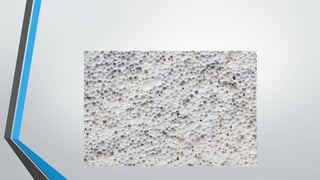
• The aerated concrete is made by introducing air or gas bubbles into the plastic
cement mortar mix to produce a material with a cellular structure, somewhat
similar to sponge rubber . It is also known as ‘ Gas Concrete’ or ‘Foam Concrete’ or ‘
Cellular Concrete’. It is a mixture of water, cement and finely crushed sand.
• The aerated concrete is different from air entrained concretes, through in both
cases air is introduced into the material. Air entrained concrete contains a much
lower proportion of air and is in fact a heavy concrete whereas the amount of
aeration is more in cellular concrete and it is weight concrete.
• The cellular concrete may or may not contain coarse aggregates.The densities
generally range from 300 kg/ m3 to 1000 kg / m3. lower density grades are used for
insulation purposes, medium density grades are used for the manufacture of
prefabricated structural members.
No Fines Concrete
• ‘ No fines concrete’ is obtained by omitting fine aggregate fraction (below 12 mm)
from the conventional concrete. It consists of cement, coarse aggregates and
water only. Cement Content is correspondingly increased.Very often only single
sized coarse aggregate, of size passing through 20 mm and retained on 10 mm is
used. By using single sized aggregate, voids can be increased.The actual void
content may vary between 30 to 40 percent depending upon the degree of
consolidation of concrete.
• No fines concrete is generally made with the aggregate/ cement ratio 6:1 to 10:1.
The water/ cement ratio for satisfactory consistency will vary between 0.38 to 0.50.
The strength of no fines concrete is dependent on the water/ cement ratio,
aggregate/ cement ratio and unit weight of concrete.
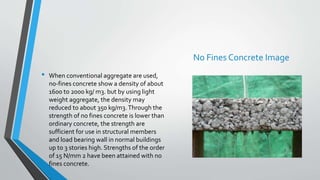
• When conventional aggregate are used,
no-fines concrete show a density of about
1600 to 2000 kg/ m3. but by using light
weight aggregate, the density may
reduced to about 350 kg/m3.Through the
strength of no fines concrete is lower than
ordinary concrete, the strength are
sufficient for use in structural members
and load bearing wall in normal buildings
up to 3 stories high. Strengths of the order
of 15 N/mm 2 have been attained with no
fines concrete.
No Fines Concrete Image
HIGH DENSITY CONCRETE
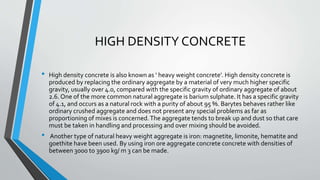
• High density concrete is also known as ‘ heavy weight concrete’. High density concrete is
produced by replacing the ordinary aggregate by a material of very much higher specific
gravity, usually over 4.0, compared with the specific gravity of ordinary aggregate of about
2.6. One of the more common natural aggregate is barium sulphate. It has a specific gravity
of 4.1, and occurs as a natural rock with a purity of about 95 %. Barytes behaves rather like
ordinary crushed aggregate and does not present any special problems as far as
proportioning of mixes is concerned.The aggregate tends to break up and dust so that care
must be taken in handling and processing and over mixing should be avoided.
• Another type of natural heavy weight aggregate is iron: magnetite, limonite, hematite and
goethite have been used. By using iron ore aggregate concrete concrete with densities of
between 3000 to 3900 kg/ m 3 can be made.
HIGH DENSITY CONCRETE
IMAGE
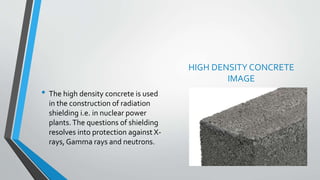
• The high density concrete is used
in the construction of radiation
shielding i.e. in nuclear power
plants.The questions of shielding
resolves into protection against X-
rays, Gamma rays and neutrons.
MASS CONCRETE
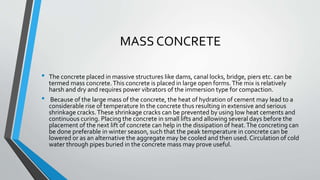
• The concrete placed in massive structures like dams, canal locks, bridge, piers etc. can be
termed mass concrete.This concrete is placed in large open forms.The mix is relatively
harsh and dry and requires power vibrators of the immersion type for compaction.
• Because of the large mass of the concrete, the heat of hydration of cement may lead to a
considerable rise of temperature In the concrete thus resulting in extensive and serious
shrinkage cracks.These shrinkage cracks can be prevented by using low heat cements and
continuous curing. Placing the concrete in small lifts and allowing several days before the
placement of the next lift of concrete can help in the dissipation of heat.The concreting can
be done preferable in winter season, such that the peak temperature in concrete can be
lowered or as an alternative the aggregate may be cooled and then used. Circulation of cold
water through pipes buried in the concrete mass may prove useful.
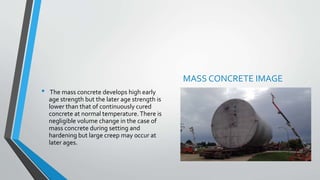
• The mass concrete develops high early
age strength but the later age strength is
lower than that of continuously cured
concrete at normal temperature.There is
negligible volume change in the case of
mass concrete during setting and
hardening but large creep may occur at
later ages.
MASS CONCRETE IMAGE
PLUM CONCRETE
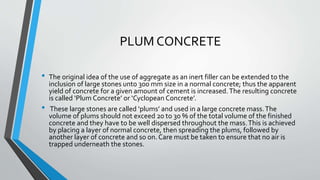
• The original idea of the use of aggregate as an inert filler can be extended to the
inclusion of large stones unto 300 mm size in a normal concrete; thus the apparent
yield of concrete for a given amount of cement is increased.The resulting concrete
is called ‘Plum Concrete’ or ‘Cyclopean Concrete’.
• These large stones are called ‘plums’ and used in a large concrete mass.The
volume of plums should not exceed 20 to 30 % of the total volume of the finished
concrete and they have to be well dispersed throughout the mass.This is achieved
by placing a layer of normal concrete, then spreading the plums, followed by
another layer of concrete and so on. Care must be taken to ensure that no air is
trapped underneath the stones.
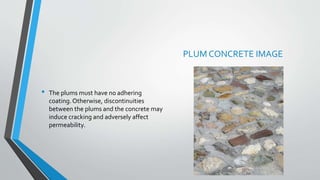
• The plums must have no adhering
coating.Otherwise, discontinuities
between the plums and the concrete may
induce cracking and adversely affect
permeability.
PLUM CONCRETE IMAGE
FIBER REINFORCED CONCRETE [FRC]
• In conventional concrete, micro-cracks develop even before loading because of
drying shrinkage and other causes of volume change. When the structure is loaded,
the micro cracks open up and propagate.The development of such micro-cracks is
the main reason of inelastic deformation in concrete.
• The weakness can be removed by inclusion of small, closely spaced and uniformly
dispersed fibers in concrete.The addition of fibers in concrete substantially
improve its static and dynamic properties.These fibers offer increased resistance
to crack growth, through a crack arresting mechanism and improve tensile
strength and ductility of concrete.
TYPES OF FIBER
• Steel Fibers
• Glass Fiber
• Plastic Fibers
• Carbon Fibers
• Asbestos Fibers
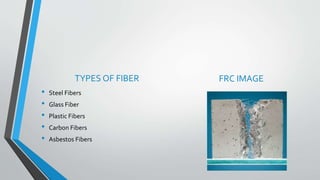
FRC IMAGE
Steel Fibers
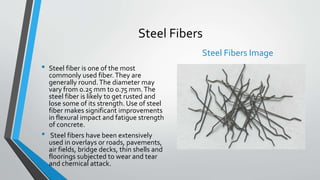
• Steel fiber is one of the most
commonly used fiber.They are
generally round.The diameter may
vary from 0.25 mm to 0.75 mm.The
steel fiber is likely to get rusted and
lose some of its strength. Use of steel
fiber makes significant improvements
in flexural impact and fatigue strength
of concrete.
• Steel fibers have been extensively
used in overlays or roads, pavements,
air fields, bridge decks, thin shells and
floorings subjected to wear and tear
and chemical attack.
Steel Fibers Image
Glass Fiber
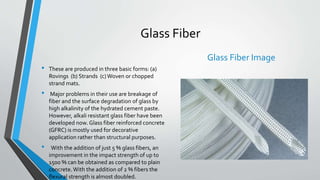
• These are produced in three basic forms: (a)
Rovings (b) Strands (c)Woven or chopped
strand mats.
• Major problems in their use are breakage of
fiber and the surface degradation of glass by
high alkalinity of the hydrated cement paste.
However, alkali resistant glass fiber have been
developed now. Glass fiber reinforced concrete
(GFRC) is mostly used for decorative
application rather than structural purposes.
• With the addition of just 5 % glass fibers, an
improvement in the impact strength of up to
1500 % can be obtained as compared to plain
concrete.With the addition of 2 % fibers the
flexural strength is almost doubled.
Glass Fiber Image
Plastic Fiber
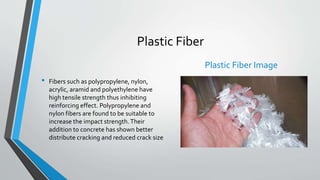
• Fibers such as polypropylene, nylon,
acrylic, aramid and polyethylene have
high tensile strength thus inhibiting
reinforcing effect. Polypropylene and
nylon fibers are found to be suitable to
increase the impact strength.Their
addition to concrete has shown better
distribute cracking and reduced crack size
Plastic Fiber Image
Carbon Fiber
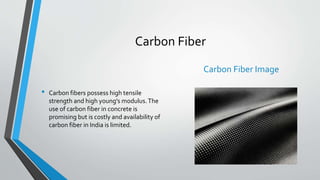
• Carbon fibers possess high tensile
strength and high young’s modulus.The
use of carbon fiber in concrete is
promising but is costly and availability of
carbon fiber in India is limited.
Carbon Fiber Image
Asbestos Fiber
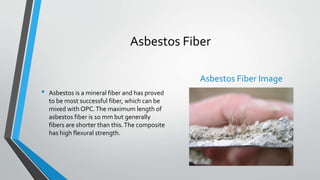
• Asbestos is a mineral fiber and has proved
to be most successful fiber, which can be
mixed with OPC.The maximum length of
asbestos fiber is 10 mm but generally
fibers are shorter than this.The composite
has high flexural strength.
Asbestos Fiber Image
POLYMER CONCRETE
• Concrete containing polymers can be classified into three categories,
namely:
• (a) Polymer- Impregnated Concrete (PIC)
• (b) Polymer Portland Cement Concrete (PPCC)
• (c) Polymer Concrete (PC)
Polymer- Impregnated Concrete (PIC)
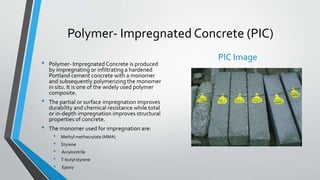
• Polymer- Impregnated Concrete is produced
by impregnating or infiltrating a hardened
Portland cement concrete with a monomer
and subsequently polymerizing the monomer
in situ. It is one of the widely used polymer
composite.
• The partial or surface impregnation improves
durability and chemical resistance while total
or in-depth impregnation improves structural
properties of concrete.
• The monomer used for impregnation are:
• Methyl methacrylate (MMA)
• Styrene
• Acrylonitrile
• T-butyl styrene
• Epoxy
PIC Image
Polymer Portland Cement Concrete (PPCC)
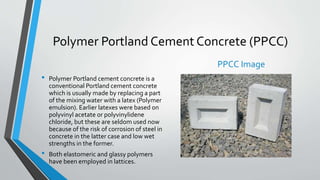
• Polymer Portland cement concrete is a
conventional Portland cement concrete
which is usually made by replacing a part
of the mixing water with a latex (Polymer
emulsion). Earlier latexes were based on
polyvinyl acetate or polyvinylidene
chloride, but these are seldom used now
because of the risk of corrosion of steel in
concrete in the latter case and low wet
strengths in the former.
• Both elastomeric and glassy polymers
have been employed in lattices.
PPCC Image
Polymer Concrete (PC)
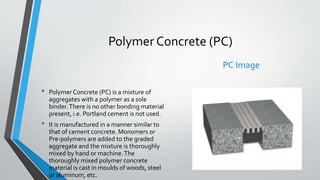
• Polymer Concrete (PC) is a mixture of
aggregates with a polymer as a sole
binder.There is no other bonding material
present, i.e. Portland cement is not used.
• It is manufactured in a manner similar to
that of cement concrete. Monomers or
Pre-polymers are added to the graded
aggregate and the mixture is thoroughly
mixed by hand or machine.The
thoroughly mixed polymer concrete
material is cast in moulds of woods, steel
or aluminum, etc.
PC Image
FERRO CEMENT
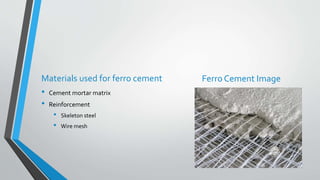
• Ferro cement is a relatively new material consisting of wire meshes and
cement mortar. It consists of closely spaced wire meshes which are
impregnated with rich cement mortar mix.While the mortar provides the
mass, the wire mesh imparts tensile strength and ductility to the material.
The Ferro cement possess high resistance against cracking, high fatigue
resistance higher toughness and higher impermeability.
Materials used for ferro cement Ferro Cement Image
• Cement mortar matrix
• Reinforcement
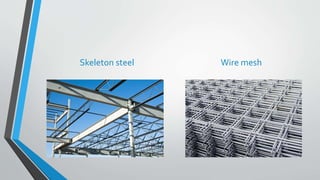
• Skeleton steel
• Wire mesh
Skeleton steel Wire mesh
HIGH STRENGTH CONCRETE
• Based on the compressive strength; concrete is normally classified as normal strength
concrete, high strength concrete and ultra strength concrete. Indian standard
recommended methods of mix design denotes the boundary at 35 Mpa between normal
strength and high strength concrete.
• The advent of prestressed concrete techniques has given impetus for making concrete of
higher strength. High strength concrete is necessary for the construction of high rise
building and long span bridges.
• To achieve high strength, it necessary to use high cement content with the lowest possible
W/C ratio which invariable affect the workability of the mix. It should be remembered that
high cement content may liberate large heat of hydration causing rise in temperature
which may affect setting and may result in excessive shrinkage.
• Various methods of producing high strength concrete are:
1. Seeding
2. Revibration
3.Inhibiting Cracks
4.Using admixtures
5.Sulphur impregnation
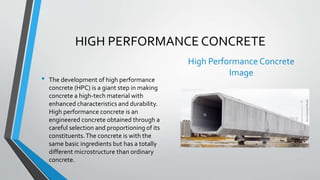
HIGH PERFORMANCE CONCRETE
• The development of high performance
concrete (HPC) is a giant step in making
concrete a high-tech material with
enhanced characteristics and durability.
High performance concrete is an
engineered concrete obtained through a
careful selection and proportioning of its
constituents.The concrete is with the
same basic ingredients but has a totally
different microstructure than ordinary
concrete.
High Performance Concrete
Image
PRECAST CONCRETE
• When mass concrete work is required for huge and speedy construction
work, precast concrete is used. Precast concrete elements are
manufactured in industries and transported to site.They are casted in
separate forms and placed in the structure on site.
• Hollow and solids concrete blocks of desired shape and size are prepared
and cured in water tanks at industrial sheds and then placed on site.
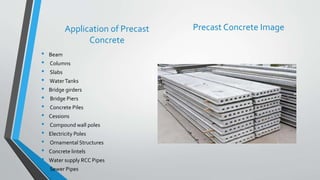
Application of Precast
Concrete
• Beam
• Columns
• Slabs
• WaterTanks
• Bridge girders
• Bridge Piers
• Concrete Piles
• Cessions
• Compound wall poles
• Electricity Poles
• Ornamental Structures
• Concrete lintels
• Water supply RCC Pipes
• Sewer Pipes
Precast Concrete Image
FLY ASH CONCRETE
• Fly ash concrete is an eco-friendly construction material in which fly ash
replaces a part of Portland cement.
• But IS:456 – 2000 and ACI:318 allows replacement of OPC by Fly ash up to
35% only as binding material.
• High volume fly ash concrete is a concrete where a replacement of about
35% or more of cement is made with the usage of fly ash.
• Fly ash is a finely divided byproduct resulting from the combustion of coal in
power plants.
• It contains large amounts of silica, alumina and small amount of unburned
carbon, which pollutes environment.
• It is grey in color and alkaline in nature.
• The particle size ranges between 1-100 microns.
• The specific gravity of FA lies between 1.9 and 2.8 (generally 3.15 for
Cement).
• The surface area is typically 300–500 m2/kg, although some FA can have a
surface area as high as 700 m2/kg ( around 330 m2/kg for Cement )
• The mass per unit volume including air between particles ( density ) can vary
from 540 to 860 kg/m3.
PUMPED CONCRETE
• A concrete which can be pushed through a pipeline is called pumpable concrete.
The Concrete mix is designed in such a manner that it does not wedge while
flowing and its friction at the inner wall of the pipe line does not become very high.
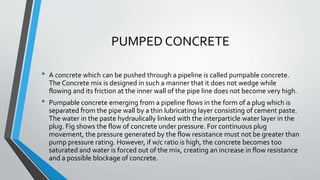
• Pumpable concrete emerging from a pipeline flows in the form of a plug which is
separated from the pipe wall by a thin lubricating layer consisting of cement paste.
The water in the paste hydraulically linked with the interparticle water layer in the
plug. Fig shows the flow of concrete under pressure. For continuous plug
movement, the pressure generated by the flow resistance must not be greater than
pump pressure rating. However, if w/c ratio is high, the concrete becomes too
saturated and water is forced out of the mix, creating an increase in flow resistance
and a possible blockage of concrete.
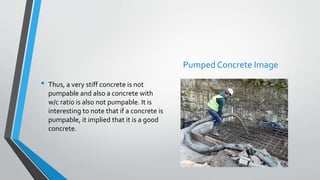
• Thus, a very stiff concrete is not
pumpable and also a concrete with
w/c ratio is also not pumpable. It is
interesting to note that if a concrete is
pumpable, it implied that it is a good
concrete.
Pumped Concrete Image
SHOTCRETE OR GUNITING
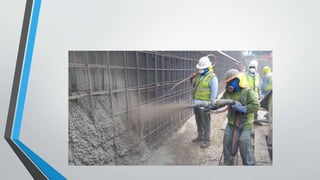
• ‘Shortcrete’ or ‘Gunite’ is a mortar or a fine concrete that is pneumatically
transported through a hose and projected on to a surface at a high velocity.
• This system is called by different names in different countries such as Blastcretes,
guncrete, Jet-crete, nucrete, spraycrete etc. though the principle is essentially the
same.This system is very well suited for construction of lightly reinforced, thin
sections, Shortcrete is more economical than conventional concrete because of
less formwork requirements, requiring a small portable plant for manufacturing
and placement.The force of the jet impacting on the surface compart the material.
Sometimes set accelerators are used to assist overhead placing.The newely
developed ‘ Redi-set cement’ can also be used for shortcreting process.
UNDER WATER CONCRETE
• Special precautions should be taken whenever concrete is to be placed
under water. Such a concrete should have cement content 450 kg/m3
of concrete and a slump of 10 to 17.5 cm.
• The methods used for placing concrete under water are:
• Bagged Concrete
• Bottom dump bucket
• Tromie
• Grouted aggregate
• Concrete pump.
Bagged Concrete
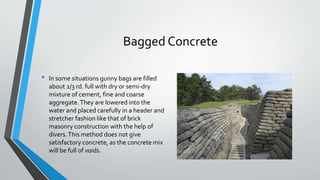
• In some situations gunny bags are filled
about 2/3 rd. full with dry or semi-dry
mixture of cement, fine and coarse
aggregate.They are lowered into the
water and placed carefully in a header and
stretcher fashion like that of brick
masonry construction with the help of
divers.This method does not give
satisfactory concrete, as the concrete mix
will be full of voids.
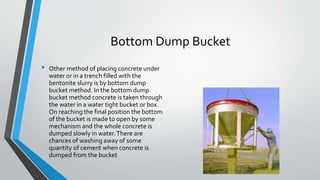
Bottom Dump Bucket
• Other method of placing concrete under
water or in a trench filled with the
bentonite slurry is by bottom dump
bucket method. In the bottom dump
bucket method concrete is taken through
the water in a water tight bucket or box.
On reaching the final position the bottom
of the bucket is made to open by some
mechanism and the whole concrete is
dumped slowly in water.There are
chances of washing away of some
quantity of cement when concrete is
dumped from the bucket
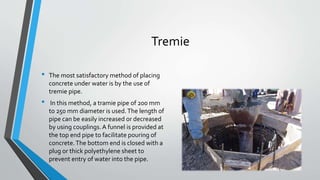
Tremie
• The most satisfactory method of placing
concrete under water is by the use of
tremie pipe.
• In this method, a tramie pipe of 200 mm
to 250 mm diameter is used.The length of
pipe can be easily increased or decreased
by using couplings.A funnel is provided at
the top end pipe to facilitate pouring of
concrete.The bottom end is closed with a
plug or thick polyethylene sheet to
prevent entry of water into the pipe.
Grouted Aggregate
• Another method of placing concrete under water is the grouting of pre-packed
aggregate. Coarse aggregate is dumped in the forms to assume full dimension of
the concrete mass. Cement mortar grout is injected through pipes, which extend
up to the bottom of the aggregate bed.The pipes are slowly withdrawn as grouting
proceeds.The grout forces the water out of the forms and fills the interstices in the
aggregate.This method, however, has been used very little. For plugging the well
foundation this method is often adopted.
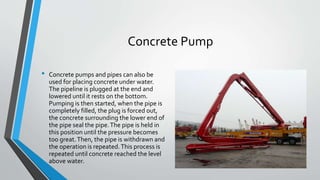
Concrete Pump
• Concrete pumps and pipes can also be
used for placing concrete under water.
The pipeline is plugged at the end and
lowered until it rests on the bottom.
Pumping is then started, when the pipe is
completely filled, the plug is forced out,
the concrete surrounding the lower end of
the pipe seal the pipe.The pipe is held in
this position until the pressure becomes
too great.Then, the pipe is withdrawn and
the operation is repeated.This process is
repeated until concrete reached the level
above water.
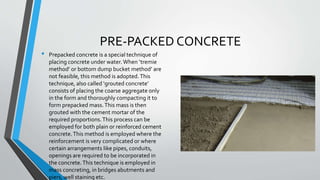
PRE-PACKED CONCRETE
• Prepacked concrete is a special technique of
placing concrete under water. When ‘tremie
method’ or bottom dump bucket method’ are
not feasible, this method is adopted.This
technique, also called ‘grouted concrete’
consists of placing the coarse aggregate only
in the form and thoroughly compacting it to
form prepacked mass.This mass is then
grouted with the cement mortar of the
required proportions.This process can be
employed for both plain or reinforced cement
concrete.This method is employed where the
reinforcement is very complicated or where
certain arrangements like pipes, conduits,
openings are required to be incorporated in
the concrete.This technique is employed in
mass concreting, in bridges abutments and
piers, well staining etc.
VACUME CONCRETE
• Whenever thin section like slabs and walls have to be concreted, it is necessary to
adopt a fluid mix with water-cement ratio 0.5 to 0.65 to facilitate the placing and
compaction. Such a mix will lead to a concrete of relatively low strength and poor
abrasion resistance. In such situations vacuum treatment of concrete is a solution.
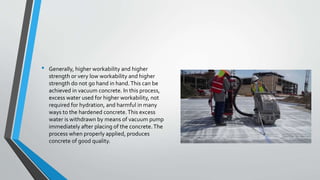
• A considerable part of excess water and air are removed by suction through a mat
connected to a vacuum pump.An arrangement for vacuum treatment of concrete
using suction through a surface mat connected to a vacuum pump is shown in fig.
• Generally, higher workability and higher
strength or very low workability and higher
strength do not go hand in hand.This can be
achieved in vacuum concrete. In this process,
excess water used for higher workability, not
required for hydration, and harmful in many
ways to the hardened concrete.This excess
water is withdrawn by means of vacuum pump
immediately after placing of the concrete.The
process when properly applied, produces
concrete of good quality.
COLD-WEATHER CONCRETE
• The production of concrete in cold weather introduces many problems such
as delay in setting and hardening, damage to concrete in plastic condition
due to the formation of ice lenses. Hence, it is essential to maintain the
temperature of the concrete above 5 0 C. it is generally accepted that there
is little cement hydration and strength gain if concrete is frozen and kept
frozen below 10 0 C.Therefore, fresh concrete must be protected against
disruptive expansion by freezing until adequate strength has been gained.
The effect of cold weather on concrete are as
follows:
• Delay Setting
• The rate of hydration of cement depends upon the ambient temperature. If the
ambient temperature is low, hydration process will go slow and concrete takes a longer
time to set and to develop strength.The setting period necessary before removal of
formwork is thus increased.The rate of progress of work will be slow.Although the
initial strength of concrete is lower, the ultimate strength will not be severely affected.
• Freezing of concrete at early age
• When the temperature of concrete falls below freezing point, the fee water held in the
plastic concrete freezes. Due to freezing of water, concrete expands and hydration of
cement will be stopped.This will result in considerable loss of strength
• Freezing andThawing
• When concrete is subjected to alternate cycles of freezing and thawing, its durability is
greatly impaired. It has been found that even one cycle of freezing and thawing during
the pre-hardening period may reduce the compressive strength to 50 % of what would
be expected for normal temperature concrete.
• Stresses due to temperature differential
• In case of mass concreting in cold weather there will be a large temperature differential
due to high temperature inside the mass, which may promote micro cracking and has a
harmful effect on durability of concrete.
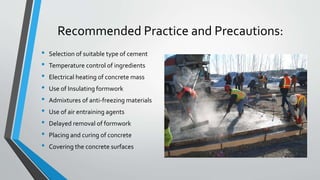
Recommended Practice and Precautions:
• Selection of suitable type of cement
• Temperature control of ingredients
• Electrical heating of concrete mass
• Use of Insulating formwork
• Admixtures of anti-freezing materials
• Use of air entraining agents
• Delayed removal of formwork
• Placing and curing of concrete
• Covering the concrete surfaces
HOT-WEATHER CONCRETING
• Concreting in hot weathers specially in tropical countries and desert areas,
where the temperature above 40 0 C are reached, poses some problems.
High temperature and reduced relative humidity are the main climatic
factors affecting concrete. In India, most of the areas are in tropical regions.
The procedure of concreting in hot-weather is set out in IS: 7861: 1975
The effect of hot-weather are as follows:
• Rapid rate of hydration
• A higher temperature results in a more rapid hydration leading to quick setting, thus
reducing the handling time of concrete and also the strength of hardened concrete.
With the increase in the temperature of concrete, the workability of concrete
decreases and water demand increases.The addition of water without proper
adjustment in the mix proportions adversely affects the ultimate quality of concrete.
• Rapid evaporation of mixing water
• As mentioned earlier, due to high ambient temperature, the water mixed with the
concrete to give the required workability will be lost by evaporation.Therefore,
workability of concrete will be reduced. Such concrete cannot be properly compacted
and it will result in reduction in strength.The rate of evaporation depends on the
ambient temperature, relative humidity and wind speed.
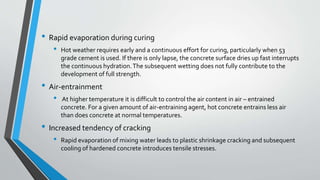
• Rapid evaporation during curing
• Hot weather requires early and a continuous effort for curing, particularly when 53
grade cement is used. If there is only lapse, the concrete surface dries up fast interrupts
the continuous hydration.The subsequent wetting does not fully contribute to the
development of full strength.
• Air-entrainment
• At higher temperature it is difficult to control the air content in air – entrained
concrete. For a given amount of air-entraining agent, hot concrete entrains less air
than does concrete at normal temperatures.
• Increased tendency of cracking
• Rapid evaporation of mixing water leads to plastic shrinkage cracking and subsequent
cooling of hardened concrete introduces tensile stresses.
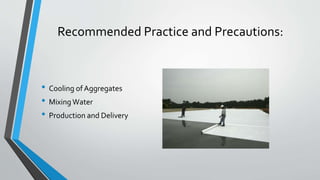
Recommended Practice and Precautions:
• Cooling of Aggregates
• Mixing Water
• Production and Delivery
READY MIXED CONCRETE [RMC]
• A Concrete whose constituents are weight-batched at a central batching plant, mixed
either at the plant itself or in truck mixers, and then transported to the construction site
and delivered in a condition ready to use, is known as ready mixed concrete (RMC).
• This technique is very useful in congested sites or at diverse work places and saves the
consumer from the botheration of procurement, storage and handling of concrete
materials. Due to low cost, durability and its ability to be customized for different
applications, ready mixed concrete is becoming more and more popular.The concrete
quality in terms of its properties or composition and quantity or volume required for the
particular application is specified by the customer.
• The use of ready mixed concrete is also advantageous when only small quantity of
concrete are required or when concrete is placed only at intervals. Usually, the price of
ready-mixed concrete is somewhat higher than of site mixed concrete, but this may often
by saving in the cement content, site organization and supervisory staff.
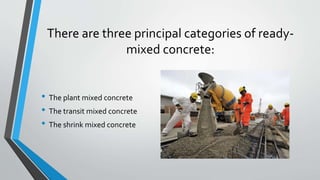
There are three principal categories of ready-
mixed concrete:
• The plant mixed concrete
• The transit mixed concrete
• The shrink mixed concrete
RECYCLED AGGREGATE CONCRETE
• To achieve sustainable issue in construction area, researchers and
companies focus on using waste concrete as a new construction material. It
is called recycled aggregate which can be produced by concrete crusher.
• The aggregates are categorized by size as coarse and fine aggregate.
• The characteristic of recycled aggregates could be different by its parent
concrete because the parent concrete was designed for its purposes such as
permeable, durable and high strength concrete
SILICA FUME CONCRETE
• Silica fume is a product resulting from reduction of high purity quartz with coal in
an electric arc furnace in 'the production of silicon or ferrosilicon alloy It is also
referred to as 'micro silica or condensed silica fume‘. it is an artificial pozzolana
material. Silica fume rises as an oxidized vapor, It cools condenses and is collected
in cloth bags. Condensed silica fume contains more than 90% of silicon dioxide in
non crystalline form.The particales of silica fume are spherical in shape, extremely
fine with size less than I micron and average diameter of 0.1 micron, about times
smaller than average cement particles. Silica fume has specific area of atV3ut
m2Ag as against 230 to 300 ml/kg for ordinary Portland cement
(1) Silica fume is available in the following
forms
• Unidentified forms with bulk density of 200 -- 300 kg/m3.
• Densified forms with bulk density of 500 — 600 kg/m3.
• Slurry forms with density of 1400 kg/m3.
• Surface area 15000 --- 20,000 m2/kg
• Standard grade slurry with pH value 4.7, specific gravity 1.3 to 1.4 and dry
content of micro silica 48 to 52%
(2) Silica fume in the concrete can be used for
the following purposes:
• To conserve cement.
• To produce ultra high strength concrete of the order of 70 to 120 Mpa.
• To increase early strength of fly ash/slag concrete
• To control alkali-aggregate reaction.
• To reduce sulphate attack and chloride associated corrosion.
ROLLER COMPACTED CONCRETE [RCC]
• RCC consists of Portland cement, coarse and fi ne aggregates, and water.
• RCC requires no forms, finishing, steel reinforcement or joint sawing.
However, saw-cut joints can be easily created to offer an enhanced
appearance and to help control cracking.
Process:
• Mix
• An RCC mixing facility, such as a pug mill, tilt drum, or dry batch ready-mixed plant,
must have the efficiency to evenly disperse the relatively small amount of water
present in the stiff, dry mix which resembles damp gravel.
• Transport
• Dump trucks transport the RCC mix from the plant to the conventional or high-density
asphalt pavers.
• Placement
• The mix is placed in layers (or lifts) 4-9 inches thick.
• Compaction
• Steel drum vibratory rollers compact the concrete.
SELF COMPACTED CONCRETE [SCC]
• Self-consolidating concrete is a highly flowable type of concrete that spreads into
the form without the need of mechanical vibration. Self-compacting concrete is a
non-segregating concrete that is placed by means of its own weight.The
importance of self-compacting concrete is that maintains all concrete’s durability
and characteristics, meeting expected performance requirements.
• In certain instances the addition of super plasticizers and viscosity modifier are
added to the mix, reducing bleeding and segregation. Concrete that segregates
loses strength and results in honeycombed areas next to the formwork. A well
designed SCC mix does not segregate, has high deformability and excellent
stability characteristics.
Thank You

Special Concrete And Concreting Method

  • 1.
  • 2.
    Group Members No. NAMEENROLLMENT NO. 1. PATEL KRISHNA J. 151100106046 2. PATEL PRINCE D. 151100106060 3. PATELTWINKLEV. 151100106063 4. PATEL ZENI K. 151100106066 5. PATEL RUTVIJ G. 151100106073
  • 3.
    INTRODUCTION • Special concretesare the concrete prepared for specific purpose like light weight, high density, fire protection, radiation shielding etc. concrete is a versatile material possessing good compressive strength. But it suffers from many drawbacks like low tensile strength, permeability to liquids, corrosion of reinforcement, susceptibility to chemical attack and low durability. • Modification have been made from time to time to overcome the deficiencies of cement concrete.The recent developments in the material and construction technology have led to significant changes resulting in improved performance, wider and more economical use. • Research work is going on in various concrete research laboratories to get improvement in the performance of concrete.
  • 4.
    • Attempts arebeing made for improvements in the following areas. • Improvement in mechanical properties like compressive strength, tensile strength, impact resistance. • Improvement in durability in terms of increased chemical and freezing resistances. • Improvements in impermeability, thermal insulation, abrasion, skid resistance etc.
  • 5.
    LIGHT WEIGHT CONCRETE •The density of conventional concrete is in order of 2200 to 2600 kg/m 3.This heavy self weight will make it uneconomical structural material.The dead weight of the structure made up of this concrete is large compared to the imposed load to be carried. A small reduction in dead weight for structural members like slab, beam and column in high-rise buildings, results in considerable saving in money and manpower. • Attempts have been made in the past to reduce the self weight of the concrete to increase the efficiency of concrete as a structural material.The light weight concrete with density in the range of 300 to 1900 kg/ m3 have been successfully developed.
  • 7.
    The LightWeight ConcreteOffersThe Following Advantage • Reduction of Dead Load • Smaller section of structural members can be adopted. • Lower haulage and handling costs. • Increase in the progress of work. • Reduction of foundation costs, particularly in the case of weak soil and tall structures. • Light weight concrete has a lower thermal conductivity. In case of buildings where air conditioning is to be installed, the use of light weight concrete will result in better thermal comforts and lower power consumption.
  • 8.
    • The useof light weight concrete gives an outlet for industrial wastes such as fly ash, clinkers, slag etc. which otherwise create problem for disposal. • It offers great fire resistance. • Light weight concrete gives overall economy. • The lower modulus of elasticity and adequate ductility of light weight concrete may be advantageous in the seismic design of structures.
  • 9.
    LightWeight Aggregate Concrete Naturallight weight aggregate • Pumice • Scoria • Rice husk • Saw dust • Diatomite • Volcanic tuff • Foamed lava Artificial Light Weight Aggregates • Sintered fly ash • Formed slag • Bloated clay • Artificial cinders • Expanded clay, slate, shale • Coke breeze • Expanded perlite • Exfoliated vermiculite
  • 10.
    Aerated Concrete • Theaerated concrete is made by introducing air or gas bubbles into the plastic cement mortar mix to produce a material with a cellular structure, somewhat similar to sponge rubber . It is also known as ‘ Gas Concrete’ or ‘Foam Concrete’ or ‘ Cellular Concrete’. It is a mixture of water, cement and finely crushed sand. • The aerated concrete is different from air entrained concretes, through in both cases air is introduced into the material. Air entrained concrete contains a much lower proportion of air and is in fact a heavy concrete whereas the amount of aeration is more in cellular concrete and it is weight concrete. • The cellular concrete may or may not contain coarse aggregates.The densities generally range from 300 kg/ m3 to 1000 kg / m3. lower density grades are used for insulation purposes, medium density grades are used for the manufacture of prefabricated structural members.
  • 12.
    No Fines Concrete •‘ No fines concrete’ is obtained by omitting fine aggregate fraction (below 12 mm) from the conventional concrete. It consists of cement, coarse aggregates and water only. Cement Content is correspondingly increased.Very often only single sized coarse aggregate, of size passing through 20 mm and retained on 10 mm is used. By using single sized aggregate, voids can be increased.The actual void content may vary between 30 to 40 percent depending upon the degree of consolidation of concrete. • No fines concrete is generally made with the aggregate/ cement ratio 6:1 to 10:1. The water/ cement ratio for satisfactory consistency will vary between 0.38 to 0.50. The strength of no fines concrete is dependent on the water/ cement ratio, aggregate/ cement ratio and unit weight of concrete.
  • 13.
    • When conventionalaggregate are used, no-fines concrete show a density of about 1600 to 2000 kg/ m3. but by using light weight aggregate, the density may reduced to about 350 kg/m3.Through the strength of no fines concrete is lower than ordinary concrete, the strength are sufficient for use in structural members and load bearing wall in normal buildings up to 3 stories high. Strengths of the order of 15 N/mm 2 have been attained with no fines concrete. No Fines Concrete Image
  • 14.
    HIGH DENSITY CONCRETE •High density concrete is also known as ‘ heavy weight concrete’. High density concrete is produced by replacing the ordinary aggregate by a material of very much higher specific gravity, usually over 4.0, compared with the specific gravity of ordinary aggregate of about 2.6. One of the more common natural aggregate is barium sulphate. It has a specific gravity of 4.1, and occurs as a natural rock with a purity of about 95 %. Barytes behaves rather like ordinary crushed aggregate and does not present any special problems as far as proportioning of mixes is concerned.The aggregate tends to break up and dust so that care must be taken in handling and processing and over mixing should be avoided. • Another type of natural heavy weight aggregate is iron: magnetite, limonite, hematite and goethite have been used. By using iron ore aggregate concrete concrete with densities of between 3000 to 3900 kg/ m 3 can be made.
  • 15.
    HIGH DENSITY CONCRETE IMAGE •The high density concrete is used in the construction of radiation shielding i.e. in nuclear power plants.The questions of shielding resolves into protection against X- rays, Gamma rays and neutrons.
  • 16.
    MASS CONCRETE • Theconcrete placed in massive structures like dams, canal locks, bridge, piers etc. can be termed mass concrete.This concrete is placed in large open forms.The mix is relatively harsh and dry and requires power vibrators of the immersion type for compaction. • Because of the large mass of the concrete, the heat of hydration of cement may lead to a considerable rise of temperature In the concrete thus resulting in extensive and serious shrinkage cracks.These shrinkage cracks can be prevented by using low heat cements and continuous curing. Placing the concrete in small lifts and allowing several days before the placement of the next lift of concrete can help in the dissipation of heat.The concreting can be done preferable in winter season, such that the peak temperature in concrete can be lowered or as an alternative the aggregate may be cooled and then used. Circulation of cold water through pipes buried in the concrete mass may prove useful.
  • 17.
    • The massconcrete develops high early age strength but the later age strength is lower than that of continuously cured concrete at normal temperature.There is negligible volume change in the case of mass concrete during setting and hardening but large creep may occur at later ages. MASS CONCRETE IMAGE
  • 18.
    PLUM CONCRETE • Theoriginal idea of the use of aggregate as an inert filler can be extended to the inclusion of large stones unto 300 mm size in a normal concrete; thus the apparent yield of concrete for a given amount of cement is increased.The resulting concrete is called ‘Plum Concrete’ or ‘Cyclopean Concrete’. • These large stones are called ‘plums’ and used in a large concrete mass.The volume of plums should not exceed 20 to 30 % of the total volume of the finished concrete and they have to be well dispersed throughout the mass.This is achieved by placing a layer of normal concrete, then spreading the plums, followed by another layer of concrete and so on. Care must be taken to ensure that no air is trapped underneath the stones.
  • 19.
    • The plumsmust have no adhering coating.Otherwise, discontinuities between the plums and the concrete may induce cracking and adversely affect permeability. PLUM CONCRETE IMAGE
  • 20.
    FIBER REINFORCED CONCRETE[FRC] • In conventional concrete, micro-cracks develop even before loading because of drying shrinkage and other causes of volume change. When the structure is loaded, the micro cracks open up and propagate.The development of such micro-cracks is the main reason of inelastic deformation in concrete. • The weakness can be removed by inclusion of small, closely spaced and uniformly dispersed fibers in concrete.The addition of fibers in concrete substantially improve its static and dynamic properties.These fibers offer increased resistance to crack growth, through a crack arresting mechanism and improve tensile strength and ductility of concrete.
  • 21.
    TYPES OF FIBER •Steel Fibers • Glass Fiber • Plastic Fibers • Carbon Fibers • Asbestos Fibers FRC IMAGE
  • 22.
    Steel Fibers • Steelfiber is one of the most commonly used fiber.They are generally round.The diameter may vary from 0.25 mm to 0.75 mm.The steel fiber is likely to get rusted and lose some of its strength. Use of steel fiber makes significant improvements in flexural impact and fatigue strength of concrete. • Steel fibers have been extensively used in overlays or roads, pavements, air fields, bridge decks, thin shells and floorings subjected to wear and tear and chemical attack. Steel Fibers Image
  • 23.
    Glass Fiber • Theseare produced in three basic forms: (a) Rovings (b) Strands (c)Woven or chopped strand mats. • Major problems in their use are breakage of fiber and the surface degradation of glass by high alkalinity of the hydrated cement paste. However, alkali resistant glass fiber have been developed now. Glass fiber reinforced concrete (GFRC) is mostly used for decorative application rather than structural purposes. • With the addition of just 5 % glass fibers, an improvement in the impact strength of up to 1500 % can be obtained as compared to plain concrete.With the addition of 2 % fibers the flexural strength is almost doubled. Glass Fiber Image
  • 24.
    Plastic Fiber • Fiberssuch as polypropylene, nylon, acrylic, aramid and polyethylene have high tensile strength thus inhibiting reinforcing effect. Polypropylene and nylon fibers are found to be suitable to increase the impact strength.Their addition to concrete has shown better distribute cracking and reduced crack size Plastic Fiber Image
  • 25.
    Carbon Fiber • Carbonfibers possess high tensile strength and high young’s modulus.The use of carbon fiber in concrete is promising but is costly and availability of carbon fiber in India is limited. Carbon Fiber Image
  • 26.
    Asbestos Fiber • Asbestosis a mineral fiber and has proved to be most successful fiber, which can be mixed with OPC.The maximum length of asbestos fiber is 10 mm but generally fibers are shorter than this.The composite has high flexural strength. Asbestos Fiber Image
  • 27.
    POLYMER CONCRETE • Concretecontaining polymers can be classified into three categories, namely: • (a) Polymer- Impregnated Concrete (PIC) • (b) Polymer Portland Cement Concrete (PPCC) • (c) Polymer Concrete (PC)
  • 28.
    Polymer- Impregnated Concrete(PIC) • Polymer- Impregnated Concrete is produced by impregnating or infiltrating a hardened Portland cement concrete with a monomer and subsequently polymerizing the monomer in situ. It is one of the widely used polymer composite. • The partial or surface impregnation improves durability and chemical resistance while total or in-depth impregnation improves structural properties of concrete. • The monomer used for impregnation are: • Methyl methacrylate (MMA) • Styrene • Acrylonitrile • T-butyl styrene • Epoxy PIC Image
  • 29.
    Polymer Portland CementConcrete (PPCC) • Polymer Portland cement concrete is a conventional Portland cement concrete which is usually made by replacing a part of the mixing water with a latex (Polymer emulsion). Earlier latexes were based on polyvinyl acetate or polyvinylidene chloride, but these are seldom used now because of the risk of corrosion of steel in concrete in the latter case and low wet strengths in the former. • Both elastomeric and glassy polymers have been employed in lattices. PPCC Image
  • 30.
    Polymer Concrete (PC) •Polymer Concrete (PC) is a mixture of aggregates with a polymer as a sole binder.There is no other bonding material present, i.e. Portland cement is not used. • It is manufactured in a manner similar to that of cement concrete. Monomers or Pre-polymers are added to the graded aggregate and the mixture is thoroughly mixed by hand or machine.The thoroughly mixed polymer concrete material is cast in moulds of woods, steel or aluminum, etc. PC Image
  • 31.
    FERRO CEMENT • Ferrocement is a relatively new material consisting of wire meshes and cement mortar. It consists of closely spaced wire meshes which are impregnated with rich cement mortar mix.While the mortar provides the mass, the wire mesh imparts tensile strength and ductility to the material. The Ferro cement possess high resistance against cracking, high fatigue resistance higher toughness and higher impermeability.
  • 32.
    Materials used forferro cement Ferro Cement Image • Cement mortar matrix • Reinforcement • Skeleton steel • Wire mesh
  • 33.
  • 34.
    HIGH STRENGTH CONCRETE •Based on the compressive strength; concrete is normally classified as normal strength concrete, high strength concrete and ultra strength concrete. Indian standard recommended methods of mix design denotes the boundary at 35 Mpa between normal strength and high strength concrete. • The advent of prestressed concrete techniques has given impetus for making concrete of higher strength. High strength concrete is necessary for the construction of high rise building and long span bridges. • To achieve high strength, it necessary to use high cement content with the lowest possible W/C ratio which invariable affect the workability of the mix. It should be remembered that high cement content may liberate large heat of hydration causing rise in temperature which may affect setting and may result in excessive shrinkage.
  • 35.
    • Various methodsof producing high strength concrete are: 1. Seeding 2. Revibration 3.Inhibiting Cracks 4.Using admixtures 5.Sulphur impregnation
  • 36.
    HIGH PERFORMANCE CONCRETE •The development of high performance concrete (HPC) is a giant step in making concrete a high-tech material with enhanced characteristics and durability. High performance concrete is an engineered concrete obtained through a careful selection and proportioning of its constituents.The concrete is with the same basic ingredients but has a totally different microstructure than ordinary concrete. High Performance Concrete Image
  • 37.
    PRECAST CONCRETE • Whenmass concrete work is required for huge and speedy construction work, precast concrete is used. Precast concrete elements are manufactured in industries and transported to site.They are casted in separate forms and placed in the structure on site. • Hollow and solids concrete blocks of desired shape and size are prepared and cured in water tanks at industrial sheds and then placed on site.
  • 38.
    Application of Precast Concrete •Beam • Columns • Slabs • WaterTanks • Bridge girders • Bridge Piers • Concrete Piles • Cessions • Compound wall poles • Electricity Poles • Ornamental Structures • Concrete lintels • Water supply RCC Pipes • Sewer Pipes Precast Concrete Image
  • 39.
    FLY ASH CONCRETE •Fly ash concrete is an eco-friendly construction material in which fly ash replaces a part of Portland cement. • But IS:456 – 2000 and ACI:318 allows replacement of OPC by Fly ash up to 35% only as binding material. • High volume fly ash concrete is a concrete where a replacement of about 35% or more of cement is made with the usage of fly ash.
  • 40.
    • Fly ashis a finely divided byproduct resulting from the combustion of coal in power plants. • It contains large amounts of silica, alumina and small amount of unburned carbon, which pollutes environment. • It is grey in color and alkaline in nature. • The particle size ranges between 1-100 microns. • The specific gravity of FA lies between 1.9 and 2.8 (generally 3.15 for Cement). • The surface area is typically 300–500 m2/kg, although some FA can have a surface area as high as 700 m2/kg ( around 330 m2/kg for Cement ) • The mass per unit volume including air between particles ( density ) can vary from 540 to 860 kg/m3.
  • 41.
    PUMPED CONCRETE • Aconcrete which can be pushed through a pipeline is called pumpable concrete. The Concrete mix is designed in such a manner that it does not wedge while flowing and its friction at the inner wall of the pipe line does not become very high. • Pumpable concrete emerging from a pipeline flows in the form of a plug which is separated from the pipe wall by a thin lubricating layer consisting of cement paste. The water in the paste hydraulically linked with the interparticle water layer in the plug. Fig shows the flow of concrete under pressure. For continuous plug movement, the pressure generated by the flow resistance must not be greater than pump pressure rating. However, if w/c ratio is high, the concrete becomes too saturated and water is forced out of the mix, creating an increase in flow resistance and a possible blockage of concrete.
  • 42.
    • Thus, avery stiff concrete is not pumpable and also a concrete with w/c ratio is also not pumpable. It is interesting to note that if a concrete is pumpable, it implied that it is a good concrete. Pumped Concrete Image
  • 43.
    SHOTCRETE OR GUNITING •‘Shortcrete’ or ‘Gunite’ is a mortar or a fine concrete that is pneumatically transported through a hose and projected on to a surface at a high velocity. • This system is called by different names in different countries such as Blastcretes, guncrete, Jet-crete, nucrete, spraycrete etc. though the principle is essentially the same.This system is very well suited for construction of lightly reinforced, thin sections, Shortcrete is more economical than conventional concrete because of less formwork requirements, requiring a small portable plant for manufacturing and placement.The force of the jet impacting on the surface compart the material. Sometimes set accelerators are used to assist overhead placing.The newely developed ‘ Redi-set cement’ can also be used for shortcreting process.
  • 45.
    UNDER WATER CONCRETE •Special precautions should be taken whenever concrete is to be placed under water. Such a concrete should have cement content 450 kg/m3 of concrete and a slump of 10 to 17.5 cm. • The methods used for placing concrete under water are: • Bagged Concrete • Bottom dump bucket • Tromie • Grouted aggregate • Concrete pump.
  • 46.
    Bagged Concrete • Insome situations gunny bags are filled about 2/3 rd. full with dry or semi-dry mixture of cement, fine and coarse aggregate.They are lowered into the water and placed carefully in a header and stretcher fashion like that of brick masonry construction with the help of divers.This method does not give satisfactory concrete, as the concrete mix will be full of voids.
  • 47.
    Bottom Dump Bucket •Other method of placing concrete under water or in a trench filled with the bentonite slurry is by bottom dump bucket method. In the bottom dump bucket method concrete is taken through the water in a water tight bucket or box. On reaching the final position the bottom of the bucket is made to open by some mechanism and the whole concrete is dumped slowly in water.There are chances of washing away of some quantity of cement when concrete is dumped from the bucket
  • 48.
    Tremie • The mostsatisfactory method of placing concrete under water is by the use of tremie pipe. • In this method, a tramie pipe of 200 mm to 250 mm diameter is used.The length of pipe can be easily increased or decreased by using couplings.A funnel is provided at the top end pipe to facilitate pouring of concrete.The bottom end is closed with a plug or thick polyethylene sheet to prevent entry of water into the pipe.
  • 49.
    Grouted Aggregate • Anothermethod of placing concrete under water is the grouting of pre-packed aggregate. Coarse aggregate is dumped in the forms to assume full dimension of the concrete mass. Cement mortar grout is injected through pipes, which extend up to the bottom of the aggregate bed.The pipes are slowly withdrawn as grouting proceeds.The grout forces the water out of the forms and fills the interstices in the aggregate.This method, however, has been used very little. For plugging the well foundation this method is often adopted.
  • 50.
    Concrete Pump • Concretepumps and pipes can also be used for placing concrete under water. The pipeline is plugged at the end and lowered until it rests on the bottom. Pumping is then started, when the pipe is completely filled, the plug is forced out, the concrete surrounding the lower end of the pipe seal the pipe.The pipe is held in this position until the pressure becomes too great.Then, the pipe is withdrawn and the operation is repeated.This process is repeated until concrete reached the level above water.
  • 51.
    PRE-PACKED CONCRETE • Prepackedconcrete is a special technique of placing concrete under water. When ‘tremie method’ or bottom dump bucket method’ are not feasible, this method is adopted.This technique, also called ‘grouted concrete’ consists of placing the coarse aggregate only in the form and thoroughly compacting it to form prepacked mass.This mass is then grouted with the cement mortar of the required proportions.This process can be employed for both plain or reinforced cement concrete.This method is employed where the reinforcement is very complicated or where certain arrangements like pipes, conduits, openings are required to be incorporated in the concrete.This technique is employed in mass concreting, in bridges abutments and piers, well staining etc.
  • 52.
    VACUME CONCRETE • Wheneverthin section like slabs and walls have to be concreted, it is necessary to adopt a fluid mix with water-cement ratio 0.5 to 0.65 to facilitate the placing and compaction. Such a mix will lead to a concrete of relatively low strength and poor abrasion resistance. In such situations vacuum treatment of concrete is a solution. • A considerable part of excess water and air are removed by suction through a mat connected to a vacuum pump.An arrangement for vacuum treatment of concrete using suction through a surface mat connected to a vacuum pump is shown in fig.
  • 53.
    • Generally, higherworkability and higher strength or very low workability and higher strength do not go hand in hand.This can be achieved in vacuum concrete. In this process, excess water used for higher workability, not required for hydration, and harmful in many ways to the hardened concrete.This excess water is withdrawn by means of vacuum pump immediately after placing of the concrete.The process when properly applied, produces concrete of good quality.
  • 54.
    COLD-WEATHER CONCRETE • Theproduction of concrete in cold weather introduces many problems such as delay in setting and hardening, damage to concrete in plastic condition due to the formation of ice lenses. Hence, it is essential to maintain the temperature of the concrete above 5 0 C. it is generally accepted that there is little cement hydration and strength gain if concrete is frozen and kept frozen below 10 0 C.Therefore, fresh concrete must be protected against disruptive expansion by freezing until adequate strength has been gained.
  • 55.
    The effect ofcold weather on concrete are as follows: • Delay Setting • The rate of hydration of cement depends upon the ambient temperature. If the ambient temperature is low, hydration process will go slow and concrete takes a longer time to set and to develop strength.The setting period necessary before removal of formwork is thus increased.The rate of progress of work will be slow.Although the initial strength of concrete is lower, the ultimate strength will not be severely affected. • Freezing of concrete at early age • When the temperature of concrete falls below freezing point, the fee water held in the plastic concrete freezes. Due to freezing of water, concrete expands and hydration of cement will be stopped.This will result in considerable loss of strength
  • 56.
    • Freezing andThawing •When concrete is subjected to alternate cycles of freezing and thawing, its durability is greatly impaired. It has been found that even one cycle of freezing and thawing during the pre-hardening period may reduce the compressive strength to 50 % of what would be expected for normal temperature concrete. • Stresses due to temperature differential • In case of mass concreting in cold weather there will be a large temperature differential due to high temperature inside the mass, which may promote micro cracking and has a harmful effect on durability of concrete.
  • 57.
    Recommended Practice andPrecautions: • Selection of suitable type of cement • Temperature control of ingredients • Electrical heating of concrete mass • Use of Insulating formwork • Admixtures of anti-freezing materials • Use of air entraining agents • Delayed removal of formwork • Placing and curing of concrete • Covering the concrete surfaces
  • 58.
    HOT-WEATHER CONCRETING • Concretingin hot weathers specially in tropical countries and desert areas, where the temperature above 40 0 C are reached, poses some problems. High temperature and reduced relative humidity are the main climatic factors affecting concrete. In India, most of the areas are in tropical regions. The procedure of concreting in hot-weather is set out in IS: 7861: 1975
  • 59.
    The effect ofhot-weather are as follows: • Rapid rate of hydration • A higher temperature results in a more rapid hydration leading to quick setting, thus reducing the handling time of concrete and also the strength of hardened concrete. With the increase in the temperature of concrete, the workability of concrete decreases and water demand increases.The addition of water without proper adjustment in the mix proportions adversely affects the ultimate quality of concrete. • Rapid evaporation of mixing water • As mentioned earlier, due to high ambient temperature, the water mixed with the concrete to give the required workability will be lost by evaporation.Therefore, workability of concrete will be reduced. Such concrete cannot be properly compacted and it will result in reduction in strength.The rate of evaporation depends on the ambient temperature, relative humidity and wind speed.
  • 60.
    • Rapid evaporationduring curing • Hot weather requires early and a continuous effort for curing, particularly when 53 grade cement is used. If there is only lapse, the concrete surface dries up fast interrupts the continuous hydration.The subsequent wetting does not fully contribute to the development of full strength. • Air-entrainment • At higher temperature it is difficult to control the air content in air – entrained concrete. For a given amount of air-entraining agent, hot concrete entrains less air than does concrete at normal temperatures. • Increased tendency of cracking • Rapid evaporation of mixing water leads to plastic shrinkage cracking and subsequent cooling of hardened concrete introduces tensile stresses.
  • 61.
    Recommended Practice andPrecautions: • Cooling of Aggregates • Mixing Water • Production and Delivery
  • 62.
    READY MIXED CONCRETE[RMC] • A Concrete whose constituents are weight-batched at a central batching plant, mixed either at the plant itself or in truck mixers, and then transported to the construction site and delivered in a condition ready to use, is known as ready mixed concrete (RMC). • This technique is very useful in congested sites or at diverse work places and saves the consumer from the botheration of procurement, storage and handling of concrete materials. Due to low cost, durability and its ability to be customized for different applications, ready mixed concrete is becoming more and more popular.The concrete quality in terms of its properties or composition and quantity or volume required for the particular application is specified by the customer. • The use of ready mixed concrete is also advantageous when only small quantity of concrete are required or when concrete is placed only at intervals. Usually, the price of ready-mixed concrete is somewhat higher than of site mixed concrete, but this may often by saving in the cement content, site organization and supervisory staff.
  • 63.
    There are threeprincipal categories of ready- mixed concrete: • The plant mixed concrete • The transit mixed concrete • The shrink mixed concrete
  • 64.
    RECYCLED AGGREGATE CONCRETE •To achieve sustainable issue in construction area, researchers and companies focus on using waste concrete as a new construction material. It is called recycled aggregate which can be produced by concrete crusher. • The aggregates are categorized by size as coarse and fine aggregate. • The characteristic of recycled aggregates could be different by its parent concrete because the parent concrete was designed for its purposes such as permeable, durable and high strength concrete
  • 65.
    SILICA FUME CONCRETE •Silica fume is a product resulting from reduction of high purity quartz with coal in an electric arc furnace in 'the production of silicon or ferrosilicon alloy It is also referred to as 'micro silica or condensed silica fume‘. it is an artificial pozzolana material. Silica fume rises as an oxidized vapor, It cools condenses and is collected in cloth bags. Condensed silica fume contains more than 90% of silicon dioxide in non crystalline form.The particales of silica fume are spherical in shape, extremely fine with size less than I micron and average diameter of 0.1 micron, about times smaller than average cement particles. Silica fume has specific area of atV3ut m2Ag as against 230 to 300 ml/kg for ordinary Portland cement
  • 66.
    (1) Silica fumeis available in the following forms • Unidentified forms with bulk density of 200 -- 300 kg/m3. • Densified forms with bulk density of 500 — 600 kg/m3. • Slurry forms with density of 1400 kg/m3. • Surface area 15000 --- 20,000 m2/kg • Standard grade slurry with pH value 4.7, specific gravity 1.3 to 1.4 and dry content of micro silica 48 to 52%
  • 67.
    (2) Silica fumein the concrete can be used for the following purposes: • To conserve cement. • To produce ultra high strength concrete of the order of 70 to 120 Mpa. • To increase early strength of fly ash/slag concrete • To control alkali-aggregate reaction. • To reduce sulphate attack and chloride associated corrosion.
  • 68.
    ROLLER COMPACTED CONCRETE[RCC] • RCC consists of Portland cement, coarse and fi ne aggregates, and water. • RCC requires no forms, finishing, steel reinforcement or joint sawing. However, saw-cut joints can be easily created to offer an enhanced appearance and to help control cracking.
  • 69.
    Process: • Mix • AnRCC mixing facility, such as a pug mill, tilt drum, or dry batch ready-mixed plant, must have the efficiency to evenly disperse the relatively small amount of water present in the stiff, dry mix which resembles damp gravel. • Transport • Dump trucks transport the RCC mix from the plant to the conventional or high-density asphalt pavers. • Placement • The mix is placed in layers (or lifts) 4-9 inches thick. • Compaction • Steel drum vibratory rollers compact the concrete.
  • 70.
    SELF COMPACTED CONCRETE[SCC] • Self-consolidating concrete is a highly flowable type of concrete that spreads into the form without the need of mechanical vibration. Self-compacting concrete is a non-segregating concrete that is placed by means of its own weight.The importance of self-compacting concrete is that maintains all concrete’s durability and characteristics, meeting expected performance requirements. • In certain instances the addition of super plasticizers and viscosity modifier are added to the mix, reducing bleeding and segregation. Concrete that segregates loses strength and results in honeycombed areas next to the formwork. A well designed SCC mix does not segregate, has high deformability and excellent stability characteristics.
  • 71.