“To Study the Durability of Fibre Reinforced Concrete”
Department of Civil Engineering
SOE SIMS, Indore
There is a growing awareness of the advantages of fibre
reinforcement techniques of construction all over the world . In the
recent times, there is a growing interest on the use of various types
of fibres in structural applications due to their light weight, low cost
and sustainability. This paper reports the recent developments in the
fibre reinforced for structural applications.
This project presents a brief state-of-the-art report on durability of
Fibre Reinforced concrete. In particular project related to fibre
reinforcement mechanisms, standardized testing, resistance to
dynamic loads, are discussed.
The effects of fibres on the behaviour of plastic and hardened
concrete varies depending on the concrete materials, mix
proportions, fibre type and length, and quantity of fibre added.
Experimental and analysis of results were conducted to study the
compressive & tensile behaviour of composite concrete with varying
percentage of such fibres added to it. The grade of concrete, M25 is
adopted with varying percentage of fibres ranging from 0.25%,
0.50% & 0.75% on different characteristic type of fibre .
ABSTRACT
Experimental and analysis of result on standard size of beam (50*10*10
cm)are adopted for testing. Flexure test are applying on the beam and
analysis the effect of the beam for different types of nature of the fibre .
This material can help us to develop intelligent infrastructure with
elegantly integrated sensing.
The objectives of this report use of fibre as reinforcement in concrete
for a better Durability, workability & resistance to cracking of structure.
These sustainable improvements or modifications could be easily
adopted by the common man in their regular constructions.
Keywords: FRC, Durability, Flexural Strength.
CONTENT
CHAPTER 1 : INTRODUCTION
CHAPTER 2 : METHODOLOGY
CHAPTER 3 : APPLICATIONS OF FRC
CHAPTER 4 : CONCLUSION
CHAPTER 5 : RESULT
CHAPTER 6 : REFERENCES
CHAPTER 1 : INTRODUCTION
INTRODUCTION
• Concrete is a construction material composed of cement as well as
other Cementitious materials such as fly ash and slag content,
aggregate (generally a coarse aggregate such as gravel, limestone, or
granite, plus a fine aggregate such as river sand), water, and chemical
admixtures.
• Concrete shows several desirable properties like high compressive
strength, stiffness and durability.
• Fibre reinforced concrete (FRC) is a concrete in which small and
discontinuous fibers are dispersed uniformly.
• Fibre reinforcement is one of the effective ways of improving the
properties of concrete.
• Addition of Fibers to concrete makes it a Homogeneous and
Isotropic material.
• The Fibers used in FRC may be of different materials like Steel, G.I.,
Carbon, Glass, Asbestos, Polypropylene, Jute etc.
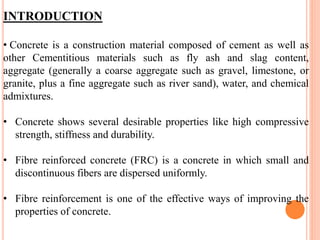
PHOTO
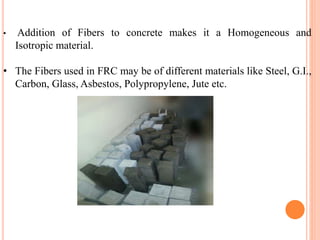
TYPES OF FIBRE
There are four types of fibres which we are using :-
STEEL FIBRE GLASS FIBRE
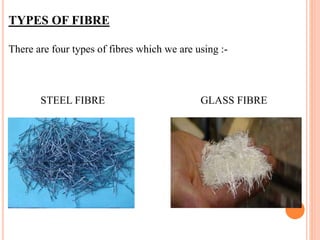
NATURAL FIBRE (COIR)
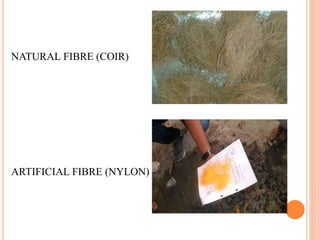
ARTIFICIAL FIBRE (NYLON)
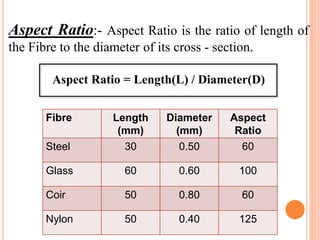
Aspect Ratio:- Aspect Ratio is the ratio of length of
the Fibre to the diameter of its cross - section.
Aspect Ratio = Length(L) / Diameter(D)
Fibre Length
(mm)
Diameter
(mm)
Aspect
Ratio
Steel 30 0.50 60
Glass 60 0.60 100
Coir 50 0.80 60
Nylon 50 0.40 125
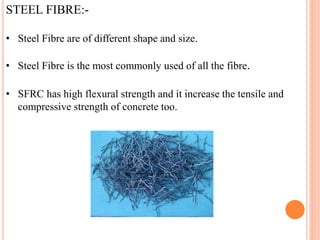
STEEL FIBRE:-
• Steel Fibre are of different shape and size.
• Steel Fibre is the most commonly used of all the fibre.
• SFRC has high flexural strength and it increase the tensile and
compressive strength of concrete too.
Application of SFRC:-
• Airport Pavements
•Tunnel Lining
•Bridge Deck Slab repairs, and so on.
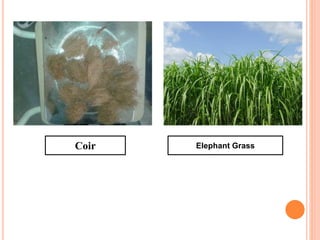
NATURAL FIBRE:-
 Natural Fibres present cheap and sustainable alternative to the
metallic and synthetic Fibres used as building materials.
 Their use, as a construction material, for improving the
properties of the composites costs a very little when compared
to the total cost of the composites.
 Natural Fibres can be used in low-cost concrete structures as
reinforcement materials, especially in tropical earthquake
regions.
Coir Elephant Grass
ARTIFICIAL FIBRE:-
• Synthetic Fibres specifically engineered for concrete are
manufactured from manmade materials that can withstand
the long term alkaline environment of concrete.
• These are made from synthesized polymers or small
molecules.
• The compounds that are used to make these Fibres come from
raw materials such as petroleum based chemicals or
petrochemicals.
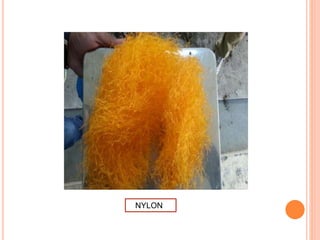
NYLON
Advantages of Nylon Fibre:-
•The reduction of concrete cracking as a result of plastic shrinkage.
•To help lower the permeability of concrete.
•Areas requiring materials that are both alkali proof and chemical
resistant.
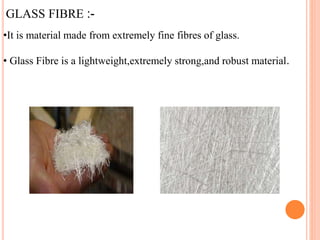
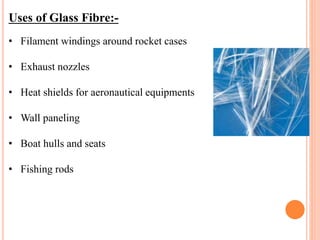
GLASS FIBRE :-
•It is material made from extremely fine fibres of glass.
• Glass Fibre is a lightweight,extremely strong,and robust material.
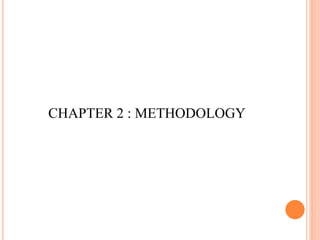
Uses of Glass Fibre:-
• Filament windings around rocket cases
• Exhaust nozzles
• Heat shields for aeronautical equipments
• Wall paneling
• Boat hulls and seats
• Fishing rods
CHAPTER 2 : METHODOLOGY
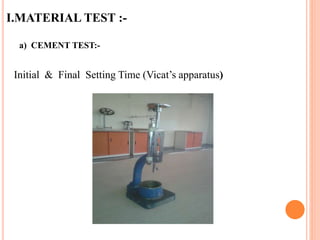
I.MATERIAL TEST :-
a) CEMENT TEST:-
Initial & Final Setting Time (Vicat’s apparatus)
b) SAND TEST:-
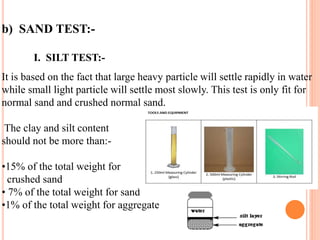
I. SILT TEST:-
It is based on the fact that large heavy particle will settle rapidly in water
while small light particle will settle most slowly. This test is only fit for
normal sand and crushed normal sand.
The clay and silt content
should not be more than:-
•15% of the total weight for
crushed sand
• 7% of the total weight for sand
•1% of the total weight for aggregate
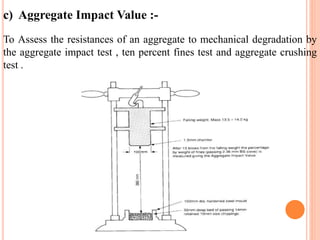
c) Aggregate Impact Value :-
To Assess the resistances of an aggregate to mechanical degradation by
the aggregate impact test , ten percent fines test and aggregate crushing
test .
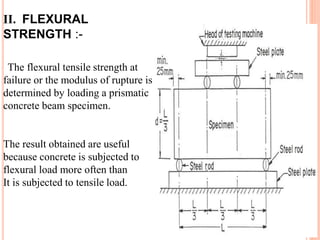
II. FLEXURAL
STRENGTH :-
The flexural tensile strength at
failure or the modulus of rupture is
determined by loading a prismatic
concrete beam specimen.
The result obtained are useful
because concrete is subjected to
flexural load more often than
It is subjected to tensile load.
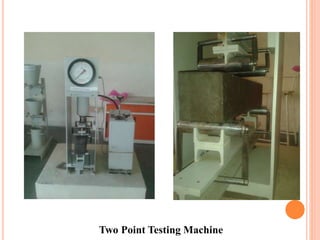
Two Point Testing Machine
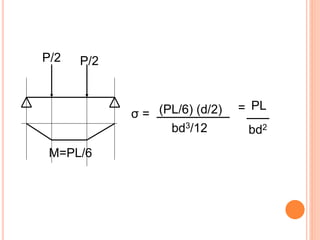
M=PL/6
P/2 P/2
σ = (PL/6) (d/2)
bd3/12
= PL
bd2
III. DURABILITY :-
The construction industry today demands high strength, long
lasting durability and low cost. While using steel fibres the
primary problem is the corrosion of the concrete structures.
Chloride penetration and Sulfate attacks are the primary reasons
for such corrosion. The chemicals we have used are NaCl and
MgSo4 because they cause the maximum corrosion. Generally the
amount of chemical added is 2 – 8%. Here we have added 3% of
each of the chemical with respect to the quantity of water.
Water = 150 litres (approx.)
MgSo4 = 4.5 kg
NaCl = 4.5kg
CHAPTER 3 : APPLICATIONS OF FRC
Applications of Fibre Reinforced Concrete :-
The applications of fibres in concrete industries depend on the designer
and builder in taking advantage of the static and dynamic characteristics
of this new material.
The main area of FRC applications are:-
•Runway, Aircraft Parking, and Pavements
For the same wheel load FRC slabs could be about one half the
thickness of plain concrete slab.
Compared to a 375mm thickness of conventionally reinforced concrete
slab, a 150mm thick crimped-end FRC slab was used to overlay an
existing as-
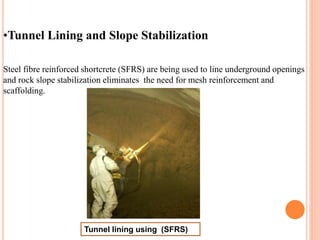
•Tunnel Lining and Slope Stabilization
Steel fibre reinforced shortcrete (SFRS) are being used to line underground openings
and rock slope stabilization eliminates the need for mesh reinforcement and
scaffolding.
Tunnel lining using (SFRS)
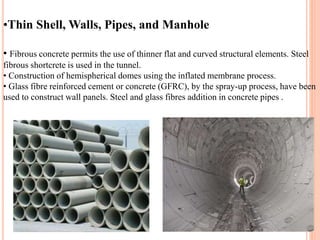
•Thin Shell, Walls, Pipes, and Manhole
• Fibrous concrete permits the use of thinner flat and curved structural elements. Steel
fibrous shortcrete is used in the tunnel.
• Construction of hemispherical domes using the inflated membrane process.
• Glass fibre reinforced cement or concrete (GFRC), by the spray-up process, have been
used to construct wall panels. Steel and glass fibres addition in concrete pipes .
•Blast Resistant Structures
When plain concrete slabs are reinforced conventionally, tests
showed that there is no reduction of fragment velocities or
number of fragments under blast and shock waves.
Similarly, reinforced slabs of fibrous concrete, however, showed
20% reduction in velocities, and over 80% in fragmentations.
•Other Applications
These include machine tool frames, lighting poles, water and oil
tanks and concrete repairs.
•Dams and Hydraulic Structure
FRC is being used for the construction and repair of dams and other
hydraulic structures to provide resistance to cavitation
and severe erosion caused by the Impact of large Waterboro debris.
CHAPTER 4 : CONCLUSION
CONCLUSION:
 There has been significant interest and development in the
use of continuous Fibre reinforcement for improving the
behavior of concrete.
 Increasing emphasis is being placed on concrete durability
than its strength. In many applications, high strength concrete
is used only because of its high durability quality rather than
the need for its strength.
 Finally the use of this high performance new generation fiber
concretes in India is only in laboratories and in research
centers. It will take many years to see in practice.
CHAPTER 5 : RESULT
RESULT
The present work is concerned with the tensile behavior
of FRC specimen with 14 days of Normal Water Curing
and 14 days of Curing of age for sulphate and chloride
attack. The following can be summarized:
 FRC controls cracking and deformation under impact
load much better than the plain concrete and increased
impact strength 25 times.
 Fracture energy of cement based materials is
significantly increased by adding Natural Fibre.
 By comparing the tensile stresses of all the Fibres we
concluded that the Natural Fibre Reinforced Concrete is
the best among all four Fibres categories (beam
samples) which were tested on Flexural Tensile Test.
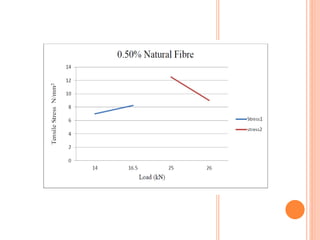
 The concrete beam samples containing 0.50% of
Natural Fibres gives us the maximum tensile strength.
CHAPTER 6 : REFERENCES
REFERENCES :-
•Properties of Concrete- Nevilla.
•Concrete Technology- MsShetty.
•‘Fibre Reinforced Concrete’-N. Banthia
•‘Synthetic Fibre Reinforcement for Concrete’- D. Ludirdja, J.F. Young, 1993.
•‘Synthetic Fibres- Anne Laning, 1992.
•‘Glass Fibre reinforced Concrete (GFRC)’ - By Wallace Neal, 1978.
•‘Tensile behavior of Glass Fibre reinforced Concrete’- J.A.O.Barros, J.A.Figueiras,
C.V.D.Veen
•‘The Use of Glass Fibre–Reinforced Concrete As A Structural Material’ - J.P.J.G.
Ferreira and F.A.B. Branco.
•‘Natural Fibre Reinforced Concrete’, Ben Davis, Dr. Kurtis,2007.
•‘Natural Fibre Composites For Structural Applications’, ShamaParveen, SohelRana,
Raul Fangueiro, 2012.
•‘STEEL FIBRE REINFORCED CONCRETE’, Nguyen Van CHAN
‘Studies on Steel Fibre Reinforced Concrete – A Sustainable Approach’, Vasudev R, Dr.
B G Vishnuram

FIBER REINFORCED CONCRETE

  • 1.
    “To Study theDurability of Fibre Reinforced Concrete” Department of Civil Engineering SOE SIMS, Indore
  • 2.
    There is agrowing awareness of the advantages of fibre reinforcement techniques of construction all over the world . In the recent times, there is a growing interest on the use of various types of fibres in structural applications due to their light weight, low cost and sustainability. This paper reports the recent developments in the fibre reinforced for structural applications. This project presents a brief state-of-the-art report on durability of Fibre Reinforced concrete. In particular project related to fibre reinforcement mechanisms, standardized testing, resistance to dynamic loads, are discussed. The effects of fibres on the behaviour of plastic and hardened concrete varies depending on the concrete materials, mix proportions, fibre type and length, and quantity of fibre added. Experimental and analysis of results were conducted to study the compressive & tensile behaviour of composite concrete with varying percentage of such fibres added to it. The grade of concrete, M25 is adopted with varying percentage of fibres ranging from 0.25%, 0.50% & 0.75% on different characteristic type of fibre . ABSTRACT
  • 3.
    Experimental and analysisof result on standard size of beam (50*10*10 cm)are adopted for testing. Flexure test are applying on the beam and analysis the effect of the beam for different types of nature of the fibre . This material can help us to develop intelligent infrastructure with elegantly integrated sensing. The objectives of this report use of fibre as reinforcement in concrete for a better Durability, workability & resistance to cracking of structure. These sustainable improvements or modifications could be easily adopted by the common man in their regular constructions. Keywords: FRC, Durability, Flexural Strength.
  • 4.
    CONTENT CHAPTER 1 :INTRODUCTION CHAPTER 2 : METHODOLOGY CHAPTER 3 : APPLICATIONS OF FRC CHAPTER 4 : CONCLUSION CHAPTER 5 : RESULT CHAPTER 6 : REFERENCES
  • 5.
    CHAPTER 1 :INTRODUCTION
  • 6.
    INTRODUCTION • Concrete isa construction material composed of cement as well as other Cementitious materials such as fly ash and slag content, aggregate (generally a coarse aggregate such as gravel, limestone, or granite, plus a fine aggregate such as river sand), water, and chemical admixtures. • Concrete shows several desirable properties like high compressive strength, stiffness and durability. • Fibre reinforced concrete (FRC) is a concrete in which small and discontinuous fibers are dispersed uniformly. • Fibre reinforcement is one of the effective ways of improving the properties of concrete.
  • 7.
    • Addition ofFibers to concrete makes it a Homogeneous and Isotropic material. • The Fibers used in FRC may be of different materials like Steel, G.I., Carbon, Glass, Asbestos, Polypropylene, Jute etc. PHOTO
  • 8.
    TYPES OF FIBRE Thereare four types of fibres which we are using :- STEEL FIBRE GLASS FIBRE
  • 9.
  • 10.
    Aspect Ratio:- AspectRatio is the ratio of length of the Fibre to the diameter of its cross - section. Aspect Ratio = Length(L) / Diameter(D) Fibre Length (mm) Diameter (mm) Aspect Ratio Steel 30 0.50 60 Glass 60 0.60 100 Coir 50 0.80 60 Nylon 50 0.40 125
  • 11.
    STEEL FIBRE:- • SteelFibre are of different shape and size. • Steel Fibre is the most commonly used of all the fibre. • SFRC has high flexural strength and it increase the tensile and compressive strength of concrete too.
  • 12.
    Application of SFRC:- •Airport Pavements •Tunnel Lining •Bridge Deck Slab repairs, and so on.
  • 13.
    NATURAL FIBRE:-  NaturalFibres present cheap and sustainable alternative to the metallic and synthetic Fibres used as building materials.  Their use, as a construction material, for improving the properties of the composites costs a very little when compared to the total cost of the composites.  Natural Fibres can be used in low-cost concrete structures as reinforcement materials, especially in tropical earthquake regions.
  • 14.
  • 15.
    ARTIFICIAL FIBRE:- • SyntheticFibres specifically engineered for concrete are manufactured from manmade materials that can withstand the long term alkaline environment of concrete. • These are made from synthesized polymers or small molecules. • The compounds that are used to make these Fibres come from raw materials such as petroleum based chemicals or petrochemicals.
  • 16.
  • 17.
    Advantages of NylonFibre:- •The reduction of concrete cracking as a result of plastic shrinkage. •To help lower the permeability of concrete. •Areas requiring materials that are both alkali proof and chemical resistant.
  • 18.
    GLASS FIBRE :- •Itis material made from extremely fine fibres of glass. • Glass Fibre is a lightweight,extremely strong,and robust material.
  • 19.
    Uses of GlassFibre:- • Filament windings around rocket cases • Exhaust nozzles • Heat shields for aeronautical equipments • Wall paneling • Boat hulls and seats • Fishing rods
  • 20.
    CHAPTER 2 :METHODOLOGY
  • 21.
    I.MATERIAL TEST :- a)CEMENT TEST:- Initial & Final Setting Time (Vicat’s apparatus)
  • 22.
    b) SAND TEST:- I.SILT TEST:- It is based on the fact that large heavy particle will settle rapidly in water while small light particle will settle most slowly. This test is only fit for normal sand and crushed normal sand. The clay and silt content should not be more than:- •15% of the total weight for crushed sand • 7% of the total weight for sand •1% of the total weight for aggregate
  • 23.
    c) Aggregate ImpactValue :- To Assess the resistances of an aggregate to mechanical degradation by the aggregate impact test , ten percent fines test and aggregate crushing test .
  • 24.
    II. FLEXURAL STRENGTH :- Theflexural tensile strength at failure or the modulus of rupture is determined by loading a prismatic concrete beam specimen. The result obtained are useful because concrete is subjected to flexural load more often than It is subjected to tensile load.
  • 25.
  • 26.
    M=PL/6 P/2 P/2 σ =(PL/6) (d/2) bd3/12 = PL bd2
  • 27.
    III. DURABILITY :- Theconstruction industry today demands high strength, long lasting durability and low cost. While using steel fibres the primary problem is the corrosion of the concrete structures. Chloride penetration and Sulfate attacks are the primary reasons for such corrosion. The chemicals we have used are NaCl and MgSo4 because they cause the maximum corrosion. Generally the amount of chemical added is 2 – 8%. Here we have added 3% of each of the chemical with respect to the quantity of water. Water = 150 litres (approx.) MgSo4 = 4.5 kg NaCl = 4.5kg
  • 28.
    CHAPTER 3 :APPLICATIONS OF FRC
  • 29.
    Applications of FibreReinforced Concrete :- The applications of fibres in concrete industries depend on the designer and builder in taking advantage of the static and dynamic characteristics of this new material. The main area of FRC applications are:- •Runway, Aircraft Parking, and Pavements For the same wheel load FRC slabs could be about one half the thickness of plain concrete slab. Compared to a 375mm thickness of conventionally reinforced concrete slab, a 150mm thick crimped-end FRC slab was used to overlay an existing as-
  • 30.
    •Tunnel Lining andSlope Stabilization Steel fibre reinforced shortcrete (SFRS) are being used to line underground openings and rock slope stabilization eliminates the need for mesh reinforcement and scaffolding. Tunnel lining using (SFRS)
  • 31.
    •Thin Shell, Walls,Pipes, and Manhole • Fibrous concrete permits the use of thinner flat and curved structural elements. Steel fibrous shortcrete is used in the tunnel. • Construction of hemispherical domes using the inflated membrane process. • Glass fibre reinforced cement or concrete (GFRC), by the spray-up process, have been used to construct wall panels. Steel and glass fibres addition in concrete pipes .
  • 32.
    •Blast Resistant Structures Whenplain concrete slabs are reinforced conventionally, tests showed that there is no reduction of fragment velocities or number of fragments under blast and shock waves. Similarly, reinforced slabs of fibrous concrete, however, showed 20% reduction in velocities, and over 80% in fragmentations.
  • 33.
    •Other Applications These includemachine tool frames, lighting poles, water and oil tanks and concrete repairs. •Dams and Hydraulic Structure FRC is being used for the construction and repair of dams and other hydraulic structures to provide resistance to cavitation and severe erosion caused by the Impact of large Waterboro debris.
  • 34.
    CHAPTER 4 :CONCLUSION
  • 35.
    CONCLUSION:  There hasbeen significant interest and development in the use of continuous Fibre reinforcement for improving the behavior of concrete.  Increasing emphasis is being placed on concrete durability than its strength. In many applications, high strength concrete is used only because of its high durability quality rather than the need for its strength.  Finally the use of this high performance new generation fiber concretes in India is only in laboratories and in research centers. It will take many years to see in practice.
  • 36.
  • 37.
    RESULT The present workis concerned with the tensile behavior of FRC specimen with 14 days of Normal Water Curing and 14 days of Curing of age for sulphate and chloride attack. The following can be summarized:  FRC controls cracking and deformation under impact load much better than the plain concrete and increased impact strength 25 times.  Fracture energy of cement based materials is significantly increased by adding Natural Fibre.  By comparing the tensile stresses of all the Fibres we concluded that the Natural Fibre Reinforced Concrete is the best among all four Fibres categories (beam samples) which were tested on Flexural Tensile Test.  The concrete beam samples containing 0.50% of Natural Fibres gives us the maximum tensile strength.
  • 39.
    CHAPTER 6 :REFERENCES
  • 40.
    REFERENCES :- •Properties ofConcrete- Nevilla. •Concrete Technology- MsShetty. •‘Fibre Reinforced Concrete’-N. Banthia •‘Synthetic Fibre Reinforcement for Concrete’- D. Ludirdja, J.F. Young, 1993. •‘Synthetic Fibres- Anne Laning, 1992. •‘Glass Fibre reinforced Concrete (GFRC)’ - By Wallace Neal, 1978. •‘Tensile behavior of Glass Fibre reinforced Concrete’- J.A.O.Barros, J.A.Figueiras, C.V.D.Veen •‘The Use of Glass Fibre–Reinforced Concrete As A Structural Material’ - J.P.J.G. Ferreira and F.A.B. Branco. •‘Natural Fibre Reinforced Concrete’, Ben Davis, Dr. Kurtis,2007. •‘Natural Fibre Composites For Structural Applications’, ShamaParveen, SohelRana, Raul Fangueiro, 2012. •‘STEEL FIBRE REINFORCED CONCRETE’, Nguyen Van CHAN ‘Studies on Steel Fibre Reinforced Concrete – A Sustainable Approach’, Vasudev R, Dr. B G Vishnuram