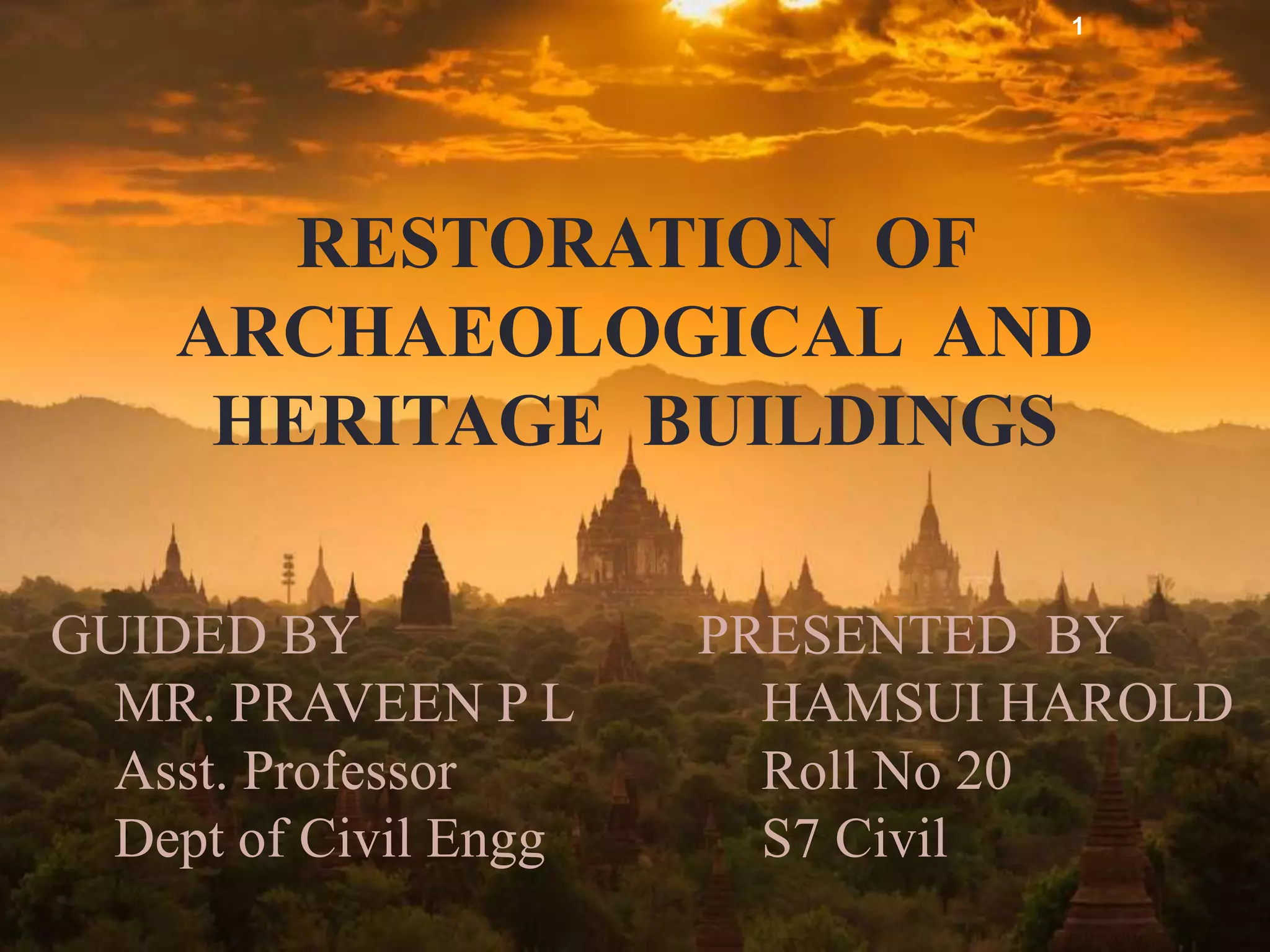
RESTORATION OF
ARCHAEOLOGICAL AND
HERITAGE BUILDINGS
PRESENTED BY
HAMSUI HAROLD
Roll No 20
S7 Civil
GUIDED BY
MR. PRAVEEN P L
Asst. Professor
Dept of Civil Engg
1
INTRODUCTION
• India has
Very rich historic background.
Heritage of the past work of man.
Culture , traditions
Many archeological buildings, Tajmahal one
among the seven wonders of world.
2
IMPORTANCE OF
HERITAGE BUILDINGS
3
NATIONALIMPORTANCE OF
HERITAGE BUILDINGS
Ancient Monument
Existence for not less than 100 years
Mute testaments of the glorious past.
Represent the remains of ancient habitation.
4
Contd...
Sense of identity and continuity for future
generations.
Represents the nations culture and beauty.
Form an impressive historic features.
5
TERMINOLOGIES
Conservation
Process of retaining structure’s historical,
architectural, aesthetic, cultural significance.
Preservation
Maintaining the fabric of a place in its existing
state and retarding deterioration .
Reconstruction
Returning a place as nearly as possible to a
known earlier.
6
Contd…
Rehabilitation
Making possible a contemporary use of a
historic building through repair and alterations
while protecting its heritage value.
Restoration
Process of accurately depicting the form,
features, and character of a property as it
appeared at a particular period of time.
7
WHY RESTORATION
8
RESTORATION
Process of correctly revealing the state of a
historic building, as it looked in the past.
Returning the existing fabric of a place to a
known earlier state.
Reassembling existing components without
introducing new materials.
9
Contd…
Restoration takes the structure to a new
minimum strength level.
Follows a precise methodology.
Purpose is to safeguard the important
archaeological monuments.
10
Contd…
Task is to point out the major structural defects
which occurs in these structures and their
remedial measures.
Increases the total expected life of the structure
11
CHALLENGES FACED
Physical condition:
Behavior of materials and structural systems
Management context:
Availability and use of resources.
Cultural significance and social
values:
The impact of interventions.
12
GUIDELINES TO BE FOLLOWED
Special attention has to be paid to the plans,
intention, materials and tools used.
Traditional building materials were mud, earth
and clay and lime.
Confirm the longevity of most of these
monuments.
13
Contd…
The proposed approach leads to efficient
restoration practice.
Identification of various problems.
Choosing the most appropriate treatment.
Date of restoration and proposed use.
14
LEGISLATIONS INVOLVED
Need for restoration decided by:
The Indian Treasure Trove Act, 1878.
The Ancient Monuments Preservation Act, 1904.
The Antiquities and Art Treasure Act, 1947.
The Ancient Monuments and Archaeological Sites
and Remains Act, 1958.
15
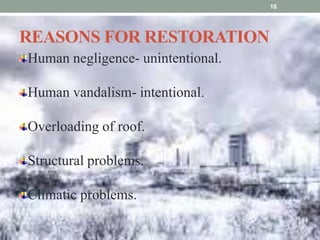
REASONS FOR RESTORATION
Human negligence- unintentional.
Human vandalism- intentional.
Overloading of roof.
Structural problems.
Climatic problems.
16
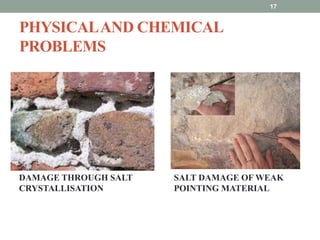
PHYSICALAND CHEMICAL
PROBLEMS
DAMAGE THROUGH SALT
CRYSTALLISATION
SALT DAMAGE OF WEAK
POINTING MATERIAL
17
Contd…
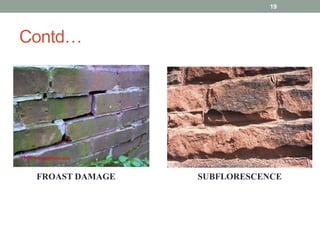
Chemical problems include swelling
compounds, leaching and encrustation.
Physical problems include salt crystallization
and frost action.
Mechanical problems include cracks from
earthquake settlements.
18
Contd…
FROAST DAMAGE SUBFLORESCENCE
19
CASE STUDIES
1. HUMAYUN’S TOMB
2. MAIN BUILDING,
UNIVERSITY OF PUNE.
20
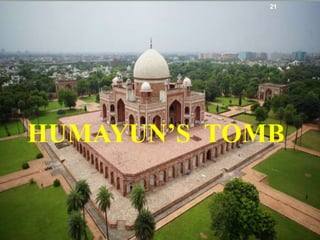
HUMAYUN’S TOMB
21
HUMAYUN’S TOMB
First privately funded restoration
Completed in March 2013 through the joint
efforts of AKTC and ASI under the National
Culture Fund.
Objective was to revitalize the gardens,
pathways, fountains and water channels.
22
Contd…
The project’s implementation phase began
when the trust began their work on the garden
site in 2000.
The tomb stands on a platform 120 metres
square and reaches a height of 47 metres.
Earliest example of using red sandstone and
white marble.
23
RESTORED PROJECT FEATURES
Removal of 3000 truckloads of earth
Planting of 12 hectares of lawn.
Repair of fountains, wells and rainwater-
harvesting systems.
Resetting and alignment of over 3500 kilometres
of path kerbstones.
Planning and installation of a new water-
circulation system for the walkway channels.
Creation of 128 groundwater recharge pits and de-
silting of other wells.
24
25
UNIVERSITY OF PUNE
CASE STUDY 2
Study of rehabilitation of main building, University of
Pune.
The building was constructed in 1871 by the British.
Designed by the then architect James Trubshawe.
The building is within 60,000 sqft area having
shallow foundation resting on black cotton soil.
Useful life of a structure being considered as 100
years.
Assessment of structure involved rapid visual
screening, data collection, condition assessment.
26
Major Problems and remedial
measures
• 1. Structural cracks in masonry walls &
damaged masonry with loose bonding
Poor load distribution
Poor water proofing.
Penetration of roots.
Growth of creepers.
27
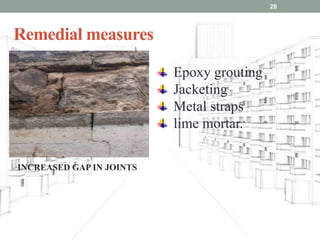
Remedial measures
28
Epoxy grouting
Jacketing
Metal straps
lime mortar.
INCREASED GAP IN JOINTS
Major Problems and remedial measures
contd..
29
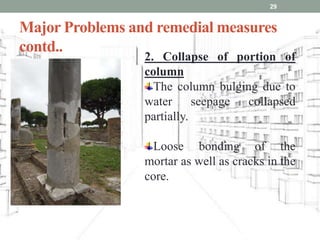
2. Collapse of portion of
column
The column bulging due to
water seepage collapsed
partially.
Loose bonding of the
mortar as well as cracks in the
core.
Remedial measures
The collapsed portion was removed and
reconstructed.
Steel rods were inserted into the old masonry.
The cracks in the core of the column were
taken care by the epoxy grouting.
30
Major Problems and remedial measures
contd..
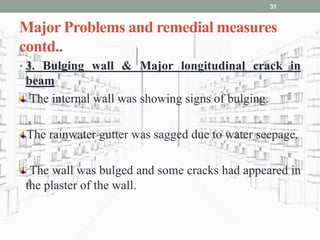
• 3. Bulging wall & Major longitudinal crack in
beam
The internal wall was showing signs of bulging.
The rainwater gutter was sagged due to water seepage.
The wall was bulged and some cracks had appeared in
the plaster of the wall.
31
Remedial Measures
32
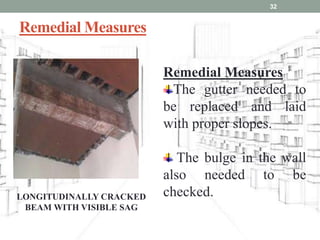
LONGITUDINALLY CRACKED
BEAM WITH VISIBLE SAG
Remedial Measures
The gutter needed to
be replaced and laid
with proper slopes.
The bulge in the wall
also needed to be
checked.
ECONOMIC BENEFITS
Businesses benefit
Growth in employment
Enhanced municipal tax base
Increased tourism.
33
RESTORATION V/S NEW
CONSTRUCTION
Cheaper
less energy required
Creates less waste.
Can be done even during winter.
34
FORTHCOMING RESTORATION
35
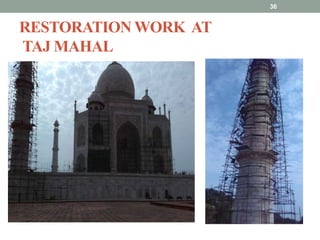
NCF, ASI and the Taj Group have signed a
Memorandum for the preservation and
upgradation of Taj Mahal.
The cleaning of the Taj will be carried out in
five phases.
scientific treatment and cleaning of interiors of
the main mausoleum up to human height will be
completed by January.
will be completed by March 2018.
RESTORATION WORK AT
TAJ MAHAL
36
DISADVANTAGES
Building materials and hardware are not easy to find.
Skilled labour is essential.
Strictly followed in accordance with the Archaeological
Act.
Affects the neighbourhood.
37
CONCLUSION
The best therapy to reduce decay is preventive
maintenance.
Adequate maintenance can limit or postpone the need for
subsequent intervention.
The repair process requires the existing condition of the
structure to be identified and its causes of its deterioration.
An understanding of the significance of the structure
should be the basis for conservation and reinforcement
measures.
38
REFERENCES
Model Building Bye-laws Chapter-8,
Conservation of heritage sites including
heritage buildings, Retrieved 2012, pp 55-100.
Sayali Sandbhor and Rohan Botre (2013):
A Systematic Approach Towards Restoration Of
Heritage Buildings, International journal of
engineering research and Technology, Volume:
02 Issue: 03, pp 33.
39
40
Thank you..!!!

BTECH SEMINAR

  • 1.
    RESTORATION OF ARCHAEOLOGICAL AND HERITAGEBUILDINGS PRESENTED BY HAMSUI HAROLD Roll No 20 S7 Civil GUIDED BY MR. PRAVEEN P L Asst. Professor Dept of Civil Engg 1
  • 2.
    INTRODUCTION • India has Veryrich historic background. Heritage of the past work of man. Culture , traditions Many archeological buildings, Tajmahal one among the seven wonders of world. 2
  • 3.
  • 4.
    NATIONALIMPORTANCE OF HERITAGE BUILDINGS AncientMonument Existence for not less than 100 years Mute testaments of the glorious past. Represent the remains of ancient habitation. 4
  • 5.
    Contd... Sense of identityand continuity for future generations. Represents the nations culture and beauty. Form an impressive historic features. 5
  • 6.
    TERMINOLOGIES Conservation Process of retainingstructure’s historical, architectural, aesthetic, cultural significance. Preservation Maintaining the fabric of a place in its existing state and retarding deterioration . Reconstruction Returning a place as nearly as possible to a known earlier. 6
  • 7.
    Contd… Rehabilitation Making possible acontemporary use of a historic building through repair and alterations while protecting its heritage value. Restoration Process of accurately depicting the form, features, and character of a property as it appeared at a particular period of time. 7
  • 8.
  • 9.
    RESTORATION Process of correctlyrevealing the state of a historic building, as it looked in the past. Returning the existing fabric of a place to a known earlier state. Reassembling existing components without introducing new materials. 9
  • 10.
    Contd… Restoration takes thestructure to a new minimum strength level. Follows a precise methodology. Purpose is to safeguard the important archaeological monuments. 10
  • 11.
    Contd… Task is topoint out the major structural defects which occurs in these structures and their remedial measures. Increases the total expected life of the structure 11
  • 12.
    CHALLENGES FACED Physical condition: Behaviorof materials and structural systems Management context: Availability and use of resources. Cultural significance and social values: The impact of interventions. 12
  • 13.
    GUIDELINES TO BEFOLLOWED Special attention has to be paid to the plans, intention, materials and tools used. Traditional building materials were mud, earth and clay and lime. Confirm the longevity of most of these monuments. 13
  • 14.
    Contd… The proposed approachleads to efficient restoration practice. Identification of various problems. Choosing the most appropriate treatment. Date of restoration and proposed use. 14
  • 15.
    LEGISLATIONS INVOLVED Need forrestoration decided by: The Indian Treasure Trove Act, 1878. The Ancient Monuments Preservation Act, 1904. The Antiquities and Art Treasure Act, 1947. The Ancient Monuments and Archaeological Sites and Remains Act, 1958. 15
  • 16.
    REASONS FOR RESTORATION Humannegligence- unintentional. Human vandalism- intentional. Overloading of roof. Structural problems. Climatic problems. 16
  • 17.
    PHYSICALAND CHEMICAL PROBLEMS DAMAGE THROUGHSALT CRYSTALLISATION SALT DAMAGE OF WEAK POINTING MATERIAL 17
  • 18.
    Contd… Chemical problems includeswelling compounds, leaching and encrustation. Physical problems include salt crystallization and frost action. Mechanical problems include cracks from earthquake settlements. 18
  • 19.
  • 20.
    CASE STUDIES 1. HUMAYUN’STOMB 2. MAIN BUILDING, UNIVERSITY OF PUNE. 20
  • 21.
  • 22.
    HUMAYUN’S TOMB First privatelyfunded restoration Completed in March 2013 through the joint efforts of AKTC and ASI under the National Culture Fund. Objective was to revitalize the gardens, pathways, fountains and water channels. 22
  • 23.
    Contd… The project’s implementationphase began when the trust began their work on the garden site in 2000. The tomb stands on a platform 120 metres square and reaches a height of 47 metres. Earliest example of using red sandstone and white marble. 23
  • 24.
    RESTORED PROJECT FEATURES Removalof 3000 truckloads of earth Planting of 12 hectares of lawn. Repair of fountains, wells and rainwater- harvesting systems. Resetting and alignment of over 3500 kilometres of path kerbstones. Planning and installation of a new water- circulation system for the walkway channels. Creation of 128 groundwater recharge pits and de- silting of other wells. 24
  • 25.
  • 26.
    CASE STUDY 2 Studyof rehabilitation of main building, University of Pune. The building was constructed in 1871 by the British. Designed by the then architect James Trubshawe. The building is within 60,000 sqft area having shallow foundation resting on black cotton soil. Useful life of a structure being considered as 100 years. Assessment of structure involved rapid visual screening, data collection, condition assessment. 26
  • 27.
    Major Problems andremedial measures • 1. Structural cracks in masonry walls & damaged masonry with loose bonding Poor load distribution Poor water proofing. Penetration of roots. Growth of creepers. 27
  • 28.
    Remedial measures 28 Epoxy grouting Jacketing Metalstraps lime mortar. INCREASED GAP IN JOINTS
  • 29.
    Major Problems andremedial measures contd.. 29 2. Collapse of portion of column The column bulging due to water seepage collapsed partially. Loose bonding of the mortar as well as cracks in the core.
  • 30.
    Remedial measures The collapsedportion was removed and reconstructed. Steel rods were inserted into the old masonry. The cracks in the core of the column were taken care by the epoxy grouting. 30
  • 31.
    Major Problems andremedial measures contd.. • 3. Bulging wall & Major longitudinal crack in beam The internal wall was showing signs of bulging. The rainwater gutter was sagged due to water seepage. The wall was bulged and some cracks had appeared in the plaster of the wall. 31
  • 32.
    Remedial Measures 32 LONGITUDINALLY CRACKED BEAMWITH VISIBLE SAG Remedial Measures The gutter needed to be replaced and laid with proper slopes. The bulge in the wall also needed to be checked.
  • 33.
    ECONOMIC BENEFITS Businesses benefit Growthin employment Enhanced municipal tax base Increased tourism. 33
  • 34.
    RESTORATION V/S NEW CONSTRUCTION Cheaper lessenergy required Creates less waste. Can be done even during winter. 34
  • 35.
    FORTHCOMING RESTORATION 35 NCF, ASIand the Taj Group have signed a Memorandum for the preservation and upgradation of Taj Mahal. The cleaning of the Taj will be carried out in five phases. scientific treatment and cleaning of interiors of the main mausoleum up to human height will be completed by January. will be completed by March 2018.
  • 36.
  • 37.
    DISADVANTAGES Building materials andhardware are not easy to find. Skilled labour is essential. Strictly followed in accordance with the Archaeological Act. Affects the neighbourhood. 37
  • 38.
    CONCLUSION The best therapyto reduce decay is preventive maintenance. Adequate maintenance can limit or postpone the need for subsequent intervention. The repair process requires the existing condition of the structure to be identified and its causes of its deterioration. An understanding of the significance of the structure should be the basis for conservation and reinforcement measures. 38
  • 39.
    REFERENCES Model Building Bye-lawsChapter-8, Conservation of heritage sites including heritage buildings, Retrieved 2012, pp 55-100. Sayali Sandbhor and Rohan Botre (2013): A Systematic Approach Towards Restoration Of Heritage Buildings, International journal of engineering research and Technology, Volume: 02 Issue: 03, pp 33. 39
  • 40.