A Vision for Textile Reinforced Concrete
Structural Sections
Barzin Mobasher
School of Sustainable Engineering and the Built Environment
Arizona State University
Tempe, AZ 85287-5306
September, 24-25th, 2019 Dresden, Germany
Presentation Outline
 Introduction, Sustainability aspects
 Textile Reinforced Concrete Directions
 Structural Sections using UHPC-FRC-TRC systems
 Experimental Characterization of Distributed Cracking
 Parametric Material Models for TRC, UHPC, and FRC
 Analytical Load-Deflection Solutions for 1 and 2-D Members
 Experimental Verification
 Conclusions
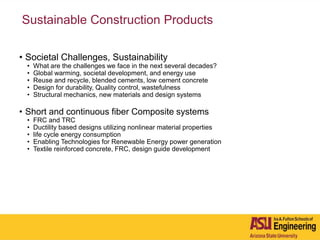
Length
Scale
Time
Scale
Disciplines
Seconds to
Centuries
(1 to 3x10¹⁰
Seconds)
hydration Early age
Long term
Performance
Service life
• Materials Science
• Engineering
• Chemistry
• Mechanics
• Computational Techniques
• Manufacturing products and systems
• Sustainable development
• Technical & non-technical labor poolnanometers to kilometers
(1x10⁻⁸ to 1x10³ meters)
Temporal, Spatial, and Scientific Span of Construction Products
Sustainable Construction Products
• Societal Challenges, Sustainability
• What are the challenges we face in the next several decades?
• Global warming, societal development, and energy use
• Reuse and recycle, blended cements, low cement concrete
• Design for durability, Quality control, wastefulness
• Structural mechanics, new materials and design systems
• Short and continuous fiber Composite systems
• FRC and TRC
• Ductility based designs utilizing nonlinear material properties
• life cycle energy consumption
• Enabling Technologies for Renewable Energy power generation
• Textile reinforced concrete, FRC, design guide development
Social Justice- Develop Alternative Construction Products
Global Warming is Global
Texas, Florida, Caribbean, Bangladesh,..
Hurricane Harvey,
2017
Hurricane Irma,
2017
Motivation: Sustainability in construction
Challenges for civil infrastructure systems
o Economic growth, Efficient resource utilization
o Global warming, Resilient structural systems
Sustainability – A need of the hour
o Energy efficient, Cost effective structural systems
o Durable and Safe
Composite Systems – A solution
o Fiber reinforcement and textile composites
o Ductility and Crack control
o Light weight
o Low cement utilization in concrete
Geospatial world, “Sustainable Infrastructure: Geospatial tech in the forefront
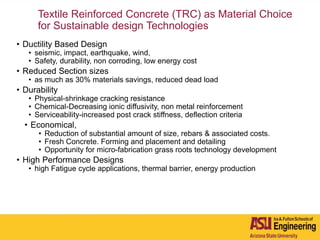
Textile Reinforced Concrete (TRC) as Material Choice
for Sustainable design Technologies
• Ductility Based Design
• seismic, impact, earthquake, wind,
• Safety, durability, non corroding, low energy cost
• Reduced Section sizes
• as much as 30% materials savings, reduced dead load
• Durability
• Physical-shrinkage cracking resistance
• Chemical-Decreasing ionic diffusivity, non metal reinforcement
• Serviceability-increased post crack stiffness, deflection criteria
• Economical,
• Reduction of substantial amount of size, rebars & associated costs.
• Fresh Concrete. Forming and placement and detailing
• Opportunity for micro-fabrication grass roots technology development
• High Performance Designs
• high Fatigue cycle applications, thermal barrier, energy production
5
Directions for: Materials Design, Mechanical Properties,
Structural Design
Materials Design:
• TRC materials as new structural components
• Candidate UHPC applications for bridge element connections, accelerated bridge
construction (ABC).
• Develop TRC using economic fibers and UHPC by low cost non-proprietary mixes
Mechanical Properties
• Parametric linearized materials model
• Cross sectional analysis based on stress and strain diagrams
• Closed-form solutions of moment and curvature responses
• Back calculation of tensile responses and extraction of tensile properties
Structural Design
• Serviceability state design: curvature, deflection, post-crack stiffness
• Design recommendations: moment capacity, minimum reinforcement ratio, serviceability
limits
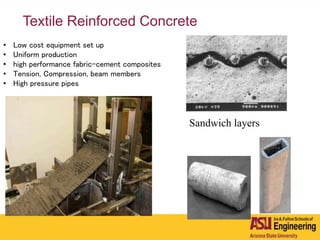
Textile Reinforced Concrete
Sandwich layers
• Low cost equipment set up
• Uniform production
• high performance fabric-cement composites
• Tension, Compression, beam members
• High pressure pipes
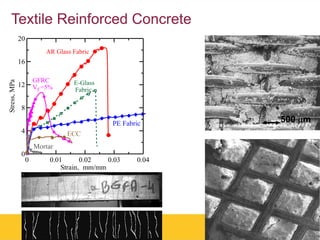
Textile Reinforced Concrete
0 0.01 0.02 0.03 0.04
Strain, mm/mm
0
4
8
12
16
20
Stress,MPa
AR Glass Fabric
GFRC
Vf =5%
PE Fabric
E-Glass
Fabric
Mortar
ECC
500 mm
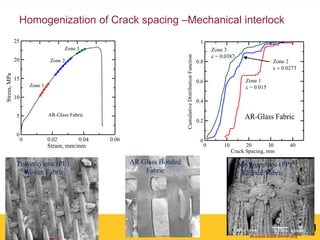
Homogenization of Crack spacing –Mechanical interlock
0 10 20 30 40
Crack Spacing, mm
0
0.2
0.4
0.6
0.8
1
CumulativeDistributionFunction
Zone 1
= 0.015
Zone 2
.0273
Zone 3
 = 0.0387
AR-Glass Fabric
0 0.02 0.04 0.06
Strain, mm/mm
0
5
10
15
20
25
Stress,MPa
Zone 3
Zone 2
Zone 1
AR-Glass Fabric
AR Glass Bonded
Fabric
Polyethylene (PE)
Woven Fabric
Polypropylene (PP)
Knitted Fabric
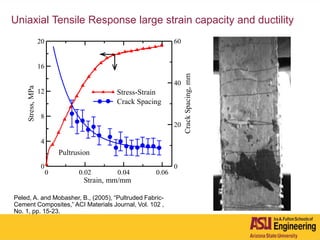
Uniaxial Tensile Response large strain capacity and ductility
0 0.02 0.04 0.06
Strain, mm/mm
0
4
8
12
16
20
Stress,MPa
0
20
40
60
CrackSpacing,mm
Stress-Strain
Crack Spacing
Pultrusion
Peled, A. and Mobasher, B., (2005), “Pultruded Fabric-
Cement Composites,” ACI Materials Journal, Vol. 102 ,
No. 1, pp. 15-23.
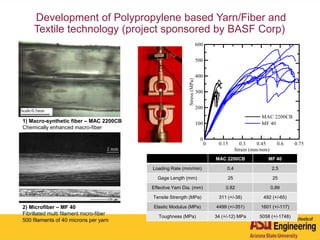
Development of Polypropylene based Yarn/Fiber and
Textile technology (project sponsored by BASF Corp)
MAC 2200CB MF 40
Loading Rate (mm/min) 0.4 2.5
Gage Length (mm) 25 25
Effective Yarn Dia. (mm) 0.82 0.89
Tensile Strength (MPa) 311 (+/-38) 492 (+/-65)
Elastic Modulus (MPa) 4499 (+/-351) 1601 (+/-117)
Toughness (MPa) 34 (+/-12) MPa 5058 (+/-1748)
2) Microfiber – MF 40
Fibrillated multi filament micro-fiber
500 filaments of 40 microns per yarn
1) Macro-synthetic fiber – MAC 2200CB
Chemically enhanced macro-fiber
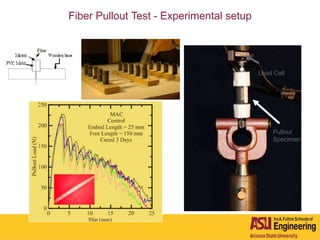
Fiber Pullout Test - Experimental setup
Load Cell
Pullout
Specimen
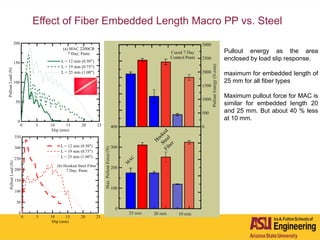
Effect of Fiber Embedded Length Macro PP vs. Steel
Pullout energy as the area
enclosed by load slip response.
maximum for embedded length of
25 mm for all fiber types
Maximum pullout force for MAC is
similar for embedded length 20
and 25 mm. But about 40 % less
at 10 mm.
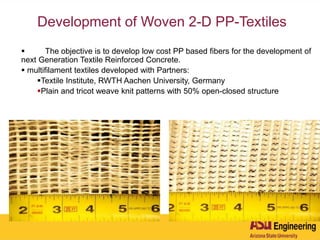
Development of Woven 2-D PP-Textiles
 The objective is to develop low cost PP based fibers for the development of
next Generation Textile Reinforced Concrete.
 multifilament textiles developed with Partners:
Textile Institute, RWTH Aachen University, Germany
Plain and tricot weave knit patterns with 50% open-closed structure
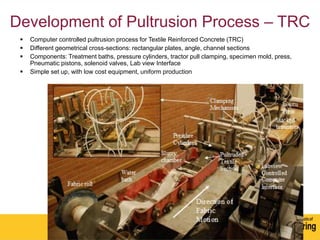
Development of Pultrusion Process – TRC
 Computer controlled pultrusion process for Textile Reinforced Concrete (TRC)
 Different geometrical cross-sections: rectangular plates, angle, channel sections
 Components: Treatment baths, pressure cylinders, tractor pull clamping, specimen mold, press,
Pneumatic pistons, solenoid valves, Lab view Interface
 Simple set up, with low cost equipment, uniform production
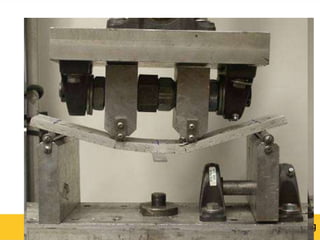
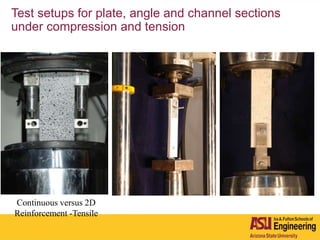
Test setups for plate, angle and channel sections
under compression and tension
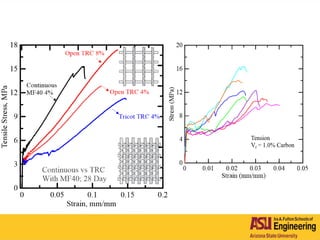
Continuous versus 2D
Reinforcement -Tensile
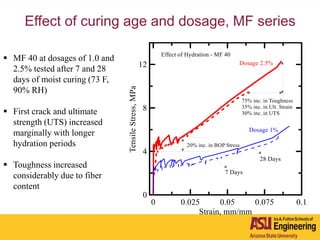
Effect of curing age and dosage, MF series
 MF 40 at dosages of 1.0 and
2.5% tested after 7 and 28
days of moist curing (73 F,
90% RH)
 First crack and ultimate
strength (UTS) increased
marginally with longer
hydration periods
 Toughness increased
considerably due to fiber
content
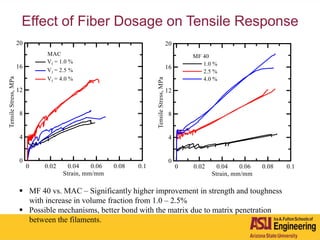
Effect of Fiber Dosage on Tensile Response
 MF 40 vs. MAC – Significantly higher improvement in strength and toughness
with increase in volume fraction from 1.0 – 2.5%
 Possible mechanisms, better bond with the matrix due to matrix penetration
between the filaments.
Continuous Fiber versus 2D Textile
Reinforcement
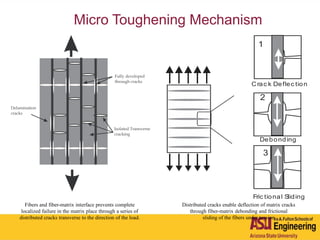
Micro Toughening Mechanism
1
2
3
Crac k Deflec tion
Debonding
Fric tional Sliding
Fibers and fiber-matrix interface prevents complete
localized failure in the matrix place through a series of
distributed cracks transverse to the direction of the load.
Distributed cracks enable deflection of matrix cracks
through fiber-matrix debonding and frictional
sliding of the fibers under tension
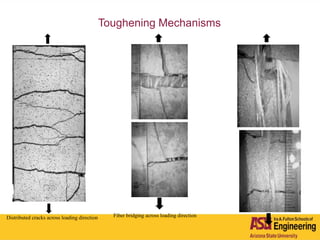
Toughening Mechanisms
Fiber bridging across loading directionDistributed cracks across loading direction
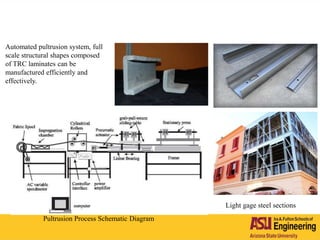
Automated pultrusion system, full
scale structural shapes composed
of TRC laminates can be
manufactured efficiently and
effectively.
Pultrusion Process Schematic Diagram
Light gage steel sections
Structural Shapes: Development, Analysis, and
Implementation using Design Approach
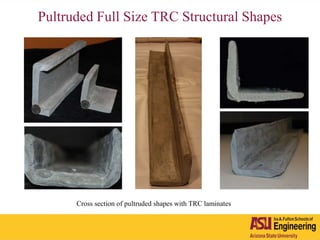
Pultruded Full Size TRC Structural Shapes
Cross section of pultruded shapes with TRC laminates
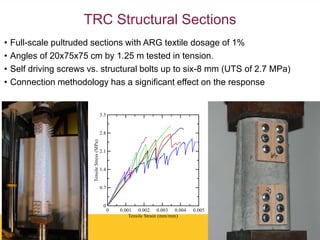
TRC Structural Sections
• Full-scale pultruded sections with ARG textile dosage of 1%
• Angles of 20x75x75 cm by 1.25 m tested in tension.
• Self driving screws vs. structural bolts up to six-8 mm (UTS of 2.7 MPa)
• Connection methodology has a significant effect on the response
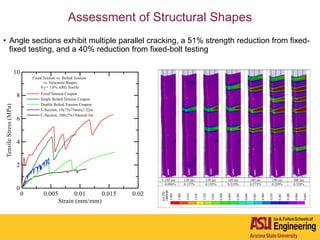
Assessment of Structural Shapes
• Angle sections exhibit multiple parallel cracking, a 51% strength reduction from fixed-
fixed testing, and a 40% reduction from fixed-bolt testing
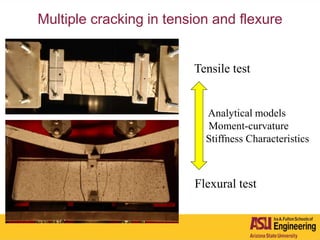
Multiple cracking in tension and flexure
Tensile test
Flexural test
Analytical models
Moment-curvature
Stiffness Characteristics
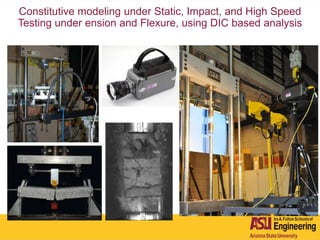
Constitutive modeling under Static, Impact, and High Speed
Testing under ension and Flexure, using DIC based analysis
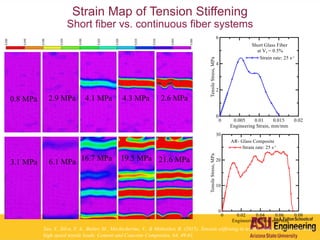
Strain Map of Tension Stiffening
Short fiber vs. continuous fiber systems
0.8 MPa 2.9 MPa 4.1 MPa 4.3 MPa 2.6 MPa
3.1 MPa 6.1 MPa 16.7 MPa 19.5 MPa 21.6 MPa
Yao, Y., Silva, F. A., Butler, M., Mechtcherine, V., & Mobasher, B. (2015). Tension stiffening in textile-reinforced concrete under
high speed tensile loads. Cement and Concrete Composites, 64, 49-61.
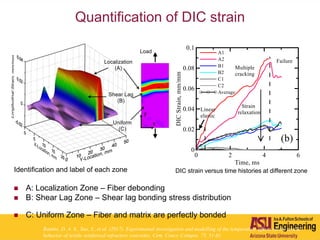
Quantification of DIC strain
 A: Localization Zone – Fiber debonding
 B: Shear Lag Zone – Shear lag bonding stress distribution
 C: Uniform Zone – Fiber and matrix are perfectly bonded
DIC strain versus time histories at different zoneIdentification and label of each zone
Rambo, D. A. S., Yao, Y., et al. (2017). Experimental investigation and modelling of the temperature effects on the tensile
behavior of textile reinforced refractory concretes. Cem. Concr. Compos. 75, 51-61.
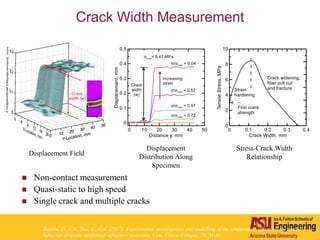
Crack Width Measurement
 Non-contact measurement
 Quasi-static to high speed
 Single crack and multiple cracks
Displacement Field
Displacement
Distribution Along
Specimen
Stress-Crack Width
Relationship
Rambo, D. A. S., Yao, Y., et al. (2017). Experimental investigation and modelling of the temperature effects on the tensile
behavior of textile reinforced refractory concretes. Cem. Concr. Compos. 75, 51-61.
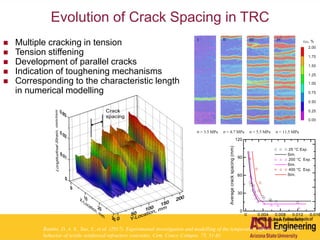
Evolution of Crack Spacing in TRC
 Multiple cracking in tension
 Tension stiffening
 Development of parallel cracks
 Indication of toughening mechanisms
 Corresponding to the characteristic length
in numerical modelling
σ = 3.5 MPa σ = 4.7 MPa σ = 5.5 MPa σ = 11.5 MPa
I II III IV
1.75
2.00
1.50
0.00
yy, %
1.25
1.00
0.75
0.50
0.25
Rambo, D. A. S., Yao, Y., et al. (2017). Experimental investigation and modelling of the temperature effects on the tensile
behavior of textile reinforced refractory concretes. Cem. Concr. Compos. 75, 51-61.
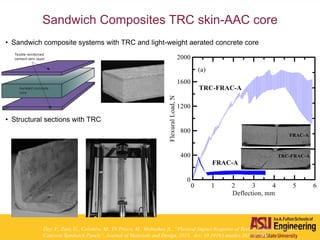
Sandwich Composites TRC skin-AAC core
• Sandwich composite systems with TRC and light-weight aerated concrete core
• Structural sections with TRC
Aerated concrete
core
Textile reinforced
cement skin layer
Dey, V., Zani, G., Colombo, M., Di Prisco, M., Mobasher, B., “Flexural Impact Response of Textile-Reinforced Aerated
Concrete Sandwich Panels”, Journal of Materials and Design, 2015, doi: 10.1016/j.matdes.2015.07.004
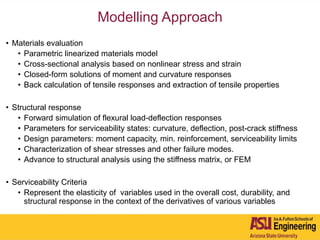
Modelling Approach
• Materials evaluation
• Parametric linearized materials model
• Cross-sectional analysis based on nonlinear stress and strain
• Closed-form solutions of moment and curvature responses
• Back calculation of tensile responses and extraction of tensile properties
• Structural response
• Forward simulation of flexural load-deflection responses
• Parameters for serviceability states: curvature, deflection, post-crack stiffness
• Design parameters: moment capacity, min. reinforcement, serviceability limits
• Characterization of shear stresses and other failure modes.
• Advance to structural analysis using the stiffness matrix, or FEM
• Serviceability Criteria
• Represent the elasticity of variables used in the overall cost, durability, and
structural response in the context of the derivatives of various variables
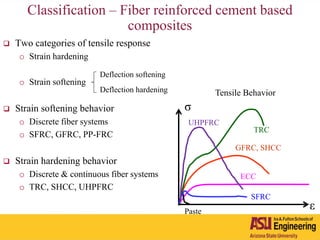
Classification – Fiber reinforced cement based
composites
 Two categories of tensile response
o Strain hardening
o Strain softening
 Strain softening behavior
o Discrete fiber systems
o SFRC, GFRC, PP-FRC
 Strain hardening behavior
o Discrete & continuous fiber systems
o TRC, SHCC, UHPFRC
GFRC, SHCC
ECC
TRC
ε
Tensile Behavior
σ
Paste
SFRC
Deflection softening
Deflection hardening
UHPFRC
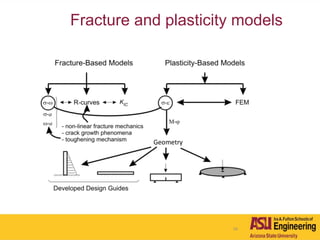
Fracture and plasticity models
39
Geometry
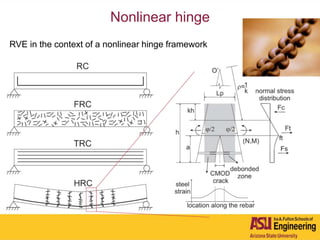
Nonlinear hinge
RVE in the context of a nonlinear hinge framework
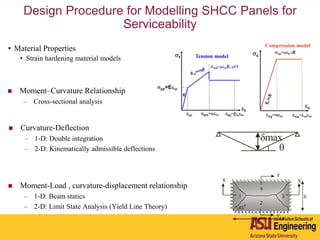
Design Procedure for Modelling SHCC Panels for
Serviceability
• Material Properties
• Strain hardening material models
 Moment-Load , curvature-displacement relationship
– 1-D: Beam statics
– 2-D: Limit State Analysis (Yield Line Theory)
1
2
3
4
b
Y
X X
Y
45
a
 Curvature-Deflection
– 1-D: Double integration
– 2-D: Kinematically admissible deflections
δmax
θ
 Moment–Curvature Relationship
– Cross-sectional analysis
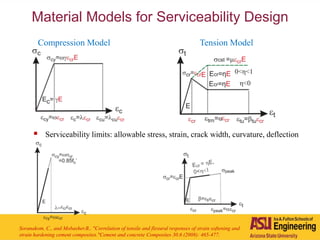
Material Models for Serviceability Design
Compression Model Tension Model
Soranakom, C., and Mobasher.B., "Correlation of tensile and flexural responses of strain softening and
strain hardening cement composites."Cement and concrete Composites 30.6 (2008): 465-477.
 Serviceability limits: allowable stress, strain, crack width, curvature, deflection
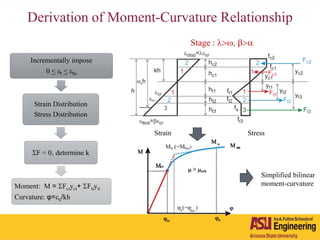
Derivation of Moment-Curvature Relationship
Strain Stress
Incrementally impose
0 < t < tu
Strain Distribution
Stress Distribution
SF = 0, determine k
Moment: M = SFciyci+ SFtiyti
Curvature: φ=c/kh
Simplified bilinear
moment-curvature
Stage : l>w, b>a
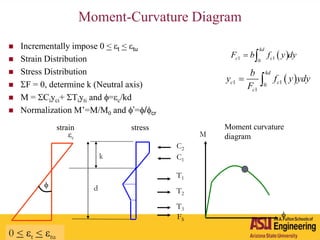
Moment-Curvature Diagram
M
f
f
c
0 < t < tu
k
d
stressstrain Moment curvature
diagram
 Incrementally impose 0 < t < tu
 Strain Distribution
 Stress Distribution
 SF = 0, determine k (Neutral axis)
 M = SCiyci+ STiyti and f=c/kd
 Normalization M’=M/M0 and f’=f/fcr
 1 10
kd
c cF b f y dy 
 1 10
1
kd
c c
c
b
y f y ydy
F
 
C2
T1
T2
T3
C1
FS
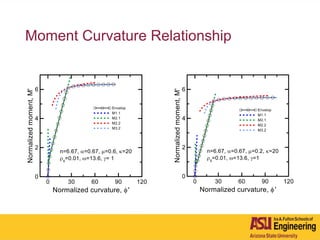
Moment Curvature Relationship
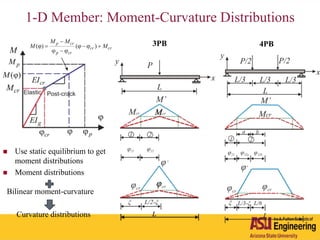
1-D Member: Moment-Curvature Distributions
 Use static equilibrium to get
moment distributions
 Moment distributions
3PB 4PB
Bilinear moment-curvature
Curvature distributions
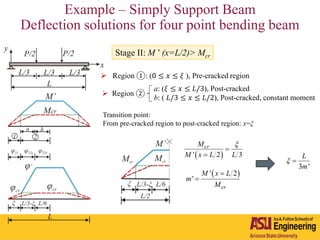
Example – Simply Support Beam
Deflection solutions for four point bending beam
 Region ①: (0 ≤ 𝑥 ≤ 𝜉 ), Pre-cracked region
Stage II: M ’ (x=L/2)> Mcr
Transition point:
From pre-cracked region to post-cracked region: x=ξ
 ' 2 3
crM
M x L L



 ' 2
'
cr
M x L
m
M


3 '
L
m
 
 Region ②
a: (𝜉 ≤ 𝑥 ≤ 𝐿/3), Post-cracked
b: ( 𝐿/3 ≤ 𝑥 ≤ 𝐿/2), Post-cracked, constant moment
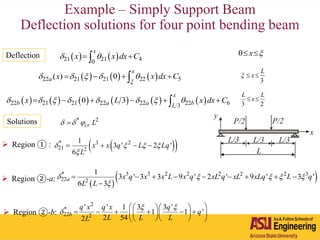
Example – Simply Support Beam
Deflection solutions for four point bending beam
Deflection    21 21 40
x
x x dx C  
     22 21 21 22 5( ) 0
x
a x x dx C

       
           22 21 21 22 22 22 63
0 3
x
b a a bL
x L x dx C            
0 x  
3
L
x  
3 2
L L
x 
Solutions
 Region ① :
 Region ②-a:
 Region ②-b:
  2
*
21
3 21
3 ' 2 '
6
x x q L Lq
L
  

   
 
 3 3 2 2* 2 2 2 3
222
1
3 ' 3 3 9 ' 2 ' 9 ' 3 '
6 3
a x q x x L x q xL q xL xLq L q
L L
   

      


2
22 2
* ' ' 1 3 3 '
1 1 '
2 542
b
q x q x q
q
L L LL


   
       
  

 
* 2
 cr L  
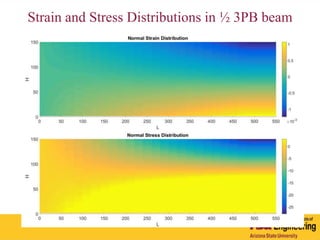
Strain and Stress Distributions in ½ 3PB beam
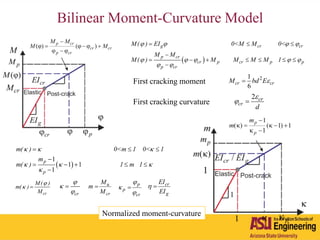
Bilinear Moment-Curvature Model
 
g cr cr
p cr
cr p cr p p
p cr
M( ) EI 0<M M 0<
M M
M( ) M M M M 1
   
    
 
  

      

 
1
1 1
1
p
p
m( ) 0<m 1 0< 1
m
m( ) 1 m 1
  
  

  

    

cr
M( )
m( )
M

 
cr



 u
cr
M
m
M
 p
p
cr




cr
g
EI
EI
 
First cracking moment 21
6
cr crM bd E
First cracking curvature
2 cr
cr
d

 
Normalized moment-curvature
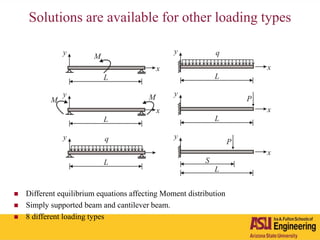
Solutions are available for other loading types
 Different equilibrium equations affecting Moment distribution
 Simply supported beam and cantilever beam.
 8 different loading types
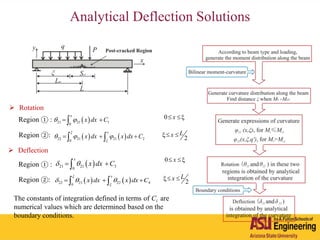
 21 21 10
x
x dx C  
0 x 
2
Lx    22 21 21 20
x
x dx x dx C


     
0 x 
2
Lx    22 21 22 40
   
x
x dx x dx C


  
 21 21 30
x
x dx C  
 Rotation
Region ① :
Region ②:
 Deflection
The constants of integration defined in terms of Ci are
numerical values which are determined based on the
boundary conditions.
Analytical Deflection Solutions
Region ① :
Region ②:
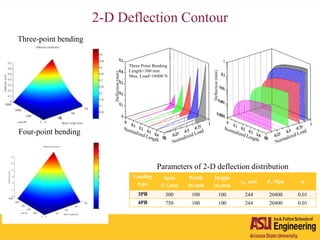
2-D Deflection Contour
Three-point bending
Four-point bending
Loading
type
Span
(L),mm
Width
(b),mm
Height
(d),mm
εcr, µstr E, Mpa η
3PB 300 100 100 244 20400 0.01
4PB 750 100 100 244 20400 0.01
h
Parameters of 2-D deflection distribution
2-D Member: Slab and Panel
Model Approach Type of Members
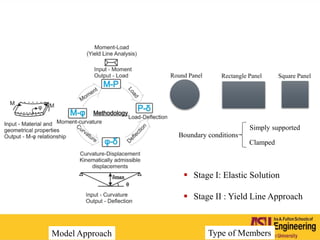
Round Panel Rectangle Panel Square Panel
Boundary conditions
Simply supported
Clamped
 Stage I: Elastic Solution
 Stage II : Yield Line Approach
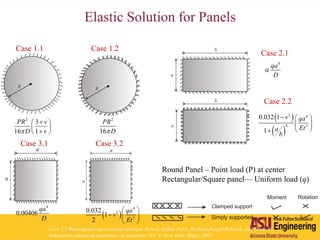
Elastic Solution for Panels
Case 1.1 Case 1.2
Case 2.1
Case 2.2
2
3
16 1
PR v
D v
 
 
 
2
16
PR
D
4
0.00406
qa
D  
4
2
3
0.032
1
2
qa
v
Et
 
  
 
4
qa
D
a
 
 
2 4
4 3
0.032 1
1
v qa
Eta
b
  
 
 
Case 3.1 Case 3.2
Clamped support
Simply supported
Free support
Moment Rotation
Round Panel – Point load (P) at center
Rectangular/Square panel— Uniform load (q)
Case 2.2 Westergaard approximate solution. Boresi, Arthur Peter, Richard Joseph Schmidt, and Omar M.
Sidebottom.Advanced mechanics of materials. Vol. 6. New York: Wiley, 1993.
Plastic Solution: Yield Line Moment– Applied Load
ext intW W
( ) ( )N ml   
Assumptions:
 Failure takes place according to the assumed pattern
 Yield lines are straight and end at slab boundary
 Yield lines at vertexes are at 45° to the edges in case of square & rectangular
slabs
 Hogging moment about the yield lines and sagging moment about the
supports are equal
Work done in moving loads = Work done in rotating yield lines
N – Load, δ – Defl., m – moment abt. YL, l – length of YL, θ - Rotation
Kennedy G., Goodchild C., “Practical yield line design”
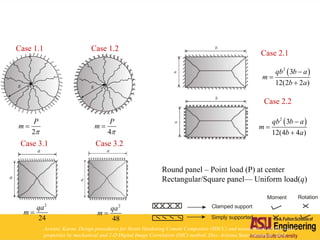
Yield Line Moment – Applied Load
Case 1.1 Case 1.2
Case 2.1
Case 2.2
Case 3.1 Case 3.2
Clamped support
Simply supported
Free support
Moment Rotation
Round panel – Point load (P) at center
Rectangular/Square panel— Uniform load(q)
2
P
m 
 4
P
m 

 2
3
12(2 2 )
qb b a
m
b a



 2
3
12(4 4 )
qb b a
m
b a



2
24
qa
m 
2
48
qa
m 
Aswani, Karan. Design procedures for Strain Hardening Cement Composites (SHCC) and measurement of their shear
properties by mechanical and 2-D Digital Image Correlation (DIC) method. Diss. Arizona State University, 2014.
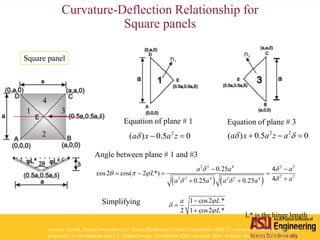
Curvature-Deflection Relationship for
Square panels
Square panel
2
( ) 0.5 0a x a z  2 2
( ) 0.5 0a x a z a   
Equation of plane # 1 Equation of plane # 3
Angle between plane # 1 and #3
   
2 2 4 2 2
2 22 2 4 2 2 4
0.25 4
cos2 cos( 2 *)
40.25 0.25
a a a
L
aa a a a
 
   
 
 
  
 
1 cos2 *
2 1 cos2 *
a L
L






Simplifying
1
2
4
3
L* is the hinge length
Aswani, Karan. Design procedures for Strain Hardening Cement Composites (SHCC) and measurement of their shear
properties by mechanical and 2-D Digital Image Correlation (DIC) method. Diss. Arizona State University, 2014.
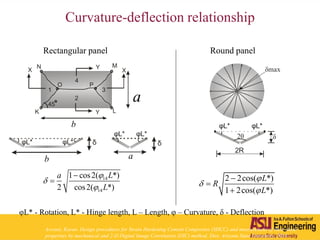
Curvature-deflection relationship
φL* - Rotation, L* - Hinge length, L – Length, φ – Curvature, δ - Deflection
Rectangular panel
δ
a
Section X-X
δ
b
Section Y-Y
φL* φL*
φL* φL*
Round panel
δmax
2R
δ2θ
φL* φL*
2 2cos( *)
1 2cos( *)
L
R
L






14
14
1 cos2( *)
2 cos2( *)
La
L





1
2
3
4
b
K L
P
Y
MN
O
X X
Y
45
a
b
b a
a
Aswani, Karan. Design procedures for Strain Hardening Cement Composites (SHCC) and measurement of their shear
properties by mechanical and 2-D Digital Image Correlation (DIC) method. Diss. Arizona State University, 2014.
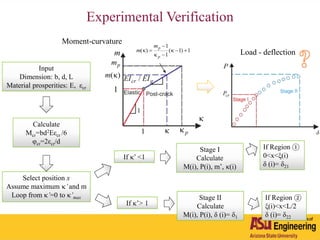
Experimental Verification
Input
Dimension: b, d, L
Material prosperities: E, εcr
Calculate
Mcr=bd2Eεcr /6
φcr=2εcr/d
Select position x
Assume maximum ’ and m
Loop from ’=0 to ’max
If ’ <1
If ’> 1
Stage I
Calculate
M(i), P(i), m’, (i)
Stage II
Calculate
M(i), P(i), δ (i)= δ1
If Region ①
0<x<ξ(i)
δ (i)= δ21
If Region ②
ξ(i)<x<L/2
δ (i)= δ22
Moment-curvature
Load - deflection
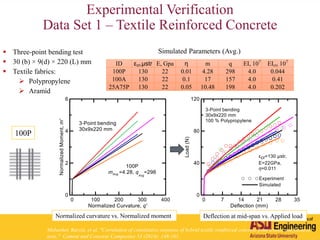
Experimental Verification
Data Set 1 – Textile Reinforced Concrete
 Three-point bending test
 30 (b) × 9(d) × 220 (L) mm
 Textile fabrics:
 Polypropylene
 Aramid
ID εcr,µstr E, Gpa η m q EI, 107
EIcr, 107
100P 130 22 0.01 4.28 298 4.0 0.044
100A 130 22 0.1 17 157 4.0 0.41
25A75P 130 22 0.05 10.48 198 4.0 0.202
100P
Normalized curvature vs. Normalized moment Deflection at mid-span vs. Applied load
Simulated Parameters (Avg.)
Mobasher, Barzin, et al. "Correlation of constitutive response of hybrid textile reinforced concrete from tensile and flexural
tests." Cement and Concrete Composites 53 (2014): 148-161.
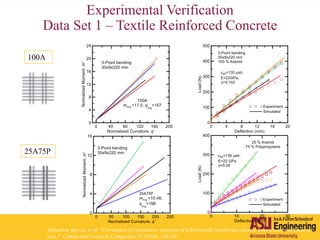
100A
25A75P
Experimental Verification
Data Set 1 – Textile Reinforced Concrete
Mobasher, Barzin, et al. "Correlation of constitutive response of hybrid textile reinforced concrete from tensile and flexural
tests." Cement and Concrete Composites 53 (2014): 148-161.
Experimental Verification
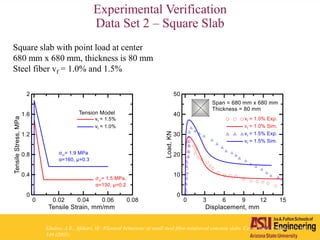
Data Set 2 – Square Slab
Square slab with point load at center
680 mm x 680 mm, thickness is 80 mm
Steel fiber vf = 1.0% and 1.5%
Khaloo, A.R., Afshari, M.: Flexural behaviour of small steel fibre reinforced concrete slabs. Cem. Concr. Compos. 27, 141–
149 (2005).
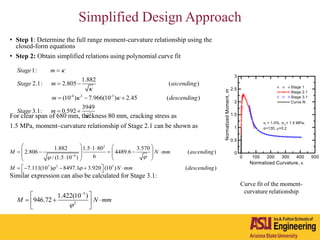
Simplified Design Approach
• Step 1: Determine the full range moment-curvature relationship using the
closed-form equations
• Step 2: Obtain simplified relations using polynomial curve fit
For clear span of 680 mm, thickness 80 mm, cracking stress as
1.5 MPa, moment–curvature relationship of Stage 2.1 can be shown as
Similar expression can also be calculated for Stage 3.1:
-4 2 -3
1:
1.882
2.1: 2.805 ( )
(10 ) (10 ) 2.45 ( )
3
7.
.1
9
:
66
Stage m
Stage m ascending
m descending
Stage


 
  
    
    
  2
3949
0.592m

  
2
6
7 2 3
1.882 3.570
2.806 4489.6 ( )
/ (1.5 )
7.111( ) 8497.1
1.5 1 80
610
10 13 0.920 ( ) ( )
M ascending
M desce
N mm
N mm nding

 

 
    
 
 
    
  
     
   
5
2
1.422(10 )
946.72M N mm


 
  



Curve fit of the moment-
curvature relationship
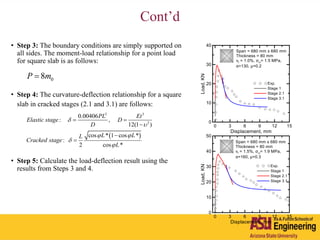
Cont’d
• Step 3: The boundary conditions are simply supported on
all sides. The moment-load relationship for a point load
for square slab is as follows:
• Step 4: The curvature-deflection relationship for a square
slab in cracked stages (2.1 and 3.1) are follows:
• Step 5: Calculate the load-deflection result using the
results from Steps 3 and 4.
08P m
 
2 3
2
0.00406
: ,
12(1
cos * 1 cos *
:
2 co
)
s *
L LL
Cracked
PL Et
stage
L
Elastic stage D
D




 
 
    






Experimental Verification
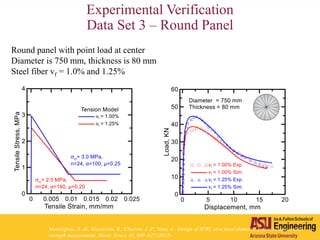
Data Set 3 – Round Panel
Round panel with point load at center
Diameter is 750 mm, thickness is 80 mm
Steel fiber vf = 1.0% and 1.25%
Montaignac, R. de, Massicotte, B., Charron, J.-P., Nour, A.: Design of SFRC structural elements: post-cracking tensile
strength measurement. Mater. Struct. 45, 609–622 (2012).
Concluding Remarks
• TRC Composites made with PP fibers can be tailored to meet the same
level of performance as Carbon Fiber systems.
• Parametric material models help in characterization of the compressive
and tensile behavior of SHCC
• Linearized moment-curvature model can be used an extension of stress-
strain models applied to a given crossection.
• Analytical deflection equations of 1-D and 2-D flexural members with
FRC and HRC were derived
• Load-deflection relationships for various types of beams and panel are
derived
• Closed form solutions can be used to obtain gradients of serviceability
functions with respect to input variables.
• Accuracy of analytical deflection equations is identified by comparing the
simulated data with experimental data
Fiber and Textile Reinforced Cement Composites
2019 trc tu_dresden

2019 trc tu_dresden

  • 1.
    A Vision forTextile Reinforced Concrete Structural Sections Barzin Mobasher School of Sustainable Engineering and the Built Environment Arizona State University Tempe, AZ 85287-5306 September, 24-25th, 2019 Dresden, Germany
  • 2.
    Presentation Outline  Introduction,Sustainability aspects  Textile Reinforced Concrete Directions  Structural Sections using UHPC-FRC-TRC systems  Experimental Characterization of Distributed Cracking  Parametric Material Models for TRC, UHPC, and FRC  Analytical Load-Deflection Solutions for 1 and 2-D Members  Experimental Verification  Conclusions
  • 3.
    Length Scale Time Scale Disciplines Seconds to Centuries (1 to3x1010 Seconds) hydration Early age Long term Performance Service life • Materials Science • Engineering • Chemistry • Mechanics • Computational Techniques • Manufacturing products and systems • Sustainable development • Technical & non-technical labor poolnanometers to kilometers (1x10⁻⁸ to 1x10³ meters) Temporal, Spatial, and Scientific Span of Construction Products
  • 4.
    Sustainable Construction Products •Societal Challenges, Sustainability • What are the challenges we face in the next several decades? • Global warming, societal development, and energy use • Reuse and recycle, blended cements, low cement concrete • Design for durability, Quality control, wastefulness • Structural mechanics, new materials and design systems • Short and continuous fiber Composite systems • FRC and TRC • Ductility based designs utilizing nonlinear material properties • life cycle energy consumption • Enabling Technologies for Renewable Energy power generation • Textile reinforced concrete, FRC, design guide development
  • 5.
    Social Justice- DevelopAlternative Construction Products
  • 6.
    Global Warming isGlobal Texas, Florida, Caribbean, Bangladesh,.. Hurricane Harvey, 2017 Hurricane Irma, 2017
  • 7.
    Motivation: Sustainability inconstruction Challenges for civil infrastructure systems o Economic growth, Efficient resource utilization o Global warming, Resilient structural systems Sustainability – A need of the hour o Energy efficient, Cost effective structural systems o Durable and Safe Composite Systems – A solution o Fiber reinforcement and textile composites o Ductility and Crack control o Light weight o Low cement utilization in concrete Geospatial world, “Sustainable Infrastructure: Geospatial tech in the forefront
  • 8.
    Textile Reinforced Concrete(TRC) as Material Choice for Sustainable design Technologies • Ductility Based Design • seismic, impact, earthquake, wind, • Safety, durability, non corroding, low energy cost • Reduced Section sizes • as much as 30% materials savings, reduced dead load • Durability • Physical-shrinkage cracking resistance • Chemical-Decreasing ionic diffusivity, non metal reinforcement • Serviceability-increased post crack stiffness, deflection criteria • Economical, • Reduction of substantial amount of size, rebars & associated costs. • Fresh Concrete. Forming and placement and detailing • Opportunity for micro-fabrication grass roots technology development • High Performance Designs • high Fatigue cycle applications, thermal barrier, energy production
  • 9.
    5 Directions for: MaterialsDesign, Mechanical Properties, Structural Design Materials Design: • TRC materials as new structural components • Candidate UHPC applications for bridge element connections, accelerated bridge construction (ABC). • Develop TRC using economic fibers and UHPC by low cost non-proprietary mixes Mechanical Properties • Parametric linearized materials model • Cross sectional analysis based on stress and strain diagrams • Closed-form solutions of moment and curvature responses • Back calculation of tensile responses and extraction of tensile properties Structural Design • Serviceability state design: curvature, deflection, post-crack stiffness • Design recommendations: moment capacity, minimum reinforcement ratio, serviceability limits
  • 10.
    Textile Reinforced Concrete Sandwichlayers • Low cost equipment set up • Uniform production • high performance fabric-cement composites • Tension, Compression, beam members • High pressure pipes
  • 11.
    Textile Reinforced Concrete 00.01 0.02 0.03 0.04 Strain, mm/mm 0 4 8 12 16 20 Stress,MPa AR Glass Fabric GFRC Vf =5% PE Fabric E-Glass Fabric Mortar ECC 500 mm
  • 12.
    Homogenization of Crackspacing –Mechanical interlock 0 10 20 30 40 Crack Spacing, mm 0 0.2 0.4 0.6 0.8 1 CumulativeDistributionFunction Zone 1 = 0.015 Zone 2 .0273 Zone 3  = 0.0387 AR-Glass Fabric 0 0.02 0.04 0.06 Strain, mm/mm 0 5 10 15 20 25 Stress,MPa Zone 3 Zone 2 Zone 1 AR-Glass Fabric AR Glass Bonded Fabric Polyethylene (PE) Woven Fabric Polypropylene (PP) Knitted Fabric
  • 13.
    Uniaxial Tensile Responselarge strain capacity and ductility 0 0.02 0.04 0.06 Strain, mm/mm 0 4 8 12 16 20 Stress,MPa 0 20 40 60 CrackSpacing,mm Stress-Strain Crack Spacing Pultrusion Peled, A. and Mobasher, B., (2005), “Pultruded Fabric- Cement Composites,” ACI Materials Journal, Vol. 102 , No. 1, pp. 15-23.
  • 15.
    Development of Polypropylenebased Yarn/Fiber and Textile technology (project sponsored by BASF Corp) MAC 2200CB MF 40 Loading Rate (mm/min) 0.4 2.5 Gage Length (mm) 25 25 Effective Yarn Dia. (mm) 0.82 0.89 Tensile Strength (MPa) 311 (+/-38) 492 (+/-65) Elastic Modulus (MPa) 4499 (+/-351) 1601 (+/-117) Toughness (MPa) 34 (+/-12) MPa 5058 (+/-1748) 2) Microfiber – MF 40 Fibrillated multi filament micro-fiber 500 filaments of 40 microns per yarn 1) Macro-synthetic fiber – MAC 2200CB Chemically enhanced macro-fiber
  • 16.
    Fiber Pullout Test- Experimental setup Load Cell Pullout Specimen
  • 17.
    Effect of FiberEmbedded Length Macro PP vs. Steel Pullout energy as the area enclosed by load slip response. maximum for embedded length of 25 mm for all fiber types Maximum pullout force for MAC is similar for embedded length 20 and 25 mm. But about 40 % less at 10 mm.
  • 18.
    Development of Woven2-D PP-Textiles  The objective is to develop low cost PP based fibers for the development of next Generation Textile Reinforced Concrete.  multifilament textiles developed with Partners: Textile Institute, RWTH Aachen University, Germany Plain and tricot weave knit patterns with 50% open-closed structure
  • 19.
    Development of PultrusionProcess – TRC  Computer controlled pultrusion process for Textile Reinforced Concrete (TRC)  Different geometrical cross-sections: rectangular plates, angle, channel sections  Components: Treatment baths, pressure cylinders, tractor pull clamping, specimen mold, press, Pneumatic pistons, solenoid valves, Lab view Interface  Simple set up, with low cost equipment, uniform production
  • 20.
    Test setups forplate, angle and channel sections under compression and tension Continuous versus 2D Reinforcement -Tensile
  • 21.
    Effect of curingage and dosage, MF series  MF 40 at dosages of 1.0 and 2.5% tested after 7 and 28 days of moist curing (73 F, 90% RH)  First crack and ultimate strength (UTS) increased marginally with longer hydration periods  Toughness increased considerably due to fiber content
  • 22.
    Effect of FiberDosage on Tensile Response  MF 40 vs. MAC – Significantly higher improvement in strength and toughness with increase in volume fraction from 1.0 – 2.5%  Possible mechanisms, better bond with the matrix due to matrix penetration between the filaments.
  • 23.
    Continuous Fiber versus2D Textile Reinforcement
  • 24.
    Micro Toughening Mechanism 1 2 3 Crack Deflec tion Debonding Fric tional Sliding Fibers and fiber-matrix interface prevents complete localized failure in the matrix place through a series of distributed cracks transverse to the direction of the load. Distributed cracks enable deflection of matrix cracks through fiber-matrix debonding and frictional sliding of the fibers under tension
  • 25.
    Toughening Mechanisms Fiber bridgingacross loading directionDistributed cracks across loading direction
  • 26.
    Automated pultrusion system,full scale structural shapes composed of TRC laminates can be manufactured efficiently and effectively. Pultrusion Process Schematic Diagram Light gage steel sections Structural Shapes: Development, Analysis, and Implementation using Design Approach
  • 27.
    Pultruded Full SizeTRC Structural Shapes Cross section of pultruded shapes with TRC laminates
  • 28.
    TRC Structural Sections •Full-scale pultruded sections with ARG textile dosage of 1% • Angles of 20x75x75 cm by 1.25 m tested in tension. • Self driving screws vs. structural bolts up to six-8 mm (UTS of 2.7 MPa) • Connection methodology has a significant effect on the response
  • 29.
    Assessment of StructuralShapes • Angle sections exhibit multiple parallel cracking, a 51% strength reduction from fixed- fixed testing, and a 40% reduction from fixed-bolt testing
  • 30.
    Multiple cracking intension and flexure Tensile test Flexural test Analytical models Moment-curvature Stiffness Characteristics
  • 31.
    Constitutive modeling underStatic, Impact, and High Speed Testing under ension and Flexure, using DIC based analysis
  • 32.
    Strain Map ofTension Stiffening Short fiber vs. continuous fiber systems 0.8 MPa 2.9 MPa 4.1 MPa 4.3 MPa 2.6 MPa 3.1 MPa 6.1 MPa 16.7 MPa 19.5 MPa 21.6 MPa Yao, Y., Silva, F. A., Butler, M., Mechtcherine, V., & Mobasher, B. (2015). Tension stiffening in textile-reinforced concrete under high speed tensile loads. Cement and Concrete Composites, 64, 49-61.
  • 33.
    Quantification of DICstrain  A: Localization Zone – Fiber debonding  B: Shear Lag Zone – Shear lag bonding stress distribution  C: Uniform Zone – Fiber and matrix are perfectly bonded DIC strain versus time histories at different zoneIdentification and label of each zone Rambo, D. A. S., Yao, Y., et al. (2017). Experimental investigation and modelling of the temperature effects on the tensile behavior of textile reinforced refractory concretes. Cem. Concr. Compos. 75, 51-61.
  • 34.
    Crack Width Measurement Non-contact measurement  Quasi-static to high speed  Single crack and multiple cracks Displacement Field Displacement Distribution Along Specimen Stress-Crack Width Relationship Rambo, D. A. S., Yao, Y., et al. (2017). Experimental investigation and modelling of the temperature effects on the tensile behavior of textile reinforced refractory concretes. Cem. Concr. Compos. 75, 51-61.
  • 35.
    Evolution of CrackSpacing in TRC  Multiple cracking in tension  Tension stiffening  Development of parallel cracks  Indication of toughening mechanisms  Corresponding to the characteristic length in numerical modelling σ = 3.5 MPa σ = 4.7 MPa σ = 5.5 MPa σ = 11.5 MPa I II III IV 1.75 2.00 1.50 0.00 yy, % 1.25 1.00 0.75 0.50 0.25 Rambo, D. A. S., Yao, Y., et al. (2017). Experimental investigation and modelling of the temperature effects on the tensile behavior of textile reinforced refractory concretes. Cem. Concr. Compos. 75, 51-61.
  • 36.
    Sandwich Composites TRCskin-AAC core • Sandwich composite systems with TRC and light-weight aerated concrete core • Structural sections with TRC Aerated concrete core Textile reinforced cement skin layer Dey, V., Zani, G., Colombo, M., Di Prisco, M., Mobasher, B., “Flexural Impact Response of Textile-Reinforced Aerated Concrete Sandwich Panels”, Journal of Materials and Design, 2015, doi: 10.1016/j.matdes.2015.07.004
  • 37.
    Modelling Approach • Materialsevaluation • Parametric linearized materials model • Cross-sectional analysis based on nonlinear stress and strain • Closed-form solutions of moment and curvature responses • Back calculation of tensile responses and extraction of tensile properties • Structural response • Forward simulation of flexural load-deflection responses • Parameters for serviceability states: curvature, deflection, post-crack stiffness • Design parameters: moment capacity, min. reinforcement, serviceability limits • Characterization of shear stresses and other failure modes. • Advance to structural analysis using the stiffness matrix, or FEM • Serviceability Criteria • Represent the elasticity of variables used in the overall cost, durability, and structural response in the context of the derivatives of various variables
  • 38.
    Classification – Fiberreinforced cement based composites  Two categories of tensile response o Strain hardening o Strain softening  Strain softening behavior o Discrete fiber systems o SFRC, GFRC, PP-FRC  Strain hardening behavior o Discrete & continuous fiber systems o TRC, SHCC, UHPFRC GFRC, SHCC ECC TRC ε Tensile Behavior σ Paste SFRC Deflection softening Deflection hardening UHPFRC
  • 39.
    Fracture and plasticitymodels 39 Geometry
  • 40.
    Nonlinear hinge RVE inthe context of a nonlinear hinge framework
  • 41.
    Design Procedure forModelling SHCC Panels for Serviceability • Material Properties • Strain hardening material models  Moment-Load , curvature-displacement relationship – 1-D: Beam statics – 2-D: Limit State Analysis (Yield Line Theory) 1 2 3 4 b Y X X Y 45 a  Curvature-Deflection – 1-D: Double integration – 2-D: Kinematically admissible deflections δmax θ  Moment–Curvature Relationship – Cross-sectional analysis
  • 42.
    Material Models forServiceability Design Compression Model Tension Model Soranakom, C., and Mobasher.B., "Correlation of tensile and flexural responses of strain softening and strain hardening cement composites."Cement and concrete Composites 30.6 (2008): 465-477.  Serviceability limits: allowable stress, strain, crack width, curvature, deflection
  • 43.
    Derivation of Moment-CurvatureRelationship Strain Stress Incrementally impose 0 < t < tu Strain Distribution Stress Distribution SF = 0, determine k Moment: M = SFciyci+ SFtiyti Curvature: φ=c/kh Simplified bilinear moment-curvature Stage : l>w, b>a
  • 44.
    Moment-Curvature Diagram M f f c 0 <t < tu k d stressstrain Moment curvature diagram  Incrementally impose 0 < t < tu  Strain Distribution  Stress Distribution  SF = 0, determine k (Neutral axis)  M = SCiyci+ STiyti and f=c/kd  Normalization M’=M/M0 and f’=f/fcr  1 10 kd c cF b f y dy   1 10 1 kd c c c b y f y ydy F   C2 T1 T2 T3 C1 FS
  • 45.
  • 46.
    1-D Member: Moment-CurvatureDistributions  Use static equilibrium to get moment distributions  Moment distributions 3PB 4PB Bilinear moment-curvature Curvature distributions
  • 47.
    Example – SimplySupport Beam Deflection solutions for four point bending beam  Region ①: (0 ≤ 𝑥 ≤ 𝜉 ), Pre-cracked region Stage II: M ’ (x=L/2)> Mcr Transition point: From pre-cracked region to post-cracked region: x=ξ  ' 2 3 crM M x L L     ' 2 ' cr M x L m M   3 ' L m    Region ② a: (𝜉 ≤ 𝑥 ≤ 𝐿/3), Post-cracked b: ( 𝐿/3 ≤ 𝑥 ≤ 𝐿/2), Post-cracked, constant moment
  • 48.
    Example – SimplySupport Beam Deflection solutions for four point bending beam Deflection    21 21 40 x x x dx C        22 21 21 22 5( ) 0 x a x x dx C                     22 21 21 22 22 22 63 0 3 x b a a bL x L x dx C             0 x   3 L x   3 2 L L x  Solutions  Region ① :  Region ②-a:  Region ②-b:   2 * 21 3 21 3 ' 2 ' 6 x x q L Lq L            3 3 2 2* 2 2 2 3 222 1 3 ' 3 3 9 ' 2 ' 9 ' 3 ' 6 3 a x q x x L x q xL q xL xLq L q L L               2 22 2 * ' ' 1 3 3 ' 1 1 ' 2 542 b q x q x q q L L LL                     * 2  cr L  
  • 49.
    Strain and StressDistributions in ½ 3PB beam
  • 50.
    Bilinear Moment-Curvature Model  g cr cr p cr cr p cr p p p cr M( ) EI 0<M M 0< M M M( ) M M M M 1                          1 1 1 1 p p m( ) 0<m 1 0< 1 m m( ) 1 m 1                  cr M( ) m( ) M    cr     u cr M m M  p p cr     cr g EI EI   First cracking moment 21 6 cr crM bd E First cracking curvature 2 cr cr d    Normalized moment-curvature
  • 51.
    Solutions are availablefor other loading types  Different equilibrium equations affecting Moment distribution  Simply supported beam and cantilever beam.  8 different loading types
  • 52.
     21 2110 x x dx C   0 x  2 Lx    22 21 21 20 x x dx x dx C         0 x  2 Lx    22 21 22 40     x x dx x dx C       21 21 30 x x dx C    Rotation Region ① : Region ②:  Deflection The constants of integration defined in terms of Ci are numerical values which are determined based on the boundary conditions. Analytical Deflection Solutions Region ① : Region ②:
  • 53.
    2-D Deflection Contour Three-pointbending Four-point bending Loading type Span (L),mm Width (b),mm Height (d),mm εcr, µstr E, Mpa η 3PB 300 100 100 244 20400 0.01 4PB 750 100 100 244 20400 0.01 h Parameters of 2-D deflection distribution
  • 54.
    2-D Member: Slaband Panel Model Approach Type of Members Round Panel Rectangle Panel Square Panel Boundary conditions Simply supported Clamped  Stage I: Elastic Solution  Stage II : Yield Line Approach
  • 55.
    Elastic Solution forPanels Case 1.1 Case 1.2 Case 2.1 Case 2.2 2 3 16 1 PR v D v       2 16 PR D 4 0.00406 qa D   4 2 3 0.032 1 2 qa v Et        4 qa D a     2 4 4 3 0.032 1 1 v qa Eta b        Case 3.1 Case 3.2 Clamped support Simply supported Free support Moment Rotation Round Panel – Point load (P) at center Rectangular/Square panel— Uniform load (q) Case 2.2 Westergaard approximate solution. Boresi, Arthur Peter, Richard Joseph Schmidt, and Omar M. Sidebottom.Advanced mechanics of materials. Vol. 6. New York: Wiley, 1993.
  • 56.
    Plastic Solution: YieldLine Moment– Applied Load ext intW W ( ) ( )N ml    Assumptions:  Failure takes place according to the assumed pattern  Yield lines are straight and end at slab boundary  Yield lines at vertexes are at 45° to the edges in case of square & rectangular slabs  Hogging moment about the yield lines and sagging moment about the supports are equal Work done in moving loads = Work done in rotating yield lines N – Load, δ – Defl., m – moment abt. YL, l – length of YL, θ - Rotation Kennedy G., Goodchild C., “Practical yield line design”
  • 57.
    Yield Line Moment– Applied Load Case 1.1 Case 1.2 Case 2.1 Case 2.2 Case 3.1 Case 3.2 Clamped support Simply supported Free support Moment Rotation Round panel – Point load (P) at center Rectangular/Square panel— Uniform load(q) 2 P m   4 P m    2 3 12(2 2 ) qb b a m b a     2 3 12(4 4 ) qb b a m b a    2 24 qa m  2 48 qa m  Aswani, Karan. Design procedures for Strain Hardening Cement Composites (SHCC) and measurement of their shear properties by mechanical and 2-D Digital Image Correlation (DIC) method. Diss. Arizona State University, 2014.
  • 58.
    Curvature-Deflection Relationship for Squarepanels Square panel 2 ( ) 0.5 0a x a z  2 2 ( ) 0.5 0a x a z a    Equation of plane # 1 Equation of plane # 3 Angle between plane # 1 and #3     2 2 4 2 2 2 22 2 4 2 2 4 0.25 4 cos2 cos( 2 *) 40.25 0.25 a a a L aa a a a                1 cos2 * 2 1 cos2 * a L L       Simplifying 1 2 4 3 L* is the hinge length Aswani, Karan. Design procedures for Strain Hardening Cement Composites (SHCC) and measurement of their shear properties by mechanical and 2-D Digital Image Correlation (DIC) method. Diss. Arizona State University, 2014.
  • 59.
    Curvature-deflection relationship φL* -Rotation, L* - Hinge length, L – Length, φ – Curvature, δ - Deflection Rectangular panel δ a Section X-X δ b Section Y-Y φL* φL* φL* φL* Round panel δmax 2R δ2θ φL* φL* 2 2cos( *) 1 2cos( *) L R L       14 14 1 cos2( *) 2 cos2( *) La L      1 2 3 4 b K L P Y MN O X X Y 45 a b b a a Aswani, Karan. Design procedures for Strain Hardening Cement Composites (SHCC) and measurement of their shear properties by mechanical and 2-D Digital Image Correlation (DIC) method. Diss. Arizona State University, 2014.
  • 60.
    Experimental Verification Input Dimension: b,d, L Material prosperities: E, εcr Calculate Mcr=bd2Eεcr /6 φcr=2εcr/d Select position x Assume maximum ’ and m Loop from ’=0 to ’max If ’ <1 If ’> 1 Stage I Calculate M(i), P(i), m’, (i) Stage II Calculate M(i), P(i), δ (i)= δ1 If Region ① 0<x<ξ(i) δ (i)= δ21 If Region ② ξ(i)<x<L/2 δ (i)= δ22 Moment-curvature Load - deflection
  • 61.
    Experimental Verification Data Set1 – Textile Reinforced Concrete  Three-point bending test  30 (b) × 9(d) × 220 (L) mm  Textile fabrics:  Polypropylene  Aramid ID εcr,µstr E, Gpa η m q EI, 107 EIcr, 107 100P 130 22 0.01 4.28 298 4.0 0.044 100A 130 22 0.1 17 157 4.0 0.41 25A75P 130 22 0.05 10.48 198 4.0 0.202 100P Normalized curvature vs. Normalized moment Deflection at mid-span vs. Applied load Simulated Parameters (Avg.) Mobasher, Barzin, et al. "Correlation of constitutive response of hybrid textile reinforced concrete from tensile and flexural tests." Cement and Concrete Composites 53 (2014): 148-161.
  • 62.
    100A 25A75P Experimental Verification Data Set1 – Textile Reinforced Concrete Mobasher, Barzin, et al. "Correlation of constitutive response of hybrid textile reinforced concrete from tensile and flexural tests." Cement and Concrete Composites 53 (2014): 148-161.
  • 63.
    Experimental Verification Data Set2 – Square Slab Square slab with point load at center 680 mm x 680 mm, thickness is 80 mm Steel fiber vf = 1.0% and 1.5% Khaloo, A.R., Afshari, M.: Flexural behaviour of small steel fibre reinforced concrete slabs. Cem. Concr. Compos. 27, 141– 149 (2005).
  • 64.
    Simplified Design Approach •Step 1: Determine the full range moment-curvature relationship using the closed-form equations • Step 2: Obtain simplified relations using polynomial curve fit For clear span of 680 mm, thickness 80 mm, cracking stress as 1.5 MPa, moment–curvature relationship of Stage 2.1 can be shown as Similar expression can also be calculated for Stage 3.1: -4 2 -3 1: 1.882 2.1: 2.805 ( ) (10 ) (10 ) 2.45 ( ) 3 7. .1 9 : 66 Stage m Stage m ascending m descending Stage                    2 3949 0.592m     2 6 7 2 3 1.882 3.570 2.806 4489.6 ( ) / (1.5 ) 7.111( ) 8497.1 1.5 1 80 610 10 13 0.920 ( ) ( ) M ascending M desce N mm N mm nding                                  5 2 1.422(10 ) 946.72M N mm           Curve fit of the moment- curvature relationship
  • 65.
    Cont’d • Step 3:The boundary conditions are simply supported on all sides. The moment-load relationship for a point load for square slab is as follows: • Step 4: The curvature-deflection relationship for a square slab in cracked stages (2.1 and 3.1) are follows: • Step 5: Calculate the load-deflection result using the results from Steps 3 and 4. 08P m   2 3 2 0.00406 : , 12(1 cos * 1 cos * : 2 co ) s * L LL Cracked PL Et stage L Elastic stage D D                   
  • 66.
    Experimental Verification Data Set3 – Round Panel Round panel with point load at center Diameter is 750 mm, thickness is 80 mm Steel fiber vf = 1.0% and 1.25% Montaignac, R. de, Massicotte, B., Charron, J.-P., Nour, A.: Design of SFRC structural elements: post-cracking tensile strength measurement. Mater. Struct. 45, 609–622 (2012).
  • 67.
    Concluding Remarks • TRCComposites made with PP fibers can be tailored to meet the same level of performance as Carbon Fiber systems. • Parametric material models help in characterization of the compressive and tensile behavior of SHCC • Linearized moment-curvature model can be used an extension of stress- strain models applied to a given crossection. • Analytical deflection equations of 1-D and 2-D flexural members with FRC and HRC were derived • Load-deflection relationships for various types of beams and panel are derived • Closed form solutions can be used to obtain gradients of serviceability functions with respect to input variables. • Accuracy of analytical deflection equations is identified by comparing the simulated data with experimental data
  • 68.
    Fiber and TextileReinforced Cement Composites