Moh’d Sharshir, Fellow Critical Care
King Faisal Specialist Hospital & Research Center
What is meningitis?……
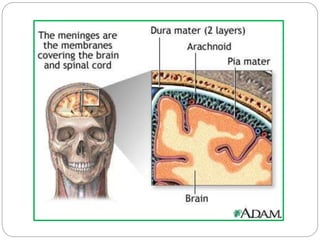
 The brain and spinal cord are covered by connective
tissue layers collectively called the meninges which
form the blood-brain barrier.
1-the pia mater (closest to the CNS)
2-the arachnoid mater
3-the dura mater (farthest from the CNS).
 The meninges contain cerebrospinal fluid (CSF).
 Meningitis is an inflammatory disease of the
leptomeninges, the tissues surrounding the brain and
spinal cord, and is defined by an abnormal number of
white blood cells in the cerebrospinal fluid (CSF) .
Causes of Meningitis:
1.Bacterial Infections
2.Viral Infections
3.Fungal Infections(Cryptococcus
neoformans,Coccidiodes immitus)
4.Inflammatory disease (SLE)
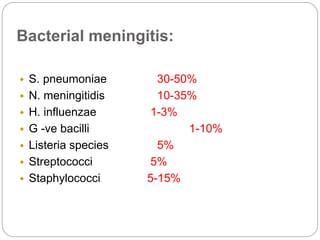
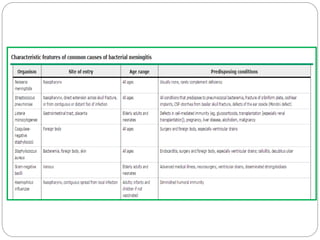
Bacterial meningitis:
 S. pneumoniae 30-50%
 N. meningitidis 10-35%
 H. influenzae 1-3%
 G -ve bacilli 1-10%
 Listeria species 5%
 Streptococci 5%
 Staphylococci 5-15%
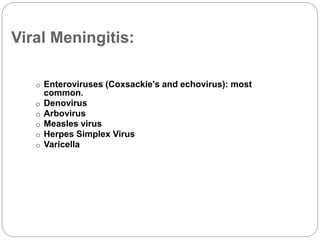
Viral Meningitis:
o Enteroviruses (Coxsackie's and echovirus): most
common.
o Denovirus
o Arbovirus
o Measles virus
o Herpes Simplex Virus
o Varicella
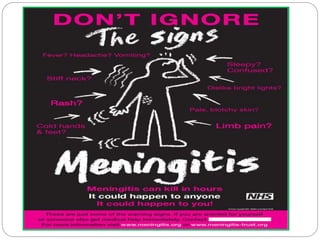
CLINICAL FEATURES
CLINICAL FEATURES:
 The classic triad of acute bacterial meningitis
consists of :
 fever.
 nuchal rigidity.
 and a change in mental status.
 Most patients have high fevers, but a small
percentage have hypothermia.
CLINICAL FEATURES:
 CNS symptoms:
 Some patients will have significant photophobia.
 Changes in mental and level of consciousnes,
seizures, and focal neurologic signs tend to appear
later in the course of disease.
CLINICAL FEATURES:
 Nuchal rigidity:
 Passive or active flexion of the neck will usually result in an
inability to touch the chin to the chest
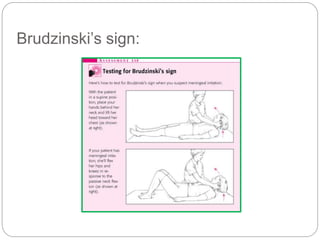
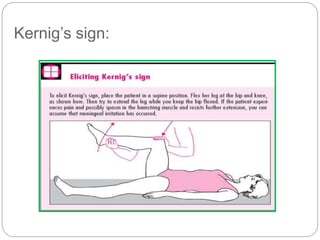
 Tests to illustrate nuchal rigidity:
Brudzinski’s sign:
Kernig’s sign:
CLINICAL FEATURES:
 Other findings
 Some infectious agents, particularly N. meningitidis,
can also cause characteristic skin manifestations,
petechiae and palpable purpura.
LABORATORY FEATURES:
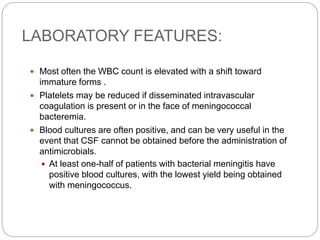
 Most often the WBC count is elevated with a shift toward
immature forms .
 Platelets may be reduced if disseminated intravascular
coagulation is present or in the face of meningococcal
bacteremia.
 Blood cultures are often positive, and can be very useful in the
event that CSF cannot be obtained before the administration of
antimicrobials.
 At least one-half of patients with bacterial meningitis have
positive blood cultures, with the lowest yield being obtained
with meningococcus.
LABORATORY FEATURES:
 CSF analysis – every patient with meningitis should have CSF
obtained unless the procedure is contraindicated
 Chemistry and cytologic findings highly suggestive of bacterial
meningitis include a CSF glucose concentration below 45
mg/dL, a protein concentration above 500 mg/dL, and a white
blood cell count above 1000/mm3
 A Gram stain should also be obtained
 The Gram stain is positive in up to 10 percent of patients with
negative CSF cultures and in up to 80 percent of those with
positive cultures
LABORATORY FEATURES:
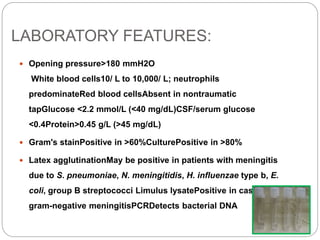
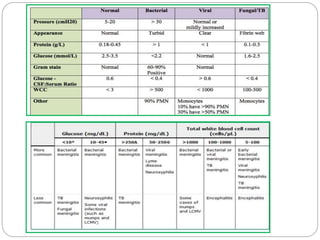
 Opening pressure>180 mmH2O
White blood cells10/ L to 10,000/ L; neutrophils
predominateRed blood cellsAbsent in nontraumatic
tapGlucose <2.2 mmol/L (<40 mg/dL)CSF/serum glucose
<0.4Protein>0.45 g/L (>45 mg/dL)
 Gram's stainPositive in >60%CulturePositive in >80%
 Latex agglutinationMay be positive in patients with meningitis
due to S. pneumoniae, N. meningitidis, H. influenzae type b, E.
coli, group B streptococci Limulus lysatePositive in cases of
gram-negative meningitisPCRDetects bacterial DNA
Treatment and prevention of bacterial
meningitis:
 Suspected bacterial meningitis is a medical
emergency and immediate diagnostic steps must be
taken to establish the specific cause.
 The mortality rate of untreated bacterial meningitis
approaches 100 percent and, even with optimal
therapy, there is a high failure rate.
 Empiric treatment should be begun as soon as the
diagnosis is suspected using bactericidal agent(s) that
achieve significant levels in the CSF.
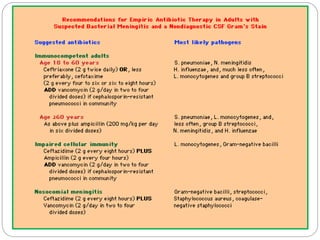
Treatment - Empiric
 Ceftriaxone 2 gm IV Q 12h or Cefotaxime 2 gm IV Q 4-6h
PLUS Vancomycin 15 mg/kg Q 6h.
 If > 50 years, also add Ampicillin 2 gm IV Q 4h (for Listeria) .
THERAPY FOR SPECIFIC
PATHOGENS :
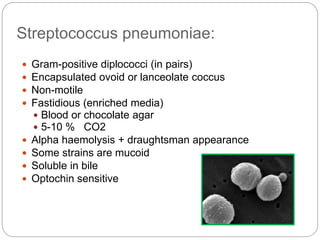
Streptococcus pneumoniae:
 Gram-positive diplococci (in pairs)
 Encapsulated ovoid or lanceolate coccus
 Non-motile
 Fastidious (enriched media)
 Blood or chocolate agar
 5-10 % CO2
 Alpha haemolysis + draughtsman appearance
 Some strains are mucoid
 Soluble in bile
 Optochin sensitive
Pathogenesis:
 Virulence factors
 Capsular polysaccharide
 The major factor
 84 serotypes
 Both antigenic and type specific
 Antiphagocytic
 Serotype 3 , 7 are most virulent
 90% of cases of bacteraemic pneumococcal pneumonia
and meningitis are caused by 23 serotypes
 Quellung reaction , india ink
 Pneumolysin
 Membrane damaging toxin
Predisposing factors:
 Aspiration of upper airway secretions ( endogenous )
 No person-person spread
 Disturbed consciousness , general anaesthesia , convulsions
, CVA , epilepsy , head trauma
 Prior LRT. VIRAL infection
 Preexisting respiratory diseases , smoking
 Chronic bronchitis , bronchogenic malignancy
 Chronic heart disease
 Chronic renal disease ( nephrotic syndrome )
 Chronic liver disease ( cirrhosis)
 Diabetes mellitus
 Old age , (extreme of age )
 Malnutrition , alcoholism
 Meningitis:
 The most virulent pathogen of meningitis
 Mortality ( 20% )
 Primary
 Complicate infections at other site ( lung )
 Bacteraemia usually coexists
 Bimodal incidence ( < 3 yr - > 45 yr )
 The conventional approach to the treatment of pneumococcal
meningitis was the administration of penicillin alone for two
weeks at a dose of four million units intravenously every four
hours.
 Good results have also been obtained with third generation
cephalosporins.
 However, the problem of treating pneumococcal meningitis has
recently been compounded by the widespread and increasingly
common reports of pneumococcal strains resistant to penicillin.
 Cefotaxime or ceftriaxone can be used if the MIC for these drugs is
less than 0.5 µg/mL.
 It is recommended that vancomycin (2 g/day) should be given with
cefotaxime or ceftriaxone in the initial treatment of pneumococcal
meningitis if there has been beta-lactam resistance noted locally.
 Vancomycin should be continued if there is high level penicillin
resistance and an MIC >0.5 µg/mL to third generation
cephalosporins.
 If corticosteroids are given, rifampin should be added as a third
agent since it increases the efficacy of the other two drugs .
 The usual duration of therapy is two weeks.
Haemophilus influenzae
 A third generation cephalosporin is the drug of choice for H.
influenzae meningitis.
 Patients with H. influenzae meningitis should be treated for five
to seven days.
 For adults, a dose of 2 g every six hours of cefotaxime and 2 g
every 12 hours of ceftriaxone is more than adequate therapy.
 Pharyngeal colonization persists after curative therapy and may
require a short course of rifampin if there are other children in the
household at risk for invasive Haemophilus infection.
 The recommended dose is 20 mg/kg per day (to a maximum of
600 mg/day) for four days.
Neisseria meningitidis:
 This infection is best treated with penicillin.
 Although there are scattered case reports of N. meningitidis
resistant to penicillin, such strains are still very rare.
 A third-generation cephalosporin is an effective alternative to
penicillin for meningococcal meningitis.
 A five day duration of therapy is adequate.
 However, when penicillin is used, there may still be pharyngeal
colonization with the infecting strain. As a result, the index
patient may need to take rifampin, a fluoroquinolone, or a
cephalosporin.
Listeria monocytogenes:
 Listeria has been traditionally treated with ampicillin and
gentamicin, as resistance to these drugs is quite rare.
 Ampicillin is given in typical meningitis doses (2 g intravenously
every four to six hours in adults) and gentamicin is used for
synergy.
 An alternative in penicillin-allergic patients is trimethoprim-
sulfamethoxazole (dose of 10-50 mg/kg per day in two or three
divided doses).
 The usual duration of therapy is at least three weeks.
Enteric Gram negative rods:
 Prior to the availability of third generation cephalosporins, it was
often necessary to instill an aminoglycoside antibiotic such as
gentamicin directly into the cerebral ventricles.
 It is now possible to cure these infections with high doses of third
generation antibiotics.
 A repeat CSF sample should be obtained for culture two to four
days into therapy to help assess the efficacy of treatment.
 The duration of therapy should be at least three weeks.
PREVENTION OF MENINGITIS
Vaccines
A spectacular reduction in H. influenzae meningitis has been
associated with the near universal use of a vaccine against
this organism in developed countries since 1987
 There has been a 94 percent reduction in H. influenzae
meningitis between 1987 and 1995
 Pneumococcal vaccine administered to the chronically ill and
elderly is probably useful in reducing the overall incidence of
pneumococcal infections. However, its role in the prevention
of meningitis is as yet undetermined
PREVENTION OF MENINGITIS
Vaccines
 Meningococcal vaccines are active against many strains of N.
meningitidis.
 However, the majority of meningococcal infections in the United
States are caused by type b meningococcus for which there is
no vaccine.
 Vaccines for other types (notably type a) are recommended for
travelers and American military personnel to countries with
epidemic meningitis.
 Immunization against meningococci is not warranted as
postexposure prophylaxis.
PREVENTION OF MENINGITIS
Chemoprophylaxis:
 There is a role for chemoprophylaxis to prevent spread of
meningococcal and haemophilus meningitis but not for
pneumococcal disease.
 The use of antimicrobial therapy to eradicate pharyngeal
carriage of meningococci is widely accepted to prevent
development of disease in close contacts and to eradicate
pharyngeal carriage.
 Rifampin 600 mg PO every 12 h for a total of four doses is
recommended.
 Ciprofloxacin, in a single dose of 500 mg PO, is equally effective
and can be used in patients over the age of 18.
Role Of Steroids
Role Of Steroids:
 The addition of anti-inflammatory agents has been attempted as
an adjuvant in the treatment of meningitis.
 Early administration of corticosteroids such as dexamethasone
for pediatric meningitis has shown no survival advantage, but
there is a reduction in the incidence of severe neurologic
complications and deafness.
Role Of Steroids:
 Early intravenous administration of glucocorticoids usually
dexamethasone has been evaluated as adjuvant therapy in an
attempt to diminish the rate of hearing loss and other neurologic
complications as well as mortality in selected patients with
bacterial meningitis.
 The efficacy of dexamethasone therapy has been reported to
vary in developed and developing countries.
Role Of Steroids:
 dexamethasone reduces cerebrospinal fluid (CSF)
concentrations of cytokines (such as tumor necrosis factor
[TNF]-alpha and interleukin [IL]-1), CSF inflammation, and
cerebral edema
Role Of Steroids:
 When indicated, dexamethasone is given 15 to 20 minutes
before or at the time of antibiotic administration.
 Two-dose regimens are recommended:
A. 0.15 mg/kg every six hours for four days in the developed
world, based upon the Infectious Diseases Society of America
guidelines.
B. and 0.4 mg/kg every 12 hours for four days in the developing
world, based upon the Vietnamese trial.
 Adjunctive dexamethasone should not be given to adults who
have already received antimicrobial therapy because it is
unlikely to improve patient outcomes.
Role Of Steroids:
 For adults in the developed world with suspected or
proven acute pneumococcal meningitis, recommend
administration of dexamethasone (Grade 1B).
Dexamethasone should only be continued if the
cerebrospinal fluid (CSF) Gram stain and/or the CSF
or blood cultures reveal Streptococcus pneumoniae.
 In areas of the developing world where there is a high
prevalence of HIV infection, poor nutrition, and
significant delays in clinical presentation, such as
some regions of Africa, it is unlikely that the use of
adjunctivedexamethasone will be of benefit. Thus, for
adults in such regions with known or suspected
bacterial meningitis, we recommend not administering
dexamethasone (Grade 1B). In other regions of the
developing world, we suggest administering
dexamethasone in patients who have bacterial
meningitis confirmed by Gram stain or a rapid
diagnostic test (Grade 2B). It is also reasonable to
empirically administer adjunctive dexamethasone in
patients in whom there is a strong clinical suspicion
for acute bacterial meningitis until microbiologic
results are available. (See 'In developing
regions' above and 'Developing regions' above.)
 In patients with known or suspected
pneumococcal meningitis who are treated
with dexamethasone, we suggest
adding rifampin to the standard antibiotic regimen
(vancomycin plus
either ceftriaxone or cefotaxime) if susceptibility
studies show intermediate susceptibility
(minimum inhibitory concentration [MIC]
≥2 mcg/mL) to ceftriaxone and cefotaxime (Grade
2C). A reasonable alternative is to initiate rifampin
and then discontinue it if the isolate is susceptible
to the cephalosporin. (See 'Antibiotic
regimens' above.)
MORTALITY RATE AND LATE
SEQUELAE
 The prognosis of meningitis is linked to age and
the presence of underlying disease
 Bacterial meningitis accompanying advanced liver
disease, HIV infection, or organ transplantation is
likely to be associated with more morbidity and
mortality
 In addition, the prognosis and complications differ
in children and adults
 Complications are more common in adults
 A series of 86 adults with meningitis, for example,
showed a mortality rate of 18.6 percent with a
complication rate of 50 percent
 The most common problems were:
 Cerebrovascular involvement – 15.1 percent.
 Cerebral edema – 14 percent.
 Hydrocephalus – 11.6 percent.
 Septic shock – 11.6 percent.
 Disseminated intravascular coagulation – 8.1 percent.
 Acute respiratory distress syndrome – 3.5 percent.
Spectrum of complications during bacterial meningitis
in adults. Results of a prospective clinical study.
Arch Neurol 1993; 50:575
Cerebrovascular complications
 Thrombosis, vasculitis, acute cerebral
hemorrhage, and aneurysm formation of large,
medium, or small cerebral vessels are potential
complications of bacterial meningitis. These
diverse processes can manifest similarly as a
focal abnormality, such as hemiparesis
 In a prospective study of 86 adults with bacterial
meningitis, cerebral angiography was performed
in 27 (31 percent) because one or more of the
following findings were present: focal neurologic
deficits, abnormalities on computed tomographic
(CT) scanning, or persistent coma after three
days of antibiotic therapy [16]. Abnormal
angiograms were found in 13 of these 27
patients; the abnormal findings included:
 Vessel wall irregularities and focal dilatations
 Arterial occlusions
 Focal arterial bleeding
 Thrombosis of the superior sagittal and cortical
veins
 In another report, a cranial CT scan was
performed in 87 of 122 adults with bacterial
meningitis seen after 1975 [2]. A cerebral infarct
was noted in four, lesions consistent with septic
emboli in two and cavernous sinus thrombosis in
one. Four patients without a lesion on initial scan
had signs of an infarct on a later CT scan that
was performed because of persistent hemiparesis
in three and triplegia in one
 The mortality rates are lowest in children
 A meta-analysis of prospectively enrolled cohorts of children
in developed countries showed a 4.8 percent mortality from
1955 to 1993
 The mortality rate varied by organism, ranging from 3.8% for
H. influenzae to 7.5 percent for N. meningitidis to 15.3% for S.
pneumoniae
 83.6 percent of the surviving children had apparently
complete recovery
 The most common sequelae were
 Deafness – 10.5 percent.
 Bilateral severe or profound deafness – 5.1 percent.
 Mental retardation – 4.2 percent.
 Spasticity and/or paresis – 3.5 percent.
 Seizures – 4.2 percent.
Cerebral vein and dural sinus
thrombosis (CVT)
Outline
 Introduction
 Epidemiology and Risk Factors for CVT
 Clinical Diagnosis of CVT
 Imaging in the Diagnosis of CVT
 Management and Treatment
 CVT in Special Populations
 Clinical Outcomes: Prognosis
 Summary
Introduction :
 Thrombosis of the dural sinus and/or cerebral veins
(CVT) is an uncommon form of stroke.
 CVT represents approximately 0.5-1% of all strokes.
 Multiple factors have been associated with CVT, but
only some of them are reversible.
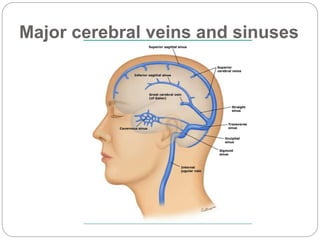
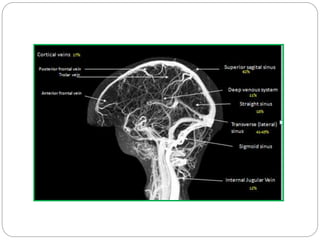
Major cerebral veins and sinuses
Epidemiology and Risk Factors:
 CVT is an uncommon and frequently unrecognized
type of stroke that affects about 5 people per million
annually and accounts for 0·5-1% of all strokes.
Epidemiology and Risk Factors:
 CVT is more commonly seen in young individuals
(78% occurred in patients younger than 50).
 Cerebral venous thrombosis is more common in
women than men, with a female to male ratio of 3:1
International Study on Cerebral Vein and Dural Sinus Thrombosis (ISCVT), Stroke. 2004;35(3):664
Epidemiology and Risk Factors:
 Compared with men, women were significantly younger
(mean age 34 years, versus 42 years for men).
 Furthermore, a gender specific risk factor – oral
contraceptives, pregnancy, puerperium, and hormone
replacement therapy – was identified in 65 percent of
women.
 Women also had a better prognosis when CVT was related
to gender specific risk factor.
International Study on Cerebral Vein and Dural Sinus Thrombosis (ISCVT), Stroke. 2004;35(3):664
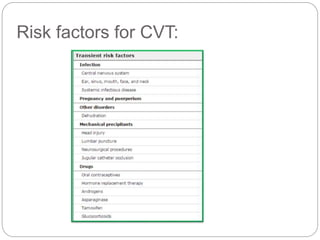
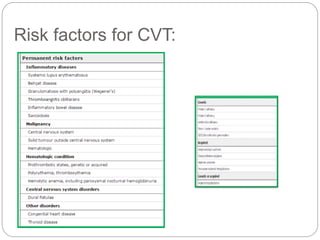
Risk factors for CVT:
 The major risk factors for CVT in adults can be
grouped as transient or permanent.
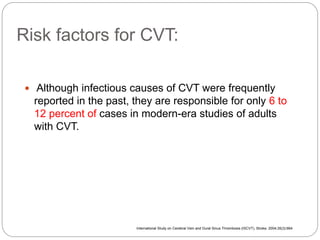
Risk factors for CVT:
 Although infectious causes of CVT were frequently
reported in the past, they are responsible for only 6 to
12 percent of cases in modern-era studies of adults
with CVT.
International Study on Cerebral Vein and Dural Sinus Thrombosis (ISCVT), Stroke. 2004;35(3):664
PATHOGENESIS :
 The pathogenesis of CVT remains incompletely
understood because of the high variability in the
anatomy of the venous system.
PATHOGENESIS :
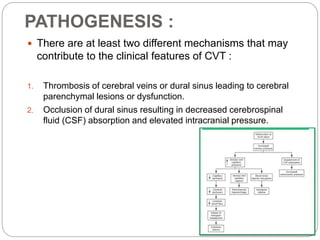
 There are at least two different mechanisms that may
contribute to the clinical features of CVT :
1. Thrombosis of cerebral veins or dural sinus leading to cerebral
parenchymal lesions or dysfunction.
2. Occlusion of dural sinus resulting in decreased cerebrospinal
fluid (CSF) absorption and elevated intracranial pressure.
Symptoms and signs
Symptoms and signs:
 Symptoms and signs of CVT can be grouped in three
major syndromes:
A. Isolated intracranial hypertension syndrome (headache
with or without vomiting, papilledema, and visual
problems).
B. Focal syndrome (focal deficits, seizures, or both).
C. Encephalopathy (multifocal signs, mental status
changes, stupor, or coma).
 Less common presentations include cavernous sinus
syndrome, subarachnoid hemorrhage, and multiple cranial
nerve palsies.
Symptoms and signs:
 Headache:
 generally indicative of an increase in ICP, is the most common
symptom in CVT and was present in nearly 89%.
 The headache of CVT is typically diffuse and often progresses in
severity over days to weeks.
 A minority of patients may present with thunderclap headache, and
migrainous type headache.
 Isolated headache without focal neurologic findings or papilledema
occurs in up to 25% of patients.
International Study on Cerebral Vein and Dural Sinus Thrombosis (ISCVT), Stroke. 2004;35(3):664
Symptoms and signs:
 Focal symptoms and signs :
 Motor weakness with monoparesis or hemiparesis, sometimes
bilateral, is the most frequent focal deficit associated with CVT
37 percent.
 Aphasia, in particular of the fluent type, may follow sinus
thrombosis, especially when the left lateral sinus is affected.
 Sensory deficits and visual field defects are less common
International Study on Cerebral Vein and Dural Sinus Thrombosis (ISCVT), Stroke. 2004;35(3):664
Symptoms and signs:
 Seizures :
 Focal or generalized seizures, including status
epilepticus, are more frequent in CVT than in other
stroke types 39 percent.
International Study on Cerebral Vein and Dural Sinus Thrombosis (ISCVT), Stroke. 2004;35(3):664
Symptoms and signs:
 Clinical manifestations of CVT may also depend on the
location of the thrombosis
 The superior sagittal sinus, is most commonly
involved and may lead to :
 headache, increased ICP, and papilledema .
 motor deficits, bilateral deficits.
 seizures .
 while presentation as an isolated intracranial hypertension
syndrome is infrequent.
 The lateral sinus thromboses, symptoms of an
underlying condition :middle ear infection may be noted.
Symptoms and signs:
 The cavernous sinus thrombosis:
 ocular signs dominate the clinical picture with orbital pain,
chemosis, proptosis, and oculomotor palsies.
 Approximately 16% of CVT patients have thrombosis of the deep
cerebral venous system (internal cerebral vein, Vein of Galen
and straight sinus), which can lead to thalamic or basal ganglial
infarction
International Study on Cerebral Vein and Dural Sinus Thrombosis (ISCVT), Stroke. 2004;35(3):664
DIAGNOSIS
DIAGNOSIS :
Routine Blood Work
 Class I Recommendations
 In patients with suspected CVT, routine blood studies
consisting of a complete blood count, chemistry panel,
prothrombin time and activated partial thromboplastin time
should be performed.
 Screening for potential prothrombotic conditions that may
predispose CVT (i.e.: use of contraceptives, underlying
inflammatory disease, infectious process, etc) is
recommended in the initial clinical assessment (specific
recommendations for testing for thrombophilia are found in the
long-term management section of the main document).
2011 AHA/ASA, http://stroke.ahajournals.org/cgi/content/full/STROKEAHA.108.189696
DIAGNOSIS :
D-dimer Testing
 Class II Recommendation
 A normal D-dimer level using sensitive immunoassay or rapid
Enzyme-Linked ImmunoSorbent Assay (ELISA) may be
considered to help identify patients with low probability of CVT.
 If there is a strong clinical suspicion of CVT, a normal D-dimer
level should not preclude further evaluation.
2011 AHA/ASA, http://stroke.ahajournals.org/cgi/content/full/STROKEAHA.108.189696
Imaging in the Diagnosis of CVT:
 Diagnostic imaging of cerebral venous thrombosis
may be divided into two categories:
1. Non-Invasive Diagnostic Modalities: Computed
Tomography (CT), Magnetic Resonance Imaging
(MRI) and Ultrasound.
2. Invasive Diagnostic Angiographic Procedures:
Cerebral Angiography and Direct Cerebral
Venography.
Imaging in the Diagnosis of CVT:
 The neuroimaging features of CVT include findings that
suggest the primary underlying pathology of venous
thrombosis and associated brain parenchymal
lesions,These may include:
 focal areas of edema.
 venous infarction.
 hemorrhagic venous infarction.
 diffuse brain edema.
 isolated subarachnoid hemorrhage (rarely).
Imaging in the Diagnosis of CVT:
 In patients with CVT, the proportion who present with
intracerebral hemorrhage is 30 to 40 percent.
analysis of a multicenter cohort from the United States, J Stroke Cerebrovasc Dis. 2008;17(2):49
Imaging in the Diagnosis of CVT:
Head CT:
 Normal in up to 30 percent of CVT cases, and most
of the findings are nonspecific.
Bousser MG, Russell RR. Cerebral venous thrombosis. In: Major Problems in Neurology,
Warlow CP, Van Gijn J (Eds), WB Saunders, London 1997. p.27, 10
Imaging in the Diagnosis of CVT:
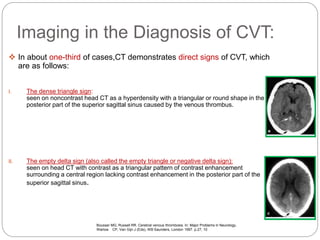
 In about one-third of cases,CT demonstrates direct signs of CVT, which
are as follows:
I. The dense triangle sign:
seen on noncontrast head CT as a hyperdensity with a triangular or round shape in the
posterior part of the superior sagittal sinus caused by the venous thrombus.
II. The empty delta sign (also called the empty triangle or negative delta sign):
seen on head CT with contrast as a triangular pattern of contrast enhancement
surrounding a central region lacking contrast enhancement in the posterior part of the
superior sagittal sinus.
Bousser MG, Russell RR. Cerebral venous thrombosis. In: Major Problems in Neurology,
Warlow CP, Van Gijn J (Eds), WB Saunders, London 1997. p.27, 10
Imaging in the Diagnosis of CVT:
 Indirect signs of CVT on head CT are more frequent.
These can include:
 intense contrast enhancement of falx and tentorium.
 dilated transcerebral veins.
 small ventricles.
 parenchyma abnormalities. In addition.
 associated brain lesions may be depicted in 60 to 80 percent of
patients with CVT, these may be hemorrhagic or
nonhemorrhagic.
Bousser MG, Russell RR. Cerebral venous thrombosis. In: Major Problems in Neurology,
Warlow CP, Van Gijn J (Eds), WB Saunders, London 1997. p.27, 10
Imaging in the Diagnosis of CVT:
 CT venography :
 Gives a good visualization of the major dural sinuses, can be
used for patients who have contraindications to MRI (eg,
pacemaker) and is quicker than MRI.
 CT venography is at least equivalent to MR venography in the
diagnosis of CVT
 CT venography is often particularly helpful in subacute or chronic
CVT because it can demonstrate heterogeneous density in
thrombosed venous sinuses.
Imaging in the Diagnosis of CVT:
 However, its use may be limited because of:
 low resolution of the deep venous system and cortical veins.
 the risk of contrast reactions.
 and radiation exposure.
Imaging in the Diagnosis of CVT:
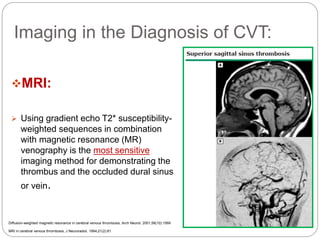
MRI:
 Using gradient echo T2* susceptibility-
weighted sequences in combination
with magnetic resonance (MR)
venography is the most sensitive
imaging method for demonstrating the
thrombus and the occluded dural sinus
or vein.
Diffusion-weighted magnetic resonance in cerebral venous thrombosis, Arch Neurol. 2001;58(10):1569
MRI in cerebral venous thrombosis, J Neuroradiol. 1994;21(2):81
Imaging in the Diagnosis of CVT:
 The characteristics of the MRI signal depend on the
age of the thrombus:
1) In the first five days, the thrombosed sinuses appear isointense on
T1-weighted images and hypointense on T2-weighted images.
2) Beyond five days, venous thrombus becomes more apparent because
signal is increased on both T1 and T2-weighted images.
3) After the first month, thrombosed sinuses exhibit a variable pattern of
signal, which may appear isointens.
Imaging in the Diagnosis of CVT:
 MR venography :
 MR venography, usually performed using the time-of-flight (TOF)
technique, is useful for demonstrating absence of flow in cerebral
venous sinuses, though interpretation can be confounded by
normal anatomic variants such as sinus hypoplasia and
asymmetric flow.
 Other MR techniques may be useful to distinguish these
variants from venous thrombosis. Contrast-enhanced MR
venography can provide better visualization of cerebral venous
channels, and gradient echo or susceptibility-weighted
sequences will show normal signal in a hypoplastic sinus and
abnormally low signal in the presence of thrombus.
 A chronically thrombosed hypoplastic sinus will show absence of
flow on two-dimensional TOF MR venography and enhancement
on contrast-enhanced MRI and MR venography.
Imaging in the Diagnosis of CVT:
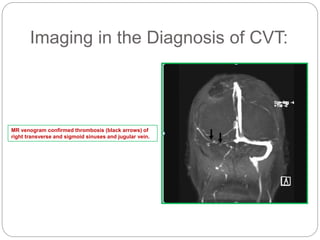
MR venogram confirmed thrombosis (black arrows) of
right transverse and sigmoid sinuses and jugular vein.
Imaging in the Diagnosis of CVT:
 Brain MRI in combination with magnetic resonance
(MR) venography is the most sensitive examination
technique for demonstrating the thrombus and the
occluded dural sinus or vein.
Imaging in the Diagnosis of CVT:
 Invasive cerebral angiographic procedures:
 Less commonly needed to establish the diagnosis of CVT given
the availability of MRV and CTV.
 These techniques are reserved for situations in which the MRV
or CTV results are inconclusive or if an endovascular procedure
is being considered.
Imaging in the Diagnosis of CVT:
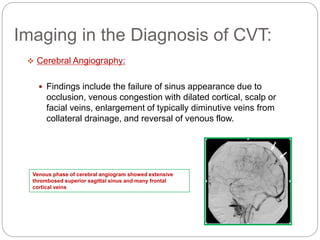
 Cerebral Angiography:
 Findings include the failure of sinus appearance due to
occlusion, venous congestion with dilated cortical, scalp or
facial veins, enlargement of typically diminutive veins from
collateral drainage, and reversal of venous flow.
Venous phase of cerebral angiogram showed extensive
thrombosed superior sagittal sinus and many frontal
cortical veins
Imaging in the Diagnosis of CVT:
Direct Cerebral Venography:
 Direct cerebral venography is usually performed during
endovascular therapeutic procedures.
 Intraluminal thrombus is seen either as a filling defect within
the lumen in the setting of non-occlusive thrombosis or as
complete nonfilling in occlusive thrombosis.
 Venous pressure measurements may be performed during
direct cerebral venography to identify venous hypertension
(normal venous sinus pressure is less than 10 mm of water) .
Imaging in the Diagnosis of CVT:
Recommendations:
 Class I Recommendations:
 Although a plain CT or MRI is useful in the initial
evaluation of patients with suspected CVT, a negative
plain CT or MRI does not rule out CVT.
 A venographic study (either CT or MR venogram) should
be performed in suspected CVT if the plain CT or MRI is
negative, or, to define the extent of CVT if the plain CT or
MRI suggests CVT.
2011 American Heart Association/American Stroke Association
Imaging in the Diagnosis of CVT:
Recommendations:
 Class I Recommendations:
 An early follow up CTV or MRV is recommended in CVT
patients with persistent or evolving symptoms despite medical
treatment or with symptoms suggestive of propagation of
thrombus.
 In patients with previous CVT who present with recurrent
symptoms suggestive of CVT, repeat CT or MR venogram is
recommended.
2011 American Heart Association/American Stroke Association
Imaging in the Diagnosis of CVT:
Recommendations:
 Class II Recommendations:
 Gradient Echo T2 susceptibility weighted images combined
with MR venography can be useful to improve the accuracy of
CVT diagnosis.
 Catheter cerebral angiography can be useful in patients with
inconclusive CTV or MRV in whom a clinical suspicion for
CVT remains high.
 A follow up CTV or MRV at 3-6 months following diagnosis is
reasonable to assess for recanalization of the occluded
cortical vein/sinuses in stable patients .
2011 American Heart Association/American Stroke Association
Management and Treatment
 Organized care is one of the most effective
interventions to reduce mortality and morbidity
following acute stroke
 CVT is an uncommon but potentially serious and life-
threatening cause of stroke
 Based on findings for stroke unit care in general,
management of CVT in a stroke unit is reasonable for
the initial management of CVT in order to optimize
care and minimize complications
PROGNOSIS
Prognosis:
 Neurologic worsening may occur in 23% of the
patients, even several days after diagnosis.
 About one-third of patients with neurologic
deterioration will have new parenchymal lesions when
neuroimaging is repeated.
 Patients with depressed consciousness on admission
are more likely to deteriorate.
Prognosis:
Early Death:
 Approximately 3-15% of patients die in the acute phase of
the disorder.
 In the ISCVT, 21/624 patients (3.4 %) died within 30 days
from symptom onset.
Prognosis:
 The main cause of acute death with CVT is transtentorial
herniation secondary to a large hemorrhagic lesion.
 followed by herniation due to multiple lesions or to diffuse brain
edema.
 Status epilepticus, medical complications, and pulmonary
embolism are among other causes of early death.
Prognosis:
 Risk factors for 30-day mortality were :
 Depressed consciousness.
 Altered mental status.
 Thrombosis of the deep venous system.
 Right hemisphere hemorrhage.
 Posterior fossa lesions.
Prognosis:
Long-Term Outcome :
 In the ISCVT study, complete recovery at last follow-up (median
16 months) was observed in 79% of the patients.
 However, there was an 8.3% overall death rate at the end of
follow-up.
Prognosis:
 Risk Factors for Long-Term Poor Outcomes:
 Central nervous system infection.
 Any malignancy.
 Thrombosis of the deep venous system.
 Intracranial hemorrhage on the admission CT/MR.
 Glasgow coma scale score (GCS) <9 .
 Mental status disturbance .
 Age >37 years.
 Male gender.
International Study on Cerebral Vein and Dural Sinus Thrombosis (ISCVT, Stroke. 2004;35(3):664
Management and Treatment
Management and Treatment :
 The aim of treatment for (CVT) is to improve outcome.
 The immediate goals of antithrombotic treatment are:
1. To recanalize the occluded sinus/vein.
2. To prevent the propagation of the thrombus.
3. To treat the underlying prothrombotic state, in order to prevent venous
thrombosis in other parts of the body, particularly pulmonary embolism, and to
prevent the recurrence of CVT.
 The main treatment option to achieve these goals is anticoagulation,
using either heparin or low molecular weight heparin (LMWH).
Management and Treatment :
 Controversy has ensued because cerebral infarction with
hemorrhagic transformation or intracerebral hemorrhage is
commonly present at the time of diagnosis of CVT, and it may
also complicate treatment.
Management and Treatment :
Anticoagulation:
 Two randomized controlled trials of anticoagulation in acute CVT
have been published. ??Both have methodologic problems, most
importantly their modest sample size.
Management and Treatment :
Anticoagulation:
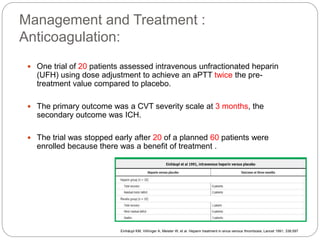
 One trial of 20 patients assessed intravenous unfractionated heparin
(UFH) using dose adjustment to achieve an aPTT twice the pre-
treatment value compared to placebo.
 The primary outcome was a CVT severity scale at 3 months, the
secondary outcome was ICH.
 The trial was stopped early after 20 of a planned 60 patients were
enrolled because there was a benefit of treatment .
Einhäupl KM, Villringer A, Meister W, et al. Heparin treatment in sinus venous thrombosis. Lancet 1991; 338:597
Management and Treatment :
Anticoagulation:
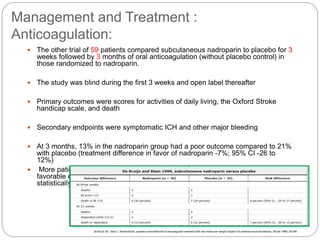
 The other trial of 59 patients compared subcutaneous nadroparin to placebo for 3
weeks followed by 3 months of oral anticoagulation (without placebo control) in
those randomized to nadroparin.
 The study was blind during the first 3 weeks and open label thereafter
 Primary outcomes were scores for activities of daily living, the Oxford Stroke
handicap scale, and death
 Secondary endpoints were symptomatic ICH and other major bleeding
 At 3 months, 13% in the nadroparin group had a poor outcome compared to 21%
with placebo (treatment difference in favor of nadroparin -7%; 95% CI -26 to
12%)
 More patients treated with LMWH followed by oral anticoagulation had a
favorable outcome than controls, but the difference between the groups was not
statistically significant
de Bruijn SF, Stam J. Randomized, placebo-controlled trial of anticoagulant treatment with low-molecular-weight heparin for cerebral sinus thrombosis. Stroke 1999; 30:484
Management and Treatment :
Anticoagulation:
 A meta-analysis of these two trials found that anticoagulant
treatment compared with placebo was associated with a pooled
relative risk of death of 0.33 (95% CI 0.08-1.21) and a risk of
death or dependency of 0.46 (95% CI 0.16-1.31).
 While these data suggest that anticoagulant treatment for CVT
may be associated with a reduced risk of death or dependency,
the results did not achieve statistical significance.
Management and Treatment :
Anticoagulation:
 Limited data suggest that LMWH is more effective
than unfractionated heparin and at least as safe
for the treatment of CVT:
Management and Treatment :
Anticoagulation:
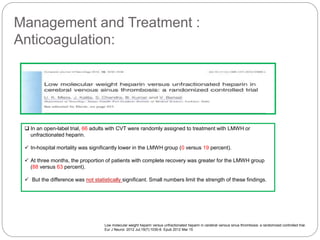
Low molecular weight heparin versus unfractionated heparin in cerebral venous sinus thrombosis: a randomized controlled trial.
Eur J Neurol. 2012 Jul;19(7):1030-6. Epub 2012 Mar 15
 In an open-label trial, 66 adults with CVT were randomly assigned to treatment with LMWH or
unfractionated heparin.
 In-hospital mortality was significantly lower in the LMWH group (0 versus 19 percent).
 At three months, the proportion of patients with complete recovery was greater for the LMWH group
(88 versus 63 percent).
 But the difference was not statistically significant. Small numbers limit the strength of these findings.
Management and Treatment :
Anticoagulation:
 In a nonrandomized case-control study, a greater proportion of
adult patients treated with LMWH (n = 119) compared with
unfractionated heparin (n = 302) were independent at six months
(92 versus 84 percent, adjusted odds ratio 2.4, 95% CI 1.0-5.7)
[33]. Treatment with LMWH was also associated with slightly
lower rates of mortality (6 versus 8 percent) and new intracranial
hemorrhage (10 versus 16 percent), but these outcomes were
not statistically significant
Unfractionated or low-molecular weight
heparin for the treatment of cerebral
venous thrombosis. Stroke.
2010;41(11):2575.
Management and Treatment
 In the special situation of CVT with cerebral hemorrhage
on presentation, even in the absence of anticoagulation,
hemorrhage is associated with adverse outcomes
 In one trial of nadroparin, all 6 deaths in the trial overall
occurred in the group of 29 patients with hemorrhage on
their pre-treatment CT scan
 None of the deaths were attributed to new or enlarged
hemorrhage
 Cerebral hemorrhage was strongly associated with
mortality, but not with cerebral bleeding on treatment
Management and Treatment
 A number of observational studies, both prospective and
retrospective, are available, primarily from single centers
 In a retrospective study of 102 patients with CVT, 43 had
an ICH
 Among 27 (63%) who were treated with dose-adjusted,
intravenous heparin after the ICH, 4 died (15%), and 14
(52%) patients completely recovered
 Mortality was higher (69%) with lower improvement in
functional outcomes (3 patients completely recovered)
Management and Treatment
 The largest study by far was the ISCVT, which
included 624 patients at 89 centers in 21 countries
 Nearly all patients were treated with anticoagulation
initially and mortality was 8.3% over 16 months
 79% had complete recovery (modified Rankin scale 0-
1), 10.4% had mild to moderate disability (mRS 2-3)
and 2.2% remained severely disabled (mRS 4-5)
Management and Treatment
 Few studies had sufficient numbers of patients not
treated with anticoagulation to adequately address the
role of anticoagulation in relation to outcome
 Data from observational studies suggest a range of
risks for ICH after anticoagulation for CVT from zero
to 5.4%
 In conclusion, limited data from randomized controlled
clinical trials in combination with observational data
on outcomes and bleeding complications of
anticoagulation support a role for anticoagulation in
treatment of CVT, regardless of the presence of pre-
treatment ICH
Management and Treatment
Fibrinolytic Therapy
 Although patients with CVT may recover with
anticoagulation therapy, 9-13% have poor
outcomes despite anticoagulation
 Anticoagulation alone may not dissolve a large
and extensive thrombus and the clinical condition
may worsen even during heparin treatment
 Incomplete recanalization or persistent
thrombosis may explain this phenomenon
Management and Treatment
 Combining four studies including 114 CVT
patients, partial or complete recanalization at 3-6
months was observed in 94 (82.5%)
 Recanalization rates may be higher for patients
receiving thrombolytic therapy
 In general, thrombolytic therapy is used if clinical
deterioration continues despite anticoagulation or
if a patient has elevated intracranial pressure that
evolves despite other management approaches
Management and Treatment
Direct Catheter Thrombolysis
 A systematic review including 169 patients with
CVT treated with local thrombolysis showed a
possible benefit for those with severe CVT,
indicating that fibrinolytics may reduce case
fatality in critically ill patients
 ICH occurred in 17% of patients after
thrombolysis and was associated with clinical
worsening in 5%
Management and Treatment
Mechanical Thrombectomy/ Thrombolysis
 For patients with extensive thrombus persisting
despite local administration of fibrinolytic agent,
rheolytic catheter thrombectomy may be
considered
 Surgical thrombectomy is uncommonly needed,
but may be considered if severe neurological or
visual deterioration occurs despite maximal
medical therapy
Management and Treatment
Mechanical Thrombectomy/ Thrombolysis
 For patients with extensive thrombus persisting
despite local administration of fibrinolytic agent,
rheolytic catheter thrombectomy may be
considered
 Surgical thrombectomy is uncommonly needed,
but may be considered if severe neurological or
visual deterioration occurs despite maximal
medical therapy
Management and Treatment
 The use of these direct intrasinus thrombolytic
techniques and mechanical therapies are only
supported by case reports and small case series
 If clinical deterioration occurs despite use of
anticoagulation, or the patient develops mass
effect from a venous infarction or intracerebral
hemorrhage causing intracranial hypertension
resistant to standard therapies, then these
interventional techniques may be considered
Management and Treatment
Seizures
 Seizures are present in 37% of adults, 48% of
children and 71% of newborns presenting with CVT
 No clinical trials have studied either the optimal timing
or medication choice for anticonvulsants in CVT
 Since seizures increase the risk of anoxic damage,
anticonvulsant treatment after even a single seizure is
reasonable
 In the absence of seizures, the prophylactic use of
anti-epileptic drugs may be harmful
Management and Treatment
Hydrocephalus
 The superior sagittal and lateral dural sinuses are the
principal sites for cerebrospinal fluid (CSF) absorption
by the arachnoid granulations
 In CVT, function of the arachnoid granulations may be
impaired potentially resulting in failure of CSF
absorption and communicating hydrocephalus (6.6%)
 Obstructive hydrocephalus is a less common
complication from CVT and results from hemorrhage
into the ventricular system
Management and Treatment
Intracranial Hypertension
 Up to 40% of patients with CVT present with isolated intracranial
hypertension
 Clinical features include progressive headache, papilledema and
third or sixth nerve palsies
 No randomized trials are available to clarify optimal treatment
 Measures to reduce the thrombotic occlusion of venous outflow
may resolve intracranial hypertension
 Reduction of increased ICP can be immediately accomplished by
lumbar puncture
 Acetazolamide may have a limited role in the acute management
of intracranial hypertension for patients with CVT
Management and Treatment:
Recommendations
 Class I Recommendations
 In patients with CVT and a single seizure with
parenchymal lesions, early initiation of anti-epileptic
drugs for a defined duration is recommended to
prevent further seizures
 Patients with CVT and a suspected bacterial
infection should receive appropriate antibiotics and
surgical drainage of purulent collections of
infectious sources associated with CVT when
appropriate
 Class I Recommendations
 In patients with CVT and increased intracranial
pressure, monitoring for progressive visual loss is
recommended, and when this is observed,
increased intracranial pressure should be urgently
treated
 In patients with a past history of CVT who complain
of new, persisting or severe headache, evaluation
for CVT recurrence and intracranial hypertension
should be considered
 Class II Recommendations
 For patients with CVT, initial anticoagulation with
adjusted-dose unfractionated heparin or weight-
based low molecular weight heparin in full
anticoagulant doses is reasonable, followed by
vitamin K antagonists, regardless of the presence of
intracerebral hemorrhage
 Admission to a stroke unit is reasonable for
treatment and for prevention of clinical
complications of patients with CVT
 Class II Recommendations
 In patients with CVT and a single seizure without
parenchymal lesions, early initiation of anti-epileptic
drugs for a defined duration is probably
recommended to prevent further seizures
 In patients with CVT and increased intracranial
pressure, it is reasonable to initiate treatment with
acetazolamide. Other therapies (lumbar puncture,
optic nerve decompression or shunts) can be
effective if there is progressive visual loss
 Class II Recommendations
 Endovascular intervention may be considered if
deterioration occurs despite intensive
anticoagulation treatment
 In patients with neurological deterioration due to
severe mass effect or intracranial hemorrhage
causing intractable intracranial hypertension,
decompressive hemicraniectomy may be
considered
 Class II Recommendations
 Testing for prothrombotic conditions, including
protein C, protein S, antithrombin deficiency,
antiphospholipid syndrome, prothrombin G20210A
mutation and Factor V Leiden, can be beneficial for
the management of patients with CVT. Testing for
protein C, protein S, and antithrombin deficiency is
generally indicated 2-4 weeks after completion of
anticoagulation. There is a very limited value of
testing in the acute setting or in patients on warfarin
 Class II Recommendations
 In patients with provoked CVT (associated with a
transient risk factor), vitamin K antagonists with a
target INR of 2.0-3.0 may be continued for 3 to 6
months
 In patients with unprovoked CVT, vitamin K
antagonists with a target INR of 2.0-3.0 may be
continued for 6 to 12 months
 Class II Recommendations
 For patients with recurrent CVT, VTE after CVT, or
first CVT with severe thrombophilia (i.e.
homozygous prothrombin G20210A, homozygous
Factor V Leiden, deficiencies of protein C, protein S
or antithrombin, combined thrombophilia defects or
antiphospholipid syndrome), indefinite
anticoagulation may be considered with a target
INR of 2.0-3.0
 Consultation with a physician with expertise in
thrombosis may be considered to assist in the
prothrombotic testing and care of patients with
cerebral venous sinus thrombosis
 Class III Recommendations
 For patients with CVT, steroid medications are not
recommended, even in the presence of
parenchymal brain lesions on CT/MRI, unless
needed for another underlying disease
 In the absence of seizures, the routine use of anti-
epileptic drugs in patients with CVT is not
recommended
Summary
 A dural sinus or cerebral venous thrombosis
(CVT) accounts for 0.5-1% of all strokes, mostly
affecting young individuals and women of
childbearing age
 Patients with CVT commonly present with
headache, while some develop a focal
neurological deficit, decreased level of
consciousness, seizures, or intracranial
hypertension without focal neurological signs
 A prothrombotic factor or a direct cause is identified in
about two thirds of patients with sinus thrombosis
 The diagnosis is usually made by venographic studies
using computed tomography (CT venogram) or
magnetic resonance imaging (MR venogram)
 Management includes treatment of the underlying
condition, symptomatic treatment, the prevention or
treatment of complications of increased ICP, ICH, or
venous infarction, and typically includes
anticoagulation
 Despite substantial progress in the study of CVT in
recent years, much of the literature remains
descriptive
 A randomized clinical trial comparing the benefit of
anticoagulation therapy vs. endovascular
thrombolysis (TO-ACT Trial - Thrombolysis Or
Anticoagulation for Cerebral Venous Thrombosis) is
underway
 Through innovative research and systematic
evaluation, the diagnosis, management and
therapeutic alternatives will continue to evolve, and
consequently lead to better outcomes for patients with
CVT
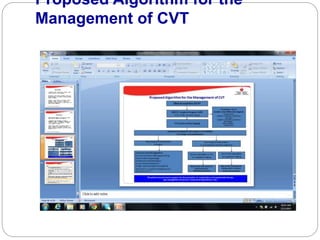
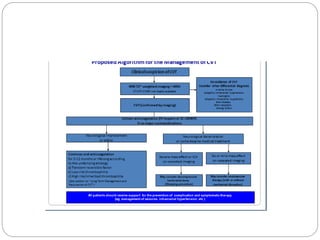
Proposed Algorithm for the
Management of CVT
Case presentation, meningitis and treatment, Moh'd Sharshir

Case presentation, meningitis and treatment, Moh'd Sharshir

  • 1.
    Moh’d Sharshir, FellowCritical Care King Faisal Specialist Hospital & Research Center
  • 2.
    What is meningitis?…… The brain and spinal cord are covered by connective tissue layers collectively called the meninges which form the blood-brain barrier. 1-the pia mater (closest to the CNS) 2-the arachnoid mater 3-the dura mater (farthest from the CNS).  The meninges contain cerebrospinal fluid (CSF).
  • 4.
     Meningitis isan inflammatory disease of the leptomeninges, the tissues surrounding the brain and spinal cord, and is defined by an abnormal number of white blood cells in the cerebrospinal fluid (CSF) .
  • 5.
    Causes of Meningitis: 1.BacterialInfections 2.Viral Infections 3.Fungal Infections(Cryptococcus neoformans,Coccidiodes immitus) 4.Inflammatory disease (SLE)
  • 6.
    Bacterial meningitis:  S.pneumoniae 30-50%  N. meningitidis 10-35%  H. influenzae 1-3%  G -ve bacilli 1-10%  Listeria species 5%  Streptococci 5%  Staphylococci 5-15%
  • 8.
    Viral Meningitis: o Enteroviruses(Coxsackie's and echovirus): most common. o Denovirus o Arbovirus o Measles virus o Herpes Simplex Virus o Varicella
  • 9.
  • 11.
    CLINICAL FEATURES:  Theclassic triad of acute bacterial meningitis consists of :  fever.  nuchal rigidity.  and a change in mental status.  Most patients have high fevers, but a small percentage have hypothermia.
  • 12.
    CLINICAL FEATURES:  CNSsymptoms:  Some patients will have significant photophobia.  Changes in mental and level of consciousnes, seizures, and focal neurologic signs tend to appear later in the course of disease.
  • 13.
    CLINICAL FEATURES:  Nuchalrigidity:  Passive or active flexion of the neck will usually result in an inability to touch the chin to the chest  Tests to illustrate nuchal rigidity:
  • 14.
  • 15.
  • 16.
    CLINICAL FEATURES:  Otherfindings  Some infectious agents, particularly N. meningitidis, can also cause characteristic skin manifestations, petechiae and palpable purpura.
  • 17.
    LABORATORY FEATURES:  Mostoften the WBC count is elevated with a shift toward immature forms .  Platelets may be reduced if disseminated intravascular coagulation is present or in the face of meningococcal bacteremia.  Blood cultures are often positive, and can be very useful in the event that CSF cannot be obtained before the administration of antimicrobials.  At least one-half of patients with bacterial meningitis have positive blood cultures, with the lowest yield being obtained with meningococcus.
  • 18.
    LABORATORY FEATURES:  CSFanalysis – every patient with meningitis should have CSF obtained unless the procedure is contraindicated  Chemistry and cytologic findings highly suggestive of bacterial meningitis include a CSF glucose concentration below 45 mg/dL, a protein concentration above 500 mg/dL, and a white blood cell count above 1000/mm3  A Gram stain should also be obtained  The Gram stain is positive in up to 10 percent of patients with negative CSF cultures and in up to 80 percent of those with positive cultures
  • 19.
    LABORATORY FEATURES:  Openingpressure>180 mmH2O White blood cells10/ L to 10,000/ L; neutrophils predominateRed blood cellsAbsent in nontraumatic tapGlucose <2.2 mmol/L (<40 mg/dL)CSF/serum glucose <0.4Protein>0.45 g/L (>45 mg/dL)  Gram's stainPositive in >60%CulturePositive in >80%  Latex agglutinationMay be positive in patients with meningitis due to S. pneumoniae, N. meningitidis, H. influenzae type b, E. coli, group B streptococci Limulus lysatePositive in cases of gram-negative meningitisPCRDetects bacterial DNA
  • 21.
    Treatment and preventionof bacterial meningitis:  Suspected bacterial meningitis is a medical emergency and immediate diagnostic steps must be taken to establish the specific cause.  The mortality rate of untreated bacterial meningitis approaches 100 percent and, even with optimal therapy, there is a high failure rate.  Empiric treatment should be begun as soon as the diagnosis is suspected using bactericidal agent(s) that achieve significant levels in the CSF.
  • 22.
    Treatment - Empiric Ceftriaxone 2 gm IV Q 12h or Cefotaxime 2 gm IV Q 4-6h PLUS Vancomycin 15 mg/kg Q 6h.  If > 50 years, also add Ampicillin 2 gm IV Q 4h (for Listeria) .
  • 24.
  • 25.
    Streptococcus pneumoniae:  Gram-positivediplococci (in pairs)  Encapsulated ovoid or lanceolate coccus  Non-motile  Fastidious (enriched media)  Blood or chocolate agar  5-10 % CO2  Alpha haemolysis + draughtsman appearance  Some strains are mucoid  Soluble in bile  Optochin sensitive
  • 26.
    Pathogenesis:  Virulence factors Capsular polysaccharide  The major factor  84 serotypes  Both antigenic and type specific  Antiphagocytic  Serotype 3 , 7 are most virulent  90% of cases of bacteraemic pneumococcal pneumonia and meningitis are caused by 23 serotypes  Quellung reaction , india ink  Pneumolysin  Membrane damaging toxin
  • 27.
    Predisposing factors:  Aspirationof upper airway secretions ( endogenous )  No person-person spread  Disturbed consciousness , general anaesthesia , convulsions , CVA , epilepsy , head trauma  Prior LRT. VIRAL infection  Preexisting respiratory diseases , smoking  Chronic bronchitis , bronchogenic malignancy  Chronic heart disease  Chronic renal disease ( nephrotic syndrome )  Chronic liver disease ( cirrhosis)  Diabetes mellitus  Old age , (extreme of age )  Malnutrition , alcoholism
  • 28.
     Meningitis:  Themost virulent pathogen of meningitis  Mortality ( 20% )  Primary  Complicate infections at other site ( lung )  Bacteraemia usually coexists  Bimodal incidence ( < 3 yr - > 45 yr )
  • 29.
     The conventionalapproach to the treatment of pneumococcal meningitis was the administration of penicillin alone for two weeks at a dose of four million units intravenously every four hours.  Good results have also been obtained with third generation cephalosporins.  However, the problem of treating pneumococcal meningitis has recently been compounded by the widespread and increasingly common reports of pneumococcal strains resistant to penicillin.
  • 30.
     Cefotaxime orceftriaxone can be used if the MIC for these drugs is less than 0.5 µg/mL.  It is recommended that vancomycin (2 g/day) should be given with cefotaxime or ceftriaxone in the initial treatment of pneumococcal meningitis if there has been beta-lactam resistance noted locally.  Vancomycin should be continued if there is high level penicillin resistance and an MIC >0.5 µg/mL to third generation cephalosporins.  If corticosteroids are given, rifampin should be added as a third agent since it increases the efficacy of the other two drugs .  The usual duration of therapy is two weeks.
  • 31.
    Haemophilus influenzae  Athird generation cephalosporin is the drug of choice for H. influenzae meningitis.  Patients with H. influenzae meningitis should be treated for five to seven days.  For adults, a dose of 2 g every six hours of cefotaxime and 2 g every 12 hours of ceftriaxone is more than adequate therapy.  Pharyngeal colonization persists after curative therapy and may require a short course of rifampin if there are other children in the household at risk for invasive Haemophilus infection.  The recommended dose is 20 mg/kg per day (to a maximum of 600 mg/day) for four days.
  • 32.
    Neisseria meningitidis:  Thisinfection is best treated with penicillin.  Although there are scattered case reports of N. meningitidis resistant to penicillin, such strains are still very rare.  A third-generation cephalosporin is an effective alternative to penicillin for meningococcal meningitis.  A five day duration of therapy is adequate.  However, when penicillin is used, there may still be pharyngeal colonization with the infecting strain. As a result, the index patient may need to take rifampin, a fluoroquinolone, or a cephalosporin.
  • 33.
    Listeria monocytogenes:  Listeriahas been traditionally treated with ampicillin and gentamicin, as resistance to these drugs is quite rare.  Ampicillin is given in typical meningitis doses (2 g intravenously every four to six hours in adults) and gentamicin is used for synergy.  An alternative in penicillin-allergic patients is trimethoprim- sulfamethoxazole (dose of 10-50 mg/kg per day in two or three divided doses).  The usual duration of therapy is at least three weeks.
  • 34.
    Enteric Gram negativerods:  Prior to the availability of third generation cephalosporins, it was often necessary to instill an aminoglycoside antibiotic such as gentamicin directly into the cerebral ventricles.  It is now possible to cure these infections with high doses of third generation antibiotics.  A repeat CSF sample should be obtained for culture two to four days into therapy to help assess the efficacy of treatment.  The duration of therapy should be at least three weeks.
  • 35.
    PREVENTION OF MENINGITIS Vaccines Aspectacular reduction in H. influenzae meningitis has been associated with the near universal use of a vaccine against this organism in developed countries since 1987  There has been a 94 percent reduction in H. influenzae meningitis between 1987 and 1995  Pneumococcal vaccine administered to the chronically ill and elderly is probably useful in reducing the overall incidence of pneumococcal infections. However, its role in the prevention of meningitis is as yet undetermined
  • 36.
    PREVENTION OF MENINGITIS Vaccines Meningococcal vaccines are active against many strains of N. meningitidis.  However, the majority of meningococcal infections in the United States are caused by type b meningococcus for which there is no vaccine.  Vaccines for other types (notably type a) are recommended for travelers and American military personnel to countries with epidemic meningitis.  Immunization against meningococci is not warranted as postexposure prophylaxis.
  • 37.
    PREVENTION OF MENINGITIS Chemoprophylaxis: There is a role for chemoprophylaxis to prevent spread of meningococcal and haemophilus meningitis but not for pneumococcal disease.  The use of antimicrobial therapy to eradicate pharyngeal carriage of meningococci is widely accepted to prevent development of disease in close contacts and to eradicate pharyngeal carriage.  Rifampin 600 mg PO every 12 h for a total of four doses is recommended.  Ciprofloxacin, in a single dose of 500 mg PO, is equally effective and can be used in patients over the age of 18.
  • 38.
  • 39.
    Role Of Steroids: The addition of anti-inflammatory agents has been attempted as an adjuvant in the treatment of meningitis.  Early administration of corticosteroids such as dexamethasone for pediatric meningitis has shown no survival advantage, but there is a reduction in the incidence of severe neurologic complications and deafness.
  • 40.
    Role Of Steroids: Early intravenous administration of glucocorticoids usually dexamethasone has been evaluated as adjuvant therapy in an attempt to diminish the rate of hearing loss and other neurologic complications as well as mortality in selected patients with bacterial meningitis.  The efficacy of dexamethasone therapy has been reported to vary in developed and developing countries.
  • 41.
    Role Of Steroids: dexamethasone reduces cerebrospinal fluid (CSF) concentrations of cytokines (such as tumor necrosis factor [TNF]-alpha and interleukin [IL]-1), CSF inflammation, and cerebral edema
  • 42.
    Role Of Steroids: When indicated, dexamethasone is given 15 to 20 minutes before or at the time of antibiotic administration.  Two-dose regimens are recommended: A. 0.15 mg/kg every six hours for four days in the developed world, based upon the Infectious Diseases Society of America guidelines. B. and 0.4 mg/kg every 12 hours for four days in the developing world, based upon the Vietnamese trial.  Adjunctive dexamethasone should not be given to adults who have already received antimicrobial therapy because it is unlikely to improve patient outcomes.
  • 43.
    Role Of Steroids: For adults in the developed world with suspected or proven acute pneumococcal meningitis, recommend administration of dexamethasone (Grade 1B). Dexamethasone should only be continued if the cerebrospinal fluid (CSF) Gram stain and/or the CSF or blood cultures reveal Streptococcus pneumoniae.
  • 44.
     In areasof the developing world where there is a high prevalence of HIV infection, poor nutrition, and significant delays in clinical presentation, such as some regions of Africa, it is unlikely that the use of adjunctivedexamethasone will be of benefit. Thus, for adults in such regions with known or suspected bacterial meningitis, we recommend not administering dexamethasone (Grade 1B). In other regions of the developing world, we suggest administering dexamethasone in patients who have bacterial meningitis confirmed by Gram stain or a rapid diagnostic test (Grade 2B). It is also reasonable to empirically administer adjunctive dexamethasone in patients in whom there is a strong clinical suspicion for acute bacterial meningitis until microbiologic results are available. (See 'In developing regions' above and 'Developing regions' above.)
  • 45.
     In patientswith known or suspected pneumococcal meningitis who are treated with dexamethasone, we suggest adding rifampin to the standard antibiotic regimen (vancomycin plus either ceftriaxone or cefotaxime) if susceptibility studies show intermediate susceptibility (minimum inhibitory concentration [MIC] ≥2 mcg/mL) to ceftriaxone and cefotaxime (Grade 2C). A reasonable alternative is to initiate rifampin and then discontinue it if the isolate is susceptible to the cephalosporin. (See 'Antibiotic regimens' above.)
  • 46.
    MORTALITY RATE ANDLATE SEQUELAE  The prognosis of meningitis is linked to age and the presence of underlying disease  Bacterial meningitis accompanying advanced liver disease, HIV infection, or organ transplantation is likely to be associated with more morbidity and mortality  In addition, the prognosis and complications differ in children and adults
  • 47.
     Complications aremore common in adults  A series of 86 adults with meningitis, for example, showed a mortality rate of 18.6 percent with a complication rate of 50 percent  The most common problems were:  Cerebrovascular involvement – 15.1 percent.  Cerebral edema – 14 percent.  Hydrocephalus – 11.6 percent.  Septic shock – 11.6 percent.  Disseminated intravascular coagulation – 8.1 percent.  Acute respiratory distress syndrome – 3.5 percent. Spectrum of complications during bacterial meningitis in adults. Results of a prospective clinical study. Arch Neurol 1993; 50:575
  • 48.
    Cerebrovascular complications  Thrombosis,vasculitis, acute cerebral hemorrhage, and aneurysm formation of large, medium, or small cerebral vessels are potential complications of bacterial meningitis. These diverse processes can manifest similarly as a focal abnormality, such as hemiparesis
  • 49.
     In aprospective study of 86 adults with bacterial meningitis, cerebral angiography was performed in 27 (31 percent) because one or more of the following findings were present: focal neurologic deficits, abnormalities on computed tomographic (CT) scanning, or persistent coma after three days of antibiotic therapy [16]. Abnormal angiograms were found in 13 of these 27 patients; the abnormal findings included:
  • 50.
     Vessel wallirregularities and focal dilatations  Arterial occlusions  Focal arterial bleeding  Thrombosis of the superior sagittal and cortical veins
  • 51.
     In anotherreport, a cranial CT scan was performed in 87 of 122 adults with bacterial meningitis seen after 1975 [2]. A cerebral infarct was noted in four, lesions consistent with septic emboli in two and cavernous sinus thrombosis in one. Four patients without a lesion on initial scan had signs of an infarct on a later CT scan that was performed because of persistent hemiparesis in three and triplegia in one
  • 52.
     The mortalityrates are lowest in children  A meta-analysis of prospectively enrolled cohorts of children in developed countries showed a 4.8 percent mortality from 1955 to 1993  The mortality rate varied by organism, ranging from 3.8% for H. influenzae to 7.5 percent for N. meningitidis to 15.3% for S. pneumoniae  83.6 percent of the surviving children had apparently complete recovery  The most common sequelae were  Deafness – 10.5 percent.  Bilateral severe or profound deafness – 5.1 percent.  Mental retardation – 4.2 percent.  Spasticity and/or paresis – 3.5 percent.  Seizures – 4.2 percent.
  • 53.
    Cerebral vein anddural sinus thrombosis (CVT)
  • 54.
    Outline  Introduction  Epidemiologyand Risk Factors for CVT  Clinical Diagnosis of CVT  Imaging in the Diagnosis of CVT  Management and Treatment  CVT in Special Populations  Clinical Outcomes: Prognosis  Summary
  • 55.
    Introduction :  Thrombosisof the dural sinus and/or cerebral veins (CVT) is an uncommon form of stroke.  CVT represents approximately 0.5-1% of all strokes.  Multiple factors have been associated with CVT, but only some of them are reversible.
  • 56.
  • 57.
    Epidemiology and RiskFactors:  CVT is an uncommon and frequently unrecognized type of stroke that affects about 5 people per million annually and accounts for 0·5-1% of all strokes.
  • 58.
    Epidemiology and RiskFactors:  CVT is more commonly seen in young individuals (78% occurred in patients younger than 50).  Cerebral venous thrombosis is more common in women than men, with a female to male ratio of 3:1 International Study on Cerebral Vein and Dural Sinus Thrombosis (ISCVT), Stroke. 2004;35(3):664
  • 59.
    Epidemiology and RiskFactors:  Compared with men, women were significantly younger (mean age 34 years, versus 42 years for men).  Furthermore, a gender specific risk factor – oral contraceptives, pregnancy, puerperium, and hormone replacement therapy – was identified in 65 percent of women.  Women also had a better prognosis when CVT was related to gender specific risk factor. International Study on Cerebral Vein and Dural Sinus Thrombosis (ISCVT), Stroke. 2004;35(3):664
  • 60.
    Risk factors forCVT:  The major risk factors for CVT in adults can be grouped as transient or permanent.
  • 61.
  • 62.
  • 63.
    Risk factors forCVT:  Although infectious causes of CVT were frequently reported in the past, they are responsible for only 6 to 12 percent of cases in modern-era studies of adults with CVT. International Study on Cerebral Vein and Dural Sinus Thrombosis (ISCVT), Stroke. 2004;35(3):664
  • 64.
    PATHOGENESIS :  Thepathogenesis of CVT remains incompletely understood because of the high variability in the anatomy of the venous system.
  • 65.
    PATHOGENESIS :  Thereare at least two different mechanisms that may contribute to the clinical features of CVT : 1. Thrombosis of cerebral veins or dural sinus leading to cerebral parenchymal lesions or dysfunction. 2. Occlusion of dural sinus resulting in decreased cerebrospinal fluid (CSF) absorption and elevated intracranial pressure.
  • 67.
  • 68.
    Symptoms and signs: Symptoms and signs of CVT can be grouped in three major syndromes: A. Isolated intracranial hypertension syndrome (headache with or without vomiting, papilledema, and visual problems). B. Focal syndrome (focal deficits, seizures, or both). C. Encephalopathy (multifocal signs, mental status changes, stupor, or coma).  Less common presentations include cavernous sinus syndrome, subarachnoid hemorrhage, and multiple cranial nerve palsies.
  • 69.
    Symptoms and signs: Headache:  generally indicative of an increase in ICP, is the most common symptom in CVT and was present in nearly 89%.  The headache of CVT is typically diffuse and often progresses in severity over days to weeks.  A minority of patients may present with thunderclap headache, and migrainous type headache.  Isolated headache without focal neurologic findings or papilledema occurs in up to 25% of patients. International Study on Cerebral Vein and Dural Sinus Thrombosis (ISCVT), Stroke. 2004;35(3):664
  • 70.
    Symptoms and signs: Focal symptoms and signs :  Motor weakness with monoparesis or hemiparesis, sometimes bilateral, is the most frequent focal deficit associated with CVT 37 percent.  Aphasia, in particular of the fluent type, may follow sinus thrombosis, especially when the left lateral sinus is affected.  Sensory deficits and visual field defects are less common International Study on Cerebral Vein and Dural Sinus Thrombosis (ISCVT), Stroke. 2004;35(3):664
  • 71.
    Symptoms and signs: Seizures :  Focal or generalized seizures, including status epilepticus, are more frequent in CVT than in other stroke types 39 percent. International Study on Cerebral Vein and Dural Sinus Thrombosis (ISCVT), Stroke. 2004;35(3):664
  • 72.
    Symptoms and signs: Clinical manifestations of CVT may also depend on the location of the thrombosis  The superior sagittal sinus, is most commonly involved and may lead to :  headache, increased ICP, and papilledema .  motor deficits, bilateral deficits.  seizures .  while presentation as an isolated intracranial hypertension syndrome is infrequent.  The lateral sinus thromboses, symptoms of an underlying condition :middle ear infection may be noted.
  • 73.
    Symptoms and signs: The cavernous sinus thrombosis:  ocular signs dominate the clinical picture with orbital pain, chemosis, proptosis, and oculomotor palsies.  Approximately 16% of CVT patients have thrombosis of the deep cerebral venous system (internal cerebral vein, Vein of Galen and straight sinus), which can lead to thalamic or basal ganglial infarction International Study on Cerebral Vein and Dural Sinus Thrombosis (ISCVT), Stroke. 2004;35(3):664
  • 74.
  • 75.
    DIAGNOSIS : Routine BloodWork  Class I Recommendations  In patients with suspected CVT, routine blood studies consisting of a complete blood count, chemistry panel, prothrombin time and activated partial thromboplastin time should be performed.  Screening for potential prothrombotic conditions that may predispose CVT (i.e.: use of contraceptives, underlying inflammatory disease, infectious process, etc) is recommended in the initial clinical assessment (specific recommendations for testing for thrombophilia are found in the long-term management section of the main document). 2011 AHA/ASA, http://stroke.ahajournals.org/cgi/content/full/STROKEAHA.108.189696
  • 76.
    DIAGNOSIS : D-dimer Testing Class II Recommendation  A normal D-dimer level using sensitive immunoassay or rapid Enzyme-Linked ImmunoSorbent Assay (ELISA) may be considered to help identify patients with low probability of CVT.  If there is a strong clinical suspicion of CVT, a normal D-dimer level should not preclude further evaluation. 2011 AHA/ASA, http://stroke.ahajournals.org/cgi/content/full/STROKEAHA.108.189696
  • 77.
    Imaging in theDiagnosis of CVT:  Diagnostic imaging of cerebral venous thrombosis may be divided into two categories: 1. Non-Invasive Diagnostic Modalities: Computed Tomography (CT), Magnetic Resonance Imaging (MRI) and Ultrasound. 2. Invasive Diagnostic Angiographic Procedures: Cerebral Angiography and Direct Cerebral Venography.
  • 78.
    Imaging in theDiagnosis of CVT:  The neuroimaging features of CVT include findings that suggest the primary underlying pathology of venous thrombosis and associated brain parenchymal lesions,These may include:  focal areas of edema.  venous infarction.  hemorrhagic venous infarction.  diffuse brain edema.  isolated subarachnoid hemorrhage (rarely).
  • 79.
    Imaging in theDiagnosis of CVT:  In patients with CVT, the proportion who present with intracerebral hemorrhage is 30 to 40 percent. analysis of a multicenter cohort from the United States, J Stroke Cerebrovasc Dis. 2008;17(2):49
  • 80.
    Imaging in theDiagnosis of CVT: Head CT:  Normal in up to 30 percent of CVT cases, and most of the findings are nonspecific. Bousser MG, Russell RR. Cerebral venous thrombosis. In: Major Problems in Neurology, Warlow CP, Van Gijn J (Eds), WB Saunders, London 1997. p.27, 10
  • 81.
    Imaging in theDiagnosis of CVT:  In about one-third of cases,CT demonstrates direct signs of CVT, which are as follows: I. The dense triangle sign: seen on noncontrast head CT as a hyperdensity with a triangular or round shape in the posterior part of the superior sagittal sinus caused by the venous thrombus. II. The empty delta sign (also called the empty triangle or negative delta sign): seen on head CT with contrast as a triangular pattern of contrast enhancement surrounding a central region lacking contrast enhancement in the posterior part of the superior sagittal sinus. Bousser MG, Russell RR. Cerebral venous thrombosis. In: Major Problems in Neurology, Warlow CP, Van Gijn J (Eds), WB Saunders, London 1997. p.27, 10
  • 82.
    Imaging in theDiagnosis of CVT:  Indirect signs of CVT on head CT are more frequent. These can include:  intense contrast enhancement of falx and tentorium.  dilated transcerebral veins.  small ventricles.  parenchyma abnormalities. In addition.  associated brain lesions may be depicted in 60 to 80 percent of patients with CVT, these may be hemorrhagic or nonhemorrhagic. Bousser MG, Russell RR. Cerebral venous thrombosis. In: Major Problems in Neurology, Warlow CP, Van Gijn J (Eds), WB Saunders, London 1997. p.27, 10
  • 83.
    Imaging in theDiagnosis of CVT:  CT venography :  Gives a good visualization of the major dural sinuses, can be used for patients who have contraindications to MRI (eg, pacemaker) and is quicker than MRI.  CT venography is at least equivalent to MR venography in the diagnosis of CVT  CT venography is often particularly helpful in subacute or chronic CVT because it can demonstrate heterogeneous density in thrombosed venous sinuses.
  • 84.
    Imaging in theDiagnosis of CVT:  However, its use may be limited because of:  low resolution of the deep venous system and cortical veins.  the risk of contrast reactions.  and radiation exposure.
  • 85.
    Imaging in theDiagnosis of CVT: MRI:  Using gradient echo T2* susceptibility- weighted sequences in combination with magnetic resonance (MR) venography is the most sensitive imaging method for demonstrating the thrombus and the occluded dural sinus or vein. Diffusion-weighted magnetic resonance in cerebral venous thrombosis, Arch Neurol. 2001;58(10):1569 MRI in cerebral venous thrombosis, J Neuroradiol. 1994;21(2):81
  • 86.
    Imaging in theDiagnosis of CVT:  The characteristics of the MRI signal depend on the age of the thrombus: 1) In the first five days, the thrombosed sinuses appear isointense on T1-weighted images and hypointense on T2-weighted images. 2) Beyond five days, venous thrombus becomes more apparent because signal is increased on both T1 and T2-weighted images. 3) After the first month, thrombosed sinuses exhibit a variable pattern of signal, which may appear isointens.
  • 87.
    Imaging in theDiagnosis of CVT:  MR venography :  MR venography, usually performed using the time-of-flight (TOF) technique, is useful for demonstrating absence of flow in cerebral venous sinuses, though interpretation can be confounded by normal anatomic variants such as sinus hypoplasia and asymmetric flow.  Other MR techniques may be useful to distinguish these variants from venous thrombosis. Contrast-enhanced MR venography can provide better visualization of cerebral venous channels, and gradient echo or susceptibility-weighted sequences will show normal signal in a hypoplastic sinus and abnormally low signal in the presence of thrombus.  A chronically thrombosed hypoplastic sinus will show absence of flow on two-dimensional TOF MR venography and enhancement on contrast-enhanced MRI and MR venography.
  • 88.
    Imaging in theDiagnosis of CVT: MR venogram confirmed thrombosis (black arrows) of right transverse and sigmoid sinuses and jugular vein.
  • 89.
    Imaging in theDiagnosis of CVT:  Brain MRI in combination with magnetic resonance (MR) venography is the most sensitive examination technique for demonstrating the thrombus and the occluded dural sinus or vein.
  • 90.
    Imaging in theDiagnosis of CVT:  Invasive cerebral angiographic procedures:  Less commonly needed to establish the diagnosis of CVT given the availability of MRV and CTV.  These techniques are reserved for situations in which the MRV or CTV results are inconclusive or if an endovascular procedure is being considered.
  • 91.
    Imaging in theDiagnosis of CVT:  Cerebral Angiography:  Findings include the failure of sinus appearance due to occlusion, venous congestion with dilated cortical, scalp or facial veins, enlargement of typically diminutive veins from collateral drainage, and reversal of venous flow. Venous phase of cerebral angiogram showed extensive thrombosed superior sagittal sinus and many frontal cortical veins
  • 92.
    Imaging in theDiagnosis of CVT: Direct Cerebral Venography:  Direct cerebral venography is usually performed during endovascular therapeutic procedures.  Intraluminal thrombus is seen either as a filling defect within the lumen in the setting of non-occlusive thrombosis or as complete nonfilling in occlusive thrombosis.  Venous pressure measurements may be performed during direct cerebral venography to identify venous hypertension (normal venous sinus pressure is less than 10 mm of water) .
  • 93.
    Imaging in theDiagnosis of CVT: Recommendations:  Class I Recommendations:  Although a plain CT or MRI is useful in the initial evaluation of patients with suspected CVT, a negative plain CT or MRI does not rule out CVT.  A venographic study (either CT or MR venogram) should be performed in suspected CVT if the plain CT or MRI is negative, or, to define the extent of CVT if the plain CT or MRI suggests CVT. 2011 American Heart Association/American Stroke Association
  • 94.
    Imaging in theDiagnosis of CVT: Recommendations:  Class I Recommendations:  An early follow up CTV or MRV is recommended in CVT patients with persistent or evolving symptoms despite medical treatment or with symptoms suggestive of propagation of thrombus.  In patients with previous CVT who present with recurrent symptoms suggestive of CVT, repeat CT or MR venogram is recommended. 2011 American Heart Association/American Stroke Association
  • 95.
    Imaging in theDiagnosis of CVT: Recommendations:  Class II Recommendations:  Gradient Echo T2 susceptibility weighted images combined with MR venography can be useful to improve the accuracy of CVT diagnosis.  Catheter cerebral angiography can be useful in patients with inconclusive CTV or MRV in whom a clinical suspicion for CVT remains high.  A follow up CTV or MRV at 3-6 months following diagnosis is reasonable to assess for recanalization of the occluded cortical vein/sinuses in stable patients . 2011 American Heart Association/American Stroke Association
  • 96.
    Management and Treatment Organized care is one of the most effective interventions to reduce mortality and morbidity following acute stroke  CVT is an uncommon but potentially serious and life- threatening cause of stroke  Based on findings for stroke unit care in general, management of CVT in a stroke unit is reasonable for the initial management of CVT in order to optimize care and minimize complications
  • 97.
  • 98.
    Prognosis:  Neurologic worseningmay occur in 23% of the patients, even several days after diagnosis.  About one-third of patients with neurologic deterioration will have new parenchymal lesions when neuroimaging is repeated.  Patients with depressed consciousness on admission are more likely to deteriorate.
  • 99.
    Prognosis: Early Death:  Approximately3-15% of patients die in the acute phase of the disorder.  In the ISCVT, 21/624 patients (3.4 %) died within 30 days from symptom onset.
  • 100.
    Prognosis:  The maincause of acute death with CVT is transtentorial herniation secondary to a large hemorrhagic lesion.  followed by herniation due to multiple lesions or to diffuse brain edema.  Status epilepticus, medical complications, and pulmonary embolism are among other causes of early death.
  • 101.
    Prognosis:  Risk factorsfor 30-day mortality were :  Depressed consciousness.  Altered mental status.  Thrombosis of the deep venous system.  Right hemisphere hemorrhage.  Posterior fossa lesions.
  • 102.
    Prognosis: Long-Term Outcome : In the ISCVT study, complete recovery at last follow-up (median 16 months) was observed in 79% of the patients.  However, there was an 8.3% overall death rate at the end of follow-up.
  • 103.
    Prognosis:  Risk Factorsfor Long-Term Poor Outcomes:  Central nervous system infection.  Any malignancy.  Thrombosis of the deep venous system.  Intracranial hemorrhage on the admission CT/MR.  Glasgow coma scale score (GCS) <9 .  Mental status disturbance .  Age >37 years.  Male gender. International Study on Cerebral Vein and Dural Sinus Thrombosis (ISCVT, Stroke. 2004;35(3):664
  • 104.
  • 105.
    Management and Treatment:  The aim of treatment for (CVT) is to improve outcome.  The immediate goals of antithrombotic treatment are: 1. To recanalize the occluded sinus/vein. 2. To prevent the propagation of the thrombus. 3. To treat the underlying prothrombotic state, in order to prevent venous thrombosis in other parts of the body, particularly pulmonary embolism, and to prevent the recurrence of CVT.  The main treatment option to achieve these goals is anticoagulation, using either heparin or low molecular weight heparin (LMWH).
  • 106.
    Management and Treatment:  Controversy has ensued because cerebral infarction with hemorrhagic transformation or intracerebral hemorrhage is commonly present at the time of diagnosis of CVT, and it may also complicate treatment.
  • 107.
    Management and Treatment: Anticoagulation:  Two randomized controlled trials of anticoagulation in acute CVT have been published. ??Both have methodologic problems, most importantly their modest sample size.
  • 108.
    Management and Treatment: Anticoagulation:  One trial of 20 patients assessed intravenous unfractionated heparin (UFH) using dose adjustment to achieve an aPTT twice the pre- treatment value compared to placebo.  The primary outcome was a CVT severity scale at 3 months, the secondary outcome was ICH.  The trial was stopped early after 20 of a planned 60 patients were enrolled because there was a benefit of treatment . Einhäupl KM, Villringer A, Meister W, et al. Heparin treatment in sinus venous thrombosis. Lancet 1991; 338:597
  • 109.
    Management and Treatment: Anticoagulation:  The other trial of 59 patients compared subcutaneous nadroparin to placebo for 3 weeks followed by 3 months of oral anticoagulation (without placebo control) in those randomized to nadroparin.  The study was blind during the first 3 weeks and open label thereafter  Primary outcomes were scores for activities of daily living, the Oxford Stroke handicap scale, and death  Secondary endpoints were symptomatic ICH and other major bleeding  At 3 months, 13% in the nadroparin group had a poor outcome compared to 21% with placebo (treatment difference in favor of nadroparin -7%; 95% CI -26 to 12%)  More patients treated with LMWH followed by oral anticoagulation had a favorable outcome than controls, but the difference between the groups was not statistically significant de Bruijn SF, Stam J. Randomized, placebo-controlled trial of anticoagulant treatment with low-molecular-weight heparin for cerebral sinus thrombosis. Stroke 1999; 30:484
  • 110.
    Management and Treatment: Anticoagulation:  A meta-analysis of these two trials found that anticoagulant treatment compared with placebo was associated with a pooled relative risk of death of 0.33 (95% CI 0.08-1.21) and a risk of death or dependency of 0.46 (95% CI 0.16-1.31).  While these data suggest that anticoagulant treatment for CVT may be associated with a reduced risk of death or dependency, the results did not achieve statistical significance.
  • 111.
    Management and Treatment: Anticoagulation:  Limited data suggest that LMWH is more effective than unfractionated heparin and at least as safe for the treatment of CVT:
  • 112.
    Management and Treatment: Anticoagulation: Low molecular weight heparin versus unfractionated heparin in cerebral venous sinus thrombosis: a randomized controlled trial. Eur J Neurol. 2012 Jul;19(7):1030-6. Epub 2012 Mar 15  In an open-label trial, 66 adults with CVT were randomly assigned to treatment with LMWH or unfractionated heparin.  In-hospital mortality was significantly lower in the LMWH group (0 versus 19 percent).  At three months, the proportion of patients with complete recovery was greater for the LMWH group (88 versus 63 percent).  But the difference was not statistically significant. Small numbers limit the strength of these findings.
  • 113.
    Management and Treatment: Anticoagulation:  In a nonrandomized case-control study, a greater proportion of adult patients treated with LMWH (n = 119) compared with unfractionated heparin (n = 302) were independent at six months (92 versus 84 percent, adjusted odds ratio 2.4, 95% CI 1.0-5.7) [33]. Treatment with LMWH was also associated with slightly lower rates of mortality (6 versus 8 percent) and new intracranial hemorrhage (10 versus 16 percent), but these outcomes were not statistically significant Unfractionated or low-molecular weight heparin for the treatment of cerebral venous thrombosis. Stroke. 2010;41(11):2575.
  • 115.
    Management and Treatment In the special situation of CVT with cerebral hemorrhage on presentation, even in the absence of anticoagulation, hemorrhage is associated with adverse outcomes  In one trial of nadroparin, all 6 deaths in the trial overall occurred in the group of 29 patients with hemorrhage on their pre-treatment CT scan  None of the deaths were attributed to new or enlarged hemorrhage  Cerebral hemorrhage was strongly associated with mortality, but not with cerebral bleeding on treatment
  • 116.
    Management and Treatment A number of observational studies, both prospective and retrospective, are available, primarily from single centers  In a retrospective study of 102 patients with CVT, 43 had an ICH  Among 27 (63%) who were treated with dose-adjusted, intravenous heparin after the ICH, 4 died (15%), and 14 (52%) patients completely recovered  Mortality was higher (69%) with lower improvement in functional outcomes (3 patients completely recovered)
  • 117.
    Management and Treatment The largest study by far was the ISCVT, which included 624 patients at 89 centers in 21 countries  Nearly all patients were treated with anticoagulation initially and mortality was 8.3% over 16 months  79% had complete recovery (modified Rankin scale 0- 1), 10.4% had mild to moderate disability (mRS 2-3) and 2.2% remained severely disabled (mRS 4-5)
  • 118.
    Management and Treatment Few studies had sufficient numbers of patients not treated with anticoagulation to adequately address the role of anticoagulation in relation to outcome  Data from observational studies suggest a range of risks for ICH after anticoagulation for CVT from zero to 5.4%  In conclusion, limited data from randomized controlled clinical trials in combination with observational data on outcomes and bleeding complications of anticoagulation support a role for anticoagulation in treatment of CVT, regardless of the presence of pre- treatment ICH
  • 119.
    Management and Treatment FibrinolyticTherapy  Although patients with CVT may recover with anticoagulation therapy, 9-13% have poor outcomes despite anticoagulation  Anticoagulation alone may not dissolve a large and extensive thrombus and the clinical condition may worsen even during heparin treatment  Incomplete recanalization or persistent thrombosis may explain this phenomenon
  • 120.
    Management and Treatment Combining four studies including 114 CVT patients, partial or complete recanalization at 3-6 months was observed in 94 (82.5%)  Recanalization rates may be higher for patients receiving thrombolytic therapy  In general, thrombolytic therapy is used if clinical deterioration continues despite anticoagulation or if a patient has elevated intracranial pressure that evolves despite other management approaches
  • 121.
    Management and Treatment DirectCatheter Thrombolysis  A systematic review including 169 patients with CVT treated with local thrombolysis showed a possible benefit for those with severe CVT, indicating that fibrinolytics may reduce case fatality in critically ill patients  ICH occurred in 17% of patients after thrombolysis and was associated with clinical worsening in 5%
  • 122.
    Management and Treatment MechanicalThrombectomy/ Thrombolysis  For patients with extensive thrombus persisting despite local administration of fibrinolytic agent, rheolytic catheter thrombectomy may be considered  Surgical thrombectomy is uncommonly needed, but may be considered if severe neurological or visual deterioration occurs despite maximal medical therapy
  • 123.
    Management and Treatment MechanicalThrombectomy/ Thrombolysis  For patients with extensive thrombus persisting despite local administration of fibrinolytic agent, rheolytic catheter thrombectomy may be considered  Surgical thrombectomy is uncommonly needed, but may be considered if severe neurological or visual deterioration occurs despite maximal medical therapy
  • 124.
    Management and Treatment The use of these direct intrasinus thrombolytic techniques and mechanical therapies are only supported by case reports and small case series  If clinical deterioration occurs despite use of anticoagulation, or the patient develops mass effect from a venous infarction or intracerebral hemorrhage causing intracranial hypertension resistant to standard therapies, then these interventional techniques may be considered
  • 125.
    Management and Treatment Seizures Seizures are present in 37% of adults, 48% of children and 71% of newborns presenting with CVT  No clinical trials have studied either the optimal timing or medication choice for anticonvulsants in CVT  Since seizures increase the risk of anoxic damage, anticonvulsant treatment after even a single seizure is reasonable  In the absence of seizures, the prophylactic use of anti-epileptic drugs may be harmful
  • 126.
    Management and Treatment Hydrocephalus The superior sagittal and lateral dural sinuses are the principal sites for cerebrospinal fluid (CSF) absorption by the arachnoid granulations  In CVT, function of the arachnoid granulations may be impaired potentially resulting in failure of CSF absorption and communicating hydrocephalus (6.6%)  Obstructive hydrocephalus is a less common complication from CVT and results from hemorrhage into the ventricular system
  • 127.
    Management and Treatment IntracranialHypertension  Up to 40% of patients with CVT present with isolated intracranial hypertension  Clinical features include progressive headache, papilledema and third or sixth nerve palsies  No randomized trials are available to clarify optimal treatment  Measures to reduce the thrombotic occlusion of venous outflow may resolve intracranial hypertension  Reduction of increased ICP can be immediately accomplished by lumbar puncture  Acetazolamide may have a limited role in the acute management of intracranial hypertension for patients with CVT
  • 128.
    Management and Treatment: Recommendations Class I Recommendations  In patients with CVT and a single seizure with parenchymal lesions, early initiation of anti-epileptic drugs for a defined duration is recommended to prevent further seizures  Patients with CVT and a suspected bacterial infection should receive appropriate antibiotics and surgical drainage of purulent collections of infectious sources associated with CVT when appropriate
  • 129.
     Class IRecommendations  In patients with CVT and increased intracranial pressure, monitoring for progressive visual loss is recommended, and when this is observed, increased intracranial pressure should be urgently treated  In patients with a past history of CVT who complain of new, persisting or severe headache, evaluation for CVT recurrence and intracranial hypertension should be considered
  • 130.
     Class IIRecommendations  For patients with CVT, initial anticoagulation with adjusted-dose unfractionated heparin or weight- based low molecular weight heparin in full anticoagulant doses is reasonable, followed by vitamin K antagonists, regardless of the presence of intracerebral hemorrhage  Admission to a stroke unit is reasonable for treatment and for prevention of clinical complications of patients with CVT
  • 131.
     Class IIRecommendations  In patients with CVT and a single seizure without parenchymal lesions, early initiation of anti-epileptic drugs for a defined duration is probably recommended to prevent further seizures  In patients with CVT and increased intracranial pressure, it is reasonable to initiate treatment with acetazolamide. Other therapies (lumbar puncture, optic nerve decompression or shunts) can be effective if there is progressive visual loss
  • 132.
     Class IIRecommendations  Endovascular intervention may be considered if deterioration occurs despite intensive anticoagulation treatment  In patients with neurological deterioration due to severe mass effect or intracranial hemorrhage causing intractable intracranial hypertension, decompressive hemicraniectomy may be considered
  • 133.
     Class IIRecommendations  Testing for prothrombotic conditions, including protein C, protein S, antithrombin deficiency, antiphospholipid syndrome, prothrombin G20210A mutation and Factor V Leiden, can be beneficial for the management of patients with CVT. Testing for protein C, protein S, and antithrombin deficiency is generally indicated 2-4 weeks after completion of anticoagulation. There is a very limited value of testing in the acute setting or in patients on warfarin
  • 134.
     Class IIRecommendations  In patients with provoked CVT (associated with a transient risk factor), vitamin K antagonists with a target INR of 2.0-3.0 may be continued for 3 to 6 months  In patients with unprovoked CVT, vitamin K antagonists with a target INR of 2.0-3.0 may be continued for 6 to 12 months
  • 135.
     Class IIRecommendations  For patients with recurrent CVT, VTE after CVT, or first CVT with severe thrombophilia (i.e. homozygous prothrombin G20210A, homozygous Factor V Leiden, deficiencies of protein C, protein S or antithrombin, combined thrombophilia defects or antiphospholipid syndrome), indefinite anticoagulation may be considered with a target INR of 2.0-3.0  Consultation with a physician with expertise in thrombosis may be considered to assist in the prothrombotic testing and care of patients with cerebral venous sinus thrombosis
  • 136.
     Class IIIRecommendations  For patients with CVT, steroid medications are not recommended, even in the presence of parenchymal brain lesions on CT/MRI, unless needed for another underlying disease  In the absence of seizures, the routine use of anti- epileptic drugs in patients with CVT is not recommended
  • 137.
    Summary  A duralsinus or cerebral venous thrombosis (CVT) accounts for 0.5-1% of all strokes, mostly affecting young individuals and women of childbearing age  Patients with CVT commonly present with headache, while some develop a focal neurological deficit, decreased level of consciousness, seizures, or intracranial hypertension without focal neurological signs
  • 138.
     A prothromboticfactor or a direct cause is identified in about two thirds of patients with sinus thrombosis  The diagnosis is usually made by venographic studies using computed tomography (CT venogram) or magnetic resonance imaging (MR venogram)  Management includes treatment of the underlying condition, symptomatic treatment, the prevention or treatment of complications of increased ICP, ICH, or venous infarction, and typically includes anticoagulation
  • 139.
     Despite substantialprogress in the study of CVT in recent years, much of the literature remains descriptive  A randomized clinical trial comparing the benefit of anticoagulation therapy vs. endovascular thrombolysis (TO-ACT Trial - Thrombolysis Or Anticoagulation for Cerebral Venous Thrombosis) is underway  Through innovative research and systematic evaluation, the diagnosis, management and therapeutic alternatives will continue to evolve, and consequently lead to better outcomes for patients with CVT
  • 140.
    Proposed Algorithm forthe Management of CVT