
TESTING THE
TRANSLATION
Diart Mulya
Intan Primarahajeng SP
Hana Holilah
Lilik Milkiyah
5D

1
Four Aspects of
Testing


Why test the translation



Who does the testing



How the testing is done



How the results are used in polishing

the final manuscript
2
Why Test The
Translation?


The translator is working hard to at
getting across the meaning, if in doing
adds information which was not really
in the source text. This information
should be deleted.

3


Reason for testing the
translator

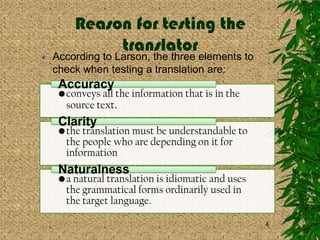
According to Larson, the three elements to
check when testing a translation are:

Accuracy

•conveys all the information that is in the
source text.

Clarity

•the translation must be understandable to
the people who are depending on it for
information

Naturalness

•a natural translation is idiomatic and uses
the grammatical forms ordinarily used in
the target language.
4
Who test the translation
Consultant

Tester

Reviewer

• An Expert
• Help translator to checking
• Correct the translation that may be
inaccurate

• Not Expert
• Unfamiliar with the text
• Help to Judge translation well and naturally

• An Expert
• Someone are willing read the translation
• Comments about clarity and naturalness
5
How the testing is
done?


Comparison with the source text



Back-translation into the source
language



Comprehension checks



Naturalness and readability testing and
finally
6



Consistency checks
Comparison With the
Source Language


This test by comparing the translation with the
source language.



Comparison should be done periodically during
the translation process.



The purpose of comparison is to check the
equivalence of the content between source and
target texts.
7
Back - Translation


Process of translating a document that has
already been translated into a foreign
language back to the original language preferably by an independent translator.

8
Comprehension Tests


This is a test of the product and is not done
by the translator but by the person who is a
speaker of the target language.



The purpose is if speakers of the target
language
understand
the
translation
correctly.

9
Natural tests


The purpose of naturalness tests is to
see if the form of the translation is
natural and the style appropriate.



This testing is done by reviewers.

10
Readability tests






The translator and tester may do readability
tests.
These tests are done by asking someone to
read a part of the translation aloud. It should
be a complete section; that is, a unit.
As they read, the tester will notice any
places where the reader hesitates. Also, if
he stops and re –reads the sentence, this
should be noted as it indicates some
problem in readability
11
Consistency Check


The source text will have had certain key
terms which were identified and for which
lexical equivalents were found.



In the final review, the formatting of the text
and of any supplementary material like
footnotes, glossary, and index or table of
contents, should also be checked for
formatting style.
12
How the results are used in
polishing the final manuscript


The results will need to be evaluated and
recommended.



After the initial draft is completed, it will be very
helpful to the translator if he himself does some
readability checks and comprehension checks with
various people.

13


The final draft will then need to be
checked very carefully for consistency
in technical matters and proofread a
number of times. If a number of people
can read through it completely, this will
give the best check of the final draft.

14
Thank
you
15

Testing Translation

  • 1.
    TESTING THE TRANSLATION Diart Mulya IntanPrimarahajeng SP Hana Holilah Lilik Milkiyah 5D 1
  • 2.
    Four Aspects of Testing  Whytest the translation  Who does the testing  How the testing is done  How the results are used in polishing the final manuscript 2
  • 3.
    Why Test The Translation?  Thetranslator is working hard to at getting across the meaning, if in doing adds information which was not really in the source text. This information should be deleted. 3
  • 4.
     Reason for testingthe translator According to Larson, the three elements to check when testing a translation are: Accuracy •conveys all the information that is in the source text. Clarity •the translation must be understandable to the people who are depending on it for information Naturalness •a natural translation is idiomatic and uses the grammatical forms ordinarily used in the target language. 4
  • 5.
    Who test thetranslation Consultant Tester Reviewer • An Expert • Help translator to checking • Correct the translation that may be inaccurate • Not Expert • Unfamiliar with the text • Help to Judge translation well and naturally • An Expert • Someone are willing read the translation • Comments about clarity and naturalness 5
  • 6.
    How the testingis done?  Comparison with the source text  Back-translation into the source language  Comprehension checks  Naturalness and readability testing and finally 6  Consistency checks
  • 7.
    Comparison With the SourceLanguage  This test by comparing the translation with the source language.  Comparison should be done periodically during the translation process.  The purpose of comparison is to check the equivalence of the content between source and target texts. 7
  • 8.
    Back - Translation  Processof translating a document that has already been translated into a foreign language back to the original language preferably by an independent translator. 8
  • 9.
    Comprehension Tests  This isa test of the product and is not done by the translator but by the person who is a speaker of the target language.  The purpose is if speakers of the target language understand the translation correctly. 9
  • 10.
    Natural tests  The purposeof naturalness tests is to see if the form of the translation is natural and the style appropriate.  This testing is done by reviewers. 10
  • 11.
    Readability tests    The translatorand tester may do readability tests. These tests are done by asking someone to read a part of the translation aloud. It should be a complete section; that is, a unit. As they read, the tester will notice any places where the reader hesitates. Also, if he stops and re –reads the sentence, this should be noted as it indicates some problem in readability 11
  • 12.
    Consistency Check  The sourcetext will have had certain key terms which were identified and for which lexical equivalents were found.  In the final review, the formatting of the text and of any supplementary material like footnotes, glossary, and index or table of contents, should also be checked for formatting style. 12
  • 13.
    How the resultsare used in polishing the final manuscript  The results will need to be evaluated and recommended.  After the initial draft is completed, it will be very helpful to the translator if he himself does some readability checks and comprehension checks with various people. 13
  • 14.
     The final draftwill then need to be checked very carefully for consistency in technical matters and proofread a number of times. If a number of people can read through it completely, this will give the best check of the final draft. 14
  • 15.