UEEC103 Control of
Electric Drives
MODULE 1
SYLLABUS
WHAT ARE ELECTRIC DRIVES?
Drive - Systems employed for motion control
Types
 Mechanical Drives
 Motion control using mechanical elements
 Mechanical elements like friction disc, various types of belts, rope, chain,
gears, couplings, etc. are used for power transmission.
 Energy is wasted as heat
 Electrical Drives
 Drives employing electric motors
 Energy saving is possible
APPLICATIONS
Low Power Applications
•Driving – air conditioners, washing machines, electric cars, locomotives
High Power Applications
•Lifting goods by hoists and cranes
•Conveyor control in factories, mines, warehouses
•Running excavators, escalators, drum winders
•Cutting, milling, drilling, punching, pressing, clipping, in industries like textile mills, paper mills, printing
presses
•Flight landing and control systems of aircrafts
•Propulsion systems of submarines
Advantages of Electric Drives
•They have flexible control characteristics
 Wide range of speed control
 Electric braking can be applied
•Control gear requirement is simple and easy to operate.
•Available in wide range of torque, speed and power.
•Have high efficiency, low losses, longer life, low noise, low maintenance compared to other
prime movers
•Adaptable to any operating conditions such as explosive and radioactive environments
•Do not pollute the environment
•Can operate in all four quadrants
•Breaking is smooth and regenerative operation is possible
•Powered by electrical energy
Disadvantages of Electric Drives
• Power failure completely disabled the whole of the system.
• Causes noise pollution.
• Initial cost of the system is high.
• During the breakdown of conductors or short circuit, the system may get damaged.
Parts/Elements of an Electric Drive
Load:
Different types having its own requirements
• Torque independent of speed
• Linear rising characteristic
• Non linear rising characteristic
• Non linear falling characteristic
• Combined characteristics
Motor
Control Unit
 Control for power modulators
 If control is by semiconductor devices this has firing circuits
 Provides sequencing and interlocking
Sources
Single phase supply
◦ Low power drives
◦ High power traction drives
50 Hz frequency supplies
◦ Speeds of motors are limited to 3000rpm
◦ For higher speeds conversion to higher frequency is required
400Hz AC in aircraft and space applications
Locomotive traction- 25kV,50Hz
Underground traction – 500-750v DC
Forklifts, Milkvans-6V,12V,24V,48V,110V,DC from battery
Power Modulator
Functions
◦ Modulates the flow of power from source to load as required by load
◦ Restricts source and motor current within limits during transient operations
◦ Converts energy of the source in the form suitable to the motor- called converters
◦ Selects the mode of operation of motor
Types of modulators
◦ Bridge Rectifiers and choppers for DC drives
◦ Inverters and Cycloconverters for AC Drives
◦ Variable Impedances
◦ Switching Circuits
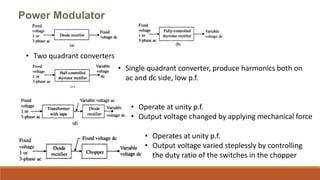
Power Modulator
• Two quadrant converters
• Single quadrant converter, produce harmonics both on
ac and dc side, low p.f.
• Operate at unity p.f.
• Output voltage changed by applying mechanical force
• Operates at unity p.f.
• Output voltage varied steplessly by controlling
the duty ratio of the switches in the chopper
• Operates at unity p.f.
• Power transistors, IGBTs, GTOs are used
• Can be single or two quadrant converter
• Rotating machine- has disadvantages – bulky, heavy, noisy, less
efficiency, slow response ,expensive
• Commutator and brush associated disadvantages are
overcome
• Can operate in single quadrant
• Output voltage can be varied by varying the duty cycle of the
device
 Can obtain variable frequency
 Can behave as VSI or CSI
 Output V and I have stepped waveform
 Induce large amount of harmonics into the system
 Can obtain variable frequency
 Can behave as VSI or CSI
 Output V and I have stepped waveform
 harmonics is reduced
Cycloconverters
 Fixed frequency to variable frequency
 Output frequency restricted to 40% of input frequency to reduce harmonics
 Runs motor at low speed
Classification of Electric Drives
Based on type of motor
◦ DC Motors- DC drives
◦ AC Motors- AC drives
Based on number of machines
◦ Group Drive
◦ Individual drive
◦ Multimotor drive
Group Drive
 If several group of mechanisms or machines are organized on one shaft and driven or
actuated by one motor, the system is called a group drive.
 Also called "line shaft drive".
 Line shafts are connected to multi stepped
pulleys and belts that connect the pulley and
shaft of the driven machine
 Pulley and belt serves to vary the speed.
Advantages:
◦ Less installation cost
◦ Efficiency and p.f will be higher as the motor works on full load
◦ Operation can be stopped simultaneously
◦ A single motor of large capacity costs less than that of the total cost of
number of small motors for same total capacity
Disdvantages:
◦ No flexibility
◦ Addition of extra machine to the shaft is difficult
◦ Any Fault that occurs in the driving motor renders all the driving equipment
idle.
◦ Power losses occurring in the energy transmitting mechanisms will bring the
efficiency down
◦ Noise level at the working spot is high.
Individual Drive
 If a single motor is used to drive or actuate a given mechanism and it does all
the jobs connected with this load , the drive is called individual drive.
 All the operations connected with
operating a lathe may be performed by
a single motor.
 Such drive are used to rotate the spindle,
moves the feed and with the help of gears
imparts motion to lubricating and cooling
pumps in lathe
Advantages:
 The machine can be placed in any desired position
 Efficiency is higher than group drive
 Machine will work independently
Disdvantages:
• High Initial cost
• Energy is transmitted to different parts of the same mechanism through gears and
pulleys and this causes some losses
Multimotor Drive
 Each operation of the mechanism is taken care of by a separate drive motor.
 The system contains several individual drives each of which is used to operate its own
mechanism.
 Separate motors are provided for actuating different parts of the driven mechanism.
 In travelling crane, there are three motors used. One for hoisting, other for long travel
motion and third for cross travel motion.
 Such a drive is essential in complicated metal cutting machine, paper making machine,
rolling mills, rotary printing machine, etc.
 The use of multimotor drive is expanding in modern industries due to their advantage
outweighs increase in capital cost compared to the group drive.
Advantages
 Each Machine is driven by a separated motor it can be run and stopped as
desired.
 Machines not required can be shut down and also replaced with a minimum of
dislocation.
 There is a flexibility in the installation of different machine’s.
 In the case of motor fault, only its connected machine will stop where as others
will continue working undisturbed.
 Absence of belts and line shafts greatly reduces the risk of a accidents to the
operating personnel.
Disadvantages
 Initial high cost
Requirements for the Choice of Electrical Drives
Requirements related to the source
 Type of source
 Capacity
 Magnitude of voltage
 Voltage fluctuations
 Power factor
 Harmonics – generation and effects
 Ability to accept generated power
Capital, running and maintenance costs
Life
Space and weight restrictions
Environment and location
Reliability
Steady State Requirements
 Nature of speed torque characteristics
 Speed regulation
 Speed range
 Efficiency
 Duty cycle
 Quadrants of operation
 Ratings
Transient Operation Requirements
Values of acceleration and deceleration
Starting
Braking
Reversing performance
Speed Torque Convention
 A motor operates in two modes – Motoring and Braking.
 A motor drive capable of operating in both directions of rotation
and of producing both motoring and regeneration is called a Four
Quadrant variable speed drive.
 In motoring mode, the machine works as a motor and converts
the electrical energy into mechanical energy, supporting its
motion.
 In braking mode, the machine works as a generator and converts
mechanical energy into electrical energy and as a result, it
opposes the motion.
 The product of angular speed and torque is equal to the power
developed by a motor.
Speed Torque Convention
 In the I quadrant power developed is positive- called Forward
Motoring
 In the III (third) quadrant, both the speed and the torque have
negative values,so power is positive – called reverse motoring.
 The motor works, in the reverse direction.
 In II (second) quadrant , the direction of rotation is positive, and
the torque is negative called Forward Braking.
 The machine operates as a generator developing a negative
torque, which opposes the motion.
 In the IV (fourth) quadrant, the torque is positive, and the speed
is negative- called reverse braking
Examples
 Compressor, pump and fan type load requires operation in
the I quadrant only. As their operation is unidirectional, they
are called one quadrant drive systems.
 Transportation drives require operation in both directions.
 In transportation if regeneration is necessary, application in
all four quadrants may be required. If not, then the operation
is restricted to quadrants I and III, and thus dynamic braking
or mechanical braking may be required.
 In hoist drives, a four-quadrant operation is needed.
Multiquadrant Operation
Conventions/ Assumptions
 Motor speed is +ve when moving in forward direction
 For up-and-down motions, direction of motor which causes
upward motion is considered forward motion
 +ve motor torque is - torque which produces acceleration or the
positive rate of change of speed in forward direction.
 Motor torque is considered negative if it produces deceleration
 In motoring, it converts electrical energy to mechanical energy,
which supports its motion.
 In braking, it works as a generator converting mechanical
energy to electrical energy, and thus, opposes the motion.
 Weight of the counter weight is chosen to be higher than the
weight of an empty cage but lower than of a fully loaded cage.
 The quadrant I operation - movement of the cage upward, which corresponds to the positive motor speed which is
in anticlockwise direction here.
 This motion is obtained if the motor produces positive torque in anticlockwise direction equal to the magnitude of
load torque Tl1.
 Since developed motor power is positive, this is forward motoring operation.
 Quadrant IV operation is obtained when a loaded cage is lowered.
 Weight of a loaded cage is higher than that of a counter weight, it is
able to come down due to the gravity itself.
 To limit the speed of cage within a safe value, motor must produce a
positive torque T equal to Tl2 in anticlockwise direction.
 Power and speed are negative, so drive is operating in reverse braking.
 Operation in quadrant II is obtained - empty cage is moved up.
 Counter weight is heavier than an empty cage, it is able to pull it up.
 To limit the speed within a safe value, motor must produce a braking
torque equal to Tl2 in clockwise (negative) direction.
 Speed is positive and developed power negative, it is forward braking
operation
 Operation in quadrant III - empty cage is lowered.
 Empty cage has a lesser weight than a counter weight, the motor should
produce a torque in clockwise direction.
 Since speed is negative and developed power positive, this is reverse motoring operation.

CED Unit 1.pptx

  • 1.
  • 2.
  • 3.
    WHAT ARE ELECTRICDRIVES? Drive - Systems employed for motion control
  • 4.
    Types  Mechanical Drives Motion control using mechanical elements  Mechanical elements like friction disc, various types of belts, rope, chain, gears, couplings, etc. are used for power transmission.  Energy is wasted as heat  Electrical Drives  Drives employing electric motors  Energy saving is possible
  • 5.
    APPLICATIONS Low Power Applications •Driving– air conditioners, washing machines, electric cars, locomotives High Power Applications •Lifting goods by hoists and cranes •Conveyor control in factories, mines, warehouses •Running excavators, escalators, drum winders •Cutting, milling, drilling, punching, pressing, clipping, in industries like textile mills, paper mills, printing presses •Flight landing and control systems of aircrafts •Propulsion systems of submarines
  • 6.
    Advantages of ElectricDrives •They have flexible control characteristics  Wide range of speed control  Electric braking can be applied •Control gear requirement is simple and easy to operate. •Available in wide range of torque, speed and power. •Have high efficiency, low losses, longer life, low noise, low maintenance compared to other prime movers •Adaptable to any operating conditions such as explosive and radioactive environments •Do not pollute the environment •Can operate in all four quadrants •Breaking is smooth and regenerative operation is possible •Powered by electrical energy
  • 7.
    Disadvantages of ElectricDrives • Power failure completely disabled the whole of the system. • Causes noise pollution. • Initial cost of the system is high. • During the breakdown of conductors or short circuit, the system may get damaged.
  • 8.
    Parts/Elements of anElectric Drive
  • 10.
    Load: Different types havingits own requirements • Torque independent of speed • Linear rising characteristic • Non linear rising characteristic • Non linear falling characteristic • Combined characteristics Motor
  • 11.
    Control Unit  Controlfor power modulators  If control is by semiconductor devices this has firing circuits  Provides sequencing and interlocking Sources Single phase supply ◦ Low power drives ◦ High power traction drives 50 Hz frequency supplies ◦ Speeds of motors are limited to 3000rpm ◦ For higher speeds conversion to higher frequency is required 400Hz AC in aircraft and space applications Locomotive traction- 25kV,50Hz Underground traction – 500-750v DC Forklifts, Milkvans-6V,12V,24V,48V,110V,DC from battery
  • 12.
    Power Modulator Functions ◦ Modulatesthe flow of power from source to load as required by load ◦ Restricts source and motor current within limits during transient operations ◦ Converts energy of the source in the form suitable to the motor- called converters ◦ Selects the mode of operation of motor Types of modulators ◦ Bridge Rectifiers and choppers for DC drives ◦ Inverters and Cycloconverters for AC Drives ◦ Variable Impedances ◦ Switching Circuits
  • 13.
    Power Modulator • Twoquadrant converters • Single quadrant converter, produce harmonics both on ac and dc side, low p.f. • Operate at unity p.f. • Output voltage changed by applying mechanical force • Operates at unity p.f. • Output voltage varied steplessly by controlling the duty ratio of the switches in the chopper
  • 14.
    • Operates atunity p.f. • Power transistors, IGBTs, GTOs are used • Can be single or two quadrant converter • Rotating machine- has disadvantages – bulky, heavy, noisy, less efficiency, slow response ,expensive • Commutator and brush associated disadvantages are overcome • Can operate in single quadrant
  • 15.
    • Output voltagecan be varied by varying the duty cycle of the device  Can obtain variable frequency  Can behave as VSI or CSI  Output V and I have stepped waveform  Induce large amount of harmonics into the system  Can obtain variable frequency  Can behave as VSI or CSI  Output V and I have stepped waveform  harmonics is reduced Cycloconverters  Fixed frequency to variable frequency  Output frequency restricted to 40% of input frequency to reduce harmonics  Runs motor at low speed
  • 16.
    Classification of ElectricDrives Based on type of motor ◦ DC Motors- DC drives ◦ AC Motors- AC drives Based on number of machines ◦ Group Drive ◦ Individual drive ◦ Multimotor drive
  • 17.
    Group Drive  Ifseveral group of mechanisms or machines are organized on one shaft and driven or actuated by one motor, the system is called a group drive.  Also called "line shaft drive".  Line shafts are connected to multi stepped pulleys and belts that connect the pulley and shaft of the driven machine  Pulley and belt serves to vary the speed.
  • 18.
    Advantages: ◦ Less installationcost ◦ Efficiency and p.f will be higher as the motor works on full load ◦ Operation can be stopped simultaneously ◦ A single motor of large capacity costs less than that of the total cost of number of small motors for same total capacity Disdvantages: ◦ No flexibility ◦ Addition of extra machine to the shaft is difficult ◦ Any Fault that occurs in the driving motor renders all the driving equipment idle. ◦ Power losses occurring in the energy transmitting mechanisms will bring the efficiency down ◦ Noise level at the working spot is high.
  • 19.
    Individual Drive  Ifa single motor is used to drive or actuate a given mechanism and it does all the jobs connected with this load , the drive is called individual drive.  All the operations connected with operating a lathe may be performed by a single motor.  Such drive are used to rotate the spindle, moves the feed and with the help of gears imparts motion to lubricating and cooling pumps in lathe
  • 20.
    Advantages:  The machinecan be placed in any desired position  Efficiency is higher than group drive  Machine will work independently Disdvantages: • High Initial cost • Energy is transmitted to different parts of the same mechanism through gears and pulleys and this causes some losses
  • 21.
    Multimotor Drive  Eachoperation of the mechanism is taken care of by a separate drive motor.  The system contains several individual drives each of which is used to operate its own mechanism.  Separate motors are provided for actuating different parts of the driven mechanism.  In travelling crane, there are three motors used. One for hoisting, other for long travel motion and third for cross travel motion.  Such a drive is essential in complicated metal cutting machine, paper making machine, rolling mills, rotary printing machine, etc.  The use of multimotor drive is expanding in modern industries due to their advantage outweighs increase in capital cost compared to the group drive.
  • 22.
    Advantages  Each Machineis driven by a separated motor it can be run and stopped as desired.  Machines not required can be shut down and also replaced with a minimum of dislocation.  There is a flexibility in the installation of different machine’s.  In the case of motor fault, only its connected machine will stop where as others will continue working undisturbed.  Absence of belts and line shafts greatly reduces the risk of a accidents to the operating personnel. Disadvantages  Initial high cost
  • 23.
    Requirements for theChoice of Electrical Drives Requirements related to the source  Type of source  Capacity  Magnitude of voltage  Voltage fluctuations  Power factor  Harmonics – generation and effects  Ability to accept generated power Capital, running and maintenance costs Life Space and weight restrictions Environment and location Reliability Steady State Requirements  Nature of speed torque characteristics  Speed regulation  Speed range  Efficiency  Duty cycle  Quadrants of operation  Ratings Transient Operation Requirements Values of acceleration and deceleration Starting Braking Reversing performance
  • 24.
    Speed Torque Convention A motor operates in two modes – Motoring and Braking.  A motor drive capable of operating in both directions of rotation and of producing both motoring and regeneration is called a Four Quadrant variable speed drive.  In motoring mode, the machine works as a motor and converts the electrical energy into mechanical energy, supporting its motion.  In braking mode, the machine works as a generator and converts mechanical energy into electrical energy and as a result, it opposes the motion.  The product of angular speed and torque is equal to the power developed by a motor.
  • 25.
    Speed Torque Convention In the I quadrant power developed is positive- called Forward Motoring  In the III (third) quadrant, both the speed and the torque have negative values,so power is positive – called reverse motoring.  The motor works, in the reverse direction.  In II (second) quadrant , the direction of rotation is positive, and the torque is negative called Forward Braking.  The machine operates as a generator developing a negative torque, which opposes the motion.  In the IV (fourth) quadrant, the torque is positive, and the speed is negative- called reverse braking
  • 26.
    Examples  Compressor, pumpand fan type load requires operation in the I quadrant only. As their operation is unidirectional, they are called one quadrant drive systems.  Transportation drives require operation in both directions.  In transportation if regeneration is necessary, application in all four quadrants may be required. If not, then the operation is restricted to quadrants I and III, and thus dynamic braking or mechanical braking may be required.  In hoist drives, a four-quadrant operation is needed.
  • 27.
    Multiquadrant Operation Conventions/ Assumptions Motor speed is +ve when moving in forward direction  For up-and-down motions, direction of motor which causes upward motion is considered forward motion  +ve motor torque is - torque which produces acceleration or the positive rate of change of speed in forward direction.  Motor torque is considered negative if it produces deceleration  In motoring, it converts electrical energy to mechanical energy, which supports its motion.  In braking, it works as a generator converting mechanical energy to electrical energy, and thus, opposes the motion.  Weight of the counter weight is chosen to be higher than the weight of an empty cage but lower than of a fully loaded cage.
  • 28.
     The quadrantI operation - movement of the cage upward, which corresponds to the positive motor speed which is in anticlockwise direction here.  This motion is obtained if the motor produces positive torque in anticlockwise direction equal to the magnitude of load torque Tl1.  Since developed motor power is positive, this is forward motoring operation.  Quadrant IV operation is obtained when a loaded cage is lowered.  Weight of a loaded cage is higher than that of a counter weight, it is able to come down due to the gravity itself.  To limit the speed of cage within a safe value, motor must produce a positive torque T equal to Tl2 in anticlockwise direction.  Power and speed are negative, so drive is operating in reverse braking.  Operation in quadrant II is obtained - empty cage is moved up.  Counter weight is heavier than an empty cage, it is able to pull it up.  To limit the speed within a safe value, motor must produce a braking torque equal to Tl2 in clockwise (negative) direction.  Speed is positive and developed power negative, it is forward braking operation  Operation in quadrant III - empty cage is lowered.  Empty cage has a lesser weight than a counter weight, the motor should produce a torque in clockwise direction.  Since speed is negative and developed power positive, this is reverse motoring operation.