TRUBA INSTITUTE OF ENGG. & INFO. TECHNOLOGY
                     BHOPAL


                              A
                      TECHNICAL SEMINAR
                             ON
                   “TESTING OF DC MACHINE”


  SUBMITTED TO:-                            SUBMITTED BY:-
MR. PRIYANK NEMA                          MRITYUNJAI KUMAR ANAND
                                          ROLL NO. 0114EX101035


        DEPARTMENT OF ELECTRICAL & ELECTRONICS ENGG.

                   SESSION-2012-13
CONTENTS
1. Testing method of dc m/c.
2. simple/direct test .
     (a) Explanation,(b) Numerical (C)
   Disadvantage .
3 .Swinburne’s test.
4.Hopkinsion’s test
TESTING OF DC MACHINE
 Q:- Why testing are required ?


Ans-Machines are tested for finding out losses,
    efficiency and temperature rise. For
    small m/c we used DIRECT LOADING
    test and for large shunt m/c, INDIRECT MET-
    HOD are used.
TESTING METHOD ARE


 Simple / Direct test.


 Swinburne’s / Indirect Method test.

 Hopkinson’s / Regenerative / Back - to -
  Back / Heat –run test.
Simple / Direct test
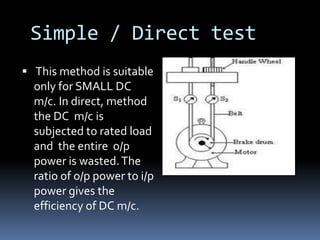
 This method is suitable
  only for SMALL DC
  m/c. In direct, method
  the DC m/c is
  subjected to rated load
  and the entire o/p
  power is wasted. The
  ratio of o/p power to i/p
  power gives the
  efficiency of DC m/c.
EFFICIENCY MOTOR
 Motor o/p={ω(s1-s2)r× 9. 81}
 Motor i/p= VtI.
 ή(motor)={o/p}/{i/p}.
           = [{ω(s1-s2)r× 9. 81}×100]/VtI
where; s1&s2 are the tension on the belt.
       ω=2πn(motor speed in rad/sec
        r=radius of pulley in meters(=1/2 out
 side pulley dia+1/2 belt thickness)
       Vt=terminal voltage & I=line current.
NUMERICAL

 A full load break test on a small d.c m/c shunt
  motor ,give the following data
   Spring balance readings 25 kg & 9 kg
   Out side pulley diameter 19.5 cm
   Belt thickness 0.50 cm
   Motor speed 1500 rpm
   Applied voltage 230 v
   Line current 12.5 A
Calculate the shaft torque, shaft power & motor
 efficiency at rated load.
SOLUTION
 Shaft torque=(S1-S2)×Effective radius
    =(25.9)[(19.5/2)+(0.5/2)]×(1/100)kg-m
    =16×0.1×9.81 Nm=15.7 Nm
  Shaft power=ω×Shaft torque
                =[(2π×1500)/60]×15.7=2470w
  Motor i/p=Vti=230×12.5=2875w
  ή(motor efficiency at rated
  load)=[2470/2875]×100=85.6%
DISADVANTAGES
 The spring balance readings are not steady.


 Friction torque does not const. At a particular
  setting of handwheels H1&H2
INDIRECT METHOD

 In this method ,no load m/c losses are first
  measured by a suitable test and then
  additional losses on load are determined
  from the m/c data ,in order to calculate the
  m/c efficiency .
 The simplest method of measuring the no
  load m/c losses is by SWINBURNE’S
  METHOD.
SWINBURNE’S METHOD
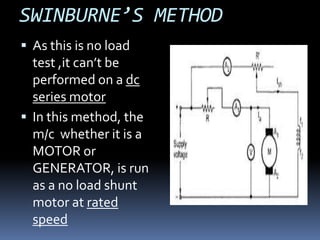
 As this is no load
  test ,it can’t be
  performed on a dc
  series motor
 In this method, the
  m/c whether it is a
  MOTOR or
  GENERATOR, is run
  as a no load shunt
  motor at rated
  speed
 If Ia0 and If are the no load armature and
  field current respectively .Then power
  absorbed by the armature (=Vt×Iao) is equal
  to the no load rotational loss W0 plus a small
  amount armature circuit loss Ia0^2 ×ra.
 No load rotational loss W0=Vt×Iao- Ia0^2 ×ra.
 Here armature circuit resistance ra includes
  the brush contact resistance also.
 Shunt field loss=Vt×If.
 Let IL be the load current at which m/c
  efficiency is required.
 Generator efficiency
       Generator o/p=Vt×IL
       Armature current Ia=IL+If
      Armature circuit loss= Ia^2×ra
      ra=armature circuit resistance when hot.
 Total loss=W0+ Ia^2×ra+Vt×If
  ή(Generator)=[1-{(W0+
  Ia^2×ra+Vt×If)}/{(Vt×IL+ W0+ Ia^2×ra+Vt×If)}]
 Motor efficiency
 When m/c is working as a motor then
    Ia=IL-If
  Motor i/p=Vt×IL
 ή(motor efficiency)=[1-
 {(W0+Ia^2×ra+If×Vt)}/{(Vt×IL)}]
NUMERICAL
 A 400 v,20kw dc shunt motor takes 2.5 A
  when running light. For an armature
  resistance of 800Ω and brush drop 2V,find full
  load efficiency.
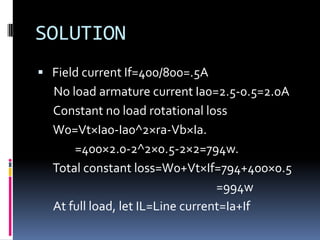
SOLUTION
 Field current If=400/800=.5A
  No load armature current Ia0=2.5-0.5=2.0A
  Constant no load rotational loss
  W0=Vt×Ia0-Ia0^2×ra-Vb×Ia.
      =400×2.0-2^2×0.5-2×2=794w.
  Total constant loss=W0+Vt×If=794+400×0.5
                                  =994w
  At full load, let IL=Line current=Ia+If
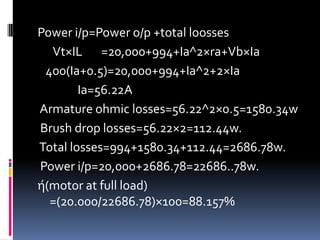
Power i/p=Power o/p +total loosses
  Vt×IL =20,000+994+Ia^2×ra+Vb×Ia
 400(Ia+0.5)=20,000+994+Ia^2+2×Ia
        Ia=56.22A
Armature ohmic losses=56.22^2×0.5=1580.34w
Brush drop losses=56.22×2=112.44w.
Total losses=994+1580.34+112.44=2686.78w.
Power i/p=20,000+2686.78=22686..78w.
ή(motor at full load)
  =(20.000/22686.78)×100=88.157%
ADVANTAGES
 Low power is required for testing even large
  m/c, since only no load losses are to be
  supplied from the main.

 It is convenient and economical.


 The efficiency can be calculated at any load
  because constant losses are known.
DISADVANTAGES
 As the test is on no load, it doesn’t indicate whether
  the commutation on full load is satisfactory and
  whether the temperature rise would be within
  specified limit.
 THIS TEST CAN’T BE APPLIED FOR A SERIES
  MOTOR because speed of series motor is very high at
  no load ,it is not possible to run series motor on no
  load.
 Note:-In comparison to other the armature cu
  losses is so small that it may be neglected &
  constant loss may be take equal to no load i/p
Regenerative/Hopkinson’s
method.
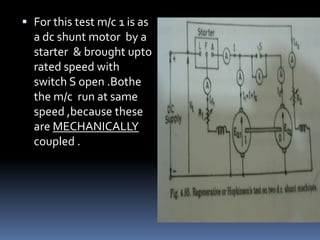
  In this method ,two identical d.c m/c are
   coupled ,both mechanically & electrically and
   are tested simultaneously. One of the m/c
   made to run as a MOTOR and it derives the
   other m/c as GENERATOR .
 For this test m/c 1 is as
  a dc shunt motor by a
  starter & brought upto
  rated speed with
  switch S open .Bothe
  the m/c run at same
  speed ,because these
  are MECHANICALLY
  coupled .
TO PERFORM THE TEST FOLLOWING
PROCEDURE IS ADOPTED

 M/c 1(motor) is started through starter & its
  field rheostat is adjusted so that it runs at
  normal speed. The m/c 1(Motor) will drive m/c
  2(Generator).The switch S is initially kept
  open.
 The excitation of m/c 2 is gradually increased
  ( by decreasing the field circuit resistance).till
  the volt metre 1 reads ZERO.Then switch S is
  closed.
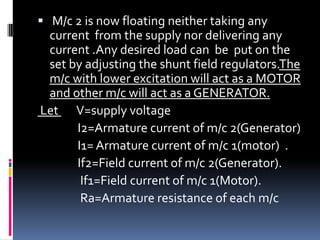
 M/c 2 is now floating neither taking any
 current from the supply nor delivering any
 current .Any desired load can be put on the
 set by adjusting the shunt field regulators.The
 m/c with lower excitation will act as a MOTOR
 and other m/c will act as a GENERATOR.
Let V=supply voltage
      I2=Armature current of m/c 2(Generator)
      I1= Armature current of m/c 1(motor) .
      If2=Field current of m/c 2(Generator).
       If1=Field current of m/c 1(Motor).
       Ra=Armature resistance of each m/c
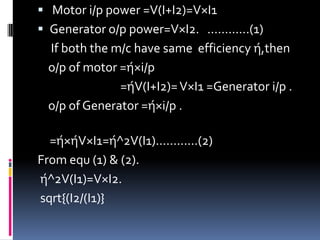
 Motor i/p power =V(I+I2)=V×I1
 Generator o/p power=V×I2. ............(1)
  If both the m/c have same efficiency ή,then
  o/p of motor =ή×i/p
               =ήV(I+I2)= V×I1 =Generator i/p .
  o/p of Generator =ή×i/p .

  =ή×ήV×I1=ή^2V(I1)............(2)
From equ (1) & (2).
ή^2V(I1)=V×I2.
sqrt{(I2/(I1)}
EFFICIENCY
Armature circuit loss in Generator =I2^2×ra .
 Armature circuit loss in Motor=I1^2×ra .
 Power drawn from supply= V×I.
No load rotational loss in two m/c=W0=
       V×I-ra(I1^2+I2^2) .
No load rotational loss for each m/c=W0/2 .
Generator o/p= I2^2×ra.
Generator loss=Wg=(W0/2)+V×If2+ I2^2×ra.
ή(g)=[1-(Wg)/(V×I2+Wg)]
 Motor i/p=V(I1+If1)
 Total motor losses Wm=(W0/2)+ V×If1
 +I1^2×ra .
ή( Motor)=[1-(Wm)/V(I1+If2)]
ADVANTAGE
 Total power taken from the supply is very
  low. Therefore this method is very
  economical.
 The temperature rise and the commutation
  condition can be checked under rated load
  condition.
 Large m/c can be tested at rated load
  without consuming much power from the
  supply.
 Efficiency at different load can be determine.
DISADVANTAGES
 The main disadvantage of this method is the
  necessity two practically identical m/c to be
  available
THANK
        YOU....

testing of dc machine

  • 1.
    TRUBA INSTITUTE OFENGG. & INFO. TECHNOLOGY BHOPAL A TECHNICAL SEMINAR ON “TESTING OF DC MACHINE” SUBMITTED TO:- SUBMITTED BY:- MR. PRIYANK NEMA MRITYUNJAI KUMAR ANAND ROLL NO. 0114EX101035 DEPARTMENT OF ELECTRICAL & ELECTRONICS ENGG. SESSION-2012-13
  • 2.
    CONTENTS 1. Testing methodof dc m/c. 2. simple/direct test . (a) Explanation,(b) Numerical (C) Disadvantage . 3 .Swinburne’s test. 4.Hopkinsion’s test
  • 3.
    TESTING OF DCMACHINE Q:- Why testing are required ? Ans-Machines are tested for finding out losses, efficiency and temperature rise. For small m/c we used DIRECT LOADING test and for large shunt m/c, INDIRECT MET- HOD are used.
  • 4.
    TESTING METHOD ARE Simple / Direct test.  Swinburne’s / Indirect Method test.  Hopkinson’s / Regenerative / Back - to - Back / Heat –run test.
  • 5.
    Simple / Directtest  This method is suitable only for SMALL DC m/c. In direct, method the DC m/c is subjected to rated load and the entire o/p power is wasted. The ratio of o/p power to i/p power gives the efficiency of DC m/c.
  • 6.
    EFFICIENCY MOTOR  Motoro/p={ω(s1-s2)r× 9. 81}  Motor i/p= VtI.  ή(motor)={o/p}/{i/p}. = [{ω(s1-s2)r× 9. 81}×100]/VtI where; s1&s2 are the tension on the belt. ω=2πn(motor speed in rad/sec r=radius of pulley in meters(=1/2 out side pulley dia+1/2 belt thickness) Vt=terminal voltage & I=line current.
  • 7.
    NUMERICAL  A fullload break test on a small d.c m/c shunt motor ,give the following data Spring balance readings 25 kg & 9 kg Out side pulley diameter 19.5 cm Belt thickness 0.50 cm Motor speed 1500 rpm Applied voltage 230 v Line current 12.5 A Calculate the shaft torque, shaft power & motor efficiency at rated load.
  • 8.
    SOLUTION  Shaft torque=(S1-S2)×Effectiveradius =(25.9)[(19.5/2)+(0.5/2)]×(1/100)kg-m =16×0.1×9.81 Nm=15.7 Nm Shaft power=ω×Shaft torque =[(2π×1500)/60]×15.7=2470w Motor i/p=Vti=230×12.5=2875w ή(motor efficiency at rated load)=[2470/2875]×100=85.6%
  • 9.
    DISADVANTAGES  The springbalance readings are not steady.  Friction torque does not const. At a particular setting of handwheels H1&H2
  • 10.
    INDIRECT METHOD  Inthis method ,no load m/c losses are first measured by a suitable test and then additional losses on load are determined from the m/c data ,in order to calculate the m/c efficiency .  The simplest method of measuring the no load m/c losses is by SWINBURNE’S METHOD.
  • 11.
    SWINBURNE’S METHOD  Asthis is no load test ,it can’t be performed on a dc series motor  In this method, the m/c whether it is a MOTOR or GENERATOR, is run as a no load shunt motor at rated speed
  • 12.
     If Ia0and If are the no load armature and field current respectively .Then power absorbed by the armature (=Vt×Iao) is equal to the no load rotational loss W0 plus a small amount armature circuit loss Ia0^2 ×ra.  No load rotational loss W0=Vt×Iao- Ia0^2 ×ra.  Here armature circuit resistance ra includes the brush contact resistance also.  Shunt field loss=Vt×If.
  • 13.
     Let ILbe the load current at which m/c efficiency is required.  Generator efficiency Generator o/p=Vt×IL Armature current Ia=IL+If Armature circuit loss= Ia^2×ra ra=armature circuit resistance when hot. Total loss=W0+ Ia^2×ra+Vt×If ή(Generator)=[1-{(W0+ Ia^2×ra+Vt×If)}/{(Vt×IL+ W0+ Ia^2×ra+Vt×If)}]
  • 14.
     Motor efficiency When m/c is working as a motor then Ia=IL-If Motor i/p=Vt×IL ή(motor efficiency)=[1- {(W0+Ia^2×ra+If×Vt)}/{(Vt×IL)}]
  • 15.
    NUMERICAL  A 400v,20kw dc shunt motor takes 2.5 A when running light. For an armature resistance of 800Ω and brush drop 2V,find full load efficiency.
  • 16.
    SOLUTION  Field currentIf=400/800=.5A No load armature current Ia0=2.5-0.5=2.0A Constant no load rotational loss W0=Vt×Ia0-Ia0^2×ra-Vb×Ia. =400×2.0-2^2×0.5-2×2=794w. Total constant loss=W0+Vt×If=794+400×0.5 =994w At full load, let IL=Line current=Ia+If
  • 17.
    Power i/p=Power o/p+total loosses Vt×IL =20,000+994+Ia^2×ra+Vb×Ia 400(Ia+0.5)=20,000+994+Ia^2+2×Ia Ia=56.22A Armature ohmic losses=56.22^2×0.5=1580.34w Brush drop losses=56.22×2=112.44w. Total losses=994+1580.34+112.44=2686.78w. Power i/p=20,000+2686.78=22686..78w. ή(motor at full load) =(20.000/22686.78)×100=88.157%
  • 18.
    ADVANTAGES  Low poweris required for testing even large m/c, since only no load losses are to be supplied from the main.  It is convenient and economical.  The efficiency can be calculated at any load because constant losses are known.
  • 19.
    DISADVANTAGES  As thetest is on no load, it doesn’t indicate whether the commutation on full load is satisfactory and whether the temperature rise would be within specified limit.  THIS TEST CAN’T BE APPLIED FOR A SERIES MOTOR because speed of series motor is very high at no load ,it is not possible to run series motor on no load.  Note:-In comparison to other the armature cu losses is so small that it may be neglected & constant loss may be take equal to no load i/p
  • 20.
    Regenerative/Hopkinson’s method.  Inthis method ,two identical d.c m/c are coupled ,both mechanically & electrically and are tested simultaneously. One of the m/c made to run as a MOTOR and it derives the other m/c as GENERATOR .
  • 21.
     For thistest m/c 1 is as a dc shunt motor by a starter & brought upto rated speed with switch S open .Bothe the m/c run at same speed ,because these are MECHANICALLY coupled .
  • 22.
    TO PERFORM THETEST FOLLOWING PROCEDURE IS ADOPTED  M/c 1(motor) is started through starter & its field rheostat is adjusted so that it runs at normal speed. The m/c 1(Motor) will drive m/c 2(Generator).The switch S is initially kept open.  The excitation of m/c 2 is gradually increased ( by decreasing the field circuit resistance).till the volt metre 1 reads ZERO.Then switch S is closed.
  • 23.
     M/c 2is now floating neither taking any current from the supply nor delivering any current .Any desired load can be put on the set by adjusting the shunt field regulators.The m/c with lower excitation will act as a MOTOR and other m/c will act as a GENERATOR. Let V=supply voltage I2=Armature current of m/c 2(Generator) I1= Armature current of m/c 1(motor) . If2=Field current of m/c 2(Generator). If1=Field current of m/c 1(Motor). Ra=Armature resistance of each m/c
  • 24.
     Motor i/ppower =V(I+I2)=V×I1  Generator o/p power=V×I2. ............(1) If both the m/c have same efficiency ή,then o/p of motor =ή×i/p =ήV(I+I2)= V×I1 =Generator i/p . o/p of Generator =ή×i/p . =ή×ήV×I1=ή^2V(I1)............(2) From equ (1) & (2). ή^2V(I1)=V×I2. sqrt{(I2/(I1)}
  • 25.
    EFFICIENCY Armature circuit lossin Generator =I2^2×ra . Armature circuit loss in Motor=I1^2×ra . Power drawn from supply= V×I. No load rotational loss in two m/c=W0= V×I-ra(I1^2+I2^2) . No load rotational loss for each m/c=W0/2 . Generator o/p= I2^2×ra. Generator loss=Wg=(W0/2)+V×If2+ I2^2×ra. ή(g)=[1-(Wg)/(V×I2+Wg)]
  • 26.
     Motor i/p=V(I1+If1) Total motor losses Wm=(W0/2)+ V×If1 +I1^2×ra . ή( Motor)=[1-(Wm)/V(I1+If2)]
  • 27.
    ADVANTAGE  Total powertaken from the supply is very low. Therefore this method is very economical.  The temperature rise and the commutation condition can be checked under rated load condition.  Large m/c can be tested at rated load without consuming much power from the supply.  Efficiency at different load can be determine.
  • 28.
    DISADVANTAGES  The maindisadvantage of this method is the necessity two practically identical m/c to be available
  • 29.
    THANK YOU....