ED First lecture
What is Electrical Drives
?????????????
Motion control is called as drives.
It may use any of the prime mover such as diesel
engine, gas or steam turbine , steam engine or any
electrical motors etc.
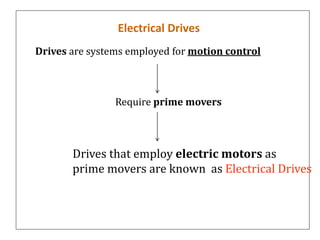
Electrical Drives
Drives are systems employed for motion control
Require prime movers
Drives that employ electric motors as
prime movers are known as Electrical Drives
History of Electrical Drives:
• In year 1838,Prof B.S.Lakobi tested a DC
motor supplied from a storage battery and
used it to drive a screw propeller on a boat.
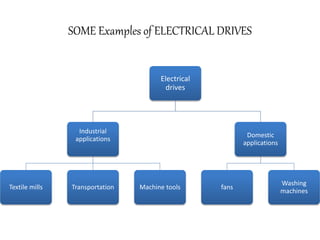
SOME Examples of ELECTRICAL DRIVES
Electrical
drives
Industrial
applications
Textile mills Transportation Machine tools
Domestic
applications
fans
Washing
machines
Advantages of Electrical Drives
• Have flexible control characteristics
• Available in wide range of torque , speed and
power
• Not pollute the environment
• Adaptable in almost any operating conditions
• Can operate in all the four quadrant of
operations
• Smooth speed control
AC and DC Drives:
Advantages of DC drives:
• DC motors are very versatile for the purpose of
speed control
Disadvantage of DC drives :
• Sparking at the brushes limit both the highest
speed of operation and design capacity of
motor.
• Also the ripple content of the motor current
due to processes of rectification impairs the
commutation capability of the motor.
Disadvantages of AC Drives:
• In past AC motors were mainly used in fixed speed
applications
• When controlled using conventional methods , only
stepped speeds are possible with a limited range of
speed control.
Advantages of AC Drives:
With thyristor power converter ,the variable voltage and
variable frequency supply the speed control of
Induction motor is making AC drive competitive with
DC drives.
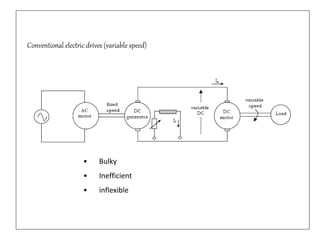
Conventional electric drives (variable speed)
• Bulky
• Inefficient
• inflexible
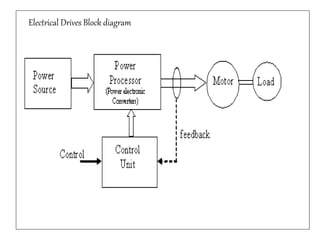
Electrical Drives Block diagram
Components of Block Diagram
• Power source
• Power Processor/power modulator
• Motor
• Load
• Control unit
• Sensing unit
Power Source
• Single phase AC
• Three Phase AC
• DC supply
Power Modulator:-
• Modulates flow of power from the source to the
motor in such a manner that motor is imparted
speed torque characteristics required by the load
• During transient operations , such as starting,
braking and speed reversal . It restricts the source
and motor current within permissible value
• Converts electrical energy of the source in the
form suitable to motor.
• Selects the mode of operation
Selection Criteria for Electric Machines
• Cost
• Thermal Capacity
• Efficiency
• Torque-speed profile
• Acceleration
• Power density, volume of motor/Torque to
weight ratio
• Ripple, cogging torques
• Peak torque capability
Requirement of an adjustable speed Drive:
• Stable operation: The speed torque
characteristics of the motor should be such
that stable operation of the drive is assured
in all four quadrants.
• The drive motor should also have a good
transient response.
Load:-
• The load has certain torque speed
characteristic
• A motor having speed torque characteristic
and capabilities compatible to the load
requirement is chosen
Example of cranes and hoist drives
Requirement of Drives:
The motion of the crane hook is in all three
dimensions
In crane drives , the acceleration and
retardation must be uniform . This is more
important than the speed control
For exact positioning of the load creep speed
must be possible.
classification of power modulator:
(a)Converters:
Need for converter arises when nature of the
available electrical power is different than what is
required for the motor.
1.ac to dc converter
2.dc to dc converter
3.Inverters
4.cycloconverters
(b)Variable impedances
Variable resistors are commonly used for the
control of dc and ac drives.
Can be controlled manually or automatic .
Stepless variation of resistance can be
obtained using a semiconductor switch in
parallel with a fixed resistance; variation of
duty ratio of the switch gives a stepless
variation in effective value of the resistance.
(c)Switching Circuits:
Need:-
For changing motor connections to change it’s
quadrant of operation
For operating motors and drives according to
predetermined sequence
To disconnect motor when abnormal
conditions occur
IInd lecture
Dynamics of Electrical Drives:
Torque equations
Four quadrant operation
Equivalent values of Drive parameter
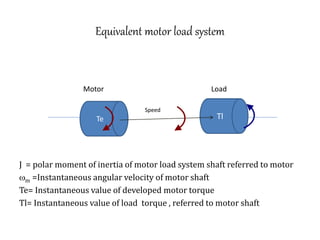
Equivalent motor load system
Motor Load
Speed
J = polar moment of inertia of motor load system shaft referred to motor
m =Instantaneous angular velocity of motor shaft
Te= Instantaneous value of developed motor torque
Tl= Instantaneous value of load torque , referred to motor shaft
Te Tl
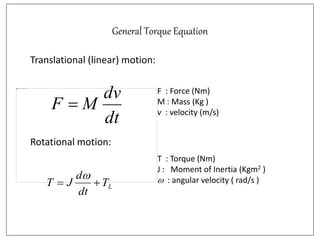
General Torque Equation
Translational (linear) motion:
Rotational motion:
dt
dv
MF 
F : Force (Nm)
M : Mass (Kg )
v : velocity (m/s)
T : Torque (Nm)
J : Moment of Inertia (Kgm2 )
 : angular velocity ( rad/s )
LT
dt
d
JT 

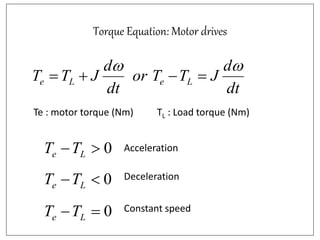
Torque Equation: Motor drives
dt
d
JTTor
dt
d
JTT LeLe


0 Le TT Acceleration
0 Le TT Deceleration
0 Le TT Constant speed
Te : motor torque (Nm) TL : Load torque (Nm)
• Drive accelerate or decelerate depends
upon whether Te is greater or less than Tl .
• During acceleration motor should supply
not only the load torque but additional
torque component
dt
d
J

Four quadrant operation
Speed conventions:-
Motor speed is considered +ve ,when rotating in
the forward direction.
forward direction :
• for the drive which operate only in one
direction, their normal speed taken as it’s
forward speed.
• for up-down motion drive, up speed is
taken as forward speed.
Torque conventions:-
+ve torque: the torque which produce
acceleration or +ve rate of change of speed
in forward direction.
-ve torque -deceleration
MOTORING AND BRAKING
• Motoring: converts Electrical energy into
mechanical energy
• Braking: converts mechanical energy into
Electrical energy and thus oppose the
motion.
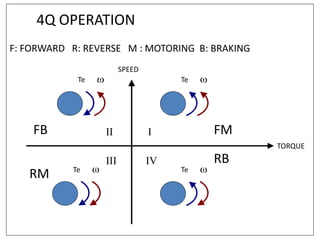
4Q OPERATION
SPEED
TORQUE
I
III
II
IV
TeTe
Te Te
FMFB
RM
RB
F: FORWARD R: REVERSE M : MOTORING B: BRAKING
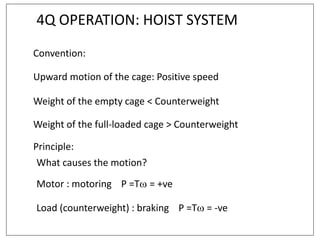
4Q OPERATION: HOIST SYSTEM
Convention:
Upward motion of the cage: Positive speed
Weight of the empty cage < Counterweight
Weight of the full-loaded cage > Counterweight
Principle:
What causes the motion?
Motor : motoring P =T = +ve
Load (counterweight) : braking P =T = -ve
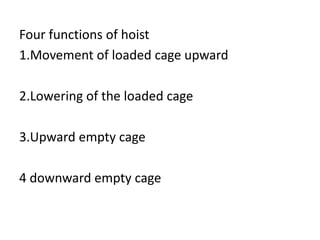
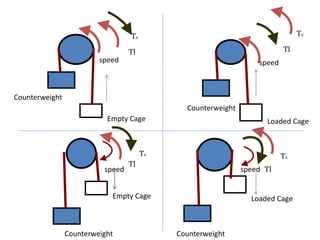
Four functions of hoist
1.Movement of loaded cage upward
2.Lowering of the loaded cage
3.Upward empty cage
4 downward empty cage
Counterweight
Counterweight
Counterweight Counterweight
Empty Cage Loaded Cage
Loaded CageEmpty Cage
speed
Te
Tl
speed Tl
Te
speed
Tl
Te
Tl
speed
Te
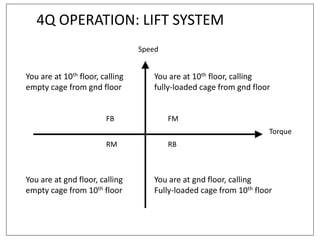
4Q OPERATION: LIFT SYSTEM
You are at 10th floor, calling
fully-loaded cage from gnd floor
You are at gnd floor, calling
empty cage from 10th floor
You are at 10th floor, calling
empty cage from gnd floor
You are at gnd floor, calling
Fully-loaded cage from 10th floor
Torque
Speed
FMFB
RM RB
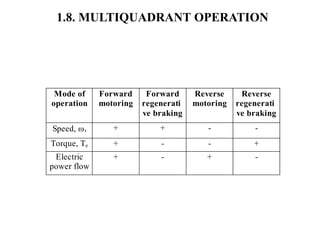
1.8. MULTIQUADRANT OPERATION
Mode of
operation
Forward
motoring
Forward
regenerati
ve braking
Reverse
motoring
Reverse
regenerati
ve braking
Speed, r + + - -
Torque, Te + - - +
Electric
power flow
+ - + -
3rdlecture
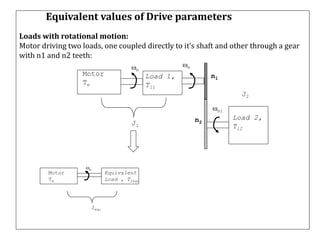
Loads with rotational motion:
Motor driving two loads, one coupled directly to it’s shaft and other through a gear
with n1 and n2 teeth:
Motor
Te
Load 1,
Tl1
Load 2,
Tl2
J1
J2
m
m
m1
n1
n2
Equivalent values of Drive parameters
Motor
Te
Jequ
Equivalent
Load , Tlequ
m
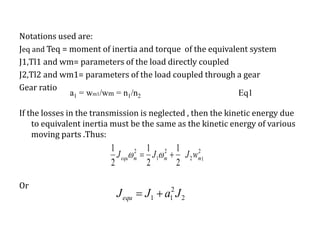
Notations used are:
Jeq and Teq = moment of inertia and torque of the equivalent system
J1,Tl1 and wm= parameters of the load directly coupled
J2,Tl2 and wm1= parameters of the load coupled through a gear
Gear ratio
If the losses in the transmission is neglected , then the kinetic energy due
to equivalent inertia must be the same as the kinetic energy of various
moving parts .Thus:
Or
a1 = wm1/wm = n1/n2 Eq1
1
2
2
2
1
2
2
1
2
1
2
1
mmmequ wJJJ  
2
2
11 JaJJequ 
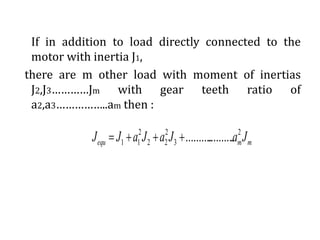
If in addition to load directly connected to the
motor with inertia J1,
there are m other load with moment of inertias
J2,J3…………Jm with gear teeth ratio of
a2,a3……………..am then :
mmequ JaJaJaJJ 2
3
2
22
2
11 .....................
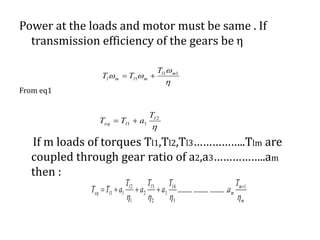
Power at the loads and motor must be same . If
transmission efficiency of the gears be η
From eq1
If m loads of torques Tl1,Tl2,Tl3……………..Tlm are
coupled through gear ratio of a2,a3……………..am
then :

2
11
l
leq
T
aTT 


 11
1
ml
mlml
T
TT 
m
m
m
lll
leq
T
a
T
a
T
a
T
aTT

1
3
4
3
2
3
2
1
2
11 ............................... 

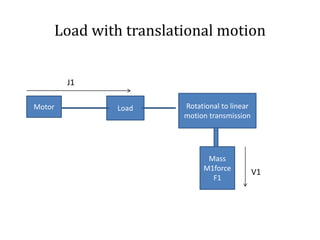
Load with translational motion
J1
V1
Motor Load Rotational to linear
motion transmission
Mass
M1force
F1
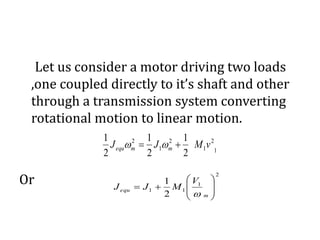
Let us consider a motor driving two loads
,one coupled directly to it’s shaft and other
through a transmission system converting
rotational motion to linear motion.
Or
2
1
11
2
1









m
equ
V
MJJ

1
2
1
2
1
2
2
1
2
1
2
1
vMJJ mmequ  
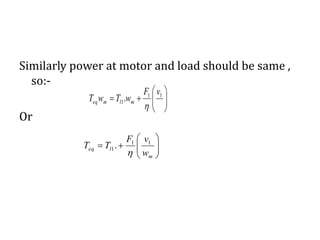
Similarly power at motor and load should be same ,
so:-
Or







m
leq
w
vF
TT 11
1.







 11
1.
vF
wTwT mlmeq

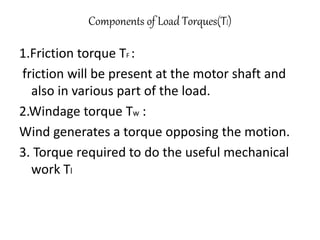
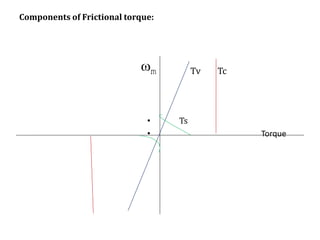
Components of Load Torques(Tl)
1.Friction torque TF :
friction will be present at the motor shaft and
also in various part of the load.
2.Windage torque Tw :
Wind generates a torque opposing the motion.
3. Torque required to do the useful mechanical
work Tl
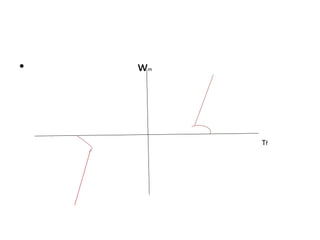
• wm
•
Tf
m Tv Tc
• Ts
• Torque
Components of Frictional torque:
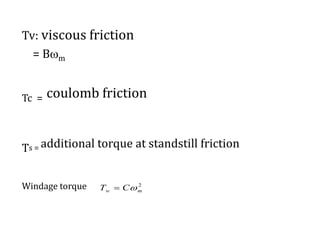
Tv: viscous friction
= Bm
Tc = coulomb friction
Ts = additional torque at standstill friction
Windage torque 2
mw CT 
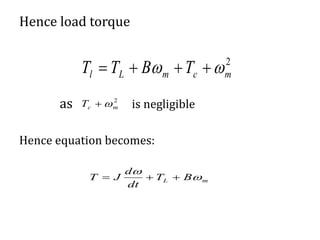
Hence load torque
as is negligible
Hence equation becomes:
2
mcmLl TBTT  
2
mcT 
mL BT
dt
d
JT 


Classification of load torques

Electric Drive Chapter 1

  • 1.
  • 2.
    What is ElectricalDrives ????????????? Motion control is called as drives. It may use any of the prime mover such as diesel engine, gas or steam turbine , steam engine or any electrical motors etc.
  • 3.
    Electrical Drives Drives aresystems employed for motion control Require prime movers Drives that employ electric motors as prime movers are known as Electrical Drives
  • 4.
    History of ElectricalDrives: • In year 1838,Prof B.S.Lakobi tested a DC motor supplied from a storage battery and used it to drive a screw propeller on a boat.
  • 5.
    SOME Examples ofELECTRICAL DRIVES Electrical drives Industrial applications Textile mills Transportation Machine tools Domestic applications fans Washing machines
  • 6.
    Advantages of ElectricalDrives • Have flexible control characteristics • Available in wide range of torque , speed and power • Not pollute the environment • Adaptable in almost any operating conditions • Can operate in all the four quadrant of operations • Smooth speed control
  • 7.
    AC and DCDrives: Advantages of DC drives: • DC motors are very versatile for the purpose of speed control Disadvantage of DC drives : • Sparking at the brushes limit both the highest speed of operation and design capacity of motor. • Also the ripple content of the motor current due to processes of rectification impairs the commutation capability of the motor.
  • 8.
    Disadvantages of ACDrives: • In past AC motors were mainly used in fixed speed applications • When controlled using conventional methods , only stepped speeds are possible with a limited range of speed control. Advantages of AC Drives: With thyristor power converter ,the variable voltage and variable frequency supply the speed control of Induction motor is making AC drive competitive with DC drives.
  • 9.
    Conventional electric drives(variable speed) • Bulky • Inefficient • inflexible
  • 10.
  • 11.
    Components of BlockDiagram • Power source • Power Processor/power modulator • Motor • Load • Control unit • Sensing unit
  • 12.
    Power Source • Singlephase AC • Three Phase AC • DC supply
  • 13.
    Power Modulator:- • Modulatesflow of power from the source to the motor in such a manner that motor is imparted speed torque characteristics required by the load • During transient operations , such as starting, braking and speed reversal . It restricts the source and motor current within permissible value • Converts electrical energy of the source in the form suitable to motor. • Selects the mode of operation
  • 14.
    Selection Criteria forElectric Machines • Cost • Thermal Capacity • Efficiency • Torque-speed profile • Acceleration • Power density, volume of motor/Torque to weight ratio • Ripple, cogging torques • Peak torque capability
  • 15.
    Requirement of anadjustable speed Drive: • Stable operation: The speed torque characteristics of the motor should be such that stable operation of the drive is assured in all four quadrants. • The drive motor should also have a good transient response.
  • 16.
    Load:- • The loadhas certain torque speed characteristic • A motor having speed torque characteristic and capabilities compatible to the load requirement is chosen
  • 17.
    Example of cranesand hoist drives Requirement of Drives: The motion of the crane hook is in all three dimensions In crane drives , the acceleration and retardation must be uniform . This is more important than the speed control For exact positioning of the load creep speed must be possible.
  • 18.
    classification of powermodulator: (a)Converters: Need for converter arises when nature of the available electrical power is different than what is required for the motor. 1.ac to dc converter 2.dc to dc converter 3.Inverters 4.cycloconverters
  • 19.
    (b)Variable impedances Variable resistorsare commonly used for the control of dc and ac drives. Can be controlled manually or automatic . Stepless variation of resistance can be obtained using a semiconductor switch in parallel with a fixed resistance; variation of duty ratio of the switch gives a stepless variation in effective value of the resistance.
  • 20.
    (c)Switching Circuits: Need:- For changingmotor connections to change it’s quadrant of operation For operating motors and drives according to predetermined sequence To disconnect motor when abnormal conditions occur
  • 21.
    IInd lecture Dynamics ofElectrical Drives: Torque equations Four quadrant operation Equivalent values of Drive parameter
  • 22.
    Equivalent motor loadsystem Motor Load Speed J = polar moment of inertia of motor load system shaft referred to motor m =Instantaneous angular velocity of motor shaft Te= Instantaneous value of developed motor torque Tl= Instantaneous value of load torque , referred to motor shaft Te Tl
  • 23.
    General Torque Equation Translational(linear) motion: Rotational motion: dt dv MF  F : Force (Nm) M : Mass (Kg ) v : velocity (m/s) T : Torque (Nm) J : Moment of Inertia (Kgm2 )  : angular velocity ( rad/s ) LT dt d JT  
  • 24.
    Torque Equation: Motordrives dt d JTTor dt d JTT LeLe   0 Le TT Acceleration 0 Le TT Deceleration 0 Le TT Constant speed Te : motor torque (Nm) TL : Load torque (Nm)
  • 25.
    • Drive accelerateor decelerate depends upon whether Te is greater or less than Tl . • During acceleration motor should supply not only the load torque but additional torque component dt d J 
  • 26.
    Four quadrant operation Speedconventions:- Motor speed is considered +ve ,when rotating in the forward direction. forward direction : • for the drive which operate only in one direction, their normal speed taken as it’s forward speed. • for up-down motion drive, up speed is taken as forward speed.
  • 27.
    Torque conventions:- +ve torque:the torque which produce acceleration or +ve rate of change of speed in forward direction. -ve torque -deceleration
  • 28.
    MOTORING AND BRAKING •Motoring: converts Electrical energy into mechanical energy • Braking: converts mechanical energy into Electrical energy and thus oppose the motion.
  • 29.
  • 30.
    4Q OPERATION: HOISTSYSTEM Convention: Upward motion of the cage: Positive speed Weight of the empty cage < Counterweight Weight of the full-loaded cage > Counterweight Principle: What causes the motion? Motor : motoring P =T = +ve Load (counterweight) : braking P =T = -ve
  • 31.
    Four functions ofhoist 1.Movement of loaded cage upward 2.Lowering of the loaded cage 3.Upward empty cage 4 downward empty cage
  • 32.
    Counterweight Counterweight Counterweight Counterweight Empty CageLoaded Cage Loaded CageEmpty Cage speed Te Tl speed Tl Te speed Tl Te Tl speed Te
  • 33.
    4Q OPERATION: LIFTSYSTEM You are at 10th floor, calling fully-loaded cage from gnd floor You are at gnd floor, calling empty cage from 10th floor You are at 10th floor, calling empty cage from gnd floor You are at gnd floor, calling Fully-loaded cage from 10th floor Torque Speed FMFB RM RB
  • 34.
    1.8. MULTIQUADRANT OPERATION Modeof operation Forward motoring Forward regenerati ve braking Reverse motoring Reverse regenerati ve braking Speed, r + + - - Torque, Te + - - + Electric power flow + - + -
  • 35.
  • 36.
    Loads with rotationalmotion: Motor driving two loads, one coupled directly to it’s shaft and other through a gear with n1 and n2 teeth: Motor Te Load 1, Tl1 Load 2, Tl2 J1 J2 m m m1 n1 n2 Equivalent values of Drive parameters Motor Te Jequ Equivalent Load , Tlequ m
  • 37.
    Notations used are: Jeqand Teq = moment of inertia and torque of the equivalent system J1,Tl1 and wm= parameters of the load directly coupled J2,Tl2 and wm1= parameters of the load coupled through a gear Gear ratio If the losses in the transmission is neglected , then the kinetic energy due to equivalent inertia must be the same as the kinetic energy of various moving parts .Thus: Or a1 = wm1/wm = n1/n2 Eq1 1 2 2 2 1 2 2 1 2 1 2 1 mmmequ wJJJ   2 2 11 JaJJequ 
  • 38.
    If in additionto load directly connected to the motor with inertia J1, there are m other load with moment of inertias J2,J3…………Jm with gear teeth ratio of a2,a3……………..am then : mmequ JaJaJaJJ 2 3 2 22 2 11 .....................
  • 39.
    Power at theloads and motor must be same . If transmission efficiency of the gears be η From eq1 If m loads of torques Tl1,Tl2,Tl3……………..Tlm are coupled through gear ratio of a2,a3……………..am then :  2 11 l leq T aTT     11 1 ml mlml T TT  m m m lll leq T a T a T a T aTT  1 3 4 3 2 3 2 1 2 11 ...............................  
  • 40.
    Load with translationalmotion J1 V1 Motor Load Rotational to linear motion transmission Mass M1force F1
  • 41.
    Let us considera motor driving two loads ,one coupled directly to it’s shaft and other through a transmission system converting rotational motion to linear motion. Or 2 1 11 2 1          m equ V MJJ  1 2 1 2 1 2 2 1 2 1 2 1 vMJJ mmequ  
  • 42.
    Similarly power atmotor and load should be same , so:- Or        m leq w vF TT 11 1.         11 1. vF wTwT mlmeq 
  • 43.
    Components of LoadTorques(Tl) 1.Friction torque TF : friction will be present at the motor shaft and also in various part of the load. 2.Windage torque Tw : Wind generates a torque opposing the motion. 3. Torque required to do the useful mechanical work Tl
  • 44.
  • 45.
    m Tv Tc •Ts • Torque Components of Frictional torque:
  • 46.
    Tv: viscous friction =Bm Tc = coulomb friction Ts = additional torque at standstill friction Windage torque 2 mw CT 
  • 47.
    Hence load torque asis negligible Hence equation becomes: 2 mcmLl TBTT   2 mcT  mL BT dt d JT   
  • 48.