Group
Members
Arslan Liaqat 2014-ME-01
Ahmad Sohaib 2014-ME-06
Sarbuland Saeed 2014-ME-20
Tahreem Naveed 2014-ME-48
Wafa Riaz 2014-ME-49
Imran Haider 2014-ME-54
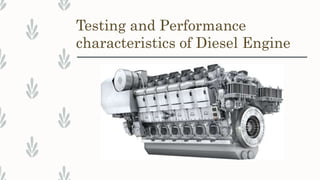
Testing and Performance
characteristics of Diesel Engine
Diesel Engine
– A diesel engine is an internal combustion engine in which
ignition of fuel is carried out in the combustion chamber
by elevated temperature of air in the cylinder due to
adiabatic compression.
– A diesel engine works on Diesel Cycle
Working of Diesel Engine
– Intake stroke
– Piston going down - intake valve open.
– Low pressure created in cylinder.
– Volumetric Efficiency maximum at w.o.t.
– Compression stroke
– Piston going up - both valves closed.
– Mixture squeezed to increase combustibility, molecules, raises temp.
– Needs good seal to compress and combust.
Contd…..
– Power stroke
– Piston going down - both valves closed.
– Work is performed by expanding gasses.
– Exhaust stroke
– Piston going up - exhaust valve open.
– Exhaust gasses exit.
– Any exhaust left over dilutes incoming a/f mixture with inert gas (exhaust)
– Causes poor quality and quantity of charge.
Characteristics of Diesel Engine
– Brake Thermal Efficiency
Brake Thermal Efficiency is defined as break power of a
heat engine as a function of thermal input from the fuel.
– Indicated Thermal Efficiency
Indicated Thermal Efficiency is defined as the extent to
which the energy added by work is converted to net heat output.
– Specific Fuel Consumption
It is the ratio of fuel consumption per unit time
(kg/hr) to power produced by engine (kwh).
Characteristics of Diesel Engine
– Mechanical Efficiency
It is the measure of effectiveness with which a mechanical
system performs. It is usually the ratio of power delivered by a mechanical system
to power supplied to it.
– Volumetric Efficiency
It is defined as the ratio of mass-density of air-fuel mixture
drawn into cylinder at atmospheric pressure to the mass density of the same
volume of air in the intake manifold.
Characteristics of Diesel Engine
– Air-fuel ratio
Air-fuel ratio is the ratio of air to fuel present in combustion
process. Diesel engines usually works at lean mixture.
– Mean Effective Pressure
Mean effective pressure can be regarded as an average pressure in
cylinder for a complete engine cycle. By definition, mean effective pressure is the
ratio between the work and engine displacement.
BASIC ENGINE
TESTING
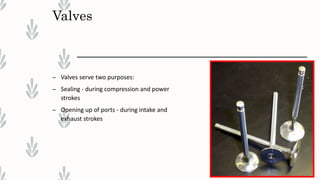
Valves
– Valves serve two purposes:
– Sealing - during compression and power
strokes
– Opening up of ports - during intake and
exhaust strokes
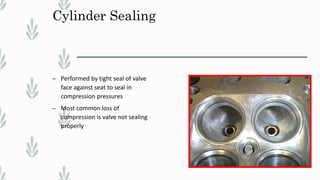
Cylinder Sealing
– Performed by tight seal of valve
face against seat to seal in
compression pressures
– Most common loss of
compression is valve not sealing
properly
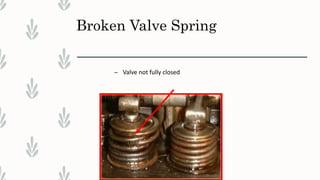
Broken Valve Spring
– Valve not fully closed
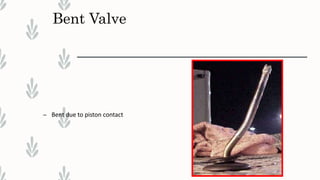
Bent Valve
– Bent due to piston contact
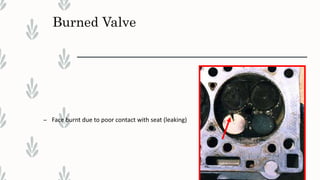
Burned Valve
– Face burnt due to poor contact with seat (leaking)
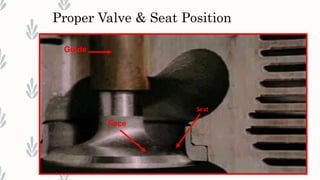
Proper Valve & Seat Position
Face
Seat
Guide
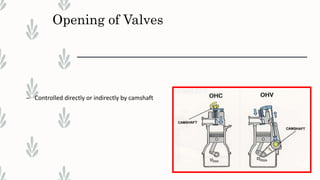
Opening of Valves
– Controlled directly or indirectly by camshaft
Volumetric Efficiency
– Three factors affect VE:
– How far the valve opens (lift)
– The amount of time that it is open (duration
– Size of opening
– A problem with valve opening will affect volumetric efficiency or the quantity
of incoming fuel mixture
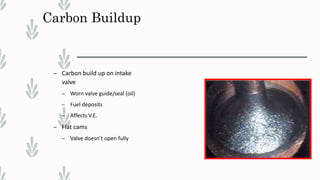
Carbon Buildup
– Carbon build up on intake
valve
– Worn valve guide/seal (oil)
– Fuel deposits
– Affects V.E.
– Flat cams
– Valve doesn’t open fully
Testing
Vacuum gauge testing
– Provides quick test for compression problems
– Should read 15-20” of manifold vacuum @ idle
– Cranking vacuum will be 3-5”
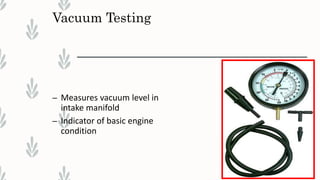
Vacuum Testing
– Measures vacuum level in
intake manifold
– Indicator of basic engine
condition
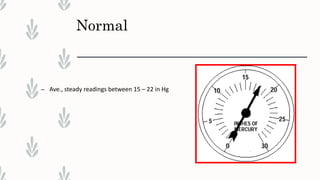
Normal
– Ave., steady readings between 15 – 22 in Hg
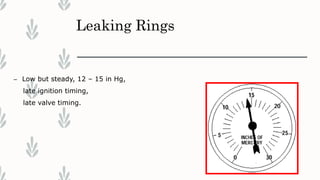
Leaking Rings
– Low but steady, 12 – 15 in Hg,
late ignition timing,
late valve timing.
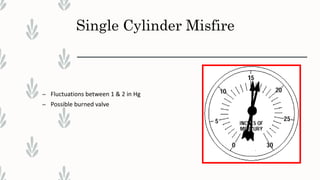
Single Cylinder Misfire
– Fluctuations between 1 & 2 in Hg
– Possible burned valve
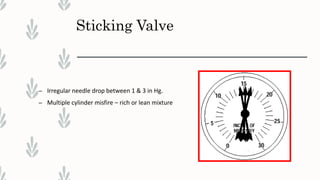
Sticking Valve
– Irregular needle drop between 1 & 3 in Hg.
– Multiple cylinder misfire – rich or lean mixture
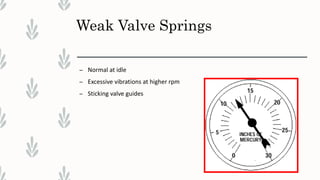
Weak Valve Springs
– Normal at idle
– Excessive vibrations at higher rpm
– Sticking valve guides
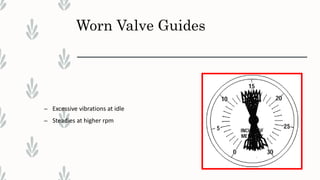
Worn Valve Guides
– Excessive vibrations at idle
– Steadies at higher rpm
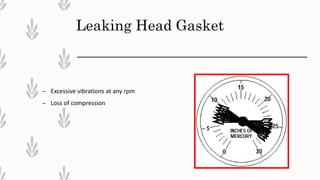
Leaking Head Gasket
– Excessive vibrations at any rpm
– Loss of compression
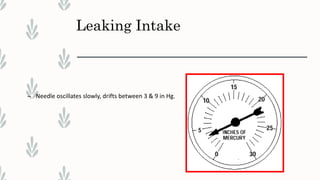
Leaking Intake
– Needle oscillates slowly, drifts between 3 & 9 in Hg.
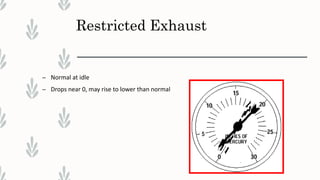
Restricted Exhaust
– Normal at idle
– Drops near 0, may rise to lower than normal
Cranking Compression Test
– Used for checking engine seal
– Must set up conditions
– W.O.T., bat. charger, disable ignition, all plugs out
– Compare readings - 10% max difference
– Typical range: 110 - 150 psi
– Wet test is performed when cranking compression is low
– Add SMALL amount of oil to cylinder, helps seal worn rings
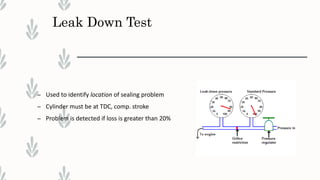
Leak Down Test
– Used to identify location of sealing problem
– Cylinder must be at TDC, comp. stroke
– Problem is detected if loss is greater than 20%
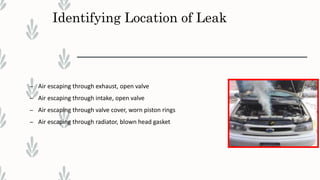
Identifying Location of Leak
– Air escaping through exhaust, open valve
– Air escaping through intake, open valve
– Air escaping through valve cover, worn piston rings
– Air escaping through radiator, blown head gasket
Running Compression Test
– Test cylinder seal at idle
– Readings will be low, less time to fill cylinder
– Compare readings - no specs
– Identifies compression loss apparent while running
– Broken valve springs
– Worn valve guided
– Burned valve
Snap Compression Test
– Tests for problems with v.e.
– Allows rush of air at relatively low rpm, nearly filling cylinder which will cause
increased compression pressures
– If a cylinder has a restricted intake snap pressures will be lower
– Compare readings - no specs
Improper Valve Lash
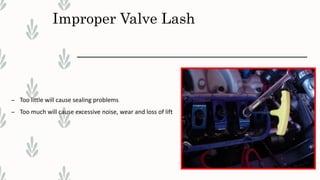
– Too little will cause sealing problems
– Too much will cause excessive noise, wear and loss of lift
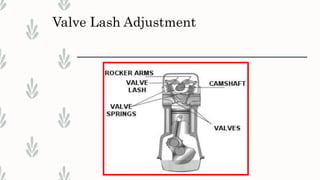
Valve Lash Adjustment
Testing and performance characteristics of diesel engine

Testing and performance characteristics of diesel engine

  • 2.
    Group Members Arslan Liaqat 2014-ME-01 AhmadSohaib 2014-ME-06 Sarbuland Saeed 2014-ME-20 Tahreem Naveed 2014-ME-48 Wafa Riaz 2014-ME-49 Imran Haider 2014-ME-54
  • 3.
  • 4.
    Diesel Engine – Adiesel engine is an internal combustion engine in which ignition of fuel is carried out in the combustion chamber by elevated temperature of air in the cylinder due to adiabatic compression. – A diesel engine works on Diesel Cycle
  • 5.
    Working of DieselEngine – Intake stroke – Piston going down - intake valve open. – Low pressure created in cylinder. – Volumetric Efficiency maximum at w.o.t. – Compression stroke – Piston going up - both valves closed. – Mixture squeezed to increase combustibility, molecules, raises temp. – Needs good seal to compress and combust.
  • 6.
    Contd….. – Power stroke –Piston going down - both valves closed. – Work is performed by expanding gasses. – Exhaust stroke – Piston going up - exhaust valve open. – Exhaust gasses exit. – Any exhaust left over dilutes incoming a/f mixture with inert gas (exhaust) – Causes poor quality and quantity of charge.
  • 7.
    Characteristics of DieselEngine – Brake Thermal Efficiency Brake Thermal Efficiency is defined as break power of a heat engine as a function of thermal input from the fuel. – Indicated Thermal Efficiency Indicated Thermal Efficiency is defined as the extent to which the energy added by work is converted to net heat output. – Specific Fuel Consumption It is the ratio of fuel consumption per unit time (kg/hr) to power produced by engine (kwh).
  • 8.
    Characteristics of DieselEngine – Mechanical Efficiency It is the measure of effectiveness with which a mechanical system performs. It is usually the ratio of power delivered by a mechanical system to power supplied to it. – Volumetric Efficiency It is defined as the ratio of mass-density of air-fuel mixture drawn into cylinder at atmospheric pressure to the mass density of the same volume of air in the intake manifold.
  • 9.
    Characteristics of DieselEngine – Air-fuel ratio Air-fuel ratio is the ratio of air to fuel present in combustion process. Diesel engines usually works at lean mixture. – Mean Effective Pressure Mean effective pressure can be regarded as an average pressure in cylinder for a complete engine cycle. By definition, mean effective pressure is the ratio between the work and engine displacement.
  • 10.
  • 11.
    Valves – Valves servetwo purposes: – Sealing - during compression and power strokes – Opening up of ports - during intake and exhaust strokes
  • 12.
    Cylinder Sealing – Performedby tight seal of valve face against seat to seal in compression pressures – Most common loss of compression is valve not sealing properly
  • 13.
    Broken Valve Spring –Valve not fully closed
  • 14.
    Bent Valve – Bentdue to piston contact
  • 15.
    Burned Valve – Faceburnt due to poor contact with seat (leaking)
  • 16.
    Proper Valve &Seat Position Face Seat Guide
  • 17.
    Opening of Valves –Controlled directly or indirectly by camshaft
  • 18.
    Volumetric Efficiency – Threefactors affect VE: – How far the valve opens (lift) – The amount of time that it is open (duration – Size of opening – A problem with valve opening will affect volumetric efficiency or the quantity of incoming fuel mixture
  • 19.
    Carbon Buildup – Carbonbuild up on intake valve – Worn valve guide/seal (oil) – Fuel deposits – Affects V.E. – Flat cams – Valve doesn’t open fully
  • 20.
  • 21.
    Vacuum gauge testing –Provides quick test for compression problems – Should read 15-20” of manifold vacuum @ idle – Cranking vacuum will be 3-5”
  • 22.
    Vacuum Testing – Measuresvacuum level in intake manifold – Indicator of basic engine condition
  • 23.
    Normal – Ave., steadyreadings between 15 – 22 in Hg
  • 24.
    Leaking Rings – Lowbut steady, 12 – 15 in Hg, late ignition timing, late valve timing.
  • 25.
    Single Cylinder Misfire –Fluctuations between 1 & 2 in Hg – Possible burned valve
  • 26.
    Sticking Valve – Irregularneedle drop between 1 & 3 in Hg. – Multiple cylinder misfire – rich or lean mixture
  • 27.
    Weak Valve Springs –Normal at idle – Excessive vibrations at higher rpm – Sticking valve guides
  • 28.
    Worn Valve Guides –Excessive vibrations at idle – Steadies at higher rpm
  • 29.
    Leaking Head Gasket –Excessive vibrations at any rpm – Loss of compression
  • 30.
    Leaking Intake – Needleoscillates slowly, drifts between 3 & 9 in Hg.
  • 31.
    Restricted Exhaust – Normalat idle – Drops near 0, may rise to lower than normal
  • 32.
    Cranking Compression Test –Used for checking engine seal – Must set up conditions – W.O.T., bat. charger, disable ignition, all plugs out – Compare readings - 10% max difference – Typical range: 110 - 150 psi – Wet test is performed when cranking compression is low – Add SMALL amount of oil to cylinder, helps seal worn rings
  • 33.
    Leak Down Test –Used to identify location of sealing problem – Cylinder must be at TDC, comp. stroke – Problem is detected if loss is greater than 20%
  • 34.
    Identifying Location ofLeak – Air escaping through exhaust, open valve – Air escaping through intake, open valve – Air escaping through valve cover, worn piston rings – Air escaping through radiator, blown head gasket
  • 35.
    Running Compression Test –Test cylinder seal at idle – Readings will be low, less time to fill cylinder – Compare readings - no specs – Identifies compression loss apparent while running – Broken valve springs – Worn valve guided – Burned valve
  • 36.
    Snap Compression Test –Tests for problems with v.e. – Allows rush of air at relatively low rpm, nearly filling cylinder which will cause increased compression pressures – If a cylinder has a restricted intake snap pressures will be lower – Compare readings - no specs
  • 37.
    Improper Valve Lash –Too little will cause sealing problems – Too much will cause excessive noise, wear and loss of lift
  • 38.