CHM 102
INTRODUCTORY CHEMISTRY II
MODULE 1
INSTRUCTOR 1
DR. MRS L.M.DUROSINMI
COURSE OUTLINE
BRIEF INTRODUCTION TO
CHM 102 TOPICS
THEORY AND TECHNIQUES OF
QUALITATIVE INORGANIC ANALYSIS
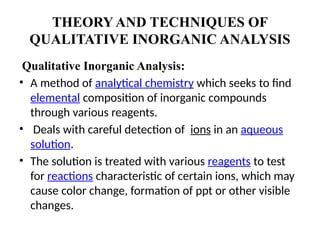
Qualitative Inorganic Analysis:
• A method of analytical chemistry which seeks to find
elemental composition of inorganic compounds
through various reagents.
• Deals with careful detection of ions in an aqueous
solution.
• The solution is treated with various reagents to test
for reactions characteristic of certain ions, which may
cause color change, formation of ppt or other visible
changes.
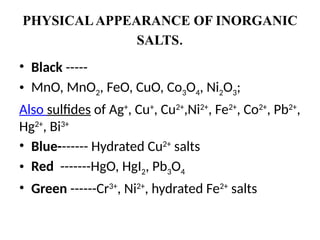
PHYSICALAPPEARANCE OF INORGANIC
SALTS.
• Black -----
• MnO, MnO2, FeO, CuO, Co3O4, Ni2O3;
Also sulfides of Ag+
, Cu+
, Cu2+
,Ni2+
, Fe2+
, Co2+
, Pb2+
,
Hg2+
, Bi3+
• Blue------- Hydrated Cu2+
salts
• Red -------HgO, HgI2, Pb3O4
• Green ------Cr3+
, Ni2+
, hydrated Fe2+
salts
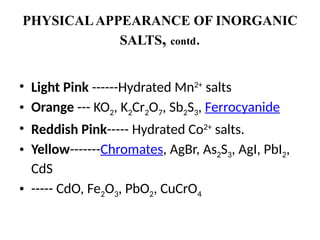
PHYSICALAPPEARANCE OF INORGANIC
SALTS, contd.
• Light Pink ------Hydrated Mn2+
salts
• Orange --- KO2, K2Cr2O7, Sb2S3, Ferrocyanide
• Reddish Pink----- Hydrated Co2+
salts.
• Yellow-------Chromates, AgBr, As2S3, AgI, PbI2,
CdS
• ----- CdO, Fe2O3, PbO2, CuCrO4
DETECTING CATIONS
• Cations are usually classified into six groups.
• Each group has a common reagent which can
be used to separate them from the solution.
• To obtain meaningful results, the separation is
done in sequence.
1st Group of Cations
• Most important cations in 1st group are Ag+
, Hg2+
and Pb2+
.
• The ions form insoluble chlorides. Thus, the group reagent to
separate them is hydrochloric acid. 1–2 M.
• Concentrated HCl must not be used, because it forms a soluble
complex ion ([PbCl4]2−
) with Pb2+
. Consequently, the Pb2+
ion
would go undetected.
• The chlorides of these elements cannot be distinguished from
each other by their colour - they are all white solid compounds.
But PbCl2 is soluble in hot water, and can therefore be
differentiated easily. Ammonia is used as a reagent to
distinguish between the other two. While AgCl dissolves in
ammonia (due to the formation of the complex ion
[Ag(NH3)2]+
), Hg2Cl2 gives a black precipitate.
2nd Group of Cations
• These consists of ions that form acid-insoluble sulfides. The
Cations include: Cd2+
, Bi3+
, Cu2+
, As3+
, As5+
, Sb3+
, Sb5+
, Sn2+
,
Sn4+
and Hg2+
. Pb2+.
• The reagent used is any substance that gives S2−
ions in such
solutions; most commonly used are hydrogen sulfide (at 0.2-0.3 M)
in the presence of dilute HCl.
• CdS, is yellow. All the precipitates, except for HgS, are soluble in
dilute nitric acid. HgS is soluble only in aqua regia, which can be
used to separate it from the rest.
2nd Group of Cations
• The action of ammonia is also useful in differentiating the
cations. CuS dissolves in ammonia forming an intense blue
solution, whereas CdS dissolves forming a colourless
solution. The sulfides of As3+
, As5+
, Sb3+
, Sb5+
, Sn2+
, Sn4+
are
soluble in yellow ammonium sulfide, where they form
polysulphide complexes.
•
• If it forms a yellow precipitate, then Cd2+
or Sn4+
is present;
or if it forms a brown precipitate, then Sn2+
must be
present; or if a red orange precipitate is formed, then Sb3+
is
present.
3rd Group of Cations
• This group of cations includes ions that form hydroxides
which are insoluble even at low concentrations.
• Cations : Fe2+
, Fe3+
, Al3+
, and Cr3+
.
• The group is determined by making a solution of the salt in
water and adding ammonium chloride and ammonium
hydroxide. Ammonium chloride is added to ensure low
concentration of hydroxide ions.
3rd Group of Cations, contd
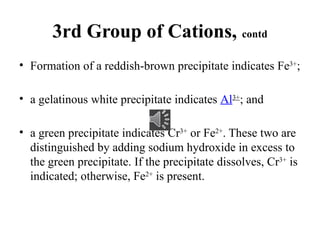
• Formation of a reddish-brown precipitate indicates Fe3+
;
• a gelatinous white precipitate indicates Al3+
; and
• a green precipitate indicates Cr3+
or Fe2+
. These two are
distinguished by adding sodium hydroxide in excess to
the green precipitate. If the precipitate dissolves, Cr3+
is
indicated; otherwise, Fe2+
is present.
4th Group of Cations
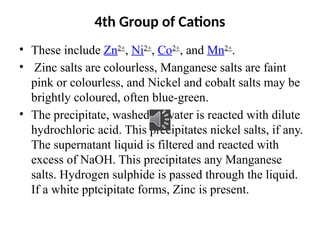
• These include Zn2+
, Ni2+
, Co2+
, and Mn2+
.
• Zinc salts are colourless, Manganese salts are faint
pink or colourless, and Nickel and cobalt salts may be
brightly coloured, often blue-green.
• The precipitate, washed in water is reacted with dilute
hydrochloric acid. This precipitates nickel salts, if any.
The supernatant liquid is filtered and reacted with
excess of NaOH. This precipitates any Manganese
salts. Hydrogen sulphide is passed through the liquid.
If a white pptcipitate forms, Zinc is present.
5th Group of Cations
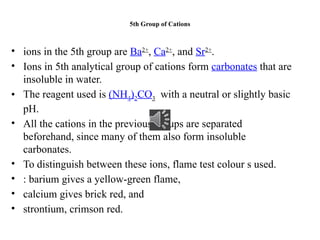
• ions in the 5th group are Ba2+
, Ca2+
, and Sr2+
.
• Ions in 5th analytical group of cations form carbonates that are
insoluble in water.
• The reagent used is (NH4)2CO3 with a neutral or slightly basic
pH.
• All the cations in the previous groups are separated
beforehand, since many of them also form insoluble
carbonates.
• To distinguish between these ions, flame test colour s used.
• : barium gives a yellow-green flame,
• calcium gives brick red, and
• strontium, crimson red.
6th Group of Cations
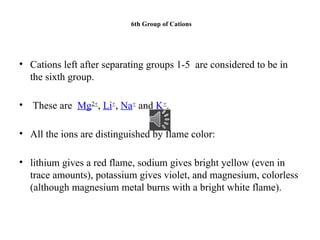
• Cations left after separating groups 1-5 are considered to be in
the sixth group.
• These are Mg2+
, Li+
, Na+
and K+
.
• All the ions are distinguished by flame color:
• lithium gives a red flame, sodium gives bright yellow (even in
trace amounts), potassium gives violet, and magnesium, colorless
(although magnesium metal burns with a bright white flame).
DETECTING ANIONS
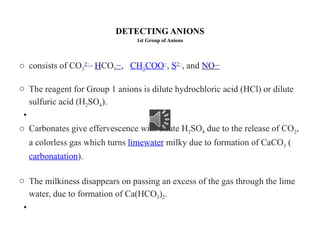
1st Group of Anions
o consists of CO3
2− ,
HCO3−, CH3COO−
, S2−
, and NO−
o The reagent for Group 1 anions is dilute hydrochloric acid (HCl) or dilute
sulfuric acid (H2SO4).
•
o Carbonates give effervescence with dilute H2SO4 due to the release of CO2,
a colorless gas which turns limewater milky due to formation of CaCO3 (
carbonatation).
o The milkiness disappears on passing an excess of the gas through the lime
water, due to formation of Ca(HCO3)2.
•
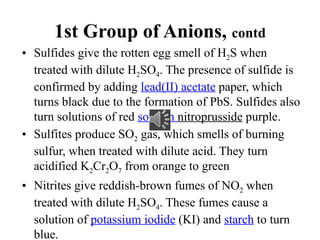
1st Group of Anions, contd
• Sulfides give the rotten egg smell of H2S when
treated with dilute H2SO4. The presence of sulfide is
confirmed by adding lead(II) acetate paper, which
turns black due to the formation of PbS. Sulfides also
turn solutions of red sodium nitroprusside purple.
• Sulfites produce SO2 gas, which smells of burning
sulfur, when treated with dilute acid. They turn
acidified K2Cr2O7 from orange to green
• Nitrites give reddish-brown fumes of NO2 when
treated with dilute H2SO4. These fumes cause a
solution of potassium iodide (KI) and starch to turn
blue.
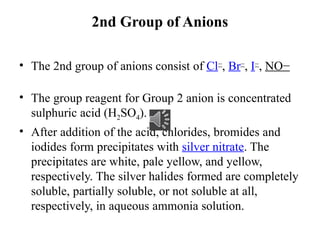
2nd Group of Anions
• The 2nd group of anions consist of Cl−
, Br−
, I−
, NO−
• The group reagent for Group 2 anion is concentrated
sulphuric acid (H2SO4).
• After addition of the acid, chlorides, bromides and
iodides form precipitates with silver nitrate. The
precipitates are white, pale yellow, and yellow,
respectively. The silver halides formed are completely
soluble, partially soluble, or not soluble at all,
respectively, in aqueous ammonia solution.
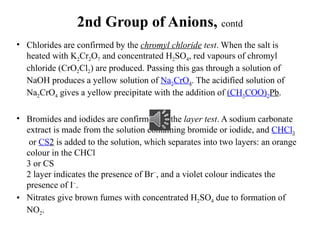
2nd Group of Anions, contd
• Chlorides are confirmed by the chromyl chloride test. When the salt is
heated with K2Cr2O7 and concentrated H2SO4, red vapours of chromyl
chloride (CrO2Cl2) are produced. Passing this gas through a solution of
NaOH produces a yellow solution of Na2CrO4. The acidified solution of
Na2CrO4 gives a yellow precipitate with the addition of (CH3COO)2Pb.
• Bromides and iodides are confirmed by the layer test. A sodium carbonate
extract is made from the solution containing bromide or iodide, and CHCl3
or CS2 is added to the solution, which separates into two layers: an orange
colour in the CHCl
3 or CS
2 layer indicates the presence of Br−
, and a violet colour indicates the
presence of I−
.
• Nitrates give brown fumes with concentrated H2SO4 due to formation of
NO2.
3rd Group of Anions
• The anions consist of SO4
2−
, Phosphate and borate anions;
• They react neither with concentrated nor diluted H2SO4.
• Sulfates give a white precipitate of BaSO4 with BaCl2 which is insoluble in
any acid or base.
• Phosphates give a yellow crystalline precipitate upon addition of
HNO3 and ammonium molybdate.
• Borates give a green flame characteristic of ethyl borate when ignited
with concentrated H2SO4 and ethanol.

AUDIO -CHM 102--MODULE 1 --QUALITATIVE ANALYSIS.pptx

  • 1.
    CHM 102 INTRODUCTORY CHEMISTRYII MODULE 1 INSTRUCTOR 1 DR. MRS L.M.DUROSINMI
  • 2.
  • 3.
    THEORY AND TECHNIQUESOF QUALITATIVE INORGANIC ANALYSIS Qualitative Inorganic Analysis: • A method of analytical chemistry which seeks to find elemental composition of inorganic compounds through various reagents. • Deals with careful detection of ions in an aqueous solution. • The solution is treated with various reagents to test for reactions characteristic of certain ions, which may cause color change, formation of ppt or other visible changes.
  • 4.
    PHYSICALAPPEARANCE OF INORGANIC SALTS. •Black ----- • MnO, MnO2, FeO, CuO, Co3O4, Ni2O3; Also sulfides of Ag+ , Cu+ , Cu2+ ,Ni2+ , Fe2+ , Co2+ , Pb2+ , Hg2+ , Bi3+ • Blue------- Hydrated Cu2+ salts • Red -------HgO, HgI2, Pb3O4 • Green ------Cr3+ , Ni2+ , hydrated Fe2+ salts
  • 5.
    PHYSICALAPPEARANCE OF INORGANIC SALTS,contd. • Light Pink ------Hydrated Mn2+ salts • Orange --- KO2, K2Cr2O7, Sb2S3, Ferrocyanide • Reddish Pink----- Hydrated Co2+ salts. • Yellow-------Chromates, AgBr, As2S3, AgI, PbI2, CdS • ----- CdO, Fe2O3, PbO2, CuCrO4
  • 6.
    DETECTING CATIONS • Cationsare usually classified into six groups. • Each group has a common reagent which can be used to separate them from the solution. • To obtain meaningful results, the separation is done in sequence.
  • 7.
    1st Group ofCations • Most important cations in 1st group are Ag+ , Hg2+ and Pb2+ . • The ions form insoluble chlorides. Thus, the group reagent to separate them is hydrochloric acid. 1–2 M. • Concentrated HCl must not be used, because it forms a soluble complex ion ([PbCl4]2− ) with Pb2+ . Consequently, the Pb2+ ion would go undetected. • The chlorides of these elements cannot be distinguished from each other by their colour - they are all white solid compounds. But PbCl2 is soluble in hot water, and can therefore be differentiated easily. Ammonia is used as a reagent to distinguish between the other two. While AgCl dissolves in ammonia (due to the formation of the complex ion [Ag(NH3)2]+ ), Hg2Cl2 gives a black precipitate.
  • 8.
    2nd Group ofCations • These consists of ions that form acid-insoluble sulfides. The Cations include: Cd2+ , Bi3+ , Cu2+ , As3+ , As5+ , Sb3+ , Sb5+ , Sn2+ , Sn4+ and Hg2+ . Pb2+. • The reagent used is any substance that gives S2− ions in such solutions; most commonly used are hydrogen sulfide (at 0.2-0.3 M) in the presence of dilute HCl. • CdS, is yellow. All the precipitates, except for HgS, are soluble in dilute nitric acid. HgS is soluble only in aqua regia, which can be used to separate it from the rest.
  • 9.
    2nd Group ofCations • The action of ammonia is also useful in differentiating the cations. CuS dissolves in ammonia forming an intense blue solution, whereas CdS dissolves forming a colourless solution. The sulfides of As3+ , As5+ , Sb3+ , Sb5+ , Sn2+ , Sn4+ are soluble in yellow ammonium sulfide, where they form polysulphide complexes. • • If it forms a yellow precipitate, then Cd2+ or Sn4+ is present; or if it forms a brown precipitate, then Sn2+ must be present; or if a red orange precipitate is formed, then Sb3+ is present.
  • 10.
    3rd Group ofCations • This group of cations includes ions that form hydroxides which are insoluble even at low concentrations. • Cations : Fe2+ , Fe3+ , Al3+ , and Cr3+ . • The group is determined by making a solution of the salt in water and adding ammonium chloride and ammonium hydroxide. Ammonium chloride is added to ensure low concentration of hydroxide ions.
  • 11.
    3rd Group ofCations, contd • Formation of a reddish-brown precipitate indicates Fe3+ ; • a gelatinous white precipitate indicates Al3+ ; and • a green precipitate indicates Cr3+ or Fe2+ . These two are distinguished by adding sodium hydroxide in excess to the green precipitate. If the precipitate dissolves, Cr3+ is indicated; otherwise, Fe2+ is present.
  • 12.
    4th Group ofCations • These include Zn2+ , Ni2+ , Co2+ , and Mn2+ . • Zinc salts are colourless, Manganese salts are faint pink or colourless, and Nickel and cobalt salts may be brightly coloured, often blue-green. • The precipitate, washed in water is reacted with dilute hydrochloric acid. This precipitates nickel salts, if any. The supernatant liquid is filtered and reacted with excess of NaOH. This precipitates any Manganese salts. Hydrogen sulphide is passed through the liquid. If a white pptcipitate forms, Zinc is present.
  • 13.
    5th Group ofCations • ions in the 5th group are Ba2+ , Ca2+ , and Sr2+ . • Ions in 5th analytical group of cations form carbonates that are insoluble in water. • The reagent used is (NH4)2CO3 with a neutral or slightly basic pH. • All the cations in the previous groups are separated beforehand, since many of them also form insoluble carbonates. • To distinguish between these ions, flame test colour s used. • : barium gives a yellow-green flame, • calcium gives brick red, and • strontium, crimson red.
  • 14.
    6th Group ofCations • Cations left after separating groups 1-5 are considered to be in the sixth group. • These are Mg2+ , Li+ , Na+ and K+ . • All the ions are distinguished by flame color: • lithium gives a red flame, sodium gives bright yellow (even in trace amounts), potassium gives violet, and magnesium, colorless (although magnesium metal burns with a bright white flame).
  • 15.
    DETECTING ANIONS 1st Groupof Anions o consists of CO3 2− , HCO3−, CH3COO− , S2− , and NO− o The reagent for Group 1 anions is dilute hydrochloric acid (HCl) or dilute sulfuric acid (H2SO4). • o Carbonates give effervescence with dilute H2SO4 due to the release of CO2, a colorless gas which turns limewater milky due to formation of CaCO3 ( carbonatation). o The milkiness disappears on passing an excess of the gas through the lime water, due to formation of Ca(HCO3)2. •
  • 16.
    1st Group ofAnions, contd • Sulfides give the rotten egg smell of H2S when treated with dilute H2SO4. The presence of sulfide is confirmed by adding lead(II) acetate paper, which turns black due to the formation of PbS. Sulfides also turn solutions of red sodium nitroprusside purple. • Sulfites produce SO2 gas, which smells of burning sulfur, when treated with dilute acid. They turn acidified K2Cr2O7 from orange to green • Nitrites give reddish-brown fumes of NO2 when treated with dilute H2SO4. These fumes cause a solution of potassium iodide (KI) and starch to turn blue.
  • 17.
    2nd Group ofAnions • The 2nd group of anions consist of Cl− , Br− , I− , NO− • The group reagent for Group 2 anion is concentrated sulphuric acid (H2SO4). • After addition of the acid, chlorides, bromides and iodides form precipitates with silver nitrate. The precipitates are white, pale yellow, and yellow, respectively. The silver halides formed are completely soluble, partially soluble, or not soluble at all, respectively, in aqueous ammonia solution.
  • 18.
    2nd Group ofAnions, contd • Chlorides are confirmed by the chromyl chloride test. When the salt is heated with K2Cr2O7 and concentrated H2SO4, red vapours of chromyl chloride (CrO2Cl2) are produced. Passing this gas through a solution of NaOH produces a yellow solution of Na2CrO4. The acidified solution of Na2CrO4 gives a yellow precipitate with the addition of (CH3COO)2Pb. • Bromides and iodides are confirmed by the layer test. A sodium carbonate extract is made from the solution containing bromide or iodide, and CHCl3 or CS2 is added to the solution, which separates into two layers: an orange colour in the CHCl 3 or CS 2 layer indicates the presence of Br− , and a violet colour indicates the presence of I− . • Nitrates give brown fumes with concentrated H2SO4 due to formation of NO2.
  • 19.
    3rd Group ofAnions • The anions consist of SO4 2− , Phosphate and borate anions; • They react neither with concentrated nor diluted H2SO4. • Sulfates give a white precipitate of BaSO4 with BaCl2 which is insoluble in any acid or base. • Phosphates give a yellow crystalline precipitate upon addition of HNO3 and ammonium molybdate. • Borates give a green flame characteristic of ethyl borate when ignited with concentrated H2SO4 and ethanol.