Bangabandhu Sheikh Mujibur Rahman Science and Technology
University
A Presentation on Cardiovascular Drug
Presented By
Md. Shimul Bhuia
Department of Pharmacy
Course Title: Medicinal Chemistry-II
Course Code: PHR303
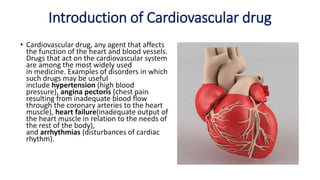
Introduction of Cardiovascular drug
• Cardiovascular drug, any agent that affects
the function of the heart and blood vessels.
Drugs that act on the cardiovascular system
are among the most widely used
in medicine. Examples of disorders in which
such drugs may be useful
include hypertension (high blood
pressure), angina pectoris (chest pain
resulting from inadequate blood flow
through the coronary arteries to the heart
muscle), heart failure(inadequate output of
the heart muscle in relation to the needs of
the rest of the body),
and arrhythmias (disturbances of cardiac
rhythm).
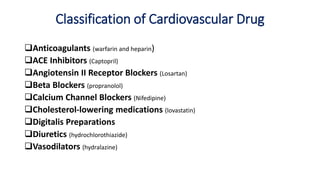
Classification of Cardiovascular Drug
Anticoagulants (warfarin and heparin)
ACE Inhibitors (Captopril)
Angiotensin II Receptor Blockers (Losartan)
Beta Blockers (propranolol)
Calcium Channel Blockers (Nifedipine)
Cholesterol-lowering medications (lovastatin)
Digitalis Preparations
Diuretics (hydrochlorothiazide)
Vasodilators (hydralazine)
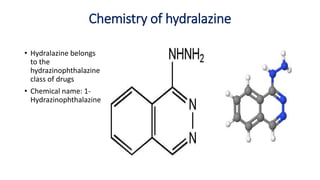
Chemistry of hydralazine
• Hydralazine belongs
to the
hydrazinophthalazine
class of drugs
• Chemical name: 1-
Hydrazinophthalazine
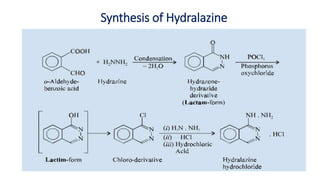
Synthesis of Hydralazine
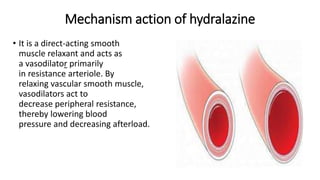
Mechanism action of hydralazine
• It is a direct-acting smooth
muscle relaxant and acts as
a vasodilator primarily
in resistance arteriole. By
relaxing vascular smooth muscle,
vasodilators act to
decrease peripheral resistance,
thereby lowering blood
pressure and decreasing afterload.
Therapeutic uses of hydralazine
• Used to treat severe essential hypertension
• often used to treat hypertension in pregnancy, with methyldopa
• To prevent heart attacks, stocks and kidney problems
• To treat heart failure (in combination with beta-blockers)
• Used to treat congestive heart failure (in combination with isosorbide
dinitrate)
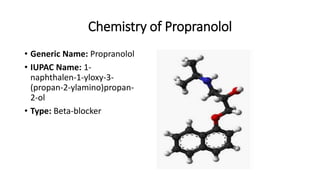
Chemistry of Propranolol
• Generic Name: Propranolol
• IUPAC Name: 1-
naphthalen-1-yloxy-3-
(propan-2-ylamino)propan-
2-ol
• Type: Beta-blocker
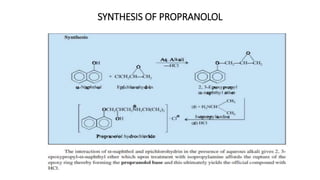
SYNTHESIS OF PROPRANOLOL
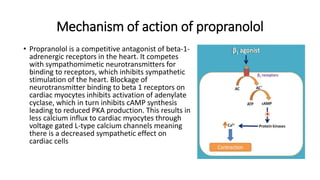
Mechanism of action of propranolol
• Propranolol is a competitive antagonist of beta-1-
adrenergic receptors in the heart. It competes
with sympathomimetic neurotransmitters for
binding to receptors, which inhibits sympathetic
stimulation of the heart. Blockage of
neurotransmitter binding to beta 1 receptors on
cardiac myocytes inhibits activation of adenylate
cyclase, which in turn inhibits cAMP synthesis
leading to reduced PKA production. This results in
less calcium influx to cardiac myocytes through
voltage gated L-type calcium channels meaning
there is a decreased sympathetic effect on
cardiac cells
THERAPEUTIC USES OF PROPRANOLOL
• Treat high blood pressure
• Control heart rhythm in atrial fibrillation
• Relieve angina
• Prevent migrations
• Reduce essential tremor
• Help with medical conditions involving thyroid and adrenal glands
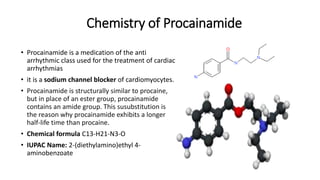
Chemistry of Procainamide
• Procainamide is a medication of the anti
arrhythmic class used for the treatment of cardiac
arrhythmias
• it is a sodium channel blocker of cardiomyocytes.
• Procainamide is structurally similar to procaine,
but in place of an ester group, procainamide
contains an amide group. This susubstitution is
the reason why procainamide exhibits a longer
half-life time than procaine.
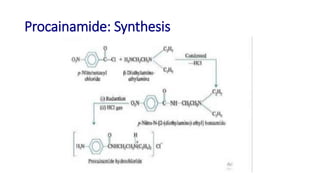
• Chemical formula C13-H21-N3-O
• IUPAC Name: 2-(diethylamino)ethyl 4-
aminobenzoate
Procainamide: Synthesis
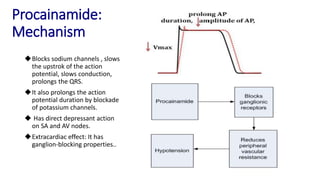
Procainamide:
Mechanism
Blocks sodium channels , slows
the upstrok of the action
potential, slows conduction,
prolongs the QRS.
It also prolongs the action
potential duration by blockade
of potassium channels.
 Has direct depressant action
on SA and AV nodes.
Extracardiac effect: It has
ganglion-blocking properties..
Procainamide: Therapeutic Uses
Used for treating ventricular arrhythmias;
Ventricular ectopy;
Tachycardia;
Supraventricular tachycardia;
Atrial fibrillation (abnormal heart rhythm
characterized by rapid and irregular beating);
SVT with aberrancy;
Pre-excitation syndromes.
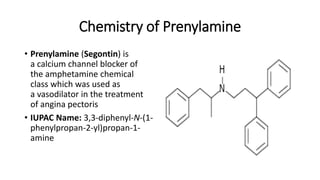
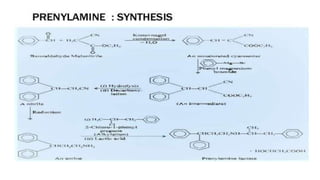
Chemistry of Prenylamine
• Prenylamine (Segontin) is
a calcium channel blocker of
the amphetamine chemical
class which was used as
a vasodilator in the treatment
of angina pectoris
• IUPAC Name: 3,3-diphenyl-N-(1-
phenylpropan-2-yl)propan-1-
amine
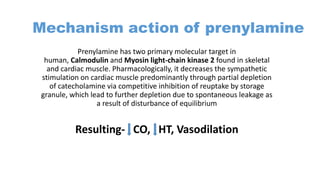
Mechanism action of prenylamine
Prenylamine has two primary molecular target in
human, Calmodulin and Myosin light-chain kinase 2 found in skeletal
and cardiac muscle. Pharmacologically, it decreases the sympathetic
stimulation on cardiac muscle predominantly through partial depletion
of catecholamine via competitive inhibition of reuptake by storage
granule, which lead to further depletion due to spontaneous leakage as
a result of disturbance of equilibrium
Resulting- CO, HT, Vasodilation
Thank you

Cardiovascular drug

  • 1.
    Bangabandhu Sheikh MujiburRahman Science and Technology University A Presentation on Cardiovascular Drug Presented By Md. Shimul Bhuia Department of Pharmacy Course Title: Medicinal Chemistry-II Course Code: PHR303
  • 2.
    Introduction of Cardiovasculardrug • Cardiovascular drug, any agent that affects the function of the heart and blood vessels. Drugs that act on the cardiovascular system are among the most widely used in medicine. Examples of disorders in which such drugs may be useful include hypertension (high blood pressure), angina pectoris (chest pain resulting from inadequate blood flow through the coronary arteries to the heart muscle), heart failure(inadequate output of the heart muscle in relation to the needs of the rest of the body), and arrhythmias (disturbances of cardiac rhythm).
  • 3.
    Classification of CardiovascularDrug Anticoagulants (warfarin and heparin) ACE Inhibitors (Captopril) Angiotensin II Receptor Blockers (Losartan) Beta Blockers (propranolol) Calcium Channel Blockers (Nifedipine) Cholesterol-lowering medications (lovastatin) Digitalis Preparations Diuretics (hydrochlorothiazide) Vasodilators (hydralazine)
  • 4.
    Chemistry of hydralazine •Hydralazine belongs to the hydrazinophthalazine class of drugs • Chemical name: 1- Hydrazinophthalazine
  • 5.
  • 6.
    Mechanism action ofhydralazine • It is a direct-acting smooth muscle relaxant and acts as a vasodilator primarily in resistance arteriole. By relaxing vascular smooth muscle, vasodilators act to decrease peripheral resistance, thereby lowering blood pressure and decreasing afterload.
  • 7.
    Therapeutic uses ofhydralazine • Used to treat severe essential hypertension • often used to treat hypertension in pregnancy, with methyldopa • To prevent heart attacks, stocks and kidney problems • To treat heart failure (in combination with beta-blockers) • Used to treat congestive heart failure (in combination with isosorbide dinitrate)
  • 8.
    Chemistry of Propranolol •Generic Name: Propranolol • IUPAC Name: 1- naphthalen-1-yloxy-3- (propan-2-ylamino)propan- 2-ol • Type: Beta-blocker
  • 9.
  • 10.
    Mechanism of actionof propranolol • Propranolol is a competitive antagonist of beta-1- adrenergic receptors in the heart. It competes with sympathomimetic neurotransmitters for binding to receptors, which inhibits sympathetic stimulation of the heart. Blockage of neurotransmitter binding to beta 1 receptors on cardiac myocytes inhibits activation of adenylate cyclase, which in turn inhibits cAMP synthesis leading to reduced PKA production. This results in less calcium influx to cardiac myocytes through voltage gated L-type calcium channels meaning there is a decreased sympathetic effect on cardiac cells
  • 11.
    THERAPEUTIC USES OFPROPRANOLOL • Treat high blood pressure • Control heart rhythm in atrial fibrillation • Relieve angina • Prevent migrations • Reduce essential tremor • Help with medical conditions involving thyroid and adrenal glands
  • 12.
    Chemistry of Procainamide •Procainamide is a medication of the anti arrhythmic class used for the treatment of cardiac arrhythmias • it is a sodium channel blocker of cardiomyocytes. • Procainamide is structurally similar to procaine, but in place of an ester group, procainamide contains an amide group. This susubstitution is the reason why procainamide exhibits a longer half-life time than procaine. • Chemical formula C13-H21-N3-O • IUPAC Name: 2-(diethylamino)ethyl 4- aminobenzoate
  • 13.
  • 14.
    Procainamide: Mechanism Blocks sodium channels, slows the upstrok of the action potential, slows conduction, prolongs the QRS. It also prolongs the action potential duration by blockade of potassium channels.  Has direct depressant action on SA and AV nodes. Extracardiac effect: It has ganglion-blocking properties..
  • 15.
    Procainamide: Therapeutic Uses Usedfor treating ventricular arrhythmias; Ventricular ectopy; Tachycardia; Supraventricular tachycardia; Atrial fibrillation (abnormal heart rhythm characterized by rapid and irregular beating); SVT with aberrancy; Pre-excitation syndromes.
  • 16.
    Chemistry of Prenylamine •Prenylamine (Segontin) is a calcium channel blocker of the amphetamine chemical class which was used as a vasodilator in the treatment of angina pectoris • IUPAC Name: 3,3-diphenyl-N-(1- phenylpropan-2-yl)propan-1- amine
  • 18.
    Mechanism action ofprenylamine Prenylamine has two primary molecular target in human, Calmodulin and Myosin light-chain kinase 2 found in skeletal and cardiac muscle. Pharmacologically, it decreases the sympathetic stimulation on cardiac muscle predominantly through partial depletion of catecholamine via competitive inhibition of reuptake by storage granule, which lead to further depletion due to spontaneous leakage as a result of disturbance of equilibrium Resulting- CO, HT, Vasodilation
  • 20.