Introduction to Terpenoid
Sub:Hemiterpenes
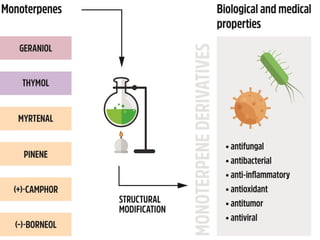
Monoterpenes
Sesquiterpenes
TEACHING TEAM
DEPARTMENT OF PHARMACY
PAKUAN UNIVERSITY
2.
Definiton and BasicStructure
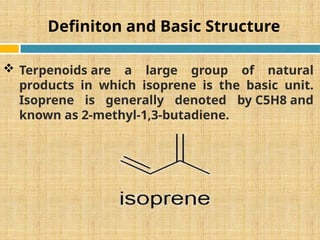
Terpenoids are a large group of natural
products in which isoprene is the basic unit.
Isoprene is generally denoted by C5H8 and
known as 2-methyl-1,3-butadiene.
3.
Definiton and BasicStructure
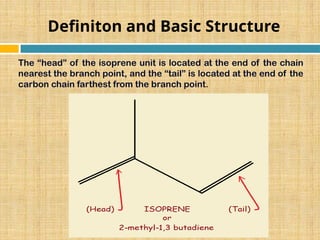
The “head” of the isoprene unit is located at the end of the chain
nearest the branch point, and the “tail” is located at the end of the
carbon chain farthest from the branch point.
4.
Head to TailRule
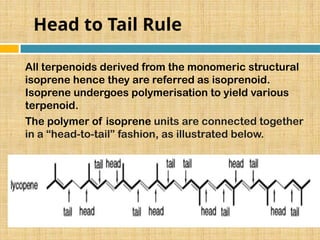
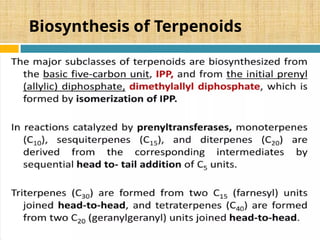
All terpenoids derived from the monomeric structural
isoprene hence they are referred as isoprenoid.
Isoprene undergoes polymerisation to yield various
terpenoid.
The polymer of isoprene units are connected together
in a “head-to-tail” fashion, as illustrated below.
5.
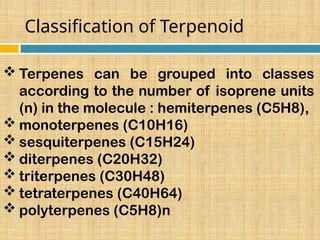
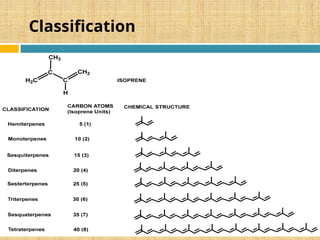
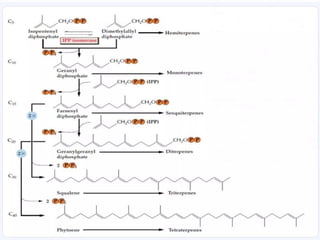
Classification of Terpenoid
Terpenes can be grouped into classes
according to the number of isoprene units
(n) in the molecule : hemiterpenes (C5H8),
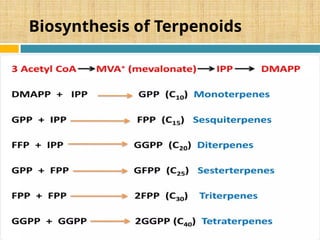
monoterpenes (C10H16)
sesquiterpenes (C15H24)
diterpenes (C20H32)
triterpenes (C30H48)
tetraterpenes (C40H64)
polyterpenes (C5H8)n
General Properties ofterpenoid
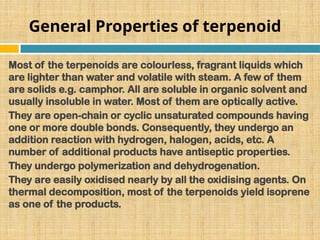
Most of the terpenoids are colourless, fragrant liquids which
are lighter than water and volatile with steam. A few of them
are solids e.g. camphor. All are soluble in organic solvent and
usually insoluble in water. Most of them are optically active.
They are open-chain or cyclic unsaturated compounds having
one or more double bonds. Consequently, they undergo an
addition reaction with hydrogen, halogen, acids, etc. A
number of additional products have antiseptic properties.
They undergo polymerization and dehydrogenation.
They are easily oxidised nearly by all the oxidising agents. On
thermal decomposition, most of the terpenoids yield isoprene
as one of the products.
12.
Hemiterpens
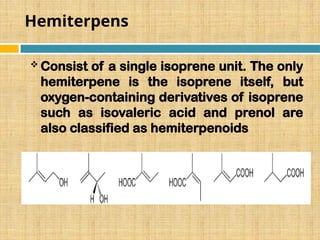
Consist ofa single isoprene unit. The only
hemiterpene is the isoprene itself, but
oxygen-containing derivatives of isoprene
such as isovaleric acid and prenol are
also classified as hemiterpenoids
13.
Hemiterpenes
The mostprominent hemiterpene, isoprene has
boiling point at 34°C)
Hemiterpenes is emitted from the leaves of many
trees including conifers, poplars, oaks, and
willows and herbs e.g., Hamamelis japonica).
Isoprene is an important starting material with a
wide range of industrial applications, including in
the synthetic chemistry industry for the synthesis
of pharmaceuticals, rubber, potential biofuels,
and flavors.
14.
Hemiterpenes
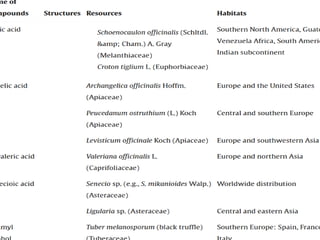
Other knownhemiterpenoids found in plants are
tiglic, angelic, isovaleric, and senecioic acids,
along with isoamyl alcohol.
Additionally, pubescenoside A, reported from Ilex
pubescens, displays antiplatelet aggregation
activity, while two chlorinated hemiterpenes
present in the leaves of Prinsepia utilis,
utililactone and epiutililactone, are reported to
exhibit immunosuppressive activities
16.
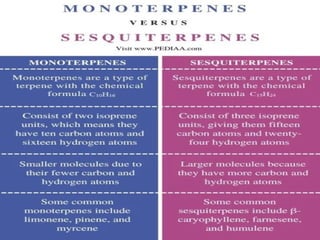
Monoterpen
Monoterpenes belongto a large and diverse
group of naturally occurring compounds which
are well-known as the constituents of the
essential oils and defensive oleoresins of the
aromatic plants.
The basic structure of monoterpenes, or
monoterpenoids, consists of two linked isoprene
units
17.
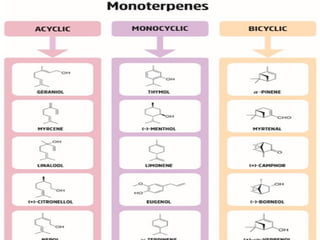
Monoterpenes
Can bedivided into three subgroups: acyclic,
monocyclic, and bicyclic. Within each group, the
monoterpenoids may be simple unsaturated
hydrocarbons or may have functional groups and
be alcohols, aldehydes, and ketones.
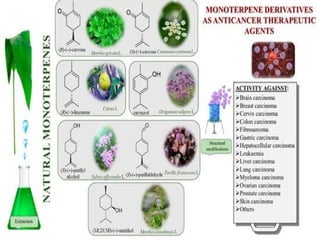
The numbers of monoterpenes have
antimicrobial, anti-inflammatory, antioxidant,
antipruritic, hypotensive, and analgesic
pharmacological properties.
20.
Monoterpenes
The mostcommon structural monoterpenes
are derivatives of geraniol, the main constituent of
geranium oil.
Menthol is the chief component of peppermint oil.
d-Limonene composes over 90% of lemon oil.
-Pinene is found in the oil of rosemary. Camphor is the
α
main component of sage oil.
Iridoids are interesting monoterpenes, which have been
isolated from ants.
Monoterpenes are used in flavor and perfume industries
because of their attractive odors, high volatilities, and low
molecular weights.78 Most of these are synthesized and
usually trigger symptoms in individuals with chemical
sensitivity. Several monoterpenes are found in turpentine.
22.
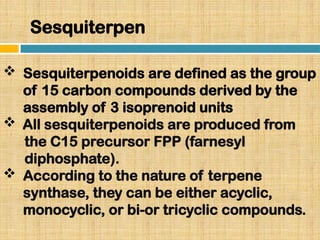
Sesquiterpen
Sesquiterpenoids aredefined as the group
of 15 carbon compounds derived by the
assembly of 3 isoprenoid units
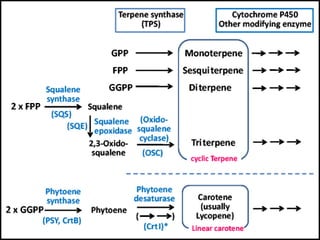
All sesquiterpenoids are produced from
the C15 precursor FPP (farnesyl
diphosphate).
According to the nature of terpene
synthase, they can be either acyclic,
monocyclic, or bi-or tricyclic compounds.
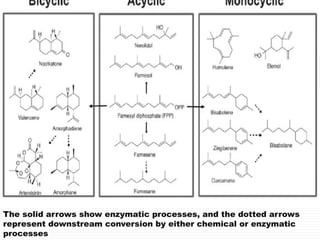
23.
The solid arrowsshow enzymatic processes, and the dotted arrows
represent downstream conversion by either chemical or enzymatic
processes
24.
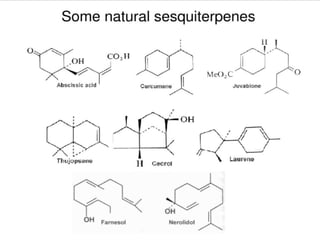
Sesquiterpen
Some well-knownsesquiterpenes include β-
Caryophyllene, α-Humulene, Patchouli Alcohol,
Germacrene D, and Santalol.
Sesquiterpenes are highly sought after in the
fragrance and perfumery industry due to their
complex and long-lasting scents.
Perfumers often use sesquiterpenes as key
components in creating rich and intricate
fragrances.
These compounds contribute to the deep and
profound notes that give perfumes their
character and longevity.
26.
Sesquiterpenes
Certain sesquiterpenes,including -
β
caryophyllene and -humulene, possess anti-
α
inflammatory effects that may help reduce
inflammation and alleviate symptoms of
inflammatory conditions.
Some sesquiterpenes have analgesic (pain-
relieving) properties which can be used topically
or in aromatherapy to ease discomfort.
Several sesquiterpenes have antioxidant activity
to help neutralize harmful free radicals in the
body. This potential antioxidative effect may
contribute to overall health and wellness.
27.
Sesquiterpenes
Certain sesquiterpenes,such as those
found in essential oils like oregano and
thyme, exhibit antimicrobial properties,
making them useful in natural remedies for
microbial infections.
Sesquiterpenes in essential oils like
frankincense and myrrh have their
potential skin benefits. They are often
present in skincare products to promote
skin health and rejuvenation.
29.
Extraction Methods
Monoand sesquiterpenes were widely known as
ESSENTIAL OIL obtained from raw material by
several extraction techniques such as water or
steam distillation, solvent extraction, expression
under pressure, microwave-assisted extraction,
supercritical fluid, or subcritical water
extractions
The best extraction method to use depends on
the ease of evaporating (volatility) and the
hydrophilicity or hydrophobicity (polarity) of the
desired components. The extraction method
chosen greatly affects the chemical composition
30.
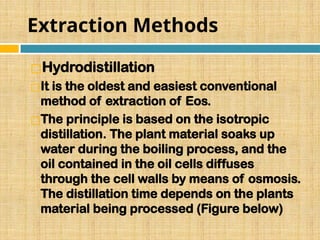
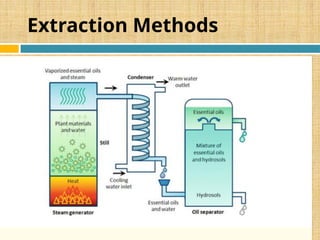
Extraction Methods
◻Hydrodistillation
◻It isthe oldest and easiest conventional
method of extraction of Eos.
◻The principle is based on the isotropic
distillation. The plant material soaks up
water during the boiling process, and the
oil contained in the oil cells diffuses
through the cell walls by means of osmosis.
The distillation time depends on the plants
material being processed (Figure below)
Extraction Methods
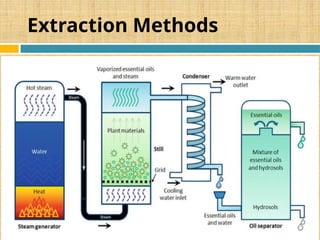
Steam distillation
Theprinciple of this technique is that the combined
vapor pressure equals the ambient pressure at
about 100°C so that the volatile components with
the boiling points ranging from 150 to 300°C can be
evaporated at a temperature close to that of water.
The steam distillation takes advantage of the
volatility of a compound to evaporate when heated
with steam and the hydrophobicity of the
compound to separate into an oil phase during the
condensation process (Figure below)
Extraction Methods
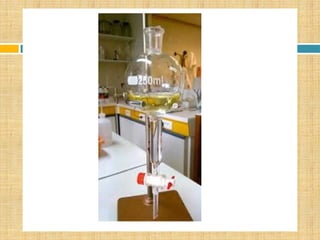
Also knownas liquid–liquid partitioning, its principle
is based on the solubility in an organic solvent non-
mixable to water. This technique is used on delicate
plants to produce higher amounts of EOs at a lower
cost. The method is limited by the compound
solubility in the specific solvent used, long extraction
time, relatively high solvent consumption and often
unsatisfactory reproducibility and purity (Figure 3) [
33].
Extraction Methods
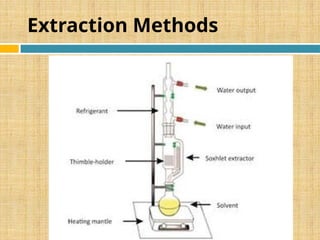
Soxhlet Extraction
It is a solid–liquid extraction used when the desired
compound has a limited solubility in a solvent and the
impurity is insoluble in that solvent.
The advantages of Soxhlet Extraction
Low solvent consumption for a larger amount of raw
material
Repeatedly brought into contact with fresh portions of
the solvent prevents the possibility of the solvent to
become saturated with extractable material and
enhances the removal of analyte from the matrix.
37.
Extraction Methods
Thetemperature of the system is close to the
boiling point of the solvent. This helps to
increase the extraction kinetic of the system.
Disadvantages of Soxhlet Extraction
It requires several hours or days to be
performed; moreover, the sample is diluted in a
large volume of solvent.
Due to heating, the thermal degradation and
volatilization of components have been
observed, and hydrolysis of esters to yield
alcohols and carboxylic acids can occur
Extraction Methods
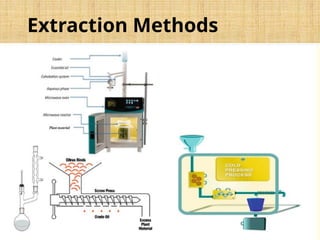
Cool pressingmethod
Also known as scarification method, this is one of
the best methods to extract EOs. The term cool
pressed theoretically means that the oil is expeller-
pressed at low temperature and pressure. This
process insures that the resulting oil is 100% pure
and retains all the properties of the plant. Here the
heat is reduced and minimized throughout the
batching of the raw material. EOs are then
separated from the material by
centrifugation (Figure below)
Extraction Methods
Supercritical fluidextraction
It is a process of separating one component (the extractant)
from another (the matrix) using supercritical fluids as the
extracting solvent. In practice, more than 90% of all
analytical supercritical fluid extraction (SFE) is performed
with carbon dioxide (CO2) as the most used fluid.
The CO2 is chosen for several reasons including the
following: relatively low critical pressure (74 bars) and
temperature (32°C), inertness, non-toxic, nonflammable, high
soluble, non-corrosive, safe, available in high purity at
relatively low cost, perfect conditions for thermosensitive
compounds extraction, selectivity for desired compounds,
and easy removal from the extract.
42.
Extraction Methods
At lowertemperatures, to avoid potential
damage of desired components of EOs,
supercritical CO2 extraction technique is
highly recommended [39, 40]. Extraction of
EOs by SFs, particularly with CO2, provides
products free of toxic waste, having a higher
quality (especially it reserves the thermal
instability of compounds) than EOs obtained
by conventional methods (Figure below).
43.
Extraction Methods
Flow diagramof SC-CO2 extraction [40]. (1) CO2 cylinder, (2) cooling bath, (3)
pump, (4) compressor, (5) oven, (6) extractor vessel, (7) monitor, (8) collecting
bottle, (9) flowmeter, and (10) CO2 outlet. V1–V6 flow control valves.
44.
SFE assisted bycold pressing (SFEAP)
SFEAP is a novel technique of extraction recently
developed by Johner et al. It integrated the cold-
pressed extraction and the SFE method. The solid
raw material is loaded inside the extraction vessel. A
cold pressing is provided by contracting an under
pressure piston with the raw material. SFEAP offer
best yield at extraction rate at 333 K and 40 MPa
with the best yield. Its advantages include gain of
extraction time and solvent consumption. This
technique has been used to extract EOs from
Foeniculum vulgare, Caryocar brasiliense, and Clove
(Figure 7)
45.
Extraction Methods
Schematic diagramof SFEAP apparatus [43]. (1) CO2 reservoir; (2) CO2 filter; (3) safety valve; (4) cooling bath;
(5) air-driven CO2 pump; (6) control (air flow); (7) air filter; (8) air compressor; (9) heating bath; (10) serpentine
tube; (11) extraction cell; (12) 1° extract collecting vessel; (13) 2° extract collecting vessel; (14) flowmeter (15)
flow totalizer, V2 back pressure; V5 micrometering valve; V(1,3,4) blocking valve; P(1,2,3,4) pressure gauge; I1
temperature indicator; I2 temperature indicator.




![Extraction Methods
Also known as liquid–liquid partitioning, its principle
is based on the solubility in an organic solvent non-
mixable to water. This technique is used on delicate
plants to produce higher amounts of EOs at a lower
cost. The method is limited by the compound
solubility in the specific solvent used, long extraction
time, relatively high solvent consumption and often
unsatisfactory reproducibility and purity (Figure 3) [
33].](https://image.slidesharecdn.com/introductiontoterpenoid-250505052538-0ff0aa7f/85/INTRODUCTION-and-identification-TO-TERPENOID-pptx-34-320.jpg)
![Extraction Methods
At lower temperatures, to avoid potential
damage of desired components of EOs,
supercritical CO2 extraction technique is
highly recommended [39, 40]. Extraction of
EOs by SFs, particularly with CO2, provides
products free of toxic waste, having a higher
quality (especially it reserves the thermal
instability of compounds) than EOs obtained
by conventional methods (Figure below).](https://image.slidesharecdn.com/introductiontoterpenoid-250505052538-0ff0aa7f/85/INTRODUCTION-and-identification-TO-TERPENOID-pptx-42-320.jpg)
![Extraction Methods
Flow diagram of SC-CO2 extraction [40]. (1) CO2 cylinder, (2) cooling bath, (3)
pump, (4) compressor, (5) oven, (6) extractor vessel, (7) monitor, (8) collecting
bottle, (9) flowmeter, and (10) CO2 outlet. V1–V6 flow control valves.](https://image.slidesharecdn.com/introductiontoterpenoid-250505052538-0ff0aa7f/85/INTRODUCTION-and-identification-TO-TERPENOID-pptx-43-320.jpg)
![Extraction Methods
Schematic diagram of SFEAP apparatus [43]. (1) CO2 reservoir; (2) CO2 filter; (3) safety valve; (4) cooling bath;
(5) air-driven CO2 pump; (6) control (air flow); (7) air filter; (8) air compressor; (9) heating bath; (10) serpentine
tube; (11) extraction cell; (12) 1° extract collecting vessel; (13) 2° extract collecting vessel; (14) flowmeter (15)
flow totalizer, V2 back pressure; V5 micrometering valve; V(1,3,4) blocking valve; P(1,2,3,4) pressure gauge; I1
temperature indicator; I2 temperature indicator.](https://image.slidesharecdn.com/introductiontoterpenoid-250505052538-0ff0aa7f/85/INTRODUCTION-and-identification-TO-TERPENOID-pptx-45-320.jpg)


![terpenoidpptt-171110062616 [Autosaved] final.pptx](https://cdn.slidesharecdn.com/ss_thumbnails/terpenoidpptt-171110062616autosavedfinal-240107160811-efeb487d-thumbnail.jpg?width=640&height=640&fit=bounds)


