 WHAT IS TERADATA ?
 HISTORY
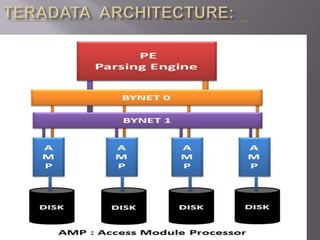
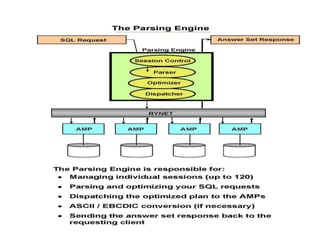
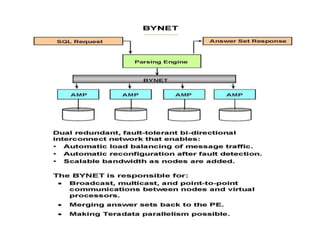
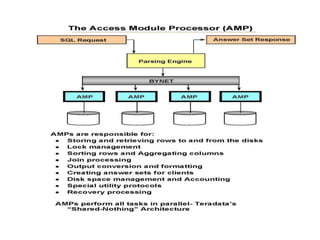
 TERADATA ARCHITECTURE
 VERSIONS
 APPLICATIONS
 ADVANTAGES
 DIS-ADVANTAGES
 CONCLUSION
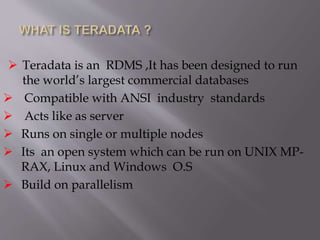
 Teradata is an RDMS ,It has been designed to run
the world’s largest commercial databases
 Compatible with ANSI industry standards
 Acts like as server
 Runs on single or multiple nodes
 Its an open system which can be run on UNIX MP-
RAX, Linux and Windows O.S
 Build on parallelism
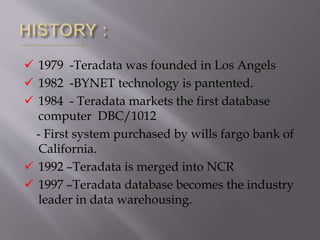
 1979 -Teradata was founded in Los Angels
 1982 -BYNET technology is pantented.
 1984 - Teradata markets the first database
computer DBC/1012
- First system purchased by wills fargo bank of
California.
 1992 –Teradata is merged into NCR
 1997 –Teradata database becomes the industry
leader in data warehousing.
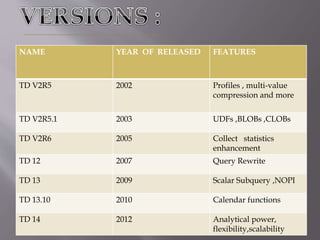
NAME YEAR OF RELEASED FEATURES
TD V2R5 2002 Profiles , multi-value
compression and more
TD V2R5.1 2003 UDFs ,BLOBs ,CLOBs
TD V2R6 2005 Collect statistics
enhancement
TD 12 2007 Query Rewrite
TD 13 2009 Scalar Subquery ,NOPI
TD 13.10 2010 Calendar functions
TD 14 2012 Analytical power,
flexibility,scalability
We can expand the database
capacity by just adding more
nodes to the existing database .
Teradata has extensive Paralell processing
capacity ,it can handle multiple requests
and many concurrent users .
Teradata database has shared nothing
architecture ,it has high fault tolerance
and data protection .
1. It is not suitable for small transactions OLTP
databases .
2. Teradata development and DBA resources are
harder to come by and more expensive .
3. Teradata is not as open as Oracle in Tech ,it is a
enterprise application , not as widely used as
Oracle or Sybase .
4. It’s not really a consideration for enterprise
software .
 Teradata makes it easy to create and drop tables .
 It can be easily create and maintain the tables in a
Data warehouse .
 Teradata provides to enhance your data
warehouse environment .
Tera data

Tera data

  • 2.
     WHAT ISTERADATA ?  HISTORY  TERADATA ARCHITECTURE  VERSIONS  APPLICATIONS  ADVANTAGES  DIS-ADVANTAGES  CONCLUSION
  • 3.
     Teradata isan RDMS ,It has been designed to run the world’s largest commercial databases  Compatible with ANSI industry standards  Acts like as server  Runs on single or multiple nodes  Its an open system which can be run on UNIX MP- RAX, Linux and Windows O.S  Build on parallelism
  • 4.
     1979 -Teradatawas founded in Los Angels  1982 -BYNET technology is pantented.  1984 - Teradata markets the first database computer DBC/1012 - First system purchased by wills fargo bank of California.  1992 –Teradata is merged into NCR  1997 –Teradata database becomes the industry leader in data warehousing.
  • 10.
    NAME YEAR OFRELEASED FEATURES TD V2R5 2002 Profiles , multi-value compression and more TD V2R5.1 2003 UDFs ,BLOBs ,CLOBs TD V2R6 2005 Collect statistics enhancement TD 12 2007 Query Rewrite TD 13 2009 Scalar Subquery ,NOPI TD 13.10 2010 Calendar functions TD 14 2012 Analytical power, flexibility,scalability
  • 13.
    We can expandthe database capacity by just adding more nodes to the existing database .
  • 14.
    Teradata has extensiveParalell processing capacity ,it can handle multiple requests and many concurrent users . Teradata database has shared nothing architecture ,it has high fault tolerance and data protection .
  • 15.
    1. It isnot suitable for small transactions OLTP databases . 2. Teradata development and DBA resources are harder to come by and more expensive . 3. Teradata is not as open as Oracle in Tech ,it is a enterprise application , not as widely used as Oracle or Sybase . 4. It’s not really a consideration for enterprise software .
  • 16.
     Teradata makesit easy to create and drop tables .  It can be easily create and maintain the tables in a Data warehouse .  Teradata provides to enhance your data warehouse environment .