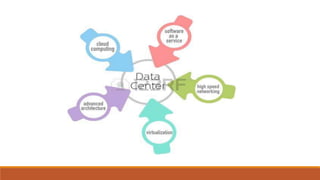
DataCenter
What is a Data Center?
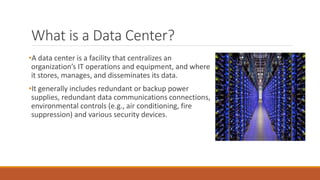
•A data center is a facility that centralizes an
organization’s IT operations and equipment, and where
it stores, manages, and disseminates its data.
•It generally includes redundant or backup power
supplies, redundant data communications connections,
environmental controls (e.g., air conditioning, fire
suppression) and various security devices.
Concerns for Data Centers
•Companies rely on their information systems to run their operations. If a system
becomes unavailable, company operations may be impaired or stopped
completely.
•Information security is also a concern, and for this reason a data center has to
offer a secure environment which minimizes the chances of a security breach.
•A data center must therefore keep high standards for assuring the integrity and
functionality of its hosted computer environment.
This is accomplished through redundancy of mechanical cooling and power
systems (including emergency backup power generators) serving the data center
along with fiber optic cables.
Telecommunications Industry Association's
Telecommunications Infrastructure Standard for Data
Centers
It specifies the minimum requirements for telecommunications infrastructure of
data centers and computer rooms including
• single tenant enterprise data centers and
• multi-tenant Internet hosting data centers.
The topology proposed in this document is intended to be applicable to any size
data center.
Telcordia GR-3160, NEBS Requirements for
Telecommunications Data Center Equipment and
Spaces
It provides guidelines for data center spaces within telecommunications network. They may be
applied to data center spaces housing data processing or Information Technology (IT)
equipment. The equipment may be used to:
•Operate and manage a carrier's telecommunication network
•Provide data center based applications directly to the carrier's customers
•Provide hosted applications for a third party to provide services to their customers
•Provide a combination of these and similar data center applications
Typical Projects within a Data Center
Standardization/consolidation: This project helps to reduce the number of hardware, software
platforms, tools and processes within a data center. Organizations replace aging data center
equipment with newer ones that provide increased capacity and performance.
Virtualize: There is a trend to use IT virtualization technologies to replace or consolidate multiple
data center equipment, such as servers. It helps lower energy consumption. This technology is
also used to create virtual desktops.
Automating: Data center automation involves automating tasks such as provisioning,
configuration, patching, release management and compliance.
Securing: In modern data centers, the security of data on virtual systems is integrated with
existing security of physical infrastructures. The security of a modern data center must take into
account physical security, network security, and data and user security.
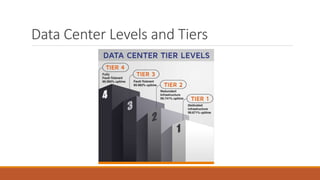
Data Center Levels and Tiers
Design Considerations
1. Design programming
Design programming, also known as architectural programming, is the process of researching
and making decisions to identify the scope of a design project.
Other than the architecture of the building itself there are three elements to design
programming for data centers:
1. Facility topology design (space planning)
2. Engineering infrastructure design (mechanical systems such as cooling and electrical systems
including power)
3. Technology infrastructure design (cable plant).
2. Modeling criteria
Modeling criteria are used to develop future-state scenarios for space, power, cooling, and costs in the data
center. The aim is to create a master plan with parameters such as number, size, location, topology, IT floor
system layouts, and power and cooling technology and configurations.
3. Design recommendations
Design recommendations/plans generally follow the modelling criteria phase. The optimal technology
infrastructure is identified and planning criteria are developed, such as critical power capacities etc.
4. Conceptual design
Conceptual floor layouts should be driven by IT performance requirements as well as lifecycle costs
associated with IT demand, energy efficiency, cost efficiency and availability.
5. Detailed design
Detailed design is undertaken once the appropriate conceptual design is determined. The detailed
design phase should include the detailed architectural, structural, mechanical and electrical
information and specification of the facility.
6. Mechanical engineering infrastructure designs
It involves maintaining the interior environment of a data center, such as heating, ventilation and air
conditioning (HVAC); humidification and dehumidification equipment; pressurization; and so
7. Electrical engineering infrastructure design
Its aspects may include utility service planning; distribution, switching and bypass from power sources;
uninterruptable power source (UPS) systems; and more.
Other considerations
8. Technology infrastructure design
9. Availability expectations
10. Site selection
11. Modularity and flexibility
12. Environmental control
13. Electrical power
14. Low-voltage cable routing
15. Fire protection
16. Security
Data center infrastructure management
Data Center Infrastructure Management(DCIM) is the integration of information
technology (IT) and facility management disciplines to centralize:
•monitoring,
•management and
•intelligent capacity planning of a data center's critical systems.
Achieved through the implementation of specialized software, hardware and
sensors, DCIM enables common, real-time monitoring and management platform
for all interdependent systems across IT and facility infrastructures.
Data Center Services:
Hardware installation and maintenance
Managed power distribution
Backup power systems
Data backup and archiving
Managed load balancing
Controlled Internet access
Managed e-mail and messaging
Managed user authentication and authorization
Diverse firewalls and anti-malware programs
Managed outsourcing
Managed business continuance.
Continuous, efficient technical support.
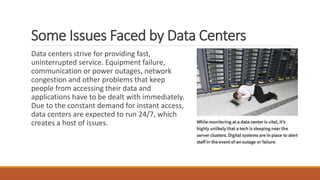
Some Issues Faced by Data Centers
Data centers strive for providing fast,
uninterrupted service. Equipment failure,
communication or power outages, network
congestion and other problems that keep
people from accessing their data and
applications have to be dealt with immediately.
Due to the constant demand for instant access,
data centers are expected to run 24/7, which
creates a host of issues.
Reference
a. https://en.wikipedia.org/wiki/Data_center
b. https://www.paloaltonetworks.com/cyberpedia/what-is-a-data-center
c. http://searchdatacenter.techtarget.com/definition/data-center-services
d. http://computer.howstuffworks.com/data-centers6.htm

Data center

  • 1.
  • 2.
    What is aData Center? •A data center is a facility that centralizes an organization’s IT operations and equipment, and where it stores, manages, and disseminates its data. •It generally includes redundant or backup power supplies, redundant data communications connections, environmental controls (e.g., air conditioning, fire suppression) and various security devices.
  • 3.
    Concerns for DataCenters •Companies rely on their information systems to run their operations. If a system becomes unavailable, company operations may be impaired or stopped completely. •Information security is also a concern, and for this reason a data center has to offer a secure environment which minimizes the chances of a security breach. •A data center must therefore keep high standards for assuring the integrity and functionality of its hosted computer environment. This is accomplished through redundancy of mechanical cooling and power systems (including emergency backup power generators) serving the data center along with fiber optic cables.
  • 4.
    Telecommunications Industry Association's TelecommunicationsInfrastructure Standard for Data Centers It specifies the minimum requirements for telecommunications infrastructure of data centers and computer rooms including • single tenant enterprise data centers and • multi-tenant Internet hosting data centers. The topology proposed in this document is intended to be applicable to any size data center.
  • 5.
    Telcordia GR-3160, NEBSRequirements for Telecommunications Data Center Equipment and Spaces It provides guidelines for data center spaces within telecommunications network. They may be applied to data center spaces housing data processing or Information Technology (IT) equipment. The equipment may be used to: •Operate and manage a carrier's telecommunication network •Provide data center based applications directly to the carrier's customers •Provide hosted applications for a third party to provide services to their customers •Provide a combination of these and similar data center applications
  • 6.
    Typical Projects withina Data Center Standardization/consolidation: This project helps to reduce the number of hardware, software platforms, tools and processes within a data center. Organizations replace aging data center equipment with newer ones that provide increased capacity and performance. Virtualize: There is a trend to use IT virtualization technologies to replace or consolidate multiple data center equipment, such as servers. It helps lower energy consumption. This technology is also used to create virtual desktops. Automating: Data center automation involves automating tasks such as provisioning, configuration, patching, release management and compliance. Securing: In modern data centers, the security of data on virtual systems is integrated with existing security of physical infrastructures. The security of a modern data center must take into account physical security, network security, and data and user security.
  • 8.
  • 9.
  • 10.
    1. Design programming Designprogramming, also known as architectural programming, is the process of researching and making decisions to identify the scope of a design project. Other than the architecture of the building itself there are three elements to design programming for data centers: 1. Facility topology design (space planning) 2. Engineering infrastructure design (mechanical systems such as cooling and electrical systems including power) 3. Technology infrastructure design (cable plant).
  • 11.
    2. Modeling criteria Modelingcriteria are used to develop future-state scenarios for space, power, cooling, and costs in the data center. The aim is to create a master plan with parameters such as number, size, location, topology, IT floor system layouts, and power and cooling technology and configurations. 3. Design recommendations Design recommendations/plans generally follow the modelling criteria phase. The optimal technology infrastructure is identified and planning criteria are developed, such as critical power capacities etc. 4. Conceptual design Conceptual floor layouts should be driven by IT performance requirements as well as lifecycle costs associated with IT demand, energy efficiency, cost efficiency and availability.
  • 12.
    5. Detailed design Detaileddesign is undertaken once the appropriate conceptual design is determined. The detailed design phase should include the detailed architectural, structural, mechanical and electrical information and specification of the facility. 6. Mechanical engineering infrastructure designs It involves maintaining the interior environment of a data center, such as heating, ventilation and air conditioning (HVAC); humidification and dehumidification equipment; pressurization; and so 7. Electrical engineering infrastructure design Its aspects may include utility service planning; distribution, switching and bypass from power sources; uninterruptable power source (UPS) systems; and more.
  • 13.
    Other considerations 8. Technologyinfrastructure design 9. Availability expectations 10. Site selection 11. Modularity and flexibility 12. Environmental control 13. Electrical power 14. Low-voltage cable routing 15. Fire protection 16. Security
  • 14.
    Data center infrastructuremanagement Data Center Infrastructure Management(DCIM) is the integration of information technology (IT) and facility management disciplines to centralize: •monitoring, •management and •intelligent capacity planning of a data center's critical systems. Achieved through the implementation of specialized software, hardware and sensors, DCIM enables common, real-time monitoring and management platform for all interdependent systems across IT and facility infrastructures.
  • 15.
    Data Center Services: Hardwareinstallation and maintenance Managed power distribution Backup power systems Data backup and archiving Managed load balancing Controlled Internet access
  • 16.
    Managed e-mail andmessaging Managed user authentication and authorization Diverse firewalls and anti-malware programs Managed outsourcing Managed business continuance. Continuous, efficient technical support.
  • 17.
    Some Issues Facedby Data Centers Data centers strive for providing fast, uninterrupted service. Equipment failure, communication or power outages, network congestion and other problems that keep people from accessing their data and applications have to be dealt with immediately. Due to the constant demand for instant access, data centers are expected to run 24/7, which creates a host of issues.
  • 18.
    Reference a. https://en.wikipedia.org/wiki/Data_center b. https://www.paloaltonetworks.com/cyberpedia/what-is-a-data-center c.http://searchdatacenter.techtarget.com/definition/data-center-services d. http://computer.howstuffworks.com/data-centers6.htm