BY: GROUP 6
A system which its basic specifications and design 
correctness arguments have ability to meet its time 
constraints. 
Correctness depend on both logical correctness 
and timeliness of its actions 
Deal with temporal data 
Response must be produced within a specific 
time , otherwise data become out dated
A database system 
which uses real time 
processing to handle 
workloads whose state is 
constantly changing. 
 Timely execution of 
transactions with the 
ACID properties. 
 Operations execute with 
predictable response , 
and with application-acceptable 
levels of 
logical and temporal 
consistency of data
Transaction :sequence of read and write 
operations. 
ACID properties: 
 Atomicity : transaction is done either completely 
or not at all 
 Consistency :transactions are executed in a given 
sequence 
 Isolation : actions of a transaction are not visible 
to any other transactions until it is committed 
 Durability : transactions of a database are 
permanent
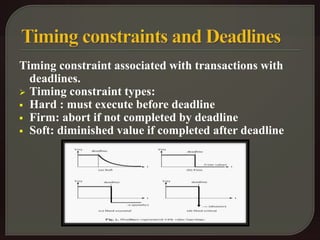
Timing constraint associated with transactions with 
deadlines. 
 Timing constraint types: 
 Hard : must execute before deadline 
 Firm: abort if not completed by deadline 
 Soft: diminished value if completed after deadline
 As the complexity of Real Time Systems going up , 
the amount of transactions to be handled by real 
time systems increases. 
 Conventional databases do not support timing and 
temporal requirements. 
 Design objectives of 
conventional databases 
are not appropriate 
for real time applications.
 Soft real time database systems 
These are databases used in non-critical real time systems 
where missed transactions only degrade system quality. 
E.g. databases in banking, stock market, and airline reservation 
systems 
 Hard real time database systems 
These are databases used in critical real-time systems used in 
places such as nuclear power plants. 
E.g. databases in early warning systems, Emergency alarm systems, 
MDARTS 
MDARTS stands for multiprocessor database architecture for real time systems. This is 
used mainly in control applications, such as controlling machine tools and robots etc
Has The ACID properties 
Has timing constraints 
 Timeliness is more important than correctness 
Queries to the database should have soft or hard deadlines 
Data returned must have both absolute consistency and relative 
consistency 
Deal with temporal data that become outdated after a certain 
time 
 Not all data are permanent but temporal, e.g., sensor data or stock 
prices 
Both real-time scheduling & database technologies can be applied 
to real-time data management
 Data items reflects the state of environment. 
Data from sensors. e.g. temperature, 
humidity, pressure etc 
Derived data. e.g. rate of reaction 
Input to actuators. e.g. amount of chemical 
Archival data. e.g. history of(interaction 
with) environment 
 Static data(as in conventional data bases)
 Real time databases have to deal with temporal 
data compared to static data as the case of 
traditional databases. 
 Unlike traditional databases , timing constraints 
are associated with the different operations carried 
out on real time databases. 
 Main objective of conventional databases is to 
provide fast “average” responce.But RTDBs focus 
on average transactions miss their deadlines(also 
the cost incurred for late transactions).
 More efficient way of 
handling large amount 
of data. 
 Specification of time 
constraints. 
 Improved overall 
timeliness. 
 Reduce development 
cost. 
 Avoid redundant data.
 Dealing with time 
constraints and violations. 
 Get the maximum benefit 
from results which generate 
from actions completed in 
time. 
 Minimize the damage which 
occurs from actions that 
delayed or not executed in 
time.
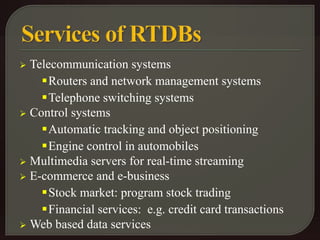
 Telecommunication systems 
Routers and network management systems 
Telephone switching systems 
 Control systems 
Automatic tracking and object positioning 
Engine control in automobiles 
 Multimedia servers for real-time streaming 
 E-commerce and e-business 
Stock market: program stock trading 
Financial services: e.g. credit card transactions 
 Web based data services
Presented by: 
Nipuna Hewamaddumage 
Thilina 
Dinushika Rathnayaka 
Nilshani Jayakodi 
Yana Yonitha

Real time databases

  • 1.
  • 2.
    A system whichits basic specifications and design correctness arguments have ability to meet its time constraints. Correctness depend on both logical correctness and timeliness of its actions Deal with temporal data Response must be produced within a specific time , otherwise data become out dated
  • 3.
    A database system which uses real time processing to handle workloads whose state is constantly changing.  Timely execution of transactions with the ACID properties.  Operations execute with predictable response , and with application-acceptable levels of logical and temporal consistency of data
  • 4.
    Transaction :sequence ofread and write operations. ACID properties:  Atomicity : transaction is done either completely or not at all  Consistency :transactions are executed in a given sequence  Isolation : actions of a transaction are not visible to any other transactions until it is committed  Durability : transactions of a database are permanent
  • 5.
    Timing constraint associatedwith transactions with deadlines.  Timing constraint types:  Hard : must execute before deadline  Firm: abort if not completed by deadline  Soft: diminished value if completed after deadline
  • 6.
     As thecomplexity of Real Time Systems going up , the amount of transactions to be handled by real time systems increases.  Conventional databases do not support timing and temporal requirements.  Design objectives of conventional databases are not appropriate for real time applications.
  • 7.
     Soft realtime database systems These are databases used in non-critical real time systems where missed transactions only degrade system quality. E.g. databases in banking, stock market, and airline reservation systems  Hard real time database systems These are databases used in critical real-time systems used in places such as nuclear power plants. E.g. databases in early warning systems, Emergency alarm systems, MDARTS MDARTS stands for multiprocessor database architecture for real time systems. This is used mainly in control applications, such as controlling machine tools and robots etc
  • 8.
    Has The ACIDproperties Has timing constraints  Timeliness is more important than correctness Queries to the database should have soft or hard deadlines Data returned must have both absolute consistency and relative consistency Deal with temporal data that become outdated after a certain time  Not all data are permanent but temporal, e.g., sensor data or stock prices Both real-time scheduling & database technologies can be applied to real-time data management
  • 9.
     Data itemsreflects the state of environment. Data from sensors. e.g. temperature, humidity, pressure etc Derived data. e.g. rate of reaction Input to actuators. e.g. amount of chemical Archival data. e.g. history of(interaction with) environment  Static data(as in conventional data bases)
  • 10.
     Real timedatabases have to deal with temporal data compared to static data as the case of traditional databases.  Unlike traditional databases , timing constraints are associated with the different operations carried out on real time databases.  Main objective of conventional databases is to provide fast “average” responce.But RTDBs focus on average transactions miss their deadlines(also the cost incurred for late transactions).
  • 11.
     More efficientway of handling large amount of data.  Specification of time constraints.  Improved overall timeliness.  Reduce development cost.  Avoid redundant data.
  • 12.
     Dealing withtime constraints and violations.  Get the maximum benefit from results which generate from actions completed in time.  Minimize the damage which occurs from actions that delayed or not executed in time.
  • 13.
     Telecommunication systems Routers and network management systems Telephone switching systems  Control systems Automatic tracking and object positioning Engine control in automobiles  Multimedia servers for real-time streaming  E-commerce and e-business Stock market: program stock trading Financial services: e.g. credit card transactions  Web based data services
  • 14.
    Presented by: NipunaHewamaddumage Thilina Dinushika Rathnayaka Nilshani Jayakodi Yana Yonitha