Netezza Vs Teradata
Topics


  Key Design Principles
  Key Technology Requirements
  Key Physical Architecture Principles
  Parameter for Comparison
  Evaluation Consideration
  Conclusion


                                          2
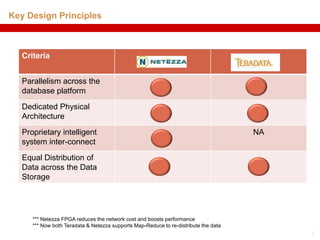
Key Design Principles


   Criteria


   Parallelism across the
   database platform
   Dedicated Physical
   Architecture
   Proprietary intelligent                                                            NA
   system inter-connect
   Equal Distribution of
   Data across the Data
   Storage


      *** Netezza FPGA reduces the network cost and boosts performance
      *** Now both Teradata & Netezza supports Map-Reduce to re-distribute the data
                                                                                           3
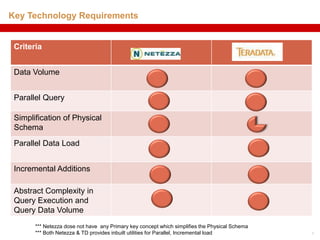
Key Technology Requirements


 Criteria


 Data Volume


 Parallel Query

 Simplification of Physical
 Schema
 Parallel Data Load


 Incremental Additions

 Abstract Complexity in
 Query Execution and
 Query Data Volume
       *** Netezza dose not have any Primary key concept which simplifies the Physical Schema
       *** Both Netezza & TD provides inbuilt utilities for Parallel, Incremental load          4
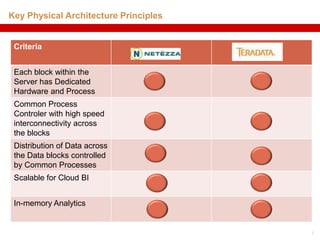
Key Physical Architecture Principles


 Criteria


 Each block within the
 Server has Dedicated
 Hardware and Process
 Common Process
 Controler with high speed
 interconnectivity across
 the blocks
 Distribution of Data across
 the Data blocks controlled
 by Common Processes
 Scalable for Cloud BI


 In-memory Analytics


                                       5
Parameter for Comparison


 Criteria
 Performance and Linear         More Scalable               Scalable
 Scalability
 Reliability and Availability   Mirror imaging and backup
                                SPU
 Data Movement Capacity         In Built Utility


 Maintenance Overhead           Less                        Medium

 Replacement Price              Less                        Medium

 Data Integration Tool          Depends on environment to   Depends on environment to
 Support (ETL, EAI, Web         be evaluated                be evaluated
 services)
 Real Time Integration          Proven                      Proven

 Data Architecture Support      Depends on environment to   Depends on environment to
 and Transaction Hub            be evaluated                be evaluated
 Capabilities
                                                                                        6
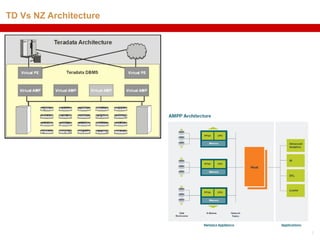
TD Vs NZ Architecture


                        7
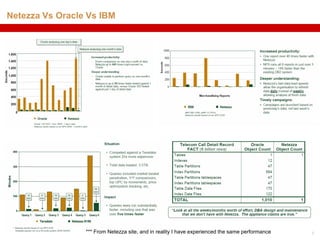
Netezza Vs Oracle Vs IBM


                 *** From Netezza site, and in reality I have experienced the same performance   8
Comparison


 Netezza adopted a 2 Tier Architecture within Hardware rather a Node based architecture with all
high level functions handled using SMP and Low level functions are handled using the SPUs. The
SMP host connects to hundred of MPP drives called Snippet Processing Units (SPUs)

 Netezza Database is designed to spread in a vertically integrated hardware matrix along with
horizontally integrated components.

 The Scalability is addressed by Netezza’s Asymmetric Massively Parallel Architecture (AMPP).
The AMPP uses modular component at two architectural levels. At the higher level the components
are rack mounted standard SMP units and at the lower level series of intelligent controllers and
redundant components that makes a small package easily manageable and extensible compared to
Teradata.

 The High degree of reliability is achieved in Netezza by full redundancy at every level of the 2
tiered AMPP Architecture.
 In Teradata the parsing engine decomposes the query passed and then executes in parallel on all
SMP Nodes. The parsing engine in a peer relationship to the execution engines all on the same SMP
architecture.

 In Netezza, the Intelligent Query Streaming Technology leverages the 2 dimension architecture.
The physical database level processing are moved at the hardware level . This allows processing
decomposition into many more processors than any other product. This increases the magnitude of
performance compared to Teradata or any other product.


                                                                                                     9
Comparison (Conn….)


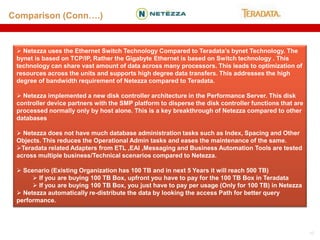
  Netezza uses the Ethernet Switch Technology Compared to Teradata’s bynet Technology. The
 bynet is based on TCP/IP, Rather the Gigabyte Ethernet is based on Switch technology . This
 technology can share vast amount of data across many processors. This leads to optimization of
 resources across the units and supports high degree data transfers. This addresses the high
 degree of bandwidth requirement of Netezza compared to Teradata.

  Netezza implemented a new disk controller architecture in the Performance Server. This disk
 controller device partners with the SMP platform to disperse the disk controller functions that are
 processed normally only by host alone. This is a key breakthrough of Netezza compared to other
 databases

  Netezza does not have much database administration tasks such as Index, Spacing and Other
 Objects. This reduces the Operational Admin tasks and eases the maintenance of the same.
 Teradata related Adapters from ETL ,EAI ,Messaging and Business Automation Tools are tested
 across multiple business/Technical scenarios compared to Netezza.

  Scenario (Existing Organization has 100 TB and in next 5 Years it will reach 500 TB)
       If you are buying 100 TB Box, upfront you have to pay for the 100 TB Box in Teradata
       If you are buying 100 TB Box, you just have to pay per usage (Only for 100 TB) in Netezza
  Netezza automatically re-distribute the data by looking the access Path for better query
 performance.


                                                                                                       10
Evaluation Consideration


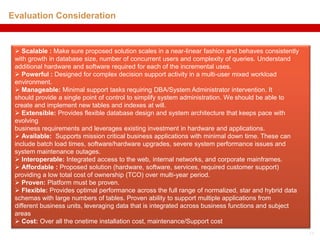
  Scalable : Make sure proposed solution scales in a near-linear fashion and behaves consistently
 with growth in database size, number of concurrent users and complexity of queries. Understand
 additional hardware and software required for each of the incremental uses.
  Powerful : Designed for complex decision support activity in a multi-user mixed workload
 environment.
  Manageable: Minimal support tasks requiring DBA/System Administrator intervention. It
 should provide a single point of control to simplify system administration. We should be able to
 create and implement new tables and indexes at will.
  Extensible: Provides flexible database design and system architecture that keeps pace with
 evolving
 business requirements and leverages existing investment in hardware and applications.
  Available: Supports mission critical business applications with minimal down time. These can
 include batch load times, software/hardware upgrades, severe system performance issues and
 system maintenance outages.
  Interoperable: Integrated access to the web, internal networks, and corporate mainframes.
  Affordable : Proposed solution (hardware, software, services, required customer support)
 providing a low total cost of ownership (TCO) over multi-year period.
  Proven: Platform must be proven.
  Flexible: Provides optimal performance across the full range of normalized, star and hybrid data
 schemas with large numbers of tables. Proven ability to support multiple applications from
 different business units, leveraging data that is integrated across business functions and subject
 areas
  Cost: Over all the onetime installation cost, maintenance/Support cost
                                                                                                      11
Conclusion


  Netezza Scores well from the subjective Architectural Analysis standpoint. Netezza
  addresses the VLDB (Very Large Data Base) needs of organization with New
  Generation Technologies rather trying to address the bottleneck in the existing
  technology in an cost effective manner.


                                                                                       12
Retailer DW/BI Platform


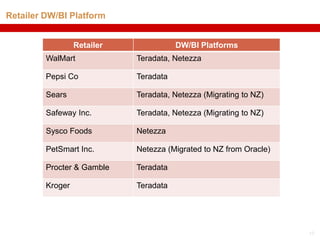
                  Retailer              DW/BI Platforms
         WalMart             Teradata, Netezza

         Pepsi Co            Teradata

         Sears               Teradata, Netezza (Migrating to NZ)

         Safeway Inc.        Teradata, Netezza (Migrating to NZ)

         Sysco Foods         Netezza

         PetSmart Inc.       Netezza (Migrated to NZ from Oracle)

         Procter & Gamble    Teradata

         Kroger              Teradata


                                                                    13
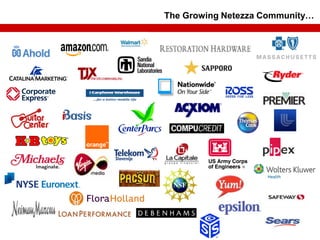
The Growing Netezza Community…
About Author


 Asis Mohanty has more than 11 Years of Industry experience on Data Warehousing and
 Business Intelligence field. Asis has wide Industry experience in Retail/CPG (Procter &
 Gamble, Pepsi Co., Sears Holdings, PertSmart Inc, Sysco Foods, Safeway Inc), Telecom
 (AT&T), Manufacturing (Apple Inc), Insurance & HealthCare (BlueCross Blue Shield, North
 Western Mutual, LTC Partners).

 He has executed various DW re-platform programs such as Oracle platform to Netezza
 platform, Teradata to Netezza, UDB to Teradata.

 He is a Certified Business Intelligence Professional from www.tdwi.org and Certified Data
 Management Professional from www.dama.org. He is also Netezza Silver Certified
 Professional, MicroStrategy Certified Professional.


                                                                                             15
Thank You!

Netezza vs teradata

  • 1.
  • 2.
    Topics  KeyDesign Principles  Key Technology Requirements  Key Physical Architecture Principles  Parameter for Comparison  Evaluation Consideration  Conclusion 2
  • 3.
    Key Design Principles Criteria Parallelism across the database platform Dedicated Physical Architecture Proprietary intelligent NA system inter-connect Equal Distribution of Data across the Data Storage *** Netezza FPGA reduces the network cost and boosts performance *** Now both Teradata & Netezza supports Map-Reduce to re-distribute the data 3
  • 4.
    Key Technology Requirements Criteria Data Volume Parallel Query Simplification of Physical Schema Parallel Data Load Incremental Additions Abstract Complexity in Query Execution and Query Data Volume *** Netezza dose not have any Primary key concept which simplifies the Physical Schema *** Both Netezza & TD provides inbuilt utilities for Parallel, Incremental load 4
  • 5.
    Key Physical ArchitecturePrinciples Criteria Each block within the Server has Dedicated Hardware and Process Common Process Controler with high speed interconnectivity across the blocks Distribution of Data across the Data blocks controlled by Common Processes Scalable for Cloud BI In-memory Analytics 5
  • 6.
    Parameter for Comparison Criteria Performance and Linear More Scalable Scalable Scalability Reliability and Availability Mirror imaging and backup SPU Data Movement Capacity In Built Utility Maintenance Overhead Less Medium Replacement Price Less Medium Data Integration Tool Depends on environment to Depends on environment to Support (ETL, EAI, Web be evaluated be evaluated services) Real Time Integration Proven Proven Data Architecture Support Depends on environment to Depends on environment to and Transaction Hub be evaluated be evaluated Capabilities 6
  • 7.
    TD Vs NZArchitecture 7
  • 8.
    Netezza Vs OracleVs IBM *** From Netezza site, and in reality I have experienced the same performance 8
  • 9.
    Comparison  Netezza adopteda 2 Tier Architecture within Hardware rather a Node based architecture with all high level functions handled using SMP and Low level functions are handled using the SPUs. The SMP host connects to hundred of MPP drives called Snippet Processing Units (SPUs)  Netezza Database is designed to spread in a vertically integrated hardware matrix along with horizontally integrated components.  The Scalability is addressed by Netezza’s Asymmetric Massively Parallel Architecture (AMPP). The AMPP uses modular component at two architectural levels. At the higher level the components are rack mounted standard SMP units and at the lower level series of intelligent controllers and redundant components that makes a small package easily manageable and extensible compared to Teradata.  The High degree of reliability is achieved in Netezza by full redundancy at every level of the 2 tiered AMPP Architecture.  In Teradata the parsing engine decomposes the query passed and then executes in parallel on all SMP Nodes. The parsing engine in a peer relationship to the execution engines all on the same SMP architecture.  In Netezza, the Intelligent Query Streaming Technology leverages the 2 dimension architecture. The physical database level processing are moved at the hardware level . This allows processing decomposition into many more processors than any other product. This increases the magnitude of performance compared to Teradata or any other product. 9
  • 10.
    Comparison (Conn….) Netezza uses the Ethernet Switch Technology Compared to Teradata’s bynet Technology. The bynet is based on TCP/IP, Rather the Gigabyte Ethernet is based on Switch technology . This technology can share vast amount of data across many processors. This leads to optimization of resources across the units and supports high degree data transfers. This addresses the high degree of bandwidth requirement of Netezza compared to Teradata.  Netezza implemented a new disk controller architecture in the Performance Server. This disk controller device partners with the SMP platform to disperse the disk controller functions that are processed normally only by host alone. This is a key breakthrough of Netezza compared to other databases  Netezza does not have much database administration tasks such as Index, Spacing and Other Objects. This reduces the Operational Admin tasks and eases the maintenance of the same. Teradata related Adapters from ETL ,EAI ,Messaging and Business Automation Tools are tested across multiple business/Technical scenarios compared to Netezza.  Scenario (Existing Organization has 100 TB and in next 5 Years it will reach 500 TB)  If you are buying 100 TB Box, upfront you have to pay for the 100 TB Box in Teradata  If you are buying 100 TB Box, you just have to pay per usage (Only for 100 TB) in Netezza  Netezza automatically re-distribute the data by looking the access Path for better query performance. 10
  • 11.
    Evaluation Consideration Scalable : Make sure proposed solution scales in a near-linear fashion and behaves consistently with growth in database size, number of concurrent users and complexity of queries. Understand additional hardware and software required for each of the incremental uses.  Powerful : Designed for complex decision support activity in a multi-user mixed workload environment.  Manageable: Minimal support tasks requiring DBA/System Administrator intervention. It should provide a single point of control to simplify system administration. We should be able to create and implement new tables and indexes at will.  Extensible: Provides flexible database design and system architecture that keeps pace with evolving business requirements and leverages existing investment in hardware and applications.  Available: Supports mission critical business applications with minimal down time. These can include batch load times, software/hardware upgrades, severe system performance issues and system maintenance outages.  Interoperable: Integrated access to the web, internal networks, and corporate mainframes.  Affordable : Proposed solution (hardware, software, services, required customer support) providing a low total cost of ownership (TCO) over multi-year period.  Proven: Platform must be proven.  Flexible: Provides optimal performance across the full range of normalized, star and hybrid data schemas with large numbers of tables. Proven ability to support multiple applications from different business units, leveraging data that is integrated across business functions and subject areas  Cost: Over all the onetime installation cost, maintenance/Support cost 11
  • 12.
    Conclusion NetezzaScores well from the subjective Architectural Analysis standpoint. Netezza addresses the VLDB (Very Large Data Base) needs of organization with New Generation Technologies rather trying to address the bottleneck in the existing technology in an cost effective manner. 12
  • 13.
    Retailer DW/BI Platform Retailer DW/BI Platforms WalMart Teradata, Netezza Pepsi Co Teradata Sears Teradata, Netezza (Migrating to NZ) Safeway Inc. Teradata, Netezza (Migrating to NZ) Sysco Foods Netezza PetSmart Inc. Netezza (Migrated to NZ from Oracle) Procter & Gamble Teradata Kroger Teradata 13
  • 14.
    The Growing NetezzaCommunity…
  • 15.
    About Author AsisMohanty has more than 11 Years of Industry experience on Data Warehousing and Business Intelligence field. Asis has wide Industry experience in Retail/CPG (Procter & Gamble, Pepsi Co., Sears Holdings, PertSmart Inc, Sysco Foods, Safeway Inc), Telecom (AT&T), Manufacturing (Apple Inc), Insurance & HealthCare (BlueCross Blue Shield, North Western Mutual, LTC Partners). He has executed various DW re-platform programs such as Oracle platform to Netezza platform, Teradata to Netezza, UDB to Teradata. He is a Certified Business Intelligence Professional from www.tdwi.org and Certified Data Management Professional from www.dama.org. He is also Netezza Silver Certified Professional, MicroStrategy Certified Professional. 15
  • 16.