SEMINAR
CONTENT
 Introduction
 What is ANGULARJS ?
 Features
 AngularJS Architecture
 Components
 Advantages and Dis-advantages
 Website and apps with ANGULARJS
Introduction
• AngularJS extends HTML with new attributes.
• AngularJS is perfect for Single Page Applications (SPAs).
• AngularJS is easy to develop the website and apps.
History :-
• Miško Hevery and Adam Abrons, a Google employee, started to work with
AngularJS in 2009.
• The idea turned out very well, and the project is now officially supported by
Google.
• AngularJS version 1.0 was released in Sunday, June 17, 2012.
• Now a days using AngularJS version is 1.6.5 was released in Tuesday, July 18,
2017.
What is ANGULARJS ?
• AngularJS is a very powerful JavaScript Framework.
• AngularJS is used to develop web based applications.
• AngularJS to develop web apps , you should have a basic understanding of:
1.HTML
2.CSS
3.JavaScript
• AngularJS is used in Single Page Application (SPA) projects.
• AngularJS extends HTML DOM with additional attributes and makes it more
responsive to user actions.
• AngularJS is open source, completely free, and used by thousands of
developers around the world.
• AngularJS is licensed under the Apache license version 2.0.
Single Page Applications (SPA) :-
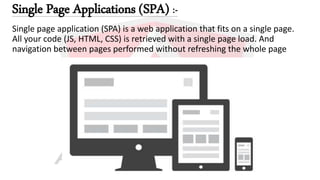
Single page application (SPA) is a web application that fits on a single page.
All your code (JS, HTML, CSS) is retrieved with a single page load. And
navigation between pages performed without refreshing the whole page
(HTML Document Object Model) HTML DOM :-
• Directives can be used to bind application data to attributes of HTML
DOM Elements.
• ng is the core module and stands for AngularJS.
Sr.No. Name Description
1 ng-disabled disables a given control.
2 ng-show shows a given control.
3 ng-hide hides a given control.
4 ng-click
represents a AngularJS
click event.
Features :-
• AngularJS is a powerful JavaScript based development framework to create RICH
Internet Application(RIA).
• AngularJS provides developers options to write client side application (using
JavaScript) in a clean MVC(Model View Controller) way.
• Application written in AngularJS is cross-browser compliant. AngularJS
automatically handles JavaScript code suitable for each browser.
• AngularJS is open source, completely free, and used by thousands of developers
around the world. It is licensed under the Apache License version 2.0.
• Overall, AngularJS is a framework to build large scale and high performance web
application while keeping them as easy-to-maintain.
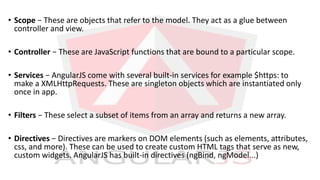
AngularJS Architecture:-
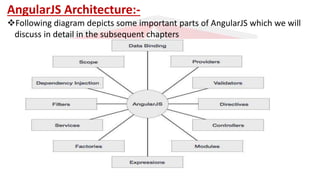
Following diagram depicts some important parts of AngularJS which we will
discuss in detail in the subsequent chapters
• Scope − These are objects that refer to the model. They act as a glue between
controller and view.
• Controller − These are JavaScript functions that are bound to a particular scope.
• Services − AngularJS come with several built-in services for example $https: to
make a XMLHttpRequests. These are singleton objects which are instantiated only
once in app.
• Filters − These select a subset of items from an array and returns a new array.
• Directives − Directives are markers on DOM elements (such as elements, attributes,
css, and more). These can be used to create custom HTML tags that serve as new,
custom widgets. AngularJS has built-in directives (ngBind, ngModel...)
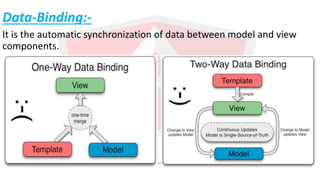
Data-Binding:-
It is the automatic synchronization of data between model and view
components.
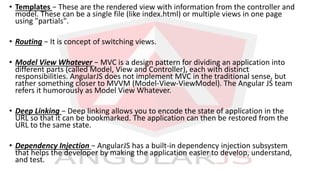
• Templates − These are the rendered view with information from the controller and
model. These can be a single file (like index.html) or multiple views in one page
using "partials".
• Routing − It is concept of switching views.
• Model View Whatever − MVC is a design pattern for dividing an application into
different parts (called Model, View and Controller), each with distinct
responsibilities. AngularJS does not implement MVC in the traditional sense, but
rather something closer to MVVM (Model-View-ViewModel). The Angular JS team
refers it humorously as Model View Whatever.
• Deep Linking − Deep linking allows you to encode the state of application in the
URL so that it can be bookmarked. The application can then be restored from the
URL to the same state.
• Dependency Injection − AngularJS has a built-in dependency injection subsystem
that helps the developer by making the application easier to develop, understand,
and test.
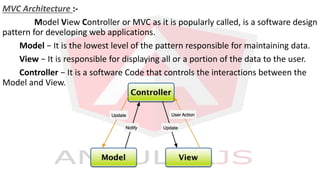
MVC Architecture :-
Model View Controller or MVC as it is popularly called, is a software design
pattern for developing web applications.
Model − It is the lowest level of the pattern responsible for maintaining data.
View − It is responsible for displaying all or a portion of the data to the user.
Controller − It is a software Code that controls the interactions between the
Model and View.
AngularJS Components :-
The AngularJS framework can be divided into following three major parts −
• ng-app − This directive defines and links an AngularJS application to HTML.
• ng-model − This directive binds the values of AngularJS application data to HTML
input controls.
• ng-bind − This directive binds the AngularJS Application data to HTML tags.
Advantages :-
• AngularJS provides capability to create Single Page Application in a very clean and
maintainable way.
• AngularJS provides data binding capability to HTML thus giving user a rich and
responsive experience
• AngularJS code is unit testable.
• AngularJS uses dependency injection and make use of separation of concerns.
• AngularJS provides reusable components.
• With AngularJS, developer write less code and get more functionality.
• In AngularJS, views are pure html pages, and controllers written in JavaScript do
the business processing.
• On top of everything, AngularJS applications can run on all major browsers and
smart phones including Android and iOS based phones/tablets.
Dis-advantages:-
Though AngularJS comes with lots of plus points but same time we
should consider the following points −
• Not Secure − Being JavaScript only framework, application written in AngularJS
are not safe. Server side authentication and authorization is must to keep an
application secure.
• Not degradable − If your application user disables JavaScript then user will just
see the basic page and nothing more.
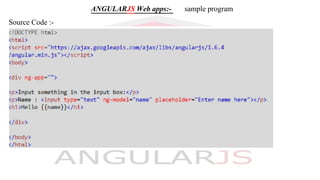
ANGULARJS Web apps:- sample program
Source Code :-
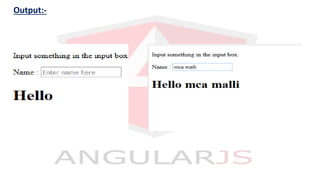
Output:-
websites and apps built with AngularJS :-
Youtube.com
Weather.com
Dream11.com, Gmail.com, etc
YOUTUBE.COM
Website view:- App view:-
Weather.com
Website view:- App view:-
Dream11.com
Website view:- App view:-
Conclusion
• AngularJS is a complete framework for client side applications.
- Based on the standard MVC design pattern.
• AngularJS is used in Single Page Application (SPA) projects.
- Source code can be used for both web apps and
.apk files.
• Two way data binding makes it easy to build data entry forms.
• Dependency injection makes it easy to separate modules.
• Build with testing in mind.
TH NK YOU

Anjular js

  • 1.
  • 2.
    CONTENT  Introduction  Whatis ANGULARJS ?  Features  AngularJS Architecture  Components  Advantages and Dis-advantages  Website and apps with ANGULARJS
  • 3.
    Introduction • AngularJS extendsHTML with new attributes. • AngularJS is perfect for Single Page Applications (SPAs). • AngularJS is easy to develop the website and apps.
  • 4.
    History :- • MiškoHevery and Adam Abrons, a Google employee, started to work with AngularJS in 2009. • The idea turned out very well, and the project is now officially supported by Google. • AngularJS version 1.0 was released in Sunday, June 17, 2012. • Now a days using AngularJS version is 1.6.5 was released in Tuesday, July 18, 2017.
  • 5.
  • 6.
    • AngularJS isa very powerful JavaScript Framework. • AngularJS is used to develop web based applications. • AngularJS to develop web apps , you should have a basic understanding of: 1.HTML 2.CSS 3.JavaScript • AngularJS is used in Single Page Application (SPA) projects. • AngularJS extends HTML DOM with additional attributes and makes it more responsive to user actions. • AngularJS is open source, completely free, and used by thousands of developers around the world. • AngularJS is licensed under the Apache license version 2.0.
  • 7.
    Single Page Applications(SPA) :- Single page application (SPA) is a web application that fits on a single page. All your code (JS, HTML, CSS) is retrieved with a single page load. And navigation between pages performed without refreshing the whole page
  • 8.
    (HTML Document ObjectModel) HTML DOM :- • Directives can be used to bind application data to attributes of HTML DOM Elements. • ng is the core module and stands for AngularJS. Sr.No. Name Description 1 ng-disabled disables a given control. 2 ng-show shows a given control. 3 ng-hide hides a given control. 4 ng-click represents a AngularJS click event.
  • 9.
    Features :- • AngularJSis a powerful JavaScript based development framework to create RICH Internet Application(RIA). • AngularJS provides developers options to write client side application (using JavaScript) in a clean MVC(Model View Controller) way. • Application written in AngularJS is cross-browser compliant. AngularJS automatically handles JavaScript code suitable for each browser. • AngularJS is open source, completely free, and used by thousands of developers around the world. It is licensed under the Apache License version 2.0. • Overall, AngularJS is a framework to build large scale and high performance web application while keeping them as easy-to-maintain.
  • 10.
    AngularJS Architecture:- Following diagramdepicts some important parts of AngularJS which we will discuss in detail in the subsequent chapters
  • 11.
    • Scope −These are objects that refer to the model. They act as a glue between controller and view. • Controller − These are JavaScript functions that are bound to a particular scope. • Services − AngularJS come with several built-in services for example $https: to make a XMLHttpRequests. These are singleton objects which are instantiated only once in app. • Filters − These select a subset of items from an array and returns a new array. • Directives − Directives are markers on DOM elements (such as elements, attributes, css, and more). These can be used to create custom HTML tags that serve as new, custom widgets. AngularJS has built-in directives (ngBind, ngModel...)
  • 12.
    Data-Binding:- It is theautomatic synchronization of data between model and view components.
  • 13.
    • Templates −These are the rendered view with information from the controller and model. These can be a single file (like index.html) or multiple views in one page using "partials". • Routing − It is concept of switching views. • Model View Whatever − MVC is a design pattern for dividing an application into different parts (called Model, View and Controller), each with distinct responsibilities. AngularJS does not implement MVC in the traditional sense, but rather something closer to MVVM (Model-View-ViewModel). The Angular JS team refers it humorously as Model View Whatever. • Deep Linking − Deep linking allows you to encode the state of application in the URL so that it can be bookmarked. The application can then be restored from the URL to the same state. • Dependency Injection − AngularJS has a built-in dependency injection subsystem that helps the developer by making the application easier to develop, understand, and test.
  • 14.
    MVC Architecture :- ModelView Controller or MVC as it is popularly called, is a software design pattern for developing web applications. Model − It is the lowest level of the pattern responsible for maintaining data. View − It is responsible for displaying all or a portion of the data to the user. Controller − It is a software Code that controls the interactions between the Model and View.
  • 15.
    AngularJS Components :- TheAngularJS framework can be divided into following three major parts − • ng-app − This directive defines and links an AngularJS application to HTML. • ng-model − This directive binds the values of AngularJS application data to HTML input controls. • ng-bind − This directive binds the AngularJS Application data to HTML tags.
  • 16.
    Advantages :- • AngularJSprovides capability to create Single Page Application in a very clean and maintainable way. • AngularJS provides data binding capability to HTML thus giving user a rich and responsive experience • AngularJS code is unit testable. • AngularJS uses dependency injection and make use of separation of concerns. • AngularJS provides reusable components. • With AngularJS, developer write less code and get more functionality. • In AngularJS, views are pure html pages, and controllers written in JavaScript do the business processing. • On top of everything, AngularJS applications can run on all major browsers and smart phones including Android and iOS based phones/tablets.
  • 17.
    Dis-advantages:- Though AngularJS comeswith lots of plus points but same time we should consider the following points − • Not Secure − Being JavaScript only framework, application written in AngularJS are not safe. Server side authentication and authorization is must to keep an application secure. • Not degradable − If your application user disables JavaScript then user will just see the basic page and nothing more.
  • 18.
    ANGULARJS Web apps:-sample program Source Code :-
  • 19.
  • 20.
    websites and appsbuilt with AngularJS :- Youtube.com Weather.com Dream11.com, Gmail.com, etc
  • 21.
  • 22.
  • 23.
  • 24.
    Conclusion • AngularJS isa complete framework for client side applications. - Based on the standard MVC design pattern. • AngularJS is used in Single Page Application (SPA) projects. - Source code can be used for both web apps and .apk files. • Two way data binding makes it easy to build data entry forms. • Dependency injection makes it easy to separate modules. • Build with testing in mind.
  • 25.