TequilaTequila
• National drink of Maxico.
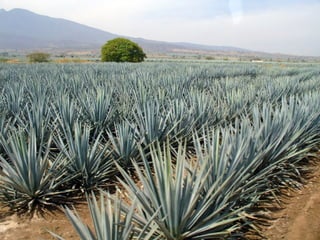
• Tequila is made from the blue agave plant,
which is a member of the lily family.
• There are more than 400 agave species called
maguey is often confused with cacti.
• Agave plants are distinguished by the
succulence of the leaves rather than the stems.
• The agave in USA known as century plant or
aloe, because it was mistakenly believed to
bloom once after every 100 yrs.
HistoryHistory
• In 1758, the King of Spain granted Jose Antonia
de Cuervo, the father of tequila, a parcel of land
in the town of Tequila to grow agave and
produce tequila
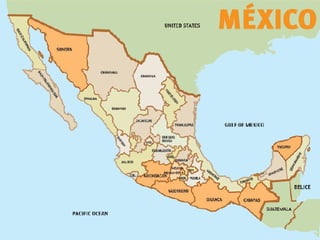
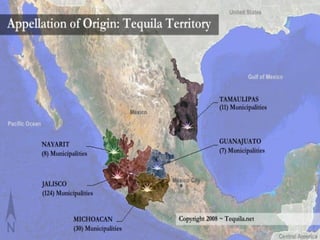
• By government decree (9 Dec, 1974), Tequila
can only come from a specific geographic area
of Mexico known as Tequila, which is within the
state of Jailson (about 40 miles northwest of
Guadalajara) and parts of the states of
Michoacan and Nayarit.
• If produced outside these geographical limits, it
is called mescal.
HarvestingHarvesting
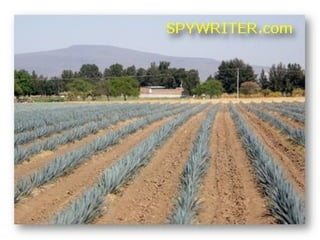
• Agave azul tequilana weber, or Blue agave,
used to make tequila. Due to a unique
combination of altitude, soil conditions, humidity,
annual rainfall, average temperature and
exposure to the sun, southwest Mexico is the
only known place in the world where Agave azul
(or blue agave) grows naturally.
• Blue agave grows on red lava soil.
• It takes up to 8 - 12 years for a blue agave plant
to mature.
HarvestingHarvesting
• Jimadors, the workers who harvest agaves, are
experts in blue agave cultivation.
• The Jimadors use a coa (a steel-tipped hoe) to
un root the blue agave plant and a machete to
cut the spiny leaves from the body of the plant to
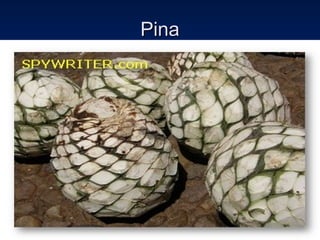
reveal a large pineapple-shaped heart called
Pina.
• The pinas, weigh 70-75kg, are then shipped to a
distillery to begin the tequila-making process.
• 7kg of pine is required to make 1lt. Of 100%
agave tequila
PinaPina
Production ProcessProduction Process
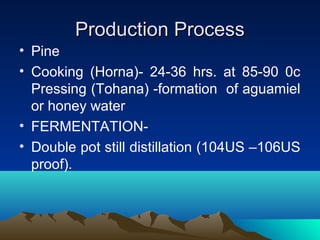
• Pine
• Cooking (Horna)- 24-36 hrs. at 85-90 0c
Pressing (Tohana) -formation of aguamiel
or honey water
• FERMENTATION-
• Double pot still distillation (104US –106US
proof).
Cont..Cont..
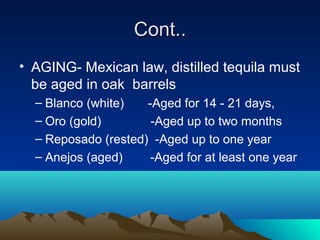
• AGING- Mexican law, distilled tequila must
be aged in oak barrels
– Blanco (white) -Aged for 14 - 21 days,
– Oro (gold) -Aged up to two months
– Reposado (rested) -Aged up to one year
– Anejos (aged) -Aged for at least one year
DIRECCION GENERAL DeDIRECCION GENERAL De
NORMAS(DGN)- 1970NORMAS(DGN)- 1970
Norma Official Mexican De Calidak(NOM).
• It must be made from 100 percent natural
ingredients
• It must be produced with no less than 38 percent
alcohol by volume
• It must be made from blue agave grown and
harvested only in the Mexican states of Jalisco,
Guanajuato, Michoacan, Nayarit
• The fermented agave juice must be distilled
twice and the finished product must result from
the agave juice processing
Cont..Cont..
• The final product must be produced form
no less than 51 percent reduced sugars
from the blue agave.
• It must be labeled with 'hecho en
Mexico' (made in Mexico), 'NOM'
(Norma Official Mexicana), the
producer's four-digit registration and
identification number and the tequila's
age (resposado, anejo, blanco, oro).
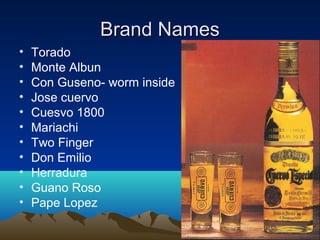
Brand NamesBrand Names
• Torado
• Monte Albun
• Con Guseno- worm inside
• Jose cuervo
• Cuesvo 1800
• Mariachi
• Two Finger
• Don Emilio
• Herradura
• Guano Roso
• Pape Lopez
Service of TequilaService of Tequila
• Drink is served cold and straight in a small shot
glass.
• Season your tongue with citrus and salt, by first
squeezing a wedge of lime and then pouring salt
on to the back of the hand and licking at I each
turn.
• The hand should be held at a 45 degree angle
away from the body, with the thumb extended
downwards, and the juice and salt deposited
along the groove between the thumb and
forefinger
• The tequila is then thrown back in one gulp like
schnapps, carrying the seasoning with it.
MezcalMezcal
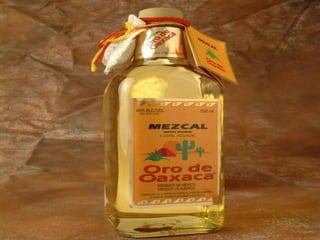
• MESCAL OR MEZCAL is one of Mexico’s
alcoholic drink (pale in colour) made from the
juice of Agave Tiquelano. The juice is fermented
to make beer called Pulque (5-6%) alcoholic
strength .It is distilled by continuous method of
distillation
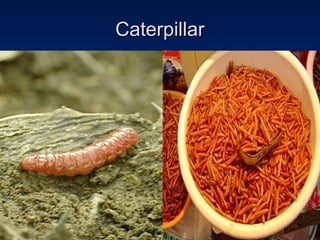
• Mescal is often bottled with pickled agave worm
(caterpillar of night butterfly) in the bottom of
bottle. It is intended to be eaten as last drink is
poured out. Worm eating encourages the
heroism in those already brave enough to
swallow
CaterpillarCaterpillar

Tequila

  • 1.
    TequilaTequila • National drinkof Maxico. • Tequila is made from the blue agave plant, which is a member of the lily family. • There are more than 400 agave species called maguey is often confused with cacti. • Agave plants are distinguished by the succulence of the leaves rather than the stems. • The agave in USA known as century plant or aloe, because it was mistakenly believed to bloom once after every 100 yrs.
  • 2.
    HistoryHistory • In 1758,the King of Spain granted Jose Antonia de Cuervo, the father of tequila, a parcel of land in the town of Tequila to grow agave and produce tequila • By government decree (9 Dec, 1974), Tequila can only come from a specific geographic area of Mexico known as Tequila, which is within the state of Jailson (about 40 miles northwest of Guadalajara) and parts of the states of Michoacan and Nayarit. • If produced outside these geographical limits, it is called mescal.
  • 5.
    HarvestingHarvesting • Agave azultequilana weber, or Blue agave, used to make tequila. Due to a unique combination of altitude, soil conditions, humidity, annual rainfall, average temperature and exposure to the sun, southwest Mexico is the only known place in the world where Agave azul (or blue agave) grows naturally. • Blue agave grows on red lava soil. • It takes up to 8 - 12 years for a blue agave plant to mature.
  • 6.
    HarvestingHarvesting • Jimadors, theworkers who harvest agaves, are experts in blue agave cultivation. • The Jimadors use a coa (a steel-tipped hoe) to un root the blue agave plant and a machete to cut the spiny leaves from the body of the plant to reveal a large pineapple-shaped heart called Pina. • The pinas, weigh 70-75kg, are then shipped to a distillery to begin the tequila-making process. • 7kg of pine is required to make 1lt. Of 100% agave tequila
  • 9.
  • 10.
    Production ProcessProduction Process •Pine • Cooking (Horna)- 24-36 hrs. at 85-90 0c Pressing (Tohana) -formation of aguamiel or honey water • FERMENTATION- • Double pot still distillation (104US –106US proof).
  • 11.
    Cont..Cont.. • AGING- Mexicanlaw, distilled tequila must be aged in oak barrels – Blanco (white) -Aged for 14 - 21 days, – Oro (gold) -Aged up to two months – Reposado (rested) -Aged up to one year – Anejos (aged) -Aged for at least one year
  • 12.
    DIRECCION GENERAL DeDIRECCIONGENERAL De NORMAS(DGN)- 1970NORMAS(DGN)- 1970 Norma Official Mexican De Calidak(NOM). • It must be made from 100 percent natural ingredients • It must be produced with no less than 38 percent alcohol by volume • It must be made from blue agave grown and harvested only in the Mexican states of Jalisco, Guanajuato, Michoacan, Nayarit • The fermented agave juice must be distilled twice and the finished product must result from the agave juice processing
  • 13.
    Cont..Cont.. • The finalproduct must be produced form no less than 51 percent reduced sugars from the blue agave. • It must be labeled with 'hecho en Mexico' (made in Mexico), 'NOM' (Norma Official Mexicana), the producer's four-digit registration and identification number and the tequila's age (resposado, anejo, blanco, oro).
  • 14.
    Brand NamesBrand Names •Torado • Monte Albun • Con Guseno- worm inside • Jose cuervo • Cuesvo 1800 • Mariachi • Two Finger • Don Emilio • Herradura • Guano Roso • Pape Lopez
  • 15.
    Service of TequilaServiceof Tequila • Drink is served cold and straight in a small shot glass. • Season your tongue with citrus and salt, by first squeezing a wedge of lime and then pouring salt on to the back of the hand and licking at I each turn. • The hand should be held at a 45 degree angle away from the body, with the thumb extended downwards, and the juice and salt deposited along the groove between the thumb and forefinger • The tequila is then thrown back in one gulp like schnapps, carrying the seasoning with it.
  • 16.
    MezcalMezcal • MESCAL ORMEZCAL is one of Mexico’s alcoholic drink (pale in colour) made from the juice of Agave Tiquelano. The juice is fermented to make beer called Pulque (5-6%) alcoholic strength .It is distilled by continuous method of distillation • Mescal is often bottled with pickled agave worm (caterpillar of night butterfly) in the bottom of bottle. It is intended to be eaten as last drink is poured out. Worm eating encourages the heroism in those already brave enough to swallow
  • 18.