WHISKeY
SASIKUMAR NATARAJAN
Educationalist & Hospitality trainer…
Sasikumar Natarajan - Educationalist & Hospitality Trainer 1
WHISKEY
Whiskey is a spirit made by fermenting and distilling grain. By long standing
tradition, Scottish distillers spell the name of the spirit as “WHISKY” and the
Irish distillers spell their spirit as “WHISKEY”. The Canadians follow the
Scottish spelling and the American follow the Irish spelling.
The use of grain as a source of alcohol originates among the Celts (the people
of Ireland) between the 10th and 15th century. The name given to the distillate
variously spelt as “UISGE BEATHA” or “UISCE BEATHA” or “USQUEBAUGH” and
pronounced as wee-ski-bah meant “WATER OF LIFE”. Over the centuries the
word has been anglicized to whiskey. Both Scotland and Ireland have long
been claiming to be the original source of whiskey. But neutral heads say that
the soldiers of Henry II had taken a lot of UISCE BEATHA to England after they
invaded Ireland in the 12th century. This precedes the older known references
to the Scotch, an entry in the Scottish exchequer rolls in 1484.
Sasikumar Natarajan - Educationalist & Hospitality Trainer 2
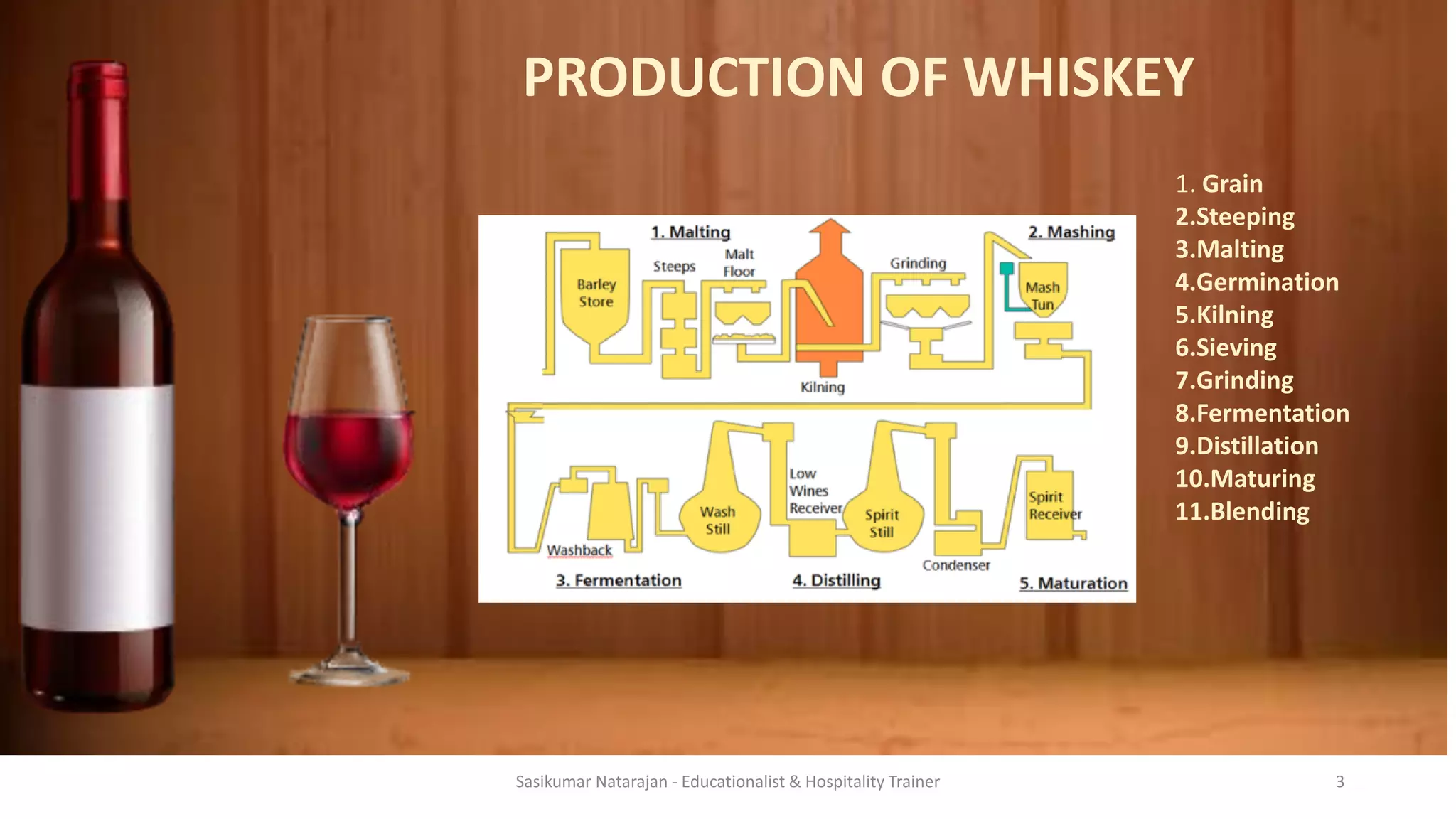
PRODUCTION OF WHISKEY
1. Grain
2.Steeping
3.Malting
4.Germination
5.Kilning
6.Sieving
7.Grinding
8.Fermentation
9.Distillation
10.Maturing
11.Blending
Sasikumar Natarajan - Educationalist & Hospitality Trainer 3
METHOD OF WHISKEY MANUFACTURE
Grains: As mentioned earlier any type of cereal can be used. The Scots use barley
both malted and unmated with a little corn added to it. The Irish use mainly
malted barley but sometimes un-malted barley is incorporated into the mash.
Steeping: The grains are then soaked in a huge tank of water for 2 to 3 days till the
moisture content goes up to 40%. The excess of water is drained off and the
barley is then taken to the malt room
Malting:. On a stone floor of the malt room the grains are spread at a depth of 15
to 30 cm. Temperature of 150 C with 40% of moisture the grains start to
germinate.
Germination: The process of germination develops the enzyme called “DIATASE”
which converts the starch to maltose and other complex Dextrenes. In order to
prevent rootlets from getting entwined among them the grains have to be
continuously disturbed.
Sasikumar Natarajan - Educationalist & Hospitality Trainer 4
METHOD OF WHISKEY MANUFACTURE
Kilning: Then the grains are kiln dried. The basic purpose is to stop sprouting and
to facilitate grinding and storing. In Scotland, the grains are dried by being heated
on steel plates by peat fire which is said to contribute to the characteristic Smokey
flavour of Scotch. In Ireland the grains are heated on perforated floors and the fire
comes from smokeless anthracite coal or oil fired furnaces. The heating goes on
till the moisture content goes down to 3%. The grains are gently dried at first but
then the temperature is raised to 510 C. The process continues for 2 to 3 days.
Sieving: The grains are then sieved to remove the plumages, which develop as a
result of germination. The plumage is sold as cattle feed.
Grinding: Roller mills grind the grains to form “GRIST” . The grains are roughly
broken and not powdered.
Sasikumar Natarajan - Educationalist & Hospitality Trainer 5
METHOD OF WHISKEY MANUFACTURE
Mashtun: The grist is then introduced into a vessel called mashtun along with
water. The water is heated to around 650 C. There are mechanical arrangements
present inside which continuously stir the mixture of water and grist for around
two hours. This extracts the sugar content from the grist in to the base of the
mashtun, which has very finely stocked plates through which only water
containing sugar can pass. The water containing sugar is known as “WORT”.
Fermentation: Wort is added with cultured yeast for fermentation in vats
(Fermentation tank). During the fermentation, the yeast breaks down sugar into
Carbon dioxide and alcohol. During the process, the temperature goes up to
beyond 320 C. the temp. This is controlled by cold water pipes called
“ATTEMPERATORS” at the bottom of the tank, which carry cold water in them
continue to keep the temperature at a particular level. Fermentation is rapid and
completed within three days. The fermented liquid is called as “WASH”. The
fermented wash has an alcoholic strength of 7 to 100 GL. The fermentation tank is
called “WASHBACK”.
Sasikumar Natarajan - Educationalist & Hospitality Trainer 6
METHOD OF WHISKEY MANUFACTURE
Distillation (pot still): The fermented wash is then transferred to a pot still, which
is generally made up of copper. This pot still is called as “WASH STILL”. This pot still
can be of various sizes and shapes. The pot stills used in Ireland are much bigger
than that used in Scotland. The fermented wash is heated either by a source of
fire from underneath or by steam coils present on the side of the pot still. At
78.30 the alcohol gets evaporated while the water is still in liquid state. The
evaporated alcohol then passes through a coiled pipe called “WORM” which
passes through a tank of cold running water, convert the alcoholic vapors into
liquid alcohol.
The first distillation produces three parts: –
•Head called as “FORESHOT”
•Heart called as low wines because of low alcoholic content.
•Tail called as “AFTERSHOT”
Sasikumar Natarajan - Educationalist & Hospitality Trainer 7
METHOD OF WHISKEY MANUFACTURE
The foreshot and the after shot are together called as “FEINTS”. The head contains
Methyl alcohol, which is not suitable for consumption. The tail contains heavier
alcohols, which are also not suitable for consumption. The head and tail are put
back in the first pot still for re-distillation with a fresh batch of wash (water and
alcohol mixture). The heart goes into a spirit still for second distillation. The heart
contains about 40% of alcohol (the heart is also called as low wines because of
low alcoholic content). The heart also produces three parts:-
1.Head 2. Heart 3. Tail
The head and tail are put back in to the spirit still for re-distillation whereas the
heart is required spirit, that is, WHISKEY. The heart, which is whiskey, is also called
as high wine because of the high alcoholic strength of 70%. In Ireland, the whiskey
is distilled thrice. Whiskey comes out from the spirit still it has an alcoholic
strength of around 86%.
Sasikumar Natarajan - Educationalist & Hospitality Trainer 8
METHOD OF WHISKEY MANUFACTURE
Maturing: The whiskey is now raw and colorless but with a pungent aroma. it is
filled into oak casks under exercise supervision and stored in bonded warehouses
often underground for at least 3 years in Scotland and 5 years in Ireland to
mature. As the whiskey matures in the casks, air penetrates through the pores of
the wood to mellow the raw whiskey. Some whiskeys mature in the casks for a
period of 15 years and sometimes more. If the whiskey is left too long in the casks,
it will start smelling woody. The age, which will appear on the label of a bottle,
indicates the youngest whiskey in the blend.
Blending: The blending takes place in the blending vat. The air lets present inside
the vats mixes the whiskeys thoroughly and finally pumped into oak casks where
they remain for some more time to harmonize.
Final stages: After blending and harmonizing the whiskey is filtered through
asbestos sheets and its strength is greatly reduced by the addition of metallic free
water. It is then tested for colour. Colour generally comes from the casks as the
spirit matures but some amount of caramel is also added to give the correct tone.
Whiskey is bottled and sent into the markets.
Sasikumar Natarajan - Educationalist & Hospitality Trainer 9
DIFFERENCE BETWEEN SCOTCH AND IRISH WHISKEY
Scotch is made from homegrown cereal as well as cereal grown in other countries,
whereas, Irish whiskey is made from homegrown cereal only. Pot still scotch is
made from only malted barley whereas Irish pot still whiskey is made from malted
as well as unmalted barley and also other grains.
Pot stills used in Scotland are much smaller than those used in Ireland.
Scotch pot still whiskey is distilled twice whereas Irish whiskeys are distilled thrice.
Scotch is matured for a minimum period of three years; Irish whiskey is matured
for a period of five years.
Sasikumar Natarajan - Educationalist & Hospitality Trainer 10
SCOTCH WHISKEY
SCOTCH- A whiskey wholly distilled in Scotland is scotch. The Scots claim that three
natural influences make their malts so outstanding.
Water, which comes from the hills to the stills, is of the greatest purity, filtered
through rock and granite in the Highlands and chalk base of the Lowlands.
The purity of the air is the reason why so many distillers are sited away from
pollution-prone locations. This is very important because while the whiskeys are
maturing in cask they are breathing in the air that surrounds them.
The wood used for casks Oak is used as it allows the spirit to breathe and mellow.
The Scots do not use new oak casks; they use casks that have already been seasoned
by other liquors such as sherry or bourbon. These casks impart a flavor nuance and
also contribute towards color.
Types of malt produced in Scotland- Scotch is basically divided into two categories: –
Malt scotch 2. Blended scotch
Sasikumar Natarajan - Educationalist & Hospitality Trainer 11
MALT SCOTCH WHISKEY
Malt Scotch: These are the authentic Usquebaugh. They are also known as
a single malt. They are so called because they are made from only malted barley
and the entire process of distillations carried out in one distillery. The malt scotch
or the single malt is all distilled by the pot still method of distillation. They are all
made from malted barley hence called as malt whiskey. The grains used in the
production single malt are heated on perforated steel plates by a peat fire. The
smoky flavor imparted by the peat is felt in the final product. There are around
100 malt whiskeys produced in Scotland right now, each of them is produced in a
single distillery. Malt whiskeys are produced from 4 different regions in Scotland.
They are: –
• High Land/ Speyside
• Lowland
• Campeltown
• Islay
Sasikumar Natarajan - Educationalist & Hospitality Trainer 12
MALT SCOTCH WHISKEY
Highlands: Whiskies have a firm, dry character, with some peatiness and saltiness. ”GLENMORANGIE” is a good
example. They can be light and delicate of medium or full-bodied nutty, spicy, herby, smoky, depending on
where they are produced.
Major brands- Aberfeldy Balblair Ben Nevis
Lowlands: The whiskies have suggestions of lemon grass and maltiness. “GLENKINCHIE” is the best known. It is
located south of the Greenoch/Dundee line:
Major brands- Littlemill Rosebank St Magdalene
Campeltown: The products are distinctly briny (sea salt flavoured) with peatness, medicinal aroma , spicy e.g.,
“GLEN SCOTIA” This is once the capital of whisky distilling in Scotland.
Major brands- Longrow Springbank
Islay: the peaty soil and Islay’s exposed position on the west coast of Scotland make it the producer of the
boldest malts. The sea weedy atmosphere permeates the soil and the warehouses, imparting a singular
character to the malts. Famous malts from this region are “LAGAVULIN” and “ADBERG”. These strong-flavoured
and strong-smelling malts are distinguished by their intense peaty and smoky characteristics.
Major brands- Bowmore Bruichaddich Laphroaig
Speyside: these malts are noted for their elegance, flowery, heathery honey notes and sometimes a restrained
fragrant peatiness. Speyside can be typified by “MACALLAN AND GLENLIVET” This is Highland sub-division.
Major brands- Aberlour An Cnoc Ardmore
Sasikumar Natarajan - Educationalist & Hospitality Trainer 13
BLENDED SCOTCH WHISKEY
Blended scotch:- Blended whiskey is a mixture of both malt and grain whiskey. Grain whiskey is made from a
mash of several grains, predominantly corn with a small amount of both malted and unmalted barley added to
that. In this case a peat fire does not heat the barley. Grain whiskey is made by patent still method of distillation.
Grain whiskeys are generally very light, as they tend to run off the still at around 1800 proof. These light grain
whiskeys are then blended with malted whiskey in different proportions.
Blended scotch is divided into two categories: –
1.Bulk 2. Bottled in Scotland
Bulk scotch: they are shipped in barrels and bottled at the destination. They are the cheapest quality of whiskey
with the minimum malt whiskey to grain whiskey ratio. Blending is not very painstaking which leads to lack of
consistency in quality. The label on the bulk scotch usually reads” distilled and blended in Scotland”.
Bulk scotch examples:- Clan Mac Gregor, Inver house, Old smuggler, Passport, Vat 69
Sasikumar Natarajan - Educationalist & Hospitality Trainer 14
BLENDED SCOTCH WHISKEY
Bottled in Scotland: These scotches are often labeled “Distilled and bottled in Scotland” and makes up around
two thirds of the total scotches available in the world. They are more expensive than the bulk. The bottled in
Scotland scotch is further divided into: –
1.Regular 2. Premium. 3. Deluxe
Regular: They are sometimes called as “standard” in Scotland. The minimum age of the youngest whiskey in the
blend is around 10 to 12 years. The following are few brand names.
Ballantine Bell’s Black & white Cutty sark
Dewar’s white label Haig J & B (Justerini and Brooks)
Johnie walker’s red label Teachers’s highland cream
Whyte & mackay White horse
Premium: the minimum age of the youngest whiskey in the blend is 12 to 15 years. It is better than the regular
whiskey.
Brand names: – Chivas regal Haig pinch Johnie walker`s black label
Deluxe premium: sometimes referred to as ultra premium. The hallmark of this group is that the minimum age
of the youngest whiskey in the blend is 20 years and above. They are the most expensive among all the
scotches available. The following are few brand names.
Ballantine 30 years Ballantine 17 years Chivas royal salute
Usquebaugh Ambassador Bell’s royal reserve
Johnnie walker’s blue label James and martin fine and rare
Sasikumar Natarajan - Educationalist & Hospitality Trainer 15
SERVING SCOTCH WHISKEY
• The best way to serve Scotch is ‘on the rocks’. In other words, you should not add anything to it,
before serving. Just pour it in a glass, directly over the ice cubes. Scotch lovers believe that adding
anything to the drink masks its smooth taste and rich aroma.
• If you are serving single malts, it is advisable to use a large bowl for the same. The glass will usually
taper up to a narrow neck, while its lip will be flared. While the bowl captures the aroma of Scotch,
the narrow neck directs it to your nose.
• Scotch whisky can also be served in a snifter. The glass is characterized by a wide base and a wide
mouth and is smaller than a wine glass. It has a slight taper towards the mouth, which directs the
focus of the person on the drink’s aroma. Make sure that the snifter is clean, so that the person
drinking it can get a clear view of the drink and appreciate it as well.
• In case you aren’t serving neat Scotch, you can keep soda or water alongside, in a separate beaker,
to act as the mixer. By doing so, those people who do not want to have the drink neat, would be
given the choice of adding the desired liquid.
• You can make use of carbonated cool drinks as a mixer for Scotch. Coke is the most preferred mixer,
other than water and soda, for Scotch whiskey.
• In case you are serving water along with Scotch, make sure to use only spring water, because it is
purer than other types of water and would have the least effect on the taste and aroma of the drink.
Moreover, experts insist on the use of spring water, because the chlorinated taste and smell of tap
water will distort the aroma and rich taste of Scotch.
• For those who find Scotch to be too strong alone, you can serve cocktails. There are a large number
of cocktails that are made with scotch
Sasikumar Natarajan - Educationalist & Hospitality Trainer 16
IRISH WHISKEY
Irish whiskey- Irish whiskey can be difficult to define because of the experimentation at play with
modern distilleries. One of the simplest requirements is that Irish whiskey must be produced in
Ireland. It must be made with a mash that contains malted barley and aged in wooden casks for at
least 3 years. To be labeled Irish whiskey, the spirit must contain no additives other than water and
caramel coloring. Many Irish whiskeys are blended, but there are also Irish single malts, grain
whiskeys, and pot still whiskeys.
Irish whiskeys are likely to be triple distilled, lending a soft, smooth mouthfeel to the spirit that
makes it easy to sip. It’s also common for Irish whiskeys to be made from barley dried in a closed
kiln, which doesn’t add the smoky flavor associated with scotch. The types of barrels used in
maturation also add more complex flavors to whiskey as it ages. Irish whiskey is known for being
less sweet than bourbon and more mellow than scotch.
These whiskies are made from malted and unmalted barley mixes in a ratio of 20: 80 or 40:
60.These whiskies have perfumy character, aroma of linseed oil, flex. These whiskies are also
produced in Dublin, Bushmill, Tullamore, Cork (Middleton).
Sasikumar Natarajan - Educationalist & Hospitality Trainer 17
BRAND NAMES OF WHISKEY
Well-known brands
Bushmills 1608, Bushmills Black Bush, Bushmills Single Malt, Coleraine,
Jameson (Ireland’s best seller on the world market), Paddy, Tullamore Dew
Middleton Very Rare- This distinctive, brilliant and very costly whiskey was first launched in 1984. It
is Ireland’s most expensive, but it is worth the price to experience its smooth, silky taste. It is super-
premium whiskey made in limited batches and vintage bottled.
Poteen – These are illicit distilled whiskies of Ireland. They are produced out side of govt. control or
revenue deptt. They are white in colour and not matured in cask.
Sasikumar Natarajan - Educationalist & Hospitality Trainer 18
AMERICAN WHISKEY
American whiskey (Production of American whiskey)
The principal grains used are maize (corn), rye, millet and barley. The grain is cleaned and coarsely
ground into a meal. Heated limestone-water is added and the combination is thoroughly roused,
the sugars are dissolved and the liquid becomes wort. The wort is cooled ready for fermenting.
Two yeasting processes are widely used in America-
• sweet mash process
• sour mash process.
In the sweet mash process, fresh yeast is added to the mash and fermentation takes place resulting
in an alcoholic liquid known as distillers’ beer. The sour mash process uses the residue or fresh hot
slop from a previous distillation. This is added to the mash, together with some fresh yeast. Sour
mash its name from the fact that the week spent been left over in the stills is fairly acidic.
Distillation- The distillers ‘beer’ / wash is taken to a patent still and after distillation will have an
alcoholic strength of 160˚ US proof (80 per cent by volume). This is diluted using limestone-water to
103˚ US proof and sent to mature in charred oak casks.
Sasikumar Natarajan - Educationalist & Hospitality Trainer 19
AMERICAN WHISKEY
Main categories of American whiskey
Bourbon- Bourbon was first made in Bourbon Country, Kentucky, hence the name. The Reverend
Elijah Craig, a Baptist minister, is credited with being the father of bourbon whiskey. In 1789 he set
up a still beside a limestone creek in Georgetown, Bourbon County. He used maize (corn) as the
main grain, principally because it was more abundant than other grains, and called his new whiskey
Bourbon County whiskey. The use of charred oak barrels is also attributed to Craig. Apparently he
was heating some white oak staves to make them pliable for bending into barrels. Something
distracted him and on his return he found some staves had been heavily scorched. He made these
into a barrel and discovered later that the whiskey in this particular barrel was far superior to any in
the batch. Bourbon is made from at least 51 percent maize (corn) mainly using the sour mash
process. It is matured in new, charred oak barrels for a minimum of two years.
Major brands- Ancient age, Elijah Craig, Four Roses, Old Crow, Wild Turkey .
Sasikumar Natarajan - Educationalist & Hospitality Trainer 20
AMERICAN WHISKEY
Tennessee- Tennessee whiskey is straight whiskey distilled in Tennessee form a mash that contains a
minimum of 51 percent corn. Its production is somewhat similar to that of bourbon, except that a
unique filtering system is used to help to produce the smooth, rich flavour associated with the
Tennessee style. Slats of sugar maple are burned and hosed with the water. The resulting charcoal is
packed into 10 foot-high (3 metre) vats and the raw spirit is slowly filtered though the charcoal. The
spirit takes ten days to pass through the charcoal. Often the whiskey is twice charcoal filtered-once
before and once after maturation which contributes to the traditional mellow, smoky flavour. The
whiskies are aged in charred, white oak barrels for four to six years and take on a smooth, mellow
character. Most is produced by the sour mash system. Only two whiskey distilleries operate in
Tennessee: Jack Daniels and George Dickel,. Both distilleries produce a variety of excellent brand,
but jack Daniels sells better on the international markets.
Moonshine/ White Lightening– These are illicit distilled whiskies of America. It is produced out side
of govt. control or revenue dept. & white in colour and not matured in cask.
Sasikumar Natarajan - Educationalist & Hospitality Trainer 21
CANADIAN WHISKEY
Canadian Whisky- These whiskies are made from Rye. Canadian whiskies have some spicy and
bitter sweet character obtained from the grain. To be labeled as Canadian whisky, the spirit must be
made in Canada and aged for at least 3 years in wooden barrels. The barrels can be new or used,
and the mash can be made with any cereal grain. Caramel color and up to 9.09% additional
flavorings can also be added. These relaxed requirements make room for distilleries to experiment
with different grains and blends.
Traditional Canadian whisky is known for its blending, whether it’s blending batches made from
different grains or blending whisky styles from other countries. Canadian whisky blends may even
contain percentages of American bourbon or single malt scotch. To help achieve the perfect blend,
Canadian distillers use a special technique. They produce a base whisky with a high alcohol content
and a flavoring whisky with a low alcohol content. These separate batches are blended together to
strike the right balance between proof and flavor. They are blended with corn whisky and bourbon
whisky which impart vanilla note to Canadian whisky
Mojor brands- Black Velvet, Canadian Club Canadian Mist , Crown Royal
Sasikumar Natarajan - Educationalist & Hospitality Trainer 22
STORING OF WHISKEY
Sealed whiskey bottles:
• Light and temperature are the main factors. These two factors will certainly degrade tasty esters and
congeners in whiskey.
• Store your sealed bottle vertically and avoid contact with light, especially direct sunlight is bad.
• whiskey comes in package, keep the package for storage purposes, even though it might be tempting
to showcase your bottle.
• Cabinet with closed doors is good for bottles without package.
• contact with light is acceptable if it’s not constant.
• Keep your bottles where the temperature will not fluctuate, basement, cellar or cabinet/closet
inside a properly air-conditioned place.
• Storage units with no good air-conditioning can have large fluctuations in temperature, so it’s wise
to avoid them too.
Opened whiskey bottles:
• keep your whiskey stored away from the light, and it still has more than two-thirds left, then you can
expect the whiskey to taste the same for about a year.
• Put the lid back on and keep the bottle stored in the same place.
• If the opened bottle of whiskey has less than half of its contents left, then you will have a much
shorter period to store. The oxidation process will occur much more quickly, and there should be a
noticeable change in taste after around one month.
Sasikumar Natarajan - Educationalist & Hospitality Trainer 23
SOURCE:
• Publications
• Journals
• Esource
THANK YOU
SASIKUMAR NATARAJAN
Sasikumar@harilini.com
Sasikumar Natarajan - Educationalist & Hospitality Trainer 24

WHISKEY.

  • 1.
    WHISKeY SASIKUMAR NATARAJAN Educationalist &Hospitality trainer… Sasikumar Natarajan - Educationalist & Hospitality Trainer 1
  • 2.
    WHISKEY Whiskey is aspirit made by fermenting and distilling grain. By long standing tradition, Scottish distillers spell the name of the spirit as “WHISKY” and the Irish distillers spell their spirit as “WHISKEY”. The Canadians follow the Scottish spelling and the American follow the Irish spelling. The use of grain as a source of alcohol originates among the Celts (the people of Ireland) between the 10th and 15th century. The name given to the distillate variously spelt as “UISGE BEATHA” or “UISCE BEATHA” or “USQUEBAUGH” and pronounced as wee-ski-bah meant “WATER OF LIFE”. Over the centuries the word has been anglicized to whiskey. Both Scotland and Ireland have long been claiming to be the original source of whiskey. But neutral heads say that the soldiers of Henry II had taken a lot of UISCE BEATHA to England after they invaded Ireland in the 12th century. This precedes the older known references to the Scotch, an entry in the Scottish exchequer rolls in 1484. Sasikumar Natarajan - Educationalist & Hospitality Trainer 2
  • 3.
    PRODUCTION OF WHISKEY 1.Grain 2.Steeping 3.Malting 4.Germination 5.Kilning 6.Sieving 7.Grinding 8.Fermentation 9.Distillation 10.Maturing 11.Blending Sasikumar Natarajan - Educationalist & Hospitality Trainer 3
  • 4.
    METHOD OF WHISKEYMANUFACTURE Grains: As mentioned earlier any type of cereal can be used. The Scots use barley both malted and unmated with a little corn added to it. The Irish use mainly malted barley but sometimes un-malted barley is incorporated into the mash. Steeping: The grains are then soaked in a huge tank of water for 2 to 3 days till the moisture content goes up to 40%. The excess of water is drained off and the barley is then taken to the malt room Malting:. On a stone floor of the malt room the grains are spread at a depth of 15 to 30 cm. Temperature of 150 C with 40% of moisture the grains start to germinate. Germination: The process of germination develops the enzyme called “DIATASE” which converts the starch to maltose and other complex Dextrenes. In order to prevent rootlets from getting entwined among them the grains have to be continuously disturbed. Sasikumar Natarajan - Educationalist & Hospitality Trainer 4
  • 5.
    METHOD OF WHISKEYMANUFACTURE Kilning: Then the grains are kiln dried. The basic purpose is to stop sprouting and to facilitate grinding and storing. In Scotland, the grains are dried by being heated on steel plates by peat fire which is said to contribute to the characteristic Smokey flavour of Scotch. In Ireland the grains are heated on perforated floors and the fire comes from smokeless anthracite coal or oil fired furnaces. The heating goes on till the moisture content goes down to 3%. The grains are gently dried at first but then the temperature is raised to 510 C. The process continues for 2 to 3 days. Sieving: The grains are then sieved to remove the plumages, which develop as a result of germination. The plumage is sold as cattle feed. Grinding: Roller mills grind the grains to form “GRIST” . The grains are roughly broken and not powdered. Sasikumar Natarajan - Educationalist & Hospitality Trainer 5
  • 6.
    METHOD OF WHISKEYMANUFACTURE Mashtun: The grist is then introduced into a vessel called mashtun along with water. The water is heated to around 650 C. There are mechanical arrangements present inside which continuously stir the mixture of water and grist for around two hours. This extracts the sugar content from the grist in to the base of the mashtun, which has very finely stocked plates through which only water containing sugar can pass. The water containing sugar is known as “WORT”. Fermentation: Wort is added with cultured yeast for fermentation in vats (Fermentation tank). During the fermentation, the yeast breaks down sugar into Carbon dioxide and alcohol. During the process, the temperature goes up to beyond 320 C. the temp. This is controlled by cold water pipes called “ATTEMPERATORS” at the bottom of the tank, which carry cold water in them continue to keep the temperature at a particular level. Fermentation is rapid and completed within three days. The fermented liquid is called as “WASH”. The fermented wash has an alcoholic strength of 7 to 100 GL. The fermentation tank is called “WASHBACK”. Sasikumar Natarajan - Educationalist & Hospitality Trainer 6
  • 7.
    METHOD OF WHISKEYMANUFACTURE Distillation (pot still): The fermented wash is then transferred to a pot still, which is generally made up of copper. This pot still is called as “WASH STILL”. This pot still can be of various sizes and shapes. The pot stills used in Ireland are much bigger than that used in Scotland. The fermented wash is heated either by a source of fire from underneath or by steam coils present on the side of the pot still. At 78.30 the alcohol gets evaporated while the water is still in liquid state. The evaporated alcohol then passes through a coiled pipe called “WORM” which passes through a tank of cold running water, convert the alcoholic vapors into liquid alcohol. The first distillation produces three parts: – •Head called as “FORESHOT” •Heart called as low wines because of low alcoholic content. •Tail called as “AFTERSHOT” Sasikumar Natarajan - Educationalist & Hospitality Trainer 7
  • 8.
    METHOD OF WHISKEYMANUFACTURE The foreshot and the after shot are together called as “FEINTS”. The head contains Methyl alcohol, which is not suitable for consumption. The tail contains heavier alcohols, which are also not suitable for consumption. The head and tail are put back in the first pot still for re-distillation with a fresh batch of wash (water and alcohol mixture). The heart goes into a spirit still for second distillation. The heart contains about 40% of alcohol (the heart is also called as low wines because of low alcoholic content). The heart also produces three parts:- 1.Head 2. Heart 3. Tail The head and tail are put back in to the spirit still for re-distillation whereas the heart is required spirit, that is, WHISKEY. The heart, which is whiskey, is also called as high wine because of the high alcoholic strength of 70%. In Ireland, the whiskey is distilled thrice. Whiskey comes out from the spirit still it has an alcoholic strength of around 86%. Sasikumar Natarajan - Educationalist & Hospitality Trainer 8
  • 9.
    METHOD OF WHISKEYMANUFACTURE Maturing: The whiskey is now raw and colorless but with a pungent aroma. it is filled into oak casks under exercise supervision and stored in bonded warehouses often underground for at least 3 years in Scotland and 5 years in Ireland to mature. As the whiskey matures in the casks, air penetrates through the pores of the wood to mellow the raw whiskey. Some whiskeys mature in the casks for a period of 15 years and sometimes more. If the whiskey is left too long in the casks, it will start smelling woody. The age, which will appear on the label of a bottle, indicates the youngest whiskey in the blend. Blending: The blending takes place in the blending vat. The air lets present inside the vats mixes the whiskeys thoroughly and finally pumped into oak casks where they remain for some more time to harmonize. Final stages: After blending and harmonizing the whiskey is filtered through asbestos sheets and its strength is greatly reduced by the addition of metallic free water. It is then tested for colour. Colour generally comes from the casks as the spirit matures but some amount of caramel is also added to give the correct tone. Whiskey is bottled and sent into the markets. Sasikumar Natarajan - Educationalist & Hospitality Trainer 9
  • 10.
    DIFFERENCE BETWEEN SCOTCHAND IRISH WHISKEY Scotch is made from homegrown cereal as well as cereal grown in other countries, whereas, Irish whiskey is made from homegrown cereal only. Pot still scotch is made from only malted barley whereas Irish pot still whiskey is made from malted as well as unmalted barley and also other grains. Pot stills used in Scotland are much smaller than those used in Ireland. Scotch pot still whiskey is distilled twice whereas Irish whiskeys are distilled thrice. Scotch is matured for a minimum period of three years; Irish whiskey is matured for a period of five years. Sasikumar Natarajan - Educationalist & Hospitality Trainer 10
  • 11.
    SCOTCH WHISKEY SCOTCH- Awhiskey wholly distilled in Scotland is scotch. The Scots claim that three natural influences make their malts so outstanding. Water, which comes from the hills to the stills, is of the greatest purity, filtered through rock and granite in the Highlands and chalk base of the Lowlands. The purity of the air is the reason why so many distillers are sited away from pollution-prone locations. This is very important because while the whiskeys are maturing in cask they are breathing in the air that surrounds them. The wood used for casks Oak is used as it allows the spirit to breathe and mellow. The Scots do not use new oak casks; they use casks that have already been seasoned by other liquors such as sherry or bourbon. These casks impart a flavor nuance and also contribute towards color. Types of malt produced in Scotland- Scotch is basically divided into two categories: – Malt scotch 2. Blended scotch Sasikumar Natarajan - Educationalist & Hospitality Trainer 11
  • 12.
    MALT SCOTCH WHISKEY MaltScotch: These are the authentic Usquebaugh. They are also known as a single malt. They are so called because they are made from only malted barley and the entire process of distillations carried out in one distillery. The malt scotch or the single malt is all distilled by the pot still method of distillation. They are all made from malted barley hence called as malt whiskey. The grains used in the production single malt are heated on perforated steel plates by a peat fire. The smoky flavor imparted by the peat is felt in the final product. There are around 100 malt whiskeys produced in Scotland right now, each of them is produced in a single distillery. Malt whiskeys are produced from 4 different regions in Scotland. They are: – • High Land/ Speyside • Lowland • Campeltown • Islay Sasikumar Natarajan - Educationalist & Hospitality Trainer 12
  • 13.
    MALT SCOTCH WHISKEY Highlands:Whiskies have a firm, dry character, with some peatiness and saltiness. ”GLENMORANGIE” is a good example. They can be light and delicate of medium or full-bodied nutty, spicy, herby, smoky, depending on where they are produced. Major brands- Aberfeldy Balblair Ben Nevis Lowlands: The whiskies have suggestions of lemon grass and maltiness. “GLENKINCHIE” is the best known. It is located south of the Greenoch/Dundee line: Major brands- Littlemill Rosebank St Magdalene Campeltown: The products are distinctly briny (sea salt flavoured) with peatness, medicinal aroma , spicy e.g., “GLEN SCOTIA” This is once the capital of whisky distilling in Scotland. Major brands- Longrow Springbank Islay: the peaty soil and Islay’s exposed position on the west coast of Scotland make it the producer of the boldest malts. The sea weedy atmosphere permeates the soil and the warehouses, imparting a singular character to the malts. Famous malts from this region are “LAGAVULIN” and “ADBERG”. These strong-flavoured and strong-smelling malts are distinguished by their intense peaty and smoky characteristics. Major brands- Bowmore Bruichaddich Laphroaig Speyside: these malts are noted for their elegance, flowery, heathery honey notes and sometimes a restrained fragrant peatiness. Speyside can be typified by “MACALLAN AND GLENLIVET” This is Highland sub-division. Major brands- Aberlour An Cnoc Ardmore Sasikumar Natarajan - Educationalist & Hospitality Trainer 13
  • 14.
    BLENDED SCOTCH WHISKEY Blendedscotch:- Blended whiskey is a mixture of both malt and grain whiskey. Grain whiskey is made from a mash of several grains, predominantly corn with a small amount of both malted and unmalted barley added to that. In this case a peat fire does not heat the barley. Grain whiskey is made by patent still method of distillation. Grain whiskeys are generally very light, as they tend to run off the still at around 1800 proof. These light grain whiskeys are then blended with malted whiskey in different proportions. Blended scotch is divided into two categories: – 1.Bulk 2. Bottled in Scotland Bulk scotch: they are shipped in barrels and bottled at the destination. They are the cheapest quality of whiskey with the minimum malt whiskey to grain whiskey ratio. Blending is not very painstaking which leads to lack of consistency in quality. The label on the bulk scotch usually reads” distilled and blended in Scotland”. Bulk scotch examples:- Clan Mac Gregor, Inver house, Old smuggler, Passport, Vat 69 Sasikumar Natarajan - Educationalist & Hospitality Trainer 14
  • 15.
    BLENDED SCOTCH WHISKEY Bottledin Scotland: These scotches are often labeled “Distilled and bottled in Scotland” and makes up around two thirds of the total scotches available in the world. They are more expensive than the bulk. The bottled in Scotland scotch is further divided into: – 1.Regular 2. Premium. 3. Deluxe Regular: They are sometimes called as “standard” in Scotland. The minimum age of the youngest whiskey in the blend is around 10 to 12 years. The following are few brand names. Ballantine Bell’s Black & white Cutty sark Dewar’s white label Haig J & B (Justerini and Brooks) Johnie walker’s red label Teachers’s highland cream Whyte & mackay White horse Premium: the minimum age of the youngest whiskey in the blend is 12 to 15 years. It is better than the regular whiskey. Brand names: – Chivas regal Haig pinch Johnie walker`s black label Deluxe premium: sometimes referred to as ultra premium. The hallmark of this group is that the minimum age of the youngest whiskey in the blend is 20 years and above. They are the most expensive among all the scotches available. The following are few brand names. Ballantine 30 years Ballantine 17 years Chivas royal salute Usquebaugh Ambassador Bell’s royal reserve Johnnie walker’s blue label James and martin fine and rare Sasikumar Natarajan - Educationalist & Hospitality Trainer 15
  • 16.
    SERVING SCOTCH WHISKEY •The best way to serve Scotch is ‘on the rocks’. In other words, you should not add anything to it, before serving. Just pour it in a glass, directly over the ice cubes. Scotch lovers believe that adding anything to the drink masks its smooth taste and rich aroma. • If you are serving single malts, it is advisable to use a large bowl for the same. The glass will usually taper up to a narrow neck, while its lip will be flared. While the bowl captures the aroma of Scotch, the narrow neck directs it to your nose. • Scotch whisky can also be served in a snifter. The glass is characterized by a wide base and a wide mouth and is smaller than a wine glass. It has a slight taper towards the mouth, which directs the focus of the person on the drink’s aroma. Make sure that the snifter is clean, so that the person drinking it can get a clear view of the drink and appreciate it as well. • In case you aren’t serving neat Scotch, you can keep soda or water alongside, in a separate beaker, to act as the mixer. By doing so, those people who do not want to have the drink neat, would be given the choice of adding the desired liquid. • You can make use of carbonated cool drinks as a mixer for Scotch. Coke is the most preferred mixer, other than water and soda, for Scotch whiskey. • In case you are serving water along with Scotch, make sure to use only spring water, because it is purer than other types of water and would have the least effect on the taste and aroma of the drink. Moreover, experts insist on the use of spring water, because the chlorinated taste and smell of tap water will distort the aroma and rich taste of Scotch. • For those who find Scotch to be too strong alone, you can serve cocktails. There are a large number of cocktails that are made with scotch Sasikumar Natarajan - Educationalist & Hospitality Trainer 16
  • 17.
    IRISH WHISKEY Irish whiskey-Irish whiskey can be difficult to define because of the experimentation at play with modern distilleries. One of the simplest requirements is that Irish whiskey must be produced in Ireland. It must be made with a mash that contains malted barley and aged in wooden casks for at least 3 years. To be labeled Irish whiskey, the spirit must contain no additives other than water and caramel coloring. Many Irish whiskeys are blended, but there are also Irish single malts, grain whiskeys, and pot still whiskeys. Irish whiskeys are likely to be triple distilled, lending a soft, smooth mouthfeel to the spirit that makes it easy to sip. It’s also common for Irish whiskeys to be made from barley dried in a closed kiln, which doesn’t add the smoky flavor associated with scotch. The types of barrels used in maturation also add more complex flavors to whiskey as it ages. Irish whiskey is known for being less sweet than bourbon and more mellow than scotch. These whiskies are made from malted and unmalted barley mixes in a ratio of 20: 80 or 40: 60.These whiskies have perfumy character, aroma of linseed oil, flex. These whiskies are also produced in Dublin, Bushmill, Tullamore, Cork (Middleton). Sasikumar Natarajan - Educationalist & Hospitality Trainer 17
  • 18.
    BRAND NAMES OFWHISKEY Well-known brands Bushmills 1608, Bushmills Black Bush, Bushmills Single Malt, Coleraine, Jameson (Ireland’s best seller on the world market), Paddy, Tullamore Dew Middleton Very Rare- This distinctive, brilliant and very costly whiskey was first launched in 1984. It is Ireland’s most expensive, but it is worth the price to experience its smooth, silky taste. It is super- premium whiskey made in limited batches and vintage bottled. Poteen – These are illicit distilled whiskies of Ireland. They are produced out side of govt. control or revenue deptt. They are white in colour and not matured in cask. Sasikumar Natarajan - Educationalist & Hospitality Trainer 18
  • 19.
    AMERICAN WHISKEY American whiskey(Production of American whiskey) The principal grains used are maize (corn), rye, millet and barley. The grain is cleaned and coarsely ground into a meal. Heated limestone-water is added and the combination is thoroughly roused, the sugars are dissolved and the liquid becomes wort. The wort is cooled ready for fermenting. Two yeasting processes are widely used in America- • sweet mash process • sour mash process. In the sweet mash process, fresh yeast is added to the mash and fermentation takes place resulting in an alcoholic liquid known as distillers’ beer. The sour mash process uses the residue or fresh hot slop from a previous distillation. This is added to the mash, together with some fresh yeast. Sour mash its name from the fact that the week spent been left over in the stills is fairly acidic. Distillation- The distillers ‘beer’ / wash is taken to a patent still and after distillation will have an alcoholic strength of 160˚ US proof (80 per cent by volume). This is diluted using limestone-water to 103˚ US proof and sent to mature in charred oak casks. Sasikumar Natarajan - Educationalist & Hospitality Trainer 19
  • 20.
    AMERICAN WHISKEY Main categoriesof American whiskey Bourbon- Bourbon was first made in Bourbon Country, Kentucky, hence the name. The Reverend Elijah Craig, a Baptist minister, is credited with being the father of bourbon whiskey. In 1789 he set up a still beside a limestone creek in Georgetown, Bourbon County. He used maize (corn) as the main grain, principally because it was more abundant than other grains, and called his new whiskey Bourbon County whiskey. The use of charred oak barrels is also attributed to Craig. Apparently he was heating some white oak staves to make them pliable for bending into barrels. Something distracted him and on his return he found some staves had been heavily scorched. He made these into a barrel and discovered later that the whiskey in this particular barrel was far superior to any in the batch. Bourbon is made from at least 51 percent maize (corn) mainly using the sour mash process. It is matured in new, charred oak barrels for a minimum of two years. Major brands- Ancient age, Elijah Craig, Four Roses, Old Crow, Wild Turkey . Sasikumar Natarajan - Educationalist & Hospitality Trainer 20
  • 21.
    AMERICAN WHISKEY Tennessee- Tennesseewhiskey is straight whiskey distilled in Tennessee form a mash that contains a minimum of 51 percent corn. Its production is somewhat similar to that of bourbon, except that a unique filtering system is used to help to produce the smooth, rich flavour associated with the Tennessee style. Slats of sugar maple are burned and hosed with the water. The resulting charcoal is packed into 10 foot-high (3 metre) vats and the raw spirit is slowly filtered though the charcoal. The spirit takes ten days to pass through the charcoal. Often the whiskey is twice charcoal filtered-once before and once after maturation which contributes to the traditional mellow, smoky flavour. The whiskies are aged in charred, white oak barrels for four to six years and take on a smooth, mellow character. Most is produced by the sour mash system. Only two whiskey distilleries operate in Tennessee: Jack Daniels and George Dickel,. Both distilleries produce a variety of excellent brand, but jack Daniels sells better on the international markets. Moonshine/ White Lightening– These are illicit distilled whiskies of America. It is produced out side of govt. control or revenue dept. & white in colour and not matured in cask. Sasikumar Natarajan - Educationalist & Hospitality Trainer 21
  • 22.
    CANADIAN WHISKEY Canadian Whisky-These whiskies are made from Rye. Canadian whiskies have some spicy and bitter sweet character obtained from the grain. To be labeled as Canadian whisky, the spirit must be made in Canada and aged for at least 3 years in wooden barrels. The barrels can be new or used, and the mash can be made with any cereal grain. Caramel color and up to 9.09% additional flavorings can also be added. These relaxed requirements make room for distilleries to experiment with different grains and blends. Traditional Canadian whisky is known for its blending, whether it’s blending batches made from different grains or blending whisky styles from other countries. Canadian whisky blends may even contain percentages of American bourbon or single malt scotch. To help achieve the perfect blend, Canadian distillers use a special technique. They produce a base whisky with a high alcohol content and a flavoring whisky with a low alcohol content. These separate batches are blended together to strike the right balance between proof and flavor. They are blended with corn whisky and bourbon whisky which impart vanilla note to Canadian whisky Mojor brands- Black Velvet, Canadian Club Canadian Mist , Crown Royal Sasikumar Natarajan - Educationalist & Hospitality Trainer 22
  • 23.
    STORING OF WHISKEY Sealedwhiskey bottles: • Light and temperature are the main factors. These two factors will certainly degrade tasty esters and congeners in whiskey. • Store your sealed bottle vertically and avoid contact with light, especially direct sunlight is bad. • whiskey comes in package, keep the package for storage purposes, even though it might be tempting to showcase your bottle. • Cabinet with closed doors is good for bottles without package. • contact with light is acceptable if it’s not constant. • Keep your bottles where the temperature will not fluctuate, basement, cellar or cabinet/closet inside a properly air-conditioned place. • Storage units with no good air-conditioning can have large fluctuations in temperature, so it’s wise to avoid them too. Opened whiskey bottles: • keep your whiskey stored away from the light, and it still has more than two-thirds left, then you can expect the whiskey to taste the same for about a year. • Put the lid back on and keep the bottle stored in the same place. • If the opened bottle of whiskey has less than half of its contents left, then you will have a much shorter period to store. The oxidation process will occur much more quickly, and there should be a noticeable change in taste after around one month. Sasikumar Natarajan - Educationalist & Hospitality Trainer 23
  • 24.
    SOURCE: • Publications • Journals •Esource THANK YOU SASIKUMAR NATARAJAN Sasikumar@harilini.com Sasikumar Natarajan - Educationalist & Hospitality Trainer 24