DistillationDistillation
Introduction to SpiritIntroduction to Spirit
DefinationDefination
• Spirit is defined as product of distillation of
fermented beverage.
DistillationDistillation
• Distillation is the process of separation of
two miscible liquids by using difference in
their boiling point. In present context the
alcohol has to be separated from water
after fermentation.
• The evaporating temp. of ethyl alcohol is
78.5C where as for water is 100C.
Method of DistillationMethod of Distillation
• Traditionally there are two method of
distillation.
• Pot still
• Patent still/ Coffey still/ Continuous still.
Pot still DistillationPot still Distillation
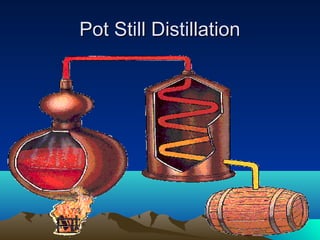
• The pot is made from Copper
• Size differ from place to place
• Alcohol vaporize at 78.5 c
• The Vapours passes through Condenser and
converted to liquid
• Liquid alcohol is collected into three parts
Head
Heart ( 30% Alcohol remaining water)
Tail
•
Cont..Cont..
• The head & tail is collected in a separate vessel.
• The head contains a lot of methyl alcohol & not
suitable for consumption.
• The head & tail are put back for re distillation
with a fresh batch of alcohol water mixture.
• The heart will be taken for a second distillation.
The will also produce the same
Head
Heart ( 70% alcohol remaining water)
Tail
Cont..Cont..
• The spirit produced by this method
contains lot of congener element, which
contributes to flavour & body of spirit.
• Spirit, which produced, is Scotch malt
whisky, Cognac, Dutch gin, Dark Rum,
Tequila & some Polish vodka.
Pot Still DistillationPot Still Distillation
Patent Still/Coffey/ContinousPatent Still/Coffey/Continous
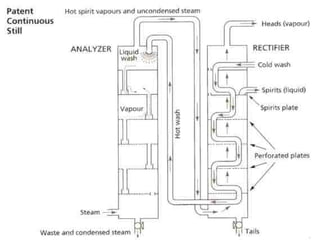
• This is also known as Coffey still because
Mr. Aneas Coffey patented it in 1830.
• Aneas Coffey patented an improvement
on an already existing model of which was
developed by Robert Stein.
• This is also known as a continuous still
because the entire process of distillation
gets completed in one continuous
operation.
Distillation
Distillation

Distillation

  • 1.
  • 2.
    DefinationDefination • Spirit isdefined as product of distillation of fermented beverage.
  • 3.
    DistillationDistillation • Distillation isthe process of separation of two miscible liquids by using difference in their boiling point. In present context the alcohol has to be separated from water after fermentation. • The evaporating temp. of ethyl alcohol is 78.5C where as for water is 100C.
  • 4.
    Method of DistillationMethodof Distillation • Traditionally there are two method of distillation. • Pot still • Patent still/ Coffey still/ Continuous still.
  • 5.
    Pot still DistillationPotstill Distillation • The pot is made from Copper • Size differ from place to place • Alcohol vaporize at 78.5 c • The Vapours passes through Condenser and converted to liquid • Liquid alcohol is collected into three parts Head Heart ( 30% Alcohol remaining water) Tail •
  • 6.
    Cont..Cont.. • The head& tail is collected in a separate vessel. • The head contains a lot of methyl alcohol & not suitable for consumption. • The head & tail are put back for re distillation with a fresh batch of alcohol water mixture. • The heart will be taken for a second distillation. The will also produce the same Head Heart ( 70% alcohol remaining water) Tail
  • 7.
    Cont..Cont.. • The spiritproduced by this method contains lot of congener element, which contributes to flavour & body of spirit. • Spirit, which produced, is Scotch malt whisky, Cognac, Dutch gin, Dark Rum, Tequila & some Polish vodka.
  • 9.
    Pot Still DistillationPotStill Distillation
  • 12.
    Patent Still/Coffey/ContinousPatent Still/Coffey/Continous •This is also known as Coffey still because Mr. Aneas Coffey patented it in 1830. • Aneas Coffey patented an improvement on an already existing model of which was developed by Robert Stein. • This is also known as a continuous still because the entire process of distillation gets completed in one continuous operation.