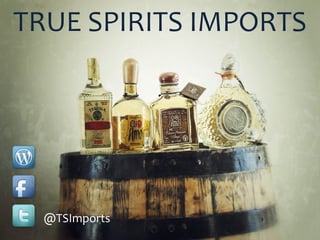
TRUE SPIRITS IMPORTS


  @TSImports
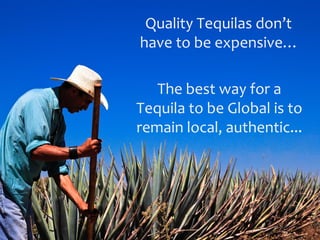
Quality Tequilas don’t
have to be expensive…

   The best way for a
Tequila to be Global is to
remain local, authentic...
When it comes to TRUE SPIRITS what really
         counts is on the inside...
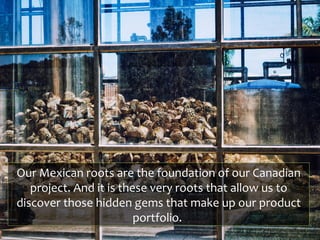
Our Mexican roots are the foundation of our Canadian
   project. And it is these very roots that allow us to
discover those hidden gems that make up our product
                         portfolio.
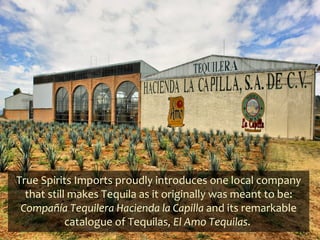
True Spirits Imports proudly introduces one local company
  that still makes Tequila as it originally was meant to be:
 Compañía Tequilera Hacienda la Capilla and its remarkable
            catalogue of Tequilas, El Amo Tequilas.
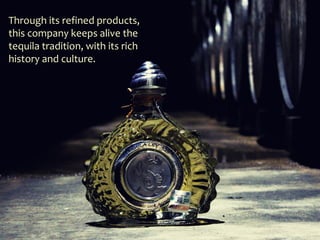
Through its refined products,
this company keeps alive the
tequila tradition, with its rich
history and culture.
Tequilas crafted
  with patience
and care offer a
    unique and
   unparalleled
experience. This
 is the standard
 for True Spirits
   Imports. We
  make luscious
     products
    available to
    discerning
   individuals.
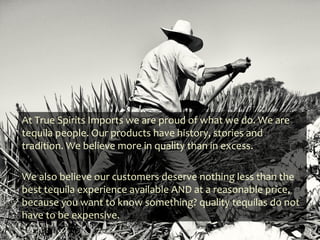
At True Spirits Imports we are proud of what we do. We are
tequila people. Our products have history, stories and
tradition. We believe more in quality than in excess.

We also believe our customers deserve nothing less than the
best tequila experience available AND at a reasonable price,
because you want to know something? quality tequilas do not
have to be expensive.
TEQUILA 101

Tequila came to life when the Spaniards arrived in Mexico around
1520. Applying the distillation techniques they had learned from the
Arabs to the ancient Mexican process of Pulque, the Spanish created
Tequila--an enigmatic and audacious spirit of mixed heritage.

As the first distilled spirit of North America, Tequila
holds an exuberant heritage and is slowly gaining its rightful place
with the finest whiskeys, brandies and cognacs. Legendary in Mexico
for centuries, True Spirits now offers the harmonic blend of a quality
Tequila spirit in Alberta, Canada
ORIGIN
 DENOMINATION/APPELLATION
        OF ORIGIN
In 1978, the "Appellation of Origin Tequila” was
registered before the World Intellectual Property Organization, (WIPO).
For a product to be labeled 'Tequila', it must be produced in the declared
territory of Mexico, and the producer must follow the Official Standard for
Tequila, known as NOM.

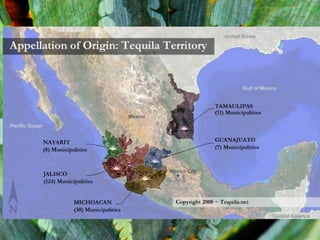
Jalisco:              125 municipalities
Michoacán:             30 municipalities
Nayarit:                8 municipalities
Guanajuato:             7 municipalities
Tamaulipas:             11 municipalities
TEQUILA REGIONS

The state of Jalisco is the most important region
for producing Tequila. 96% of total production
takes place here. It is convenient to separate production into zones
for the purpose of evaluating Tequilas, as there are unique qualities
characteristic that can be distinguished in the Tequilas that originate in each
zone. Each zone's climate and soil conditions give its agave a distinct and
special flavor. Two significant zones of note are:

1.) HIGHLANDS: Arandas, Atotonilco, Tepatitlan, Tototlan & Zapotlanejo
The average sugar content of the agave plants in this zone ranges between
26-27%, making the tequilas of this region sweeter, with fruity and flowery
notes.

2.) TEQUILA: Amatitan, Arenal, Magdalena & Tequila
The average sugar content of the agave plants in this zone ranges between
23-24%. The Tequilas from this region have a drier, earthy flavour.
*NOM = NORMA OFICIAL MEXICANA

 NOM is the Official Mexican Standard of Tequila that is regulated
 by the Mexican Government, which contains specifications to be followed by all
 individuals and companies producing Tequila. The NOM applies to all processes
 and activities related to the supply of agave, production, bottling, marketing,
 information and business practices linked to the distilled alcoholic beverage
 known as Tequila.


 Companies that comply with regulations are then certified by the CRT
 (Tequila Regulatory Council) and then granted a NOM registry
 number, a government regulated distillery number that distinguishes the
 Tequila as the unique product of an individual distillery. The # has to be
 displayed in their bottles.
a) TEQUILA CATEGORIES & CLASSES


1.) Tequila 100% Agave (bottled in origin). 100% of the sugars present in the
      spirit come from the BLUE WEBER AGAVE plant.
2.) Tequila 'Mixto' or 'mixed' (can be bottled outside of Mexico). 51% of the
      sugar present in the liquor come from the BLUE WEBER AGAVE plant.
      The remaining 49% come from different sources .


•    SILVER: Unaged tequila. Found in both 100% de agave and mixed
    tequilas
•    GOLD: Silver tequila colored with caramel. Found ONLY in MIXED
    tequilas
•    REPOSADO: Aged for a minimum of 2 months to a maximum of 11
    months. Found in 100% de Agave
•    AŃEJO: Aged for a minimum of 1 year to a maximum of 3 years
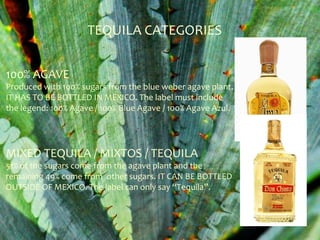
TEQUILA CATEGORIES


100% AGAVE
Produced with 100% sugars from the blue weber agave plant.
IT HAS TO BE BOTTLED IN MEXICO. The label must include
the legend: 100% Agave / 100% Blue Agave / 100% Agave Azul.


MIXED TEQUILA / MIXTOS / TEQUILA
51% of the sugars come from the agave plant and the
remaining 49% come from other sugars. IT CAN BE BOTTLED
OUTSIDE OF MEXICO. The label can only say “Tequila”.
The distilled alcoholic beverage known as Tequila
   can only be made using Agave of the species
   “tequilana weber blue variety”, grown in the
 federal states and municipalities indicated in the
                    Declaration.
Ideal conditions for the growth of agave plants include the
following:

*volcanic soils heavy in basalt and iron
*an elevation of approximately 1500 meters above sea level
*approximately 1 meter of annual precipitation
*a semi-dry climate with an average temperate of approximately 20
degrees Celsius

These conditions create robust agave and, subsequently great Tequila
in a relationship of 7:1 between the weight (kilograms) of the agave
and the volume (liters) of Tequila produced.
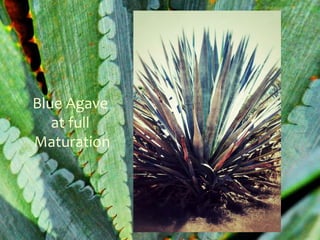
Blue Agave
   at full
Maturation
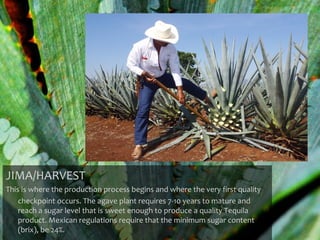
JIMA/HARVEST
This is where the production process begins and where the very first quality
    checkpoint occurs. The agave plant requires 7-10 years to mature and
    reach a sugar level that is sweet enough to produce a quality Tequila
    product. Mexican regulations require that the minimum sugar content
    (brix), be 24%.
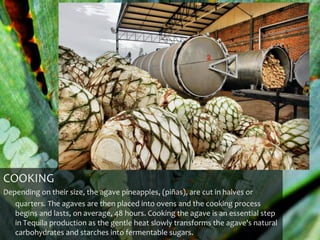
COOKING
Depending on their size, the agave pineapples, (piñas), are cut in halves or
   quarters. The agaves are then placed into ovens and the cooking process
   begins and lasts, on average, 48 hours. Cooking the agave is an essential step
   in Tequila production as the gentle heat slowly transforms the agave's natural
   carbohydrates and starches into fermentable sugars.
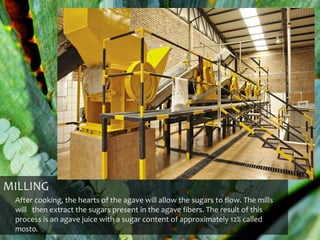
MILLING
 After cooking, the hearts of the agave will allow the sugars to flow. The mills
 will then extract the sugars present in the agave fibers. The result of this
 process is an agave juice with a sugar content of approximately 12% called
 mosto.
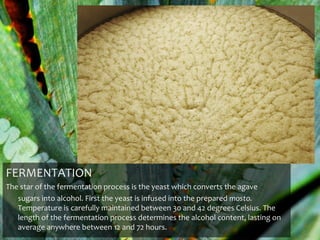
FERMENTATION
The star of the fermentation process is the yeast which converts the agave
   sugars into alcohol. First the yeast is infused into the prepared mosto.
   Temperature is carefully maintained between 30 and 42 degrees Celsius. The
   length of the fermentation process determines the alcohol content, lasting on
   average anywhere between 12 and 72 hours.
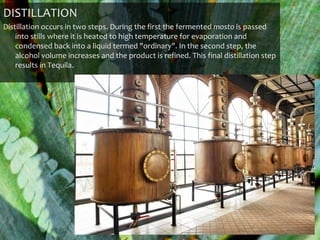
DISTILLATION
Distillation occurs in two steps. During the first the fermented mosto is passed
    into stills where it is heated to high temperature for evaporation and
    condensed back into a liquid termed "ordinary". In the second step, the
    alcohol volume increases and the product is refined. This final distillation step
    results in Tequila.
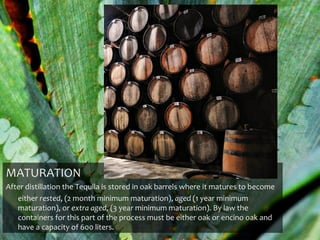
MATURATION
After distillation the Tequila is stored in oak barrels where it matures to become
   either rested, (2 month minimum maturation), aged (1 year minimum
   maturation), or extra aged, (3 year minimum maturation). By law the
   containers for this part of the process must be either oak or encino oak and
   have a capacity of 600 liters.
USEFUL FACTS, MYTHS, & TIPS

• NOM’s vs brands

• 4) 100% AGAVE SILVER TEQUILA is the building block
  for every other product. Always try this first.

• 5) 100% AGAVE legend on the bottle is not a
  guarantee of quality

• 6) WORM in the bottle is NOT a good sign.

• 7) 7 kgms of agave make 1 litre of tequila 100%
  AGAVE
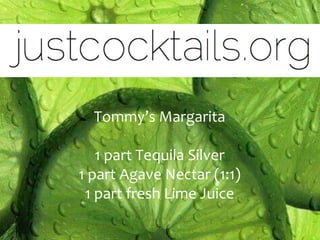
Tommy’s Margarita

   1 part Tequila Silver
1 part Agave Nectar (1:1)
 1 part fresh Lime Juice
agaveaficionados.wordpress.com/

facebook.com/truespiritsimports

@TSImports

@TSImports module 1- Introduction to Tequila

  • 1.
  • 2.
    Quality Tequilas don’t haveto be expensive… The best way for a Tequila to be Global is to remain local, authentic...
  • 3.
    When it comesto TRUE SPIRITS what really counts is on the inside...
  • 4.
    Our Mexican rootsare the foundation of our Canadian project. And it is these very roots that allow us to discover those hidden gems that make up our product portfolio.
  • 5.
    True Spirits Importsproudly introduces one local company that still makes Tequila as it originally was meant to be: Compañía Tequilera Hacienda la Capilla and its remarkable catalogue of Tequilas, El Amo Tequilas.
  • 6.
    Through its refinedproducts, this company keeps alive the tequila tradition, with its rich history and culture.
  • 7.
    Tequilas crafted with patience and care offer a unique and unparalleled experience. This is the standard for True Spirits Imports. We make luscious products available to discerning individuals.
  • 8.
    At True SpiritsImports we are proud of what we do. We are tequila people. Our products have history, stories and tradition. We believe more in quality than in excess. We also believe our customers deserve nothing less than the best tequila experience available AND at a reasonable price, because you want to know something? quality tequilas do not have to be expensive.
  • 9.
    TEQUILA 101 Tequila cameto life when the Spaniards arrived in Mexico around 1520. Applying the distillation techniques they had learned from the Arabs to the ancient Mexican process of Pulque, the Spanish created Tequila--an enigmatic and audacious spirit of mixed heritage. As the first distilled spirit of North America, Tequila holds an exuberant heritage and is slowly gaining its rightful place with the finest whiskeys, brandies and cognacs. Legendary in Mexico for centuries, True Spirits now offers the harmonic blend of a quality Tequila spirit in Alberta, Canada
  • 10.
    ORIGIN DENOMINATION/APPELLATION OF ORIGIN In 1978, the "Appellation of Origin Tequila” was registered before the World Intellectual Property Organization, (WIPO). For a product to be labeled 'Tequila', it must be produced in the declared territory of Mexico, and the producer must follow the Official Standard for Tequila, known as NOM. Jalisco: 125 municipalities Michoacán: 30 municipalities Nayarit: 8 municipalities Guanajuato: 7 municipalities Tamaulipas: 11 municipalities
  • 12.
    TEQUILA REGIONS The stateof Jalisco is the most important region for producing Tequila. 96% of total production takes place here. It is convenient to separate production into zones for the purpose of evaluating Tequilas, as there are unique qualities characteristic that can be distinguished in the Tequilas that originate in each zone. Each zone's climate and soil conditions give its agave a distinct and special flavor. Two significant zones of note are: 1.) HIGHLANDS: Arandas, Atotonilco, Tepatitlan, Tototlan & Zapotlanejo The average sugar content of the agave plants in this zone ranges between 26-27%, making the tequilas of this region sweeter, with fruity and flowery notes. 2.) TEQUILA: Amatitan, Arenal, Magdalena & Tequila The average sugar content of the agave plants in this zone ranges between 23-24%. The Tequilas from this region have a drier, earthy flavour.
  • 13.
    *NOM = NORMAOFICIAL MEXICANA NOM is the Official Mexican Standard of Tequila that is regulated by the Mexican Government, which contains specifications to be followed by all individuals and companies producing Tequila. The NOM applies to all processes and activities related to the supply of agave, production, bottling, marketing, information and business practices linked to the distilled alcoholic beverage known as Tequila. Companies that comply with regulations are then certified by the CRT (Tequila Regulatory Council) and then granted a NOM registry number, a government regulated distillery number that distinguishes the Tequila as the unique product of an individual distillery. The # has to be displayed in their bottles.
  • 14.
    a) TEQUILA CATEGORIES& CLASSES 1.) Tequila 100% Agave (bottled in origin). 100% of the sugars present in the spirit come from the BLUE WEBER AGAVE plant. 2.) Tequila 'Mixto' or 'mixed' (can be bottled outside of Mexico). 51% of the sugar present in the liquor come from the BLUE WEBER AGAVE plant. The remaining 49% come from different sources . • SILVER: Unaged tequila. Found in both 100% de agave and mixed tequilas • GOLD: Silver tequila colored with caramel. Found ONLY in MIXED tequilas • REPOSADO: Aged for a minimum of 2 months to a maximum of 11 months. Found in 100% de Agave • AŃEJO: Aged for a minimum of 1 year to a maximum of 3 years
  • 15.
    TEQUILA CATEGORIES 100% AGAVE Producedwith 100% sugars from the blue weber agave plant. IT HAS TO BE BOTTLED IN MEXICO. The label must include the legend: 100% Agave / 100% Blue Agave / 100% Agave Azul. MIXED TEQUILA / MIXTOS / TEQUILA 51% of the sugars come from the agave plant and the remaining 49% come from other sugars. IT CAN BE BOTTLED OUTSIDE OF MEXICO. The label can only say “Tequila”.
  • 16.
    The distilled alcoholicbeverage known as Tequila can only be made using Agave of the species “tequilana weber blue variety”, grown in the federal states and municipalities indicated in the Declaration. Ideal conditions for the growth of agave plants include the following: *volcanic soils heavy in basalt and iron *an elevation of approximately 1500 meters above sea level *approximately 1 meter of annual precipitation *a semi-dry climate with an average temperate of approximately 20 degrees Celsius These conditions create robust agave and, subsequently great Tequila in a relationship of 7:1 between the weight (kilograms) of the agave and the volume (liters) of Tequila produced.
  • 18.
    Blue Agave at full Maturation
  • 19.
    JIMA/HARVEST This is wherethe production process begins and where the very first quality checkpoint occurs. The agave plant requires 7-10 years to mature and reach a sugar level that is sweet enough to produce a quality Tequila product. Mexican regulations require that the minimum sugar content (brix), be 24%.
  • 20.
    COOKING Depending on theirsize, the agave pineapples, (piñas), are cut in halves or quarters. The agaves are then placed into ovens and the cooking process begins and lasts, on average, 48 hours. Cooking the agave is an essential step in Tequila production as the gentle heat slowly transforms the agave's natural carbohydrates and starches into fermentable sugars.
  • 21.
    MILLING After cooking,the hearts of the agave will allow the sugars to flow. The mills will then extract the sugars present in the agave fibers. The result of this process is an agave juice with a sugar content of approximately 12% called mosto.
  • 22.
    FERMENTATION The star ofthe fermentation process is the yeast which converts the agave sugars into alcohol. First the yeast is infused into the prepared mosto. Temperature is carefully maintained between 30 and 42 degrees Celsius. The length of the fermentation process determines the alcohol content, lasting on average anywhere between 12 and 72 hours.
  • 23.
    DISTILLATION Distillation occurs intwo steps. During the first the fermented mosto is passed into stills where it is heated to high temperature for evaporation and condensed back into a liquid termed "ordinary". In the second step, the alcohol volume increases and the product is refined. This final distillation step results in Tequila.
  • 24.
    MATURATION After distillation theTequila is stored in oak barrels where it matures to become either rested, (2 month minimum maturation), aged (1 year minimum maturation), or extra aged, (3 year minimum maturation). By law the containers for this part of the process must be either oak or encino oak and have a capacity of 600 liters.
  • 25.
    USEFUL FACTS, MYTHS,& TIPS • NOM’s vs brands • 4) 100% AGAVE SILVER TEQUILA is the building block for every other product. Always try this first. • 5) 100% AGAVE legend on the bottle is not a guarantee of quality • 6) WORM in the bottle is NOT a good sign. • 7) 7 kgms of agave make 1 litre of tequila 100% AGAVE
  • 26.
    Tommy’s Margarita 1 part Tequila Silver 1 part Agave Nectar (1:1) 1 part fresh Lime Juice
  • 27.

Editor's Notes

  • #3 OUR Premises A high price does not guarantee quality. At TRUE SPIRITS, our Tequila products will always provide you with excellent quality for exceptional value. Adhering to the old craft and staying true to its origins is how Tequila should be made. TRUE SPIRITS Tequilas are made in this way; they are the real thing. The real thing is bottled in Mexico; the entire process begins and ends there. Unlike many sub-contracted brands, our Tequilas are recognized and available in Mexico, for Mexicans who know how Tequila should be.
  • #4 At TRUE SPIRITS we know that the core is more important than the package. We know that we don't need flashy packaging, massive advertisement or accessories; our substance is more than enough. Our Tequilas are classics, made in Mexico, the right way, with no disguises. And we have the taste to prove it.
  • #9 At True Spirits Imports we are proud of what we do. We are tequila people. Our products have history, stories and tradition. We believe more in quality than in excess. We also believe our customers deserve nothing less than the best tequila experience available AND at a reasonable price, because you want to know something? quality tequilas do not have to be expensive.
  • #10 Gusano aclarar Sticking to the old craft and staying true to its origins is how tequila should be made. True Spirits tequilas are made this way, they are the real thing. The real thing is bottled in Mex. The entire process begins and ends there. Unlike many subcontracted brands, our tequilas are recognized and available in Mex, for mexicans who know how tequila should be.
  • #14 Types & classes of tequilas
  • #17 SILVER TASTING
  • #18 7-10 years to mature
  • #19 Agave blue weber tequilana british botanist REPOSADO TASTING
  • #20 Harvest of the agave = How do companies assure a steady supply of agave @ 24% sugar content ?
  • #25 ANEJO TASTING
  • #26 PREMIUM SILVER TASTING