RUM
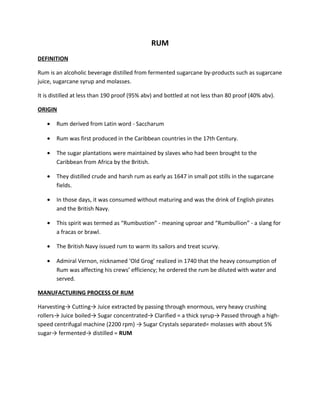
DEFINITION
Rum is an alcoholic beverage distilled from fermented sugarcane by-products such as sugarcane
juice, sugarcane syrup and molasses.
It is distilled at less than 190 proof (95% abv) and bottled at not less than 80 proof (40% abv).
ORIGIN
• Rum derived from Latin word - Saccharum
• Rum was first produced in the Caribbean countries in the 17th Century.
• The sugar plantations were maintained by slaves who had been brought to the
Caribbean from Africa by the British.
• They distilled crude and harsh rum as early as 1647 in small pot stills in the sugarcane
fields.
• In those days, it was consumed without maturing and was the drink of English pirates
and the British Navy.
• This spirit was termed as “Rumbustion” - meaning uproar and “Rumbullion” - a slang for
a fracas or brawl.
• The British Navy issued rum to warm its sailors and treat scurvy.
• Admiral Vernon, nicknamed ‘Old Grog’ realized in 1740 that the heavy consumption of
Rum was affecting his crews’ efficiency; he ordered the rum be diluted with water and
served.
MANUFACTURING PROCESS OF RUM
Harvesting→ Cutting→ Juice extracted by passing through enormous, very heavy crushing
rollers→ Juice boiled→ Sugar concentrated→ Clarified = a thick syrup→ Passed through a high-
speed centrifugal machine (2200 rpm) → Sugar Crystals separated= molasses with about 5%
sugar→ fermented→ distilled = RUM
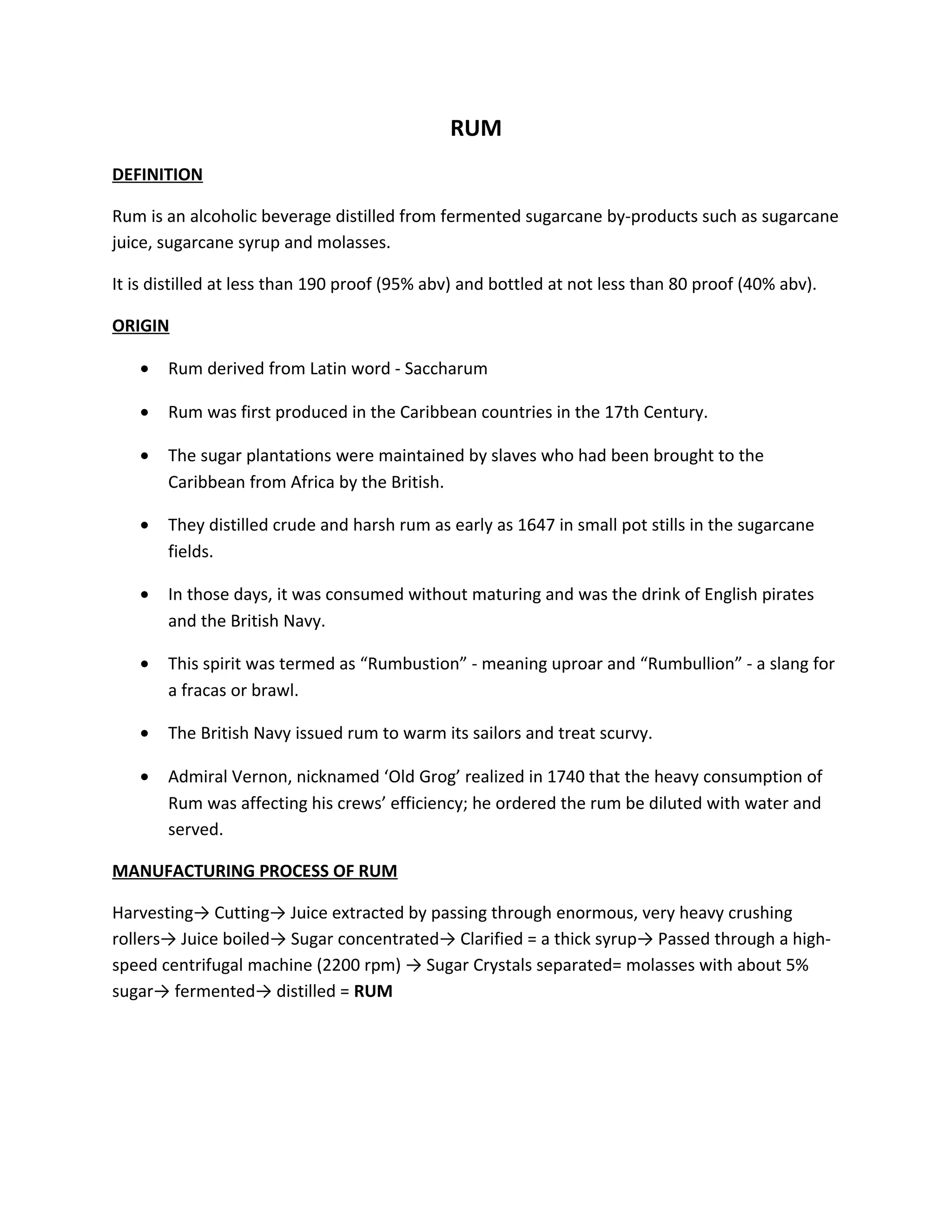
STYLES OF RUM
Puerto Rican Rums
• The molasses is fermented in huge vats together with some of the mash from previous
fermentation.
• Resultant wash is distilled in Patent Still.
• Filtered with sand and burnt oak.
• Very dry & light-bodied.
• Popular in Spanish-speaking countries like Puerto Rico, Cuba, Venezuela, Haiti, The
Virgin Islands, etc.
PRODUCTION OF PUERTO RICAN RUMS
Molasses taken in large vats
↓
+ water + slop from previous batch + cultured yeast
↓
= quick fermentation (2 to 4 days)
↓
Produces alcoholic wash with about 7% alcohol v/v
↓
Patent still (80% to 95% v/v)
↓
Aged in used, uncharred oak for1 to 4 years
↓
Filtered through alternate layers of sand & vegetable charcoal
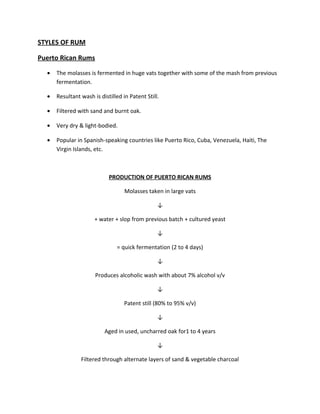
↓
Color adjustment with caramel
↓
Matured further, blended and bottled
VARIANTS
• White/Silver Rum - This is matured for a period of 1 year. It is lighter, paler & more
neutral.
• Amber/Gold Rum - This is matured for a period of 3 years. It is heavier, more
flavored, often older & deeper with more caramel.
• Vieux/Liqueur Rum - This is matured for a period of more than 6 years.
Jamaican Rums
• Rich, full-bodied & pungent.
• Distilled in Pot Still.
• It is non-filtered.
• Matured for more number of years.
• Popular in English-speaking countries like Jamaica, Trinidad, Barbados, Guyana, etc.
PRODUCTION OF JAMAICAN RUMS
Molasses taken in large vats
↓
+ water + dunder from sugar boilers
↓
Natural yeast spores settle on surface
↓
= slow fermentation (5 to 20 days)
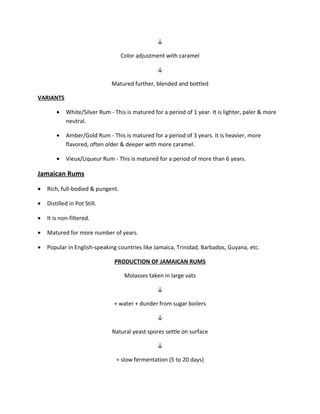
↓
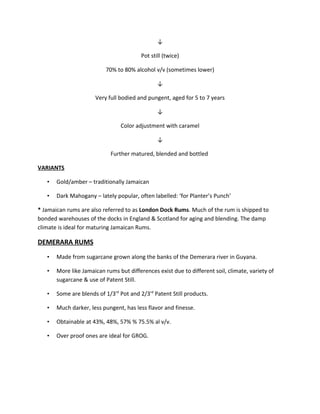
Pot still (twice)
70% to 80% alcohol v/v (sometimes lower)
↓
Very full bodied and pungent, aged for 5 to 7 years
↓
Color adjustment with caramel
↓
Further matured, blended and bottled
VARIANTS
• Gold/amber – traditionally Jamaican
• Dark Mahogany – lately popular, often labelled: ‘for Planter’s Punch’
* Jamaican rums are also referred to as London Dock Rums. Much of the rum is shipped to
bonded warehouses of the docks in England & Scotland for aging and blending. The damp
climate is ideal for maturing Jamaican Rums.
DEMERARA RUMS
• Made from sugarcane grown along the banks of the Demerara river in Guyana.
• More like Jamaican rums but differences exist due to different soil, climate, variety of
sugarcane & use of Patent Still.
• Some are blends of 1/3rd
Pot and 2/3rd
Patent Still products.
• Much darker, less pungent, has less flavor and finesse.
• Obtainable at 43%, 48%, 57% % 75.5% al v/v.
• Over proof ones are ideal for GROG.
USES OF RUM
• Drunk straight in rum-producing countries
• In The UK, The USA, etc. popular as base for mixed drinks
• Rum & Cola (Cuba Libre)
• In the kitchen – to flambé desserts, ice creams, fruit punch, candies, etc.
• Tobacco flavouring
BRAND NAMES
Puerto Rican – Bacardi, Daiquiri, Don Q, Tropicana, Dry Cane, White diamond, Ron Rico, Palo
Viejo, Ron Merito
Jamaican – Lemon Hart, Captain Morgan, Myers, Rope & Anchor, Appleton
Demerara – Lemon Hart, Captain Morgan, Lamb’s Navy, Old Jack Dark
USES OF RUM
• Drunk straight in rum-producing countries
• In The UK, The USA, etc. popular as base for mixed drinks
• Rum & Cola (Cuba Libre)
• In the kitchen – to flambé desserts, ice creams, fruit punch, candies, etc.
• Tobacco flavouring
BRAND NAMES
Puerto Rican – Bacardi, Daiquiri, Don Q, Tropicana, Dry Cane, White diamond, Ron Rico, Palo
Viejo, Ron Merito
Jamaican – Lemon Hart, Captain Morgan, Myers, Rope & Anchor, Appleton
Demerara – Lemon Hart, Captain Morgan, Lamb’s Navy, Old Jack Dark

7. rum

  • 1.
    RUM DEFINITION Rum is analcoholic beverage distilled from fermented sugarcane by-products such as sugarcane juice, sugarcane syrup and molasses. It is distilled at less than 190 proof (95% abv) and bottled at not less than 80 proof (40% abv). ORIGIN • Rum derived from Latin word - Saccharum • Rum was first produced in the Caribbean countries in the 17th Century. • The sugar plantations were maintained by slaves who had been brought to the Caribbean from Africa by the British. • They distilled crude and harsh rum as early as 1647 in small pot stills in the sugarcane fields. • In those days, it was consumed without maturing and was the drink of English pirates and the British Navy. • This spirit was termed as “Rumbustion” - meaning uproar and “Rumbullion” - a slang for a fracas or brawl. • The British Navy issued rum to warm its sailors and treat scurvy. • Admiral Vernon, nicknamed ‘Old Grog’ realized in 1740 that the heavy consumption of Rum was affecting his crews’ efficiency; he ordered the rum be diluted with water and served. MANUFACTURING PROCESS OF RUM Harvesting→ Cutting→ Juice extracted by passing through enormous, very heavy crushing rollers→ Juice boiled→ Sugar concentrated→ Clarified = a thick syrup→ Passed through a high- speed centrifugal machine (2200 rpm) → Sugar Crystals separated= molasses with about 5% sugar→ fermented→ distilled = RUM
  • 2.
    STYLES OF RUM PuertoRican Rums • The molasses is fermented in huge vats together with some of the mash from previous fermentation. • Resultant wash is distilled in Patent Still. • Filtered with sand and burnt oak. • Very dry & light-bodied. • Popular in Spanish-speaking countries like Puerto Rico, Cuba, Venezuela, Haiti, The Virgin Islands, etc. PRODUCTION OF PUERTO RICAN RUMS Molasses taken in large vats ↓ + water + slop from previous batch + cultured yeast ↓ = quick fermentation (2 to 4 days) ↓ Produces alcoholic wash with about 7% alcohol v/v ↓ Patent still (80% to 95% v/v) ↓ Aged in used, uncharred oak for1 to 4 years ↓ Filtered through alternate layers of sand & vegetable charcoal
  • 3.
    ↓ Color adjustment withcaramel ↓ Matured further, blended and bottled VARIANTS • White/Silver Rum - This is matured for a period of 1 year. It is lighter, paler & more neutral. • Amber/Gold Rum - This is matured for a period of 3 years. It is heavier, more flavored, often older & deeper with more caramel. • Vieux/Liqueur Rum - This is matured for a period of more than 6 years. Jamaican Rums • Rich, full-bodied & pungent. • Distilled in Pot Still. • It is non-filtered. • Matured for more number of years. • Popular in English-speaking countries like Jamaica, Trinidad, Barbados, Guyana, etc. PRODUCTION OF JAMAICAN RUMS Molasses taken in large vats ↓ + water + dunder from sugar boilers ↓ Natural yeast spores settle on surface ↓ = slow fermentation (5 to 20 days)
  • 4.
    ↓ Pot still (twice) 70%to 80% alcohol v/v (sometimes lower) ↓ Very full bodied and pungent, aged for 5 to 7 years ↓ Color adjustment with caramel ↓ Further matured, blended and bottled VARIANTS • Gold/amber – traditionally Jamaican • Dark Mahogany – lately popular, often labelled: ‘for Planter’s Punch’ * Jamaican rums are also referred to as London Dock Rums. Much of the rum is shipped to bonded warehouses of the docks in England & Scotland for aging and blending. The damp climate is ideal for maturing Jamaican Rums. DEMERARA RUMS • Made from sugarcane grown along the banks of the Demerara river in Guyana. • More like Jamaican rums but differences exist due to different soil, climate, variety of sugarcane & use of Patent Still. • Some are blends of 1/3rd Pot and 2/3rd Patent Still products. • Much darker, less pungent, has less flavor and finesse. • Obtainable at 43%, 48%, 57% % 75.5% al v/v. • Over proof ones are ideal for GROG.
  • 5.
    USES OF RUM •Drunk straight in rum-producing countries • In The UK, The USA, etc. popular as base for mixed drinks • Rum & Cola (Cuba Libre) • In the kitchen – to flambé desserts, ice creams, fruit punch, candies, etc. • Tobacco flavouring BRAND NAMES Puerto Rican – Bacardi, Daiquiri, Don Q, Tropicana, Dry Cane, White diamond, Ron Rico, Palo Viejo, Ron Merito Jamaican – Lemon Hart, Captain Morgan, Myers, Rope & Anchor, Appleton Demerara – Lemon Hart, Captain Morgan, Lamb’s Navy, Old Jack Dark
  • 6.
    USES OF RUM •Drunk straight in rum-producing countries • In The UK, The USA, etc. popular as base for mixed drinks • Rum & Cola (Cuba Libre) • In the kitchen – to flambé desserts, ice creams, fruit punch, candies, etc. • Tobacco flavouring BRAND NAMES Puerto Rican – Bacardi, Daiquiri, Don Q, Tropicana, Dry Cane, White diamond, Ron Rico, Palo Viejo, Ron Merito Jamaican – Lemon Hart, Captain Morgan, Myers, Rope & Anchor, Appleton Demerara – Lemon Hart, Captain Morgan, Lamb’s Navy, Old Jack Dark