K.ARUNKUMAR AIT-07-002 Temperature Transducer
It is a temperature monitoring device. The four most common temperature transducers: the thermocouple the RTD(Resistance Temperature Detector), the thermistor and  the IC (Integrated Circuit) sensor What is?
Thermocouple Two dissimilar metals connected to form two junctions is called  thermocouple . The emf developed in the circuit is thermo electric emf. The current through the circuit is called thermoelectric current this effect is called  thermoelectric effect  or  Seebeck effect .
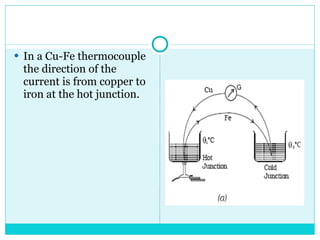
In a Cu-Fe thermocouple the direction of the current is from copper to iron at the hot junction.
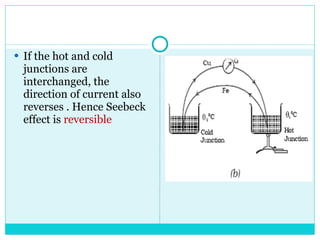
If the hot and cold junctions are interchanged, the direction of current also reverses . Hence Seebeck effect is  reversible
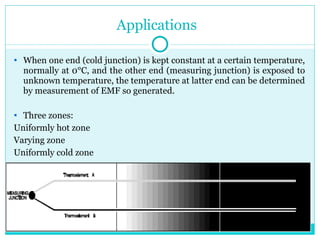
Applications  When one end (cold junction) is kept constant at a certain temperature, normally at 0°C, and the other end (measuring junction) is exposed to unknown temperature, the temperature at latter end can be determined by measurement of EMF so generated. Three zones: Uniformly hot zone  Varying zone Uniformly cold zone
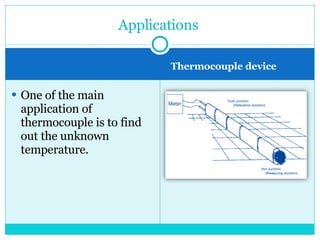
One of the main application of thermocouple is to find out the unknown temperature. Applications  Thermocouple device
Standard thermocouple types They differ only by the way of pair of metals that forms the thermocouple. Base metal type: T,J,E,K,N Nobel metal types: S,R,B
Advantages  Self powered Simple strong Inexpensive Wide variety of physical forms  Wide temperature range
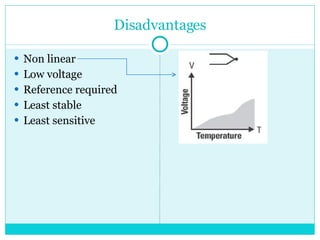
Disadvantages Non linear Low voltage Reference required Least stable Least sensitive
RTD(Resistance Temperature Detector) An RTD  is basically a  temperature sensitive  resistor. It is a  positive temperature coefficient device . As like thermocouple it doesn't produce any voltage  by itself.  It is used in electrical appliances such as motors, generators etc;
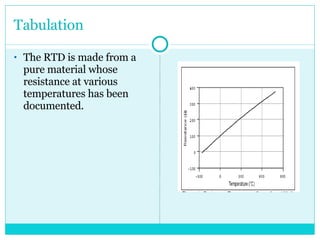
Tabulation  The RTD is made from a pure material whose resistance at various temperatures has been documented.
When voltage is passed to the RTD connected device there is a voltage drop across the RTD element. By that voltage drop the resistance of the RTD element can be easily determined. Then by tabulating the resistance value in the table, the temperature of the device can be measured.
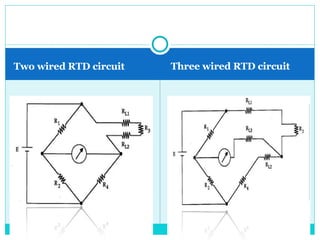
Two wired RTD circuit Three wired RTD circuit
Common Resistance Materials for RTDs Platinum (most popular and accurate)  Nickel Copper  Balco (rare) Tungsten (rare)
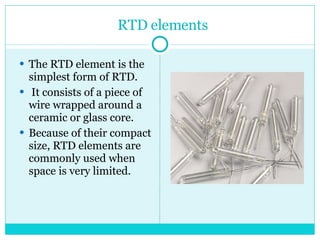
RTD elements The RTD element is the simplest form of RTD. It consists of a piece of wire wrapped around a ceramic or glass core.  Because of their compact size, RTD elements are commonly used when space is very limited.
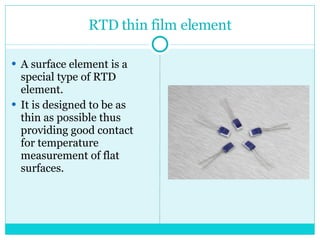
RTD thin film element A surface element is a special type of RTD element.  It is designed to be as thin as possible thus providing good contact for temperature measurement of flat surfaces.
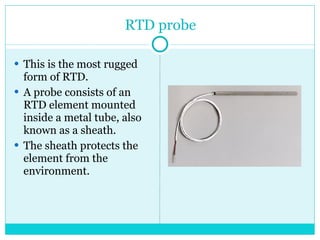
RTD probe This is the most rugged form of RTD.  A probe consists of an RTD element mounted inside a metal tube, also known as a sheath.  The sheath protects the element from the environment.
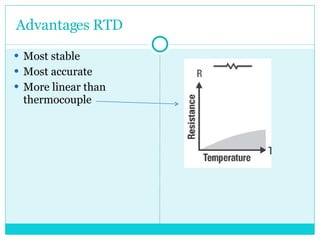
Advantages RTD   Most stable Most accurate More linear than thermocouple
Disadvantages  Expensive Slow Current source required Small resistance change Four-wire measurement
Thank   you

Temperature Transducer

  • 1.
  • 2.
    It is atemperature monitoring device. The four most common temperature transducers: the thermocouple the RTD(Resistance Temperature Detector), the thermistor and the IC (Integrated Circuit) sensor What is?
  • 3.
    Thermocouple Two dissimilarmetals connected to form two junctions is called thermocouple . The emf developed in the circuit is thermo electric emf. The current through the circuit is called thermoelectric current this effect is called thermoelectric effect or Seebeck effect .
  • 4.
    In a Cu-Fethermocouple the direction of the current is from copper to iron at the hot junction.
  • 5.
    If the hotand cold junctions are interchanged, the direction of current also reverses . Hence Seebeck effect is reversible
  • 6.
    Applications Whenone end (cold junction) is kept constant at a certain temperature, normally at 0°C, and the other end (measuring junction) is exposed to unknown temperature, the temperature at latter end can be determined by measurement of EMF so generated. Three zones: Uniformly hot zone Varying zone Uniformly cold zone
  • 7.
    One of themain application of thermocouple is to find out the unknown temperature. Applications Thermocouple device
  • 8.
    Standard thermocouple typesThey differ only by the way of pair of metals that forms the thermocouple. Base metal type: T,J,E,K,N Nobel metal types: S,R,B
  • 9.
    Advantages Selfpowered Simple strong Inexpensive Wide variety of physical forms Wide temperature range
  • 10.
    Disadvantages Non linearLow voltage Reference required Least stable Least sensitive
  • 11.
    RTD(Resistance Temperature Detector)An RTD is basically a temperature sensitive resistor. It is a positive temperature coefficient device . As like thermocouple it doesn't produce any voltage by itself. It is used in electrical appliances such as motors, generators etc;
  • 12.
    Tabulation TheRTD is made from a pure material whose resistance at various temperatures has been documented.
  • 13.
    When voltage ispassed to the RTD connected device there is a voltage drop across the RTD element. By that voltage drop the resistance of the RTD element can be easily determined. Then by tabulating the resistance value in the table, the temperature of the device can be measured.
  • 14.
    Two wired RTDcircuit Three wired RTD circuit
  • 15.
    Common Resistance Materialsfor RTDs Platinum (most popular and accurate) Nickel Copper Balco (rare) Tungsten (rare)
  • 16.
    RTD elements TheRTD element is the simplest form of RTD. It consists of a piece of wire wrapped around a ceramic or glass core. Because of their compact size, RTD elements are commonly used when space is very limited.
  • 17.
    RTD thin filmelement A surface element is a special type of RTD element. It is designed to be as thin as possible thus providing good contact for temperature measurement of flat surfaces.
  • 18.
    RTD probe Thisis the most rugged form of RTD. A probe consists of an RTD element mounted inside a metal tube, also known as a sheath. The sheath protects the element from the environment.
  • 19.
    Advantages RTD Most stable Most accurate More linear than thermocouple
  • 20.
    Disadvantages ExpensiveSlow Current source required Small resistance change Four-wire measurement
  • 21.
    Thank you