MEMS Thermal Sensors
Dr.D.Sindhanaiselvi
PTU
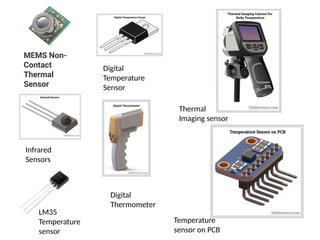
MEMS Non-
Contact
Thermal
Sensor
Digital
Temperature
Sensor
Thermal
Imaging sensor
Infrared
Sensors
Digital
Thermometer
Temperature
sensor on PCB
LM35
Temperature
sensor
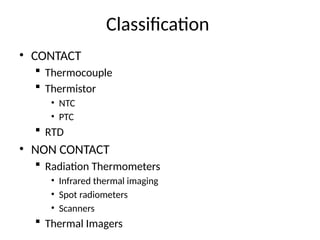
Classification
• CONTACT
 Thermocouple
 Thermistor
• NTC
• PTC
 RTD
• NON CONTACT
 Radiation Thermometers
• Infrared thermal imaging
• Spot radiometers
• Scanners
 Thermal Imagers
TEMPERATURE COEFFICIENT OF
RESISTANCE:
• The temperature coefficient of resistance is COEFFICIENT OF
RESISTANCE generally defined as the change in electrical
resistance of a substance with respect to per degree change in
temperature.
• The electrical resistance of conductors such as gold,
aluminium, silver, copper, it all depends upon the process of
collision between the electrons within the material.
• When the temperature increases, the process of electron
collision becomes rapid and faster.
• As a result, the resistance will increase with the rise in
temperature of the conductor.
• Consider a conductor whose resistance at 0°C is R0 and the
resistance at a temperature T°C is RT. The relation between
temperature and resistances R0 and RT is approximately given as
• RT = R0 [1+ α (T-T0)];
• RT = R0 [1+ α (∆T)]
• The above equation that the change in electrical resistance of any
substance due to temperature depends mainly on three factors –
– The value of resistance at an initial temperature.
– The rise in temperature.
– The temperature coefficient of resistance α.
• The value of α can vary depending on the type of material.
• In metals, as the temperature increases the electrons attain more
kinetic energy, thus more speed to undergo frequent collisions.
• We know that the resistivity of any substance is given by
• ρ = m/nq2
τ
RELATION BETWEEN TEMPERATURE AND RESISTANCE
• So, the resistivity depends on the number of charge
carriers per unit volume n and the relaxation time τ
between collisions. When the temperature of the metal
is increased, the average velocity of the current carriers
i.e the electrons increases and result in more collisions.
• This means that the average time between successive
collisions τ decreases. But the change in the value of n
due to the increase in temperature is negligible which
further means that the value of resistivity now is
dependent only on the change in τ.
TYPES OF TEMPERATURE COEFFICIENT
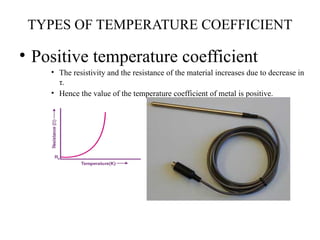
• Positive temperature coefficient
• The resistivity and the resistance of the material increases due to decrease in
τ.
• Hence the value of the temperature coefficient of metal is positive.
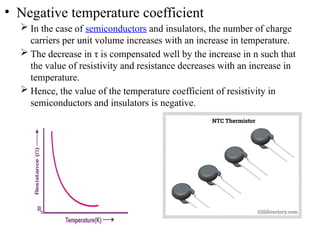
• Negative temperature coefficient
 In the case of semiconductors and insulators, the number of charge
carriers per unit volume increases with an increase in temperature.
 The decrease in τ is compensated well by the increase in n such that
the value of resistivity and resistance decreases with an increase in
temperature.
 Hence, the value of the temperature coefficient of resistivity in
semiconductors and insulators is negative.
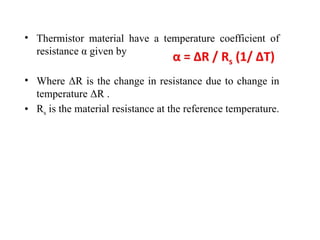
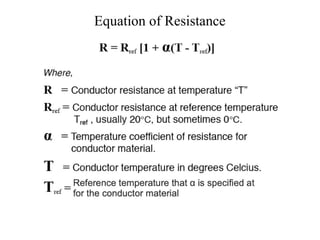
• Thermistor material have a temperature coefficient of
resistance α given by
• Where ΔR is the change in resistance due to change in
temperature ΔR .
• Rs is the material resistance at the reference temperature.
Equation of Resistance
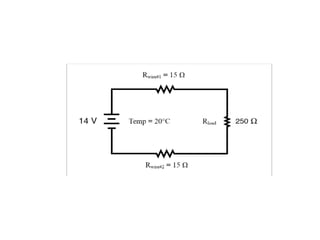
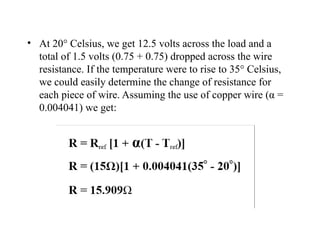
• At 20° Celsius, we get 12.5 volts across the load and a
total of 1.5 volts (0.75 + 0.75) dropped across the wire
resistance. If the temperature were to rise to 35° Celsius,
we could easily determine the change of resistance for
each piece of wire. Assuming the use of copper wire (α =
0.004041) we get:
THERMOELECTRICITY
Thermoelectricity is the direct and thermodynamically
reversible conversion of heat to electricity and vice versa.
It is encompassed by three differentiated effects that are:
1. Seeback effect
2. Peltier effect
3. Thompson effect
Seeback Effect & Peltier Effect
• Seeback effect is a phenomenon in which a
temperature difference between two dissimilar
electrical conductors or semiconductors produces a
voltage difference between the two substances.
• Peltier effect, the cooling of one junction and the
heating of the other when electric current is
maintained in a circuit of material consisting of two
dissimilar conductors, the effect is even stronger in
circuits containing dissimilar semiconductors.
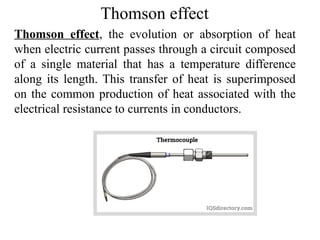
Thomson effect
Thomson effect, the evolution or absorption of heat
when electric current passes through a circuit composed
of a single material that has a temperature difference
along its length. This transfer of heat is superimposed
on the common production of heat associated with the
electrical resistance to currents in conductors.
THERMOCOUPLE
• A thermocouple is defined as a thermal junction that
functions based on the phenomenon of the thermoelectric
effect, i.e. the direct conversion of temperature differences
to an electric voltage.
• It is an electrical device or sensor used to measure
temperature.
• A thermocouple can measure a wide range of temperatures.
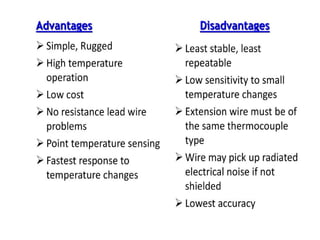
• It is a simple, robust, and cost-effective temperature sensor
used in various industrial applications, home, office, and
commercial applications.
Working of Thermocouple
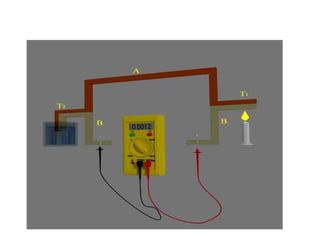
• A thermocouple consists of two plates of different
metals.
• Both plates are connected at one end and make a
junction.
• The junction is placed on the element or surface
where we want to measure the temperature.
• This junction is known as a hot junction.
• And the second end of the plate is kept at a lower
temperature (room temperature).
• This junction is known as a cold junction or
reference junction.
• According to the Seebeck effect, the temperature
difference between the two different metals induces
the potential differences between two points of the
thermocouple plates.
• If the circuit is closed, a very small amount of current
will flow through the circuit.
• A voltmeter is connected to the circuit.
• The voltage measured by the voltmeter is a function
of a temperature difference between two junctions.
Types of Thermocouples
• According to different types of combinations of alloys,
the thermocouples are available in different types.
• The type of thermocouple is chosen according to the
application, cost, availability, stability, chemical
properties, output, and temperature ranges.
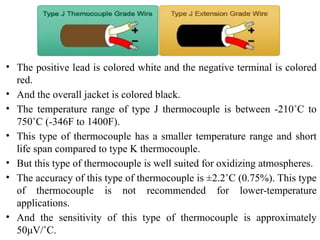
Type J Thermocouple
• This type of thermocouple is a low-cost and most used
thermocouple.
• The positive lead is made of iron and a negative lead is
made of constantan (45% nickel and 55% copper).
• Thermocouple grade wire, -346 to 1,400F (-210 to 760C)
• Extension wire, 32 to 392F (0 to 200C)
• The positive lead is colored white and the negative terminal is colored
red.
• And the overall jacket is colored black.
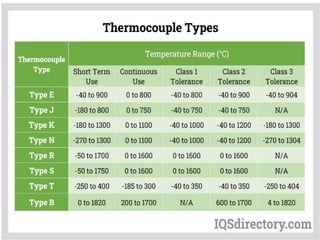
• The temperature range of type J thermocouple is between -210˚C to
750˚C (-346F to 1400F).
• This type of thermocouple has a smaller temperature range and short
life span compared to type K thermocouple.
• But this type of thermocouple is well suited for oxidizing atmospheres.
• The accuracy of this type of thermocouple is ±2.2˚C (0.75%). This type
of thermocouple is not recommended for lower-temperature
applications.
• And the sensitivity of this type of thermocouple is approximately
50μV/˚C.
Type K Thermocouple
• The K-type thermocouple is the most common type of
thermocouple, and it has the widest temperature measuring range.
• The positive lead of Type K thermocouple is composed of
approximately 90% nickel and 10% chromium.
• The negative lead is composed of approximately 95% nickel, 2%
aluminum, 2% manganese, and 1% silicon.
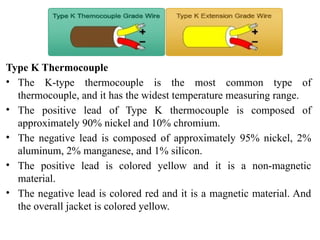
• The positive lead is colored yellow and it is a non-magnetic
material.
• The negative lead is colored red and it is a magnetic material. And
the overall jacket is colored yellow.
• The temperature range of type K thermocouple is -200˚C
to +1260˚C (-328 F to +2300 F).
• It is inexpensive and widely used in general-purpose
applications where temperature sensitivity requires
approximately 41μV/˚C.
• The accuracy of type K thermocouple is ±2.2 C%
(0.75%).
• The accuracy of thermocouples also depends on the
deviation in alloys
APPLICATIONS OF THERMOCOUPLE
• Thermocouples are used widely across the different
industrial and scientific applications.
• Some of the most common application areas of
thermocouples are;
• Industrial sectors
Power generation
Steel mills
Biotech
Pharmaceutical
Cement
Oil & Gas Industry
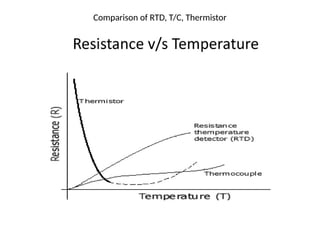
Comparison of RTD, T/C, Thermistor
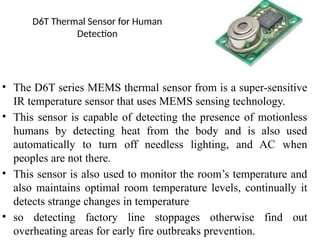
D6T Thermal Sensor for Human
Detection
• The D6T series MEMS thermal sensor from is a super-sensitive
IR temperature sensor that uses MEMS sensing technology.
• This sensor is capable of detecting the presence of motionless
humans by detecting heat from the body and is also used
automatically to turn off needless lighting, and AC when
peoples are not there.
• This sensor is also used to monitor the room’s temperature and
also maintains optimal room temperature levels, continually it
detects strange changes in temperature
• so detecting factory line stoppages otherwise find out
overheating areas for early fire outbreaks prevention.
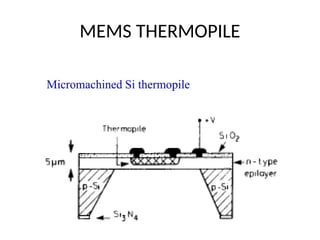
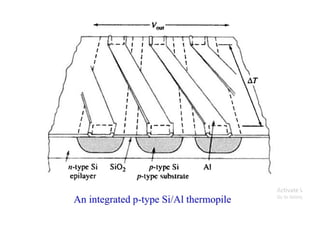
MEMS THERMOPILE
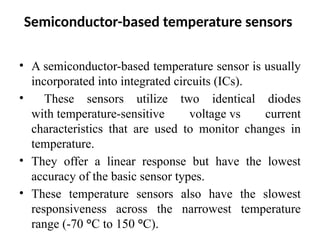
Semiconductor-based temperature sensors
• A semiconductor-based temperature sensor is usually
incorporated into integrated circuits (ICs).
• These sensors utilize two identical diodes
with temperature-sensitive voltage vs current
characteristics that are used to monitor changes in
temperature.
• They offer a linear response but have the lowest
accuracy of the basic sensor types.
• These temperature sensors also have the slowest
responsiveness across the narrowest temperature
range (-70 °C to 150 °C).
• https://byjus.com/jee/temperature-coefficient
-of-resistance
/
• https://www.precisionmass.com/types-and-ap
plications-of-thermocouple
/
• https://www.ametherm.com/blog/thermistor
s/temperature-sensor-types

MEMS Thermal Sensors .pptx

  • 1.
  • 2.
  • 3.
    Classification • CONTACT  Thermocouple Thermistor • NTC • PTC  RTD • NON CONTACT  Radiation Thermometers • Infrared thermal imaging • Spot radiometers • Scanners  Thermal Imagers
  • 4.
    TEMPERATURE COEFFICIENT OF RESISTANCE: •The temperature coefficient of resistance is COEFFICIENT OF RESISTANCE generally defined as the change in electrical resistance of a substance with respect to per degree change in temperature. • The electrical resistance of conductors such as gold, aluminium, silver, copper, it all depends upon the process of collision between the electrons within the material. • When the temperature increases, the process of electron collision becomes rapid and faster. • As a result, the resistance will increase with the rise in temperature of the conductor.
  • 5.
    • Consider aconductor whose resistance at 0°C is R0 and the resistance at a temperature T°C is RT. The relation between temperature and resistances R0 and RT is approximately given as • RT = R0 [1+ α (T-T0)]; • RT = R0 [1+ α (∆T)] • The above equation that the change in electrical resistance of any substance due to temperature depends mainly on three factors – – The value of resistance at an initial temperature. – The rise in temperature. – The temperature coefficient of resistance α. • The value of α can vary depending on the type of material. • In metals, as the temperature increases the electrons attain more kinetic energy, thus more speed to undergo frequent collisions. • We know that the resistivity of any substance is given by • ρ = m/nq2 τ RELATION BETWEEN TEMPERATURE AND RESISTANCE
  • 6.
    • So, theresistivity depends on the number of charge carriers per unit volume n and the relaxation time τ between collisions. When the temperature of the metal is increased, the average velocity of the current carriers i.e the electrons increases and result in more collisions. • This means that the average time between successive collisions τ decreases. But the change in the value of n due to the increase in temperature is negligible which further means that the value of resistivity now is dependent only on the change in τ.
  • 7.
    TYPES OF TEMPERATURECOEFFICIENT • Positive temperature coefficient • The resistivity and the resistance of the material increases due to decrease in τ. • Hence the value of the temperature coefficient of metal is positive.
  • 8.
    • Negative temperaturecoefficient  In the case of semiconductors and insulators, the number of charge carriers per unit volume increases with an increase in temperature.  The decrease in τ is compensated well by the increase in n such that the value of resistivity and resistance decreases with an increase in temperature.  Hence, the value of the temperature coefficient of resistivity in semiconductors and insulators is negative.
  • 9.
    • Thermistor materialhave a temperature coefficient of resistance α given by • Where ΔR is the change in resistance due to change in temperature ΔR . • Rs is the material resistance at the reference temperature.
  • 11.
  • 13.
    • At 20°Celsius, we get 12.5 volts across the load and a total of 1.5 volts (0.75 + 0.75) dropped across the wire resistance. If the temperature were to rise to 35° Celsius, we could easily determine the change of resistance for each piece of wire. Assuming the use of copper wire (α = 0.004041) we get:
  • 14.
    THERMOELECTRICITY Thermoelectricity is thedirect and thermodynamically reversible conversion of heat to electricity and vice versa. It is encompassed by three differentiated effects that are: 1. Seeback effect 2. Peltier effect 3. Thompson effect
  • 15.
    Seeback Effect &Peltier Effect • Seeback effect is a phenomenon in which a temperature difference between two dissimilar electrical conductors or semiconductors produces a voltage difference between the two substances. • Peltier effect, the cooling of one junction and the heating of the other when electric current is maintained in a circuit of material consisting of two dissimilar conductors, the effect is even stronger in circuits containing dissimilar semiconductors.
  • 16.
    Thomson effect Thomson effect,the evolution or absorption of heat when electric current passes through a circuit composed of a single material that has a temperature difference along its length. This transfer of heat is superimposed on the common production of heat associated with the electrical resistance to currents in conductors.
  • 17.
    THERMOCOUPLE • A thermocoupleis defined as a thermal junction that functions based on the phenomenon of the thermoelectric effect, i.e. the direct conversion of temperature differences to an electric voltage. • It is an electrical device or sensor used to measure temperature. • A thermocouple can measure a wide range of temperatures. • It is a simple, robust, and cost-effective temperature sensor used in various industrial applications, home, office, and commercial applications.
  • 18.
    Working of Thermocouple •A thermocouple consists of two plates of different metals. • Both plates are connected at one end and make a junction. • The junction is placed on the element or surface where we want to measure the temperature. • This junction is known as a hot junction. • And the second end of the plate is kept at a lower temperature (room temperature). • This junction is known as a cold junction or reference junction.
  • 20.
    • According tothe Seebeck effect, the temperature difference between the two different metals induces the potential differences between two points of the thermocouple plates. • If the circuit is closed, a very small amount of current will flow through the circuit. • A voltmeter is connected to the circuit. • The voltage measured by the voltmeter is a function of a temperature difference between two junctions.
  • 22.
    Types of Thermocouples •According to different types of combinations of alloys, the thermocouples are available in different types. • The type of thermocouple is chosen according to the application, cost, availability, stability, chemical properties, output, and temperature ranges. Type J Thermocouple • This type of thermocouple is a low-cost and most used thermocouple. • The positive lead is made of iron and a negative lead is made of constantan (45% nickel and 55% copper). • Thermocouple grade wire, -346 to 1,400F (-210 to 760C) • Extension wire, 32 to 392F (0 to 200C)
  • 23.
    • The positivelead is colored white and the negative terminal is colored red. • And the overall jacket is colored black. • The temperature range of type J thermocouple is between -210˚C to 750˚C (-346F to 1400F). • This type of thermocouple has a smaller temperature range and short life span compared to type K thermocouple. • But this type of thermocouple is well suited for oxidizing atmospheres. • The accuracy of this type of thermocouple is ±2.2˚C (0.75%). This type of thermocouple is not recommended for lower-temperature applications. • And the sensitivity of this type of thermocouple is approximately 50μV/˚C.
  • 24.
    Type K Thermocouple •The K-type thermocouple is the most common type of thermocouple, and it has the widest temperature measuring range. • The positive lead of Type K thermocouple is composed of approximately 90% nickel and 10% chromium. • The negative lead is composed of approximately 95% nickel, 2% aluminum, 2% manganese, and 1% silicon. • The positive lead is colored yellow and it is a non-magnetic material. • The negative lead is colored red and it is a magnetic material. And the overall jacket is colored yellow.
  • 25.
    • The temperaturerange of type K thermocouple is -200˚C to +1260˚C (-328 F to +2300 F). • It is inexpensive and widely used in general-purpose applications where temperature sensitivity requires approximately 41μV/˚C. • The accuracy of type K thermocouple is ±2.2 C% (0.75%). • The accuracy of thermocouples also depends on the deviation in alloys
  • 27.
    APPLICATIONS OF THERMOCOUPLE •Thermocouples are used widely across the different industrial and scientific applications. • Some of the most common application areas of thermocouples are; • Industrial sectors Power generation Steel mills Biotech Pharmaceutical Cement Oil & Gas Industry
  • 28.
    Comparison of RTD,T/C, Thermistor
  • 29.
    D6T Thermal Sensorfor Human Detection • The D6T series MEMS thermal sensor from is a super-sensitive IR temperature sensor that uses MEMS sensing technology. • This sensor is capable of detecting the presence of motionless humans by detecting heat from the body and is also used automatically to turn off needless lighting, and AC when peoples are not there. • This sensor is also used to monitor the room’s temperature and also maintains optimal room temperature levels, continually it detects strange changes in temperature • so detecting factory line stoppages otherwise find out overheating areas for early fire outbreaks prevention.
  • 30.
  • 32.
    Semiconductor-based temperature sensors •A semiconductor-based temperature sensor is usually incorporated into integrated circuits (ICs). • These sensors utilize two identical diodes with temperature-sensitive voltage vs current characteristics that are used to monitor changes in temperature. • They offer a linear response but have the lowest accuracy of the basic sensor types. • These temperature sensors also have the slowest responsiveness across the narrowest temperature range (-70 °C to 150 °C).
  • 33.