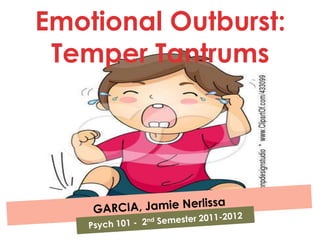
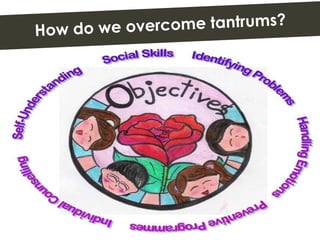
Emotional Outburst:
Temper Tantrums
Tantrum is defined as:
emotional “explosions” designed to express extreme personal displeasure.

A behavior usually associated with emotional distress.
a behavior that attempts to manipulate others towards a desired end.
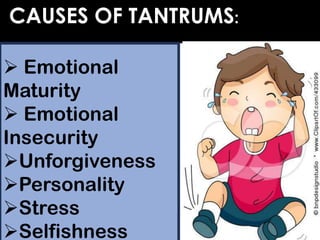
CAUSES OF TANTRUMS:
 Emotional
Maturity
 Emotional
Insecurity
Unforgiveness
Personality
Stress
Selfishness
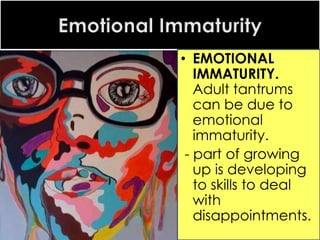
• EMOTIONAL
IMMATURITY.
Adult tantrums
can be due to
emotional
immaturity.
- part of growing
up is developing
to skills to deal
with
disappointments.
By the end
of the teen
years the
skills should
be in
place.
 EMOTIONAL
INSECURITY. Emotional
insecurity in adulthood
can prompt tantrums.
Emotional insecurity
produces frustration
with life. Little is
needed in the way of
additional frustration or
disappointment to
spark and emotional
outburst.
 UNFORGIVENESS.
Unforgiveness motivates
adult tantrums because
the person feels they are
already the victims of
injustice. The otherwise
minor setbacks of the day
can cause lingering
feelings of being treated
unjustly by others to
transition into anger.
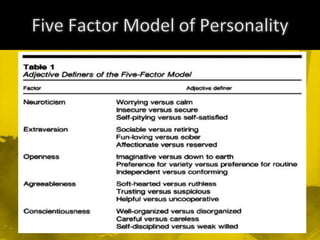
 PERSONALITY. Adult
tantrums can be related to
personality traits. The five
factor model of personality
includes a dimension labeled
“neuroticism” that includes
characteristics associated
with tantrum-like acting out.
High neuroticism could cause
people to have a tendency
towards emotional
outbursts.
SSTRESS
STRESS. Stress is the
inability to manage the
demands of two or
more priorities in life or
due to our inability to
successfully resolve
inconsistencies
between two or more
demands on us.
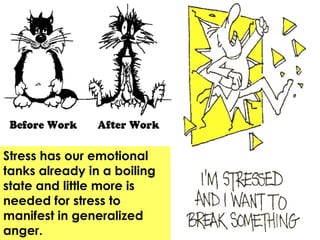
Stress has our emotional
tanks already in a boiling
state and little more is
needed for stress to
manifest in generalized
anger.
SELFISHNESS
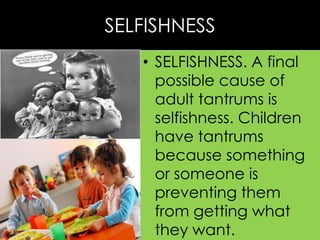
• SELFISHNESS. A final
possible cause of
adult tantrums is
selfishness. Children
have tantrums
because something
or someone is
preventing them
from getting what
they want.
Guidance and Counseling
• Guidance and Counseling is provided
in almost all schools, may it be tertiary,
secondary or primary schools.
• Seeking professional help is useful
especially when tantrums severely
affect your life.
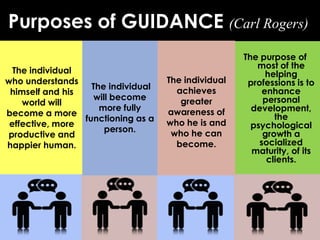
Purposes of GUIDANCE (Carl Rogers)
The individual
who understands
The individual
himself and his
will become
world will
more fully
become a more
functioning as a
effective, more
person.
productive and
happier human.

The individual
achieves
greater
awareness of
who he is and
who he can
become.

The purpose of
most of the
helping
professions is to
enhance
personal
development,
the
psychological
growth a
socialized
maturity, of its
clients.
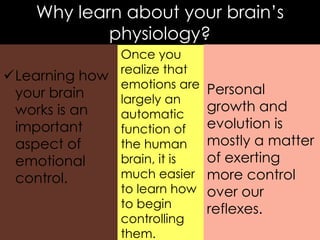
Why learn about your brain‟s
physiology?
Once you
realize that
Learning how
emotions are
your brain
largely an
works is an
automatic
important
function of
the human
aspect of
brain, it is
emotional
much easier
control.
to learn how
to begin
controlling
them.

Personal
growth and
evolution is
mostly a matter
of exerting
more control
over our
reflexes.
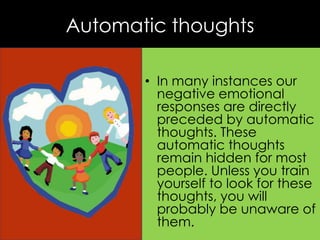
Automatic thoughts
• In many instances our
negative emotional
responses are directly
preceded by automatic
thoughts. These
automatic thoughts
remain hidden for most
people. Unless you train
yourself to look for these
thoughts, you will
probably be unaware of
them.
Identification
 When we identify ourselves with our negative
emotional states, it is difficult to control them.
By identifying with our negative emotions, we
open up the possibility (and likelihood) that we
will become dominated by them. Emotional
control is essentially a matter of disidentifying
with or detaching ourselves from our negative
emotions.
Emotional control techniques and
therapies:

Freeze-framing is a simple yet
powerful technique for
disengaging from negative
emotions. When you freezeframe, you shift out of gear and
into neutral.
• Thought Field therapy enables
you to access the deepest,
most fundamental underlying
cause of all negative emotions.
Major debilitating emotions
such as depression, anxiety and
phobias can be quickly
eliminated by correcting the
problem at the fundamental
level.
• Idenics is a self-development
technology which enables you
to rid yourself of unwanted
mental or emotional conditions.
•
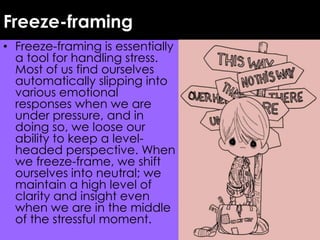
Freeze-framing
• Freeze-framing is essentially
a tool for handling stress.
Most of us find ourselves
automatically slipping into
various emotional
responses when we are
under pressure, and in
doing so, we loose our
ability to keep a levelheaded perspective. When
we freeze-frame, we shift
ourselves into neutral; we
maintain a high level of
clarity and insight even
when we are in the middle
of the stressful moment.
Thought Field Therapy
• Dr. Roger Callahan has pioneered a
remarkable form of psychotherapy
called "Thought Field Therapy™."
Originally Dr. Callahan had developed
thought field therapy to help his clients
eliminate their fears and phobias.
• The implications of thought field therapy are
profound. We still have not acquired the
knack of eliminating to any significant degree,
the negativity in our lives. We still manage to
get ourselves tangled up in problems and
negativities which have the potential to more
or less destroy our lives. And the realistic, yet
sad, fact is that most of it is completely
unnecessary. Humans have got to reach a
point in their development where such things
as depression, anxiety, addictions, obsessions,
etc., are laughable absurdities.
Idenics
• The basic working idea behind Idenics is
that we tend to get stuck in various
unwanted mental or emotional
conditions; we automatically slip into
certain perspectives and response
patterns which at one time may have
been quite useful, but now cause us
trouble, limit us or hold us back. The
problem is not so much the perspective
itself as the fact that we seem to be stuck
in it and unable to see beyond it.
• It offered a set of alternative
viewpoints with respect to coping with
deeper „unwanted conditions.
• Provides a functional methodology for
value enhancement and clarification.
References
• Villar, I. (2007). Implementing a Comprehensive
Guidance and Counseling Program in the Philippines.
Philippines: Aligned Transformations Publications.
• http://healing.about.com/od/emotion/a/vali
datefeeling.htm
• http://www.helium.com/items/1753700-adulttemper-tantrums

• http://www.buildfreedom.com/tl/tl12.shtml

Temper Tantrums: Emotional Outbursts

  • 1.
  • 6.
    Tantrum is definedas: emotional “explosions” designed to express extreme personal displeasure. A behavior usually associated with emotional distress. a behavior that attempts to manipulate others towards a desired end.
  • 7.
    CAUSES OF TANTRUMS: Emotional Maturity  Emotional Insecurity Unforgiveness Personality Stress Selfishness
  • 8.
    • EMOTIONAL IMMATURITY. Adult tantrums canbe due to emotional immaturity. - part of growing up is developing to skills to deal with disappointments.
  • 9.
    By the end ofthe teen years the skills should be in place.
  • 10.
     EMOTIONAL INSECURITY. Emotional insecurityin adulthood can prompt tantrums. Emotional insecurity produces frustration with life. Little is needed in the way of additional frustration or disappointment to spark and emotional outburst.
  • 11.
     UNFORGIVENESS. Unforgiveness motivates adulttantrums because the person feels they are already the victims of injustice. The otherwise minor setbacks of the day can cause lingering feelings of being treated unjustly by others to transition into anger.
  • 13.
     PERSONALITY. Adult tantrumscan be related to personality traits. The five factor model of personality includes a dimension labeled “neuroticism” that includes characteristics associated with tantrum-like acting out. High neuroticism could cause people to have a tendency towards emotional outbursts.
  • 15.
    SSTRESS STRESS. Stress isthe inability to manage the demands of two or more priorities in life or due to our inability to successfully resolve inconsistencies between two or more demands on us.
  • 16.
    Stress has ouremotional tanks already in a boiling state and little more is needed for stress to manifest in generalized anger.
  • 17.
    SELFISHNESS • SELFISHNESS. Afinal possible cause of adult tantrums is selfishness. Children have tantrums because something or someone is preventing them from getting what they want.
  • 20.
    Guidance and Counseling •Guidance and Counseling is provided in almost all schools, may it be tertiary, secondary or primary schools. • Seeking professional help is useful especially when tantrums severely affect your life.
  • 21.
    Purposes of GUIDANCE(Carl Rogers) The individual who understands The individual himself and his will become world will more fully become a more functioning as a effective, more person. productive and happier human. The individual achieves greater awareness of who he is and who he can become. The purpose of most of the helping professions is to enhance personal development, the psychological growth a socialized maturity, of its clients.
  • 23.
    Why learn aboutyour brain‟s physiology? Once you realize that Learning how emotions are your brain largely an works is an automatic important function of the human aspect of brain, it is emotional much easier control. to learn how to begin controlling them. Personal growth and evolution is mostly a matter of exerting more control over our reflexes.
  • 24.
    Automatic thoughts • Inmany instances our negative emotional responses are directly preceded by automatic thoughts. These automatic thoughts remain hidden for most people. Unless you train yourself to look for these thoughts, you will probably be unaware of them.
  • 25.
    Identification  When weidentify ourselves with our negative emotional states, it is difficult to control them. By identifying with our negative emotions, we open up the possibility (and likelihood) that we will become dominated by them. Emotional control is essentially a matter of disidentifying with or detaching ourselves from our negative emotions.
  • 27.
    Emotional control techniquesand therapies: Freeze-framing is a simple yet powerful technique for disengaging from negative emotions. When you freezeframe, you shift out of gear and into neutral. • Thought Field therapy enables you to access the deepest, most fundamental underlying cause of all negative emotions. Major debilitating emotions such as depression, anxiety and phobias can be quickly eliminated by correcting the problem at the fundamental level. • Idenics is a self-development technology which enables you to rid yourself of unwanted mental or emotional conditions. •
  • 28.
    Freeze-framing • Freeze-framing isessentially a tool for handling stress. Most of us find ourselves automatically slipping into various emotional responses when we are under pressure, and in doing so, we loose our ability to keep a levelheaded perspective. When we freeze-frame, we shift ourselves into neutral; we maintain a high level of clarity and insight even when we are in the middle of the stressful moment.
  • 29.
    Thought Field Therapy •Dr. Roger Callahan has pioneered a remarkable form of psychotherapy called "Thought Field Therapy™." Originally Dr. Callahan had developed thought field therapy to help his clients eliminate their fears and phobias.
  • 30.
    • The implicationsof thought field therapy are profound. We still have not acquired the knack of eliminating to any significant degree, the negativity in our lives. We still manage to get ourselves tangled up in problems and negativities which have the potential to more or less destroy our lives. And the realistic, yet sad, fact is that most of it is completely unnecessary. Humans have got to reach a point in their development where such things as depression, anxiety, addictions, obsessions, etc., are laughable absurdities.
  • 31.
    Idenics • The basicworking idea behind Idenics is that we tend to get stuck in various unwanted mental or emotional conditions; we automatically slip into certain perspectives and response patterns which at one time may have been quite useful, but now cause us trouble, limit us or hold us back. The problem is not so much the perspective itself as the fact that we seem to be stuck in it and unable to see beyond it.
  • 32.
    • It offereda set of alternative viewpoints with respect to coping with deeper „unwanted conditions. • Provides a functional methodology for value enhancement and clarification.
  • 33.
    References • Villar, I.(2007). Implementing a Comprehensive Guidance and Counseling Program in the Philippines. Philippines: Aligned Transformations Publications. • http://healing.about.com/od/emotion/a/vali datefeeling.htm • http://www.helium.com/items/1753700-adulttemper-tantrums • http://www.buildfreedom.com/tl/tl12.shtml

Editor's Notes

  • #3 The Acculturation Model of Second Language Acquisition was formulated by John H. Schumann in order to determine factors involved in the second-language learning process. The acculturation model is an attempt to provide a social and psychological perspective on second-language acquisition. We shall get into the details of these social and psychological factors in awhile. Acculturation is one of the derivatives of the word acculturate, which means: to “assimilate or cause to assimilate a different culture, typically the dominant one.” Assimilate, that is, to be absorbed into a different culture or to be integrated to a different culture. In the context of our discussion, we are concerned with “the social and psychological integration of the learner with the target language (TL) group – that is the group that speaks the language a learner intends to learn. In the acculturation model of SLA, we are talking about the natural context of SLA, that is, learning the language without instruction and in the environment where it is spoken.
  • #7 While there are many factors influencing second language acquisition, the acculturation model, as hinted in the awhile ago, is mainly concerned with the social factors and affective factors that may influence the success or failure in the acquisition of an L2.
  • #8 Social Factors – refer to the relationship between two social groups who are in a contact situation, but who speak different languages. Social factors can either promote or inhibit contact between the two groups and thus affect the degree to which the 2LL group acculturates (integrates) which in turn affects the degree to which that group will acquire the target language.TARGT LANGAUGE GROUP – the group that speaks the language (target language) that the 2LL wishes to learn.
  • #16 ENCLOSURE - If the two groups share these social constructs then enclosure said to be low, contact bet the two groups is enhanced and acquisition of the target language by the 2LL group is enhanced.