ROLE OF TELOMERE, TELOMERASE
IN CANCER
-a future drug target
By
Jeet Mazumder
M.Pharm(Pharmacology) 1st Year
Bengal School of Technology
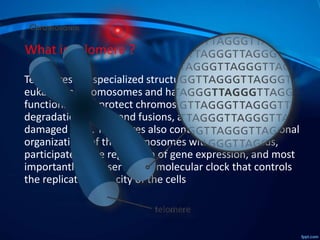
What is Telomere ?
Telomeres are specialized structures at the ends of all
eukaryotic chromosomes and have special biological
functions. They protect chromosomes from nucleolytic
degradation, endto-end fusions, and to be recognized as
damaged DNA. Telomeres also contribute to the functional
organizations of the chromosomes within the nucleus,
participate in the regulation of gene expression, and most
importantly, they serve as a molecular clock that controls
the replicative capacity of the cells
By What Actually Telomeres Are Made Up Of
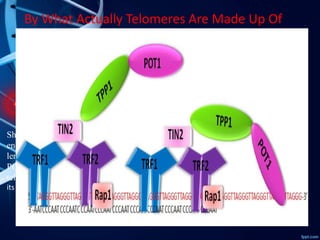
Humans like other vertebrates, have telomeres composed of repetitive 5’-TTAGGG-
3’ sequences Human telomeres end in a 3’ overhang composed of TTAGGG track
which is 50-500 nucleotides long
SHELTERIN - and its importance
Shelterin complex represses DNA damage signaling responses at the chromosome
ends. It also participates in the formation of t-loops and regulation of telomere
length. This complex consists of six subunits including TRF1, TRF2, TIN2, Rap1,
POT1, and TPP1. The expression of shelterin is ubiquitous and it is present at
telomeres throughout cell cycle. Shelterin binds to double stranded telomeric DNA via
its DNA binding proteins TRF1 (TTAGGG-repeat-binding factor 1) and TRF2
Why Telomere Is Called Cellular Clock
Telomeres cap and protect the ends of chromosomes from degradation and
illegitimate recombination. The termini of a linear template cannot,
however, be completely replicated by conventional DNA-dependent DNA
polymerases, and thus in the absence of a mechanisms to counter this effect,
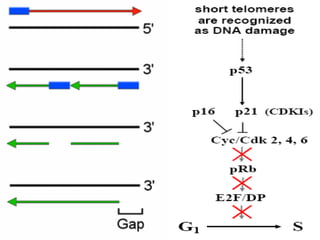
telomeres of eukaryotic cells shorten every round of DNA replication. In
humans and possibly other higher eukaryotes, telomere shortening may
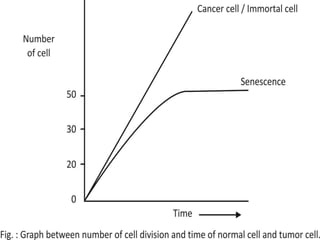
have been adopted to limit the life span of somatic cells. Human somatic
cells have a finite proliferative capacity and enter a viable growth arrested
state called senescence. Life span appears to be governed by cell division,
not time. The regular loss of telomeric DNA could therefore serve as a
mitotic clock in the senescence programme, counting cell divisions. In most
eukaryotic organisms, however, THERE ARE CERTAIN CASES
WHERE CELL BECOME IMMORTAL
What is Hayflick Limit?
The Hayflick Limit is a concept that helps to explain the mechanisms
behind cellular aging The concept states that a normal human cell can only
replicate and divide forty to sixty times before it cannot divide anymore, and will
break down by programmed cell death or apoptosis. The concept of the Hayflick
Limit revised Alexis Carrel's earlier theory, which stated that cells can replicate
themselves infinitely. Leonard Hayflick developed the concept while at the Wistar
Institute in Philadelphia.
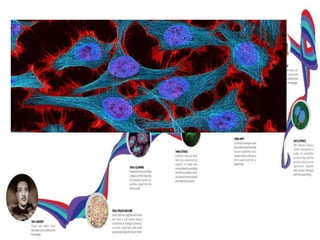
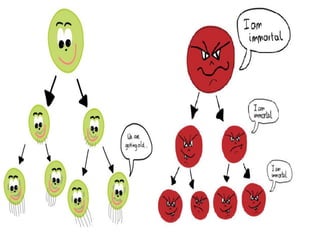
• BUT MAJORITY OF CANCEROUS CELLS HAS VERY VERY HIGH
HAYFLICK LIMIT SO THEY MAY BE CALLED IMMORTAL BEST
EXAMPLE OF ONE SUCH IMMORTAL CELL LINE IS
HeLa CELL LINES
THIS IMMORTALITY ARE ASSOCIATED WITH TELOMERE
What is Telomerase
Telomeric Sequence is Maintained by a special Enzyme Called TELOMERASE.
Telomerase, also called terminal transferase,[1] is a ribonucleoprotein that adds
a species-dependent telomere repeat sequence to the 3' end of telomeres. A
telomere is a region of repetitive sequences at each end
of eukaryotic chromosomes in most eukaryotes. Telomeres protect the end of
the chromosome from DNA damage or from fusion with neighboring
chromosomes.
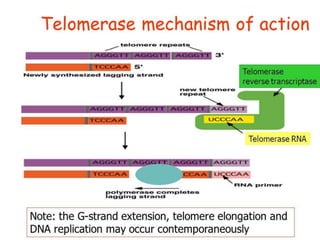
Telomerase is a reverse transcriptase enzyme that carries its own RNA molecule
which is used as a template when it elongates telomeres. Telomerase is active
in normal stem cells and most cancer cells, but is normally absent from, or at
very low levels in, most somatic cells.
Mechanism of Telomerase
By using TERC, TERT can add a six-nucleotide repeating sequence,
5'-TTAGGG (in vertebrates, the sequence differs in other organisms)
to the 3' strand of chromosomes. These TTAGGG repeats are called
telomeres. The template region of TERC is 3'-CAAUCCCAAUC-5'.
Telomerase can bind the first few nucleotides of the template to the
last telomere sequence on the chromosome, add a new telomere repeat
(5'-GGTTAG-3') sequence, let go, realign the new 3'-end of telomere
to the template, and repeat the process. Telomerase reverses telomere
shortening
Constitute Of Telomerase
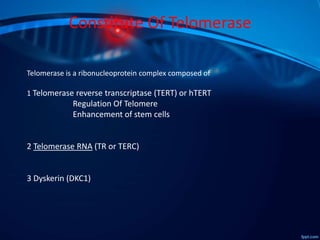
Telomerase is a ribonucleoprotein complex composed of
1 Telomerase reverse transcriptase (TERT) or hTERT
Regulation Of Telomere
Enhancement of stem cells
2 Telomerase RNA (TR or TERC)
3 Dyskerin (DKC1)
hTERT and telomerase Regulation
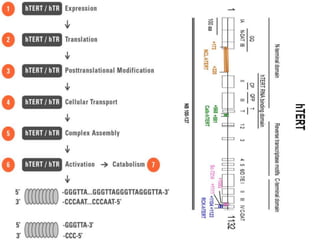
hTERT is encoded by hTERT gene located at 5p15.33 This gene spans
approximately 40 kb of the genome and contains 16 exons. Molecular
Location: base pairs 1,253,167 to 1,295,047 on chromosome 5
ACTIVATION
The regulation of telomerase activity in human cells plays a significant role in the
development of cancer. Telomerase is tightly Repressed in the vast majority of
Normal Human Somatic Cells but becomes activated during cellular immortalization
and in CANCER. While the mechanisms for telomerase activation in cancers have
not been fully defined, they include Telomerase catalytic subunit gene (hTERT)
amplification and trans-activation of the hTERT promoter by the myc
oncogene product. Ectopic expression of hTERT is sufficient to restore telomerase
activity in cells that lack the enzyme and can immortalize many cell types.
Understanding telomerase biology will eventually lead to several clinically relevant
telomerase-based therapies. These applications include inhibiting or targeting
telomerase as a novel antineoplastic strategy and using cells immortalized by
telomerase for therapeutic applications.
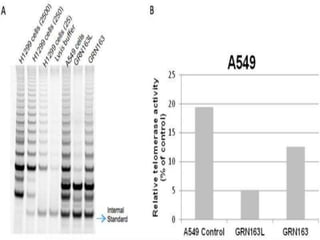
the TRAP assay is a popular method to determine telomerase activity in
mammalian cells and tissue samples The TRAP assay includes three steps:
extension, amplification, and detection of telomerase products. In the extension
step, telomeric repeats are added to the telomerase substrate (which is actually a
non telomeric oligonucleotide, TS) by telomerase. In the amplification step, the
extension products are amplified by the polymerase chain reaction (PCR) using
specific primers (TS upstream primer and ACX downstream primer) and in the
detection step, the presence or absence of telomerase is analyzed by
electrophoresis. TSNT is, an internal standard control, amplified by TS primer. NT is
its own reverse primer, which is not a substrate for telomerase.
TRAP ASSAY
TELOMERASE REPETED AMPLIFICATION PROTOCOL
CANCER-a brief introduction
• Cancer is actually a group of many related diseases that
all have to do with cells. Cancer happens when cells that
are not normal grow and spread very fast. Normal body
cells grow and divide and know to stop growing. Over
time, they also die. Unlike these normal cells, cancer cells
just continue to grow and divide out of control and don't
die when they're supposed to.
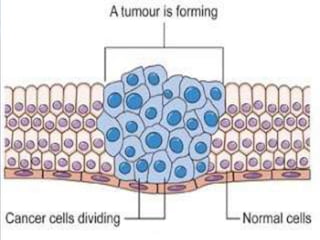
• Cancer cells usually group or clump together to form
tumors A growing tumor becomes a lump of cancer cells
that can destroy the normal cells around the tumor and
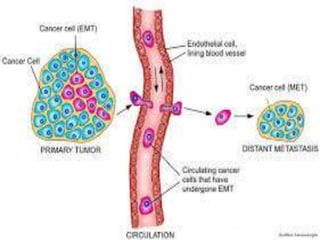
damage the body's healthy tissues. Sometimes cancer
cells break away from the original tumor and travel to
other areas of the body, where they keep growing and
can go on to form new tumors. This is how cancer
spreads. The spread of a tumor to a new place in the
body is called Metastasis
HALL MARKS OF CANCER
• Cancer has 6 major hallmarks
IMMORTALITY CONTINOUS CELL DIVISION AND LIMIT
LESS CELL DIVISION
PRODUCE GO SIGNAL GROWTH FACTOR FROM ONCOGENES
OVER RIDE STOP SIGNALS OVERIDE STOP SIGNAL
RESISTANCE TO CELL DEATH APPOTOSIS
ANGIOGENESIS INDUCTION OF NEW BLOOD VESSELS
GROWTH
METASTASIS SPREAD TO OTHER CELLS
HOW CANCER AND TELOMERASE RELATED
Telomerase expression in humans is limited to rare stem
cells of renewal tissues (gastrointestinal track, blood and
skin). Telomerase is almost always aberrantly overexpressed
in cancer. This overexpression is detected in 85% of all
cancers, irrespective of the tumour type. Telomerase is being
developed as a marker to allow the detection of cancer cells
in otherwise telomerase‐negative normal tissues.
CANCER CELLS ARE IMMORTAL
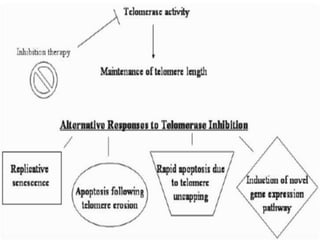
TELOMERASE INHIBITORS-a new horizon
Telomerase inhibitors are possible in near future they are group of
drugs that inhibit the enzyme telomeres and cause cell death
APPORACHES
TARGETING TELOMERASE ENZYME COMPONENTS
Antisense and Related Oligonucleotide
RNA Interference
Selective Expression of Cytotoxic or Pro-Apoptotic Genes
Mutant-Template Telomerase RNA
Selective Expression of Cytotoxic or Pro-Apoptotic Genes
Some Cancer That Can Be Treated By This
• Gastric Cancer
• Breast Cancer
• Pancreatic Cancer
• Ovarian Cancer
• Melanoma
• Lymphoma
TELOMERASE INHIBITORS WITH CONVENTIONAL
THERAPY
• As reviewed here, telomerase inhibitors have been shown
to be effective by themselves as potentially valuable
therapeutic agents. However, their greatest use may come
not as stand-alone pharmaceuticals but as part of a
coordinated treatment strategy in conjunction with
standard treatments including various chemotherapeutics
and radiation therapy. Several of the studies cited in this
review demonstrated success with their telomerase
inhibitors both alone and with synergistic effects when
combined with other chemotherapeutics. The method of
action of the various chemotherapeutic agents include
topoisomerase inhibitors
'-O-methoxyethyl RNA Cisplatin/carboplatin Synergistic effect
Antisense-hTR Paclitaxel
Significant increase in
sensitivity
Antisense-hTR Cisplatin Increase in sensitivity
DN-hTERT
Cisplatin/taxanes/etoposi
de
Increase in induction of
apoptosis
DN-hTERT Daunorubicin Increase in apoptosis
Ribozyme-hTERT Doxorubicin Increase in sensitivity
RNAi-hTERT
Topoisomerase
inhibitors/bleomycin/radi
ation
Increase in sensitivity
hTR-NAT [131
I]MIBG Induced uptake
AZT Paclitaxel
Increased activity and
effect
SOME TELOMERASE INHIBITORS
• Yes, Recently some of the Telomerase inhibitors are
in development with promising out comes some of
them are
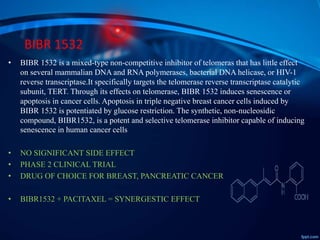
BIBR 1532
• BIBR 1532 is a mixed-type non-competitive inhibitor of telomeras that has little effect
on several mammalian DNA and RNA polymerases, bacterial DNA helicase, or HIV-1
reverse transcriptase.It specifically targets the telomerase reverse transcriptase catalytic
subunit, TERT. Through its effects on telomerase, BIBR 1532 induces senescence or
apoptosis in cancer cells. Apoptosis in triple negative breast cancer cells induced by
BIBR 1532 is potentiated by glucose restriction. The synthetic, non-nucleosidic
compound, BIBR1532, is a potent and selective telomerase inhibitor capable of inducing
senescence in human cancer cells
• NO SIGNIFICANT SIDE EFFECT
• PHASE 2 CLINICAL TRIAL
• DRUG OF CHOICE FOR BREAST, PANCREATIC CANCER
• BIBR1532 + PACITAXEL = SYNERGESTIC EFFECT
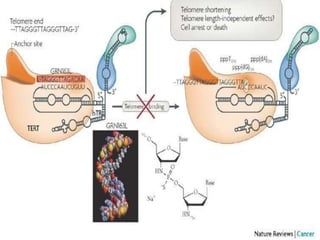
IMETELESAT (GRN163L)
Originally known as GRN163L, imetelstat sodium (imetelstat) is a 13-
mer N3’---P5’ thio-phosphoramidate (NPS) oligonucleotide that has a
covalently bound 5’ palmitoyl (C16) lipid group. The proprietary nucleic
acid backbone provides resistance to the effect of cellular nucleases, thus
conferring improved stability in plasma and tissues, as well as significantly
improved binding affinity to its target. The lipid group enhances cell
permeability to increase potency and improve pharmacokinetic and
pharmacodynamic properties. The compound has a long residence time in
bone marrow, spleen and liver. Imetelstat binds with high affinity to the
template region of the RNA component of telomerase, resulting in
direct, competitive inhibition of telomerase enzymatic activity, rather
than elicit its effect through an antisense inhibition of protein
translation. Imetelstat is administered by intravenous infusion.
PANCREATIC CANCER
PHASE 2 CLINICA TRIAL
HIGHLY SELECTIVITY
GV1OO1 VACCINE
• GV1001, a peptide vaccine representing a 16-aa hTERT sequence. GV1001
binds multiple HLA class II molecules and harbors putative HLA class I
epitopes. The peptide may therefore elicit combined CD4/CD8 T-cell
responses, considered important to initiate tumor eradication and long-
term memory. Phase I/II trials in advanced pancreatic and pulmonary
cancer patients have demonstrated GV1001-specific T-cell responses in >
50% of subjects, without clinically important toxicity. The results indicate a
correlation between development of GV1001-specific responses and
prolonged survival.
LUNGS CANCER
PHASE II CLINICAL TRIALS
GRN VAC 1
• GRMNVAC1 as an anti-cancer vaccine, aims to help
the immune system recognize cells expressing
telomerase as a target to be destroyed.
PHASE II CLINICAL TRIALS
ADVANTAGES
HIGHLY SELECTIVITY AS TELOMERASE ENZYME IS
GENERALLY PRODUCED IN CANCEROUS CELLS VERY
LOW CONCENTRATION IN SOMATIC CELLS
LESS TOXIC
A SINGLE DRUG CANDIDATE CAN BE USED IN
MULTIPLE CANCER AS TELOMERASE IS PRESENT IN
90% CANCERS
CHALLENGES
• AGENING (VERY MINIMAL)
• POOR ABSORTION AT THE SITE OF ACTION
CONCLUSION
• This, may be the most promising approach, and it is
likely that many new advances will develop that
merge different types of anti-telomerase methods or
combine telomerase inhibition with other proven
modes of anticancer therapy. The continued
development of novel tools will likely be at the
forefront of cancer therapy, many different anti-
telomerase approaches that may revolutionize cancer
therapeutics in the future
REFFERENCES
• shikawa F. Regulation mechanisms of mammalian telomerase. A
review. Biochemistry (Mosc) 1997;62:1332–1337. [PubMed]
• 2. Weinrich SL, Pruzan R, Ma L, Ouellette M, Tesmer VM, Holt
SE, Bodnar AG, Lichtsteiner S, Kim NW, Trager JB, Taylor RD,
Carlos R, Andrews WH, Wright WE, Shay JW, Harley CB, Morin
GB. Reconstitution of human telomerase with the template
RNA component hTR and the catalytic protein subunit
hTRT. Nat. Genet. 1997;17:498–502. [PubMed]
• 3. Beattie TL, Zhou W, Robinson MO, Harrington L.
Reconstitution of human telomerase activity in vitro. Curr.
Biol. 1998;29:177–180. [PubMed]
• 4. Shay JW, Bacchetti S. A survey of telomerase activity in
human cancer. Eur. J. Cancer. 1997;33:787–791. [PubMed]
Telomere and telomerase inbitors

Telomere and telomerase inbitors

  • 1.
    ROLE OF TELOMERE,TELOMERASE IN CANCER -a future drug target By Jeet Mazumder M.Pharm(Pharmacology) 1st Year Bengal School of Technology
  • 2.
    What is Telomere? Telomeres are specialized structures at the ends of all eukaryotic chromosomes and have special biological functions. They protect chromosomes from nucleolytic degradation, endto-end fusions, and to be recognized as damaged DNA. Telomeres also contribute to the functional organizations of the chromosomes within the nucleus, participate in the regulation of gene expression, and most importantly, they serve as a molecular clock that controls the replicative capacity of the cells
  • 3.
    By What ActuallyTelomeres Are Made Up Of Humans like other vertebrates, have telomeres composed of repetitive 5’-TTAGGG- 3’ sequences Human telomeres end in a 3’ overhang composed of TTAGGG track which is 50-500 nucleotides long SHELTERIN - and its importance Shelterin complex represses DNA damage signaling responses at the chromosome ends. It also participates in the formation of t-loops and regulation of telomere length. This complex consists of six subunits including TRF1, TRF2, TIN2, Rap1, POT1, and TPP1. The expression of shelterin is ubiquitous and it is present at telomeres throughout cell cycle. Shelterin binds to double stranded telomeric DNA via its DNA binding proteins TRF1 (TTAGGG-repeat-binding factor 1) and TRF2
  • 4.
    Why Telomere IsCalled Cellular Clock Telomeres cap and protect the ends of chromosomes from degradation and illegitimate recombination. The termini of a linear template cannot, however, be completely replicated by conventional DNA-dependent DNA polymerases, and thus in the absence of a mechanisms to counter this effect, telomeres of eukaryotic cells shorten every round of DNA replication. In humans and possibly other higher eukaryotes, telomere shortening may have been adopted to limit the life span of somatic cells. Human somatic cells have a finite proliferative capacity and enter a viable growth arrested state called senescence. Life span appears to be governed by cell division, not time. The regular loss of telomeric DNA could therefore serve as a mitotic clock in the senescence programme, counting cell divisions. In most eukaryotic organisms, however, THERE ARE CERTAIN CASES WHERE CELL BECOME IMMORTAL
  • 5.
    What is HayflickLimit? The Hayflick Limit is a concept that helps to explain the mechanisms behind cellular aging The concept states that a normal human cell can only replicate and divide forty to sixty times before it cannot divide anymore, and will break down by programmed cell death or apoptosis. The concept of the Hayflick Limit revised Alexis Carrel's earlier theory, which stated that cells can replicate themselves infinitely. Leonard Hayflick developed the concept while at the Wistar Institute in Philadelphia. • BUT MAJORITY OF CANCEROUS CELLS HAS VERY VERY HIGH HAYFLICK LIMIT SO THEY MAY BE CALLED IMMORTAL BEST EXAMPLE OF ONE SUCH IMMORTAL CELL LINE IS HeLa CELL LINES THIS IMMORTALITY ARE ASSOCIATED WITH TELOMERE
  • 6.
    What is Telomerase TelomericSequence is Maintained by a special Enzyme Called TELOMERASE. Telomerase, also called terminal transferase,[1] is a ribonucleoprotein that adds a species-dependent telomere repeat sequence to the 3' end of telomeres. A telomere is a region of repetitive sequences at each end of eukaryotic chromosomes in most eukaryotes. Telomeres protect the end of the chromosome from DNA damage or from fusion with neighboring chromosomes. Telomerase is a reverse transcriptase enzyme that carries its own RNA molecule which is used as a template when it elongates telomeres. Telomerase is active in normal stem cells and most cancer cells, but is normally absent from, or at very low levels in, most somatic cells.
  • 7.
    Mechanism of Telomerase Byusing TERC, TERT can add a six-nucleotide repeating sequence, 5'-TTAGGG (in vertebrates, the sequence differs in other organisms) to the 3' strand of chromosomes. These TTAGGG repeats are called telomeres. The template region of TERC is 3'-CAAUCCCAAUC-5'. Telomerase can bind the first few nucleotides of the template to the last telomere sequence on the chromosome, add a new telomere repeat (5'-GGTTAG-3') sequence, let go, realign the new 3'-end of telomere to the template, and repeat the process. Telomerase reverses telomere shortening
  • 8.
    Constitute Of Telomerase Telomeraseis a ribonucleoprotein complex composed of 1 Telomerase reverse transcriptase (TERT) or hTERT Regulation Of Telomere Enhancement of stem cells 2 Telomerase RNA (TR or TERC) 3 Dyskerin (DKC1)
  • 9.
    hTERT and telomeraseRegulation hTERT is encoded by hTERT gene located at 5p15.33 This gene spans approximately 40 kb of the genome and contains 16 exons. Molecular Location: base pairs 1,253,167 to 1,295,047 on chromosome 5 ACTIVATION The regulation of telomerase activity in human cells plays a significant role in the development of cancer. Telomerase is tightly Repressed in the vast majority of Normal Human Somatic Cells but becomes activated during cellular immortalization and in CANCER. While the mechanisms for telomerase activation in cancers have not been fully defined, they include Telomerase catalytic subunit gene (hTERT) amplification and trans-activation of the hTERT promoter by the myc oncogene product. Ectopic expression of hTERT is sufficient to restore telomerase activity in cells that lack the enzyme and can immortalize many cell types. Understanding telomerase biology will eventually lead to several clinically relevant telomerase-based therapies. These applications include inhibiting or targeting telomerase as a novel antineoplastic strategy and using cells immortalized by telomerase for therapeutic applications.
  • 10.
    the TRAP assayis a popular method to determine telomerase activity in mammalian cells and tissue samples The TRAP assay includes three steps: extension, amplification, and detection of telomerase products. In the extension step, telomeric repeats are added to the telomerase substrate (which is actually a non telomeric oligonucleotide, TS) by telomerase. In the amplification step, the extension products are amplified by the polymerase chain reaction (PCR) using specific primers (TS upstream primer and ACX downstream primer) and in the detection step, the presence or absence of telomerase is analyzed by electrophoresis. TSNT is, an internal standard control, amplified by TS primer. NT is its own reverse primer, which is not a substrate for telomerase. TRAP ASSAY TELOMERASE REPETED AMPLIFICATION PROTOCOL
  • 11.
    CANCER-a brief introduction •Cancer is actually a group of many related diseases that all have to do with cells. Cancer happens when cells that are not normal grow and spread very fast. Normal body cells grow and divide and know to stop growing. Over time, they also die. Unlike these normal cells, cancer cells just continue to grow and divide out of control and don't die when they're supposed to. • Cancer cells usually group or clump together to form tumors A growing tumor becomes a lump of cancer cells that can destroy the normal cells around the tumor and damage the body's healthy tissues. Sometimes cancer cells break away from the original tumor and travel to other areas of the body, where they keep growing and can go on to form new tumors. This is how cancer spreads. The spread of a tumor to a new place in the body is called Metastasis
  • 12.
    HALL MARKS OFCANCER • Cancer has 6 major hallmarks IMMORTALITY CONTINOUS CELL DIVISION AND LIMIT LESS CELL DIVISION PRODUCE GO SIGNAL GROWTH FACTOR FROM ONCOGENES OVER RIDE STOP SIGNALS OVERIDE STOP SIGNAL RESISTANCE TO CELL DEATH APPOTOSIS ANGIOGENESIS INDUCTION OF NEW BLOOD VESSELS GROWTH METASTASIS SPREAD TO OTHER CELLS
  • 13.
    HOW CANCER ANDTELOMERASE RELATED Telomerase expression in humans is limited to rare stem cells of renewal tissues (gastrointestinal track, blood and skin). Telomerase is almost always aberrantly overexpressed in cancer. This overexpression is detected in 85% of all cancers, irrespective of the tumour type. Telomerase is being developed as a marker to allow the detection of cancer cells in otherwise telomerase‐negative normal tissues.
  • 14.
  • 15.
    TELOMERASE INHIBITORS-a newhorizon Telomerase inhibitors are possible in near future they are group of drugs that inhibit the enzyme telomeres and cause cell death APPORACHES TARGETING TELOMERASE ENZYME COMPONENTS Antisense and Related Oligonucleotide RNA Interference Selective Expression of Cytotoxic or Pro-Apoptotic Genes Mutant-Template Telomerase RNA Selective Expression of Cytotoxic or Pro-Apoptotic Genes
  • 16.
    Some Cancer ThatCan Be Treated By This • Gastric Cancer • Breast Cancer • Pancreatic Cancer • Ovarian Cancer • Melanoma • Lymphoma
  • 17.
    TELOMERASE INHIBITORS WITHCONVENTIONAL THERAPY • As reviewed here, telomerase inhibitors have been shown to be effective by themselves as potentially valuable therapeutic agents. However, their greatest use may come not as stand-alone pharmaceuticals but as part of a coordinated treatment strategy in conjunction with standard treatments including various chemotherapeutics and radiation therapy. Several of the studies cited in this review demonstrated success with their telomerase inhibitors both alone and with synergistic effects when combined with other chemotherapeutics. The method of action of the various chemotherapeutic agents include topoisomerase inhibitors '-O-methoxyethyl RNA Cisplatin/carboplatin Synergistic effect Antisense-hTR Paclitaxel Significant increase in sensitivity Antisense-hTR Cisplatin Increase in sensitivity DN-hTERT Cisplatin/taxanes/etoposi de Increase in induction of apoptosis DN-hTERT Daunorubicin Increase in apoptosis Ribozyme-hTERT Doxorubicin Increase in sensitivity RNAi-hTERT Topoisomerase inhibitors/bleomycin/radi ation Increase in sensitivity hTR-NAT [131 I]MIBG Induced uptake AZT Paclitaxel Increased activity and effect
  • 18.
    SOME TELOMERASE INHIBITORS •Yes, Recently some of the Telomerase inhibitors are in development with promising out comes some of them are
  • 19.
    BIBR 1532 • BIBR1532 is a mixed-type non-competitive inhibitor of telomeras that has little effect on several mammalian DNA and RNA polymerases, bacterial DNA helicase, or HIV-1 reverse transcriptase.It specifically targets the telomerase reverse transcriptase catalytic subunit, TERT. Through its effects on telomerase, BIBR 1532 induces senescence or apoptosis in cancer cells. Apoptosis in triple negative breast cancer cells induced by BIBR 1532 is potentiated by glucose restriction. The synthetic, non-nucleosidic compound, BIBR1532, is a potent and selective telomerase inhibitor capable of inducing senescence in human cancer cells • NO SIGNIFICANT SIDE EFFECT • PHASE 2 CLINICAL TRIAL • DRUG OF CHOICE FOR BREAST, PANCREATIC CANCER • BIBR1532 + PACITAXEL = SYNERGESTIC EFFECT
  • 20.
    IMETELESAT (GRN163L) Originally knownas GRN163L, imetelstat sodium (imetelstat) is a 13- mer N3’---P5’ thio-phosphoramidate (NPS) oligonucleotide that has a covalently bound 5’ palmitoyl (C16) lipid group. The proprietary nucleic acid backbone provides resistance to the effect of cellular nucleases, thus conferring improved stability in plasma and tissues, as well as significantly improved binding affinity to its target. The lipid group enhances cell permeability to increase potency and improve pharmacokinetic and pharmacodynamic properties. The compound has a long residence time in bone marrow, spleen and liver. Imetelstat binds with high affinity to the template region of the RNA component of telomerase, resulting in direct, competitive inhibition of telomerase enzymatic activity, rather than elicit its effect through an antisense inhibition of protein translation. Imetelstat is administered by intravenous infusion. PANCREATIC CANCER PHASE 2 CLINICA TRIAL HIGHLY SELECTIVITY
  • 21.
    GV1OO1 VACCINE • GV1001,a peptide vaccine representing a 16-aa hTERT sequence. GV1001 binds multiple HLA class II molecules and harbors putative HLA class I epitopes. The peptide may therefore elicit combined CD4/CD8 T-cell responses, considered important to initiate tumor eradication and long- term memory. Phase I/II trials in advanced pancreatic and pulmonary cancer patients have demonstrated GV1001-specific T-cell responses in > 50% of subjects, without clinically important toxicity. The results indicate a correlation between development of GV1001-specific responses and prolonged survival. LUNGS CANCER PHASE II CLINICAL TRIALS
  • 22.
    GRN VAC 1 •GRMNVAC1 as an anti-cancer vaccine, aims to help the immune system recognize cells expressing telomerase as a target to be destroyed. PHASE II CLINICAL TRIALS
  • 23.
    ADVANTAGES HIGHLY SELECTIVITY ASTELOMERASE ENZYME IS GENERALLY PRODUCED IN CANCEROUS CELLS VERY LOW CONCENTRATION IN SOMATIC CELLS LESS TOXIC A SINGLE DRUG CANDIDATE CAN BE USED IN MULTIPLE CANCER AS TELOMERASE IS PRESENT IN 90% CANCERS
  • 24.
    CHALLENGES • AGENING (VERYMINIMAL) • POOR ABSORTION AT THE SITE OF ACTION
  • 25.
    CONCLUSION • This, maybe the most promising approach, and it is likely that many new advances will develop that merge different types of anti-telomerase methods or combine telomerase inhibition with other proven modes of anticancer therapy. The continued development of novel tools will likely be at the forefront of cancer therapy, many different anti- telomerase approaches that may revolutionize cancer therapeutics in the future
  • 26.
    REFFERENCES • shikawa F.Regulation mechanisms of mammalian telomerase. A review. Biochemistry (Mosc) 1997;62:1332–1337. [PubMed] • 2. Weinrich SL, Pruzan R, Ma L, Ouellette M, Tesmer VM, Holt SE, Bodnar AG, Lichtsteiner S, Kim NW, Trager JB, Taylor RD, Carlos R, Andrews WH, Wright WE, Shay JW, Harley CB, Morin GB. Reconstitution of human telomerase with the template RNA component hTR and the catalytic protein subunit hTRT. Nat. Genet. 1997;17:498–502. [PubMed] • 3. Beattie TL, Zhou W, Robinson MO, Harrington L. Reconstitution of human telomerase activity in vitro. Curr. Biol. 1998;29:177–180. [PubMed] • 4. Shay JW, Bacchetti S. A survey of telomerase activity in human cancer. Eur. J. Cancer. 1997;33:787–791. [PubMed]