MOLECULAR BIOLOGY 
TOPIC OF PRESENTATION:
STRUCTURE OF CHROMOSOMES
GROUP MEMBERS:
RABAB MAQSOOD
RABIA IQBAL
AYESHA KABEER
SHADAB ARIF
RUKHMA JAVEED
SHAFAQ QAISER
RIMSHA
STRUCTURE OF
CHROMOSOMES
STRUCTURE OF CHROMOSOMES
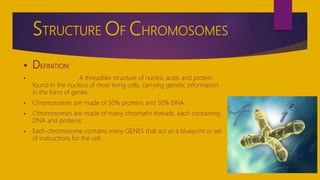
 DEFINITION:
 A threadlike structure of nucleic acids and protein
found in the nucleus of most living cells, carrying genetic information
in the form of genes.
 Chromosomes are made of 50% proteins and 50% DNA.
 Chromosomes are made of many chromatin threads, each containing
DNA and proteins.
 Each chromosome contains many GENES that act as a blueprint or set
of instructions for the cell.
STRUCTURE OF CHROMOSOMES
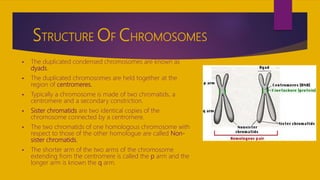
 The duplicated condensed chromosomes are known as
dyads.
 The duplicated chromosomes are held together at the
region of centromeres.
 Typically a chromosome is made of two chromatids, a
centromere and a secondary constriction.
 Sister chromatids are two identical copies of the
chromosome connected by a centromere.
 The two chromatids of one homologous chromosome with
respect to those of the other homologue are called Non-
sister chromatids.
 The shorter arm of the two arms of the chromosome
extending from the centromere is called the p arm and the
longer arm is known the q arm.
CHEMICAL COMPOSITION OF CHROMOSOMES
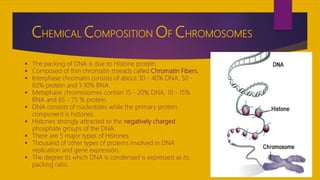
 The packing of DNA is due to Histone protein.
 Composed of thin chromatin threads called Chromatin Fibers.
 Interphase chromatin consists of about 30 - 40% DNA, 50 -
65% protein and 1-10% RNA.
 Metaphase chromosomes contain 15 - 20% DNA, 10 - 15%
RNA and 65 - 75 % protein.
 DNA consists of nucleotides while the primary protein
component is histones.
 Histones strongly attracted to the negatively charged
phosphate groups of the DNA.
 There are 5 major types of Histones.
 Thousand of other types of proteins involved in DNA
replication and gene expression.
 The degree to which DNA is condensed is expressed as its
packing ratio.
PACKING RATIO:
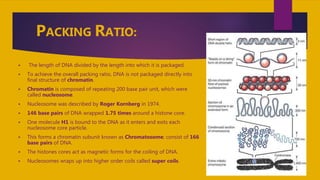
 The length of DNA divided by the length into which it is packaged.
 To achieve the overall packing ratio, DNA is not packaged directly into
final structure of chromatin.
 Chromatin is composed of repeating 200 base pair unit, which were
called nucleosome.
 Nucleosome was described by Roger Kornberg in 1974.
 146 base pairs of DNA wrapped 1.75 times around a histone core.
 One molecule H1 is bound to the DNA as it enters and exits each
nucleosome core particle.
 This forms a chromatin subunit known as Chromatosome; consist of 166
base pairs of DNA.
 The histones cores act as magnetic forms for the coiling of DNA.
 Nucleosomes wraps up into higher order coils called super coils.
THANK YOU 

STRUCTURE OF CHROMOSOMES

  • 2.
    MOLECULAR BIOLOGY  TOPICOF PRESENTATION: STRUCTURE OF CHROMOSOMES
  • 3.
    GROUP MEMBERS: RABAB MAQSOOD RABIAIQBAL AYESHA KABEER SHADAB ARIF RUKHMA JAVEED SHAFAQ QAISER RIMSHA STRUCTURE OF CHROMOSOMES
  • 4.
    STRUCTURE OF CHROMOSOMES DEFINITION:  A threadlike structure of nucleic acids and protein found in the nucleus of most living cells, carrying genetic information in the form of genes.  Chromosomes are made of 50% proteins and 50% DNA.  Chromosomes are made of many chromatin threads, each containing DNA and proteins.  Each chromosome contains many GENES that act as a blueprint or set of instructions for the cell.
  • 5.
    STRUCTURE OF CHROMOSOMES The duplicated condensed chromosomes are known as dyads.  The duplicated chromosomes are held together at the region of centromeres.  Typically a chromosome is made of two chromatids, a centromere and a secondary constriction.  Sister chromatids are two identical copies of the chromosome connected by a centromere.  The two chromatids of one homologous chromosome with respect to those of the other homologue are called Non- sister chromatids.  The shorter arm of the two arms of the chromosome extending from the centromere is called the p arm and the longer arm is known the q arm.
  • 6.
    CHEMICAL COMPOSITION OFCHROMOSOMES  The packing of DNA is due to Histone protein.  Composed of thin chromatin threads called Chromatin Fibers.  Interphase chromatin consists of about 30 - 40% DNA, 50 - 65% protein and 1-10% RNA.  Metaphase chromosomes contain 15 - 20% DNA, 10 - 15% RNA and 65 - 75 % protein.  DNA consists of nucleotides while the primary protein component is histones.  Histones strongly attracted to the negatively charged phosphate groups of the DNA.  There are 5 major types of Histones.  Thousand of other types of proteins involved in DNA replication and gene expression.  The degree to which DNA is condensed is expressed as its packing ratio.
  • 7.
    PACKING RATIO:  Thelength of DNA divided by the length into which it is packaged.  To achieve the overall packing ratio, DNA is not packaged directly into final structure of chromatin.  Chromatin is composed of repeating 200 base pair unit, which were called nucleosome.  Nucleosome was described by Roger Kornberg in 1974.  146 base pairs of DNA wrapped 1.75 times around a histone core.  One molecule H1 is bound to the DNA as it enters and exits each nucleosome core particle.  This forms a chromatin subunit known as Chromatosome; consist of 166 base pairs of DNA.  The histones cores act as magnetic forms for the coiling of DNA.  Nucleosomes wraps up into higher order coils called super coils.
  • 8.