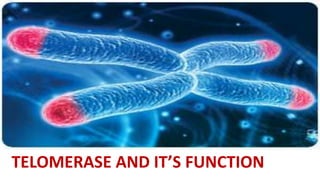
TELOMERASE AND IT’S FUNCTION
“Telomeres” is just a fancy scientific term for “the ends of a chromosome.’’
-Carol Greider
TELOMERE and TELOMERASE
Elizabeth Blackburn and Jack Szostak discovered
that a unique DNA sequence in the telomeres
protects the chromosomes from degradation.
Carol Greider and Elizabeth Blackburn identified
telomerase, the enzyme that makes telomere
DNA
The Nobel Prize in Physiology or Medicine 2009
jointly to
Elizabeth H. Blackburn, Carol W. Greider and Jack W. Szostak
for the discovery of
“how chromosomes are protected
by telomeres and the enzyme telomerase“
Tetrahymena thermophila
5′-CAACCCCAA-3′,
Telomerase RNA
sequence
Telomere DNA protects the chromosomes
These end-points are often compared to the plastic protective covers on the tips of
shoelaces
Barbara McClintock and H J Muller
revealed that the ends of chromosome are
protected,and telomere is essential for
chromosome stability(1930s)They were
able to recover chromosomes without
deletions when treated with xray and
fusion of chromosome occurred when
telomere is lost.
EFFECTS OF TELOMERE LOSS
• Essential genes are lost
• When telomere length reaches zero, difficulty of cells to divide successfully
• Chromosome breaks and rearrangement
• Nuclease attacks
• Apotopsis
• Premature aging syndromes
• Replicative cell senescence
• Chromosome fusion
• Chromosome instability
STRUCTURE OF TELOMERASE-
RIBONUCLEOPROTEIN
Multiple protein subunits+ RNA component(TERC)
Catalytic subunit contain 3 domains
it consist of:
1. A reverse transcriptase domain-(TERT) palm and finger subdomains
2. RNA binding domain(TRBD)
3. Thumb domain
Telomere terminal transferase( telomerase)
END REPLICATION PROBLEM Loss of telomeric region
HOW IS END REPLICATION PROBLEM SOLVED?
• Telomerase extends the 3′ end of template DNA
• Thereby providing an extended 3′ end,additional template is available for
replication machinery.
Telomere binding proteins regulate telomerase
activity and telomere length
• When telomere is short,telomere binding proteins accumulate and
induce telomere extension.As telomere becomes longer more of the
telomere binding proteins accumulate and inhibit telomere extension
at 3’ OH end of telomere
Cdc13: recruitment of telomerase to telomeres
pOT1:inhibitor of telomerase
Rap1,Rif1,Rif2: inhibition of telomerase binding
TRF1&TRF2 binds to
dsDNA,RAP1,TIN2,TPP1,POT1-All these
proteins together form shelterin complex
that shelter telomere from DNA repair
enzymes
Telomere length maintenance by telomerase
• It is a complex multistep process that involves a series of molecular
events including hTERT protein transport and trafficking into nucleus.
• hTR and hTERT assembly with accessory components in nucleus
• Recruitment to telomere at appropriate time during replication
Assembly of
functional
telomerase
holoenzyme
SENSITIVITY OF TELOMERIC REGIONS TO DSBs
• Highly sensitive to DSBs
• Presence of DNA end is considered as a double stranded break in the
DNA ,which is targeted by the DNA repair machinery,leads to fusion
events results in random chromosome breaks and an abnormal
chromosome with 2 centromeres
• Irreparable DSBs at telomeres contribute to aging and stress induced
senescence.
• Ectopic localisation of TRF2 caused delay of interstitial DSB repair
• A single DSB is enough to kill a cell or cause chromosomal
aberrations leading to cancer.
• Chromosome healing act as a mechanism to compensate the
deficiency of repair mechanism.
• Telomere binding proteins distinguish telomeres from other DNA
ends in the cell,Thereby preventing fusions
• Elimination of these proteins leads to recognition of telomeres as
normal Dna breaks and are attacked by enzymes
TRF2 directed t-loop formation protects the ends of DNA
• But telomerase cannot recognise this form of telomere because it
lacks an obvious single strand 3’ .it has been proposed that as
Telomeres shorten and they would have increasingly difficult time
forming the t loop ,thereby allowing increased access to the three
prime end of the Telomere.
What happens if telomerases are non
functional 😳?
• Loss of protective function of Telomeres has been hypothesized to
cause DNA damage response (DDR)
• .telomerase deletion response occurs when telomeres no longer be
maintained by telomerase.
• A discrete set of genes called telomerase deletion signature is
upregulated in TDR.
Chromosome instability result from Telomere loss
B/F/B cycles occur- results in chromosome fusions and chromosome
with 2 centromeres formed.broken chromosomes resulted during
anaphase, daughter cromatids on the next replication again fuses since
telomere is lost and gradually chromosome is lost and cell dies
• Bfb cycles can generate many types of chromosomal rearrangements
associated with the cancer, for example inverted repeats most common in
pancreatic Cancer
• The BFB cycle begins when the end region of a chromosome, called its
telomere, breaks off.
• When that chromosome subsequently replicates it forms two sister
chromatids which both lack a telomere.the lack of a telomere on these two
sister chromatids causes them to fuse with one another.
• During anaphase the sister chromatids will form a bridge . Being pulled in
opposite directions will cause the two sister chromatids to break apart
from each other, but not necessarily at the site that they fused.
• This results in the two daughter cells receiving an uneven chromatid. Since
the two resulting chromatids lack telomeres, when they replicate the BFB
cycle will repeat, and will continue every subsequent cell division until
those chromatids receive a telomere, usually from a different chromatid
through the process of translocation
TELOMERASE IN HUMAN
• Telomerase is on during Fetal development and remains active in
proliferative cells. Each zygote begins their life witH telomeres of
maximum length
-Stem cells, activated lymphocytes,hair follicles
• Telomerase is down regulated but still detectable in: Epithelial,
fibroblasts and endothelial cells
• high content of telomerase in 80-90%of invasive cancers
• Absent in most of the somatic cells
Functions of telomerase
• 1.solving end replication problem
Like all other DNA polymerases telomerase act
to extend 3 prime end of DNA substrate
• but unlike DNA polymerases telomerase
doesn’t need an exogenous DNA template to
direct the addition of new dntps
• instead r n a component of telomerase act as
template for adding telomere sequences to
3 prime terminus
• the newly synthesized DNA is single
stranded.this elongated template is then
used to extend 5’end of new DNA
telomerase is a novel DNA
polymerase that doesn’t require
an exogenous template
2.CELL SENESCENCE
3 markers of cellular aging
1. Telomerase activity
2. Telomere length
3. Cellular oxidative stress
HOW DO WE AGE?👶👴
• The Hayflick Limit is a concept that helps to explain the mechanisms behind cellular
aging. The concept states that a normal human cell can only replicate and
divide forty to sixty times before it cannot divide anymore, and will break down by
programmed cell death or apoptosis
• Hayflick hypothesized that the limited replicative capability of the cell related to
aging in cells and, consequently, to human aging.
• Red blood cells live for about four months, while white blood cells live on average
more than a year. Skin cells live about two or three weeks. Colon cells have it rough:
They die off after about four days
• In 2009, Blackburn and Szostak received the Nobel Prize in Physiology or Medicine
for their work on telomerase, in which the Hayflick Limit played an essential role
Telomerase activity is implicated in cell
senescence- replication senescence and aging
Natural aging
Telomerase activity is normal in early embryo but after birth it is active
Only in reproductive cells and stem cells.
Chromosome shortening after each replication,reaches astage where it
can no longer divide-replicative senescence
• Essential genes are lost ,cell dies
• When telomere length reaches a critical point,TRF2 forms a protective
cap-t loop
• Telomere shortening act as longevity clock.
• Leads to termination of a cell lineage.
Telomere deficiency
Dyskeratosis
congenita (DC) is a
rare congenital disorder
that is characterized by
premature aging and,
at the molecular level,
the inheritance of short
telomeres. The disease
is caused by mutations
in a number of genes,
all of which encode
products involved in
telomere maintenance.
• DC is an inherited disease which result from progressive bone marrow
failure . Individuals have shorter telomeres.,weak immune
system,bone marrow is unable to produce enough blood cells.
Genetics: a full human lifespan requires both telomerase RNA alleles to
be functional ( maternal and paternal)because telomerase gene
product quantity matters.But in DC, one copy of telomerase RNA is
deficient either maternal or paternal.
In about half of this people disorder is caused due to mutation in
TERC,TERT,TINF2 Genes these genes provide instructions for
maintaining telomeres
• A lacy-looking rash on the face, neck and chest
• White patches in the mouth, called leukoplakia
• Fingernails and toenails that are not shaped
normally
Many children with DKC develop bone marrow
failure.
• Have more infections because of problems with
white blood cells
• Be tired and have low energy because they do not
have enough red blood cells (anemia)
• Have bleeding problems because of low levels of
platelets
Hutchinson-Gilford Progeria Syndrome (HGPS)
Rare premature aging disorder caused by mutations in the gene LMNA,
which encodes the nuclear matrix protein lamin A. Previous research
has shown that the average telomere length in fibroblasts from HGPS
patients is shorter than in age-matched controls.
Stress and telomerase activity
Chronic stress reduces the ability of adult cell to replenish itself
• When cells are exposed to years of chronic stress ,effects override normal
aging making our telomeres look like they’re from an older person .
• Groups of people with
Psychiatric disorders have
Shorter telomers
• It is due to the fact that epigenetic
changes altered the overall chromatin
and transcriptional properties,
ultimately resulting in senescence
TELOMERASE FUNCTION IN MITOCHONDRIA-
OXIDATIVE STRESS AND AGING
• During aging, damaged mitochondria that produce less ATP and more
reactive oxygen species (ROS) accumulate.
• ROS cause oxidative stress, damaging mitochondria and resulting in
an energetic crisis that triggers neurodegenerative diseases and
accelerates aging.
Prolonged exposure to oxidative stress is associated with
Shorter telomere and reduced telomerase activity
• Due to the high content of guanine residue telomeres
are highly sensitive to oxidative damage
• Transport of hTERT into mitochondria mediated by mitochondrial
sequence at n-terminal of hTERT accumulating endogenous stress-induced
the nuclear export of hTERT to cytosol and decrease nuclear and total
telomerase activity. The addition of antioxidants decelerated this process
• Mitochondrial hTERT increases membrane potential reduce ROS
production ,protect mitochondrial DNA indicating an additional
protective function of telomerase in mitochondria.
Roleoftelomeraseinregulatingimmune
system
• Lymphocytes express higher level of telomerase activity ,this may
sometimes result in autoimmune disorders.during autoimmunity,
causes prematurity of aging or whether entering the senescence
program alters the function of immune cells in such a way that they
lose their ability to discriminate between self and non-self and cause
disease.
• Auto antibody production also increases with age
2. Hyperactivity of TELOMERASE is implicated
in cancer
When normal cells have telomerase activity,:
1. Absence of senescence, immortality
2. Telomeres are longer than normal
telomere shortening plays a key role in protecting human from
cancer by limiting the number of divisions a potential tumor cell can
or by preventing the transformation of a normal cell into tumor cell
cancer cells achieve proliferative immortality by activating normally
silent hTERT genes that encode telomerase complexes with other
proteins and functional RNA to make ribonucleoprotein enzyme
complex ( via mutation)
2.(a)Mutation in hTERT promoter
70%melanomas
80%gliblastomas
60%bladder cancer
30%thyroid cancer
• Telomerase as a target for anticancer therapeutics
Antitelomerase therapeutics:
Induction of apoptosis and PCD
Via-development of vaccine
Small molecular inhibitors of hTERT
Eg: BIBR1532 is a potent telomerase inhibitor that showed potential
anti-tumor activities in several types of cancer, by triggering replicative
senescence and apoptosis.
Imetelstat is a telomerase inhibitor that acts on cells with hyperactive
telomerase and short telomere lengths
Act as a competitive inhibitor
ANTITELOMERASE IMMUNOTHERAPEUTICS
1. Anti-telomerase cancer immunotherapy, using human telomerase
reverse transcriptase (hTERT) as a tumor antigen. Vaccination, using
hTERT peptides or adaptive transfer of hTERT-specific cytotoxic T
lymphocytes, induces augmented tumor regression.eg:GV1001
2. Degradation of telomerase by proteosome result in the formation
of protein fragments that are detected by immune system and
targeted by T cells and tumour cells are destroyed.eg
Exploiting telomerase activity to selectively kill
tumor cells
• Introducing a modified nucleoside into cells so that telomerase would
incorporate it into TELOMERIC DNA .an altered nucleotide
incorporated into telomere would not bind to shelter in proteins
efficiently and lead to telomere dysfunction and cell death.
• Eg:nucleoside analogue 6-thio-2’-deoxyguanosine (6-thio-dG) is
recognized by telomerase and is incorporated into de novo
synthesized telomeres. This results in modified telomeres, leading to
telomere dysfunction
2( b).ALTERNATION IN ALTERNATIVE
SPLICING OF hTERT PRE mRNA
• Some pre mRNAs are spliced to full length hTERT ,makes functional
telomerase in somatic cells
• This reprogramming of alternative splicing is the cause of
tumorigenesis
2(c).ALTERNATIVE LENGTHENING OF
TELOMERE
• Alternative Lengthening of Telomeres (also known as “ALT”)
is a telomerase-independent mechanism by which cancer
cells avoid the degradation of telomeres
• recombination-mediated telomere
synthesis
Lifestyle Interventions targeting telomerase
Whattelomerehastotellyou?🧐
Telomeres listen to you, they listen to your behaviors, they listen to your
state of mind,” said Blackburn
You don’t have to go to the gym three hours a day or run a marathon a week.
People who do moderate aerobic exercise – about three times a week for 45
minutes – have telomeres pretty much as long as marathon runners.
Have a good state of mind,have good practices and habits,eat healthy,Take
care of Your body,Spend some minutes for exercise,stay healthy ,stay happy
this is the mantra of long telomeres which help you surpass the effect of
ageing.
Cellular senescence is also thought to serve as a safety mechanism against
cancer, preventing cells with potentially dangerous levels of DNA damage from
replicating and removing them from the system. However, the problems begin
when these cells are allowed to linger.
A Double-Edged Sword – Cancer and
Senescence
REFERENCES
1. Brown. Genome.Oxford ; New York : Wiley-Liss, 2002
2. Jafri, Shakeel A Ansari, Mohammed H Alqahtani, Jerry W Shay.Roles
of telomeres and telomerase in cancer, and advances in telomerase-
targeted therapies
3. Janet, Wallace F. Marshall, and Gerald Karp. Karp’s Cell and
Molecular Biology: Concepts and Experiments.
4. Principles of molecular biology by Burton E Tropp ·
5. Weaver, Robert Franklin, 1942-. Molecular biology / Robert F.
Weaver
6. Molecular Biology of the Gene. James D. Watson. Pearson
Education
Thank you
telomerase and function.pptx

telomerase and function.pptx

  • 1.
  • 2.
    “Telomeres” is justa fancy scientific term for “the ends of a chromosome.’’ -Carol Greider TELOMERE and TELOMERASE Elizabeth Blackburn and Jack Szostak discovered that a unique DNA sequence in the telomeres protects the chromosomes from degradation. Carol Greider and Elizabeth Blackburn identified telomerase, the enzyme that makes telomere DNA
  • 3.
    The Nobel Prizein Physiology or Medicine 2009 jointly to Elizabeth H. Blackburn, Carol W. Greider and Jack W. Szostak for the discovery of “how chromosomes are protected by telomeres and the enzyme telomerase“
  • 4.
  • 7.
    Telomere DNA protectsthe chromosomes These end-points are often compared to the plastic protective covers on the tips of shoelaces Barbara McClintock and H J Muller revealed that the ends of chromosome are protected,and telomere is essential for chromosome stability(1930s)They were able to recover chromosomes without deletions when treated with xray and fusion of chromosome occurred when telomere is lost.
  • 8.
    EFFECTS OF TELOMERELOSS • Essential genes are lost • When telomere length reaches zero, difficulty of cells to divide successfully • Chromosome breaks and rearrangement • Nuclease attacks • Apotopsis • Premature aging syndromes • Replicative cell senescence • Chromosome fusion • Chromosome instability
  • 9.
    STRUCTURE OF TELOMERASE- RIBONUCLEOPROTEIN Multipleprotein subunits+ RNA component(TERC) Catalytic subunit contain 3 domains it consist of: 1. A reverse transcriptase domain-(TERT) palm and finger subdomains 2. RNA binding domain(TRBD) 3. Thumb domain
  • 10.
  • 11.
    END REPLICATION PROBLEMLoss of telomeric region
  • 12.
    HOW IS ENDREPLICATION PROBLEM SOLVED? • Telomerase extends the 3′ end of template DNA • Thereby providing an extended 3′ end,additional template is available for replication machinery.
  • 13.
    Telomere binding proteinsregulate telomerase activity and telomere length • When telomere is short,telomere binding proteins accumulate and induce telomere extension.As telomere becomes longer more of the telomere binding proteins accumulate and inhibit telomere extension at 3’ OH end of telomere Cdc13: recruitment of telomerase to telomeres pOT1:inhibitor of telomerase Rap1,Rif1,Rif2: inhibition of telomerase binding TRF1&TRF2 binds to dsDNA,RAP1,TIN2,TPP1,POT1-All these proteins together form shelterin complex that shelter telomere from DNA repair enzymes
  • 14.
    Telomere length maintenanceby telomerase • It is a complex multistep process that involves a series of molecular events including hTERT protein transport and trafficking into nucleus. • hTR and hTERT assembly with accessory components in nucleus • Recruitment to telomere at appropriate time during replication Assembly of functional telomerase holoenzyme
  • 15.
    SENSITIVITY OF TELOMERICREGIONS TO DSBs • Highly sensitive to DSBs • Presence of DNA end is considered as a double stranded break in the DNA ,which is targeted by the DNA repair machinery,leads to fusion events results in random chromosome breaks and an abnormal chromosome with 2 centromeres
  • 16.
    • Irreparable DSBsat telomeres contribute to aging and stress induced senescence. • Ectopic localisation of TRF2 caused delay of interstitial DSB repair • A single DSB is enough to kill a cell or cause chromosomal aberrations leading to cancer. • Chromosome healing act as a mechanism to compensate the deficiency of repair mechanism. • Telomere binding proteins distinguish telomeres from other DNA ends in the cell,Thereby preventing fusions • Elimination of these proteins leads to recognition of telomeres as normal Dna breaks and are attacked by enzymes TRF2 directed t-loop formation protects the ends of DNA
  • 17.
    • But telomerasecannot recognise this form of telomere because it lacks an obvious single strand 3’ .it has been proposed that as Telomeres shorten and they would have increasingly difficult time forming the t loop ,thereby allowing increased access to the three prime end of the Telomere.
  • 18.
    What happens iftelomerases are non functional 😳? • Loss of protective function of Telomeres has been hypothesized to cause DNA damage response (DDR) • .telomerase deletion response occurs when telomeres no longer be maintained by telomerase. • A discrete set of genes called telomerase deletion signature is upregulated in TDR. Chromosome instability result from Telomere loss B/F/B cycles occur- results in chromosome fusions and chromosome with 2 centromeres formed.broken chromosomes resulted during anaphase, daughter cromatids on the next replication again fuses since telomere is lost and gradually chromosome is lost and cell dies
  • 19.
    • Bfb cyclescan generate many types of chromosomal rearrangements associated with the cancer, for example inverted repeats most common in pancreatic Cancer • The BFB cycle begins when the end region of a chromosome, called its telomere, breaks off. • When that chromosome subsequently replicates it forms two sister chromatids which both lack a telomere.the lack of a telomere on these two sister chromatids causes them to fuse with one another. • During anaphase the sister chromatids will form a bridge . Being pulled in opposite directions will cause the two sister chromatids to break apart from each other, but not necessarily at the site that they fused. • This results in the two daughter cells receiving an uneven chromatid. Since the two resulting chromatids lack telomeres, when they replicate the BFB cycle will repeat, and will continue every subsequent cell division until those chromatids receive a telomere, usually from a different chromatid through the process of translocation
  • 21.
    TELOMERASE IN HUMAN •Telomerase is on during Fetal development and remains active in proliferative cells. Each zygote begins their life witH telomeres of maximum length -Stem cells, activated lymphocytes,hair follicles • Telomerase is down regulated but still detectable in: Epithelial, fibroblasts and endothelial cells • high content of telomerase in 80-90%of invasive cancers • Absent in most of the somatic cells
  • 22.
    Functions of telomerase •1.solving end replication problem
  • 23.
    Like all otherDNA polymerases telomerase act to extend 3 prime end of DNA substrate • but unlike DNA polymerases telomerase doesn’t need an exogenous DNA template to direct the addition of new dntps • instead r n a component of telomerase act as template for adding telomere sequences to 3 prime terminus • the newly synthesized DNA is single stranded.this elongated template is then used to extend 5’end of new DNA telomerase is a novel DNA polymerase that doesn’t require an exogenous template
  • 24.
  • 25.
    3 markers ofcellular aging 1. Telomerase activity 2. Telomere length 3. Cellular oxidative stress
  • 26.
    HOW DO WEAGE?👶👴 • The Hayflick Limit is a concept that helps to explain the mechanisms behind cellular aging. The concept states that a normal human cell can only replicate and divide forty to sixty times before it cannot divide anymore, and will break down by programmed cell death or apoptosis • Hayflick hypothesized that the limited replicative capability of the cell related to aging in cells and, consequently, to human aging. • Red blood cells live for about four months, while white blood cells live on average more than a year. Skin cells live about two or three weeks. Colon cells have it rough: They die off after about four days • In 2009, Blackburn and Szostak received the Nobel Prize in Physiology or Medicine for their work on telomerase, in which the Hayflick Limit played an essential role
  • 27.
    Telomerase activity isimplicated in cell senescence- replication senescence and aging Natural aging Telomerase activity is normal in early embryo but after birth it is active Only in reproductive cells and stem cells. Chromosome shortening after each replication,reaches astage where it can no longer divide-replicative senescence • Essential genes are lost ,cell dies • When telomere length reaches a critical point,TRF2 forms a protective cap-t loop • Telomere shortening act as longevity clock. • Leads to termination of a cell lineage.
  • 28.
    Telomere deficiency Dyskeratosis congenita (DC)is a rare congenital disorder that is characterized by premature aging and, at the molecular level, the inheritance of short telomeres. The disease is caused by mutations in a number of genes, all of which encode products involved in telomere maintenance.
  • 29.
    • DC isan inherited disease which result from progressive bone marrow failure . Individuals have shorter telomeres.,weak immune system,bone marrow is unable to produce enough blood cells. Genetics: a full human lifespan requires both telomerase RNA alleles to be functional ( maternal and paternal)because telomerase gene product quantity matters.But in DC, one copy of telomerase RNA is deficient either maternal or paternal. In about half of this people disorder is caused due to mutation in TERC,TERT,TINF2 Genes these genes provide instructions for maintaining telomeres
  • 30.
    • A lacy-lookingrash on the face, neck and chest • White patches in the mouth, called leukoplakia • Fingernails and toenails that are not shaped normally Many children with DKC develop bone marrow failure. • Have more infections because of problems with white blood cells • Be tired and have low energy because they do not have enough red blood cells (anemia) • Have bleeding problems because of low levels of platelets
  • 31.
    Hutchinson-Gilford Progeria Syndrome(HGPS) Rare premature aging disorder caused by mutations in the gene LMNA, which encodes the nuclear matrix protein lamin A. Previous research has shown that the average telomere length in fibroblasts from HGPS patients is shorter than in age-matched controls.
  • 33.
    Stress and telomeraseactivity Chronic stress reduces the ability of adult cell to replenish itself • When cells are exposed to years of chronic stress ,effects override normal aging making our telomeres look like they’re from an older person . • Groups of people with Psychiatric disorders have Shorter telomers • It is due to the fact that epigenetic changes altered the overall chromatin and transcriptional properties, ultimately resulting in senescence
  • 35.
    TELOMERASE FUNCTION INMITOCHONDRIA- OXIDATIVE STRESS AND AGING • During aging, damaged mitochondria that produce less ATP and more reactive oxygen species (ROS) accumulate. • ROS cause oxidative stress, damaging mitochondria and resulting in an energetic crisis that triggers neurodegenerative diseases and accelerates aging. Prolonged exposure to oxidative stress is associated with Shorter telomere and reduced telomerase activity • Due to the high content of guanine residue telomeres are highly sensitive to oxidative damage
  • 36.
    • Transport ofhTERT into mitochondria mediated by mitochondrial sequence at n-terminal of hTERT accumulating endogenous stress-induced the nuclear export of hTERT to cytosol and decrease nuclear and total telomerase activity. The addition of antioxidants decelerated this process • Mitochondrial hTERT increases membrane potential reduce ROS production ,protect mitochondrial DNA indicating an additional protective function of telomerase in mitochondria.
  • 37.
    Roleoftelomeraseinregulatingimmune system • Lymphocytes expresshigher level of telomerase activity ,this may sometimes result in autoimmune disorders.during autoimmunity, causes prematurity of aging or whether entering the senescence program alters the function of immune cells in such a way that they lose their ability to discriminate between self and non-self and cause disease. • Auto antibody production also increases with age
  • 38.
    2. Hyperactivity ofTELOMERASE is implicated in cancer When normal cells have telomerase activity,: 1. Absence of senescence, immortality 2. Telomeres are longer than normal telomere shortening plays a key role in protecting human from cancer by limiting the number of divisions a potential tumor cell can or by preventing the transformation of a normal cell into tumor cell cancer cells achieve proliferative immortality by activating normally silent hTERT genes that encode telomerase complexes with other proteins and functional RNA to make ribonucleoprotein enzyme complex ( via mutation)
  • 39.
    2.(a)Mutation in hTERTpromoter 70%melanomas 80%gliblastomas 60%bladder cancer 30%thyroid cancer
  • 40.
    • Telomerase asa target for anticancer therapeutics Antitelomerase therapeutics: Induction of apoptosis and PCD Via-development of vaccine Small molecular inhibitors of hTERT Eg: BIBR1532 is a potent telomerase inhibitor that showed potential anti-tumor activities in several types of cancer, by triggering replicative senescence and apoptosis.
  • 41.
    Imetelstat is atelomerase inhibitor that acts on cells with hyperactive telomerase and short telomere lengths Act as a competitive inhibitor
  • 42.
    ANTITELOMERASE IMMUNOTHERAPEUTICS 1. Anti-telomerasecancer immunotherapy, using human telomerase reverse transcriptase (hTERT) as a tumor antigen. Vaccination, using hTERT peptides or adaptive transfer of hTERT-specific cytotoxic T lymphocytes, induces augmented tumor regression.eg:GV1001 2. Degradation of telomerase by proteosome result in the formation of protein fragments that are detected by immune system and targeted by T cells and tumour cells are destroyed.eg
  • 43.
    Exploiting telomerase activityto selectively kill tumor cells • Introducing a modified nucleoside into cells so that telomerase would incorporate it into TELOMERIC DNA .an altered nucleotide incorporated into telomere would not bind to shelter in proteins efficiently and lead to telomere dysfunction and cell death. • Eg:nucleoside analogue 6-thio-2’-deoxyguanosine (6-thio-dG) is recognized by telomerase and is incorporated into de novo synthesized telomeres. This results in modified telomeres, leading to telomere dysfunction
  • 44.
    2( b).ALTERNATION INALTERNATIVE SPLICING OF hTERT PRE mRNA • Some pre mRNAs are spliced to full length hTERT ,makes functional telomerase in somatic cells • This reprogramming of alternative splicing is the cause of tumorigenesis
  • 45.
    2(c).ALTERNATIVE LENGTHENING OF TELOMERE •Alternative Lengthening of Telomeres (also known as “ALT”) is a telomerase-independent mechanism by which cancer cells avoid the degradation of telomeres • recombination-mediated telomere synthesis
  • 46.
  • 47.
    Whattelomerehastotellyou?🧐 Telomeres listen toyou, they listen to your behaviors, they listen to your state of mind,” said Blackburn You don’t have to go to the gym three hours a day or run a marathon a week. People who do moderate aerobic exercise – about three times a week for 45 minutes – have telomeres pretty much as long as marathon runners. Have a good state of mind,have good practices and habits,eat healthy,Take care of Your body,Spend some minutes for exercise,stay healthy ,stay happy this is the mantra of long telomeres which help you surpass the effect of ageing.
  • 48.
    Cellular senescence isalso thought to serve as a safety mechanism against cancer, preventing cells with potentially dangerous levels of DNA damage from replicating and removing them from the system. However, the problems begin when these cells are allowed to linger. A Double-Edged Sword – Cancer and Senescence
  • 49.
    REFERENCES 1. Brown. Genome.Oxford; New York : Wiley-Liss, 2002 2. Jafri, Shakeel A Ansari, Mohammed H Alqahtani, Jerry W Shay.Roles of telomeres and telomerase in cancer, and advances in telomerase- targeted therapies 3. Janet, Wallace F. Marshall, and Gerald Karp. Karp’s Cell and Molecular Biology: Concepts and Experiments. 4. Principles of molecular biology by Burton E Tropp · 5. Weaver, Robert Franklin, 1942-. Molecular biology / Robert F. Weaver 6. Molecular Biology of the Gene. James D. Watson. Pearson Education
  • 50.