GPB-121
Department of Agriculture BOTANY
“Fundamentals of Genetics”
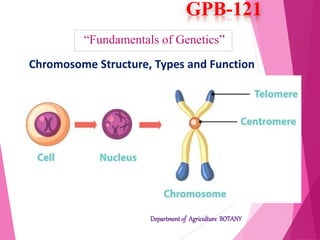
Chromosome Structure, Types and Function
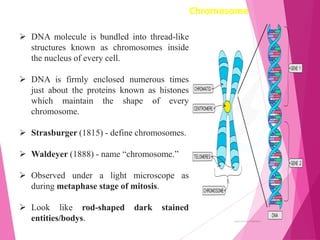
 DNA molecule is bundled into thread-like
structures known as chromosomes inside
the nucleus of every cell.
 DNA is firmly enclosed numerous times
just about the proteins known as histones
which maintain the shape of every
chromosome.
 Strasburger (1815) - define chromosomes.
 Waldeyer (1888) - name “chromosome.”
 Observed under a light microscope as
during metaphase stage of mitosis.
 Look like rod-shaped dark stained
entities/bodys.
Chromosome
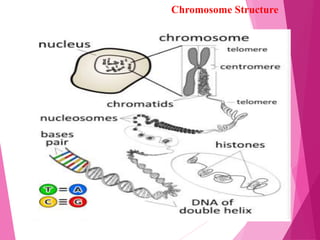
Chromosome Structure
Pellicle
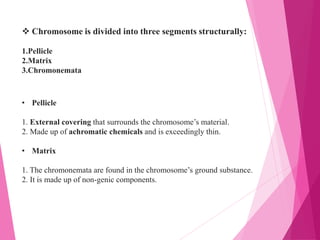
 Chromosome is divided into three segments structurally:
1.Pellicle
2.Matrix
3.Chromonemata
• Pellicle
1. External covering that surrounds the chromosome’s material.
2. Made up of achromatic chemicals and is exceedingly thin.
• Matrix
1. The chromonemata are found in the chromosome’s ground substance.
2. It is made up of non-genic components.
• Chromonemata
•The chromonemata are two similar spiral pattern coiled threads implanted within the
matrix of every chromosome.
•The two chromonemata are indeed tightly coiled together, forming a single thread
with a thickness of roughly 800A.
•Every chromonemata is made up of roughly 8 microfibrils, which are each made up
of two DNA double helixes.
• Centromere
 A tiny structure inside the chromonema defined by a restriction that is known as a
permanent component inside the chromosome is the centromere.
 Two chromonemata are now linked at this moment.
 Centromere, kinetochore, or main constriction are all terms for the same thing.
 It separates the chromosome into two parts, or “arms.” The “p arm” known as the
short arm of chromosome.
 The “q arm” known as the long arm of chromosome.
 Location is fixed for each kind of chromosome plus serves as a distinguishing
characteristic.
 During cellular division, the chromosomes are connected to spindle threads in this
area.
• Telomeres
 Specialised ends of chromosomes that show physiological differentiation and
polarity.
 Because of its polarity, each chromosome extremity prohibits other chromosomal
segments from fusing with it. The chromosomal ends are referred to as telomeres.
 Due to the lack of telomeres, if a chromosome breaks, the split ends might fuse
with each other.
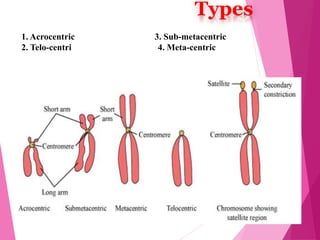
Types
1. Acrocentric 3. Sub-metacentric
2. Telo-centri 4. Meta-centric
• Types of chromosomes based on the position of the centromere -
1.Acrocentric - Centromere occupying a terminal position.
 One arm is very long and the other is absent.
 J shaped
2. Telocentric - Subterminal centromeres.
 Rod shaped
3. Submetacentric - S-shaped
 Chromosome with a centromere slightly away from the midpoint so that the
two arms are unequal.
4. Metacentric - V-shaped.
 Two arms are almost equal.
Functions of Centromere –
two functions:
•Provides attachment for the microtubules of chromosomal
spindle fibres and helps in chromosomal movement during
cell division.
•Nucleation centre — The centromere serves as the
nucleation centre for the polymerization of tubulin. The
protein is used in the formation of microtubules. Thus it helps
in the formation of spindle fibres during prometaphase.

Chromosome Structure, Types and Function.pptx

  • 1.
    GPB-121 Department of AgricultureBOTANY “Fundamentals of Genetics” Chromosome Structure, Types and Function
  • 2.
     DNA moleculeis bundled into thread-like structures known as chromosomes inside the nucleus of every cell.  DNA is firmly enclosed numerous times just about the proteins known as histones which maintain the shape of every chromosome.  Strasburger (1815) - define chromosomes.  Waldeyer (1888) - name “chromosome.”  Observed under a light microscope as during metaphase stage of mitosis.  Look like rod-shaped dark stained entities/bodys. Chromosome
  • 3.
  • 4.
  • 5.
     Chromosome isdivided into three segments structurally: 1.Pellicle 2.Matrix 3.Chromonemata • Pellicle 1. External covering that surrounds the chromosome’s material. 2. Made up of achromatic chemicals and is exceedingly thin. • Matrix 1. The chromonemata are found in the chromosome’s ground substance. 2. It is made up of non-genic components.
  • 6.
    • Chromonemata •The chromonemataare two similar spiral pattern coiled threads implanted within the matrix of every chromosome. •The two chromonemata are indeed tightly coiled together, forming a single thread with a thickness of roughly 800A. •Every chromonemata is made up of roughly 8 microfibrils, which are each made up of two DNA double helixes. • Centromere  A tiny structure inside the chromonema defined by a restriction that is known as a permanent component inside the chromosome is the centromere.  Two chromonemata are now linked at this moment.  Centromere, kinetochore, or main constriction are all terms for the same thing.  It separates the chromosome into two parts, or “arms.” The “p arm” known as the short arm of chromosome.  The “q arm” known as the long arm of chromosome.
  • 7.
     Location isfixed for each kind of chromosome plus serves as a distinguishing characteristic.  During cellular division, the chromosomes are connected to spindle threads in this area. • Telomeres  Specialised ends of chromosomes that show physiological differentiation and polarity.  Because of its polarity, each chromosome extremity prohibits other chromosomal segments from fusing with it. The chromosomal ends are referred to as telomeres.  Due to the lack of telomeres, if a chromosome breaks, the split ends might fuse with each other.
  • 8.
    Types 1. Acrocentric 3.Sub-metacentric 2. Telo-centri 4. Meta-centric
  • 9.
    • Types ofchromosomes based on the position of the centromere - 1.Acrocentric - Centromere occupying a terminal position.  One arm is very long and the other is absent.  J shaped 2. Telocentric - Subterminal centromeres.  Rod shaped 3. Submetacentric - S-shaped  Chromosome with a centromere slightly away from the midpoint so that the two arms are unequal. 4. Metacentric - V-shaped.  Two arms are almost equal.
  • 10.
    Functions of Centromere– two functions: •Provides attachment for the microtubules of chromosomal spindle fibres and helps in chromosomal movement during cell division. •Nucleation centre — The centromere serves as the nucleation centre for the polymerization of tubulin. The protein is used in the formation of microtubules. Thus it helps in the formation of spindle fibres during prometaphase.