WELCOME
RANJITHA, KM
PGS15AGR6842
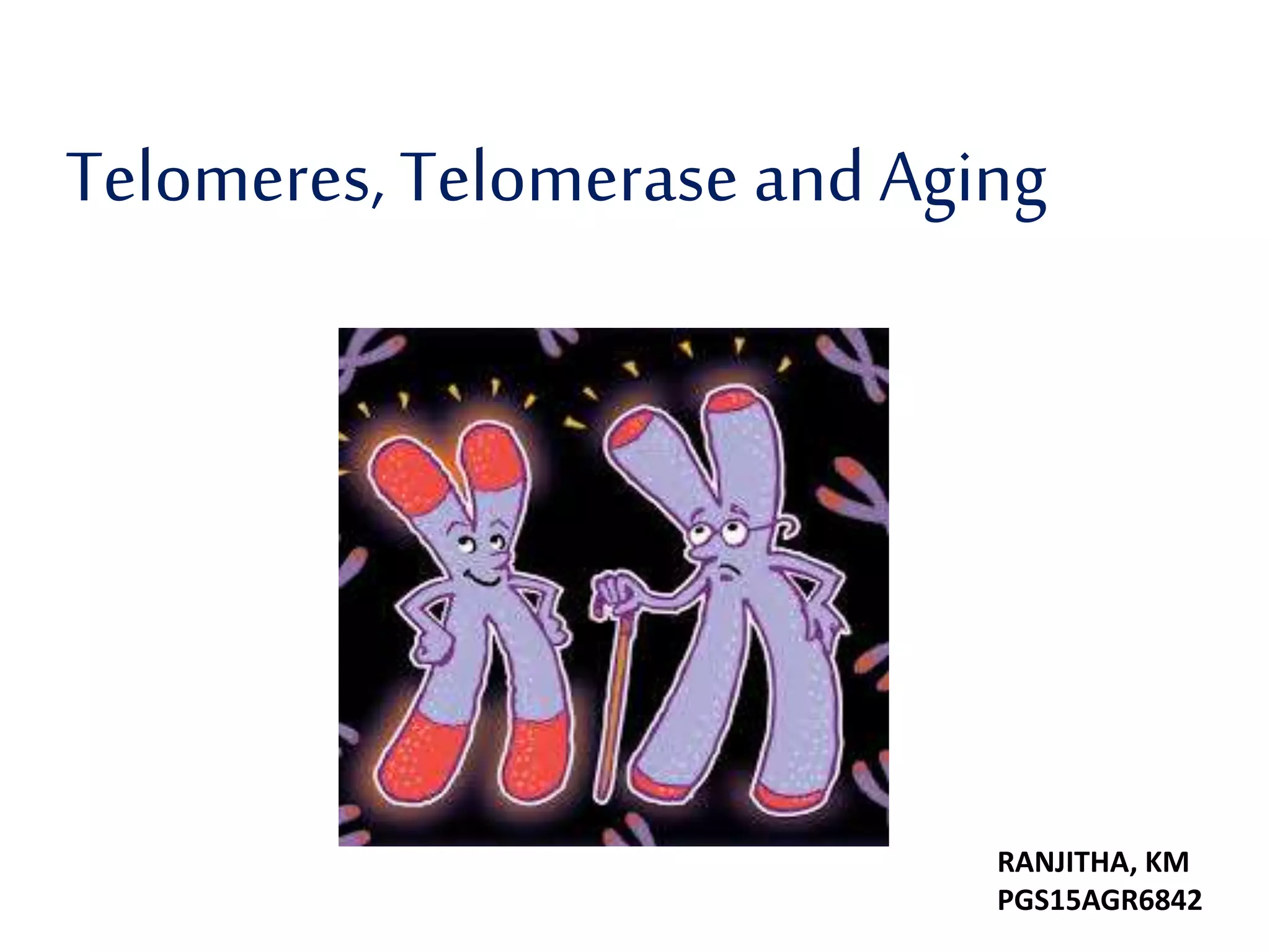
Telomeres, Telomerase and Aging
CONTENTS
• Introduction
• Telomeres : structure and function.
• End replication problem
• Telomerase
• ALT
• Aging
• Link between telomere and aging
• Telomere and aging related diseases in human
• Case studies
• Future prospects
• Conclusion
•The word ‘Telomere’ is derived from the Greek nouns telos
(τέλος) meaning 'end' and merοs (μέρος, root: μερ-) 'part‘
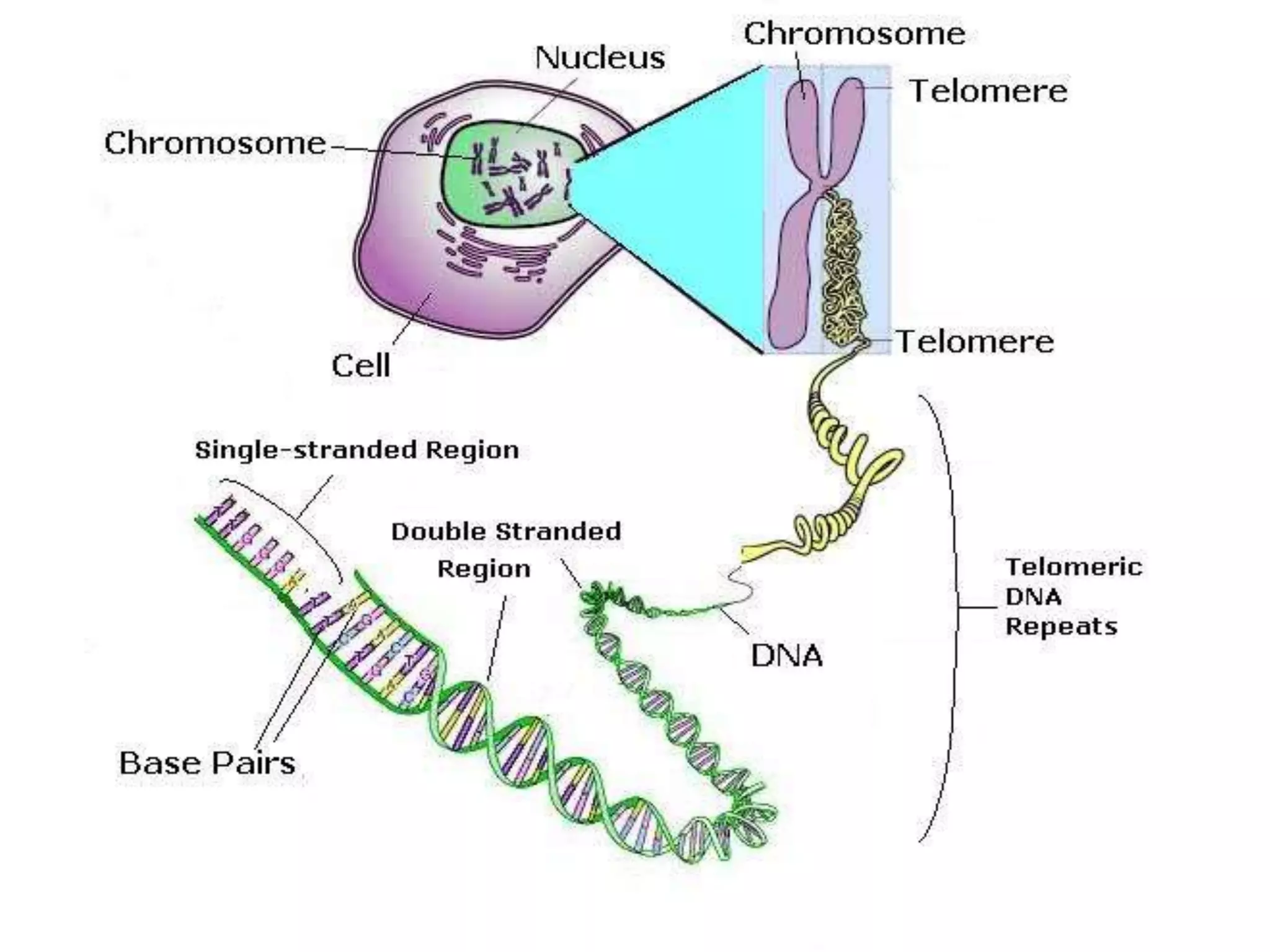
•It is a region of repetitive nucleotide sequences at each end of
a chromosome,
• The sequence of nucleotides in telomeres is varies between
the organisms.
Wikipedia
HISTORY
• Hermann J. Muller 1938 - introduced the term Telomere
• Alexey Olovnikov 1973 - existence of a compensatory
mechanism for telomere shortening, suggested the telomere
hypothesis of aging and the telomere's connections to cancer.
• Elizabeth Blackburn 1975–1977 - Discovered the unusual
nature of telomeres, with their simple repeated DNA
sequences composing chromosome ends
• Leonard Hayflick - The phenomenon of limited cellular
division and is now referred to as the Hayflick limit.
Wikipedia
• The first characterized plant telomeres were cloned
from Arabidopsis thaliana (2—5 kb).
• Same telomeric sequences were observed in Zea mays
(corn) but the length varies (30-60 kb)
• Tomato 30-60 kb
• Barley 1- 6 kb
• Soyabean 13-35 kb
• Wide variation of telomere lengths between species
and between varieties of one species also,
www.plantcell.orgª 2004
Vertebrates Human, mouse TTAGGG
Higher plants Arabidopsis thaliana TTTAGGG
Filamentous fungi Neurospora crassa
TTAGGG
Green algae Chlamydomonas TTTTAGGG
Insect Bombyx mori TTAGG
Budding yeast Saccharomyces cerevisiae TGTGGGTGTG
GTG
Ciliate protozoa Tetrahymena,Glaucoma TTGGGG
www.plantcell.orgª 2004
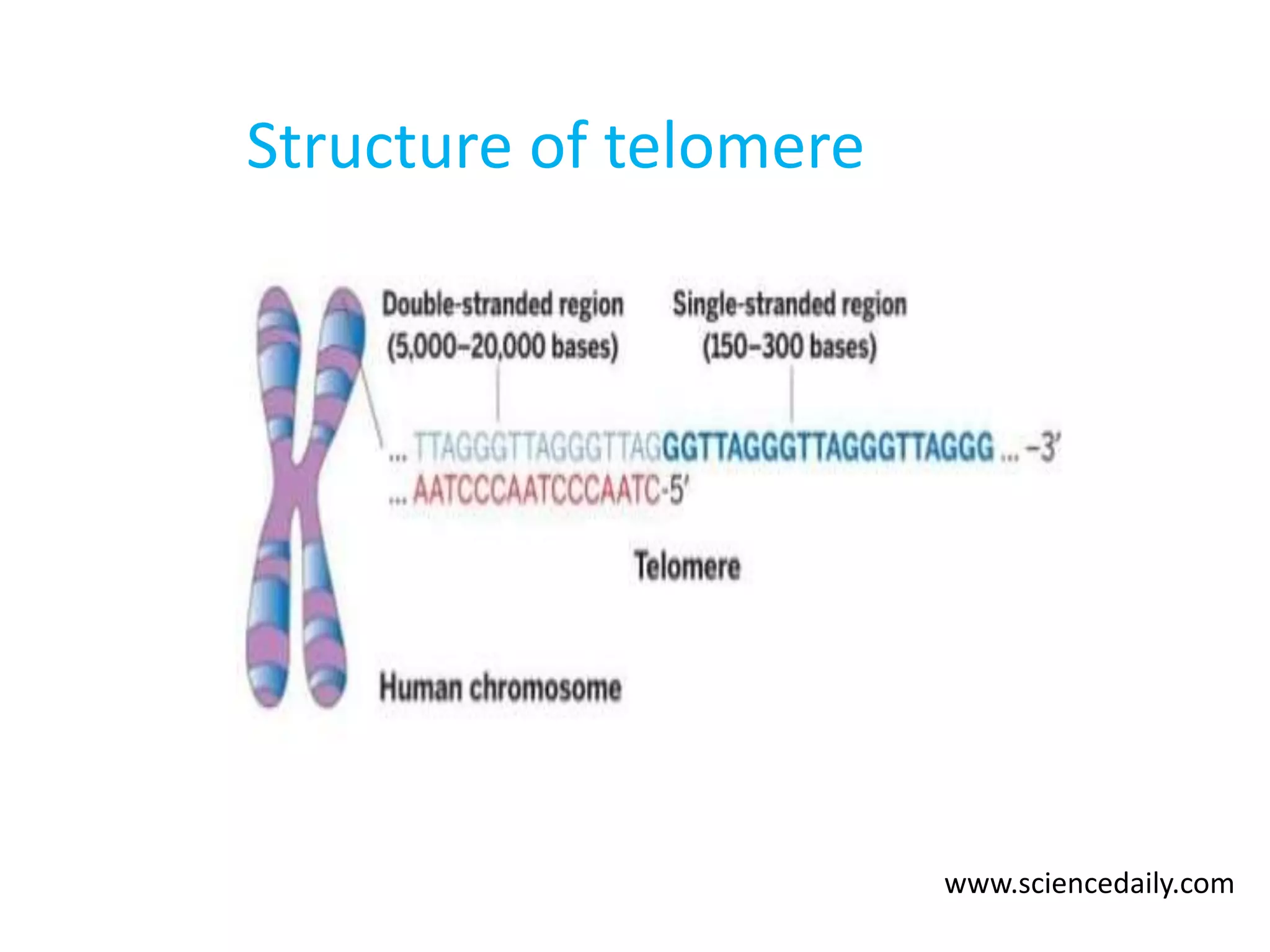
Insert telomere stucture with 3’ over hang
Structure of telomere
www.sciencedaily.com
Why this 3’ overhang exist?
• To provide a substrate for telomerase(Lingner and
Cech, 1996; Wang and Blackburn, 1997).
• Play a critical role in recombination dependent
telomere maintenance.
• To create a ‘t-loop’ (Wei and Price, 2003).
• Recent experiments suggest that in rapidly dividing
mammalian cells some telomeres instead have a 5′ C
strand ssDNA overhang (CiminoReale et al., 2003).
o Model of a human telomere stabilized by the formation of a t-loop coated
with shelterin.
Snustad Principles of Genetics 6th Edition.
Structure of telomere
https://www.dnalabsindia.com
www.hhmi.com
Functions of telomere
• Telomeres are essential elements of all eukaryotic
chromosomes
• Protecting them from exonuclease degradation and
• which protects the end of the chromosome from deterioration
or from fusion with neighboring chromosomes or prevent End-
to-end chromosomal fusions.
• Cap the end of the chromosome
• Facilitate cell replication (cell cannot divide when cell get too
short)
Telomerase
Telomerase
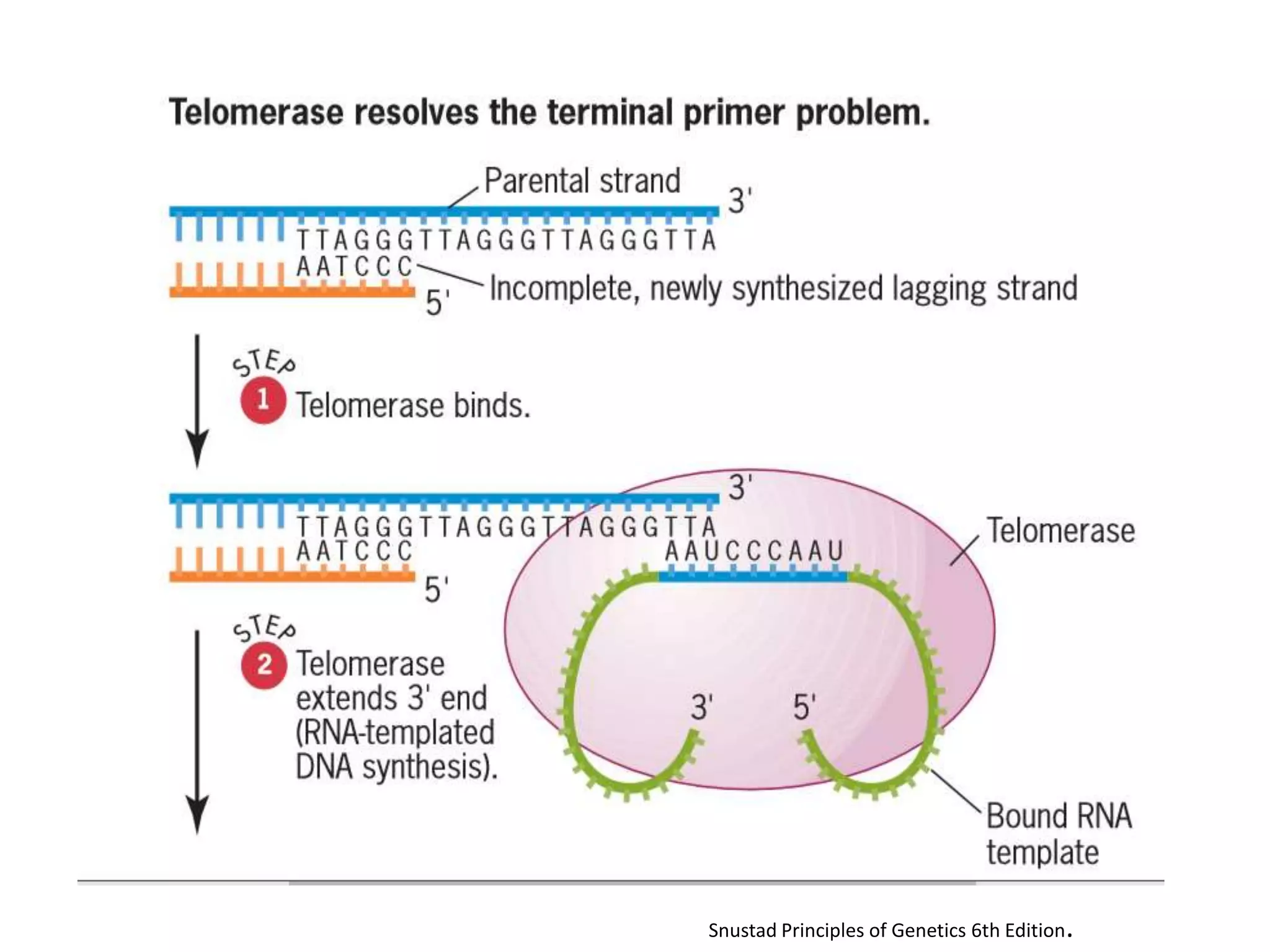
Telomerase (TEE-LÓM-ER-ACE) is a ribonucleoprotein
enzyme complex (a cellular reverse transcriptase) that
has been referred to as a cellular immortalizing
enzyme.
Telomerase was discovered by Carol W.
Greider and Elizabeth Blackburn in 1984 in the
ciliate Tetrahymena.
wikipedia
•The human telomerase enzyme
complex consists of
•Human telomerase reverse
transcriptase (TERT)
•Telomerase RNA (TR or TERC)
and
•dyskerin (DKC1).
• The genes of telomerase
subunits, which include
TERT, TERC, DKC1 and TEP1, are
located on different
chromosomes.
Cong et al., 2002, http://www.haematologica.org/
•The protein consists of four conserved
domains (RNA-Binding Domain (TRBD),
fingers, palm and thumb)
Cong et al., 2002
• In most multicellular eukaryotic organisms,
telomerase is active only in germ cells, stem
cells, and certain white blood cells.
Snustad Principles of Genetics 6th Edition.
video
ALTERNATE LENGTHENING OF TELOMERE MECHANISMS
http://www.nature.com
• Most somatic cells do not have sufficiently
high levels of telomerase to maintain the
length of their telomeres for an indefinite
number of cell divisions.
• Consequently, telomeres gradually shorten as
cells age.
• This shortening eventually leads to cell death
or senescence.
Aging
Gerantology
Aging
• Theories of Aging
1.Programmed Theories
• Programmed Longevity: Aging is caused by certain genes switching on and
off over time.
• Endocrine Theory: Changes in hormones control aging.
• Immunological Theory: The immune system is programmed to decline
over time, leaving people more susceptible to diseases
2.Error Theories
• Wear and Tear: Cells and tissues simply wear out.
• Rates of Living: The faster an organism uses oxygen, the shorter it lives.
• Cross-Linking: Cross-linked proteins accumulate and slow down body
processes.
• Free Radicals: Free radicals cause damage to cells that eventually impairs
function.
• Somatic DNA Damage: Genetic mutations cause cells to malfunction
Source: National Institute on Aging: National Instituteof Health
 The progressive loss of telomeric repeats of chromosomes may function as an important
timing mechanism during the aging process in various species
(Campisi et al.,2001)
Other factors influences Aging
Diseases Affected By
Telomere Shortening
• Muscular Dystrophy
• Cell & Tissue
Transplants
• AIDS
• Progeria
• Dyskeratosis Congenita
• Idiopathic Pulmonary
Fibrosis
• Cri du Chat syndrome
• Down’s Syndrome
• Fanconi’s Anemia
• Tuberous Sclerosis
• Werner’s Syndrome
• Cardiovascular
• Cancer
• COPD
• Degenerative Disc
Disease
• Alzheimer’s
• Osteoarthritis
• Rheumatoid Arthritis
• Osteoporosis
• General Immunity
• Skin Aging
• Macular Degeneration
• Liver Cirrhosis
www.alsearsmd.com, Wellness Research Foundation
Astragalus tragacantha (ssp. Vicentinus))
Naturally-occurring, highly
purified single molecule derived
from the Chinese herb
Astragalus
Activates the hTERT gene
In vitro: moderately activated
telomerase in keratinocytes,
fibroblasts, and immune cells
In vivo: orally administered in
doses of 10-50 mg/day for 12-
months
Blasco et al.. A natural product telomerase activator as part of a health maintenance program. Rejuvenation Res. 2011
Feb;14(1):45-56.
The Search for the First Telomerase Activator
TA-65
• Developmental Control of Telomere Lengths and Telomerase
Activity in Plants
-Riha et al., 1998
• Telomere shortening is the molecular clock that triggers
senescence
-Bodnar et al., 1998
• Telomere Shortening and Tumor Formation by Mouse Cells
Lacking Telomerase- indicate that telomerase is essential for
telomere length maintenance
- Blasco et al., 1997
• Disruption of the telomerase catalytic subunit gene from
Arabidopsis inactivates telomerase and leads to a slow loss of
telomeric DNA
-Fitzgerald et al 1999
• The Shortest Telomere, Not Average Telomere Length, Is
Critical for Cell Viability and Chromosome Stability
– Hemann et al., 2001
• Telomerase knockout mice displayed a decrease in mean
telomere length and a higher % of short telomeres in several
organs which co-related with an incapacity to regenerated
-Strong et al.,2011
Future prospects
• Long-lived normal human cells could be used for the
production of normal or engineered biotechnology
products; and expanded populations of normal or
genetically engineered rejuvenated cells could be
used for autologous or allogeneic cell and gene
therapy.
• Better understanding the role of telomerase will help
to treat cancer, aging and age related diseases.
• The roles of telomerase in both cellular immortality
and cancer are vibrant areas of current research.
Conclusion
• Understanding the molecular mechanism of
aging could have enormous medical
implications and there are plentiful evidences
suggesting that DNA constitute the central
molecule in aging process. More and more
studies showed that Age related decline,
dysfunction, and a shortened lifespan are all
related to telomere shortening.
Thank you

Telomere telomerase and aging

  • 1.
  • 2.
  • 3.
    CONTENTS • Introduction • Telomeres: structure and function. • End replication problem • Telomerase • ALT • Aging • Link between telomere and aging • Telomere and aging related diseases in human • Case studies • Future prospects • Conclusion
  • 5.
    •The word ‘Telomere’is derived from the Greek nouns telos (τέλος) meaning 'end' and merοs (μέρος, root: μερ-) 'part‘ •It is a region of repetitive nucleotide sequences at each end of a chromosome, • The sequence of nucleotides in telomeres is varies between the organisms. Wikipedia
  • 6.
    HISTORY • Hermann J.Muller 1938 - introduced the term Telomere • Alexey Olovnikov 1973 - existence of a compensatory mechanism for telomere shortening, suggested the telomere hypothesis of aging and the telomere's connections to cancer. • Elizabeth Blackburn 1975–1977 - Discovered the unusual nature of telomeres, with their simple repeated DNA sequences composing chromosome ends • Leonard Hayflick - The phenomenon of limited cellular division and is now referred to as the Hayflick limit. Wikipedia
  • 8.
    • The firstcharacterized plant telomeres were cloned from Arabidopsis thaliana (2—5 kb). • Same telomeric sequences were observed in Zea mays (corn) but the length varies (30-60 kb) • Tomato 30-60 kb • Barley 1- 6 kb • Soyabean 13-35 kb • Wide variation of telomere lengths between species and between varieties of one species also, www.plantcell.orgª 2004
  • 9.
    Vertebrates Human, mouseTTAGGG Higher plants Arabidopsis thaliana TTTAGGG Filamentous fungi Neurospora crassa TTAGGG Green algae Chlamydomonas TTTTAGGG Insect Bombyx mori TTAGG Budding yeast Saccharomyces cerevisiae TGTGGGTGTG GTG Ciliate protozoa Tetrahymena,Glaucoma TTGGGG www.plantcell.orgª 2004
  • 10.
    Insert telomere stucturewith 3’ over hang Structure of telomere www.sciencedaily.com
  • 11.
    Why this 3’overhang exist? • To provide a substrate for telomerase(Lingner and Cech, 1996; Wang and Blackburn, 1997). • Play a critical role in recombination dependent telomere maintenance. • To create a ‘t-loop’ (Wei and Price, 2003). • Recent experiments suggest that in rapidly dividing mammalian cells some telomeres instead have a 5′ C strand ssDNA overhang (CiminoReale et al., 2003).
  • 12.
    o Model ofa human telomere stabilized by the formation of a t-loop coated with shelterin. Snustad Principles of Genetics 6th Edition.
  • 13.
  • 14.
  • 15.
    Functions of telomere •Telomeres are essential elements of all eukaryotic chromosomes • Protecting them from exonuclease degradation and • which protects the end of the chromosome from deterioration or from fusion with neighboring chromosomes or prevent End- to-end chromosomal fusions. • Cap the end of the chromosome • Facilitate cell replication (cell cannot divide when cell get too short)
  • 17.
  • 18.
    Telomerase Telomerase (TEE-LÓM-ER-ACE) isa ribonucleoprotein enzyme complex (a cellular reverse transcriptase) that has been referred to as a cellular immortalizing enzyme. Telomerase was discovered by Carol W. Greider and Elizabeth Blackburn in 1984 in the ciliate Tetrahymena. wikipedia
  • 19.
    •The human telomeraseenzyme complex consists of •Human telomerase reverse transcriptase (TERT) •Telomerase RNA (TR or TERC) and •dyskerin (DKC1). • The genes of telomerase subunits, which include TERT, TERC, DKC1 and TEP1, are located on different chromosomes. Cong et al., 2002, http://www.haematologica.org/
  • 20.
    •The protein consistsof four conserved domains (RNA-Binding Domain (TRBD), fingers, palm and thumb) Cong et al., 2002
  • 21.
    • In mostmulticellular eukaryotic organisms, telomerase is active only in germ cells, stem cells, and certain white blood cells.
  • 22.
    Snustad Principles ofGenetics 6th Edition.
  • 23.
    Snustad Principles ofGenetics 6th Edition.
  • 24.
  • 25.
    ALTERNATE LENGTHENING OFTELOMERE MECHANISMS http://www.nature.com
  • 26.
  • 27.
    • Most somaticcells do not have sufficiently high levels of telomerase to maintain the length of their telomeres for an indefinite number of cell divisions. • Consequently, telomeres gradually shorten as cells age. • This shortening eventually leads to cell death or senescence.
  • 28.
  • 29.
    Aging • Theories ofAging 1.Programmed Theories • Programmed Longevity: Aging is caused by certain genes switching on and off over time. • Endocrine Theory: Changes in hormones control aging. • Immunological Theory: The immune system is programmed to decline over time, leaving people more susceptible to diseases 2.Error Theories • Wear and Tear: Cells and tissues simply wear out. • Rates of Living: The faster an organism uses oxygen, the shorter it lives. • Cross-Linking: Cross-linked proteins accumulate and slow down body processes. • Free Radicals: Free radicals cause damage to cells that eventually impairs function. • Somatic DNA Damage: Genetic mutations cause cells to malfunction Source: National Institute on Aging: National Instituteof Health
  • 30.
     The progressiveloss of telomeric repeats of chromosomes may function as an important timing mechanism during the aging process in various species (Campisi et al.,2001)
  • 31.
  • 32.
    Diseases Affected By TelomereShortening • Muscular Dystrophy • Cell & Tissue Transplants • AIDS • Progeria • Dyskeratosis Congenita • Idiopathic Pulmonary Fibrosis • Cri du Chat syndrome • Down’s Syndrome • Fanconi’s Anemia • Tuberous Sclerosis • Werner’s Syndrome • Cardiovascular • Cancer • COPD • Degenerative Disc Disease • Alzheimer’s • Osteoarthritis • Rheumatoid Arthritis • Osteoporosis • General Immunity • Skin Aging • Macular Degeneration • Liver Cirrhosis www.alsearsmd.com, Wellness Research Foundation
  • 33.
    Astragalus tragacantha (ssp.Vicentinus)) Naturally-occurring, highly purified single molecule derived from the Chinese herb Astragalus Activates the hTERT gene In vitro: moderately activated telomerase in keratinocytes, fibroblasts, and immune cells In vivo: orally administered in doses of 10-50 mg/day for 12- months Blasco et al.. A natural product telomerase activator as part of a health maintenance program. Rejuvenation Res. 2011 Feb;14(1):45-56. The Search for the First Telomerase Activator TA-65
  • 34.
    • Developmental Controlof Telomere Lengths and Telomerase Activity in Plants -Riha et al., 1998 • Telomere shortening is the molecular clock that triggers senescence -Bodnar et al., 1998 • Telomere Shortening and Tumor Formation by Mouse Cells Lacking Telomerase- indicate that telomerase is essential for telomere length maintenance - Blasco et al., 1997
  • 35.
    • Disruption ofthe telomerase catalytic subunit gene from Arabidopsis inactivates telomerase and leads to a slow loss of telomeric DNA -Fitzgerald et al 1999 • The Shortest Telomere, Not Average Telomere Length, Is Critical for Cell Viability and Chromosome Stability – Hemann et al., 2001 • Telomerase knockout mice displayed a decrease in mean telomere length and a higher % of short telomeres in several organs which co-related with an incapacity to regenerated -Strong et al.,2011
  • 36.
    Future prospects • Long-livednormal human cells could be used for the production of normal or engineered biotechnology products; and expanded populations of normal or genetically engineered rejuvenated cells could be used for autologous or allogeneic cell and gene therapy. • Better understanding the role of telomerase will help to treat cancer, aging and age related diseases. • The roles of telomerase in both cellular immortality and cancer are vibrant areas of current research.
  • 37.
    Conclusion • Understanding themolecular mechanism of aging could have enormous medical implications and there are plentiful evidences suggesting that DNA constitute the central molecule in aging process. More and more studies showed that Age related decline, dysfunction, and a shortened lifespan are all related to telomere shortening.
  • 38.