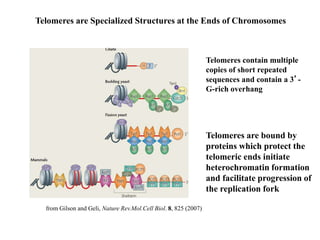
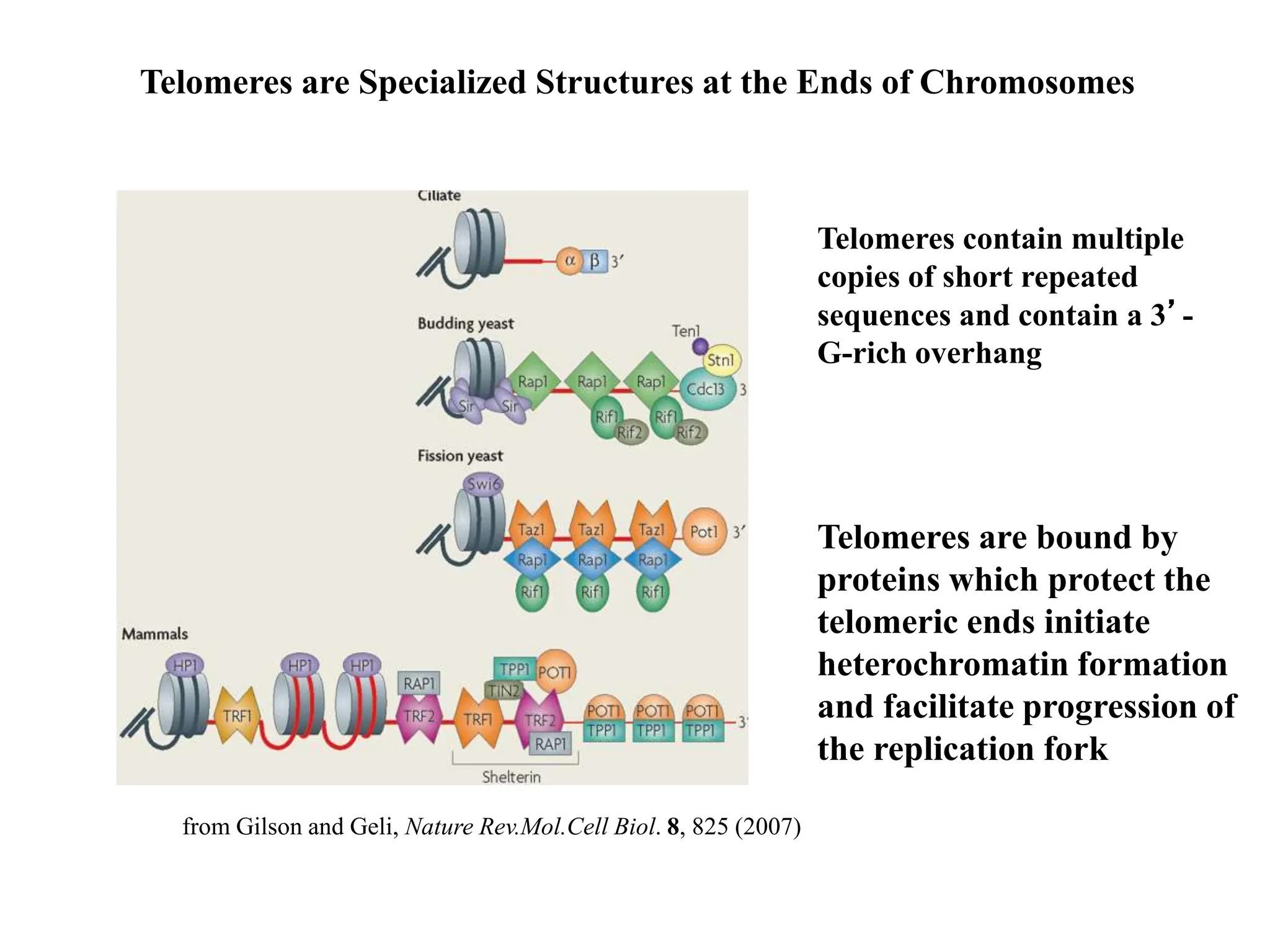
Telomeres are Specialized Structures at the Ends of Chromosomes
Telomeres contain multiple
copies of short repeated
sequences and contain a 3’-
G-rich overhang
Telomeres are bound by
proteins which protect the
telomeric ends initiate
heterochromatin formation
and facilitate progression of
the replication fork
from Gilson and Geli, Nature Rev.Mol.Cell Biol. 8, 825 (2007)
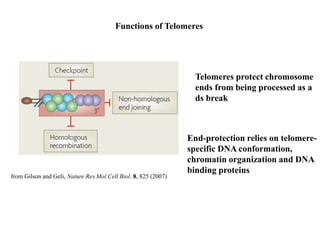
Functions of Telomeres
Telomeres protect chromosome
ends from being processed as a
ds break
End-protection relies on telomere-
specific DNA conformation,
chromatin organization and DNA
binding proteins
from Gilson and Geli, Nature Rev.Mol.Cell Biol. 8, 825 (2007)
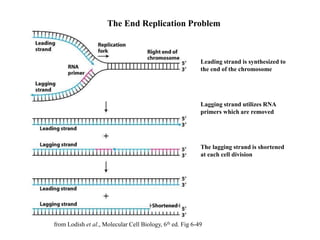
The End Replication Problem
Leading strand is synthesized to
the end of the chromosome
Lagging strand utilizes RNA
primers which are removed
The lagging strand is shortened
at each cell division
from Lodish et al., Molecular Cell Biology, 6th ed. Fig 6-49
5’
3’
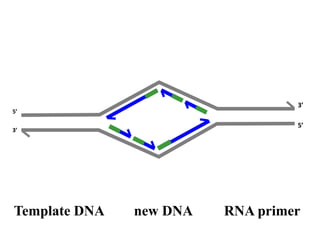
Template DNA new DNA RNA primer
5’
3’
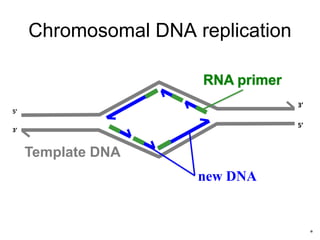
Chromosomal DNA replication
Template DNA
new DNA
5’
3’
5’
3’
*
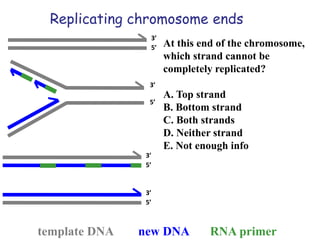
Replicating chromosome ends
At this end of the chromosome,
which strand cannot be
completely replicated?
A. Top strand
B. Bottom strand
C. Both strands
D. Neither strand
E. Not enough info
template DNA new DNA RNA primer
5’
3’
5’
3’
5’
3’
5’
3’
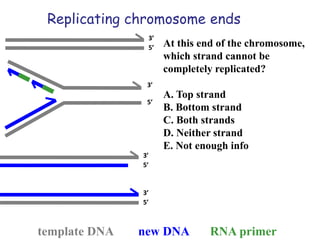
Replicating chromosome ends
At this end of the chromosome,
which strand cannot be
completely replicated?
A. Top strand
B. Bottom strand
C. Both strands
D. Neither strand
E. Not enough info
template DNA new DNA RNA primer
5’
3’
5’
3’
5’
3’
5’
3’
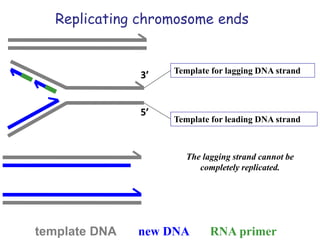
Replicating chromosome ends
template DNA new DNA RNA primer
The lagging strand cannot be
completely replicated.
Template for lagging DNA strand
Template for leading DNA strand
3’
5’
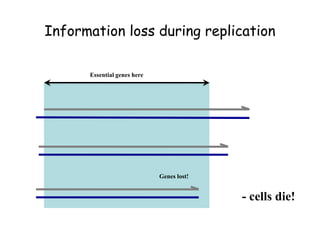
Genes lost!
Essential genes here
- cells die!
Information loss during replication
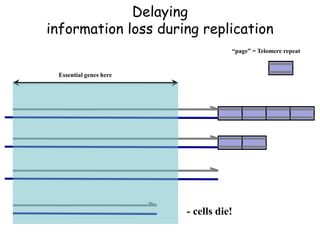
Essential genes here
“page” = Telomere repeat
- cells die!
Delaying
information loss during replication
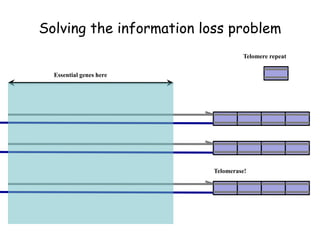
Telomerase!
Telomere repeat
Solving the information loss problem
Essential genes here
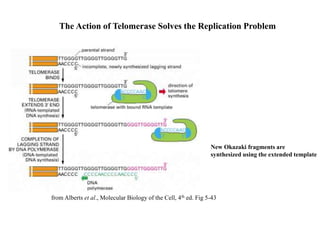
The Action of Telomerase Solves the Replication Problem
from Alberts et al., Molecular Biology of the Cell, 4th ed. Fig 5-43
New Okazaki fragments are
synthesized using the extended template
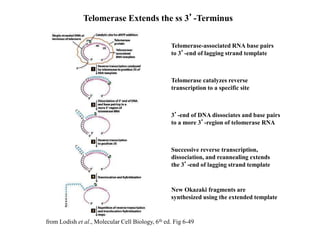
Telomerase Extends the ss 3’-Terminus
Telomerase-associated RNA base pairs
to 3’-end of lagging strand template
Telomerase catalyzes reverse
transcription to a specific site
3’-end of DNA dissociates and base pairs
to a more 3’-region of telomerase RNA
Successive reverse transcription,
dissociation, and reannealing extends
the 3’-end of lagging strand template
New Okazaki fragments are
synthesized using the extended template
from Lodish et al., Molecular Cell Biology, 6th ed. Fig 6-49
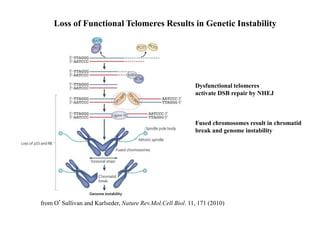
Loss of Functional Telomeres Results in Genetic Instability
from O’Sullivan and Karlseder, Nature Rev.Mol.Cell Biol. 11, 171 (2010)
Dysfunctional telomeres
activate DSB repair by NHEJ
Fused chromosomes result in chromatid
break and genome instability
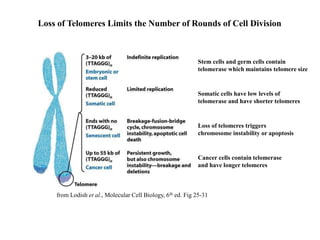
from Lodish et al., Molecular Cell Biology, 6th ed. Fig 25-31
Stem cells and germ cells contain
telomerase which maintains telomere size
Somatic cells have low levels of
telomerase and have shorter telomeres
Loss of telomeres triggers
chromosome instability or apoptosis
Cancer cells contain telomerase
and have longer telomeres
Loss of Telomeres Limits the Number of Rounds of Cell Division
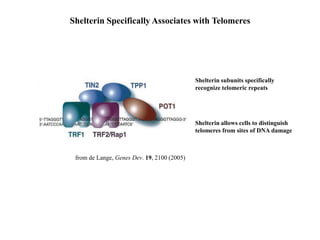
from de Lange, Genes Dev. 19, 2100 (2005)
Shelterin Specifically Associates with Telomeres
Shelterin subunits specifically
recognize telomeric repeats
Shelterin allows cells to distinguish
telomeres from sites of DNA damage
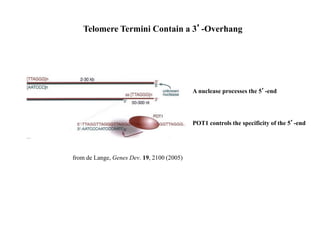
Telomere Termini Contain a 3’-Overhang
from de Lange, Genes Dev. 19, 2100 (2005)
A nuclease processes the 5’-end
POT1 controls the specificity of the 5’-end
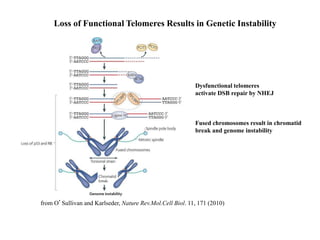
Loss of Functional Telomeres Results in Genetic Instability
from O’Sullivan and Karlseder, Nature Rev.Mol.Cell Biol. 11, 171 (2010)
Dysfunctional telomeres
activate DSB repair by NHEJ
Fused chromosomes result in chromatid
break and genome instability
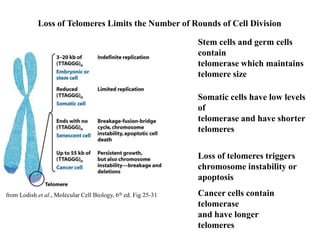
from Lodish et al., Molecular Cell Biology, 6th ed. Fig 25-31
Stem cells and germ cells
contain
telomerase which maintains
telomere size
Somatic cells have low levels
of
telomerase and have shorter
telomeres
Loss of telomeres triggers
chromosome instability or
apoptosis
Cancer cells contain
telomerase
and have longer
telomeres
Loss of Telomeres Limits the Number of Rounds of Cell Division
Telomerase is widely expressed in cancers
80-90% of tumors are telomerase-positive
Telomerase-based Cancer Therapy
Strategies include
Direct telomerase inhibition
Telomerase immunotherapy

End DNA replication in prokaryotes mechanism

  • 1.
    Telomeres are SpecializedStructures at the Ends of Chromosomes Telomeres contain multiple copies of short repeated sequences and contain a 3’- G-rich overhang Telomeres are bound by proteins which protect the telomeric ends initiate heterochromatin formation and facilitate progression of the replication fork from Gilson and Geli, Nature Rev.Mol.Cell Biol. 8, 825 (2007)
  • 2.
    Functions of Telomeres Telomeresprotect chromosome ends from being processed as a ds break End-protection relies on telomere- specific DNA conformation, chromatin organization and DNA binding proteins from Gilson and Geli, Nature Rev.Mol.Cell Biol. 8, 825 (2007)
  • 3.
    The End ReplicationProblem Leading strand is synthesized to the end of the chromosome Lagging strand utilizes RNA primers which are removed The lagging strand is shortened at each cell division from Lodish et al., Molecular Cell Biology, 6th ed. Fig 6-49
  • 4.
    5’ 3’ Template DNA newDNA RNA primer 5’ 3’
  • 5.
    Chromosomal DNA replication TemplateDNA new DNA 5’ 3’ 5’ 3’ *
  • 6.
    Replicating chromosome ends Atthis end of the chromosome, which strand cannot be completely replicated? A. Top strand B. Bottom strand C. Both strands D. Neither strand E. Not enough info template DNA new DNA RNA primer 5’ 3’ 5’ 3’ 5’ 3’ 5’ 3’
  • 7.
    Replicating chromosome ends Atthis end of the chromosome, which strand cannot be completely replicated? A. Top strand B. Bottom strand C. Both strands D. Neither strand E. Not enough info template DNA new DNA RNA primer 5’ 3’ 5’ 3’ 5’ 3’ 5’ 3’
  • 8.
    Replicating chromosome ends templateDNA new DNA RNA primer The lagging strand cannot be completely replicated. Template for lagging DNA strand Template for leading DNA strand 3’ 5’
  • 9.
    Genes lost! Essential geneshere - cells die! Information loss during replication
  • 10.
    Essential genes here “page”= Telomere repeat - cells die! Delaying information loss during replication
  • 11.
    Telomerase! Telomere repeat Solving theinformation loss problem Essential genes here
  • 12.
    The Action ofTelomerase Solves the Replication Problem from Alberts et al., Molecular Biology of the Cell, 4th ed. Fig 5-43 New Okazaki fragments are synthesized using the extended template
  • 13.
    Telomerase Extends thess 3’-Terminus Telomerase-associated RNA base pairs to 3’-end of lagging strand template Telomerase catalyzes reverse transcription to a specific site 3’-end of DNA dissociates and base pairs to a more 3’-region of telomerase RNA Successive reverse transcription, dissociation, and reannealing extends the 3’-end of lagging strand template New Okazaki fragments are synthesized using the extended template from Lodish et al., Molecular Cell Biology, 6th ed. Fig 6-49
  • 14.
    Loss of FunctionalTelomeres Results in Genetic Instability from O’Sullivan and Karlseder, Nature Rev.Mol.Cell Biol. 11, 171 (2010) Dysfunctional telomeres activate DSB repair by NHEJ Fused chromosomes result in chromatid break and genome instability
  • 15.
    from Lodish etal., Molecular Cell Biology, 6th ed. Fig 25-31 Stem cells and germ cells contain telomerase which maintains telomere size Somatic cells have low levels of telomerase and have shorter telomeres Loss of telomeres triggers chromosome instability or apoptosis Cancer cells contain telomerase and have longer telomeres Loss of Telomeres Limits the Number of Rounds of Cell Division
  • 16.
    from de Lange,Genes Dev. 19, 2100 (2005) Shelterin Specifically Associates with Telomeres Shelterin subunits specifically recognize telomeric repeats Shelterin allows cells to distinguish telomeres from sites of DNA damage
  • 17.
    Telomere Termini Containa 3’-Overhang from de Lange, Genes Dev. 19, 2100 (2005) A nuclease processes the 5’-end POT1 controls the specificity of the 5’-end
  • 18.
    Loss of FunctionalTelomeres Results in Genetic Instability from O’Sullivan and Karlseder, Nature Rev.Mol.Cell Biol. 11, 171 (2010) Dysfunctional telomeres activate DSB repair by NHEJ Fused chromosomes result in chromatid break and genome instability
  • 19.
    from Lodish etal., Molecular Cell Biology, 6th ed. Fig 25-31 Stem cells and germ cells contain telomerase which maintains telomere size Somatic cells have low levels of telomerase and have shorter telomeres Loss of telomeres triggers chromosome instability or apoptosis Cancer cells contain telomerase and have longer telomeres Loss of Telomeres Limits the Number of Rounds of Cell Division
  • 20.
    Telomerase is widelyexpressed in cancers 80-90% of tumors are telomerase-positive Telomerase-based Cancer Therapy Strategies include Direct telomerase inhibition Telomerase immunotherapy