By: Muna Al-Dhahouri
   Fatma Al-Shehhi
• What Is Television Broadcasting

• Why To Use It In Education

• Features, Advantages And Limitations

• Delivering And Supporting Learning

• Concerns

• Some Case Studies/Examples
   Television (TV) is a telecommunication
    medium for transmitting and receiving
    moving images that can be
    monochrome (black-and-white) or
    colored, with accompanying sound.

   "Television" may also refer specifically to a
    television set, television programming,
    television transmission.
 consists of radio and television stations and
  networks that create content or acquire
  the right to broadcast prerecorded
  television and radio programs.
 Networks transmit their signals from
  broadcasting studios via satellite signals to
  local stations or cable distributors.

 Educational television is the use of
  television programs in the field of distance
  education. It may be in the form of
  individual television programs or dedicated
  specialty channels
The aim of education is to give quality to
human nature. Student wants to see the face
of the teacher where he/she is not able to see
from the books and texts. Educational
television provides answer to this need:
Programs aim to particular audience parallel
to formal education creates practical goals.
The television is used in distance education for:

   Supporting and enhancing teaching
   Instructing
   Explaining, clarifying
   Summarizing
   Reinforcement
   Motivation and encouragement
   Using as supplementary for the other materials
   Imposing study speed ( determining rate of study)
   Presenting a reference to large masses
   Changing behavior
   Presenting unreachable facts and events
 Huge number of channels and
  programs
 Can reach so far regions (cross
  Continents).
 Presentation of both sound and moving
  pictures.
 Can be synchronously broadcast (live)
  or asynchronously (previously recorded)
…
   Since most people have watched television, the
    medium is familiar.
   Motion and visuals can be combined in a single
    format so that complex or abstract concepts can be
    illustrated through visual simulation. The old cliche "a
    picture is worth a thousand words" rings true.
   Instructional television is an effective way to take
    students to new environments (the moon, a foreign
    country, or through the lens of a microscope).
   Time and space can be collapsed, so that events
    can be captured and relayed as they happen.
   It is very effective for introducing, summarizing, and
    reviewing concepts.
   It can be used effectively as a motivational tool.
   Broadcast quality ITV is expensive to create.
   Video production is time consuming and can be
    technically demanding, often requiring relatively
    sophisticated production facilities and equipment.
   Sites choosing to interactively participate in an ITV
    program may require specialized equipment, facilities, and
    staffing.
   Most prepackaged ITV courses use a mass media
    approach to instruction aimed at the average student. As
    a result, they can be ineffective in serving students with
    special needs.
   When used passively, without interaction, its instructional
    effectiveness can be limited.
   Unless professionally produced, completed ITV programs
    often look amateurish.
   Once completed, ITV programs can be difficult to revise
    and update.
   Broadcasting entire lesson but the instructor
    and the students are separated (maybe also
    in different countries).


   Simulating normal classes (face to face) but
    with no interaction.


   The instructor can go in depth of the
    information like face to face.
 The ability of understanding and
  comprehending information presented via
  television.
 long-term exposure to the effects of television
 the effects of televised messages on the
  socialization of children.
 concern for receiving skills (media literacy)
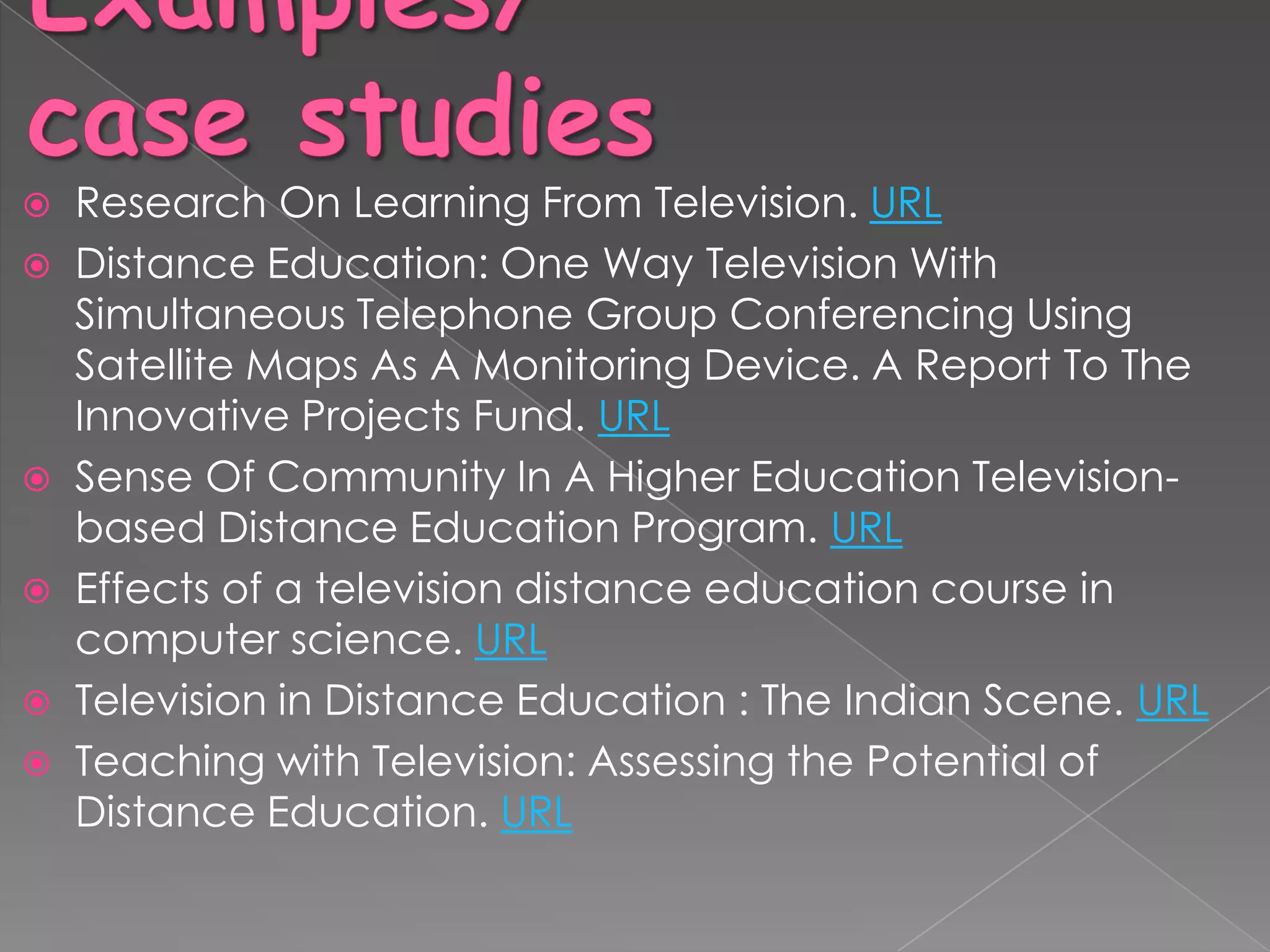
 Research On Learning From Television. URL
 Distance Education: One Way Television With
  Simultaneous Telephone Group Conferencing Using
  Satellite Maps As A Monitoring Device. A Report To The
  Innovative Projects Fund. URL
 Sense Of Community In A Higher Education Television-
  based Distance Education Program. URL
 Effects of a television distance education course in
  computer science. URL
 Television in Distance Education : The Indian Scene. URL
 Teaching with Television: Assessing the Potential of
  Distance Education. URL
http://en.wikipedia.org/wiki/Television

http://www.bls.gov/oco/cg/cgs017.htm

http://tojde.anadolu.edu.tr/tojde3/2/medihatxt.htm

http://www.uiweb.uidaho.edu/eo/dist5.html

http://www.aect.org/edtech/12.pdf

Television broadcasting

  • 1.
    By: Muna Al-Dhahouri Fatma Al-Shehhi
  • 2.
    • What IsTelevision Broadcasting • Why To Use It In Education • Features, Advantages And Limitations • Delivering And Supporting Learning • Concerns • Some Case Studies/Examples
  • 3.
    Television (TV) is a telecommunication medium for transmitting and receiving moving images that can be monochrome (black-and-white) or colored, with accompanying sound.  "Television" may also refer specifically to a television set, television programming, television transmission.
  • 4.
     consists ofradio and television stations and networks that create content or acquire the right to broadcast prerecorded television and radio programs.  Networks transmit their signals from broadcasting studios via satellite signals to local stations or cable distributors.  Educational television is the use of television programs in the field of distance education. It may be in the form of individual television programs or dedicated specialty channels
  • 5.
    The aim ofeducation is to give quality to human nature. Student wants to see the face of the teacher where he/she is not able to see from the books and texts. Educational television provides answer to this need: Programs aim to particular audience parallel to formal education creates practical goals.
  • 6.
    The television isused in distance education for:  Supporting and enhancing teaching  Instructing  Explaining, clarifying  Summarizing  Reinforcement  Motivation and encouragement  Using as supplementary for the other materials  Imposing study speed ( determining rate of study)  Presenting a reference to large masses  Changing behavior  Presenting unreachable facts and events
  • 7.
     Huge numberof channels and programs  Can reach so far regions (cross Continents).  Presentation of both sound and moving pictures.  Can be synchronously broadcast (live) or asynchronously (previously recorded) …
  • 8.
    Since most people have watched television, the medium is familiar.  Motion and visuals can be combined in a single format so that complex or abstract concepts can be illustrated through visual simulation. The old cliche "a picture is worth a thousand words" rings true.  Instructional television is an effective way to take students to new environments (the moon, a foreign country, or through the lens of a microscope).  Time and space can be collapsed, so that events can be captured and relayed as they happen.  It is very effective for introducing, summarizing, and reviewing concepts.  It can be used effectively as a motivational tool.
  • 9.
    Broadcast quality ITV is expensive to create.  Video production is time consuming and can be technically demanding, often requiring relatively sophisticated production facilities and equipment.  Sites choosing to interactively participate in an ITV program may require specialized equipment, facilities, and staffing.  Most prepackaged ITV courses use a mass media approach to instruction aimed at the average student. As a result, they can be ineffective in serving students with special needs.  When used passively, without interaction, its instructional effectiveness can be limited.  Unless professionally produced, completed ITV programs often look amateurish.  Once completed, ITV programs can be difficult to revise and update.
  • 10.
    Broadcasting entire lesson but the instructor and the students are separated (maybe also in different countries).  Simulating normal classes (face to face) but with no interaction.  The instructor can go in depth of the information like face to face.
  • 11.
     The abilityof understanding and comprehending information presented via television.  long-term exposure to the effects of television  the effects of televised messages on the socialization of children.  concern for receiving skills (media literacy)
  • 12.
     Research OnLearning From Television. URL  Distance Education: One Way Television With Simultaneous Telephone Group Conferencing Using Satellite Maps As A Monitoring Device. A Report To The Innovative Projects Fund. URL  Sense Of Community In A Higher Education Television- based Distance Education Program. URL  Effects of a television distance education course in computer science. URL  Television in Distance Education : The Indian Scene. URL  Teaching with Television: Assessing the Potential of Distance Education. URL
  • 13.