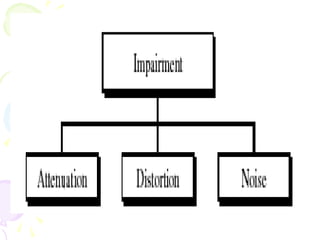
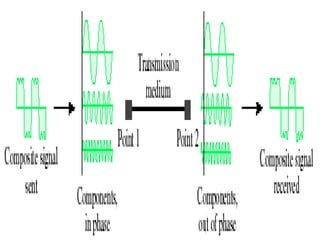
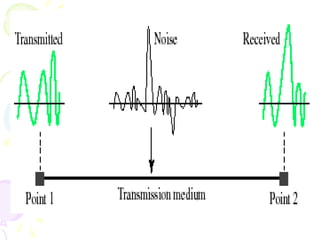
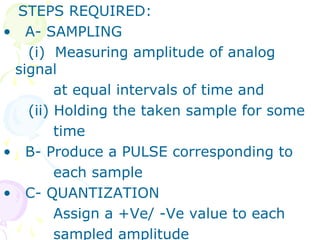
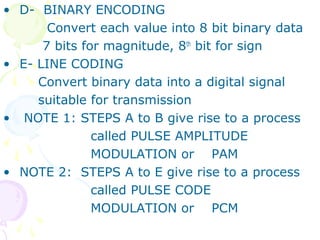
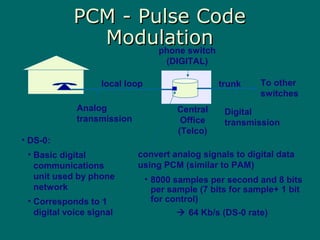
A digital signal is actually a composite analog signal with an infinite number of frequencies and infinite bandwidth. When transmitted, signals are impaired by attenuation, distortion, and noise as they travel through imperfect transmission media. To transmit information digitally, an analog signal must be converted to digital form using pulse code modulation (PCM). PCM involves sampling the analog signal, quantizing the samples, encoding them digitally using binary, and line coding the binary for transmission. The sampling rate must be at least twice the highest frequency in the analog signal per the Nyquist theorem.


![[Deck] What's New in Spark-Iceberg Integration via DSV2.pptx](https://cdn.slidesharecdn.com/ss_thumbnails/deckwhatsnewinspark-icebergintegrationviadsv2-260210005337-25955b12-thumbnail.jpg?width=640&height=640&fit=bounds)


