Data Communications and Networks
R.Anushiya
Assstiant Professor,
P.K.R Arts College for Women, Gobi
1
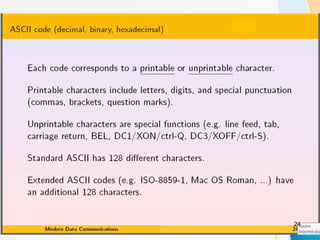
Information Encoding
Author: Achyut S.Godbole, “ Data Communications and Networks”, Tata McGraw-Hill
Publishing Company Limited, Ninth reprint, 2007
• Data Communication
• Potocols
• Standard Organizations
• Signal Popagation
• Analog and Digital Signals
• Bandwidth
2
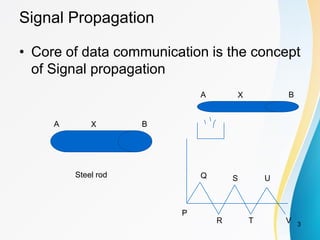
Signal Propagation
• Core of data communication is the concept
of Signal propagation
A B
X
Steel rod
V
T
R
P
U
S
Q
A B
X
3
Signal Propagation
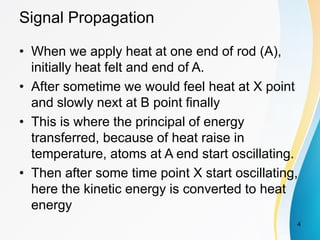
• When we apply heat at one end of rod (A),
initially heat felt and end of A.
• After sometime we would feel heat at X point
and slowly next at B point finally
• This is where the principal of energy
transferred, because of heat raise in
temperature, atoms at A end start oscillating.
• Then after some time point X start oscillating,
here the kinetic energy is converted to heat
energy
4
Signal propagation
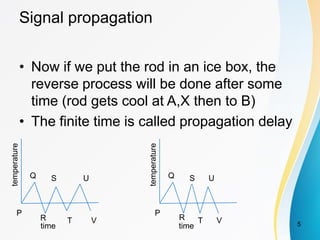
• Now if we put the rod in an ice box, the
reverse process will be done after some
time (rod gets cool at A,X then to B)
• The finite time is called propagation delay
V
T
R
P
U
S
Q
time
temperature
V
T
R
P
U
S
Q
time
temperature
5
• Instead atoms the electrons transfer
electrical energy to the adjacent electrons
• Therefore the process signifies that if we
apply some kind of signal (heat, voltage or
current, etc) at one end of conducting
material such as rod or a wire, this signal
is propagated to the other end of the
material
6
Analog Signal
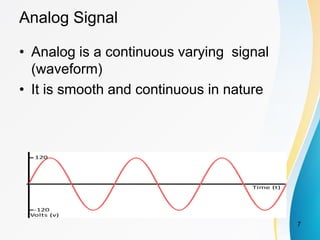
• Analog is a continuous varying signal
(waveform)
• It is smooth and continuous in nature
7
Digital Signal
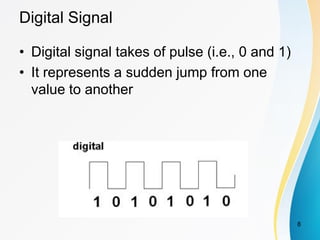
• Digital signal takes of pulse (i.e., 0 and 1)
• It represents a sudden jump from one
value to another
8
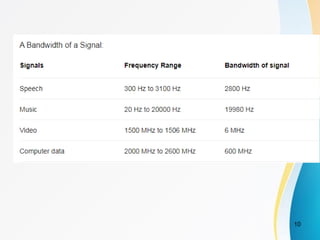
Bandwidth of a signal
Eg: Pipe at home
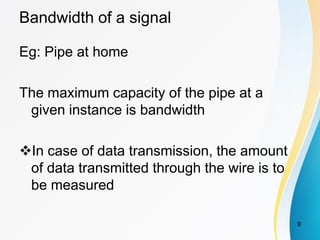
The maximum capacity of the pipe at a
given instance is bandwidth
In case of data transmission, the amount
of data transmitted through the wire is to
be measured
9
10
Sinusoidal Signal
• Signal simply means the value of any
quantity taken over a period of time.
• Signals are usually time varying in nature.
• Generally a graph is plotted between
values at different time instants. This is
called graphical representation of signal.
11
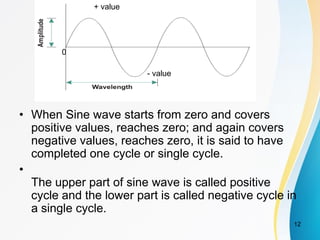
• When Sine wave starts from zero and covers
positive values, reaches zero; and again covers
negative values, reaches zero, it is said to have
completed one cycle or single cycle.
•
The upper part of sine wave is called positive
cycle and the lower part is called negative cycle in
a single cycle.
0
+ value
- value
12
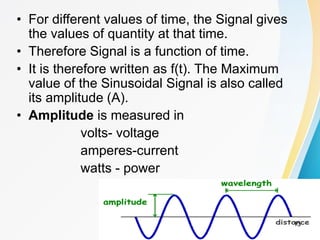
• For different values of time, the Signal gives
the values of quantity at that time.
• Therefore Signal is a function of time.
• It is therefore written as f(t). The Maximum
value of the Sinusoidal Signal is also called
its amplitude (A).
• Amplitude is measured in
volts- voltage
amperes-current
watts - power
13
Frequency
• The number of cycles of signal that took
place in a second.
• Frequency is measured in Hertz (Hz).
Period
• The time taken for the completion of one
cycle.
14
Information Encoding
15
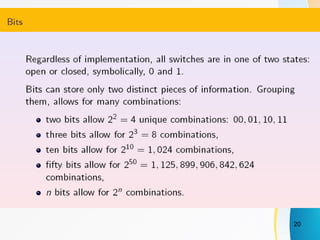
• Encoding is the process of converting the
data or a given sequence of characters,
symbols, alphabets etc., into a specified
format, for the secured transmission of
data.
• Decoding is the reverse process of
encoding which is to extract the
information from the converted format.
16
Data Encoding
Encoding is the process of using various
patterns of voltage or current levels to
represent 1s and 0s of the digital signals
on the transmission link.
17
18
19
20
21
22
EBCDIC
23
24
Definition - What does Extended Binary
Coded Decimal Interchange Code
(EBCDIC) mean?
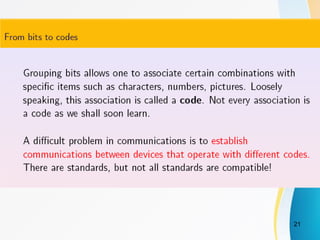
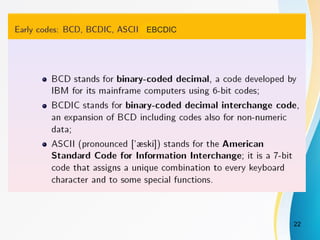
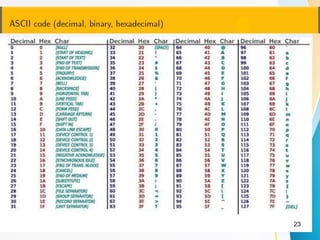
Extended binary coded decimal interchange
code (EBCDIC) is an 8-bit binary code for
numeric and alphanumeric characters.
It was developed and used by IBM. It is a
coding representation in which symbols,
letters and numbers are presented in binary
language.
25
Multimedia
The Combinations of multiple media (Text,
Image, Audio, video, Graphics, etc.,)
26
Pictures
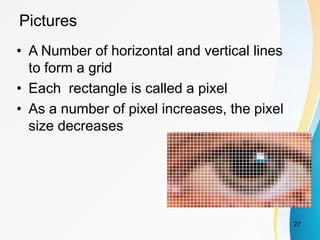
• A Number of horizontal and vertical lines
to form a grid
• Each rectangle is called a pixel
• As a number of pixel increases, the pixel
size decreases
27
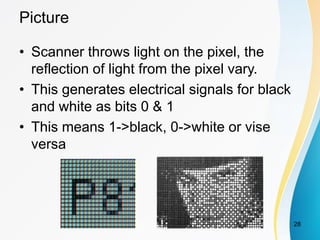
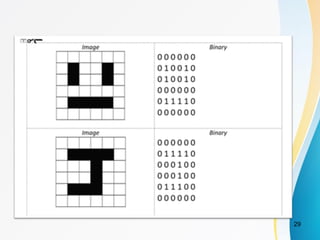
Picture
• Scanner throws light on the pixel, the
reflection of light from the pixel vary.
• This generates electrical signals for black
and white as bits 0 & 1
• This means 1->black, 0->white or vise
versa
28
29
Video
30
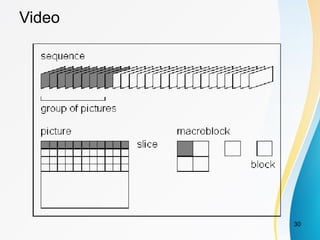
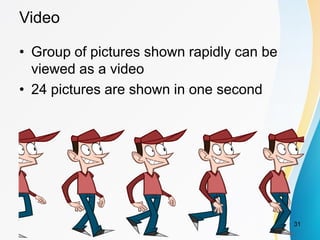
Video
• Group of pictures shown rapidly can be
viewed as a video
• 24 pictures are shown in one second
31
Sound
• Sound refers to waveforms traveling
through a fluid medium such as air
• Sound is a mechanical wave and therefore
requires a medium in which it can travel. S
• Sound travels at 1130 feet per second at
normal room temperature
• Sound is measured in  dB (decibel)
32
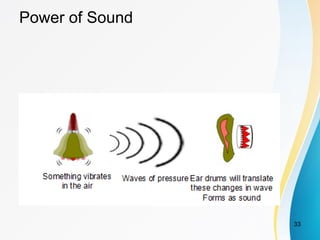
Power of Sound
33
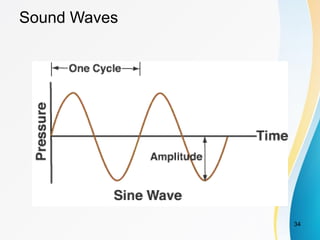
Sound Waves
34
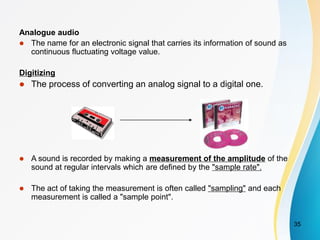
Analogue audio
 The name for an electronic signal that carries its information of sound as
continuous fluctuating voltage value.
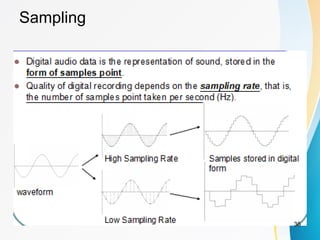
Digitizing
 The process of converting an analog signal to a digital one.
 A sound is recorded by making a measurement of the amplitude of the
sound at regular intervals which are defined by the "sample rate".
 The act of taking the measurement is often called "sampling" and each
measurement is called a "sample point".
35
Sampling
36

Data Communication and Networking- chapter 2-Information Encoding

  • 1.
    Data Communications andNetworks R.Anushiya Assstiant Professor, P.K.R Arts College for Women, Gobi 1 Information Encoding Author: Achyut S.Godbole, “ Data Communications and Networks”, Tata McGraw-Hill Publishing Company Limited, Ninth reprint, 2007
  • 2.
    • Data Communication •Potocols • Standard Organizations • Signal Popagation • Analog and Digital Signals • Bandwidth 2
  • 3.
    Signal Propagation • Coreof data communication is the concept of Signal propagation A B X Steel rod V T R P U S Q A B X 3
  • 4.
    Signal Propagation • Whenwe apply heat at one end of rod (A), initially heat felt and end of A. • After sometime we would feel heat at X point and slowly next at B point finally • This is where the principal of energy transferred, because of heat raise in temperature, atoms at A end start oscillating. • Then after some time point X start oscillating, here the kinetic energy is converted to heat energy 4
  • 5.
    Signal propagation • Nowif we put the rod in an ice box, the reverse process will be done after some time (rod gets cool at A,X then to B) • The finite time is called propagation delay V T R P U S Q time temperature V T R P U S Q time temperature 5
  • 6.
    • Instead atomsthe electrons transfer electrical energy to the adjacent electrons • Therefore the process signifies that if we apply some kind of signal (heat, voltage or current, etc) at one end of conducting material such as rod or a wire, this signal is propagated to the other end of the material 6
  • 7.
    Analog Signal • Analogis a continuous varying signal (waveform) • It is smooth and continuous in nature 7
  • 8.
    Digital Signal • Digitalsignal takes of pulse (i.e., 0 and 1) • It represents a sudden jump from one value to another 8
  • 9.
    Bandwidth of asignal Eg: Pipe at home The maximum capacity of the pipe at a given instance is bandwidth In case of data transmission, the amount of data transmitted through the wire is to be measured 9
  • 10.
  • 11.
    Sinusoidal Signal • Signalsimply means the value of any quantity taken over a period of time. • Signals are usually time varying in nature. • Generally a graph is plotted between values at different time instants. This is called graphical representation of signal. 11
  • 12.
    • When Sinewave starts from zero and covers positive values, reaches zero; and again covers negative values, reaches zero, it is said to have completed one cycle or single cycle. • The upper part of sine wave is called positive cycle and the lower part is called negative cycle in a single cycle. 0 + value - value 12
  • 13.
    • For differentvalues of time, the Signal gives the values of quantity at that time. • Therefore Signal is a function of time. • It is therefore written as f(t). The Maximum value of the Sinusoidal Signal is also called its amplitude (A). • Amplitude is measured in volts- voltage amperes-current watts - power 13
  • 14.
    Frequency • The numberof cycles of signal that took place in a second. • Frequency is measured in Hertz (Hz). Period • The time taken for the completion of one cycle. 14
  • 15.
  • 16.
    • Encoding isthe process of converting the data or a given sequence of characters, symbols, alphabets etc., into a specified format, for the secured transmission of data. • Decoding is the reverse process of encoding which is to extract the information from the converted format. 16
  • 17.
    Data Encoding Encoding isthe process of using various patterns of voltage or current levels to represent 1s and 0s of the digital signals on the transmission link. 17
  • 18.
  • 19.
  • 20.
  • 21.
  • 22.
  • 23.
  • 24.
  • 25.
    Definition - Whatdoes Extended Binary Coded Decimal Interchange Code (EBCDIC) mean? Extended binary coded decimal interchange code (EBCDIC) is an 8-bit binary code for numeric and alphanumeric characters. It was developed and used by IBM. It is a coding representation in which symbols, letters and numbers are presented in binary language. 25
  • 26.
    Multimedia The Combinations ofmultiple media (Text, Image, Audio, video, Graphics, etc.,) 26
  • 27.
    Pictures • A Numberof horizontal and vertical lines to form a grid • Each rectangle is called a pixel • As a number of pixel increases, the pixel size decreases 27
  • 28.
    Picture • Scanner throwslight on the pixel, the reflection of light from the pixel vary. • This generates electrical signals for black and white as bits 0 & 1 • This means 1->black, 0->white or vise versa 28
  • 29.
  • 30.
  • 31.
    Video • Group ofpictures shown rapidly can be viewed as a video • 24 pictures are shown in one second 31
  • 32.
    Sound • Sound refersto waveforms traveling through a fluid medium such as air • Sound is a mechanical wave and therefore requires a medium in which it can travel. S • Sound travels at 1130 feet per second at normal room temperature • Sound is measured in  dB (decibel) 32
  • 33.
  • 34.
  • 35.
    Analogue audio  Thename for an electronic signal that carries its information of sound as continuous fluctuating voltage value. Digitizing  The process of converting an analog signal to a digital one.  A sound is recorded by making a measurement of the amplitude of the sound at regular intervals which are defined by the "sample rate".  The act of taking the measurement is often called "sampling" and each measurement is called a "sample point". 35
  • 36.