
Technology to Enhance Literacy and Learning: Preparing a  Digital Generation . . .
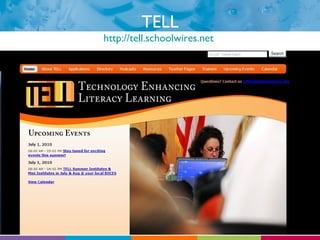
TELL http://tell.schoolwires.net
“ Maybe I’m wrong, but I should say that in ten years textbooks as the principal medium of teaching will be obsolete… Diaries of Thomas Edison, 1925 … as obsolete as the horse and carriage are now.”
International Society for Technology in Education Worldwide Network of Leaders in Education and Technology 21,000 Direct Individual Members 85+ Geographic Affiliates (CA CUE, TCEA, MassCUE, ACCE) Reach of 150,000+ Individuals with Affiliates Corporate Partners; ISTE 100 Corporate Member Program Special Interest Groups Array of Strategic Allies (NSTA, NAEYC, NCTE, ASCD) Advocates of Improved Schooling Worldwide The Premier International Organization for Technology in K-12 Schools
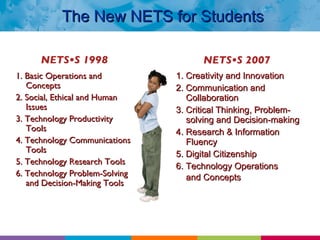
The New NETS for Students 1. Creativity and Innovation  2. Communication and Collaboration  3. Critical Thinking, Problem-solving and Decision-making  4. Research & Information  Fluency  5. Digital Citizenship  6. Technology Operations  and Concepts  1. Basic Operations and Concepts  2. Social, Ethical and Human Issues  3. Technology Productivity Tools  4. Technology Communications Tools 5. Technology Research Tools  6. Technology Problem-Solving and Decision-Making Tools  NETS•S 1998 NETS•S 2007
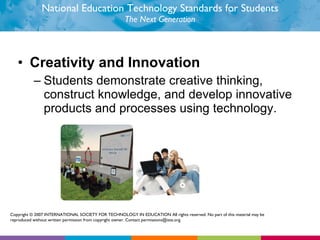
National Education Technology Standards for Students The Next Generation Creativity and Innovation  Students demonstrate creative thinking, construct knowledge, and develop innovative products and processes using technology.  Copyright © 2007 INTERNATIONAL SOCIETY FOR TECHNOLOGY IN EDUCATION All rights reserved. No part of this material may be reproduced without written permission from copyright owner. Contact permissions@iste.org.
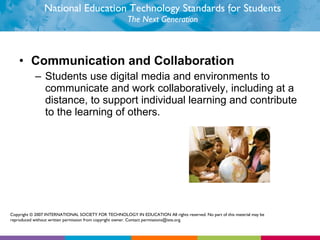
National Education Technology Standards for Students The Next Generation Communication and Collaboration Students use digital media and environments to communicate and work collaboratively, including at a distance, to support individual learning and contribute to the learning of others.  Copyright © 2007 INTERNATIONAL SOCIETY FOR TECHNOLOGY IN EDUCATION All rights reserved. No part of this material may be reproduced without written permission from copyright owner. Contact permissions@iste.org.
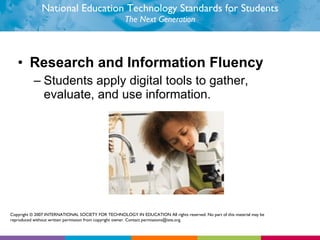
National Education Technology Standards for Students The Next Generation Research and Information Fluency Students apply digital tools to gather, evaluate, and use information.  Copyright © 2007 INTERNATIONAL SOCIETY FOR TECHNOLOGY IN EDUCATION All rights reserved. No part of this material may be reproduced without written permission from copyright owner. Contact permissions@iste.org.
National Education Technology Standards for Students The Next Generation Critical Thinking, Problem-Solving & Decision-Making  Students use critical thinking skills to plan and conduct research, manage projects, solve problems and make informed decisions using appropriate digital tools and resources.  Copyright © 2007 INTERNATIONAL SOCIETY FOR TECHNOLOGY IN EDUCATION All rights reserved. No part of this material may be reproduced without written permission from copyright owner. Contact permissions@iste.org.
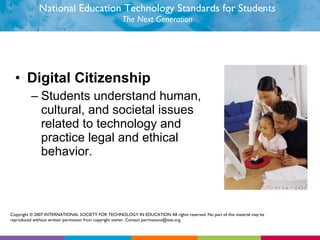
National Education Technology Standards for Students The Next Generation Digital Citizenship  Students understand human, cultural, and societal issues related to technology and practice legal and ethical behavior.  Copyright © 2007 INTERNATIONAL SOCIETY FOR TECHNOLOGY IN EDUCATION All rights reserved. No part of this material may be reproduced without written permission from copyright owner. Contact permissions@iste.org.
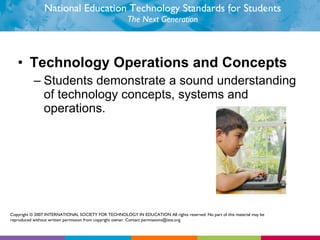
National Education Technology Standards for Students The Next Generation Technology Operations and Concepts Students demonstrate a sound understanding of technology concepts, systems and operations.  Copyright © 2007 INTERNATIONAL SOCIETY FOR TECHNOLOGY IN EDUCATION All rights reserved. No part of this material may be reproduced without written permission from copyright owner. Contact permissions@iste.org.
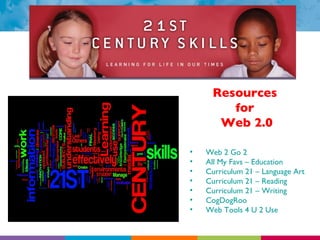
Resources  for  Web 2.0 Web 2 Go 2 All My Favs – Education Curriculum 21 – Language Art Curriculum 21 – Reading Curriculum 21 – Writing CogDogRoo Web Tools 4 U 2 Use
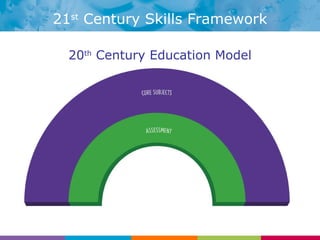
20 th  Century Education Model 21 st  Century Skills Framework
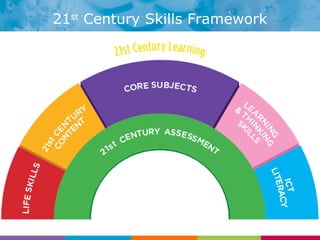
21 st  Century Skills Framework
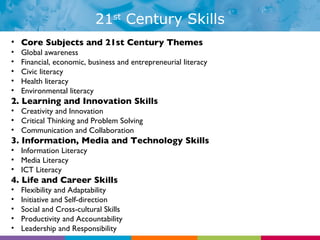
Core Subjects and 21st Century Themes   Global awareness  Financial, economic, business and entrepreneurial literacy  Civic literacy  Health literacy  Environmental literacy 2. Learning and Innovation Skills    Creativity and Innovation  Critical Thinking and Problem Solving  Communication and Collaboration  3. Information, Media and Technology Skills   Information Literacy Media Literacy  ICT Literacy  4. Life and Career Skills    Flexibility and Adaptability Initiative and Self-direction Social and Cross-cultural Skills Productivity and Accountability Leadership and Responsibility 21 st  Century Skills
Technologies Resources Horizon Report: 2009 K-12 Edition The New Media Consortium The Consortium for School Networking (CoSN) Projects timeline for entry of technology into the mainstream One year Two – Three Years Four – Five Years
Collaborative Environments One Year or Less Virtual Workplaces –  integrated media  - 2D and 3D LMS –  Moodle , Blackboard, Sakai Social Networking Platforms –  Ning ,  PageFlakes ,  Glogster 3D Virtual Worlds –  Active Worlds , Second Life
Warehouse Curriculum 21 – Language Art Curriculum 21 – Reading Curriculum 21 – Writing Ning Sites: Curriculum 21 Oklahoma Curriculum Birdville Curriculum English Companion Ning
Online Communication Tools  One Year or Less Desktop Videoconferencing –  Skype ,  Oovoo (Webconferncing  Adobe Connect , DimDim, Eluminate, WebEx)  Instant Messaging Services -  Meebo Microblogging Platforms –  Twitter ,  Plurk ,  Edmodo Social Bookmarking/Sharing –  Delicious ,  Diigo
Cloud Computing Two – Three Years  Networked computers Distributed Processing Power Hosting and Sharing -  Flickr,  Google ,  Zoho , YouTube Applications -  Splashup ,  JayCut ,  Visual Thesaurus ,  photoshop.com  Creating & Presenting -  Prezi , Vuvox,  SlideShare ,  Wordle , SlideRocket,  ManyEyes
Smart Objects Four – Five Years Link the virtual world and the real world Everyday life –  point-of-sale purchases , passport tracking, inventory management, identification Objects relate to their environment and to each other –  Violet’s Mir:ror ,  Siftables ,  Sixth Sense
The Personal Web Four – Five Years Developing and Organizing Online Content Tools for tagging,  aggregating ,  updating , and tracking Customizable  widgets  and  resources Policy decisions, inadequate infrastructure, and  limited student access
Key Trends The Next Five Years Technology affects how we work, collaborate, communicate and succeed. Technology provides with the means for empowering students. The web is an increasingly personal experience. Learning environments are changing .  The value of innovation and creativity is increasing.  It is stated that Google was the fad of the first decade and predicted Facebook will be the fad of the second.
The Paradigm Shift From the Agricultural World To the Industrial World Into World of Information,   Knowledge & Communication And onward toward the    World of Creativity and Innovation!
Andrew Taylor –  [email_address]   Karen Brooks –  [email_address] http://www.karenbrooks.wikispaces.com

Technology To Enhance Literacy And Learning

  • 1.
    Technology to EnhanceLiteracy and Learning: Preparing a Digital Generation . . .
  • 2.
  • 3.
    “ Maybe I’mwrong, but I should say that in ten years textbooks as the principal medium of teaching will be obsolete… Diaries of Thomas Edison, 1925 … as obsolete as the horse and carriage are now.”
  • 4.
    International Society forTechnology in Education Worldwide Network of Leaders in Education and Technology 21,000 Direct Individual Members 85+ Geographic Affiliates (CA CUE, TCEA, MassCUE, ACCE) Reach of 150,000+ Individuals with Affiliates Corporate Partners; ISTE 100 Corporate Member Program Special Interest Groups Array of Strategic Allies (NSTA, NAEYC, NCTE, ASCD) Advocates of Improved Schooling Worldwide The Premier International Organization for Technology in K-12 Schools
  • 5.
    The New NETSfor Students 1. Creativity and Innovation 2. Communication and Collaboration 3. Critical Thinking, Problem-solving and Decision-making 4. Research & Information Fluency 5. Digital Citizenship 6. Technology Operations and Concepts 1. Basic Operations and Concepts 2. Social, Ethical and Human Issues 3. Technology Productivity Tools 4. Technology Communications Tools 5. Technology Research Tools 6. Technology Problem-Solving and Decision-Making Tools NETS•S 1998 NETS•S 2007
  • 6.
    National Education TechnologyStandards for Students The Next Generation Creativity and Innovation Students demonstrate creative thinking, construct knowledge, and develop innovative products and processes using technology. Copyright © 2007 INTERNATIONAL SOCIETY FOR TECHNOLOGY IN EDUCATION All rights reserved. No part of this material may be reproduced without written permission from copyright owner. Contact permissions@iste.org.
  • 7.
    National Education TechnologyStandards for Students The Next Generation Communication and Collaboration Students use digital media and environments to communicate and work collaboratively, including at a distance, to support individual learning and contribute to the learning of others. Copyright © 2007 INTERNATIONAL SOCIETY FOR TECHNOLOGY IN EDUCATION All rights reserved. No part of this material may be reproduced without written permission from copyright owner. Contact permissions@iste.org.
  • 8.
    National Education TechnologyStandards for Students The Next Generation Research and Information Fluency Students apply digital tools to gather, evaluate, and use information. Copyright © 2007 INTERNATIONAL SOCIETY FOR TECHNOLOGY IN EDUCATION All rights reserved. No part of this material may be reproduced without written permission from copyright owner. Contact permissions@iste.org.
  • 9.
    National Education TechnologyStandards for Students The Next Generation Critical Thinking, Problem-Solving & Decision-Making Students use critical thinking skills to plan and conduct research, manage projects, solve problems and make informed decisions using appropriate digital tools and resources. Copyright © 2007 INTERNATIONAL SOCIETY FOR TECHNOLOGY IN EDUCATION All rights reserved. No part of this material may be reproduced without written permission from copyright owner. Contact permissions@iste.org.
  • 10.
    National Education TechnologyStandards for Students The Next Generation Digital Citizenship Students understand human, cultural, and societal issues related to technology and practice legal and ethical behavior. Copyright © 2007 INTERNATIONAL SOCIETY FOR TECHNOLOGY IN EDUCATION All rights reserved. No part of this material may be reproduced without written permission from copyright owner. Contact permissions@iste.org.
  • 11.
    National Education TechnologyStandards for Students The Next Generation Technology Operations and Concepts Students demonstrate a sound understanding of technology concepts, systems and operations. Copyright © 2007 INTERNATIONAL SOCIETY FOR TECHNOLOGY IN EDUCATION All rights reserved. No part of this material may be reproduced without written permission from copyright owner. Contact permissions@iste.org.
  • 12.
    Resources for Web 2.0 Web 2 Go 2 All My Favs – Education Curriculum 21 – Language Art Curriculum 21 – Reading Curriculum 21 – Writing CogDogRoo Web Tools 4 U 2 Use
  • 13.
    20 th Century Education Model 21 st Century Skills Framework
  • 14.
    21 st Century Skills Framework
  • 15.
    Core Subjects and21st Century Themes Global awareness Financial, economic, business and entrepreneurial literacy Civic literacy Health literacy Environmental literacy 2. Learning and Innovation Skills   Creativity and Innovation Critical Thinking and Problem Solving Communication and Collaboration 3. Information, Media and Technology Skills Information Literacy Media Literacy ICT Literacy 4. Life and Career Skills   Flexibility and Adaptability Initiative and Self-direction Social and Cross-cultural Skills Productivity and Accountability Leadership and Responsibility 21 st Century Skills
  • 16.
    Technologies Resources HorizonReport: 2009 K-12 Edition The New Media Consortium The Consortium for School Networking (CoSN) Projects timeline for entry of technology into the mainstream One year Two – Three Years Four – Five Years
  • 17.
    Collaborative Environments OneYear or Less Virtual Workplaces – integrated media - 2D and 3D LMS – Moodle , Blackboard, Sakai Social Networking Platforms – Ning , PageFlakes , Glogster 3D Virtual Worlds – Active Worlds , Second Life
  • 18.
    Warehouse Curriculum 21– Language Art Curriculum 21 – Reading Curriculum 21 – Writing Ning Sites: Curriculum 21 Oklahoma Curriculum Birdville Curriculum English Companion Ning
  • 19.
    Online Communication Tools One Year or Less Desktop Videoconferencing – Skype , Oovoo (Webconferncing Adobe Connect , DimDim, Eluminate, WebEx) Instant Messaging Services - Meebo Microblogging Platforms – Twitter , Plurk , Edmodo Social Bookmarking/Sharing – Delicious , Diigo
  • 20.
    Cloud Computing Two– Three Years Networked computers Distributed Processing Power Hosting and Sharing - Flickr, Google , Zoho , YouTube Applications - Splashup , JayCut , Visual Thesaurus , photoshop.com Creating & Presenting - Prezi , Vuvox, SlideShare , Wordle , SlideRocket, ManyEyes
  • 21.
    Smart Objects Four– Five Years Link the virtual world and the real world Everyday life – point-of-sale purchases , passport tracking, inventory management, identification Objects relate to their environment and to each other – Violet’s Mir:ror , Siftables , Sixth Sense
  • 22.
    The Personal WebFour – Five Years Developing and Organizing Online Content Tools for tagging, aggregating , updating , and tracking Customizable widgets and resources Policy decisions, inadequate infrastructure, and limited student access
  • 23.
    Key Trends TheNext Five Years Technology affects how we work, collaborate, communicate and succeed. Technology provides with the means for empowering students. The web is an increasingly personal experience. Learning environments are changing . The value of innovation and creativity is increasing. It is stated that Google was the fad of the first decade and predicted Facebook will be the fad of the second.
  • 24.
    The Paradigm ShiftFrom the Agricultural World To the Industrial World Into World of Information, Knowledge & Communication And onward toward the World of Creativity and Innovation!
  • 25.
    Andrew Taylor – [email_address] Karen Brooks – [email_address] http://www.karenbrooks.wikispaces.com

Editor's Notes

  • #14 Our current assessment model focuses on core subjects