ISOLATION OF THE OPERATING FIELD Dr shabeel pn Royal Dental College
INTRODUCTION The basic principles underlying an operative treatment are  An aseptic technique Debridement of the wound Proper drainage and Gentle treatment of the tissues with both instruments and drugs

MAGNIFICATION OF OPERATING FIELD Proper patient position Proper isolation Fluids and debris evacuation by sucking instruments and equipments Tissue retraction Use of mouth props to stabilize the operating field Use of pre medication for better co-operation for patient
Isolation   Isolation is very important for  controlling moisture Retraction and Harm prevention
Goals of Isolation Moisture control Retraction and access Harm prevention Safe and aseptic operating field Prevent accidental swallowing of restorative materials and instruments Bacterial contamination from saliva Local anesthesia
Methods for Isolation Rubber Dam Isolation Cotton roll isolation and Cellulose wafers Throat Shields High volume evacuator and saliva ejector Retraction cords Mirror and Evacuator tip retraction Mouth Props drugs
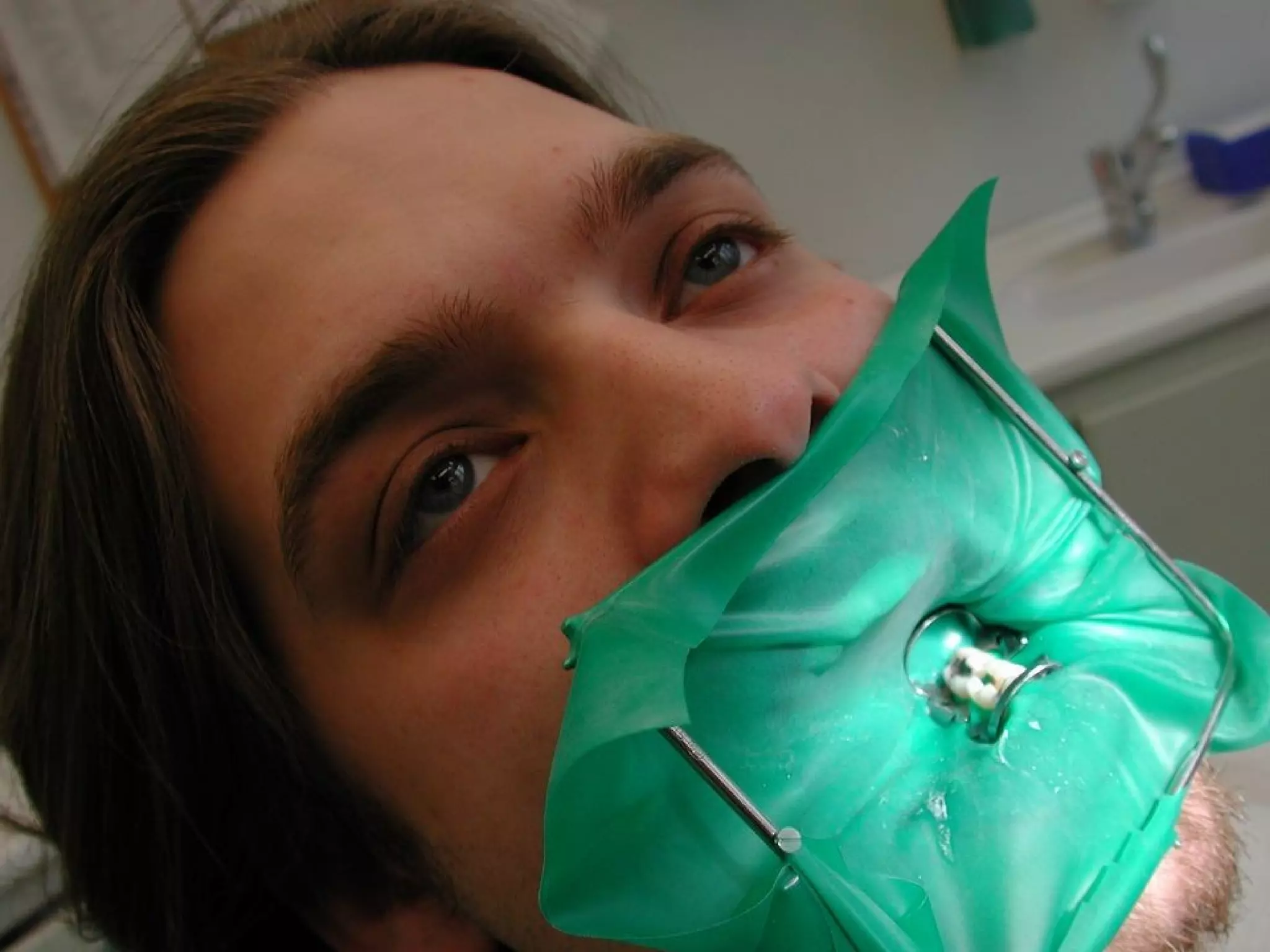
Rubber Dam “  It’s hard to believe that a sheet of rubber can make u feel more comfortable about dental treatment and allow us to do better dentistry but, rubber dam can”  S C Barnum 1864 – New York city The Rubber Dam is a flat, thin sheet of latex or non latex that is held by a clamp(retainer) and a frame that is perforated to allow the teeth that will be worked on to protrude through the perforations in the sheet while all the other teeth are covered and protected by the rubber dam.
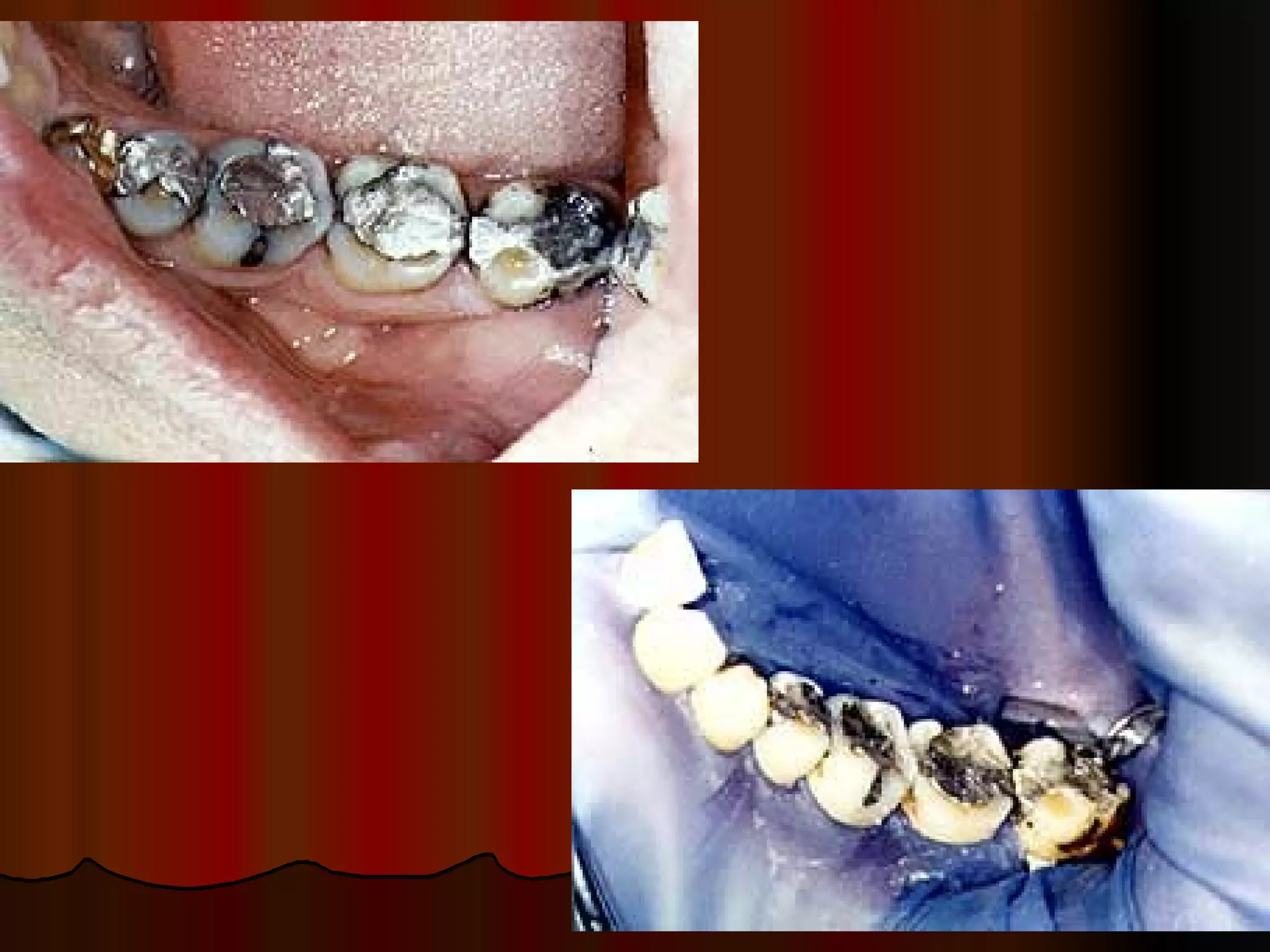
Rubber Dam A tooth bathed in saliva A tongue that insists on obstructing vision Bleeding gingiva Bacteria laden saliva reinfecting areas it also ensures: Improve the quality of operation  To define the operating field
 
Advantages Isolation of the operating field Improved access and visibility Improved properties of dental materials Protection of patient’s airway Protection of patient’s soft tissues High patient acceptance – Allow to Relax No gag reflex Keep the tongue  Time saving Operating efficiency
Disadvantages Time consumption Patient’s objection Conditions where rubber dam not used: partially erupted teeth Some third molars Extremely malpositioned teeth Asthma patients Psychological reasons Latex allergy
Materials and Instruments Rubber dam material Rubber dam holder Rubber dam retainer(clamp) Plastic tray for holding the clamp Retainer forceps Punch Napkin Lubricant Modelling compound
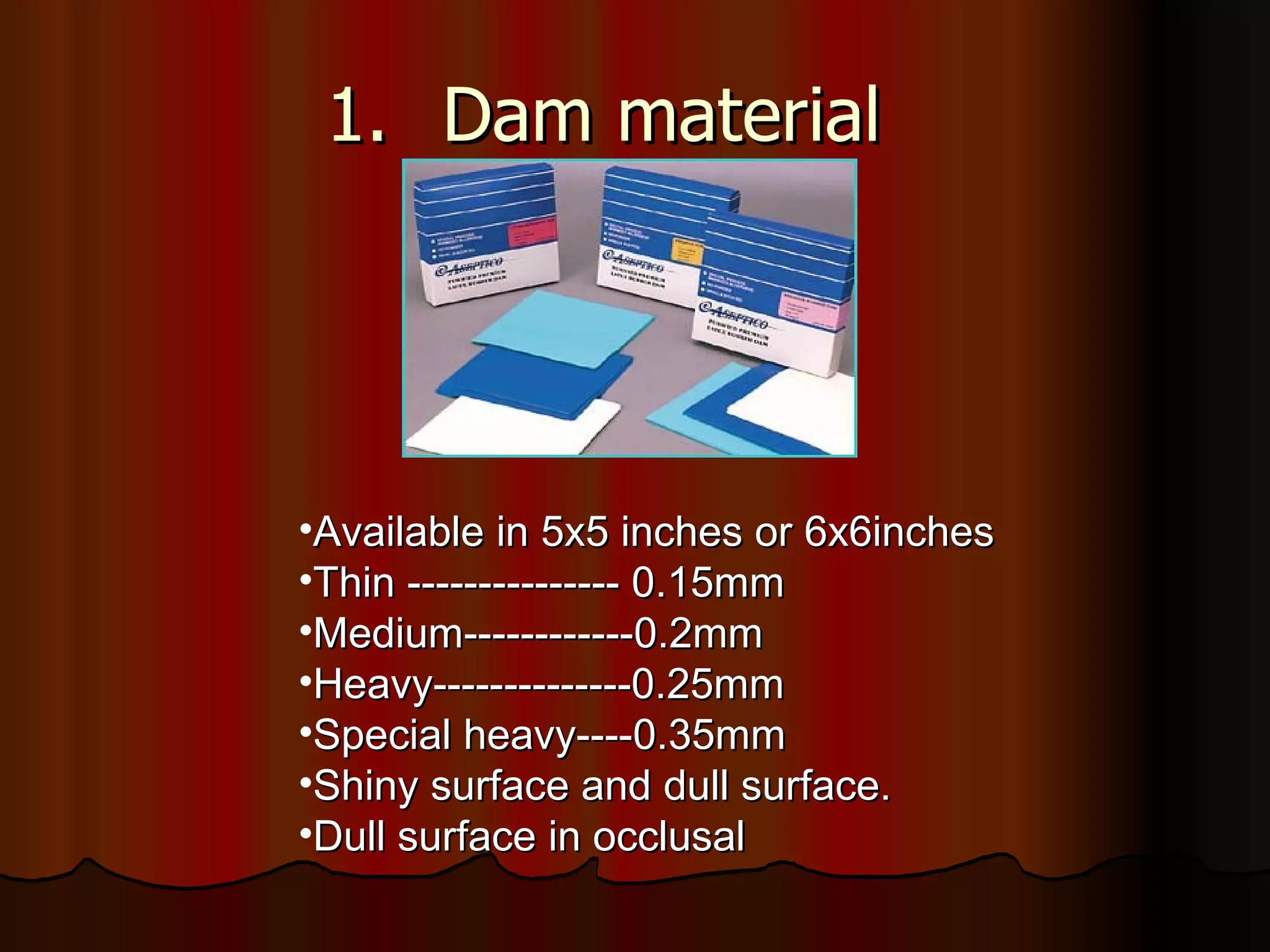
Dam material Available in 5x5 inches or 6x6inches Thin --------------- 0.15mm Medium------------0.2mm Heavy--------------0.25mm Special heavy----0.35mm Shiny surface and dull surface. Dull surface in occlusal
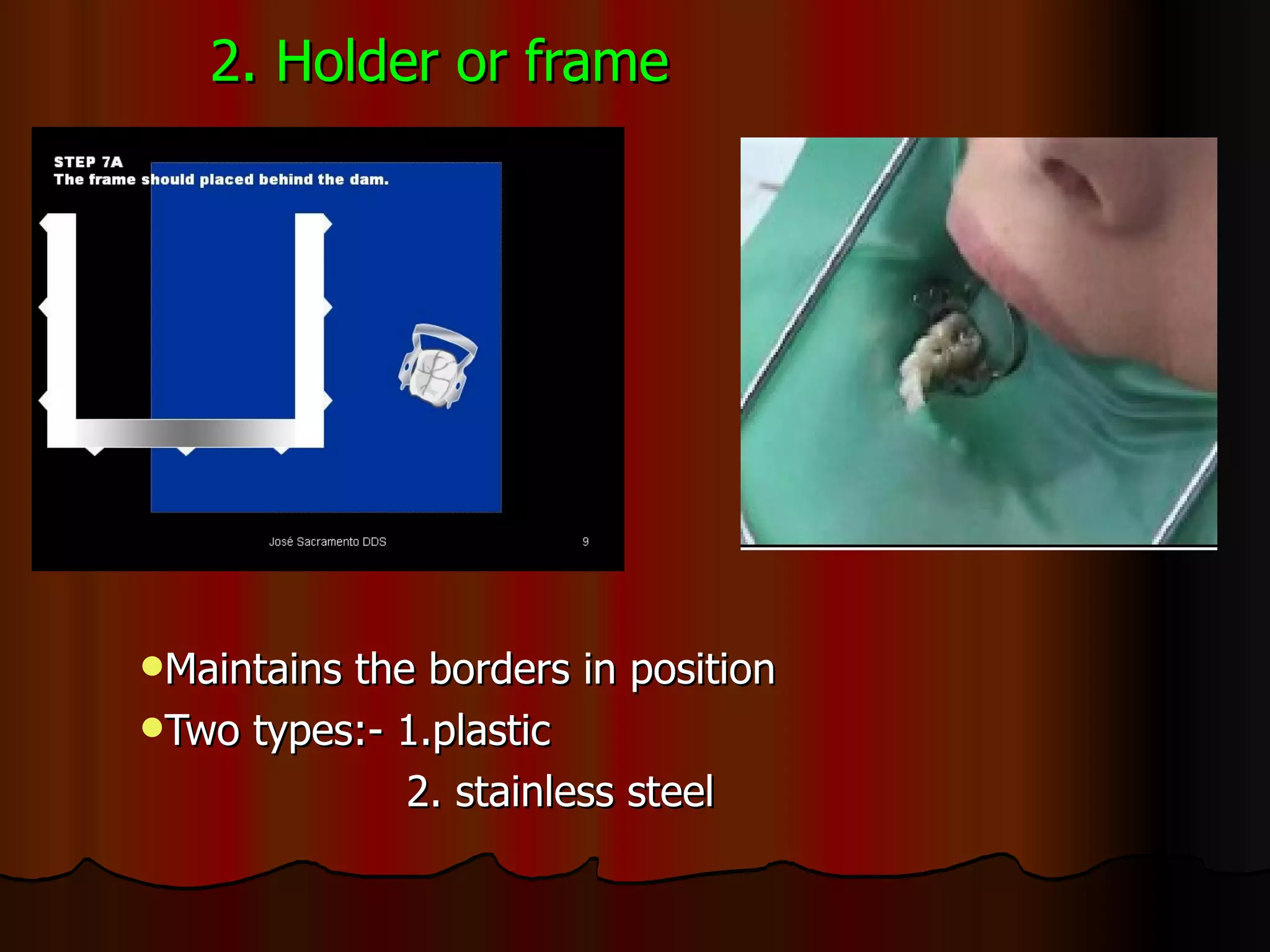
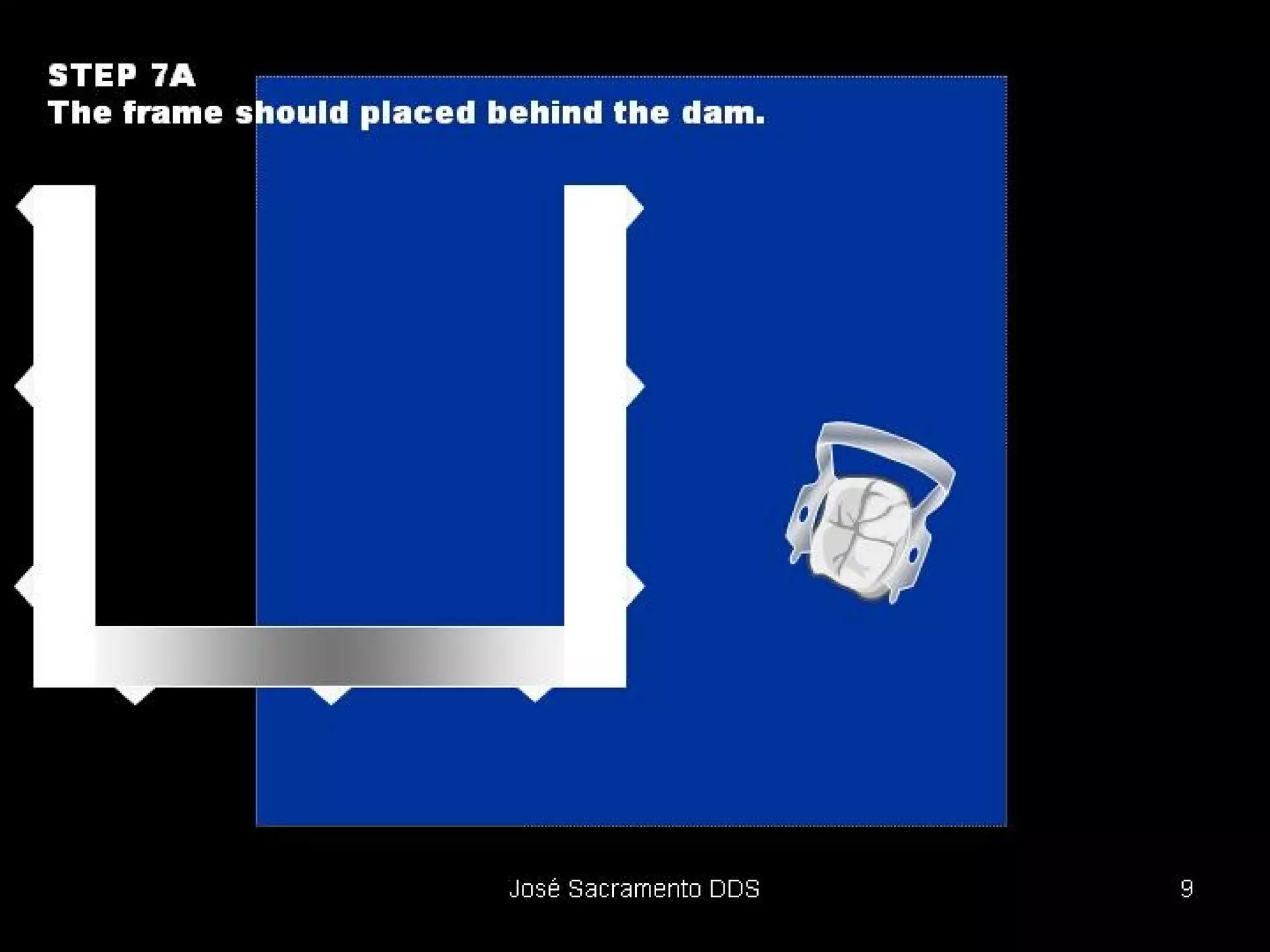
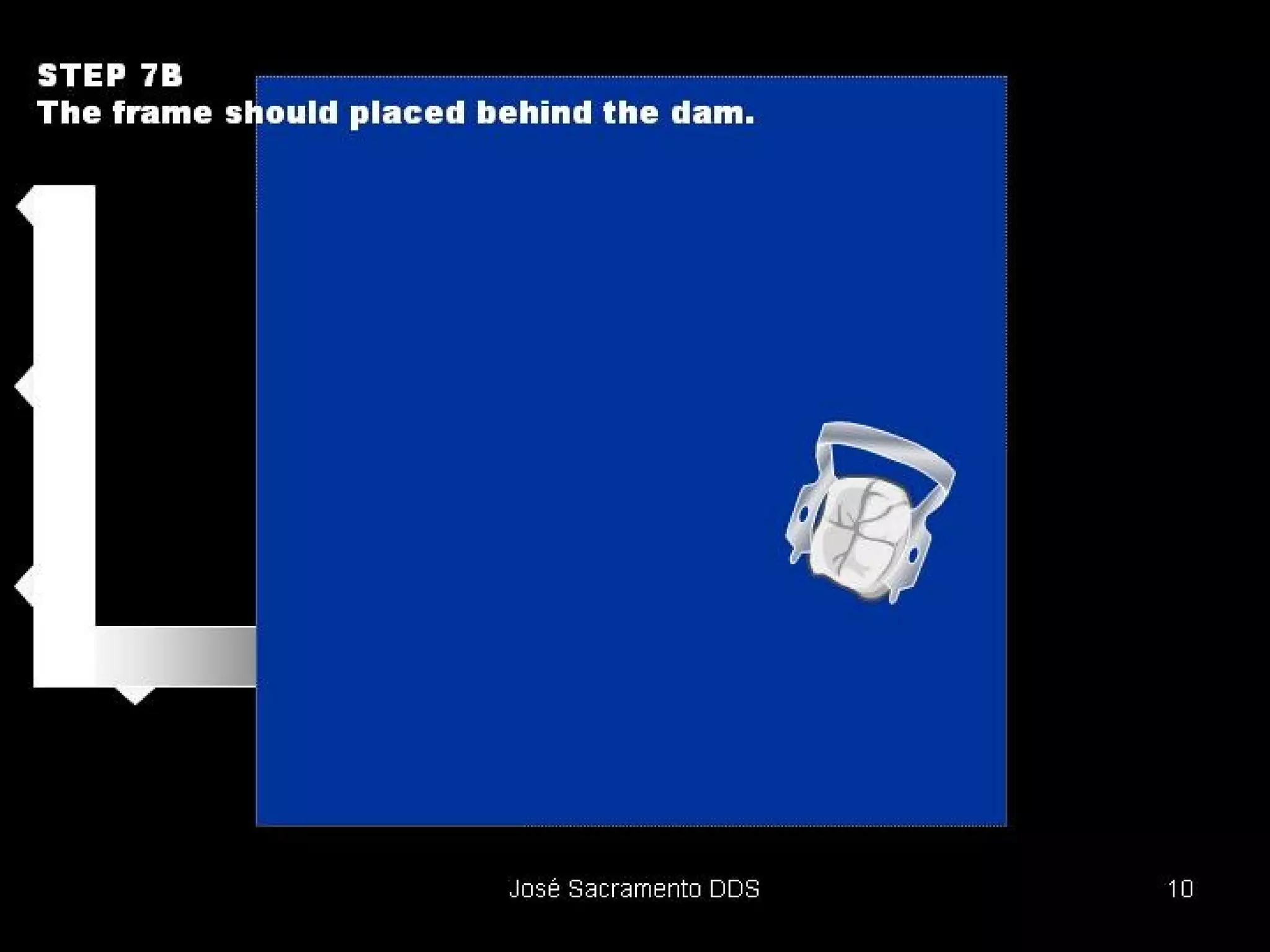
2. Holder or frame Maintains the borders in position Two types:- 1.plastic 2. stainless steel
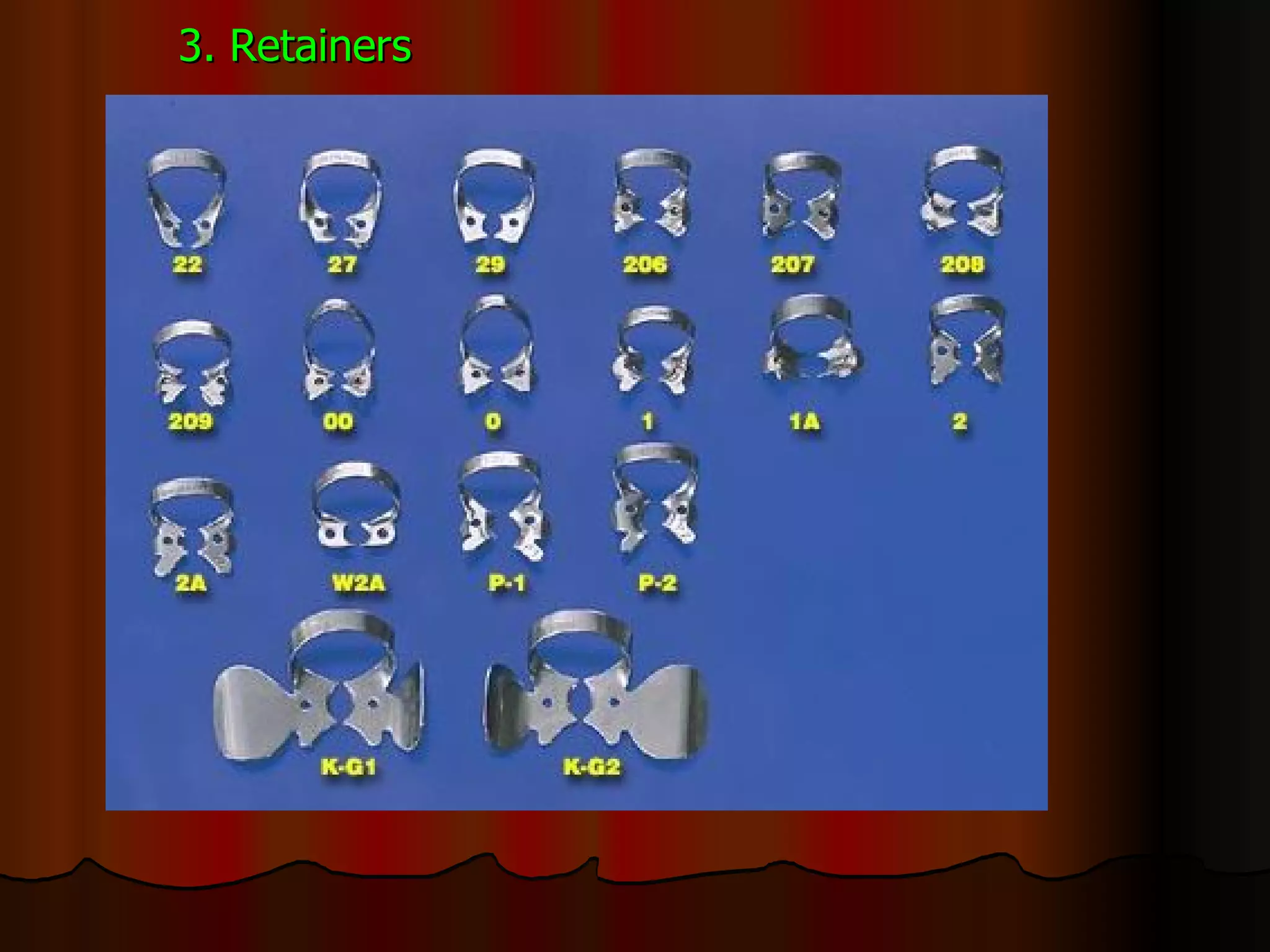
3. Retainers
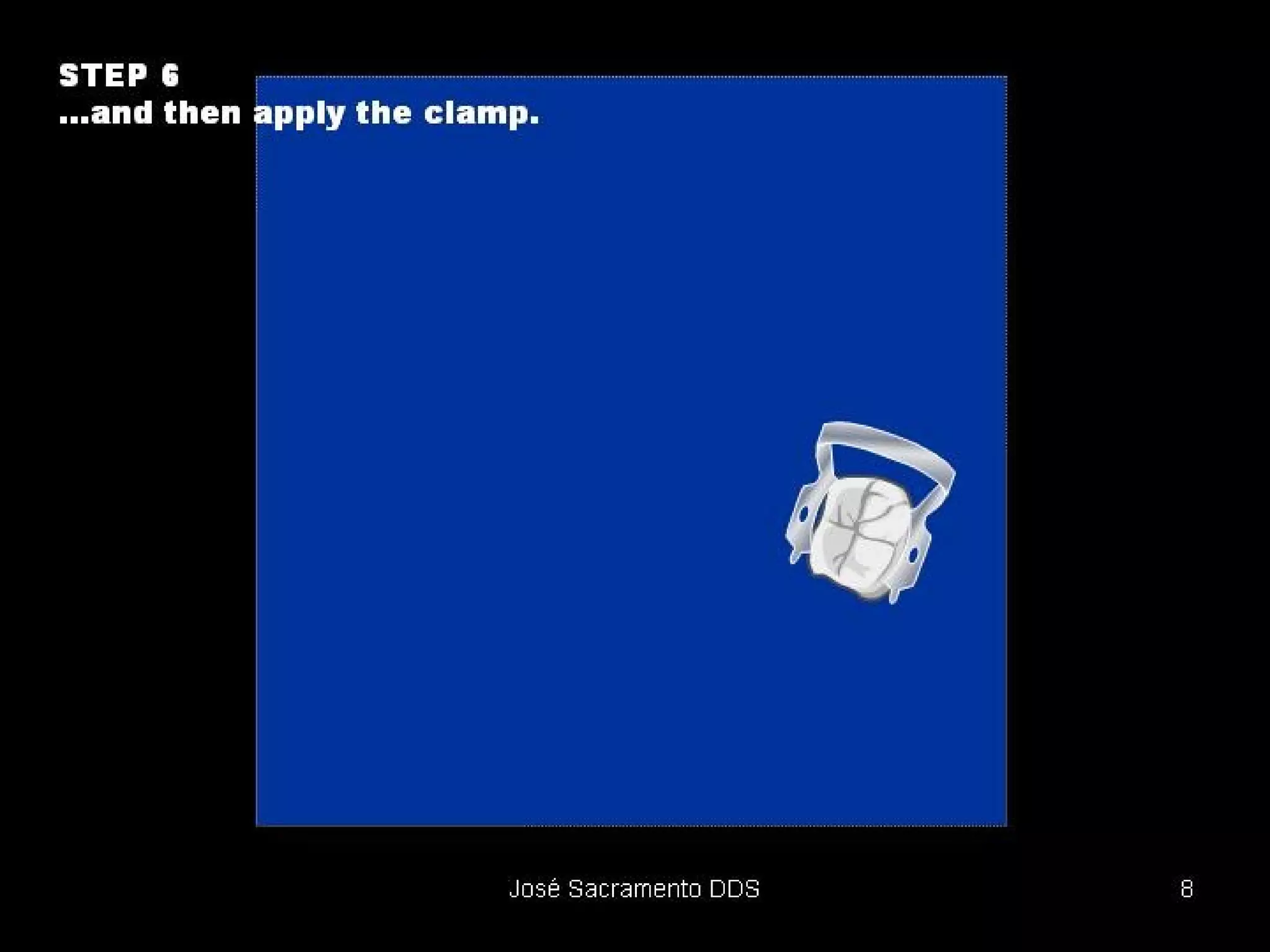
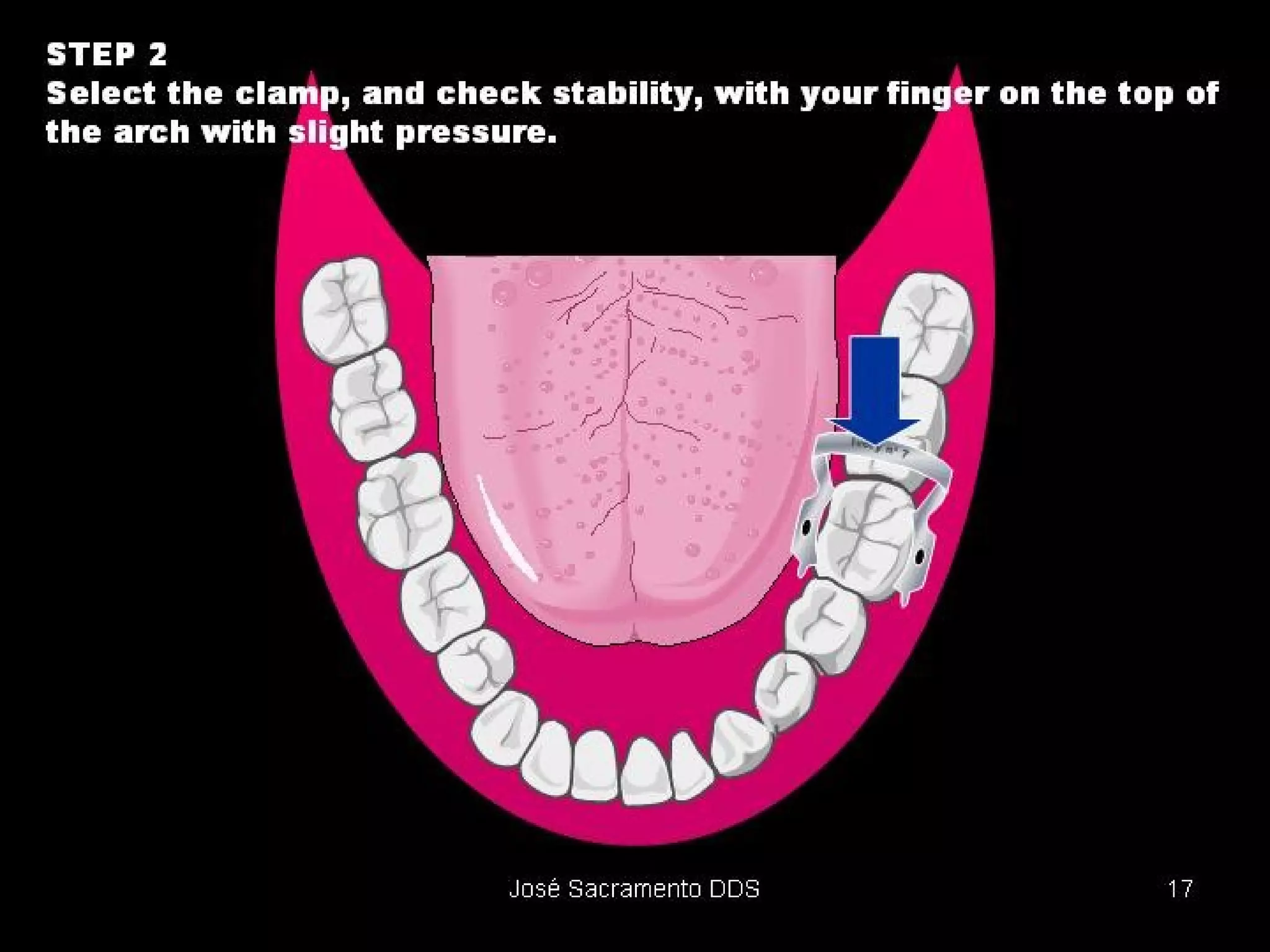
Two types: 1. wingless  2. winged Anchor the dam to the teeth Retract the gingival tissues Upper central incisors and all cuspids:– Ivory no. 9 Upper laterals and all lower incisors:- HF no. 211 For all premolars:- HF no. 27 For all molars:- HF no. 26 Not completely erupted young anterior maxillary teeth:- HF no. 27
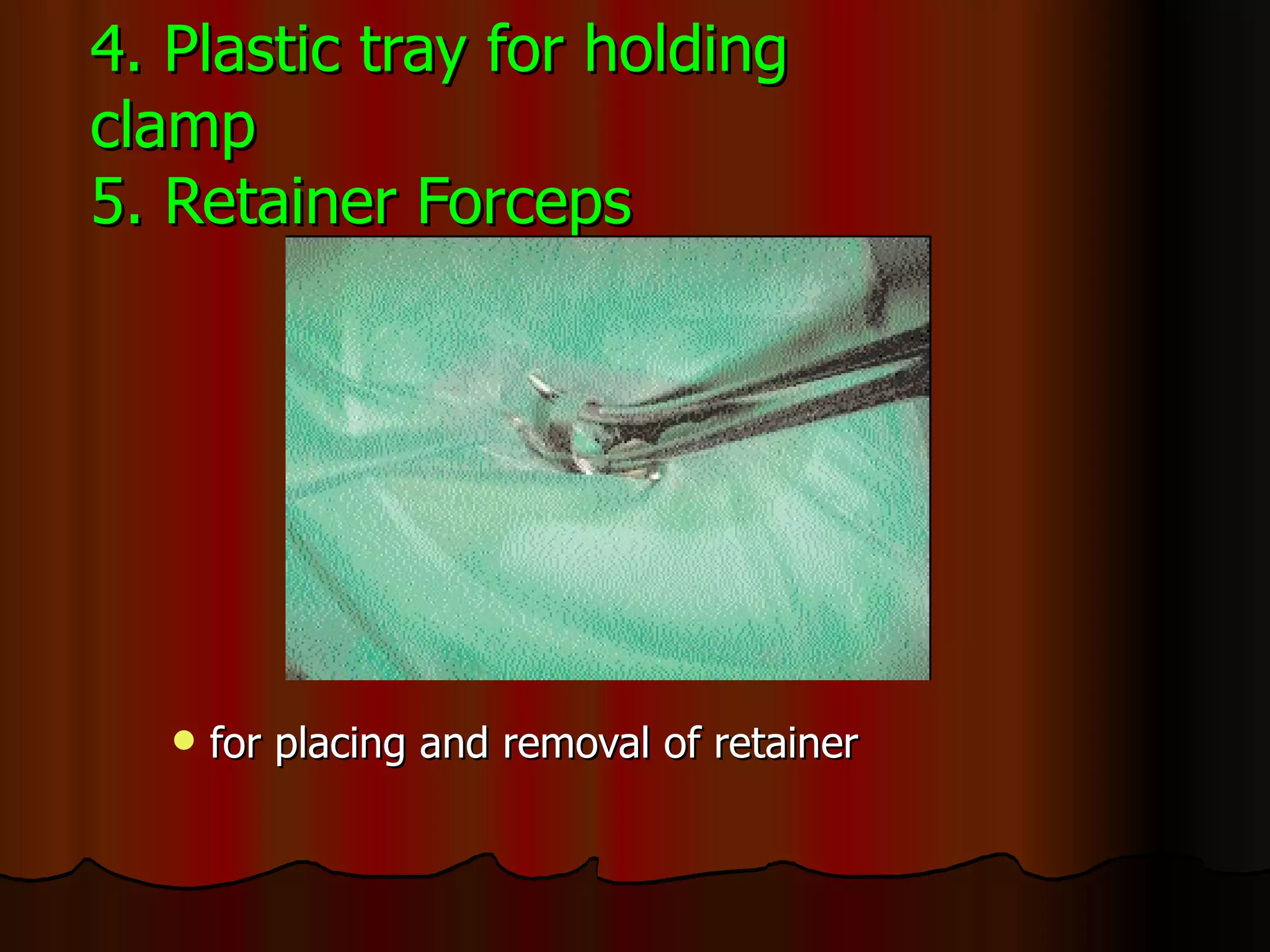
4. Plastic tray for holding clamp 5.   Retainer Forceps for placing and removal of retainer
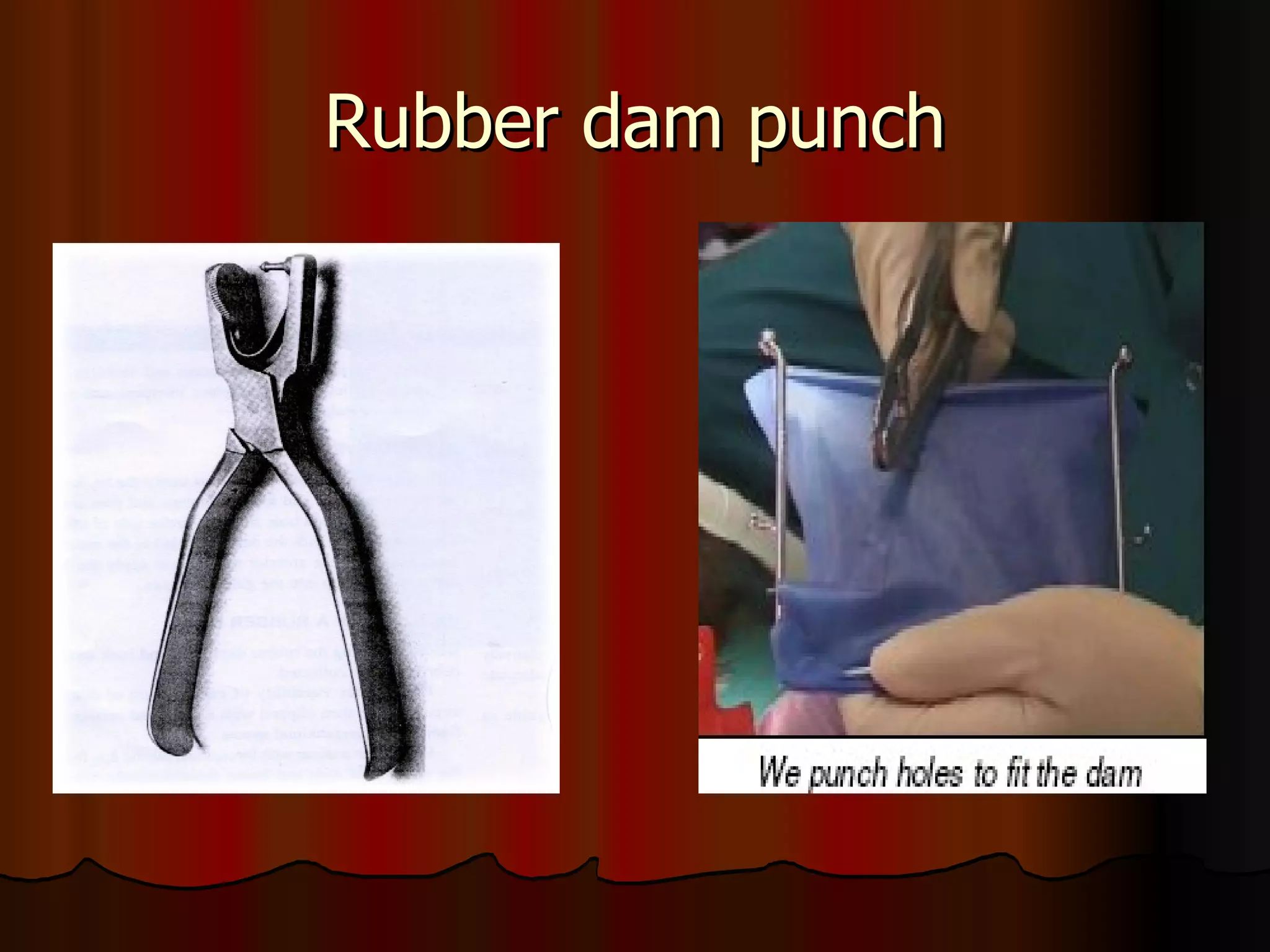
6. Punch For producing holes in the rubber dam for the teeth It is an instrument having a rotating metal table with six holes of varying sizes and a tapered sharp pointed puncher Larger holes-Molars Medium sized holes-premolars , canines and upper incisors Smallest hole –lower incisors.
Rubber dam punch
7.Napkin Between rubber dam and patients skin Reduce allergic reaction Absorbs saliva
8. lubricant Liquid soap  Petroleum and cocoa butter should not be used
9.Modelling compound Prevent the movement of retainer
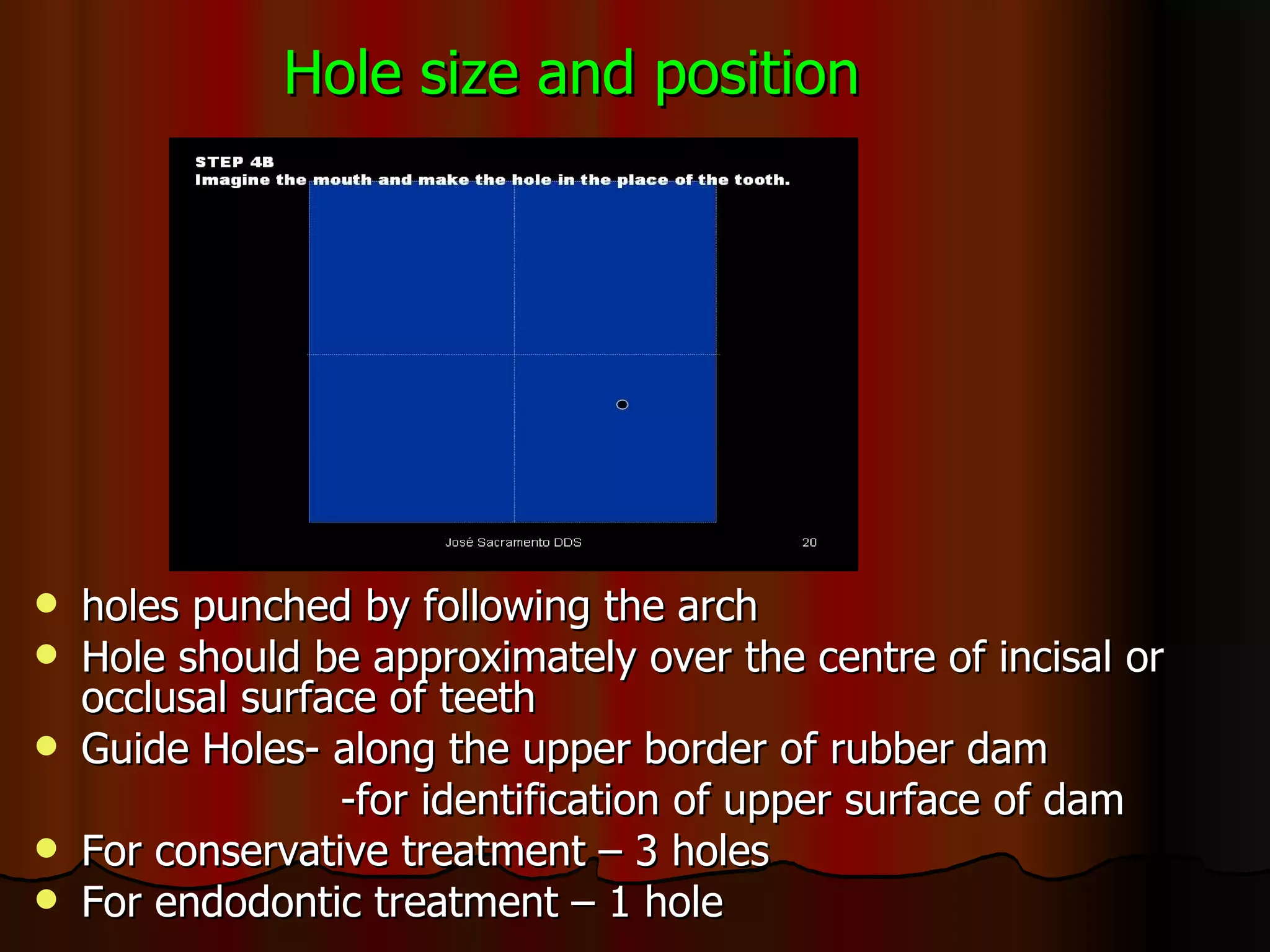
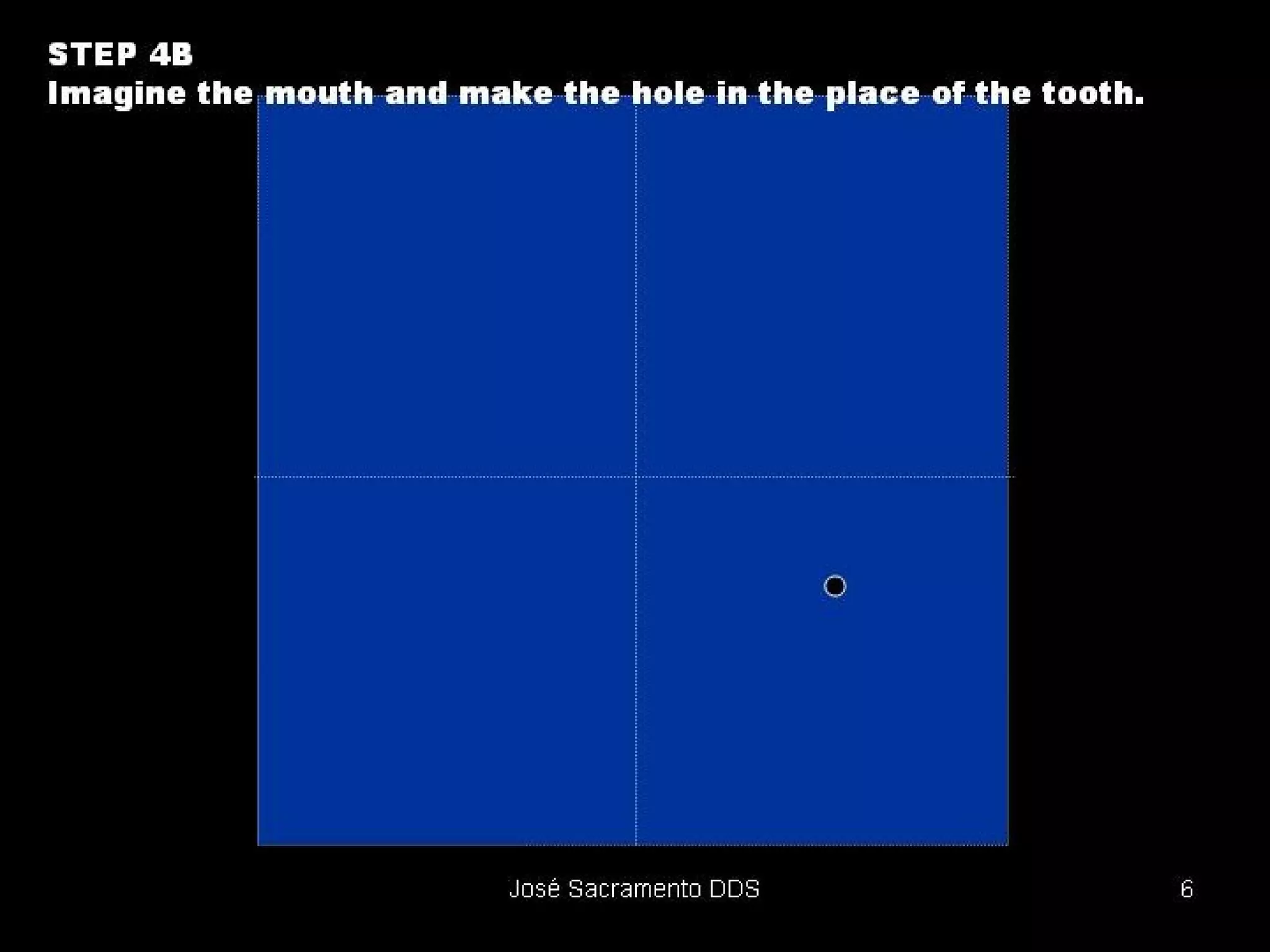
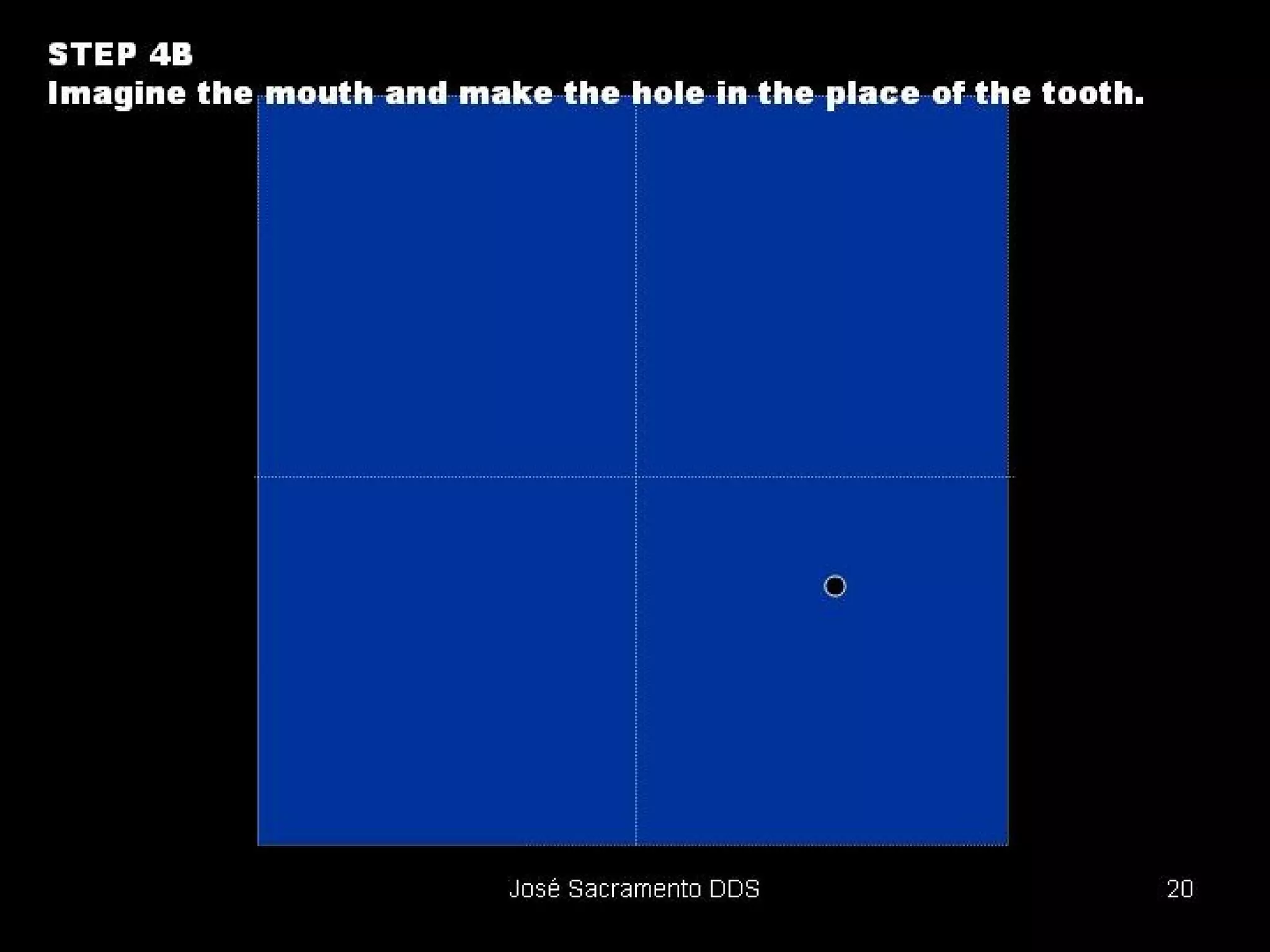
Hole size and position holes punched by following the arch Hole should be approximately over the centre of incisal or occlusal surface of teeth Guide Holes- along the upper border of rubber dam -for identification of upper surface of dam For conservative treatment – 3 holes  For endodontic treatment – 1 hole
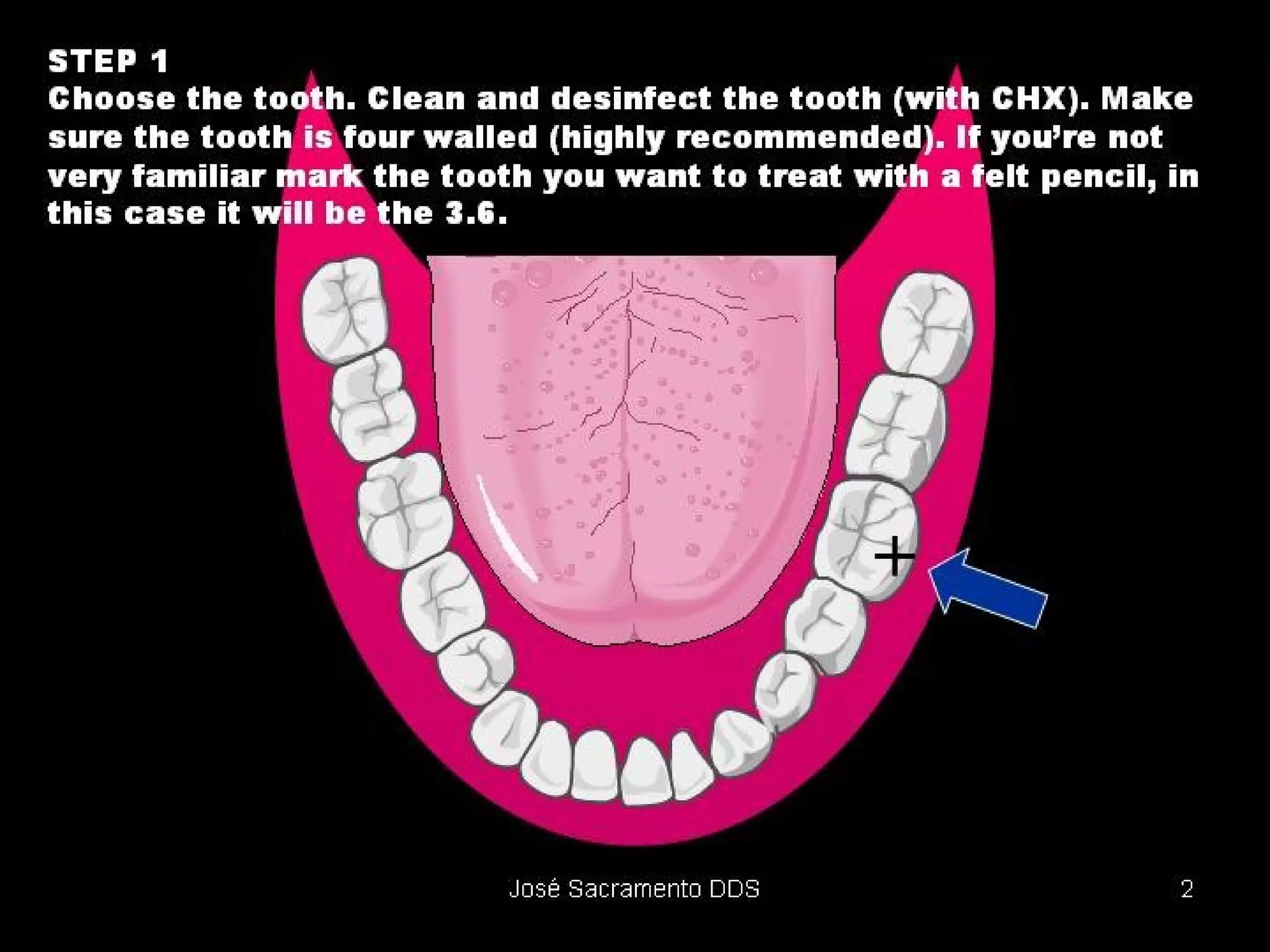
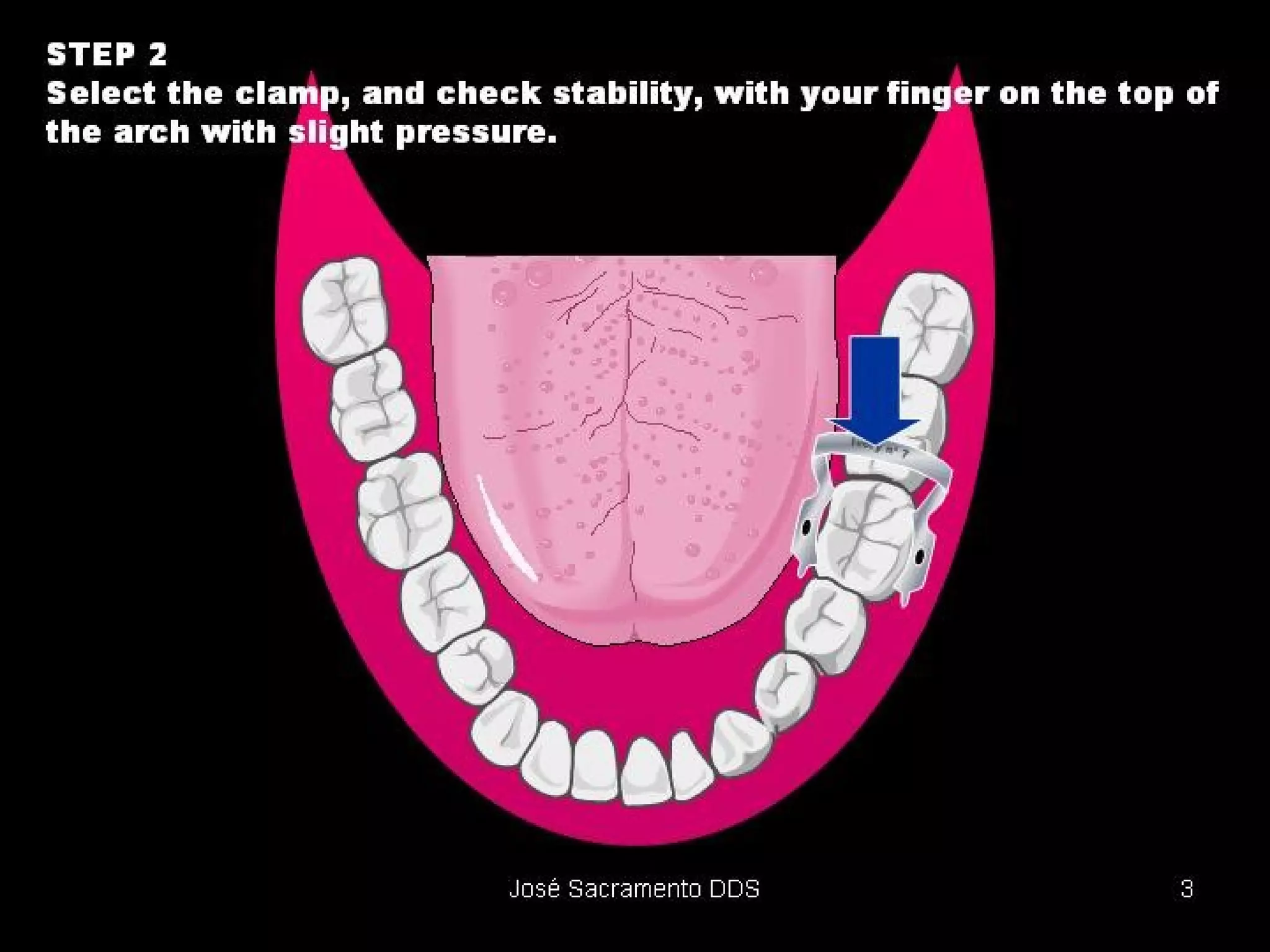
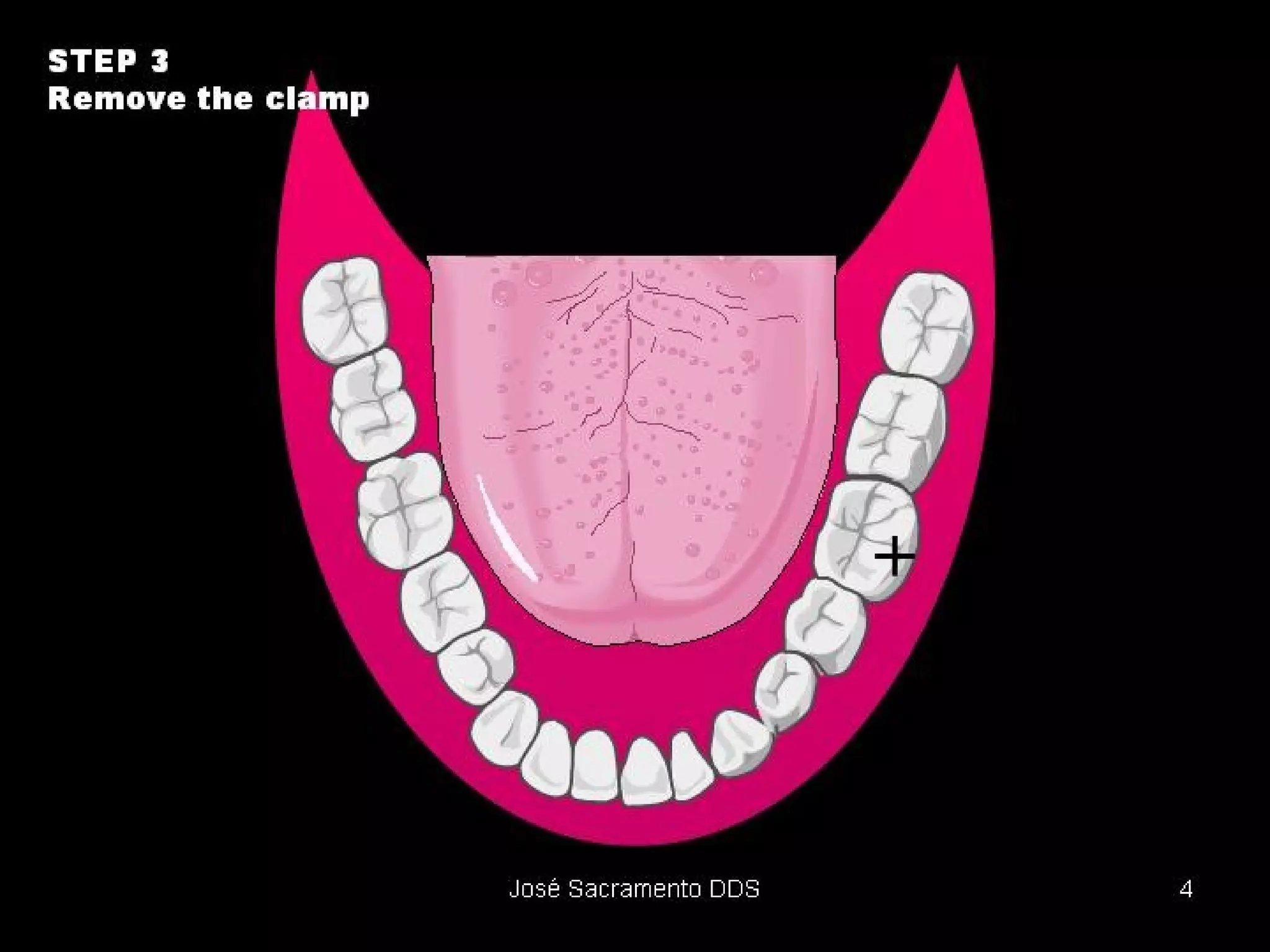
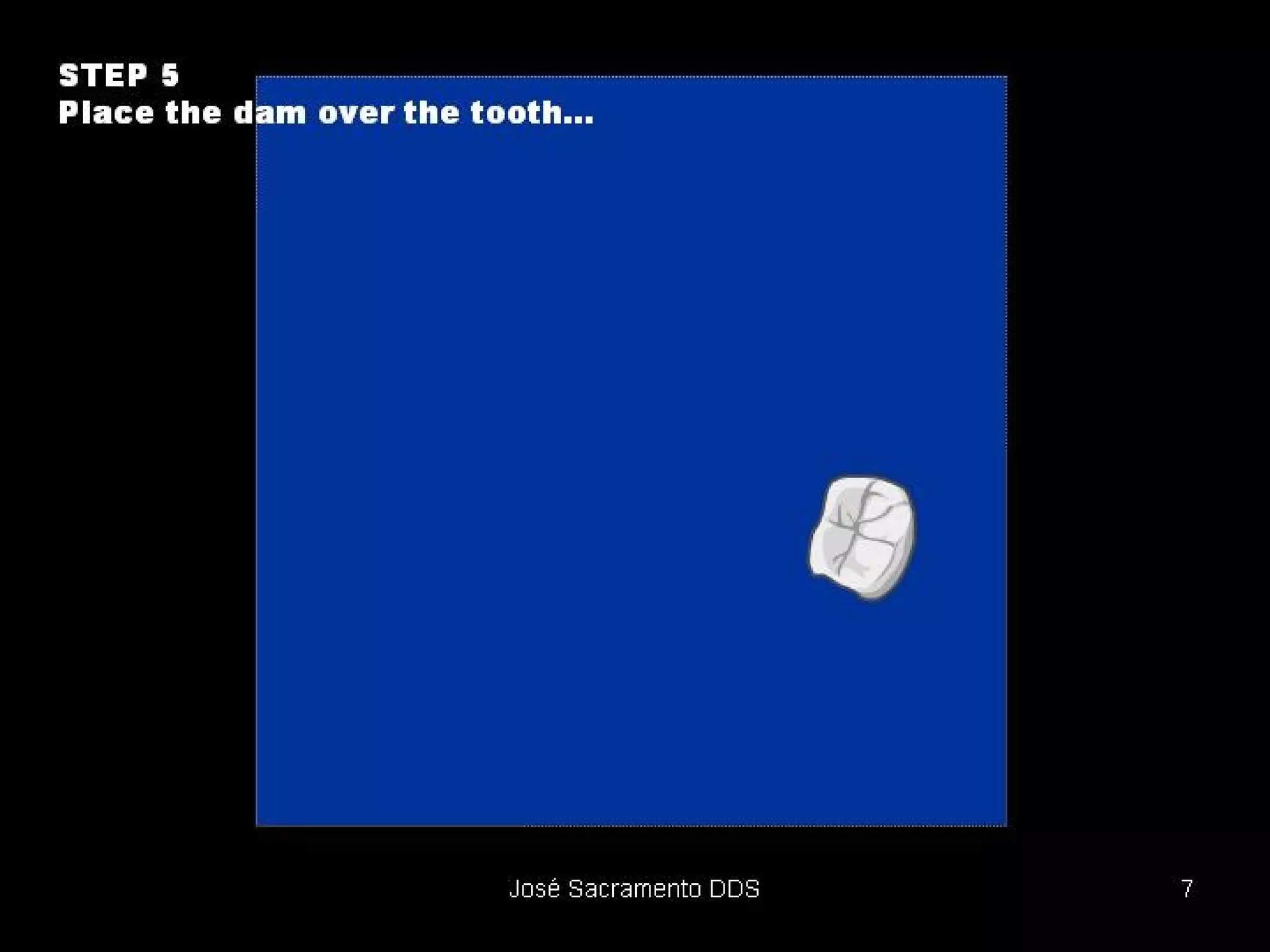
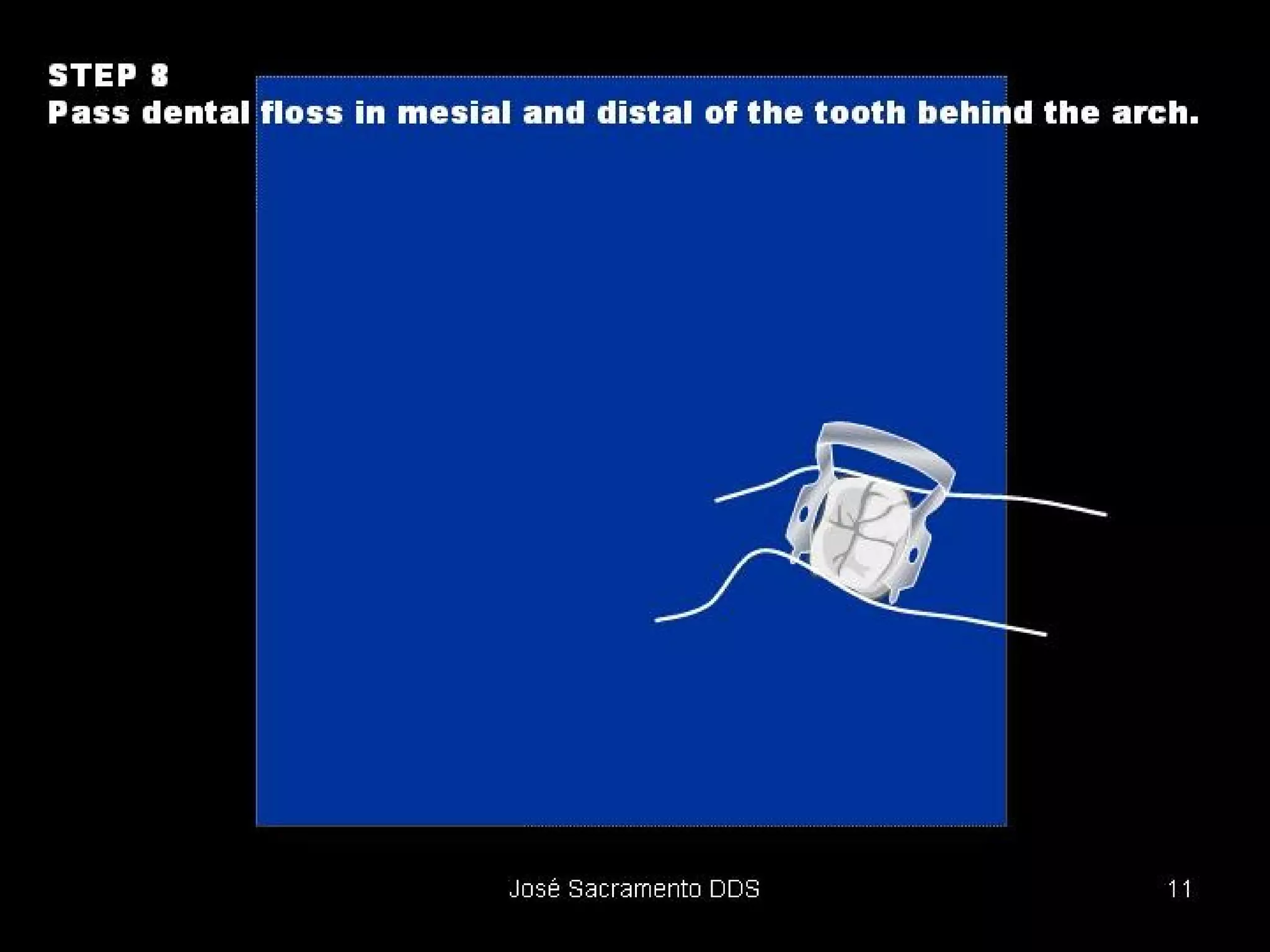
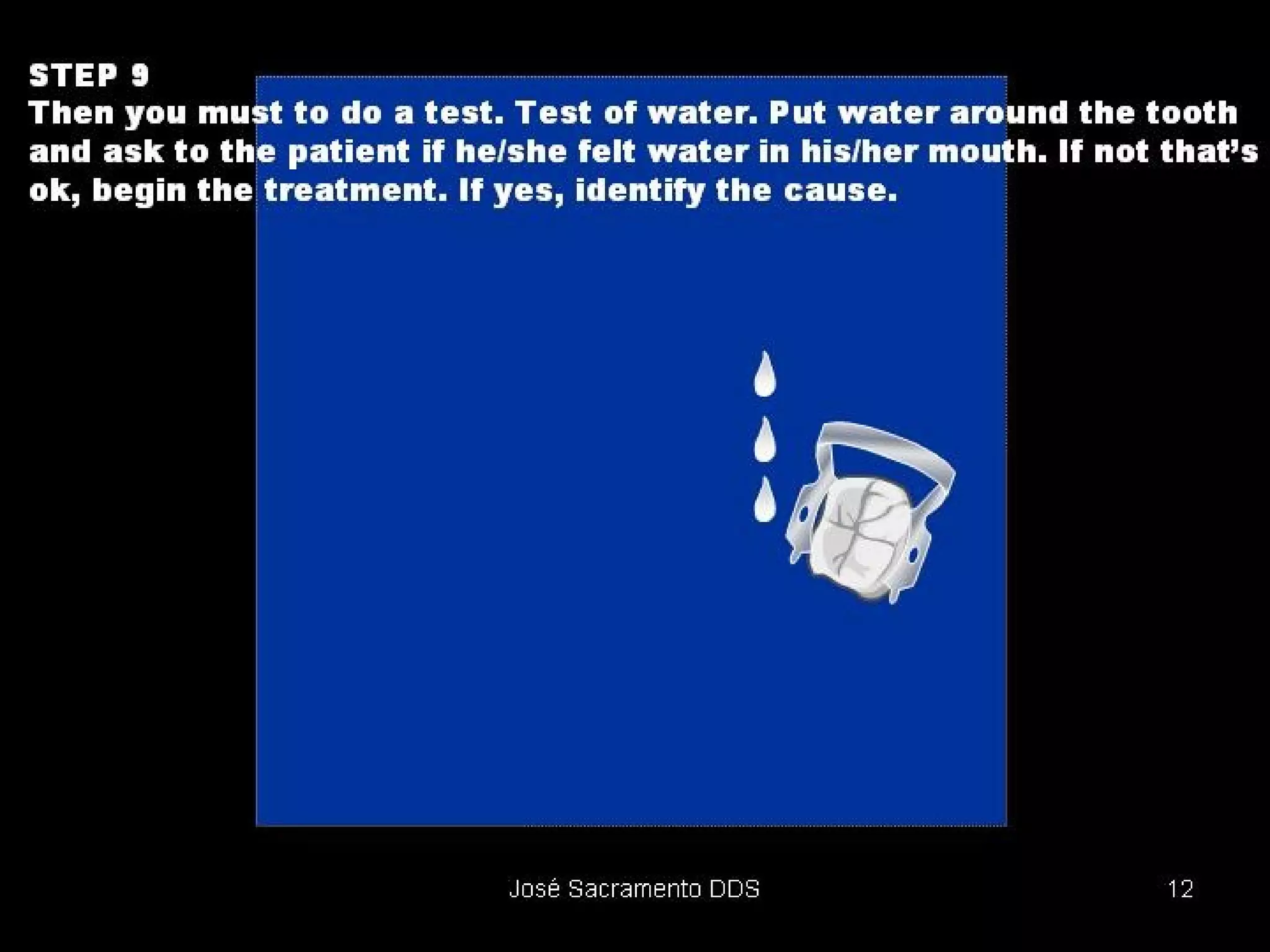
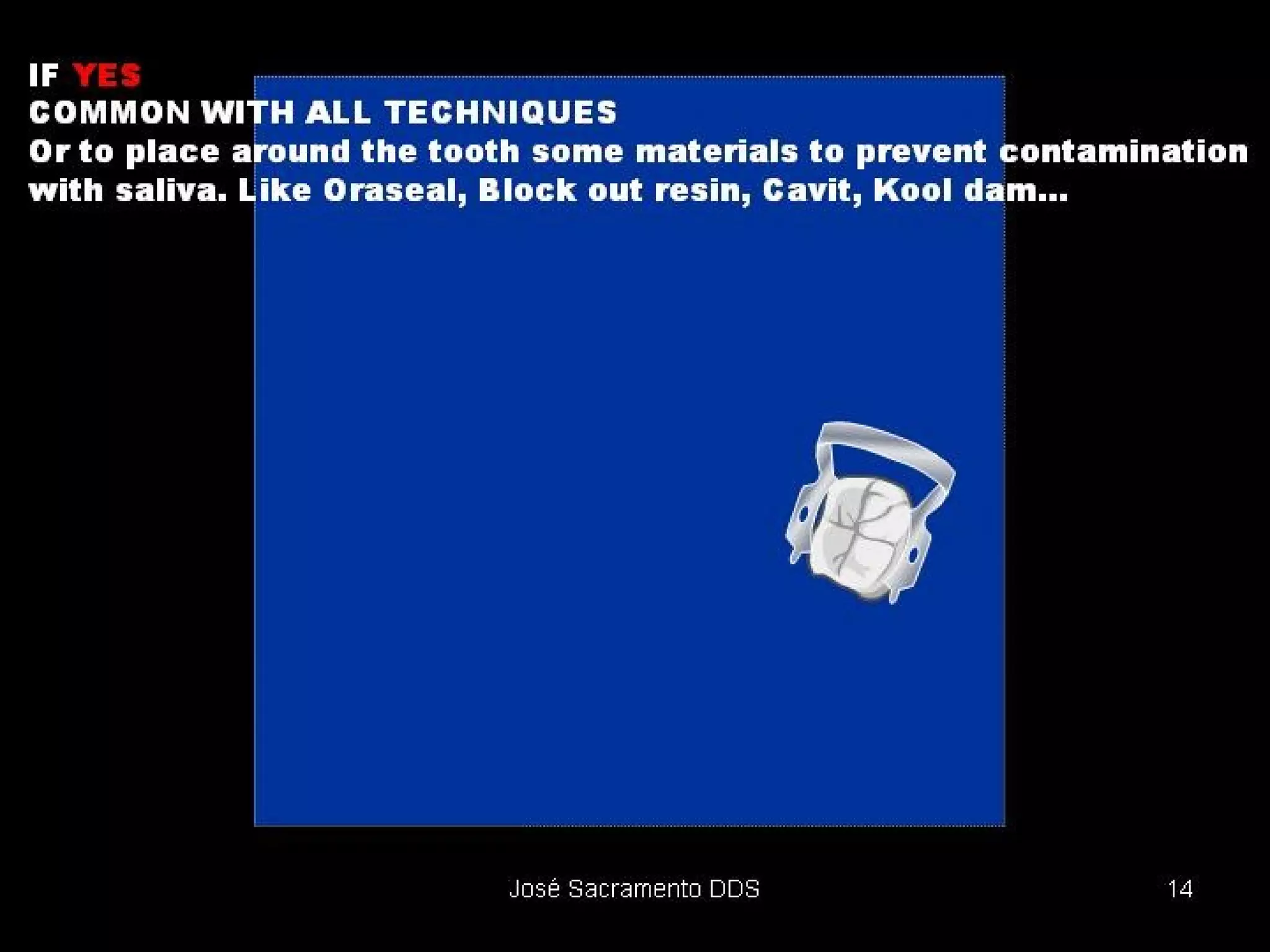
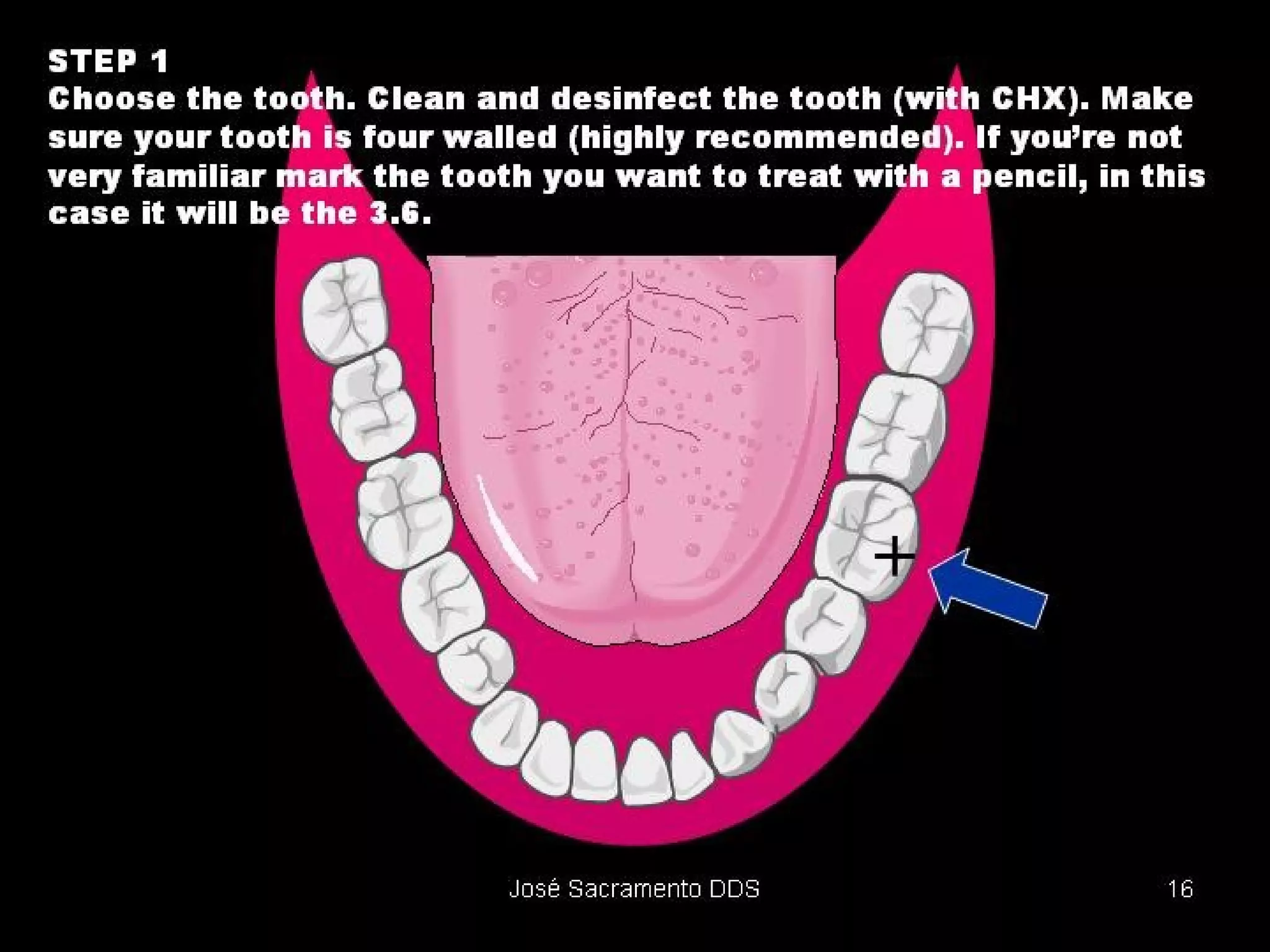
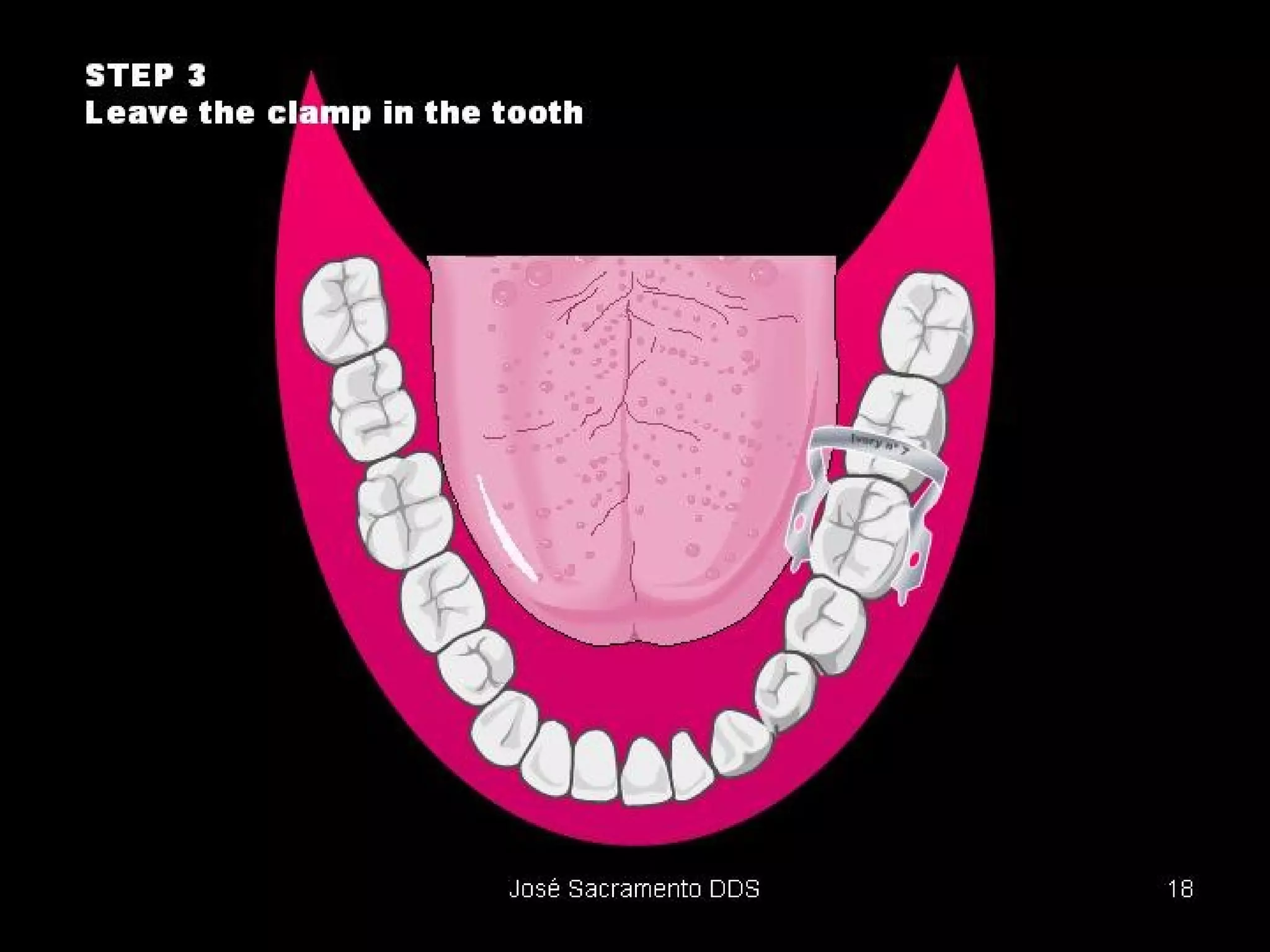
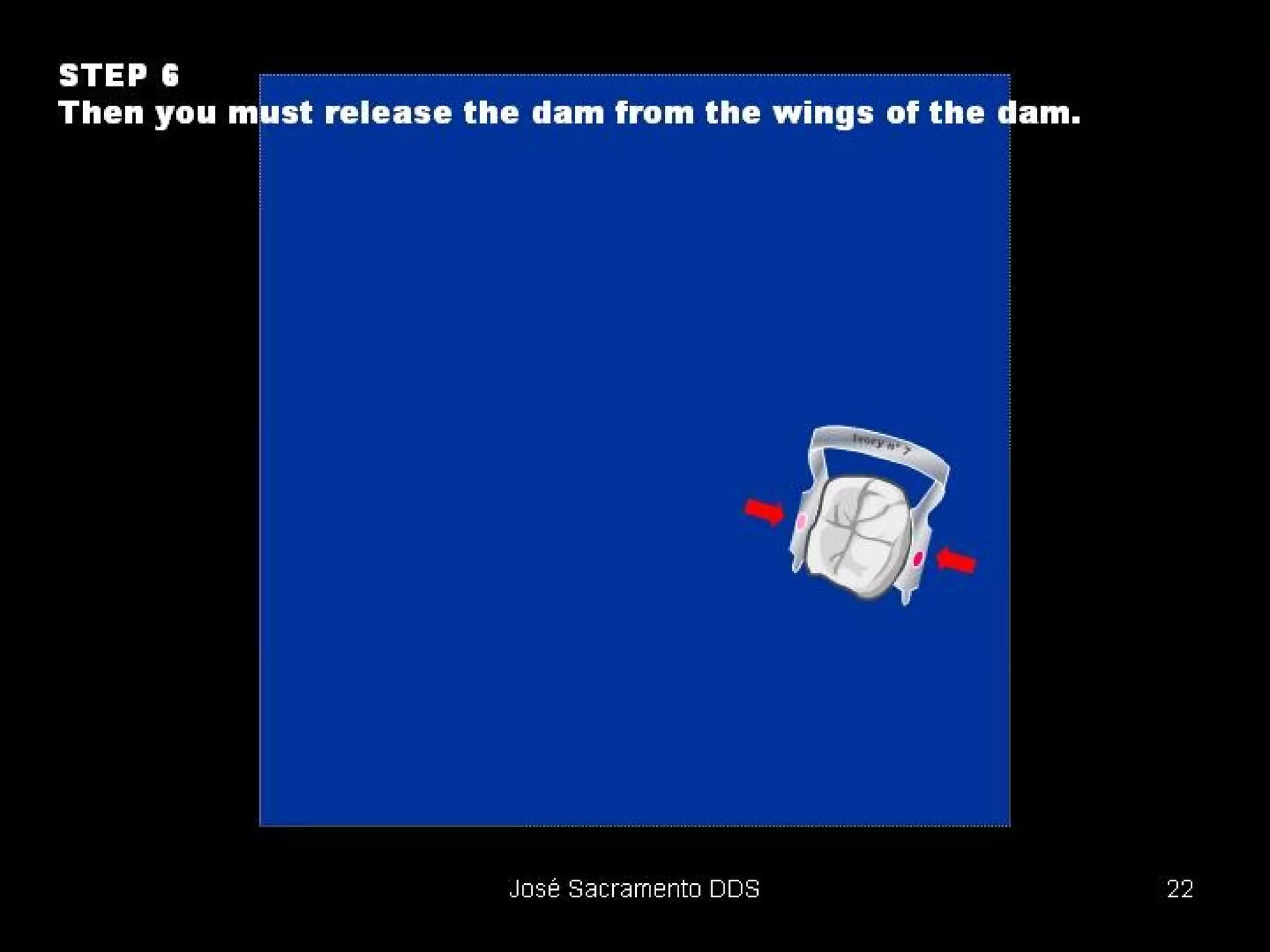
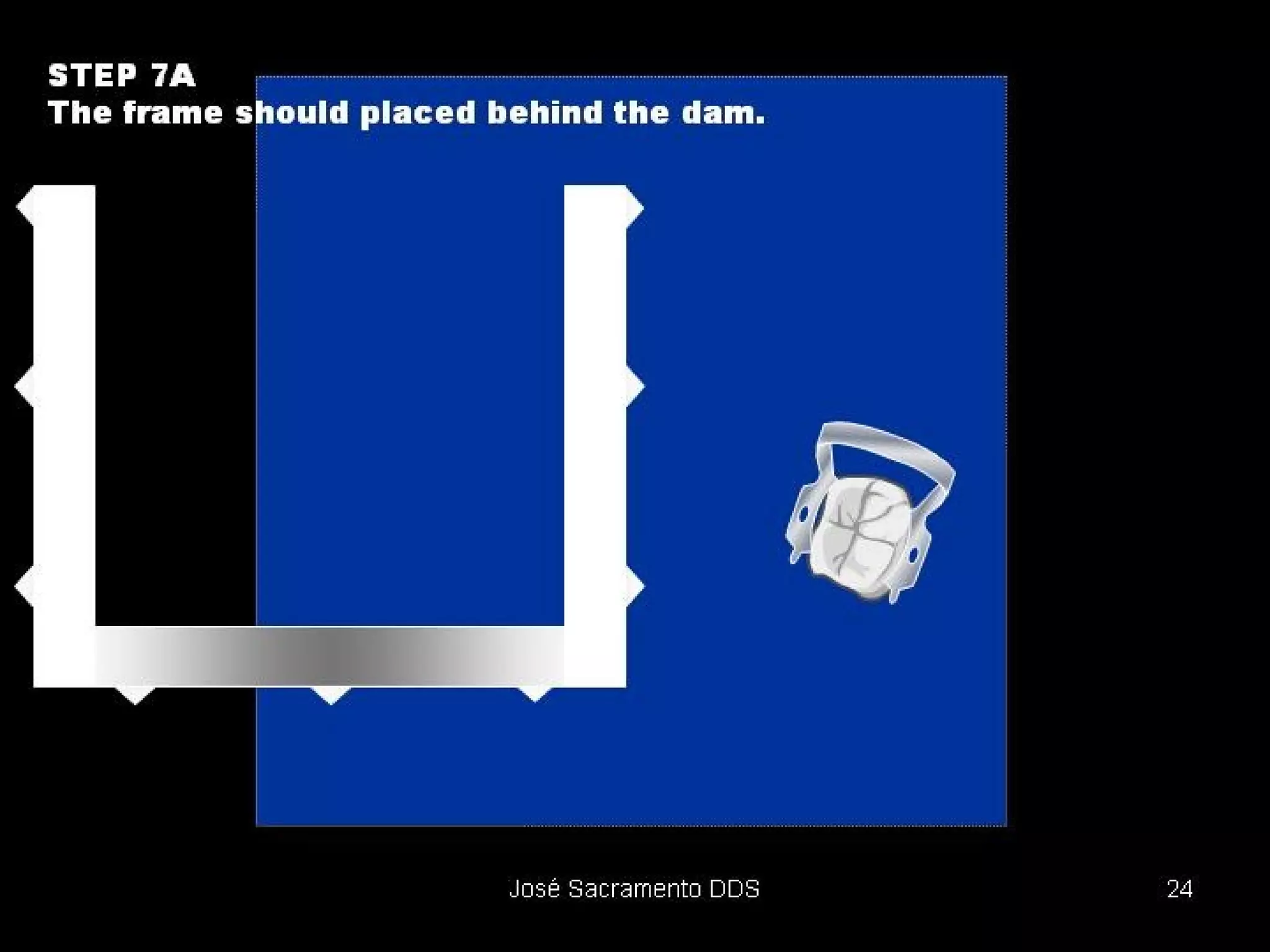
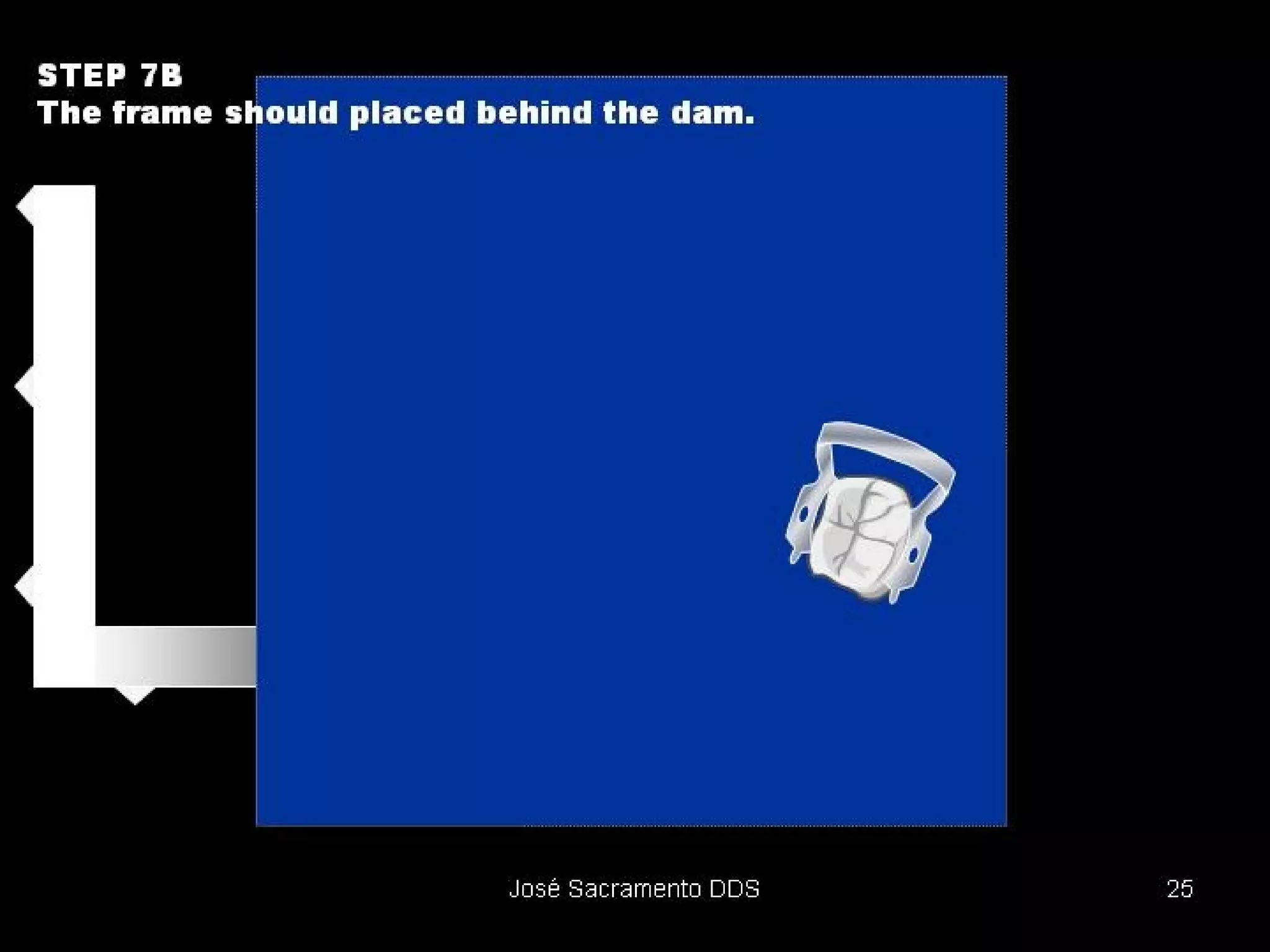
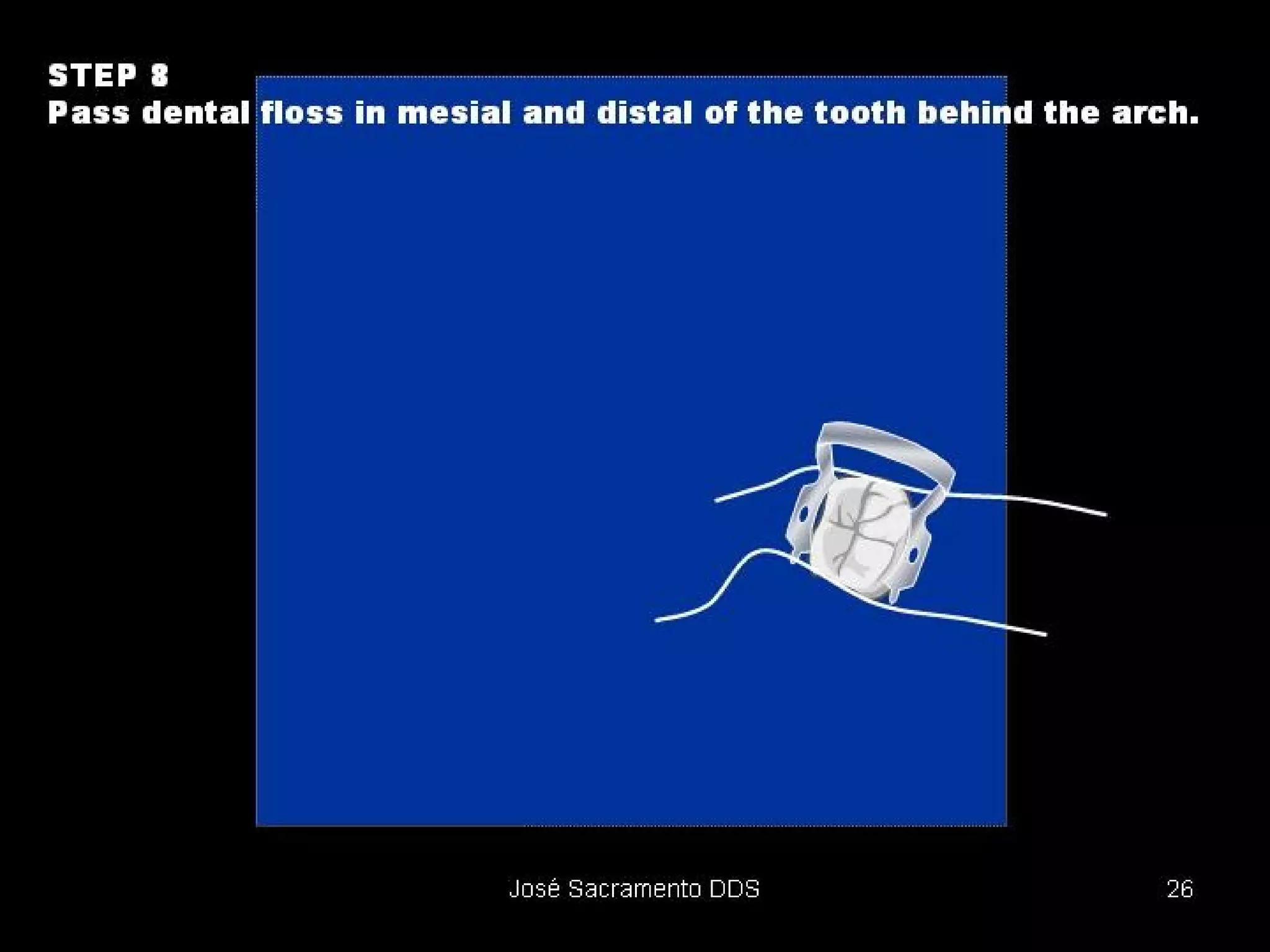
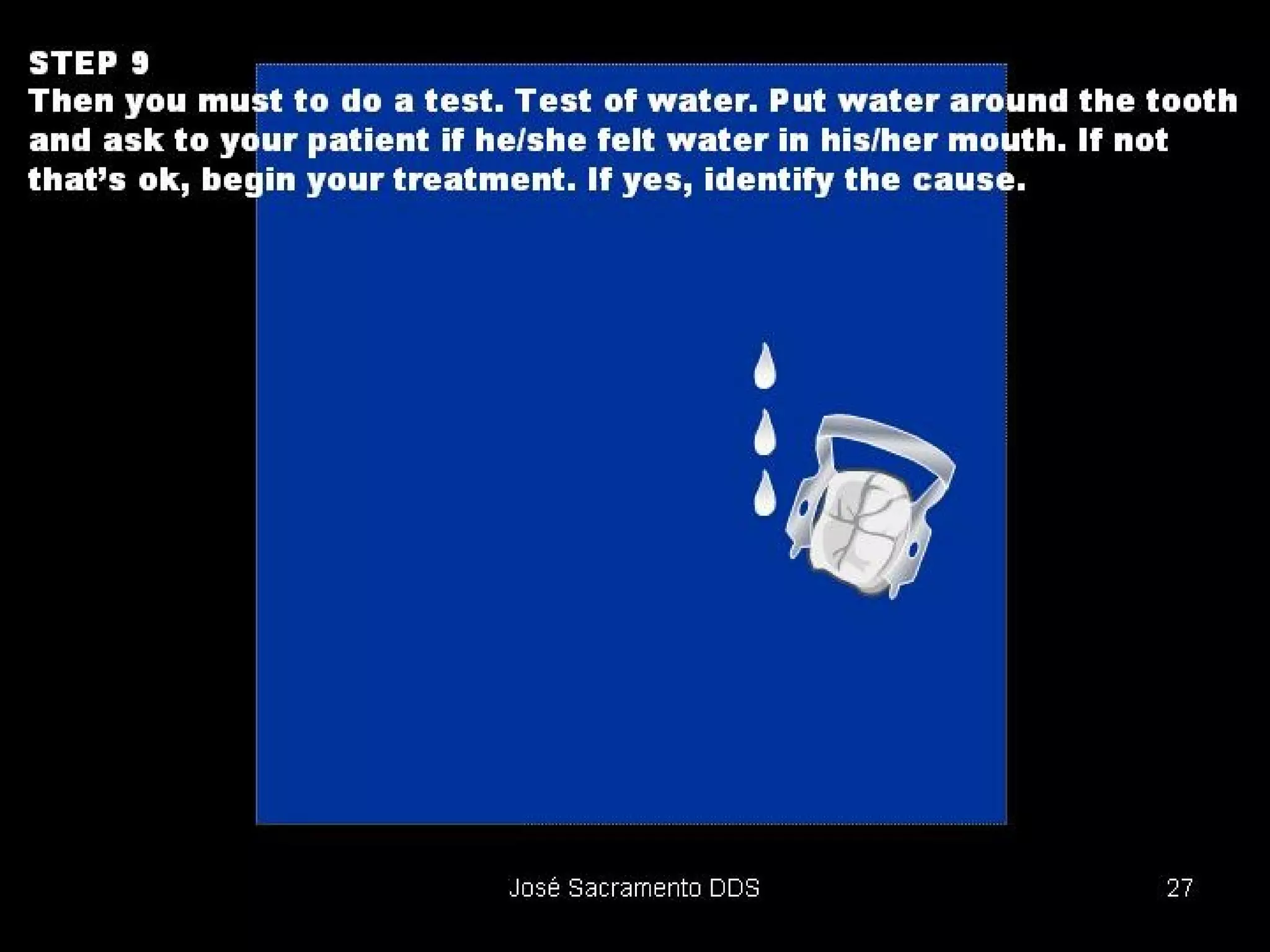
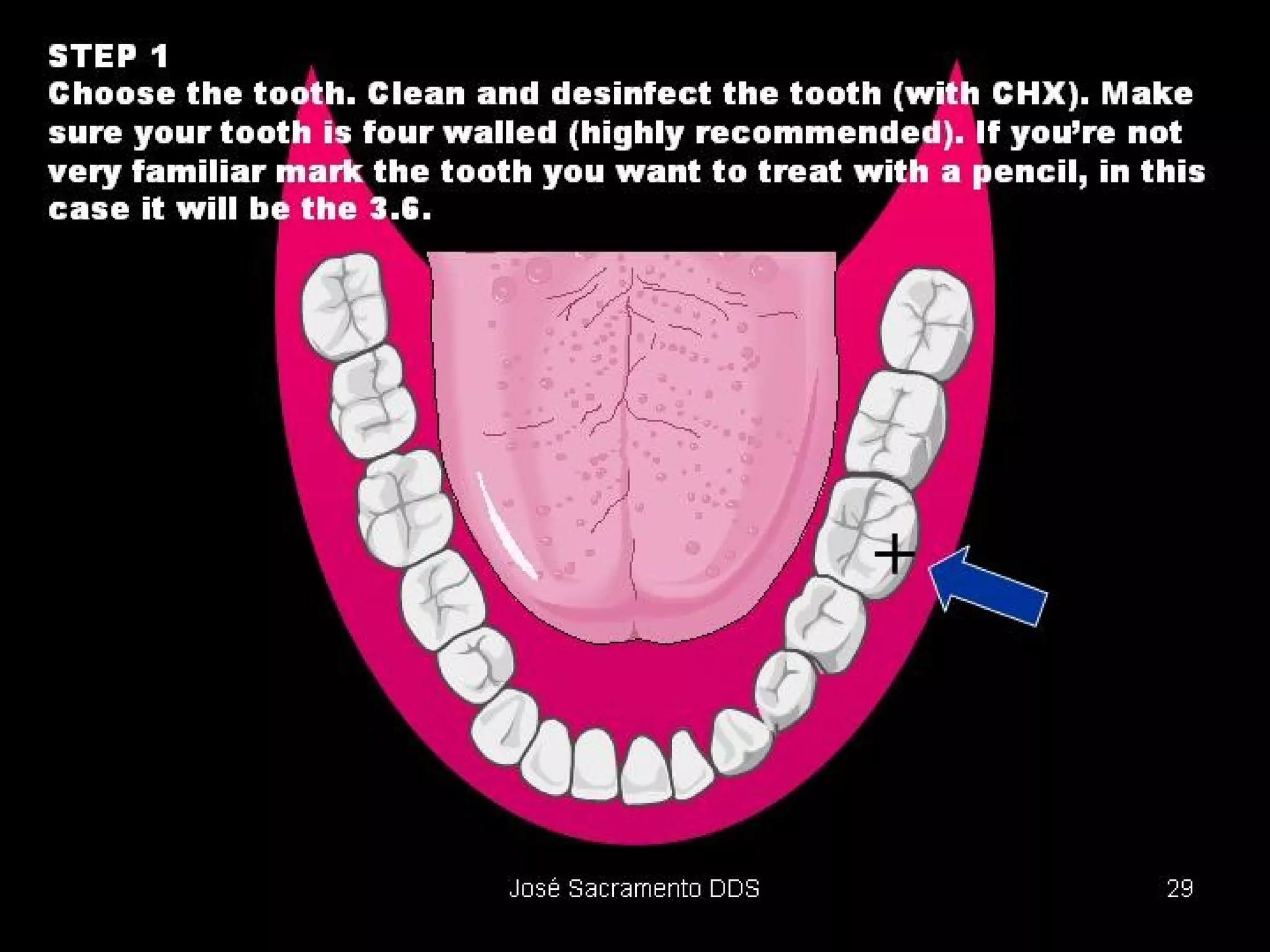
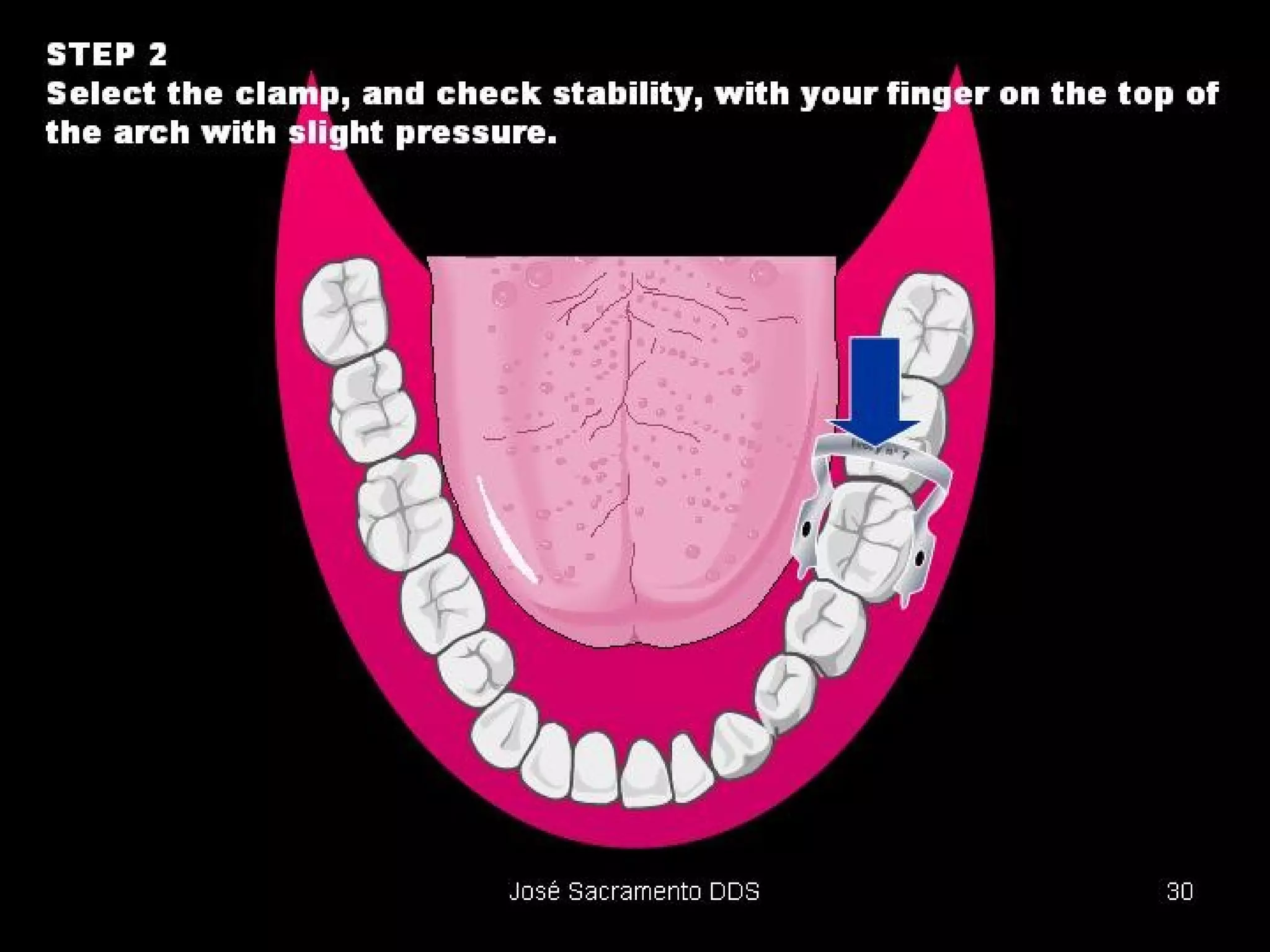
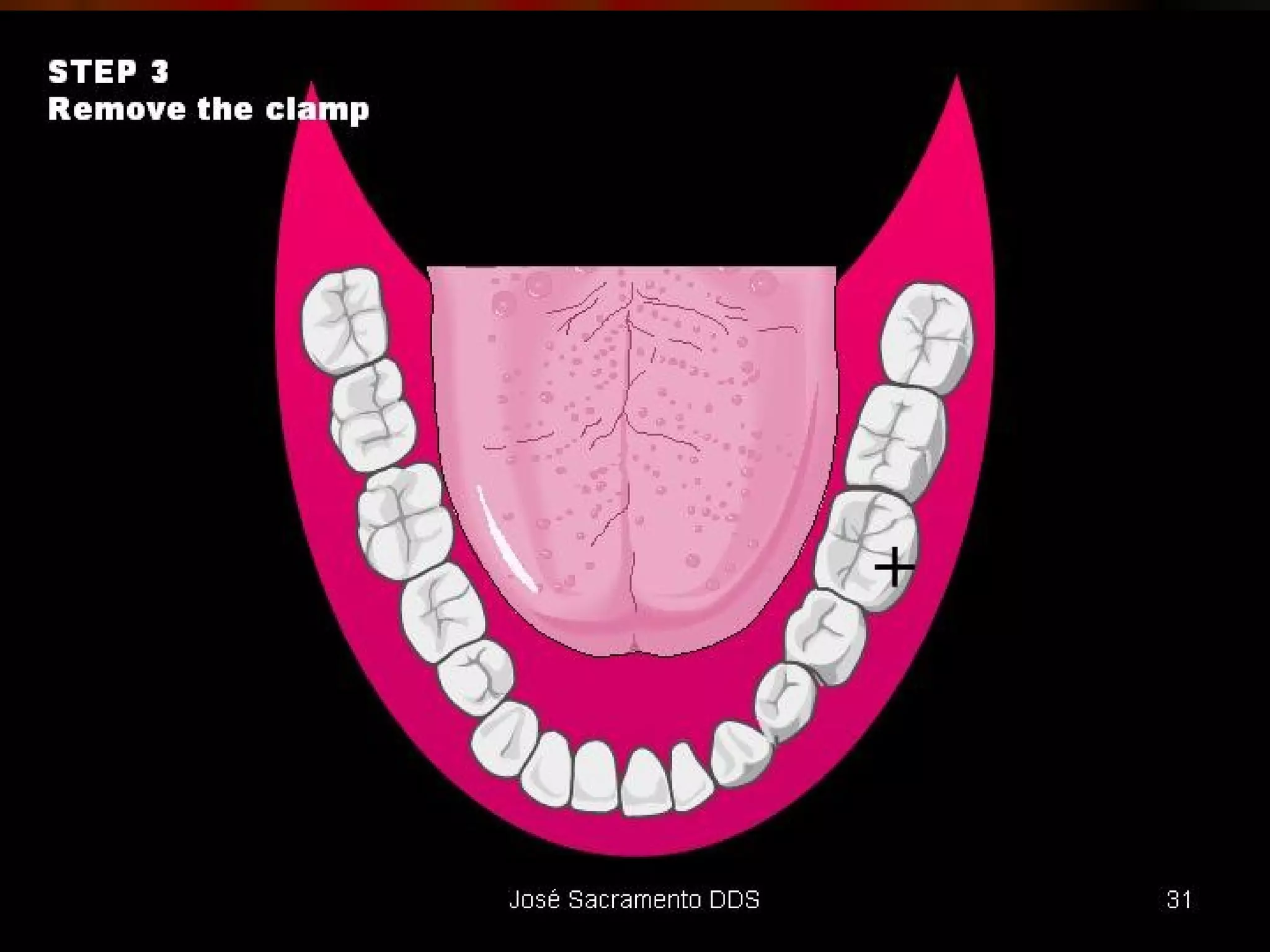
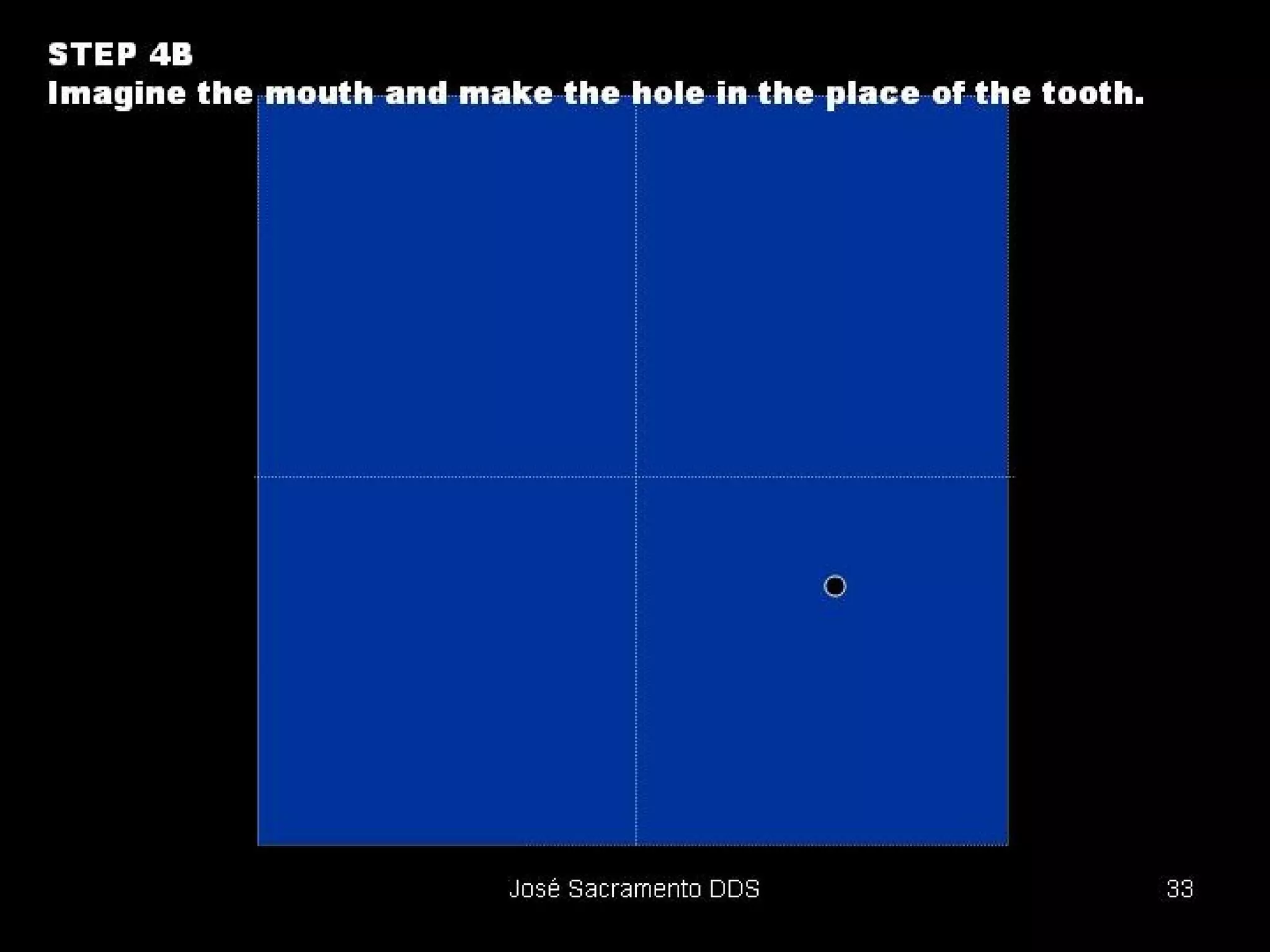
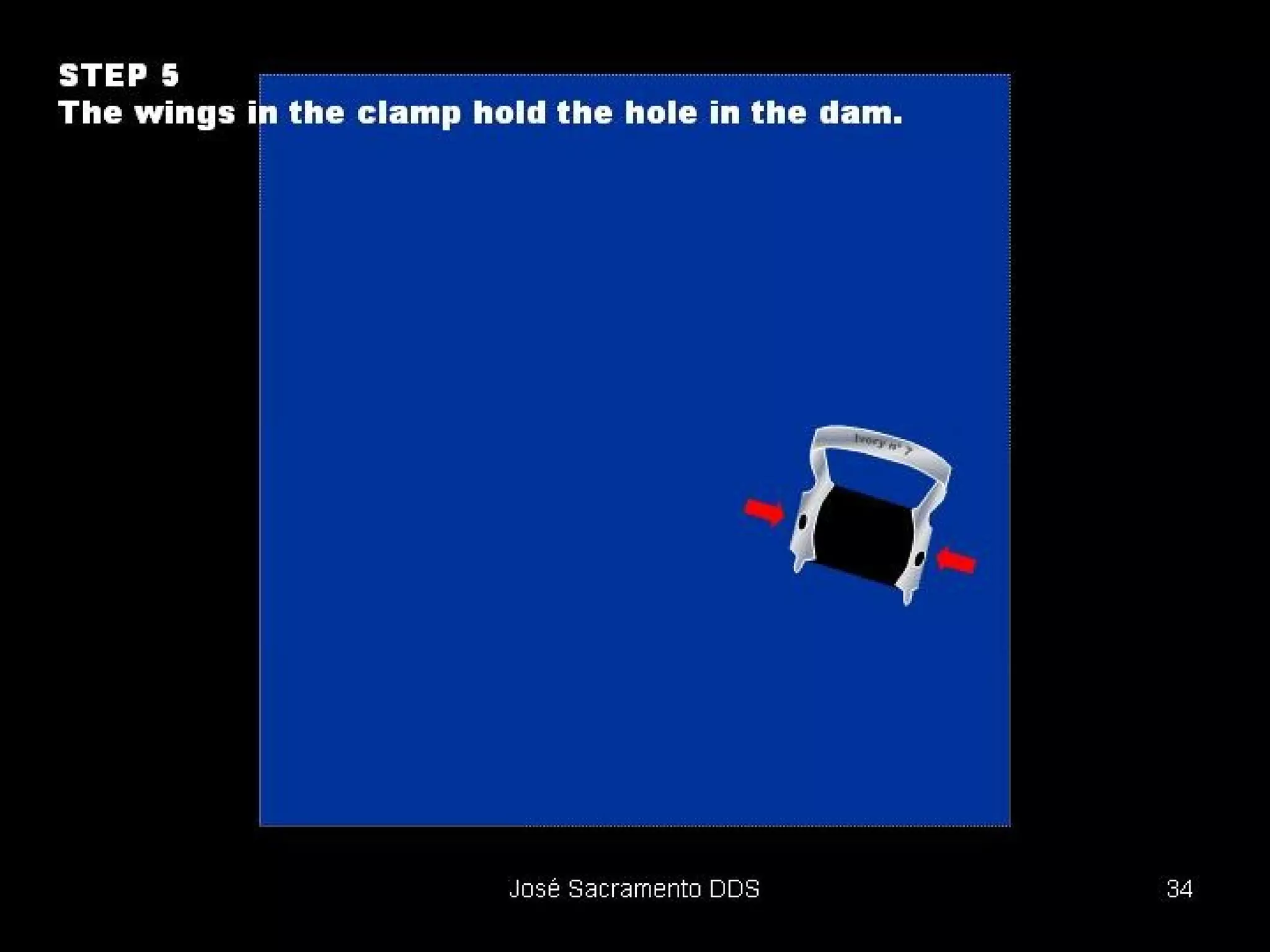
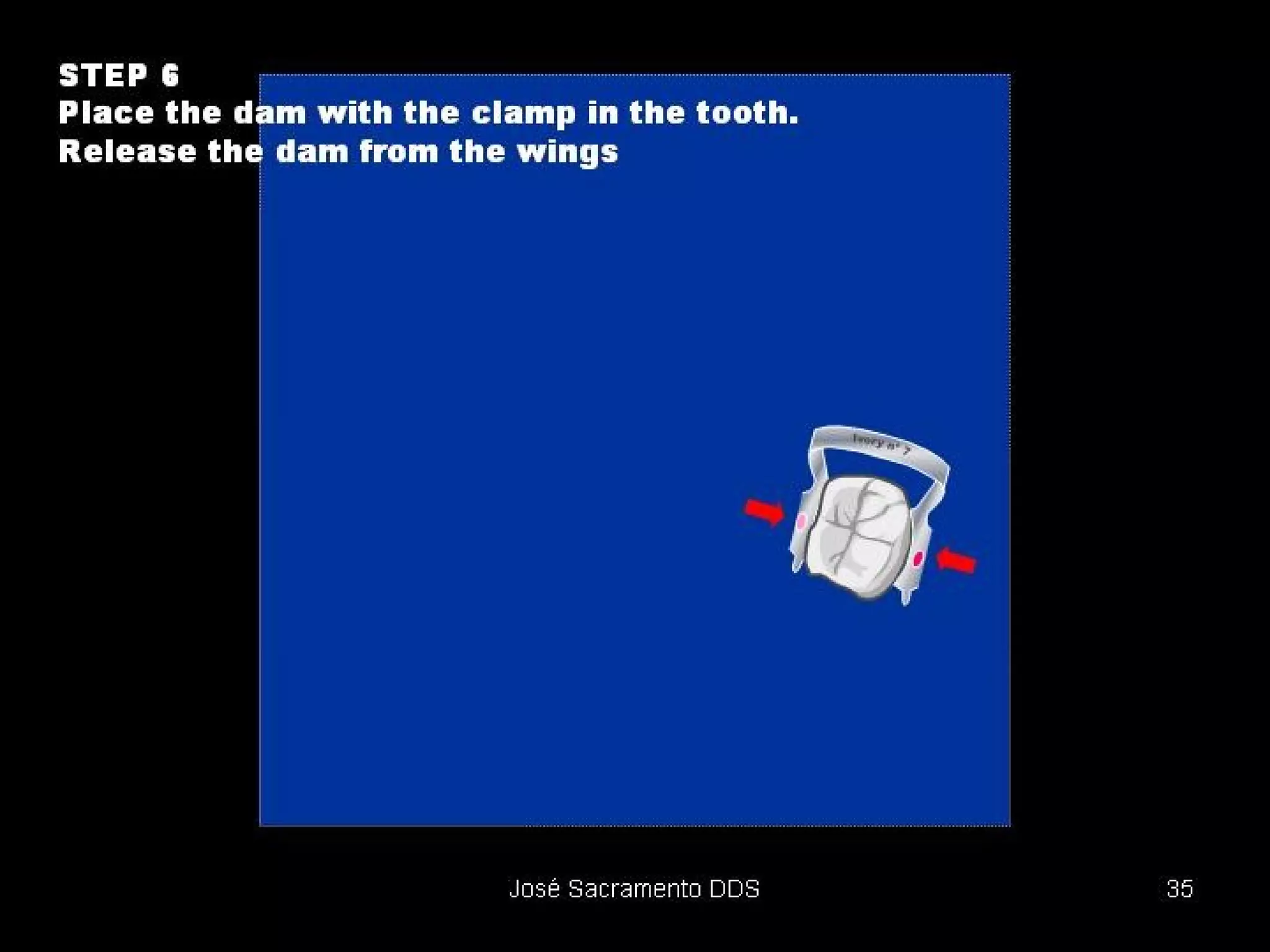
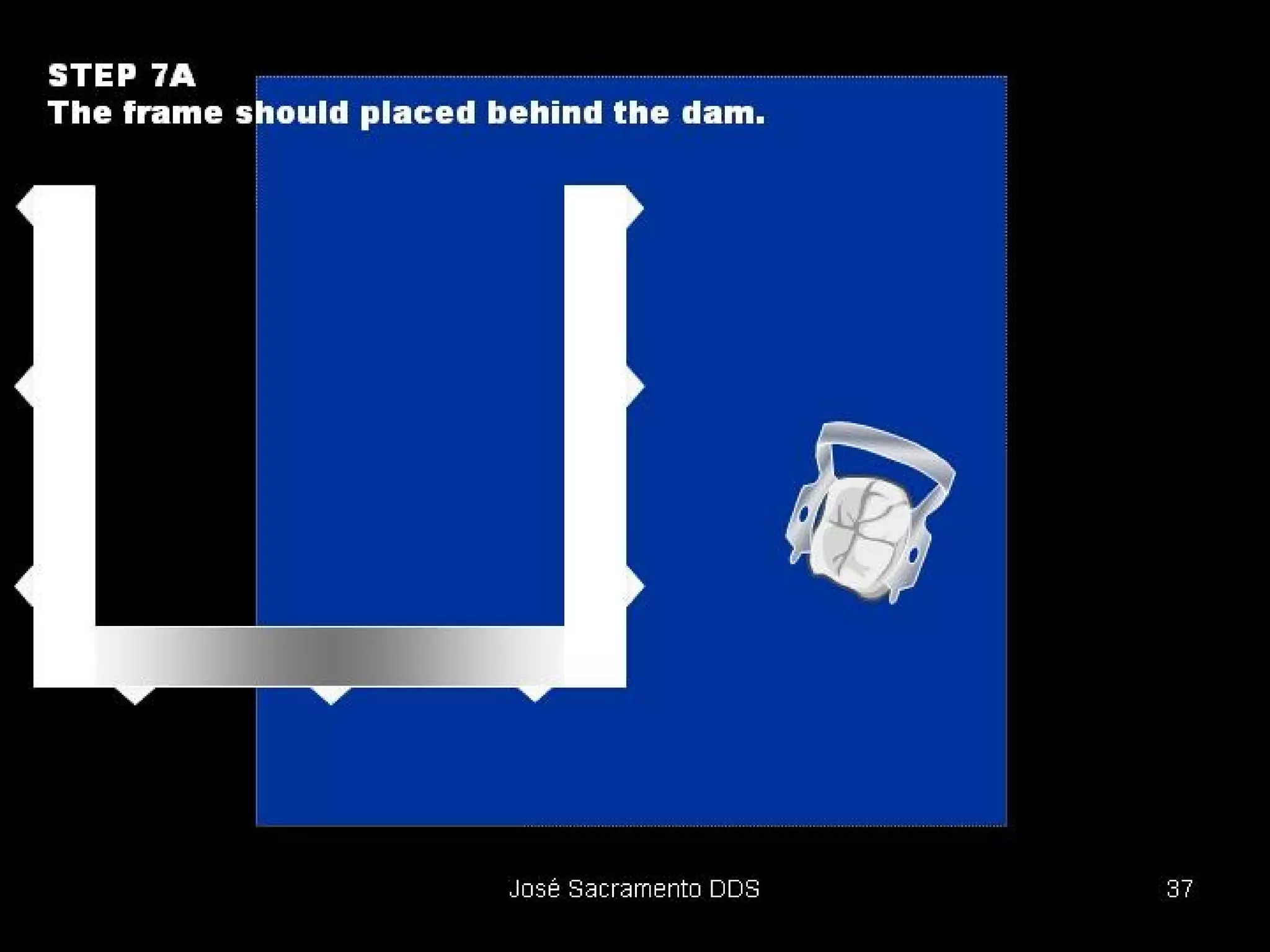
Placement of rubber dam 3 methods Dam first technique Clamp first technique Clamp and dam together technique


Removal of rubber dam Cutting the septa Removing the retainer Removing the dam Wiping the lips Rinsing the mouth  Massaging the tissue and Examining the dam
Alternative methods Cervical retainer replacement Fixed bridge isolation  Substitution of retainer with a matrix
Variations with age For younger - change the hole size - smaller sheet Primary teeth- HF no.27 retainer Young permanent teeth – Ivory no. 14
Errors in application and removal Prevent adequate moist control Reduce access and visibility Cause injury to patient off centre arch form Inappropriate distance between holes Incorrect arch form of holes Inappropriate retainer Shredded or torn Dam Sharp tips of no 212 retainer
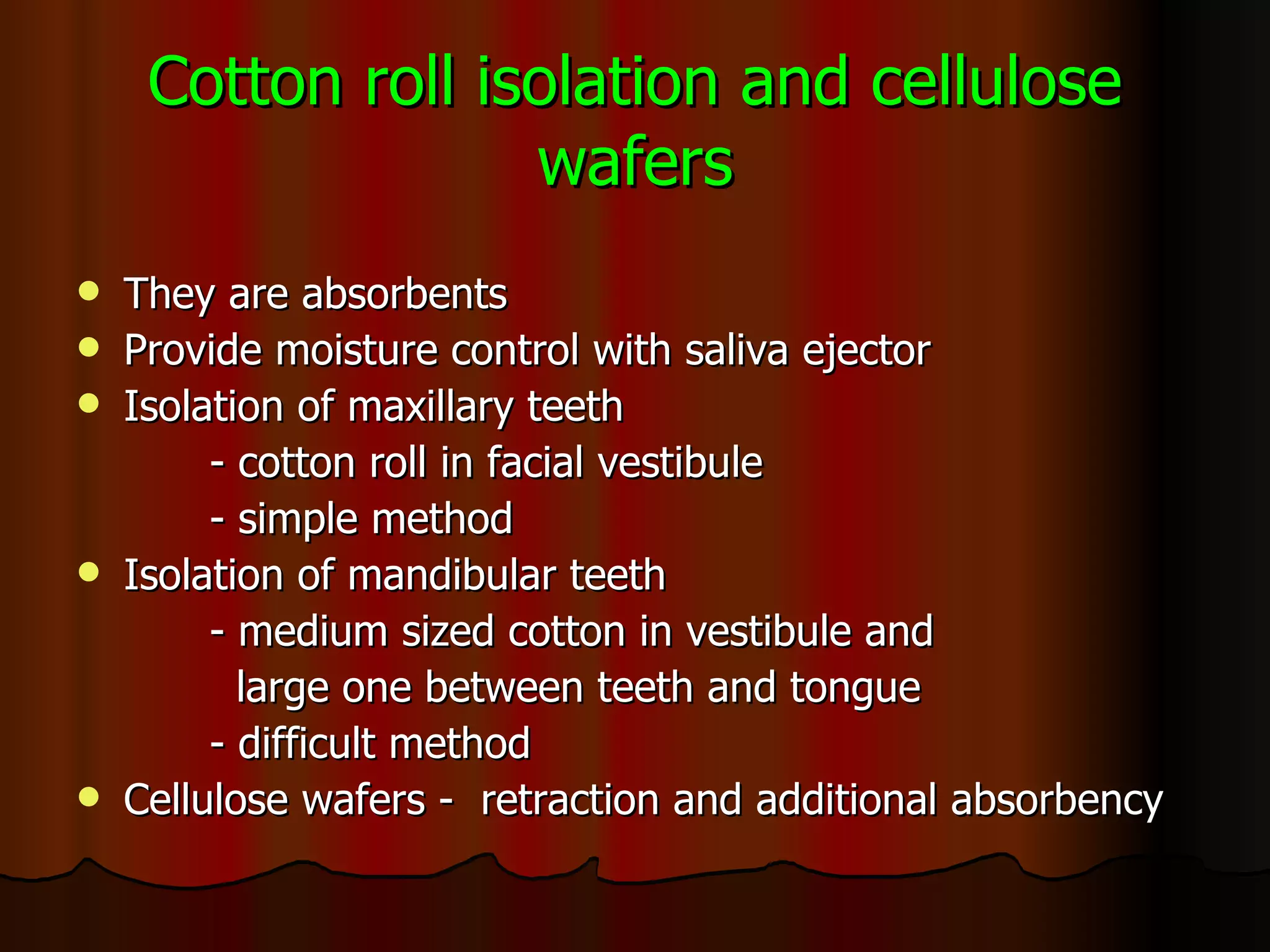
Cotton roll isolation and cellulose wafers They are absorbents Provide moisture control with saliva ejector Isolation of maxillary teeth - cotton roll in facial vestibule - simple method Isolation of mandibular teeth - medium sized cotton in vestibule and  large one between teeth and tongue - difficult method Cellulose wafers -  retraction and additional absorbency
 
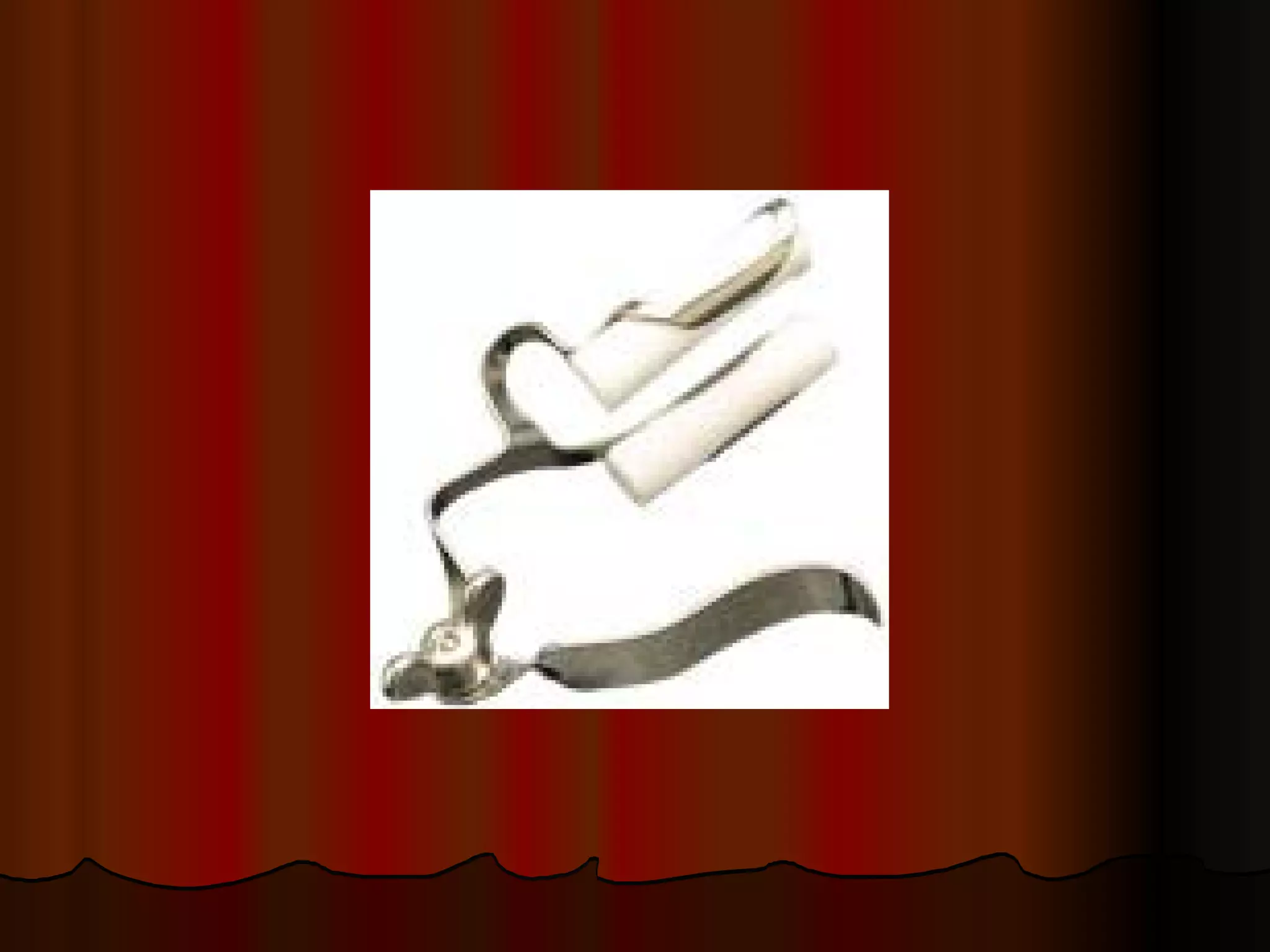
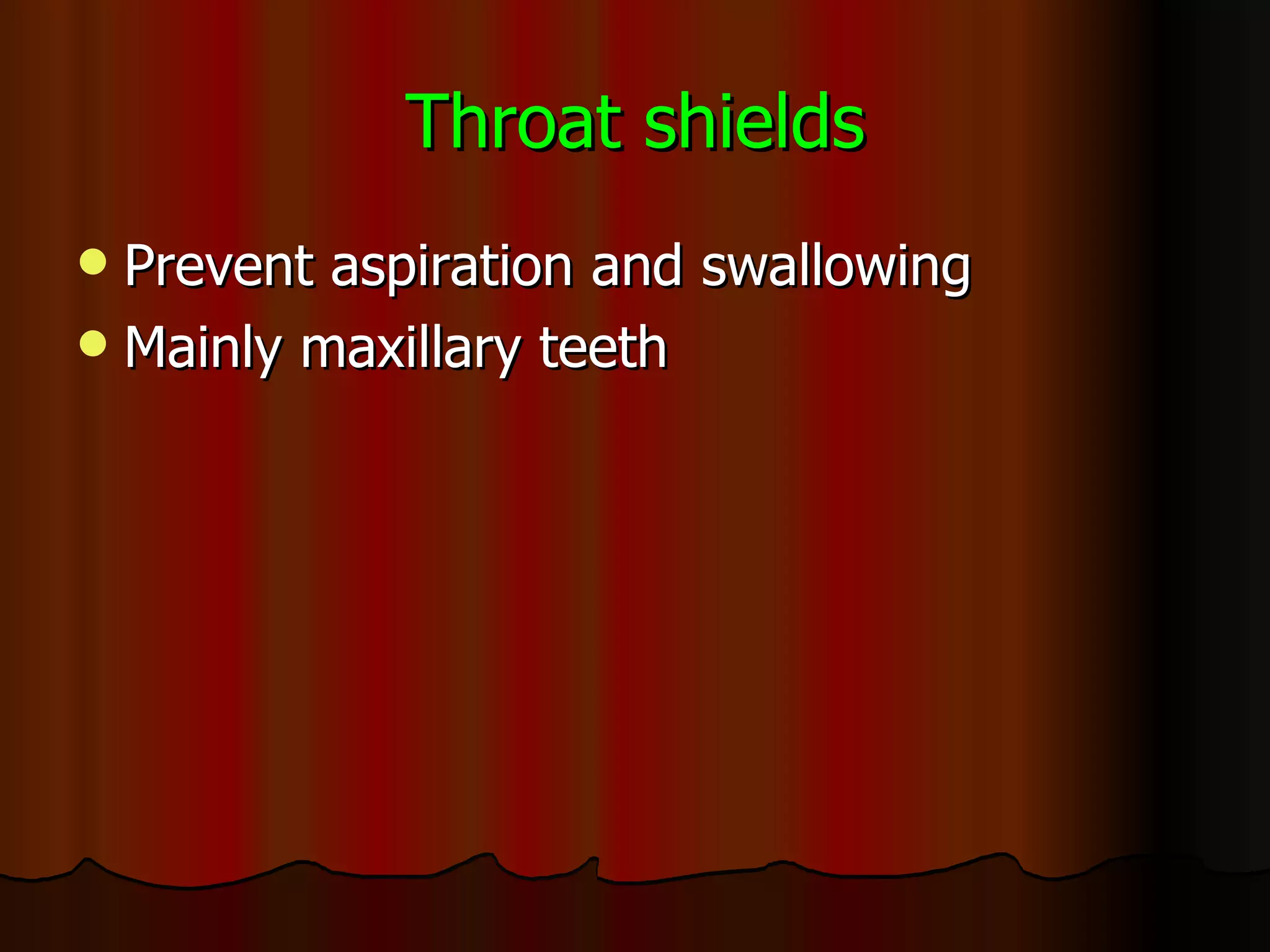
Throat shields Prevent aspiration and swallowing Mainly maxillary teeth
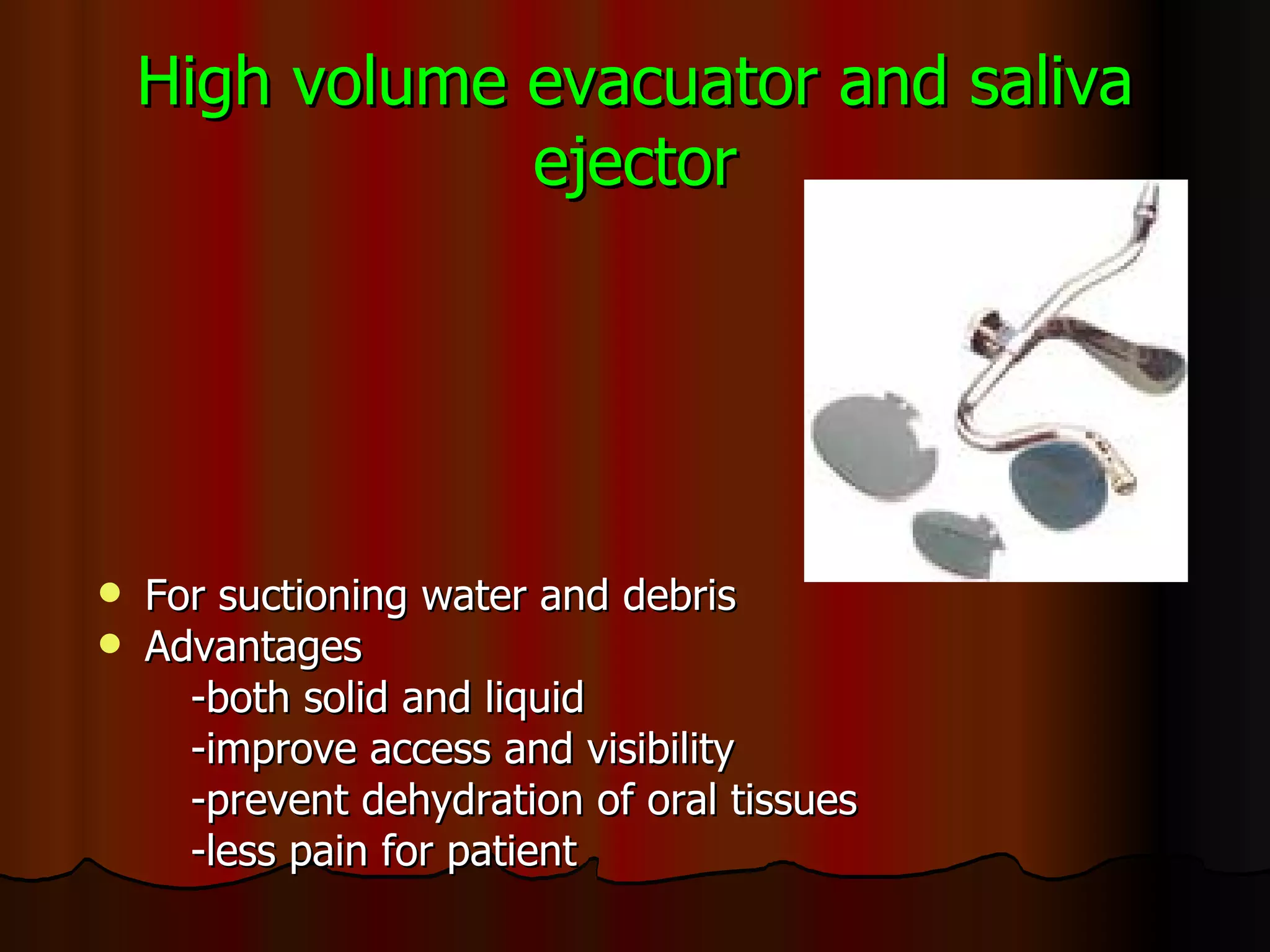
High volume evacuator and saliva ejector For suctioning water and debris Advantages -both solid and liquid -improve access and visibility -prevent dehydration of oral tissues -less pain for patient
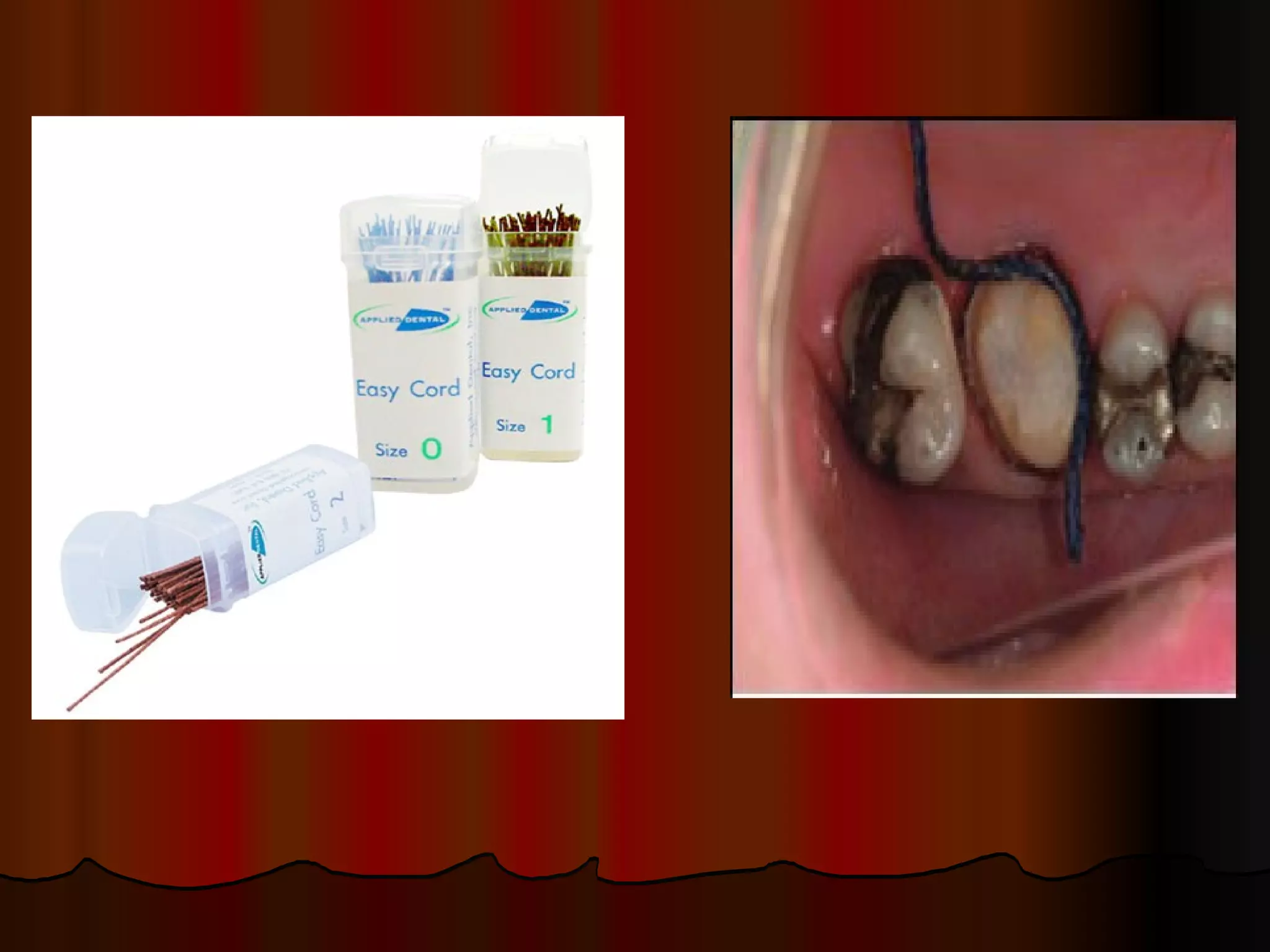
Retraction cords Control sulcular fluid Vasoconstrictor (epinephrine) along this Prevent aberration of gingival tissues Prevent excess restorative materials from entering the gingival sulcus
 
Mirror and evacuator tip retraction Cheek , lip and tongue retraction Secondary function
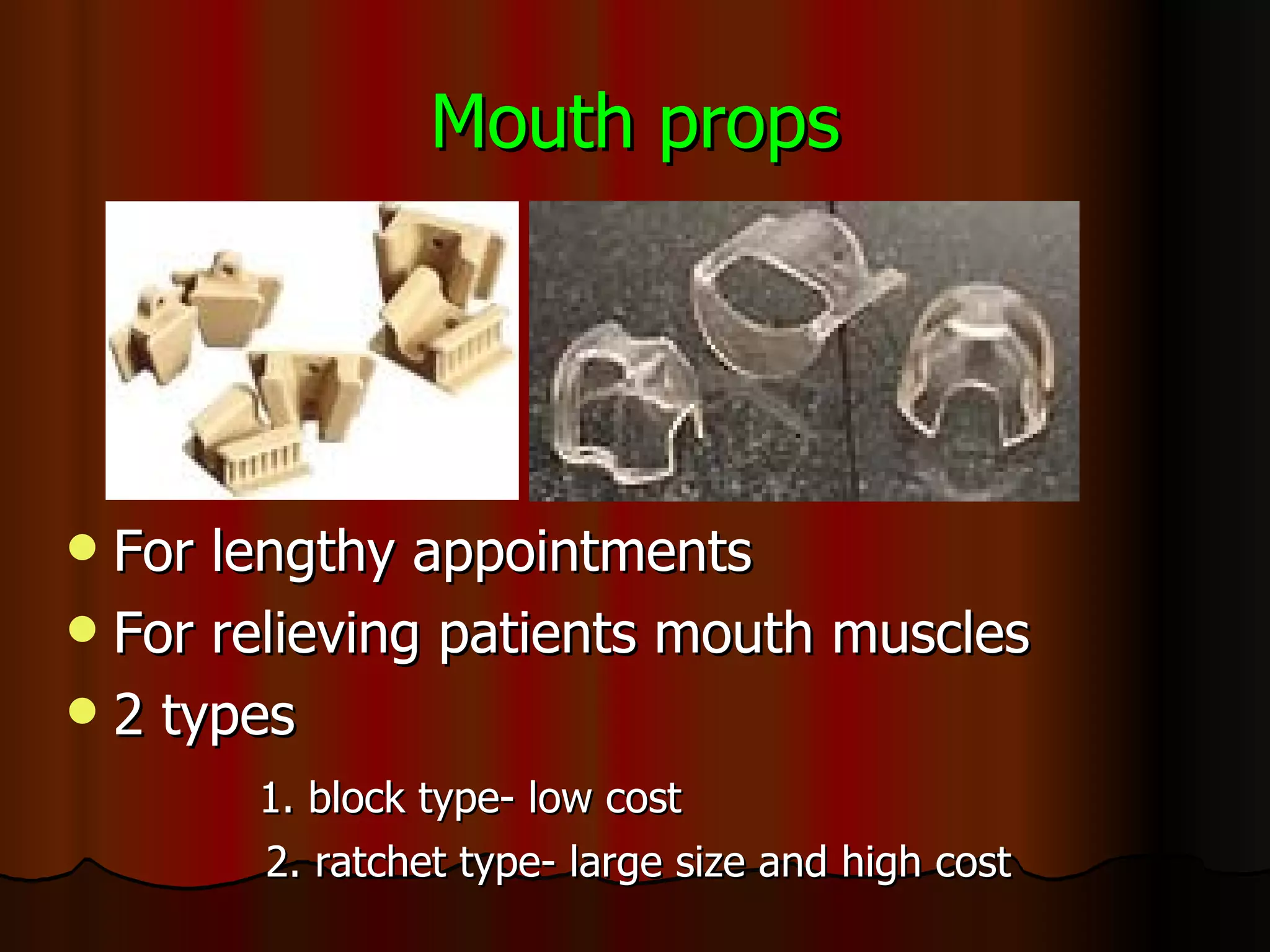
Mouth props For lengthy appointments  For relieving patients mouth muscles 2 types 1. block type- low cost 2. ratchet type- large size and high cost
Drugs   Rarely indicated Atropine(antisialogogues)-5mg,30min before the procedures-reduce salivation Antianxiety drugs like valium-5 to 10mg 30min before Muscle relaxants Medication for controlling gingival bleeding Pain control medication Contraindication-  nursing mothers and  Glaucoma patients
DISCUSSION You notice during an endo that saliva is creeping through your rubber dam hole. What should you do ? A) Put on a new piece with a smaller hole B) Put in a new piece using thicker dam C) Use caulking paste to seal the leak D) Use a curved saliva ejector in the mouth  under the  dam
When doing an MO restoration under dam on  an upper first premolar, you should apply the dam clamp to the A) Canine B) First premolar C) Second premolar D) Any of these E) None of these - you must use wedges
It is essential to lubricate dam before applying it. Which of these is NOT a suitable lubricant? A) Shaving cream B) Liquid soap C) Hibiscrub D) Vaseline
When doing an endo, how many teeth would you normally have coming through the dam? A) Just the one being root treated  B) 2  C) 3  D) As many as possible and practical
You have problems with the dam tearing. What might you consider ? A) Using thinner dam B) Using thicker dam C) Making the holes closer together D) Making the holes further apart
Which of these will make the dam most likely to tear? A) A large tooth B) A large clamp C) A small hole D) A rusty dam punch
You are having trouble getting the dam between the contact points for four anterior teeth. What might you NOT do? A) Punch the holes closer together B) Push it through with floss C) Use lubricant D) Use wooden wedges for a short while to separate the teeth E) Use an abrasive finishing strip to reduce the contact points F) Use an abrasive finishing strip to smooth off rough interproximal fillings
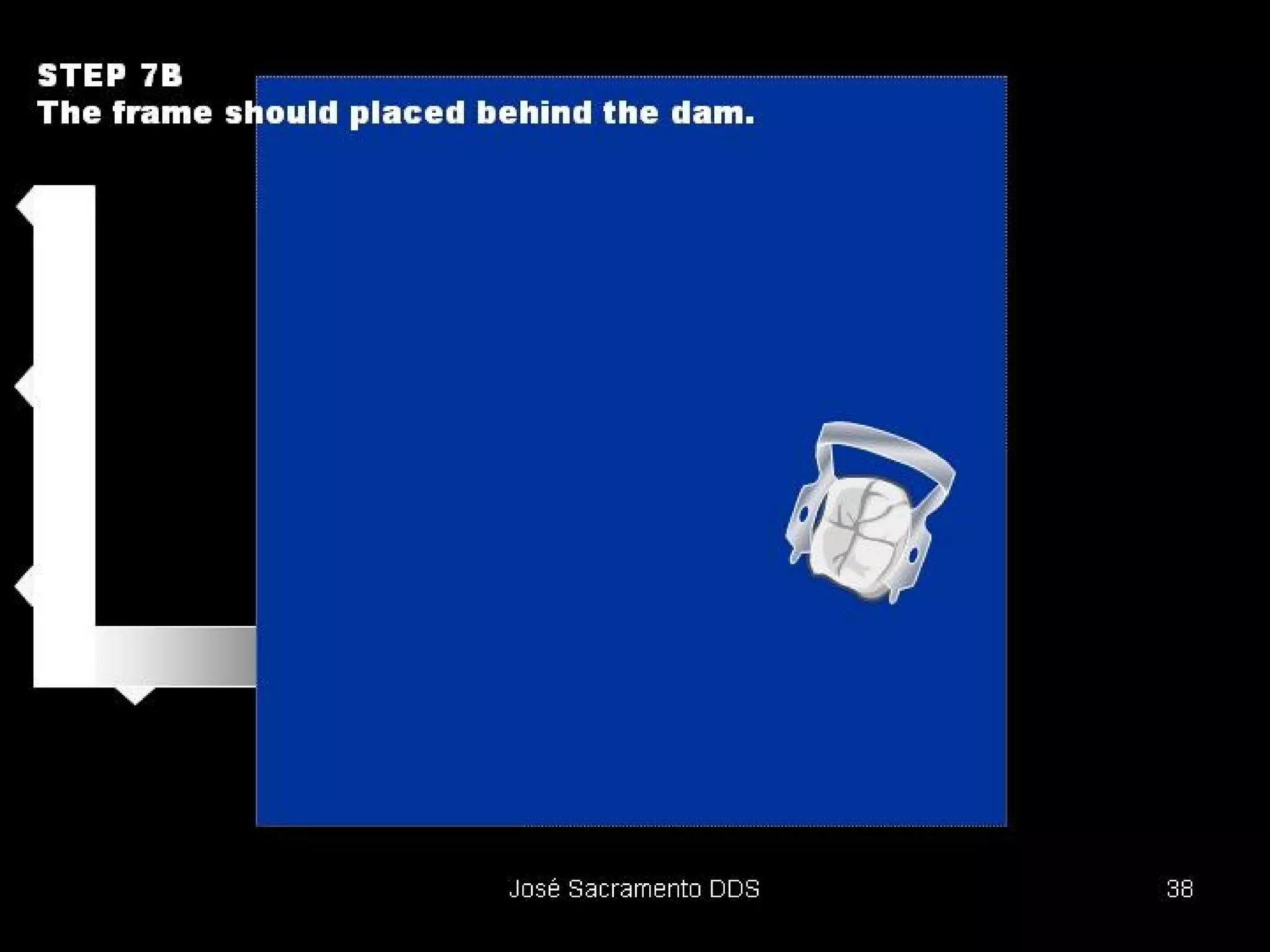
Where does the metal dam frame go? A) Under the dam B) Over the dam
Which is true? A) The curved parts of the clamp beaks  should rest on the tooth B) The pointed parts of the clamp beaks should rest on the tooth
Which of these medical conditions is not relevant when considering use of dam? A) Latex allergy B) Sleep apnoea C) Claustrophobia D) Sinusitis E) Emphysem
You are unable to apply dam to an upper molar that requires endodontic treatment. What should you do? A) Advise extraction B) Dress the pulp with a mummifying paste and provide a good  coronal seal C) Continue without dam D) Refer the patient to an endodontic specialist
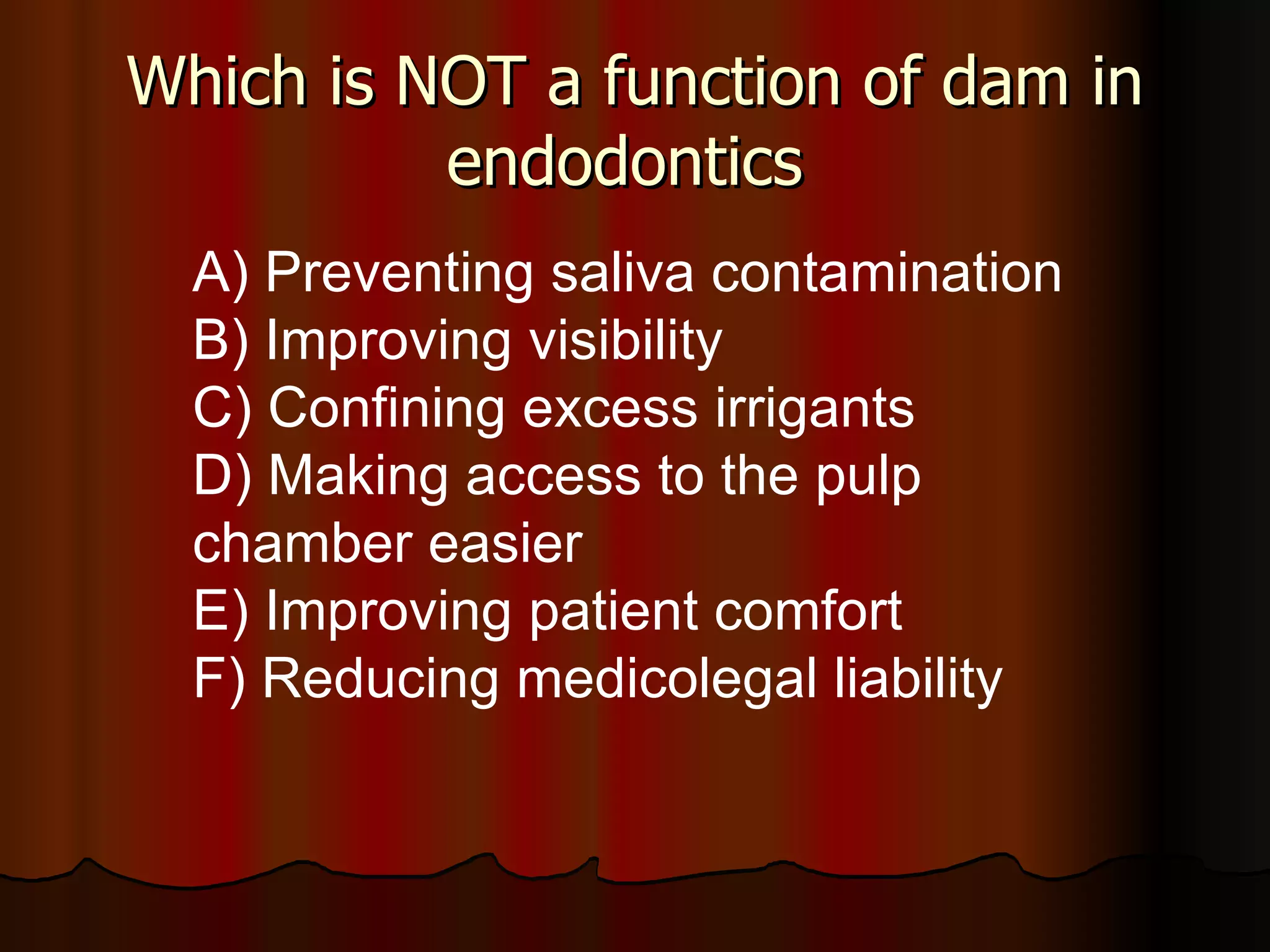
Which is NOT a function of dam in endodontics  A) Preventing saliva contamination B) Improving visibility C) Confining excess irrigants D) Making access to the pulp chamber easier E) Improving patient comfort F) Reducing medicolegal liability
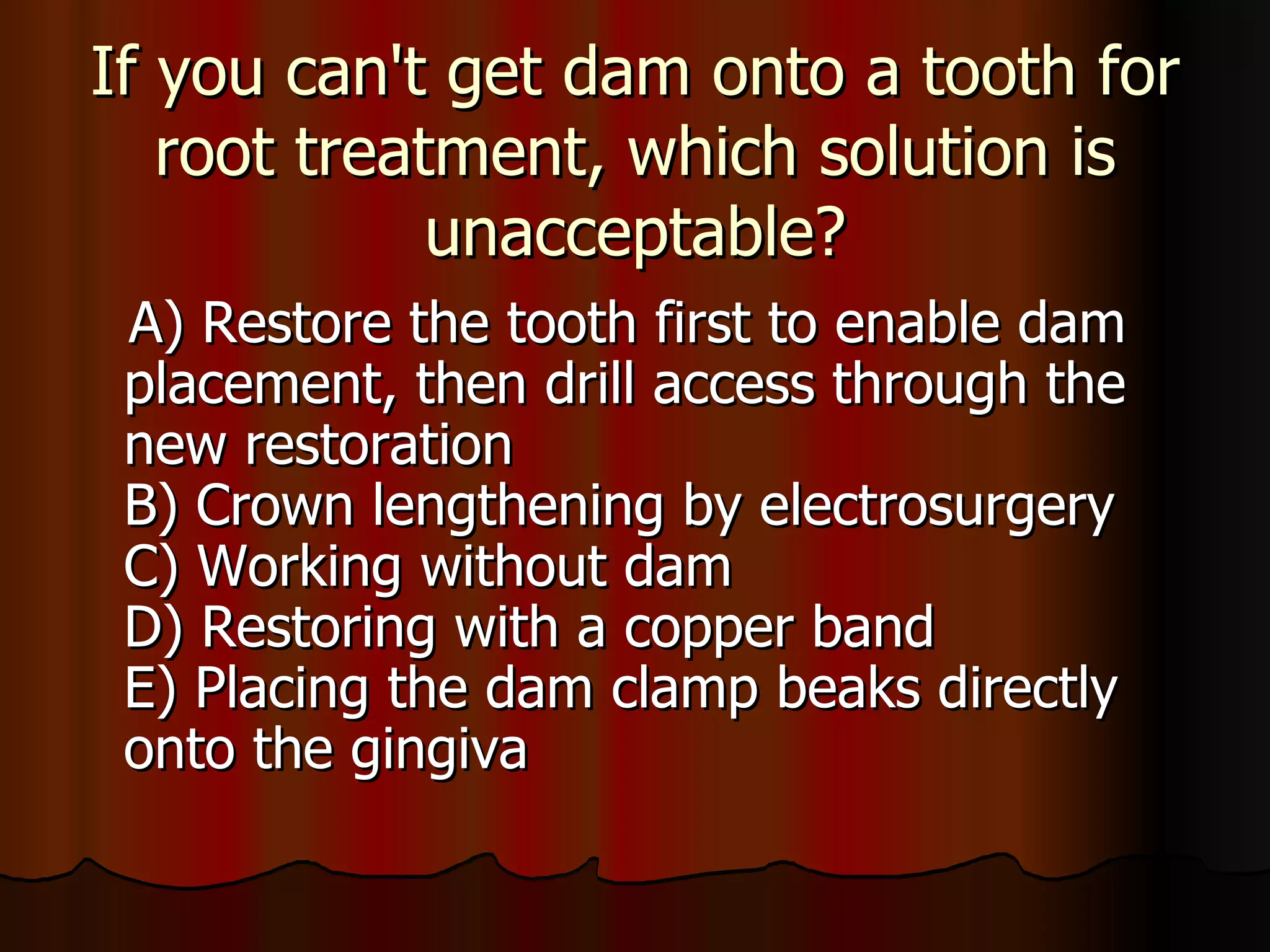
If you can't get dam onto a tooth for root treatment, which solution is unacceptable? A) Restore the tooth first to enable dam placement, then drill access through the new restoration B) Crown lengthening by electrosurgery C) Working without dam D) Restoring with a copper band E) Placing the dam clamp beaks directly onto the gingiva
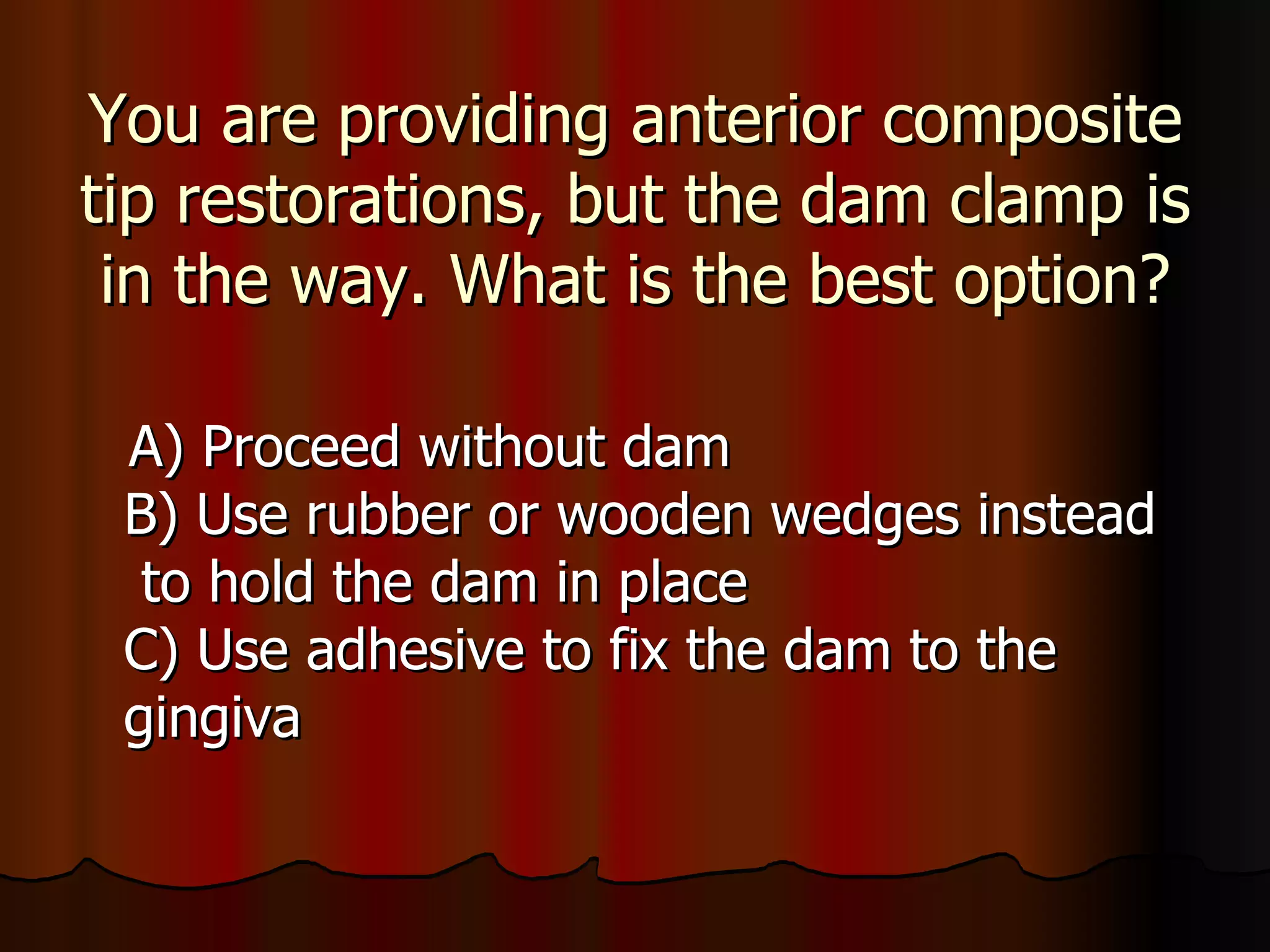
You are providing anterior composite tip restorations, but the dam clamp is in the way. What is the best option? A) Proceed without dam B) Use rubber or wooden wedges instead  to hold the dam in place C) Use adhesive to fix the dam to the  gingiva
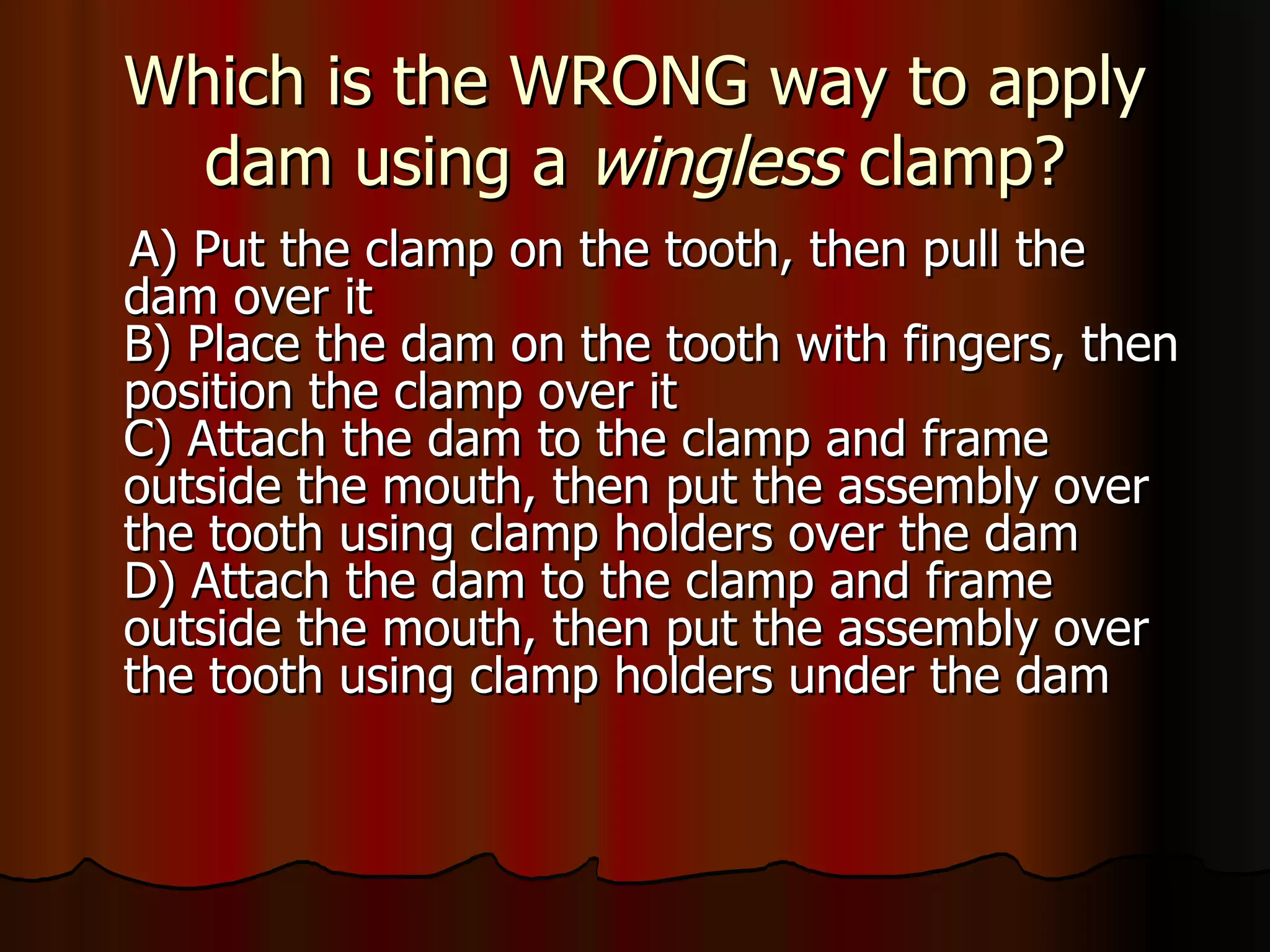
Which is the WRONG way to apply dam using a  wingless  clamp? A) Put the clamp on the tooth, then pull the dam over it B) Place the dam on the tooth with fingers, then position the clamp over it C) Attach the dam to the clamp and frame outside the mouth, then put the assembly over the tooth using clamp holders over the dam D) Attach the dam to the clamp and frame outside the mouth, then put the assembly over the tooth using clamp holders under the dam
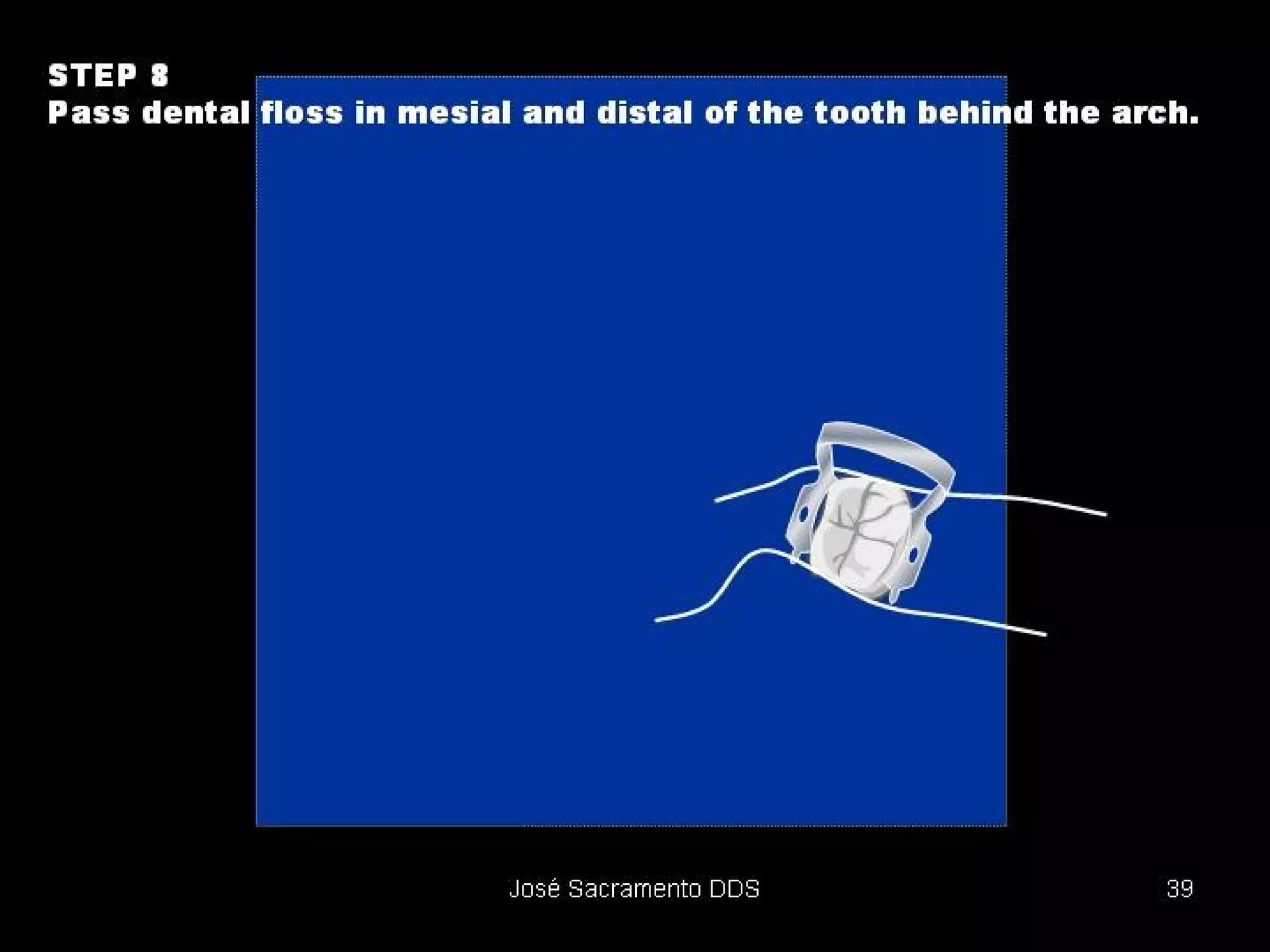
When the dam is in place, which of these will further improve the seal to the tooth? A) Placing vaseline round the tooth margins B) Inverting the edge of the dam around the tooth with a small plastic instrument C) Leaving strips of floss interproximally D) Coating the assembly with cavity varnish
References   Art and Science of Operative Dentistry- Theodore M Roberson Operative Dentistry- Grossman www.dentalindia.com www.jada.ada.org www.dentalgentlecare.com www.aseptico.com
Thank You

isolation

  • 1.
    ISOLATION OF THEOPERATING FIELD Dr shabeel pn Royal Dental College
  • 2.
    INTRODUCTION The basicprinciples underlying an operative treatment are An aseptic technique Debridement of the wound Proper drainage and Gentle treatment of the tissues with both instruments and drugs
  • 3.
    MAGNIFICATION OF OPERATINGFIELD Proper patient position Proper isolation Fluids and debris evacuation by sucking instruments and equipments Tissue retraction Use of mouth props to stabilize the operating field Use of pre medication for better co-operation for patient
  • 4.
    Isolation Isolation is very important for controlling moisture Retraction and Harm prevention
  • 5.
    Goals of IsolationMoisture control Retraction and access Harm prevention Safe and aseptic operating field Prevent accidental swallowing of restorative materials and instruments Bacterial contamination from saliva Local anesthesia
  • 6.
    Methods for IsolationRubber Dam Isolation Cotton roll isolation and Cellulose wafers Throat Shields High volume evacuator and saliva ejector Retraction cords Mirror and Evacuator tip retraction Mouth Props drugs
  • 7.
    Rubber Dam “ It’s hard to believe that a sheet of rubber can make u feel more comfortable about dental treatment and allow us to do better dentistry but, rubber dam can” S C Barnum 1864 – New York city The Rubber Dam is a flat, thin sheet of latex or non latex that is held by a clamp(retainer) and a frame that is perforated to allow the teeth that will be worked on to protrude through the perforations in the sheet while all the other teeth are covered and protected by the rubber dam.
  • 8.
    Rubber Dam Atooth bathed in saliva A tongue that insists on obstructing vision Bleeding gingiva Bacteria laden saliva reinfecting areas it also ensures: Improve the quality of operation To define the operating field
  • 9.
  • 10.
    Advantages Isolation ofthe operating field Improved access and visibility Improved properties of dental materials Protection of patient’s airway Protection of patient’s soft tissues High patient acceptance – Allow to Relax No gag reflex Keep the tongue Time saving Operating efficiency
  • 11.
    Disadvantages Time consumptionPatient’s objection Conditions where rubber dam not used: partially erupted teeth Some third molars Extremely malpositioned teeth Asthma patients Psychological reasons Latex allergy
  • 12.
    Materials and InstrumentsRubber dam material Rubber dam holder Rubber dam retainer(clamp) Plastic tray for holding the clamp Retainer forceps Punch Napkin Lubricant Modelling compound
  • 13.
    Dam material Availablein 5x5 inches or 6x6inches Thin --------------- 0.15mm Medium------------0.2mm Heavy--------------0.25mm Special heavy----0.35mm Shiny surface and dull surface. Dull surface in occlusal
  • 14.
    2. Holder orframe Maintains the borders in position Two types:- 1.plastic 2. stainless steel
  • 15.
  • 16.
    Two types: 1.wingless 2. winged Anchor the dam to the teeth Retract the gingival tissues Upper central incisors and all cuspids:– Ivory no. 9 Upper laterals and all lower incisors:- HF no. 211 For all premolars:- HF no. 27 For all molars:- HF no. 26 Not completely erupted young anterior maxillary teeth:- HF no. 27
  • 17.
    4. Plastic trayfor holding clamp 5. Retainer Forceps for placing and removal of retainer
  • 18.
    6. Punch Forproducing holes in the rubber dam for the teeth It is an instrument having a rotating metal table with six holes of varying sizes and a tapered sharp pointed puncher Larger holes-Molars Medium sized holes-premolars , canines and upper incisors Smallest hole –lower incisors.
  • 19.
  • 20.
    7.Napkin Between rubberdam and patients skin Reduce allergic reaction Absorbs saliva
  • 21.
    8. lubricant Liquidsoap Petroleum and cocoa butter should not be used
  • 22.
    9.Modelling compound Preventthe movement of retainer
  • 23.
    Hole size andposition holes punched by following the arch Hole should be approximately over the centre of incisal or occlusal surface of teeth Guide Holes- along the upper border of rubber dam -for identification of upper surface of dam For conservative treatment – 3 holes For endodontic treatment – 1 hole
  • 24.
    Placement of rubberdam 3 methods Dam first technique Clamp first technique Clamp and dam together technique
  • 25.
  • 26.
  • 27.
  • 28.
  • 29.
  • 30.
  • 31.
  • 32.
  • 33.
  • 34.
  • 35.
  • 36.
  • 37.
  • 38.
  • 39.
  • 40.
  • 41.
  • 42.
  • 43.
  • 44.
  • 45.
  • 46.
  • 47.
  • 48.
  • 49.
  • 50.
  • 51.
  • 52.
  • 53.
  • 54.
  • 55.
  • 56.
  • 57.
  • 58.
  • 59.
  • 60.
  • 61.
  • 62.
  • 63.
  • 64.
  • 65.
  • 66.
    Removal of rubberdam Cutting the septa Removing the retainer Removing the dam Wiping the lips Rinsing the mouth Massaging the tissue and Examining the dam
  • 67.
    Alternative methods Cervicalretainer replacement Fixed bridge isolation Substitution of retainer with a matrix
  • 68.
    Variations with ageFor younger - change the hole size - smaller sheet Primary teeth- HF no.27 retainer Young permanent teeth – Ivory no. 14
  • 69.
    Errors in applicationand removal Prevent adequate moist control Reduce access and visibility Cause injury to patient off centre arch form Inappropriate distance between holes Incorrect arch form of holes Inappropriate retainer Shredded or torn Dam Sharp tips of no 212 retainer
  • 70.
    Cotton roll isolationand cellulose wafers They are absorbents Provide moisture control with saliva ejector Isolation of maxillary teeth - cotton roll in facial vestibule - simple method Isolation of mandibular teeth - medium sized cotton in vestibule and large one between teeth and tongue - difficult method Cellulose wafers - retraction and additional absorbency
  • 71.
  • 72.
    Throat shields Preventaspiration and swallowing Mainly maxillary teeth
  • 73.
    High volume evacuatorand saliva ejector For suctioning water and debris Advantages -both solid and liquid -improve access and visibility -prevent dehydration of oral tissues -less pain for patient
  • 74.
    Retraction cords Controlsulcular fluid Vasoconstrictor (epinephrine) along this Prevent aberration of gingival tissues Prevent excess restorative materials from entering the gingival sulcus
  • 75.
  • 76.
    Mirror and evacuatortip retraction Cheek , lip and tongue retraction Secondary function
  • 77.
    Mouth props Forlengthy appointments For relieving patients mouth muscles 2 types 1. block type- low cost 2. ratchet type- large size and high cost
  • 78.
    Drugs Rarely indicated Atropine(antisialogogues)-5mg,30min before the procedures-reduce salivation Antianxiety drugs like valium-5 to 10mg 30min before Muscle relaxants Medication for controlling gingival bleeding Pain control medication Contraindication- nursing mothers and Glaucoma patients
  • 79.
    DISCUSSION You noticeduring an endo that saliva is creeping through your rubber dam hole. What should you do ? A) Put on a new piece with a smaller hole B) Put in a new piece using thicker dam C) Use caulking paste to seal the leak D) Use a curved saliva ejector in the mouth under the dam
  • 80.
    When doing anMO restoration under dam on an upper first premolar, you should apply the dam clamp to the A) Canine B) First premolar C) Second premolar D) Any of these E) None of these - you must use wedges
  • 81.
    It is essentialto lubricate dam before applying it. Which of these is NOT a suitable lubricant? A) Shaving cream B) Liquid soap C) Hibiscrub D) Vaseline
  • 82.
    When doing anendo, how many teeth would you normally have coming through the dam? A) Just the one being root treated B) 2 C) 3 D) As many as possible and practical
  • 83.
    You have problemswith the dam tearing. What might you consider ? A) Using thinner dam B) Using thicker dam C) Making the holes closer together D) Making the holes further apart
  • 84.
    Which of thesewill make the dam most likely to tear? A) A large tooth B) A large clamp C) A small hole D) A rusty dam punch
  • 85.
    You are havingtrouble getting the dam between the contact points for four anterior teeth. What might you NOT do? A) Punch the holes closer together B) Push it through with floss C) Use lubricant D) Use wooden wedges for a short while to separate the teeth E) Use an abrasive finishing strip to reduce the contact points F) Use an abrasive finishing strip to smooth off rough interproximal fillings
  • 86.
    Where does themetal dam frame go? A) Under the dam B) Over the dam
  • 87.
    Which is true?A) The curved parts of the clamp beaks should rest on the tooth B) The pointed parts of the clamp beaks should rest on the tooth
  • 88.
    Which of thesemedical conditions is not relevant when considering use of dam? A) Latex allergy B) Sleep apnoea C) Claustrophobia D) Sinusitis E) Emphysem
  • 89.
    You are unableto apply dam to an upper molar that requires endodontic treatment. What should you do? A) Advise extraction B) Dress the pulp with a mummifying paste and provide a good coronal seal C) Continue without dam D) Refer the patient to an endodontic specialist
  • 90.
    Which is NOTa function of dam in endodontics A) Preventing saliva contamination B) Improving visibility C) Confining excess irrigants D) Making access to the pulp chamber easier E) Improving patient comfort F) Reducing medicolegal liability
  • 91.
    If you can'tget dam onto a tooth for root treatment, which solution is unacceptable? A) Restore the tooth first to enable dam placement, then drill access through the new restoration B) Crown lengthening by electrosurgery C) Working without dam D) Restoring with a copper band E) Placing the dam clamp beaks directly onto the gingiva
  • 92.
    You are providinganterior composite tip restorations, but the dam clamp is in the way. What is the best option? A) Proceed without dam B) Use rubber or wooden wedges instead to hold the dam in place C) Use adhesive to fix the dam to the gingiva
  • 93.
    Which is theWRONG way to apply dam using a wingless clamp? A) Put the clamp on the tooth, then pull the dam over it B) Place the dam on the tooth with fingers, then position the clamp over it C) Attach the dam to the clamp and frame outside the mouth, then put the assembly over the tooth using clamp holders over the dam D) Attach the dam to the clamp and frame outside the mouth, then put the assembly over the tooth using clamp holders under the dam
  • 94.
    When the damis in place, which of these will further improve the seal to the tooth? A) Placing vaseline round the tooth margins B) Inverting the edge of the dam around the tooth with a small plastic instrument C) Leaving strips of floss interproximally D) Coating the assembly with cavity varnish
  • 95.
    References Art and Science of Operative Dentistry- Theodore M Roberson Operative Dentistry- Grossman www.dentalindia.com www.jada.ada.org www.dentalgentlecare.com www.aseptico.com
  • 96.