FILIPINO
EDUCATORS AND
THEIR
PHILOSOPHIES
by
MARK ANTHONY J. VALENTINO
SOUTHVILLE I ELEMENTARY SCHOOL
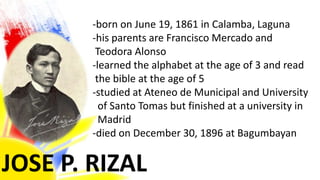
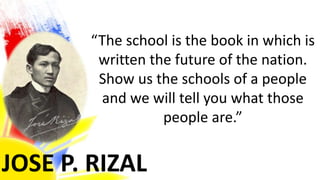
JOSE P. RIZAL
-born on June 19, 1861 in Calamba, Laguna
-his parents are Francisco Mercado and
Teodora Alonso
-learned the alphabet at the age of 3 and read
the bible at the age of 5
-studied at Ateneo de Municipal and University
of Santo Tomas but finished at a university in
Madrid
-died on December 30, 1896 at Bagumbayan
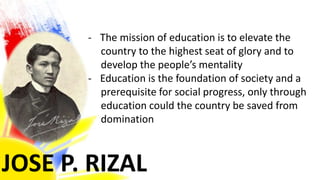
JOSE P. RIZAL
- The mission of education is to elevate the
country to the highest seat of glory and to
develop the people’s mentality
- Education is the foundation of society and a
prerequisite for social progress, only through
education could the country be saved from
domination
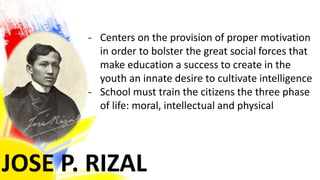
JOSE P. RIZAL
- Centers on the provision of proper motivation
in order to bolster the great social forces that
make education a success to create in the
youth an innate desire to cultivate intelligence
- School must train the citizens the three phase
of life: moral, intellectual and physical
JOSE P. RIZAL
“The school is the book in which is
written the future of the nation.
Show us the schools of a people
and we will tell you what those
people are.”
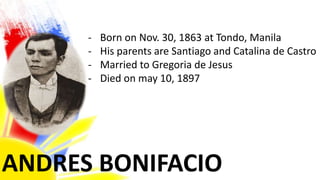
ANDRES BONIFACIO
- Born on Nov. 30, 1863 at Tondo, Manila
- His parents are Santiago and Catalina de Castro
- Married to Gregoria de Jesus
- Died on may 10, 1897
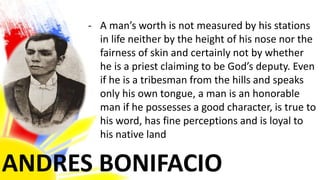
ANDRES BONIFACIO
- A man’s worth is not measured by his stations
in life neither by the height of his nose nor the
fairness of skin and certainly not by whether
he is a priest claiming to be God’s deputy. Even
if he is a tribesman from the hills and speaks
only his own tongue, a man is an honorable
man if he possesses a good character, is true to
his word, has fine perceptions and is loyal to
his native land
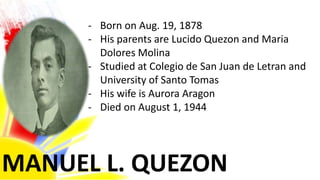
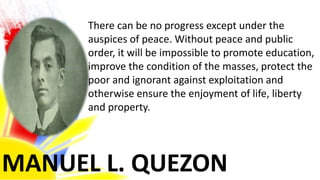
MANUEL L. QUEZON
- Born on Aug. 19, 1878
- His parents are Lucido Quezon and Maria
Dolores Molina
- Studied at Colegio de San Juan de Letran and
University of Santo Tomas
- His wife is Aurora Aragon
- Died on August 1, 1944
MANUEL L. QUEZON
There can be no progress except under the
auspices of peace. Without peace and public
order, it will be impossible to promote education,
improve the condition of the masses, protect the
poor and ignorant against exploitation and
otherwise ensure the enjoyment of life, liberty
and property.
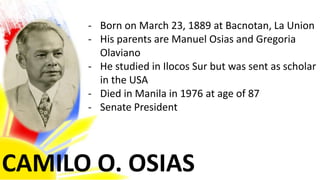
CAMILO O. OSIAS
- Born on March 23, 1889 at Bacnotan, La Union
- His parents are Manuel Osias and Gregoria
Olaviano
- He studied in Ilocos Sur but was sent as scholar
in the USA
- Died in Manila in 1976 at age of 87
- Senate President
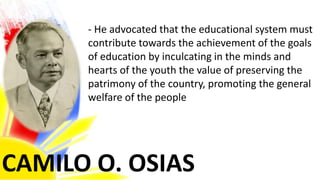
CAMILO O. OSIAS
- He advocated that the educational system must
contribute towards the achievement of the goals
of education by inculcating in the minds and
hearts of the youth the value of preserving the
patrimony of the country, promoting the general
welfare of the people
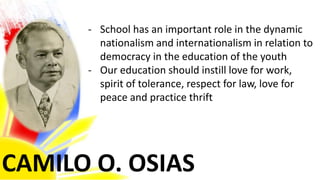
CAMILO O. OSIAS
- School has an important role in the dynamic
nationalism and internationalism in relation to
democracy in the education of the youth
- Our education should instill love for work,
spirit of tolerance, respect for law, love for
peace and practice thrift
CAMILO O. OSIAS
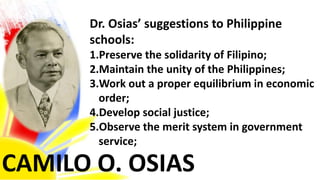
Dr. Osias’ suggestions to Philippine
schools:
1.Preserve the solidarity of Filipino;
2.Maintain the unity of the Philippines;
3.Work out a proper equilibrium in economic
order;
4.Develop social justice;
5.Observe the merit system in government
service;
CAMILO O. OSIAS
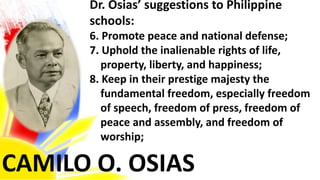
Dr. Osias’ suggestions to Philippine
schools:
6. Promote peace and national defense;
7. Uphold the inalienable rights of life,
property, liberty, and happiness;
8. Keep in their prestige majesty the
fundamental freedom, especially freedom
of speech, freedom of press, freedom of
peace and assembly, and freedom of
worship;
CAMILO O. OSIAS
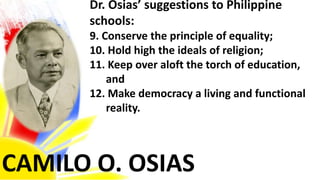
Dr. Osias’ suggestions to Philippine
schools:
9. Conserve the principle of equality;
10. Hold high the ideals of religion;
11. Keep over aloft the torch of education,
and
12. Make democracy a living and functional
reality.
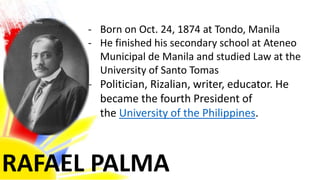
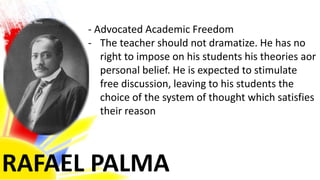
RAFAEL PALMA
- Born on Oct. 24, 1874 at Tondo, Manila
- He finished his secondary school at Ateneo
Municipal de Manila and studied Law at the
University of Santo Tomas
- Politician, Rizalian, writer, educator. He
became the fourth President of
the University of the Philippines.
RAFAEL PALMA
- Advocated Academic Freedom
- The teacher should not dramatize. He has no
right to impose on his students his theories aor
personal belief. He is expected to stimulate
free discussion, leaving to his students the
choice of the system of thought which satisfies
their reason
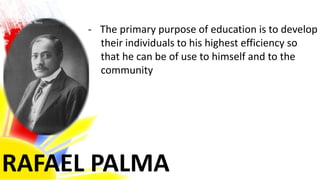
RAFAEL PALMA
- The primary purpose of education is to develop
their individuals to his highest efficiency so
that he can be of use to himself and to the
community
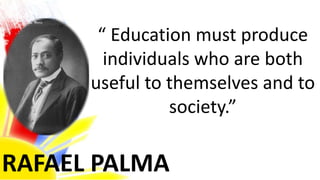
RAFAEL PALMA
“ Education must produce
individuals who are both
useful to themselves and to
society.”
JORGE BOCOBO
- Born on Oct. 19, 1886 at Gerona, Tarlac
- Obtained law degree from Indiana University
as government scholar and passed the bar in
1910 and became instructor at the University
of the Philippines
- Drafted speeches for President Quezon and
advocated Philippine independence
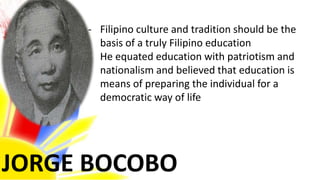
JORGE BOCOBO
- Filipino culture and tradition should be the
basis of a truly Filipino education
- He equated education with patriotism and
nationalism and believed that education is
means of preparing the individual for a
democratic way of life
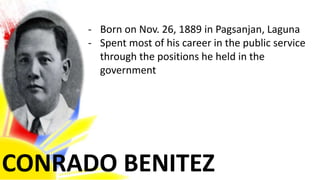
CONRADO BENITEZ
- Born on Nov. 26, 1889 in Pagsanjan, Laguna
- Spent most of his career in the public service
through the positions he held in the
government
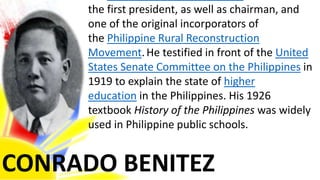
CONRADO BENITEZ
the first president, as well as chairman, and
one of the original incorporators of
the Philippine Rural Reconstruction
Movement.He testified in front of the United
States Senate Committee on the Philippines in
1919 to explain the state of higher
education in the Philippines. His 1926
textbook History of the Philippines was widely
used in Philippine public schools.
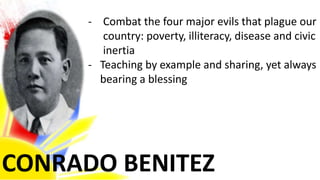
CONRADO BENITEZ
- Combat the four major evils that plague our
country: poverty, illiteracy, disease and civic
inertia
- Teaching by example and sharing, yet always
bearing a blessing
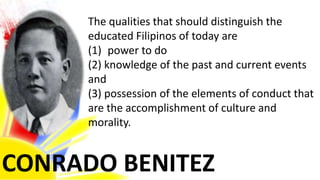
CONRADO BENITEZ
The qualities that should distinguish the
educated Filipinos of today are
(1) power to do
(2) knowledge of the past and current events
and
(3) possession of the elements of conduct that
are the accomplishment of culture and
morality.
CONRADO BENITEZ
“The function of our school is neither to
fit the individual for the past which is
dead and gone, nor to prepare him for a
remote future which is problematic,
rather it is to train the individual so that
he will be a member of the world as it
is.”
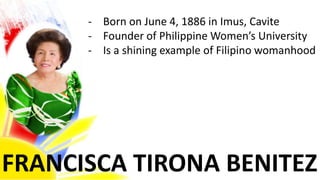
FRANCISCA TIRONA BENITEZ
- Born on June 4, 1886 in Imus, Cavite
- Founder of Philippine Women’s University
- Is a shining example of Filipino womanhood
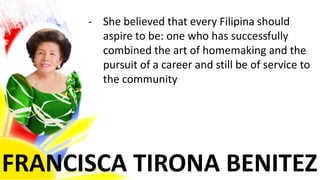
FRANCISCA TIRONA BENITEZ
- She believed that every Filipina should
aspire to be: one who has successfully
combined the art of homemaking and the
pursuit of a career and still be of service to
the community
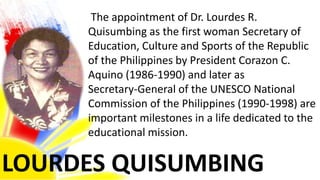
LOURDES QUISUMBING
The appointment of Dr. Lourdes R.
Quisumbing as the first woman Secretary of
Education, Culture and Sports of the Republic
of the Philippines by President Corazon C.
Aquino (1986-1990) and later as
Secretary-General of the UNESCO National
Commission of the Philippines (1990-1998) are
important milestones in a life dedicated to the
educational mission.
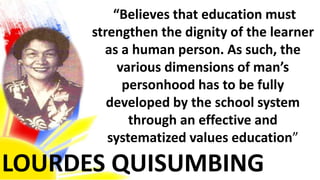
LOURDES QUISUMBING
“Believes that education must
strengthen the dignity of the learner
as a human person. As such, the
various dimensions of man’s
personhood has to be fully
developed by the school system
through an effective and
systematized values education”
Special thanks to:
http://udyong.gov.ph/teachers-corner/5792-a-glimpse-on-
educational-philosophy-of-filipino-educators
http://www.slideshare.net/haynakunaman/filipino-educators-and-
their-philosophies-37049982

Filipino philosophers

  • 1.
    FILIPINO EDUCATORS AND THEIR PHILOSOPHIES by MARK ANTHONYJ. VALENTINO SOUTHVILLE I ELEMENTARY SCHOOL
  • 2.
    JOSE P. RIZAL -bornon June 19, 1861 in Calamba, Laguna -his parents are Francisco Mercado and Teodora Alonso -learned the alphabet at the age of 3 and read the bible at the age of 5 -studied at Ateneo de Municipal and University of Santo Tomas but finished at a university in Madrid -died on December 30, 1896 at Bagumbayan
  • 3.
    JOSE P. RIZAL -The mission of education is to elevate the country to the highest seat of glory and to develop the people’s mentality - Education is the foundation of society and a prerequisite for social progress, only through education could the country be saved from domination
  • 4.
    JOSE P. RIZAL -Centers on the provision of proper motivation in order to bolster the great social forces that make education a success to create in the youth an innate desire to cultivate intelligence - School must train the citizens the three phase of life: moral, intellectual and physical
  • 5.
    JOSE P. RIZAL “Theschool is the book in which is written the future of the nation. Show us the schools of a people and we will tell you what those people are.”
  • 6.
    ANDRES BONIFACIO - Bornon Nov. 30, 1863 at Tondo, Manila - His parents are Santiago and Catalina de Castro - Married to Gregoria de Jesus - Died on may 10, 1897
  • 7.
    ANDRES BONIFACIO - Aman’s worth is not measured by his stations in life neither by the height of his nose nor the fairness of skin and certainly not by whether he is a priest claiming to be God’s deputy. Even if he is a tribesman from the hills and speaks only his own tongue, a man is an honorable man if he possesses a good character, is true to his word, has fine perceptions and is loyal to his native land
  • 8.
    MANUEL L. QUEZON -Born on Aug. 19, 1878 - His parents are Lucido Quezon and Maria Dolores Molina - Studied at Colegio de San Juan de Letran and University of Santo Tomas - His wife is Aurora Aragon - Died on August 1, 1944
  • 9.
    MANUEL L. QUEZON Therecan be no progress except under the auspices of peace. Without peace and public order, it will be impossible to promote education, improve the condition of the masses, protect the poor and ignorant against exploitation and otherwise ensure the enjoyment of life, liberty and property.
  • 10.
    CAMILO O. OSIAS -Born on March 23, 1889 at Bacnotan, La Union - His parents are Manuel Osias and Gregoria Olaviano - He studied in Ilocos Sur but was sent as scholar in the USA - Died in Manila in 1976 at age of 87 - Senate President
  • 11.
    CAMILO O. OSIAS -He advocated that the educational system must contribute towards the achievement of the goals of education by inculcating in the minds and hearts of the youth the value of preserving the patrimony of the country, promoting the general welfare of the people
  • 12.
    CAMILO O. OSIAS -School has an important role in the dynamic nationalism and internationalism in relation to democracy in the education of the youth - Our education should instill love for work, spirit of tolerance, respect for law, love for peace and practice thrift
  • 13.
    CAMILO O. OSIAS Dr.Osias’ suggestions to Philippine schools: 1.Preserve the solidarity of Filipino; 2.Maintain the unity of the Philippines; 3.Work out a proper equilibrium in economic order; 4.Develop social justice; 5.Observe the merit system in government service;
  • 14.
    CAMILO O. OSIAS Dr.Osias’ suggestions to Philippine schools: 6. Promote peace and national defense; 7. Uphold the inalienable rights of life, property, liberty, and happiness; 8. Keep in their prestige majesty the fundamental freedom, especially freedom of speech, freedom of press, freedom of peace and assembly, and freedom of worship;
  • 15.
    CAMILO O. OSIAS Dr.Osias’ suggestions to Philippine schools: 9. Conserve the principle of equality; 10. Hold high the ideals of religion; 11. Keep over aloft the torch of education, and 12. Make democracy a living and functional reality.
  • 16.
    RAFAEL PALMA - Bornon Oct. 24, 1874 at Tondo, Manila - He finished his secondary school at Ateneo Municipal de Manila and studied Law at the University of Santo Tomas - Politician, Rizalian, writer, educator. He became the fourth President of the University of the Philippines.
  • 17.
    RAFAEL PALMA - AdvocatedAcademic Freedom - The teacher should not dramatize. He has no right to impose on his students his theories aor personal belief. He is expected to stimulate free discussion, leaving to his students the choice of the system of thought which satisfies their reason
  • 18.
    RAFAEL PALMA - Theprimary purpose of education is to develop their individuals to his highest efficiency so that he can be of use to himself and to the community
  • 19.
    RAFAEL PALMA “ Educationmust produce individuals who are both useful to themselves and to society.”
  • 20.
    JORGE BOCOBO - Bornon Oct. 19, 1886 at Gerona, Tarlac - Obtained law degree from Indiana University as government scholar and passed the bar in 1910 and became instructor at the University of the Philippines - Drafted speeches for President Quezon and advocated Philippine independence
  • 21.
    JORGE BOCOBO - Filipinoculture and tradition should be the basis of a truly Filipino education - He equated education with patriotism and nationalism and believed that education is means of preparing the individual for a democratic way of life
  • 22.
    CONRADO BENITEZ - Bornon Nov. 26, 1889 in Pagsanjan, Laguna - Spent most of his career in the public service through the positions he held in the government
  • 23.
    CONRADO BENITEZ the firstpresident, as well as chairman, and one of the original incorporators of the Philippine Rural Reconstruction Movement.He testified in front of the United States Senate Committee on the Philippines in 1919 to explain the state of higher education in the Philippines. His 1926 textbook History of the Philippines was widely used in Philippine public schools.
  • 24.
    CONRADO BENITEZ - Combatthe four major evils that plague our country: poverty, illiteracy, disease and civic inertia - Teaching by example and sharing, yet always bearing a blessing
  • 25.
    CONRADO BENITEZ The qualitiesthat should distinguish the educated Filipinos of today are (1) power to do (2) knowledge of the past and current events and (3) possession of the elements of conduct that are the accomplishment of culture and morality.
  • 26.
    CONRADO BENITEZ “The functionof our school is neither to fit the individual for the past which is dead and gone, nor to prepare him for a remote future which is problematic, rather it is to train the individual so that he will be a member of the world as it is.”
  • 27.
    FRANCISCA TIRONA BENITEZ -Born on June 4, 1886 in Imus, Cavite - Founder of Philippine Women’s University - Is a shining example of Filipino womanhood
  • 28.
    FRANCISCA TIRONA BENITEZ -She believed that every Filipina should aspire to be: one who has successfully combined the art of homemaking and the pursuit of a career and still be of service to the community
  • 29.
    LOURDES QUISUMBING The appointmentof Dr. Lourdes R. Quisumbing as the first woman Secretary of Education, Culture and Sports of the Republic of the Philippines by President Corazon C. Aquino (1986-1990) and later as Secretary-General of the UNESCO National Commission of the Philippines (1990-1998) are important milestones in a life dedicated to the educational mission.
  • 30.
    LOURDES QUISUMBING “Believes thateducation must strengthen the dignity of the learner as a human person. As such, the various dimensions of man’s personhood has to be fully developed by the school system through an effective and systematized values education”
  • 31.